
通胀

Search documents
突发回落!瑞郎失守关键位 政策避险成推手
Jin Tou Wang· 2026-01-08 02:25
瑞士作为传统避险经济体,瑞郎的避险属性在当前全球市场环境中得到凸显。近期全球地缘政治局势复 杂多变,中东冲突持续升级,欧洲经济复苏乏力,市场避险情绪有所升温,资金流向瑞郎等避险资产, 间接推动美元兑瑞郎下行。此外,瑞士银行业盈利能力改善,外汇储备规模稳定,进一步增强了瑞郎的 基本面支撑。 技术分析 从技术图形上来看,美元兑瑞郎日线级别呈现震荡下行趋势,当前汇价失守MA5均线支撑,短期空头 趋势占优。RSI指标当前读数为41,处于中性偏空区间,尚未进入超卖区域,下跌动能仍有延续空间; 小时级别MACD图显示绿色动能柱温和放大,死叉信号持续,短期回调压力未减。支撑位方面,关注 0.8720一线(近期震荡区间下沿)及0.8700整数关口,若下方失守则可能测试0.8680附近的38.2%斐波那契 回撤位;阻力位先看0.8760附近(MA10均线位置),若上方突破则可能向0.8780一线发起冲击。 展望后市,美元兑瑞郎短期大概率维持震荡回落态势,后续需重点关注三大变量:一是美联储1月议息 会议政策指引,若释放更明确的宽松信号,可能加速美元回调;二是瑞士央行官员讲话及通胀数据,若 通胀持续低于目标,可能提前降息预期,削弱 ...
1月资产配置月报:宏观友好,金属乐观-20260108
Zhong Xin Qi Huo· 2026-01-08 01:38
Report Industry Investment Rating - The report does not explicitly mention an overall industry investment rating. However, it provides specific investment recommendations for different asset classes in January [9][12][69]. Report's Core View - After the Fed's rate cut in December, the market shifted its focus to re - pricing the subsequent policy path and liquidity. The domestic policy expectations in China are positive. In January, it is recommended to balance the allocation and seize structural opportunities. Long - term overweight is suggested for equities and non - ferrous metals, while precious metals should be treated with caution regarding volatility and can be re - weighted after volatility stabilizes [2][3][69]. Summary According to Relevant Catalogs 1. December Review of Major Assets - The macro theme of global major assets in December shifted from a single monetary policy expectation to structural pricing and capital transaction - driven scenarios under risk appetite recovery. Asset performance showed divergence [15]. - In the equity market, A - shares performed well, with small and medium - sized stocks and growth styles outperforming large - cap indices. Overseas, US equity indices were nearly flat [16]. - In the bond market, government bonds and US Treasuries performed weakly, with yields rising [17]. - In the foreign exchange market, the US dollar index weakened, the RMB was relatively strong, and the Japanese yen declined after the Bank of Japan's rate hike [18]. - In the commodity market, precious metals and new energy metals performed significantly better, base metals rose but with weaker gains, ferrous metals were generally weak, energy and chemicals were weak, and agricultural products had mixed performance [19]. 2. Macro Environment Outlook 2.1 Overseas Macro - The global PMI in November slightly declined to 50.5, but remained in the expansion range [23]. - US economic data from October - November showed weakening inflation, an increase in the unemployment rate, and stable consumption. The Fed cut interest rates by 25 basis points in December, with a dovish tone [24][28][29]. - Attention should be paid to the nomination of the new Fed chair. Different candidates have different policy stances, which may cause market fluctuations. The US bond market shows a "bear steepening" feature, and the US dollar is under pressure [30]. - The European Central Bank maintained the interest rate unchanged in December and raised GDP forecasts. Japan's rate hike was not radical, and short - term liquidity may tighten slightly, but the expectation of overseas easing in 2026 remains [33]. - Non - US developed markets are stable, and emerging markets had a generally positive economic sentiment in November [34][35]. 2.2 Chinese Domestic Macro - In December, domestic macro indicators were stable. Important meetings set tasks for the "15th Five - Year Plan", raising market expectations for additional policies in the first half of 2026 [36]. - The economic structure showed differentiation, with real estate and infrastructure investment remaining weak, manufacturing PMI rising to the expansion zone, consumption being stable and slightly weak, and exports contributing significantly to the economy [37]. - Social financing slightly exceeded expectations, M1 data rebound did not change the trend of activating funds, PPI was on an upward trend, and core CPI unexpectedly recovered, indicating an improvement in inflation in 2026 [37][38]. 3. Outlook for Major Assets 3.1 Equity indices - In January, policy easing expectations are likely to be the main narrative in the equity market. Domestic equities may trade in a volatile but generally stronger trend. Fiscal policy may front - load in 2026, and monetary policy may ease marginally in the first half of the year, providing a window for increasing equity index allocation [41]. 3.2 Commodities - **Precious Metals**: In January, precious metals will enter a critical phase of speculation on the Fed's monetary policy path. Gold and silver are likely to maintain a volatile upward trend under the dual fiscal and monetary easing macro - backdrop. Attention should be paid to the US fiscal deficit and the Fed's policy path changes [44]. - **Non - Ferrous Metals**: The macro environment is favorable, and upstream raw materials are tight, with supply disruption concerns. Although actual demand is weak, non - ferrous metals are expected to maintain a generally volatile but stronger trend, especially in the medium - to - long - term with supply remaining tight [49]. - **Ferrous Metals**: In January, ferrous metals are expected to trade in a range - bound manner. In the medium - to - long - term, "anti - involution" policies and export control measures may reshape the supply - demand balance and improve industry profits [54]. - **Energy & Chemicals**: In January, the crude oil sector will verify OPEC+ production cut compliance. Oil prices may oscillate in a low range. Geopolitics and supply - side factors will affect prices. In the medium - to - long - term, the global oversupply assumption remains, but prices below $60 may trigger support measures [57][59]. 3.3 Bonds - Treasury bond movements in January may continue to be range - bound, with short - end performance relatively better than long - end. In the long - term, bonds have limited upside potential as inflation expectations may put pressure on medium - and long - duration bond yields [64].
国际黄金市场火热开年
Jin Rong Shi Bao· 2026-01-08 01:07
与此同时,美国总统特朗普持续威胁要吞并格陵兰岛,这也成为市场面临的一个潜在风险。风险因素的 不断累积,为国际黄金价格在2026年初的上涨提供了关键动力。值得注意的是,地缘政治风险并非国际 黄金市场的唯一影响因素。 2026年,美联储的降息倾向以及美联储主席换届,均在一定程度上利好国际黄金市场的表现。2025年9 月,美联储正式开启降息周期,并且在2025年最后的三场货币政策会议上连续降息。进入2026年,美联 储内部对于下一步应该如何调整货币政策路径依然存在分歧。 2026年伊始,国际金价延续了2025年的火热势头。1月6日,国际现货黄金价格一度站上4500美元/盎 司,虽有波动,但总体而言,国际黄金价格仍维持在高位。2026年开年,美国与委内瑞拉之间的地缘政 治冲突点燃了市场的避险情绪,黄金作为重要的避险资产,继续受到市场投资者的追捧。 明尼阿波利斯联储行长卡什卡利表示,美联储距离停止降息已经非常接近。现在的政策立场已经非常接 近中性。需要有更多的数据来判断,究竟是通胀问题更突出,还是劳动力市场更值得担忧。 尽管当前美联储内部对后续的货币政策路径存在一定的分歧,但从目前的情况看,美联储在2026年可能 至少 ...
FSMOne:港股投资价值吸引 恒指今年目标价30000点
Zhi Tong Cai Jing· 2026-01-07 12:57
Group 1 - The core viewpoint is that the Hang Seng Index's long-term performance will depend on corporate earnings recovery, despite short-term momentum from valuation expansion [1] - The sectors expected to see the highest earnings growth by 2026 are consumer discretionary, materials, and information technology, all of which are above the market average [1] - Liquidity is a crucial factor supporting the performance of Hong Kong stocks, with significant net inflows from mainland investors exceeding HKD 1 trillion last year [1] Group 2 - Despite significant gains in Hong Kong stocks last year, structural investment opportunities remain, particularly driven by the expansion of AI applications and increased market liquidity from northbound capital and IPOs [2] - The target price for the Hang Seng Index in 2026 is projected to be 30,000 points based on a target P/E ratio of 11 times [2] - AI development is expected to continue driving growth in the US stock market, with strong semiconductor sales and high capital expenditure in tech firms supporting overall economic growth [2]
欧元区12月CPI放缓至2%,市场预期欧央行将长期“按兵不动”
Hua Er Jie Jian Wen· 2026-01-07 12:41
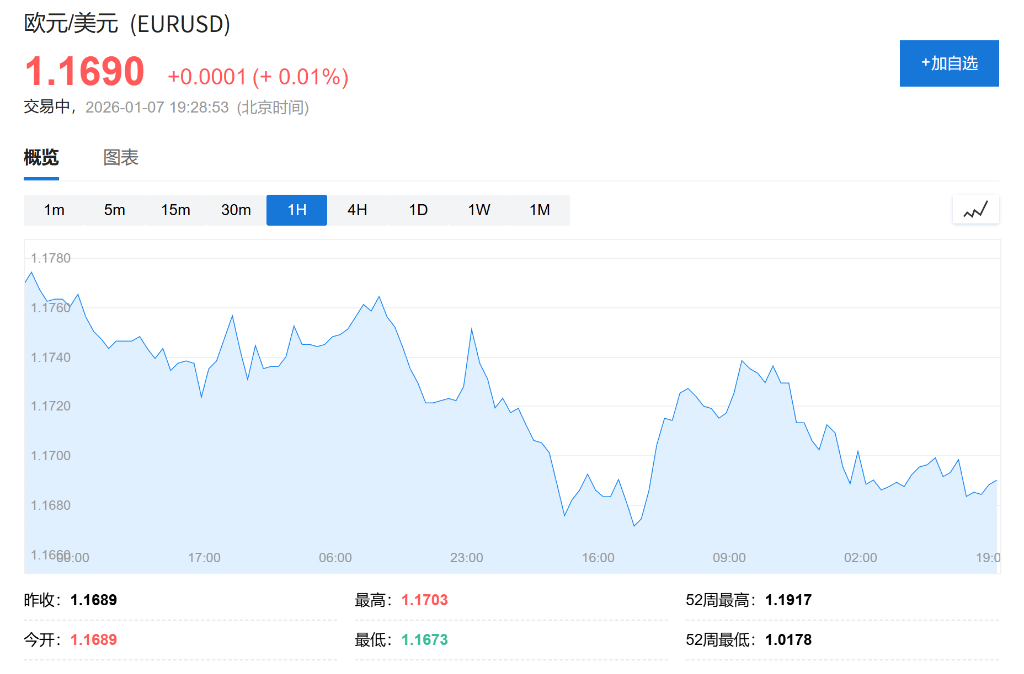
Core Insights - Eurozone inflation has returned to the European Central Bank's (ECB) target level of 2%, reinforcing the decision-makers' stance to maintain current interest rates unless significant changes in the economic outlook occur [1] - The December Consumer Price Index (CPI) rose by 2% year-on-year, down from 2.1% previously, aligning with economists' expectations [1] - Core inflation, excluding volatile food and energy prices, decreased from 2.4% in November to 2.3% in December, while service sector inflation also fell from 3.5% to 3.4% [1] Market Reaction - Following the data release, market reactions were relatively muted, with the euro holding steady against the dollar around 1.169 and the Stoxx 600 index showing no significant fluctuations [2] Interest Rate Outlook - Despite the return to target inflation potentially providing grounds for future rate cuts, traders have only slightly increased bets on monetary easing, with a 20% probability of a 25 basis point cut by September [5] - The ECB has maintained borrowing costs unchanged since the last rate cut in June, with the key deposit facility rate currently at 2% [5] - Economists and investors generally expect no further policy actions from the ECB in the foreseeable future [5] Inflation Disparities and Wage Pressures - While overall inflation slowdown meets expectations, there are significant disparities in price growth across the Eurozone, with Spain at 3%, Germany at 2%, and France at 0.7% [6] - Service sector inflation remains a primary concern for the ECB, with wage growth indicators in Q3 holding steady at 4%, above levels considered consistent with price stability [6] - ECB President Christine Lagarde indicated that while wage growth has largely caught up post-pandemic, the central bank needs to "carefully observe related trends" [6] Decision-Maker Stance and Market Projections - Most decision-makers believe inflation is under control but remain cautious due to persistent global economic uncertainties [7] - Analysts from Nordea maintain a long-term view that the ECB will keep rates unchanged until 2026, with short-term risks leaning towards rate cuts and long-term risks towards hikes [7] - The ECB's forecast suggests that inflation will be slightly below target in 2025, with an average inflation rate of 1.9% expected in 2026, followed by a rise to 2% in 2028 [7] External Factors and Risks - Several external factors could lead to inflation deviating from the target, including the delayed effects of U.S. tariff policies, a strong euro, and potential fiscal expansion policies in Germany [8] - ECB officials have indicated that the easing cycle is nearing its end, emphasizing a data-dependent decision-making approach [8]

美委局势引爆贵金属市场!全球避险情绪升温,金银价格再创新高
Sou Hu Cai Jing· 2026-01-07 10:16
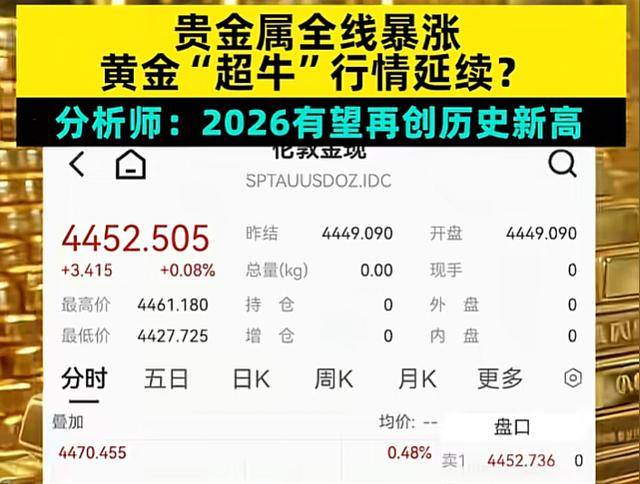
哈喽,大家好!小洲这篇国际评论,主要来分析美国突袭委内瑞拉导致金融市场避险情绪升温,贵金属 价格一路飙升,黄金更是冲破4400美元/盎司,这背后全球贵金属领域将会如何发展? 美军突袭委内瑞拉,点燃避险导火索 1月6日早间,现货黄金延续暴涨势头,一举站上4460美元/盎司,再创近期新高,现货白银同步攀升近 1.5%,稳稳站在77.6美元/盎司上方。 金银的强势领跑,带动整个贵金属板块集体"狂飙":1月5日当天,现货铂金日内涨幅超6%,现货钯金 也上涨4%,原本相对低调的贵金属品种,一时间成为全球投资者追捧的焦点。 | 于情处勾? | | | | | | | --- | --- | --- | --- | --- | --- | | 分析师:2026有望再创历史新高 | | | | | | | 103 22 22 22 SPTAUUSDOZ.IDC | | | | | | | 开盘 4449.090 | 4452.505 | 昨结 | 4449.090 | | | | +3.415 | +0.08% | 总量(kq) | 0.00 | 现手 | 0 | | 最高价 રો ન | 4461.180 | 搏 仓 | ...
每日机构分析:1月7日
Xin Hua Cai Jing· 2026-01-07 09:45
花旗:韩国央行转向"长期按兵不动",2026年上半年加息基本无望 丹麦银行:挪威国债发行需求料稳健,但维持谨慎立场不变 摩根士丹利:澳大利亚四大银行股2026年估值或回调,降息预期逆转 【机构分析】 ·丹麦银行表示,挪威拟发行150亿至200亿挪威克朗的10年期国债,这进一步印证了该行对挪威债券市 场维持谨慎立场的合理性。尽管面临供应压力加大、外资参与度减弱等挑战,预计本周三的债券拍卖需 求仍将保持稳健。他强调,当前10年期国债的绝对收益率与资产互换利差均优于2025年同期水平,为 2026年债市开局创造了更有利的条件。 ·高盛分析师指出,2026年通胀前景显示,美国经济增长将成为政府债券收益率的主要驱动因素,进一 步强化债券资产的对冲属性。预计2026年底10年期美国国债收益率将升至4.20%(当前为4.16%),日 本10年期国债收益率将回落至2.0%(当前为2.12%),维持区间波动基准判断。 ·摩根士丹利表示,在通胀持续与潜在加息压力下,澳大利亚四大银行股估值或于2026年回调。该行指 出,自2023年底以来,四大行平均市盈率已因降息预期上升约6个基点,但这一趋势将在2026年逆转。 截至2025年1 ...
【财经分析】通胀低于预期 澳大利亚央行2月加息仍可能
Xin Hua Cai Jing· 2026-01-07 09:29
Core Viewpoint - Australia's inflation is projected to remain above the Reserve Bank of Australia's (RBA) target range of 2% to 3% until late 2027, despite a slight decrease in the Consumer Price Index (CPI) in November 2025 [1][2]. Group 1: Inflation Data and Predictions - The overall CPI in Australia increased by 3.4% year-on-year in November, down from 3.8% in October, and below market expectations [1]. - The trimmed mean inflation rate also fell slightly from 3.3% to 3.2%, aligning with market expectations [1]. - The RBA's forecast indicates that the overall inflation rate will remain above 3% for most of 2026, with the trimmed mean inflation rate expected to stay above the target range until the second half of 2026 [2]. Group 2: Interest Rate Outlook - The RBA has initiated a rate cut cycle in 2025, reducing the cash rate to 3.6%, the lowest level since early 2023 [2]. - Market expectations regarding interest rate changes are mixed, with some economists predicting rate hikes in February 2026, while others anticipate no changes [2][3]. - Following the release of inflation data, the probability of a rate hike in February decreased from 37% to 32%, indicating a cooling of rate hike expectations [3]. Group 3: Economic Commentary - Economists express concerns that inflation pressures may prompt the RBA to raise rates in February, with some suggesting a potential increase of 40 basis points [3][4]. - Analysts from various banks have differing views on the likelihood of a rate hike, with some predicting that the RBA will maintain the current rate due to weak inflation momentum [5][4]. - The Australian economy is described as operating near full capacity, with a tight labor market, which may necessitate a cautious adjustment in monetary policy [4].
大有期货:金银高位波动加剧 多空交织陷震荡格局
Jin Tou Wang· 2026-01-07 09:28
【黄金期货行情表现】 1月7日,沪金主力暂报998.90元/克,跌幅0.17%,今日沪金主力开盘价1006.00元/克,截至目前最高 1011.00元/克,最低997.64元/克。 【宏观消息】 美国供应管理协会(ISM)发布的调查显示,12月制造业指数降至47.9,为 2024年10月以来最低,且连续 第10个月低于50,新订单进一步萎缩,投入成本持续攀升,显示该行业仍深受特朗普政府进口关税的拖 累。调查显示,短期内制造业复苏的可能性不大,但随着特朗普的减税政策生效,经济学家仍对今年的 反弹抱有希望。 明尼阿波利斯联储总裁卡什卡利表示,通胀正在缓慢下降,但失业率仍有可能"跳升"。他表示:"我认 为通胀风险在于其持续性,这些关税影响需要数年时间才能在系统中被消化,而我确实认为失业率可能 会从当前水平跳升。"他认为失业率约为4.6%,这表明劳动力市场正在降温。但他对显示通胀也在降温 的数据持怀疑态度,指出秋季创纪录的政府停摆导致数据收集出现问题。 【机构观点】 金银价格高位波动加剧,一方面,地缘政治紧张局势持续升温,有效提振了市场的避险情绪,资金流入 黄金等传统避险资产,为其价格提供了核心支撑。另一方面,白银在 ...
固定收益点评:债市开年跌,原因与前景
GOLDEN SUN SECURITIES· 2026-01-07 08:33
1. Report Industry Investment Rating No relevant information provided. 2. Core Viewpoints of the Report - The bond market declined at the beginning of the year, with the yields of ultra - long - term interest - rate bonds rising significantly. The 10 - year and 30 - year treasury bond yields increased by 3.6bps and 4.3bps respectively to 1.88% and 2.31% compared to the previous week [1][9]. - The decline is due to multiple factors, including the strong performance of the stock market, concerns about bond supply, low central bank bond - buying volume, potential impacts from the surge in credit and social financing at the beginning of the year, and the temporary rebound in inflation data [1][2][9]. - Despite the current pressures, the relative value of bonds is changing. The impact of supply pressure is more about rhythm rather than trend, the inflation rebound's sustainability needs further observation, and the central bank's bond - buying has a cumulative effect and may increase [3][4]. - The stabilizing forces in the bond market are gradually strengthening. The bond market may remain volatile in January, and there may be a configuration opportunity at the end of the month [5][37]. 3. Summary by Related Content Reasons for the Bond Market Decline at the Beginning of the Year - **Stock Market Performance**: The strong stock market at the beginning of the year attracted non - bank funds from the bond market to the stock market and made investors more cautious about bond investment, shortening the duration and reducing long - term bond allocation. The Shanghai Composite Index exceeded 4000 points, rising more than 100 points in the first two trading days [2][9]. - **Supply Concerns**: The large - scale bond issuance in the first week and the significant increase in the single - issue size of treasury bonds raised concerns about future supply. The net financing of government bonds in the first week was 612.7 billion yuan, with treasury bond net financing of 495 billion yuan. The single - issue sizes of 2 - year and 10 - year treasury bonds this week were 175 billion yuan and 180 billion yuan respectively, significantly higher than the second half of last year [2][14]. - **Central Bank Bond - Buying**: The central bank's net purchase of treasury bonds in December was 5 billion yuan, the same as in November, which was lower than market expectations and increased the adjustment pressure on the bond market [2][19]. - **Other Factors**: At the beginning of the year, there may be impacts from the surge in credit and social financing and the temporary rebound in inflation. It is expected that the year - on - year CPI growth in December will expand to 1.1%, and the year - on - year decline in PPI may narrow to - 1.9% [2][22][23]. Analysis of the Mitigating Factors - **Stock - Bond Relative Value**: The stock - bond relative value is changing. The difference between the inverse of the P/E ratio of Wind All - A (excluding financial and petroleum sectors) and the 10 - year bond yield has returned to the level at the beginning of 2023. Bonds may even be more cost - effective compared to the current PMI [3][26]. - **Supply Pressure**: The increase in government bond supply is more of a rhythm issue. The incremental financing in 2026 may be limited compared to 2025. After the peak of credit and government bond issuance at the end of January, the impact on the bond market will gradually fade [3][29]. - **Inflation Rebound**: The temporary rebound in inflation is mainly driven by factors such as rising non - ferrous metal prices and short - term weather - related food price increases. Its impact on interest rates is limited, similar to the situation in 2019 - 2020 [4][30]. - **Central Bank Bond - Buying**: The central bank's bond - buying has a cumulative effect. Even with a monthly purchase of 5 billion yuan, the annual purchase will be about 60 billion yuan. As government bond supply increases, the purchase volume may also increase [4][31]. Outlook for the Bond Market - The bond market may remain volatile in January, with short - term interest rates potentially rising. After the supply shock at the end of the month, the bond market is expected to gradually recover. In the short term, a short - end leverage strategy can be adopted, waiting for configuration opportunities [5][37].