
反内卷

Search documents
摩根大通刘鸣镝: 明年看好四大投资主题 对消费持乐观态度
Zheng Quan Shi Bao· 2025-12-18 18:08
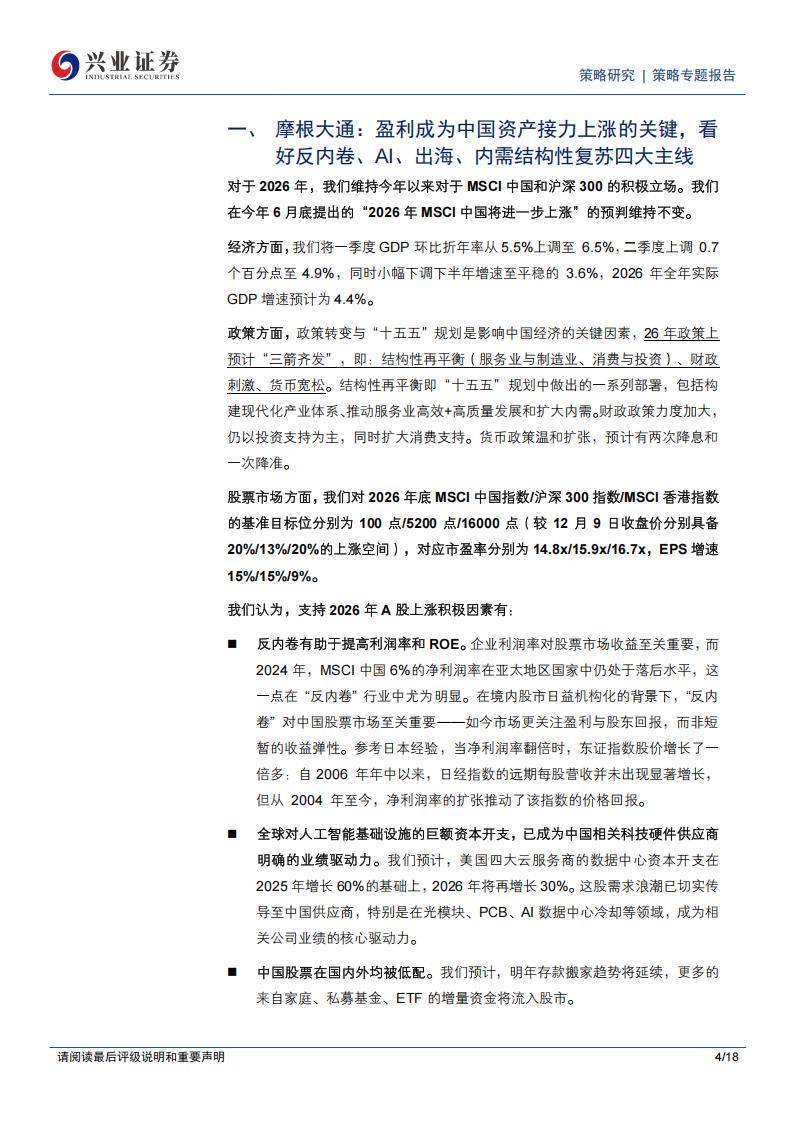
Group 1: Market Outlook - The target points for MSCI China Index, CSI 300 Index, and MSCI Hong Kong Index are projected to be 100, 5200, and 16000 respectively by 2026, indicating a potential double-digit upside [1] - Four key investment themes for 2026 include "anti-involution," growth in global AI infrastructure spending, the impact of developed countries' easing policies on exports, and the "K-shaped" recovery in consumption benefiting food and high-end consumption sectors [1] Group 2: Sector Analysis - The semiconductor hardware sector's valuation reached 4 standard deviations above normal earlier this month, indicating overheated sentiment, although it has since corrected to below 3.5 standard deviations [2] - The market has low expectations for the financial sector but high expectations for technology and healthcare, which will need significant growth to meet these high expectations [2] - The company is optimistic about the export prospects of the battery, storage, and photovoltaic industries, which are expected to provide rapid power solutions for data centers, marking them as one of the most promising directions for 2026 [2] Group 3: "Anti-Involution" Focus - The "anti-involution" theme is expected to favor growth-oriented industries with good income prospects, such as batteries and photovoltaics, over cyclical industries closely tied to macroeconomic conditions [3] - The demand for electricity driven by AI data center construction presents a structural opportunity for growth in these sectors [3] Group 4: Consumer Outlook - The company holds a relatively optimistic view on consumer spending, noting that disposable income growth is outpacing consumption growth, indicating households are repairing their balance sheets [4] - The MSCI China Consumer Staples Index has the lowest price-to-earnings ratio and the highest dividend yield compared to the US, Japan, and India, making it an attractive investment [4] - The company suggests a cautious approach to high-valuation sectors while recommending not to underweight low-valuation sectors [4]

聚焦“反内卷” ,光伏行业热议,工业和信息化部发声
Shang Hai Zheng Quan Bao· 2025-12-18 15:51
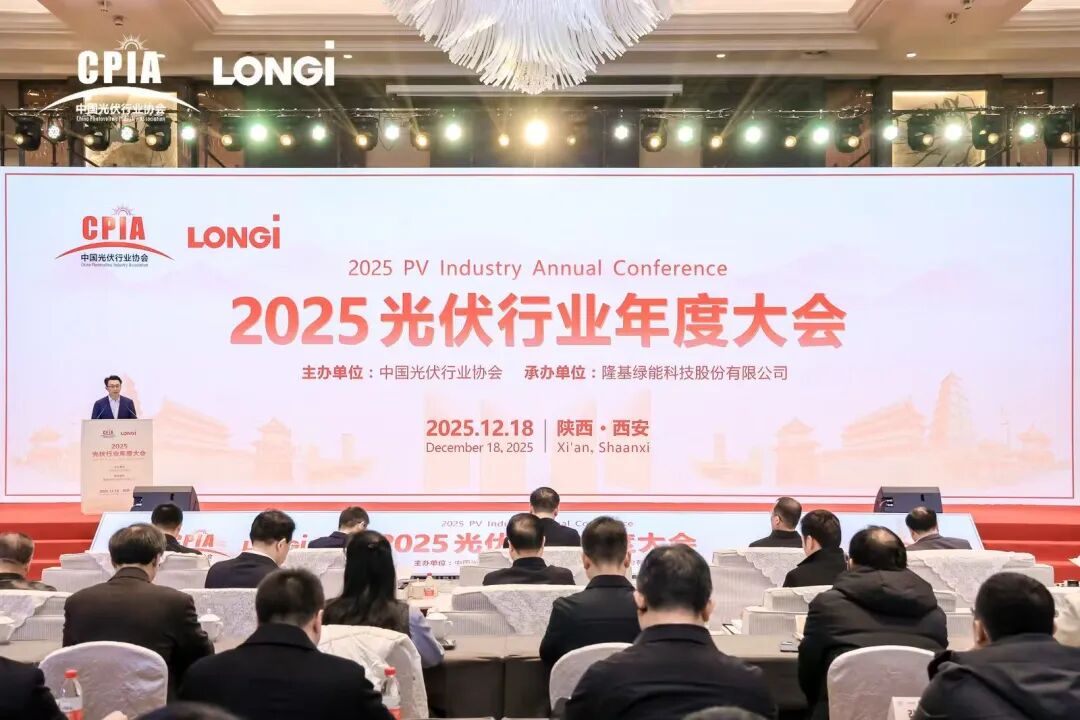
中国光伏行业协会理事长曹仁贤表示,过去以规模扩张为主的发展模式难以为继,由大到强,从速度到质量的深刻变革,是全行业必须跨越的历史性命 题。 曹仁贤认为,面对新的形势,行业要同舟共济,协同发力,积极应对。首先要以行业自律与供应链协同,重塑健康产业生态。企业要聚焦产品质量提升, 推动落后低效产能有序退出。协会将强化标准体系建设与自律职能,引导企业从价格竞争转向价值竞争,把发展重心从追求份额转移到技术、品质、服务 的提升上来,共同维护行业的整体利益与长远价值。 12月18日,由中国光伏行业协会主办、隆基绿能科技股份有限公司承办的"2025光伏行业年度大会"在陕西西安举行。工业和信息化部、行业协会、龙头企 业代表参加大会,围绕行业高质量发展献计献策。 工业和信息化部电子信息司司长杨旭东表示,2026年,光伏行业治理进入攻坚期,将进一步加强产能调控,强化光伏制造项目管理,以市场化、法治化的 手段推动落后产能有序退出,加快实现产能的动态平衡。 2026年,工业和信息化部电子信息司将会同各有关部门重点做好多项工作,包括健全价格监测机制,重点关注价格异常企业,加强产品质量监督和抽查, 对于存在质量不达标、功率虚标、侵犯知识产 ...


长城汽车董事长魏建军:将底线思维贯穿于产品研发、制造、营销全过程
Zheng Quan Ri Bao· 2025-12-18 15:40
Core Viewpoint - The future direction of the Chinese automotive industry is shifting from "scale leadership" to "quality transition," with Great Wall Motors' chairman proposing a focus on long-term quality development through a bottom-line thinking approach [1] Group 1: High-Quality Development - High-quality development is essential for China to transition from a major automotive nation to a strong one, emphasizing the need for quality enhancement alongside scale [1] - The year 2025 is seen as a pivotal year for Great Wall Motors, focusing on solidifying R&D capabilities and industry ecology while moving away from scale anxiety towards quality upgrades [1][2] Group 2: User-Centric Innovation - High-quality development is defined not by sales numbers but by genuinely meeting user needs, prioritizing user safety and industry health in decision-making [2] - Great Wall Motors advocates for a "three no" principle in technology innovation: no gimmicks, no compromises, and no betrayal of consumer trust [2] Group 3: Globalization Strategy - Globalization is identified as a critical factor for the Chinese automotive industry to evolve from large to strong, with Great Wall Motors developing a multi-power platform to cater to diverse global market demands [2][3] - The new platform aims to provide a systematic capability for "one vehicle, multiple power sources," allowing for adaptability to different market needs and enhancing cost efficiency for consumers [3]

多环节产品均价反弹 光伏行业现回暖态势
Zheng Quan Ri Bao· 2025-12-18 15:40
这一年,光伏行业虽仍整体承压,但积极变化已经开始显现。"行业发展形势和发展理念都发生了变 化。"王勃华表示。 中国光伏行业协会发布的数据显示,2025年前三季度,光伏主产业链环节31家企业营业收入同比下降 16.9%,其中第三季度同比下降11.7%,环比下降约5%。不过,主产业链环节盈利能力逐渐改善,企业 亏损持续收窄。2025年前三季度,光伏主产业链环节31家企业亏损310.39亿元,其中第三季度亏损64.22 亿元,相比第二季度亏损减少56.18亿元,环比收窄约46.7%。 "2025年光伏行业在变化中重塑格局。"在日前举行的2025光伏行业年度大会上,中国光伏行业协会名誉 理事长王勃华如是说。 "在整个行业出现亏损的情况下,相关部门整治'内卷式'竞争的力度不断加强。随着政策的深化,'反内 卷'逐步成为了行业共识,行业复苏的速度不断加快。"在大会现场,万联证券投资顾问屈放在接受《证 券日报》记者采访时表示,尤其是多晶硅环节,价格反弹最为明显。 国家能源局新能源和可再生能源司副司长桂小阳在致辞时表示,面对新变化,我国光伏行业展现出强大 韧性和蓬勃活力。截至2025年10月底,国内光伏累计装机规模已达11.4 ...
十大外资对2026年A股的建议
Sou Hu Cai Jing· 2025-12-18 15:36
Group 1: Core Insights - The core viewpoint is that the ability of listed companies to achieve real profits will be the key driver for the rise of Chinese assets in 2026, shifting focus from valuation recovery to earnings realization [2][23]. - The predicted target for the CSI 300 index in 2026 is 5200 points, indicating a potential increase of approximately 13% from the closing price in December 2025, with an average market valuation of about 15.9 times earnings [2][24]. Group 2: Investment Themes - Morgan Stanley identifies four clear investment themes: curbing excessive competition, artificial intelligence (AI), global expansion, and a structural recovery in domestic demand [3][4]. - Goldman Sachs emphasizes five major investment themes: leading industry players, beneficiaries of the "14th Five-Year Plan," AI, global expansion, and curbing excessive competition [6][7]. - UBS highlights three main investment lines: self-sufficiency, curbing excessive competition, and global expansion, suggesting a focus on consumer sectors in the second half of the year [9][11]. Group 3: Earnings Growth Projections - Morgan Stanley forecasts a 6% earnings growth for listed companies in 2026, with an acceleration to 10% in 2027, driven by supportive policies and a narrowing decline in producer prices [13][41]. - Goldman Sachs expects the MSCI China index's earnings per share (EPS) growth to rise to 12% in 2026, significantly higher than previous cycles [5][29]. - UBS anticipates an increase in overall A-share earnings growth from 6% in 2025 to 8% in 2026, supported by nominal GDP growth and ongoing policy support [9][36]. Group 4: Sector-Specific Insights - The renewable energy sector is expected to benefit from policies aimed at restoring pricing power and healthy profit margins, particularly in the context of curbing excessive competition [3][8]. - The AI sector is projected to see a 30% increase in global capital expenditure for data centers in 2026, positively impacting related industries such as optical modules and power equipment [3][28]. - Consumer sectors, particularly essential goods and high-end luxury items, are expected to perform well, with the restaurant industry growing faster than overall retail [4][6]. Group 5: Policy and Economic Environment - The Chinese government is expected to implement a series of supportive fiscal and monetary policies, including increased fiscal deficits and continued monetary easing, to stimulate domestic demand and promote industrial upgrades [23][33]. - The anticipated fiscal policy for 2026 includes a budget deficit of around 4% and a significant increase in special government bonds, aimed at supporting consumption and infrastructure [33][34]. - The overall economic growth forecast for 2026 is set at 4.4%, with a gradual recovery in the real estate market expected to reduce its drag on the economy [23][41].




2026年玻璃纯碱期货行情展望:玻璃、纯碱:上半年偏弱,下半年或有好转
Guo Tai Jun An Qi Huo· 2025-12-18 13:35
1. Report Industry Investment Rating No relevant content provided. 2. Core Views of the Report - Glass: The core contradiction in the glass industry remains weak demand, and significant improvement is unlikely in 2026. If the supply side can significantly contract, the market may reverse. Policy - driven supply contraction is possible, especially in Hubei in the second half of 2026. The key variable in 2026 is still the policy end, and the pattern of rising by expectation and falling by delivery will continue [1][104]. - Soda Ash: High production and high inventory are the core pressures on the soda ash industry. In 2026, there may be nearly 10% incremental production capacity. The industry needs to further reduce production to resolve the dilemma. Key variables in 2026 include export market trends, supply reduction due to low prices, and the resolution of warehouse receipt pressure [2][105]. 3. Summary According to the Directory 3.1 2025 Glass and Soda Ash Trend Review - Glass: In 2025, glass was weak. The price of the main contract dropped from 1470 yuan/ton to 950 yuan/ton, a decline of 35.4%. Factory inventory increased, and order volume declined. The market was affected by concerns about the capital situation of real - estate and glass processing enterprises. After a brief rebound in July, the price continued to fall from October [5]. - Soda Ash: In 2025, the soda ash market faced pressure from expanding production capacity and weak downstream demand. The price decreased significantly, with the average price of heavy soda ash in Hebei Shahe dropping by about 33.3% compared to 2024. The industry's capacity utilization rate declined, and inventory remained high. Although exports increased by 101.6% year - on - year as of November, the overall situation was still challenging [6][7]. 3.2 Real Estate Market Creeping Forward with Policy Support but No Boost - In 2026, the real - estate market is still difficult to improve substantially. The potential large - scale interest rate cuts and quantitative easing in the US may help domestic real - estate debt resolution in the second half of 2026. Domestic policies aim to stabilize the market, and although the decline rate of real - estate indicators has slowed, full recovery still takes time [8][9]. 3.3 Demand under Pressure, Supply Changes More Important in 2026 3.3.1 Demand Still under Pressure - Glass Processing: The production of glass deep - processing products decreased. As of October 2025, the cumulative production of tempered glass decreased by 6.8% year - on - year, hollow glass by 9.2%, and LOW - E glass had a low operating rate. The industry is in a negative feedback loop [23][24]. - Regional and Non - standard Arbitrage: Regional spreads narrowed, making regional arbitrage more difficult. Non - standard products, especially small - sized glass, were weak, which affected the non - standard arbitrage in Hebei. Large manufacturers no longer supported prices, and regional competition became more differentiated [34]. 3.3.2 Production Changes as the Future Key Variable - Policy: Since the second half of 2025, central policies have focused on "anti - deflation and anti - involution". The Hubei Ecological Environment Department requires energy transformation of glass kilns by the end of 2026, which may significantly impact the market [41][42]. - Supply - side Market Changes: In 2025, the glass industry's supply was slightly high, and production reduction was not active. In 2026, potential new line ignition and old line restart scale are high, but actual production depends on market demand. If demand remains poor, production reduction may resume in the second half of 2026 [50][52]. - Inventory Differentiation: As of November 2025, national glass factory inventory increased by 33.6% year - on - year, with significant regional differences. Inventory differentiation is due to factors such as proximity to demand, direct sales, and deep - processing capacity expansion. This may lead to further fragmentation of the glass industry [60]. 3.4 Photovoltaic Glass - In 2025, the photovoltaic glass market was volatile. Supply increased in the first half of the year but decreased later due to over - capacity. Demand was affected by trade risks and grid consumption factors. Prices fluctuated throughout the year. In 2026, the market may face pressure in the first half, but the second half is not overly pessimistic [68][69][82]. 3.5 Soda Ash Supply Surplus Pressure Remains High, Price Fluctuation Range May Shrink - Stock Supply Game: In 2025, soda ash supply changes mainly came from stock supply games. In 2026, glass industry production reduction may drive soda ash production reduction. Seasonal maintenance and matching with glass supply are important factors in soda ash supply [87]. - Inventory Structure and Relative Spread Support: In 2025, the soda ash market was supported by almost equal light - heavy spreads and good export performance. Inventory was concentrated, and high - inventory manufacturers took measures to hedge risks. Future export growth and heavy - to - light soda conversion may support the market [92]. - Long - term Trend: The potential new production capacity of soda ash from the end of 2025 to 2026 is 480 - 630 tons, with a potential increase of over 10%. The long - term problem of high production and high inventory needs to be resolved through industry supply clearance [102].

2026年大类资产配置展望:动能切换,增长扩散
Guohai Securities· 2025-12-18 13:32
Group 1 - The report identifies four macro clues for 2025: TACO trading, the Federal Reserve's interest rate cut rhythm, AI commercialization, and China's export resilience [8] - It suggests that in 2026, the domestic GDP growth is expected to shift from external demand to investment driven by central finance, alongside a price recovery leading to a restocking cycle [8] - The report emphasizes that the main industry themes for 2026 will focus on "anti-involution" and "hard technology" sectors, highlighting coal, chemicals, construction materials, and power equipment as key areas for potential profit recovery [8] Group 2 - The asset allocation outlook for 2026 recommends a diversified approach, favoring equities and commodities over interest rate bonds, with an overweight on A-shares and Hong Kong stocks [8] - The report notes that the current market is driven by institutional funds rather than retail investors, indicating a preference for sectors with high profitability and fundamental improvements [8] - It highlights that the active equity funds are heavily concentrated in the TMT sector, with over 40% of holdings, leaving room for "anti-involution" and domestic demand recovery sectors [8] Group 3 - The report discusses the performance of various asset classes in 2025, noting that precious metals and Asia-Pacific equities led the gains, while bonds showed lackluster performance [10][11] - It indicates that the dollar index weakened by approximately 8.3%, and the USD/CNY exchange rate decreased by about 3.01% [11] - The report also highlights that the VIX index experienced significant fluctuations due to trade policy uncertainties, impacting market sentiment and asset performance [20]





2026年短纤期货年度行情展望:供应承压关注开工节奏,旺季正套
Guo Tai Jun An Qi Huo· 2025-12-18 13:01
Group 1: Investment Rating - No investment rating for the industry is provided in the report. Group 2: Core Viewpoints - The short - fiber futures price in 2026 is expected to be weak first and then strong in the first half of the year, and may decline again due to supply pressure resonance in the second half or Q4. The inflection point in the first half focuses on the negative feedback of high polyester inventory after the Spring Festival, and the second half focuses on the production resonance of PX and short - fiber segments. [3][77] - The short - fiber market will see an increase in both supply and demand in 2026, but supply growth will be more significant. [77] - When considering the short - fiber - bottle chip spread, it is recommended to evaluate them separately and look for spread opportunities when the supply rhythm coincides with seasonal drivers. [3][78] Group 3: Summary by Directory 1. 2025 Short - fiber Futures Trend Review 1.1 Short - fiber Spot and Futures Price Trend Review - In 2025, short - fiber prices experienced a pattern of volatile decline, a sharp drop due to tariff issues followed by a quick rebound, and then a shift to a volatile and weak trend. Macro and cost factors dominated the market for most of the year, and the short - fiber's fundamentals sometimes echoed macro issues and sometimes just followed the market passively. [6] - The price fluctuations were significantly affected by macro factors, with an increased positive correlation between the commodity and stock markets. The processing fee amplitude narrowed, and the basis and monthly spread mostly maintained a neutral - to - weak oscillation. [9] 1.2 2025 Short - fiber Volatility Performance Review - In 2025, short - fiber volatility increased significantly in the first half due to the repeated US tariff policies, and narrowed in the second half. The volatility remained at a low level since 2021, mainly because of the increased supply elasticity and profit compression caused by the expansion of the industrial chain's mid - and downstream sectors. [13] 2. Cost - end Operation Logic and Viewpoint Summary 2.1 Naphtha: Transition from Shortage to Tight Balance - In 2026, naphtha supply will show a pattern of low in the first half and high in the second half. The Asian naphtha market will be in a tight - balance state in the first half, with a slight de - stocking trend, and may move towards oversupply in the second half. [16] 2.2 PX, PTA: Focus on Supply Fluctuations, PX is Stronger - The unilateral prices of PX and PTA will be weak in the first half and strong in the second half. It is recommended to go long on PXN at low prices, short the PTA - PX spread, and conduct basis and monthly spread positive arbitrage. The potential seasonal negative factor in the first half is the poor domestic clothing and export orders after the Spring Festival, leading to unexpected inventory accumulation. [17][18] 2.3 MEG: Overcapacity, Focus on Unplanned Production Cuts and Cost Bottoming - Ethylene glycol has overcapacity, and unplanned production cuts are needed to reverse the trend of significant inventory increase. The annual consumption of ethylene glycol is estimated to be 2.95 million tons in 2026, while the domestic production capacity will gradually rise to 3.25 million tons. [19][20] 3. 2026 Short - fiber Futures Operation Logic 3.1 Supply Side: Many New Devices, Focus on Fluctuations Caused by Upstream Anti - involution and Industry Self - discipline - In 2026, there are many planned short - fiber devices in China, with production pressure concentrated in the second half of the year. The annual capacity growth rate is expected to be 11% year - on - year. The actual supply rhythm will be neutral in the first half, and the pressure will be fully realized in the second half. [21][31] - Anti - involution and industry self - discipline are expected to be the main variables for seasonal supply - side fluctuations. The non - standard price spread may face downward pressure, which will affect the comprehensive profit of short - fiber factories. [23][27][31] 3.2 Demand Side: Robust Domestic Demand, Strong Export 3.2.1 Domestic Demand: Steady Growth in Total, Limited Drive of New Consumption Directions on Fiber Consumption - The growth trend of investment in textile, clothing, and apparel industries is weakening. The growth rate of the textile, clothing, and home - textile sectors is expected to decline in 2026. The overall growth rate of domestic textile and clothing demand in 2026 is estimated to be around 4% - 5%. [32][46] 3.2.2 Yarn: Regional Differentiation, High Competition Pattern - In the yarn - spinning segment, attention should be paid to the incremental demand from regions such as Xinjiang and Southwest China, as well as the substitution of ring - spinning by air - vortex spinning. The cost advantages of these two factors may intensify the processing fee competition in the main yarn production areas. [47] - Xinjiang's textile industry is in a high - growth cycle, and its textile industry chain is extending from cotton - spinning to blended - spinning and polyester. Enterprises in the East are expected to face continuous competition pressure from low - cost products in Xinjiang. [50][51] 3.2.3 Export: Easing Tariffs, Continuous "Going Global" of Downstream Enterprises, Optimistic Short - fiber Export - The reduction of terminal export tariffs to the US and the stable export chain expectations are beneficial to China's long - term textile and clothing exports. In 2026, the competitiveness of China's textile and clothing exports to the US is expected to increase marginally. [57][58] - The overseas demand in Europe and the US is good, and the import volume provides support. The export of textile machinery has increased significantly, and the direct export demand for polyester has expanded. In 2025, short - fiber exports increased by 29.5% year - on - year, and the export growth rate in 2026 is expected to be around 20%. [60][62][74] 4. Conclusion and Investment Outlook - The short - fiber price in 2026 will be weak first and then strong in the first half, and may decline again in the second half or Q4. The processing fee will be compressed, mainly transferred to the PX segment, and there are opportunities for basis and monthly spread positive arbitrage in the first half. In the second half, pay attention to the production progress of PX and short - fiber segments and the possibility of joint production cuts in the off - season to trade the processing fee spread. [77] - For the short - fiber - bottle chip spread, it is recommended to evaluate them separately in 2026, and look for spread opportunities when the supply rhythm coincides with seasonal drivers. [78]
2026年瓶片期货年度行情展望:供需好转,先抑后扬
Guo Tai Jun An Qi Huo· 2025-12-18 12:58
Report Title - "Supply and Demand Improvement, First Decline then Rise - 2026 Annual Outlook for Bottle Chip Futures" [1] Report Core View - In terms of unilateral prices, bottle chips are expected to be weak first and then strong in H1 2026, and there may be a trend change in H2 or Q4 due to weakening cost - end. For structural opportunities, focus on long - spreads during the peak season in H1, and pay attention to the redistribution of profits after the cost weakens in H2. When evaluating the spread between staple fiber and bottle chips, avoid inertial thinking and make separate assessments, and only trade the spread when the supply - side rhythm coincides with seasonal drivers [2][77] 1. 2025 Bottle Chip Futures Trend Review 1.1 Bottle Chip Spot and Futures Price Trend Review - In 2025, bottle chip futures prices were highly correlated with raw material PTA and staple fiber. The main driving factors included Sino - US trade war, geopolitical issues affecting crude oil prices, "anti - involution" expectations and their falsification, and joint production cuts by bottle chip factories. After industry - self - discipline production cuts in July, the processing fee increased compared to the previous year [5] - In different stages, the price was affected by factors such as supply - side concerns, demand - side seasonality, US tariff policies, and geopolitical events. The price showed fluctuations including declines, rebounds, and sideways movements [7] 1.2 Bottle Chip Volatility Performance Review - In H1 2025, bottle chip volatility increased significantly compared to the previous year, mainly due to the repeated US tariffs. In H2, the volatility narrowed, mainly because of increased supply elasticity and compressed profits caused by large - scale expansions in the middle and downstream of the industrial chain, and the stable production after the joint production cuts by leading factories from July [12] 2. Cost - end Operation Logic and View Summary 2.1 Naphtha: Transition from Shortage to Tight Balance - In 2026, naphtha supply will show a pattern of low in H1 and high in H2. The global naphtha supply is expected to have no growth in H1, and may increase in H2 with new refining capacity. The supply growth rate is expected to be less than 1.2%. In H1, the supply - demand balance in Asia will show a slight de - stocking trend, but it is defined as a tight balance and may change due to downstream negative feedback. In H2, factors such as the lightening of ethylene cracking raw materials in Asia may lead to an oversupply [15] 2.2 PX, PTA: Focus on Supply Fluctuations, PX is Relatively Strong - The unilateral prices of PX and PTA will be weak in H1 and strong in H2. It is recommended to go long on PXN at low prices, short the PTA - PX spread, and conduct long - spreads on basis and calendar spreads. In 2026, with a loose monetary and fiscal policy, polyester production is expected to grow by 4% - 6%. In H1, there are maintenance plans for three major private refineries, and the PX supply will tighten during the second - quarter gasoline - blending peak season. Seasonal potential negative factors include poor post - Spring Festival clothing and export orders and unexpected inventory accumulation. In H2, prices may rebound due to demand recovery [16] 2.3 MEG: Over - capacity, Focus on Unplanned Production Cuts and Cost Bottom - building - Ethylene glycol has over - capacity, and unplanned production cuts are needed to reverse the trend of significant inventory increase. Based on a 4% polyester growth rate in 2026, the annual consumption of ethylene glycol is estimated to be 29.5 million tons. The domestic production capacity of ethylene glycol will gradually increase to 32.5 million tons, and the domestic production device operating rate should not exceed 73%. The operating status of marginal coal - based devices is worthy of attention. If large - scale and long - term production cuts of coal - based ethylene glycol devices are observed, it may indicate the bottom of ethylene glycol. After the end of supply - guarantee, attention should be paid to whether coal prices have new trend - changing impacts on the ethylene glycol cost line [18][19][20] 3. 2026 Bottle Chip Operation Logic 3.1 Supply - side: Reduced Supply Pressure and Increased Operating Rate 3.1.1 Fewer New Devices - In 2026, there are few plans for new domestic bottle chip devices. The total new capacity is 700,000 tons, with a growth rate of + 3.2%, significantly lower than this year and the past three years. It is also a low - investment year globally for bottle chips. The supply - side pressure is expected to gradually reduce, and the central operating rate of factories is expected to increase [21] 3.1.2 Focus on the Anti - involution Path of the Cost - end - Pay attention to the continuation of industry self - discipline and anti - involution, especially in the cost link. In 2026, "comprehensively rectify 'involution - style' competition" was included in the 14th Five - Year Plan. The impact of anti - involution on the polyester supply - side needs continuous attention. In terms of specific anti - involution paths, focus on the possibility of updating energy - consumption standards and eliminating old or small - scale upstream devices. The impact of anti - involution in the refining and PTA links on the bottle chip link should be noted, especially the actions of leading state - owned enterprises. In the PTA link, the operating rate may fluctuate more due to increased operating competition [26] 3.1.3 Delivery: Reduced Warehouse - receipt Pressure after Spring Festival, Focus on Spot Liquidity during Peak Season - The warehouse - receipt pressure of the 2601 contract is acceptable, but there is significant inventory - accumulation pressure from the end of the 01 contract delivery to before the Spring Festival. If the joint production cuts by factories end before the Spring Festival, the pre - holiday inventory - accumulation pressure will be relatively large. The long - term contract volume will decrease, and the spot liquidity during the peak season will be tested. The current delivery buyers have digestion pressure on the delivery products and face additional costs [29][31][32] 3.2 Demand - side: Neutral Domestic Demand and Steady Export Growth 3.2.1 The Crowding - out Effect is Over, Beverage Demand Improves Moderately, but Competition Remains Fierce - In 2025, the beverage industry was affected by the crowding - out effect of optional consumption on essential consumption in H1. By the end of the year, this effect was basically over. In 2026, the government subsidy may continue but with a weaker intensity. The expansion of soft - drink production capacity is slowing down, and some leading companies still maintain high investment. The tea - beverage industry has entered a stage of stable growth, and the competition in the bottled - water market continues. The sports - drink category has a leading growth rate, and the sales of bottled water are relatively stable. The ready - to - drink beverage industry is facing a transformation from high - speed growth to stock competition. The ready - to - drink beverage market may see the elimination of marginal SKUs and an increase in the market share of leading enterprises. The ready - to - drink products and bottled beverages are facing cross - competition from ready - made drinks [33][39][45] 3.2.2 Edible Oil Demand is Still Affected by the Food Service Industry, with No Significant Increment - In 2025, the edible oil industry maintained steady growth, but the profits of the food service industry were still weak. The demand for bottle chips from the edible oil industry is expected to remain stable, waiting for the overall recovery of consumer spending to drive the food service industry [47] 3.2.3 The Continuation of the Food Delivery War and New - area Demand Support the Demand for Sheet Materials - The food delivery war in 2025 drove the demand for sheet materials, but the peak has passed. In 2026, food delivery subsidies are expected to continue in a phased and refined way. The high cost - effectiveness of bottle chips promotes the development of new demand in different fields, such as high - end applications in high - frequency circuit boards and lithium - battery separators [55][59] 3.2.4 Export: Expected Decline in Growth Rate, but Overall Steady Growth - In 2025, bottle chip exports were not negatively affected by the trade war, with concentrated stockpiling in H1, a decline in summer due to rising freight rates, and a downward - trending growth rate in H2. In 2026, factors such as high export bases and compressed export profits may lead to a decline in the growth rate, with an expected annual growth rate of about 10% [65][67] 3.3 Bottle Chip Supply - demand Fundamental Summary - In monthly supply - demand terms, the inventory - accumulation pressure during the peak season in 2026 will be reduced. Assuming a 4% growth in domestic demand, a 10% growth in exports during the peak season, and the same situation of domestic - to - export conversion as this year, the monthly production - sales balanced operating rate is about 84% - 85%, 3 - 4 percentage points higher than this year without inventory accumulation. In different operating - rate scenarios, the peak - season inventory - accumulation or de - stocking situation varies. Overall, the peak - season inventory - accumulation pressure will be reduced, and in the off - season, the inventory and operating - rate game of factories still needs to be considered [75] 4. Conclusion and Investment Outlook - In terms of unilateral prices, bottle chips will be weak first and then strong in H1 2026, and there may be a trend change in H2 or Q4 due to weakening cost - end. The key inflection points are the negative feedback of high polyester inventory after the Spring Festival in H1 and the weakening cost due to the commissioning of new PX devices in H2. In 2026, the new capacity of bottle chips is small, and the most significant capacity increment in H1 comes from the Fuhai device commissioned at the end of 2025, which supports the increase in the operating rate. After the inventory risk is released in H1, it is beneficial for long - spreads. In H2, focus on the price weakening and profit redistribution caused by the collapse of cost support after the new PX capacity is commissioned in Q4 [77] - Regarding the spread between staple fiber and bottle chips, although the seasonal demand mismatch driving force still exists in 2026, due to the expected large - scale commissioning of staple fiber devices in H2, the spread market may deviate from the seasonal demand drive. It is recommended to evaluate them separately and trade the spread when the supply - side rhythm coincides with seasonal drivers [78]
2026年MEG期货行情展望:供应扩张,估值重塑
Guo Tai Jun An Qi Huo· 2025-12-18 12:53
2025 年 12 月 18 日 供应扩张,估值重塑 ---2026 年 MEG 期货行情展望 贺晓勤 投资咨询从业资格号:Z0017709 hexiaoqin@gtht.com 报告导读: 我们的观点: 乙二醇 2026 年投产压力较大,单边趋势偏弱,基差月差反套,多 PX 空 MEG。 究 所 我们的逻辑: 乙二醇未来供应过剩的格局下,将成为能化市场的空配品种。从节奏上来看,05 合约的累库压力较大,以反 弹空的操作思路为主,09 合约关注反内卷政策对煤化工产品估值重塑。目前乙二醇的价格已经跌破 2025 年 4 月对等关税期 间的低位 3950 元/吨,2020 年负油价时乙二醇价格跌至 2900 元/吨,当前乙二醇下方空间或有限,波动率将有所收窄。 投资展望:下跌靠预期,上涨靠交割。2025 年四季度开始,乙二醇港口库存始终在底部,价格先行。供应过剩预期之下, 多头持货意愿下降,基差月差走出流畅的反套行情。2026 年一季度,乙二醇的库存压力仍较大,市场卖空情绪浓厚,但仍 需要警惕在临近交割时可能出现超卖补空的需求带动的反弹行情。 风险提示:煤炭价格受政策影响较大,可能对乙二醇行情产生扰动。 请务必阅 ...