
消费复苏

Search documents
地缘政治与贸易局势再起波澜 棉价内强外弱趋势强化
Xin Lang Cai Jing· 2026-01-12 15:19
Price Review - Domestic cotton prices continued to rise, with the Zheng cotton futures main contract reaching 15,035 yuan/ton on January 7, a 1.5-year high, before slightly retreating. The average settlement price for the Zhengzhou cotton futures main contract was 14,806 yuan/ton, up 291 yuan/ton from the previous week, a 2.0% increase. The national cotton price B index averaged 15,712 yuan/ton, up 242 yuan/ton, a 1.6% increase compared to the previous week [2] - International cotton prices experienced a brief rise due to strong domestic Zheng cotton prices and expectations of reduced U.S. cotton planting area, but faced downward pressure from weak U.S. cotton export data. The average settlement price for the New York cotton futures main contract was 64.69 cents/pound, up 0.45 cents/pound, a 0.7% increase from the previous week. The average international cotton index (M) price was 72.6 cents/pound, equivalent to an import cost of 12,435 yuan/ton (calculated with a 1% tariff, excluding port and handling fees), down 87 yuan/ton, a 0.7% decrease from the previous week. The price difference between domestic and international cotton expanded to 3,277 yuan/ton, an increase of 329 yuan/ton from the previous week [2] Market Outlook - The global supply of cotton is tightening, while terminal consumption shows signs of recovery. Brazil's cotton exports reached 453,000 tons in December 2025, with a total annual export of 3.03 million tons, a 9% year-on-year increase, effectively supplementing global supply. The Indian Cotton Association raised its production estimate for the current year to 5.262 million tons, a slight year-on-year decrease of 0.77%, alleviating concerns about reduced production [5] - U.S. cotton exports remain weak, with a net contract volume of only 32,000 tons as of January 1, a further decline from the previous week, indicating weak spot demand. A recent survey indicated that U.S. cotton planting intentions for the 2026 season are expected to drop to 9.505 million acres, a decrease of 270,000 acres year-on-year, reflecting declining farmer enthusiasm and suggesting potential tightening of future supply [5] - The global apparel consumption demand is expected to recover, with inventory levels in major markets like the U.S. and South Korea dropping to near three-year lows. The consumer confidence index in the U.S. rose to 54 in January, the highest in four months, reinforcing expectations for improved terminal demand [5] - Domestic new cotton sales continue to increase, with a national cotton sales rate of 55.6% as of January 8, up 24.1 percentage points year-on-year, and 27.6 percentage points higher than the average of the past four years. The volume of cotton inspected has reached nearly 6.7 million tons, a year-on-year increase of 14.1% [5] - The downstream cotton yarn market shows mixed performance, with high and medium count yarns selling well, while low count yarns face sluggish sales. The operating rate of spinning enterprises remains stable but slightly decreased, with limited new order quantities [5][6] Market Dynamics - The domestic cotton market is influenced by a mix of bullish and bearish factors, with tightening supply expectations clashing with sluggish downstream transmission and increased imported cotton supply. Additionally, geopolitical and trade policy uncertainties are causing short-term fluctuations in Zheng cotton prices, which are likely to remain in a volatile pattern [6]
食品饮料行业跟踪报告:i茅台抢购热度高,C端触达效果显著
Shanghai Aijian Securities· 2026-01-12 10:43
Investment Rating - The industry investment rating is "Outperform the Market" [1] Core Views - The liquor industry is entering a phase of rapid performance clearing, with demand expected to show weak recovery as policy pressures ease. The industry is currently at a low valuation, and pessimistic expectations are fully priced in. The top liquor companies are stabilizing prices and increasing dividends, making them attractive for investment. Long-term focus should be on high-quality leading companies with strong performance certainty, such as Kweichow Moutai and Shanxi Fenjiu [2] - The consumer goods sector is focusing on high-growth areas, with some segments still benefiting from new products and channels. The market is likely to give valuation premiums to "scarce" growth targets, suggesting attention to companies like Wancheng Group and Dongpeng Beverage, which are showing good growth trends [2] Summary by Sections Industry Performance - The food and beverage industry increased by 2.12% in the week of January 5-9, underperforming the Shanghai Composite Index, which rose by 3.82%. Among 31 sub-industries, it ranked 26th. The sub-sectors with the highest to lowest performance were: pre-processed foods (+6.72%), soft drinks (+5.79%), snacks (+4.47%), beer (+3.16%), seasoning and fermented products (+2.49%), liquor (+2.46%), and others [3][10] - The top five performing stocks in the food and beverage sector were Ziyuan Foods (+33.97%), Qianwei Central Kitchen (+22.52%), Anji Foods (+18.34%), Yangyuan Beverage (+14.78%), and Haoxiangni (+14.75%). The bottom five were *ST Spring (-10.61%), Xianle Health (-4.29%), Yili Group (-3.22%), Ximai Foods (-2.31%), and Shuanghui Development (-2.15%) [3][8] Liquor Sector Insights - The launch of i Moutai has been successful, with significant consumer engagement. Since January 1, the product has sold out quickly, adding over 2.7 million new users and over 400,000 transaction users within nine days. The product has ranked first in the Apple App Store's shopping category for three consecutive days, indicating strong consumer reach [3] - The pricing strategy for Moutai has been adjusted, with the maximum purchase limit per person per day reduced from 12 bottles to 6, aiming to broaden consumer reach rather than short-term sales impact. As of January 9, the price for Moutai was 1540 yuan per bottle, reflecting a weekly increase of 30 yuan [3] - The liquor market is expected to maintain upward momentum during the Spring Festival season, driven by the consumer base expansion from i Moutai and replenishment demand following inventory reduction [3] Snack Sector Developments - The company "Mingming Hen Mang" has successfully passed the Hong Kong Stock Exchange hearing, showing improved profitability. As of September 2025, the company had 19,517 stores, with revenue increasing by 75.2% year-on-year to 46.37 billion yuan and adjusted net profit rising by 240.8% to 1.81 billion yuan. The gross margin improved by 2.5 percentage points to 9.7% [3]
国泰海通:服务消费成行业复苏核心动力 2026年大概率延续温和复苏态势
Zhi Tong Cai Jing· 2026-01-12 03:57
Group 1 - The core viewpoint is that the consumption industry is expected to show a moderate recovery in 2026, driven by service consumption and resilient essential consumption, with a focus on CPI-driven recovery opportunities [1][2] - In 2025, the consumption industry demonstrated characteristics of stabilization, structural optimization, and confidence restoration, supported by a 5.4% year-on-year growth in service consumption from January to November [2][3] - The shift in China's economic growth drivers from "goods consumption" to "service consumption" is anticipated, with recovery elasticity ranking as "service industry > mass goods > high-end consumption" [3] Group 2 - New consumption opportunities are emerging due to supply-side challenges like brand aging and product homogeneity, alongside demand-side changes such as generational shifts and the rise of Generation Z as a key consumer group [4] - The supply side is focusing on innovation through product rejuvenation and leveraging new channels for enhanced efficiency, while the demand side is driven by the unique consumption values of Generation Z, who are willing to pay for diverse and niche products [4]

基金早班车丨首周46只新基齐发,科技消费赛道抢占2026风口
Sou Hu Cai Jing· 2026-01-12 00:39
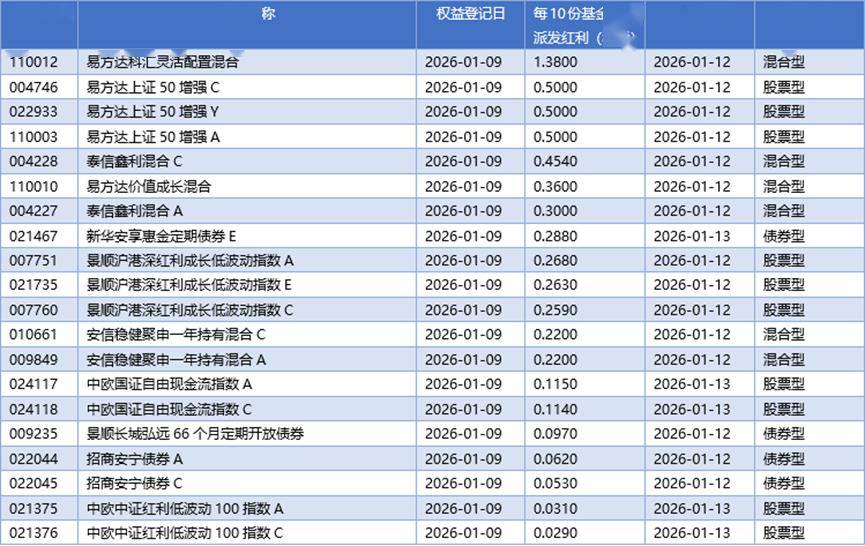
Group 1: Market Overview - In the first trading week of 2026, 46 new funds were launched, with 16 equity mixed funds and 10 passive index funds, making equity funds account for nearly 60% of the total [1] - On January 9, A-shares saw a significant increase, with the Shanghai Composite Index rising by 37.45 points (0.92%) to close at 4120.43 points, and the Shenzhen Component Index increasing by 160.67 points (1.15%) to 14120.15 points [1] - The total trading volume of the Shanghai and Shenzhen stock exchanges reached 31,227.67 billion yuan, marking the first time this year that the volume exceeded 30 trillion yuan, and the fifth occurrence in history [1] Group 2: Fund News - On January 9, six new funds were launched, primarily bond funds and funds of funds (FOF), with the Southern Huayi Stable Income Bond A aiming to raise 5 billion yuan [2] - A total of 20 funds distributed dividends, with the highest dividend payout being 1.38 yuan per 10 shares from the E Fund Ke Hui Flexible Allocation Mixed Securities Investment Fund [2] - Regulatory authorities have mandated that fund companies allocate more QDII quotas to public funds, aiming to reduce the proportion of separate accounts by half by the end of 2026 and to below 20% by the end of 2027 [2] Group 3: Investment Strategies - The consensus among public fund strategies indicates that technology sectors such as AI and semiconductors remain the core focus, while new energy and resource products are also seen as valuable for allocation amid economic recovery and expectations of RMB appreciation [3] - Institutions plan to explore profit elasticity along the "wind-solar-storage + lithium battery materials" and "copper-aluminum-gold" chains, forming a diversified portfolio of technology offensive and cyclical defensive strategies [3]

宏观“解构者”的守正与创新
Zhong Guo Zheng Quan Bao· 2026-01-11 20:49
Core Viewpoint - The investment strategy of Yin Ye Investment, led by Chief Investment Officer Xu Siyang, emphasizes a transition from a "bond expert" to a "multi-strategy allocation expert" in response to the evolving asset management landscape and declining risk-free returns [1][2]. Group 1: Investment Philosophy - The fundamental principle of asset management is to manage clients' finances effectively, while the methods to achieve this must continuously evolve [1]. - The company adopts a long-term approach based on deep macro research, embracing diverse strategies, and prioritizing absolute returns [1][2]. Group 2: Macro and Micro Research Integration - Xu Siyang's investment framework integrates macroeconomic analysis with micro-level industry insights, emphasizing the importance of understanding the intricate details within industries to identify market-driving variables [2][3]. - The research system at Yin Ye Investment is structured as a dynamic decision-making loop, where macro insights guide industry research, and micro data validate or adjust macro perspectives [3]. Group 3: "Fixed Income +" Strategy - The "Fixed Income +" strategy is central to the company's transformation, recognizing that a single asset class cannot meet clients' needs for stable returns across cycles [4]. - Xu Siyang prefers a combination of "Fixed Income + Quantitative Index Enhancement" for its dual support in risk management and return stability, while acknowledging the need for dynamic adjustments based on market conditions [4][5]. Group 4: Market Outlook for 2026 - For the bond market in 2026, the core contradiction is expected to shift from declining price expectations to marginal upward pressure, influenced by structural supply issues in long-term bonds [6][7]. - The company emphasizes the importance of micro-level industry research to uncover real economic vitality and market opportunities, focusing on cash flow changes and sector-specific improvements [6][7]. Group 5: Strategic Development and Industry Insights - Yin Ye Investment aims to enhance its alpha capabilities in existing areas while expanding its strategy breadth to become a multi-strategy collaborative platform [7]. - The company adheres to a strict development discipline, prioritizing strategy and talent development over rapid asset management scale expansion [7][8].
“量贩零食第一股”通过港交所聆讯,食品饮料ETF天弘(159736)昨日获600万份净申购居深市同类第一
2 1 Shi Ji Jing Ji Bao Dao· 2026-01-08 01:38
Group 1 - The Shanghai Composite Index recorded a slight increase, achieving a 14-day consecutive rise, with a total trading volume of 2.85 trillion yuan in the Shanghai and Shenzhen markets [1] - The Consumer Staples Index, specifically the food and beverage sector, saw a decline of 0.49%, with stocks like Ziyuan Food hitting the daily limit and others such as Yangyuan Beverage and Huanlejia also experiencing gains [1] - The Tianhong Food and Beverage ETF (159736) had a trading volume of 25.6 million yuan, with a closing premium/discount rate of 0.24%, and it received a net subscription of 6 million units, ranking first among similar products in the Shenzhen market [1] Group 2 - The food and beverage industry is characterized as a core sector of essential consumption with strong resilience, currently at historically low valuation levels, having fully priced in expectations of a slowdown in consumer recovery [2] - The investment outlook suggests a focus on leading companies with strong brand and channel advantages, growth-oriented firms actively positioning for emerging trends, and leaders in specific categories with potential for profit improvement [2] - The recent meeting between Chinese and South Korean officials aimed to enhance food safety cooperation and facilitate bilateral agricultural product trade, indicating a strategic focus on improving trade relations in the food sector [2]

穷得只剩钱了...
Ge Long Hui· 2026-01-07 12:59
Group 1 - The influence of individuals in business is often greater than that of stock investors, as business owners create extensive social networks through their operations, while stock investors primarily retain their profits for personal use [1][2] - Business owners typically have a profit structure where a significant portion of revenue is distributed to employees, suppliers, and taxes, enhancing their influence in the market [1] - The current market conditions show a decline in major companies like Alibaba and Tencent, attributed to lowered performance guidance, while Alibaba Cloud remains optimistic [2][3] Group 2 - The Hang Seng Technology Index is closely aligned with AI and robotics, indicating a strong potential for growth in these sectors, despite current market challenges [3] - The Hang Seng Technology Index has experienced a correction for over three months, suggesting that it may now offer better value for investors [4]
2026格隆汇下注中国十大核心资产之携程集团
Ge Long Hui· 2026-01-07 12:37
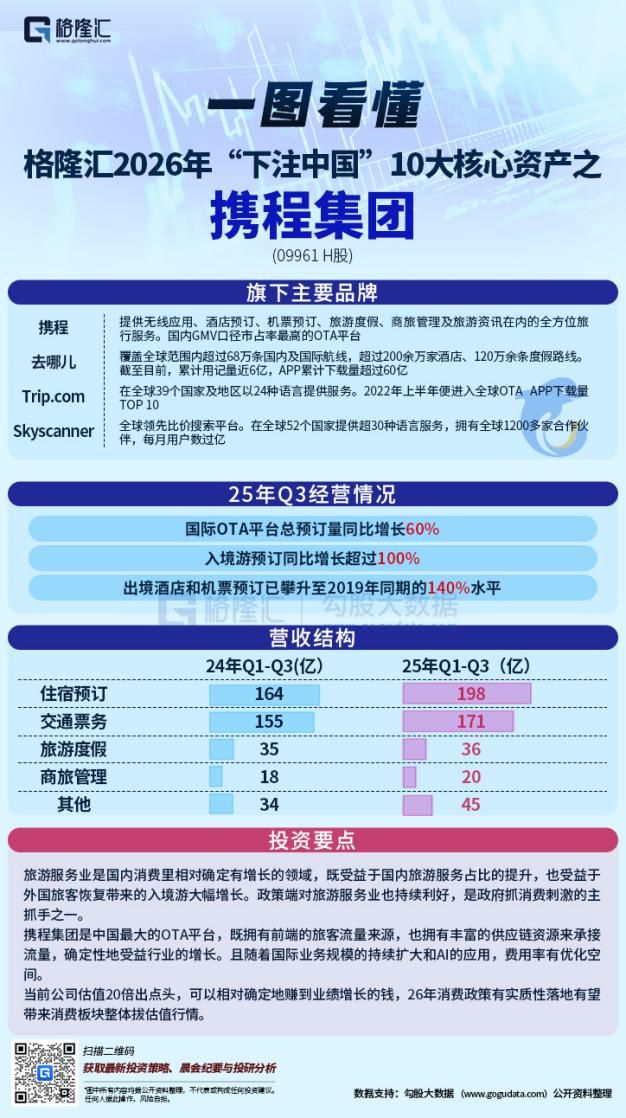
Core Viewpoint - Ctrip Group has been selected as a core asset in the consumer tourism sector for 2026, reflecting its strong position in the recovering domestic consumption market and its structural transformation into a comprehensive tourism service provider [1] Company Analysis - Ctrip is transitioning from a "single booking platform" to a "full-domain tourism ecosystem service provider," leveraging its leadership in the online travel agency (OTA) sector [1] - The company reported a revenue of 47 billion yuan for the first three quarters of 2025, a year-on-year increase of 16%, and an adjusted operating profit of 13.29 billion yuan, up 11.5%, showcasing its resilience in a challenging consumption environment [1] - Ctrip's unique model combines a stable domestic base, international business expansion, comprehensive supply chain coverage, and technological empowerment, resulting in a profit structure characterized by both cyclical resilience and growth certainty [1] Industry Trends - The tourism service industry is experiencing growth, benefiting from an increase in domestic tourism service share and a significant recovery in inbound tourism due to favorable policies aimed at stimulating consumption [3] - The domestic tourism market is showing steady growth, with a year-on-year increase of 18% in tourist numbers and 11.5% in tourism revenue for the first three quarters of 2025 [8] - The OTA penetration rate in China reached 51.5% in 2024 and continues to rise, indicating a shift towards online booking as the mainstream mode of tourism consumption [8] Competitive Advantages - Ctrip has established significant barriers to entry through brand and traffic advantages, with a user repurchase rate exceeding 60% [4] - The company has a robust supply chain covering over 750,000 hotels in more than 600 cities domestically and 1.2 million hotels globally, providing a comprehensive one-stop service for diverse travel needs [4][5] - Ctrip's early global expansion through acquisitions has positioned it well in the international market, with substantial growth in international OTA bookings [5] Business Structure - Ctrip's domestic tourism business remains the core profit base, contributing over 80% of revenue in the first three quarters of 2025, supported by both high-end and budget travel segments [10] - The international tourism business is rapidly growing, with a significant increase in bookings for inbound and outbound travel, expected to become a core growth driver alongside domestic operations [10] - The company has diversified its service offerings beyond core travel bookings to include vacation products, scenic tickets, and business travel management, enhancing its revenue structure [11][12] Investment Outlook - Ctrip is viewed as an attractive investment opportunity due to its low valuation and strong growth potential, with expected revenue growth of 15%-17% in 2026 [13] - The company is anticipated to benefit from policy incentives, rising consumer income, and a recovering tourism market, positioning it as a key player in the consumption recovery cycle [14]

2026食饮年度策略:消费者大时代
GOLDEN SUN SECURITIES· 2026-01-06 06:35
Group 1 - The report suggests that the liquor industry is expected to experience a dual improvement in supply and demand in 2026, following a risk release in 2025, with a focus on short-term sales recovery and mid-term structural and dividend considerations [4][78] - The consumer market is stabilizing, with structural growth changes continuing, as evidenced by a 4% decline in the food and beverage sector in 2025, which underperformed the Shanghai and Shenzhen 300 index by 20% [15][18] - The report highlights a significant differentiation in performance among consumer goods, with health products and frozen food sectors showing increases of 18% and 15% respectively, while liquor and beer sectors faced declines of 7% and 9% [15][18] Group 2 - The liquor sector is characterized by a threefold bottoming out, with supply clearing and value becoming more apparent, as major brands like Moutai and Wuliangye stabilize prices and restore confidence in the market [52][78] - The beer and beverage sectors are expected to benefit from a recovery in dining, with a focus on leading brands that can outperform expectations in terms of volume and price [4][52] - The food sector is positioned for recovery and growth, with a focus on strong alpha stocks, particularly in the restaurant supply chain and snack categories, as demand begins to rebound [4][52] Group 3 - The report indicates that the high-end consumer segment is showing signs of recovery, with luxury retail sales improving and experience-based consumption leading the way [30][33] - The report notes that the overall retail landscape is evolving towards discount retail, quality retail, and instant retail, reflecting a shift in consumer preferences [40][46] - The report emphasizes the importance of product innovation and channel development in the liquor industry, with a focus on lower alcohol content and appealing to younger consumers [72]





百隆东方20260105
2026-01-05 15:42
Summary of Baolong Oriental Conference Call Company Overview - **Company**: Baolong Oriental - **Industry**: Textile Manufacturing Key Points Sales Performance - In Q4, Baolong Oriental's shipment volume increased by approximately 21% year-on-year, with annual sales growth of about 5% [2][3] - The company implemented price reductions and inventory clearance strategies in the second half of the year, resulting in double-digit sales growth and reversing the decline caused by tariffs in the first half [2][3] Product Mix and Profitability - The proportion of colored yarn in Q4 rose to over 40%, improving gross margins due to declining costs and price recovery [2][4] - Despite a significant increase in colored yarn sales in Q4, the total volume for the year remained below last year's levels [2][4] - The rapid shipment of gray yarn has led to inventory saturation, extending delivery times [2][4] Domestic Operations - Domestic factories reported a narrowing of losses in Q4, nearing full production capacity with delivery times restored to 20-30 days [2][5] - The low gross margins in the first three quarters may lead to inventory impairment provisions at year-end [5] Demand and Pricing Trends - Increased demand and price recovery are attributed to concentrated customer orders before and after Christmas, low downstream inventory levels, and competitive overseas cotton prices [2][6] - The company is actively sourcing U.S. and Australian cotton to meet future demand and lock in cost advantages [2][7] Client Relationships - Uniqlo's order share has significantly increased, while Nike and Adidas orders remain stable [2][9] - Brand clients are raising their requirements for raw materials and delivery times, pushing yarn manufacturers to enhance competitiveness [9] Future Outlook - The company holds a positive outlook for 2026, expecting to achieve a net profit of between 600 million to 700 million yuan [3][20] - The anticipated performance aligns with the expected range outlined in the profit forecast [20] Market Dynamics - The company expects continued growth in orders, particularly in the first half of 2026, with a backlog of orders extending into the new year [15][21] - The demand in the U.S. and European markets is optimistic, with significant month-on-month order growth observed in Q4 [12] Competitive Landscape - Baolong Oriental differentiates itself from competitors by focusing on mid-to-high-end yarn products and leveraging its production capabilities in Vietnam [17] - The company benefits from lower labor costs and the use of overseas cotton, enhancing its competitive position [17] Raw Material Management - The company has been proactive in raw material procurement, ensuring stable production and cost advantages amid low raw material prices [7][16] - The product mix has shifted towards blended products, reflecting market trends [18] Financial Considerations - Government subsidies and exchange rate fluctuations have minimal impact on the company, with positive contributions from currency movements noted in recent reports [22] - The company anticipates stable growth in operating profit and maintains a competitive dividend policy [23] Overall Outlook - The future development prospects for Baolong Oriental are viewed positively, with expectations for continued upward growth [24]
