
货币政策

Search documents
部分银行下调存款利率!
Zhong Guo Jing Ying Bao· 2026-01-08 00:31
Group 1 - Several small and medium-sized banks have recently lowered their deposit interest rates, with some banks reducing the one-year fixed deposit rate by up to 30 basis points (BP) [1][2] - For example, Puyang Zhongyuan Village Bank announced a reduction in various fixed deposit rates effective January 7, 2026, with three-month, six-month, and one-year rates decreasing by 30 BP to 1.05%, 1.25%, and 1.40% respectively [2] - Anhui Xin'an Bank and Qing'an Rural Commercial Bank also announced reductions in their deposit rates, with Qing'an reducing rates for various terms by 5 to 30 BP [2][3] Group 2 - The overall trend for deposit rates is downward, influenced by the current macroeconomic environment and the expectation of further monetary easing, including potential cuts in reserve requirements and interest rates [4][5] - The People's Bank of China has indicated a commitment to maintaining a moderately loose monetary policy to keep social financing costs low, which may lead to lower loan rates for residents and businesses [4] - Analysts predict that as loan rates decrease, deposit rates will also continue to decline, reflecting ongoing pressure on banks to manage their funding costs [5]
降准降息可期 央行定调今年工作重点
Sou Hu Cai Jing· 2026-01-08 00:15
Core Insights - The People's Bank of China (PBOC) has outlined key priorities for 2026, including the continuation of a moderately accommodative monetary policy and the deepening of financial reforms and opening-up measures [1][2] Group 1: Monetary Policy - The PBOC aims to promote high-quality economic development and reasonable price recovery as important considerations for monetary policy [1] - The bank plans to flexibly and efficiently utilize various monetary policy tools such as reserve requirement ratio (RRR) cuts and interest rate reductions to maintain ample liquidity [1] - The goal is to ensure that the growth of social financing and money supply aligns with economic growth and price level expectations [1] Group 2: Financial Reform and Opening-Up - The PBOC has made several deployments to deepen financial reform and enhance openness, including optimizing the "Bond Connect" and "Swap Connect" mechanisms [2] - Support for the construction of the Shanghai International Financial Center and the maintenance of Hong Kong's status as an international financial hub are emphasized [2] - The bank aims to facilitate the use of the renminbi in trade and investment through central bank currency swaps and improve cross-border financial services [2] - There is an initiative to welcome more eligible foreign entities to issue panda bonds and to expand the scope of rapid payment systems [2]
央行:8日开展11000亿元买断式逆回购操作
Xin Lang Cai Jing· 2026-01-07 21:21
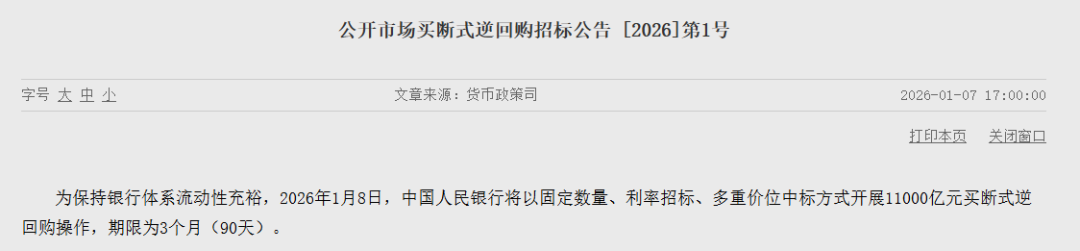
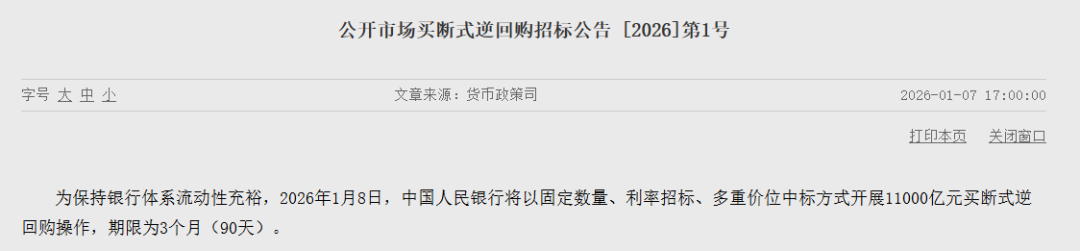
中国人民银行1月7日发布公告称,为保持银行体系流动性充裕,2026年1月8日,中国人民银行将以固定 数量、利率招标、多重价位中标方式开展11000亿元买断式逆回购操作,期限为3个月(90天)。 (来源:经济参考报) 由于本月有11000亿元3个月期买断式逆回购到期,因此此次操作将实现等量对冲。 东方金诚首席宏观分析师王青分析指出,本月3个月期买断式逆回购未加量续做,或与金融机构资金需 求的期限结构等有关,不代表央行降低流动性投放力度。本月还有6000亿6个月期买断式逆回购到期, 预计央行本月还会开展一次6个月期买断式操作,加量续做的可能性比较大。这意味着1月两个期限品种 的买断式逆回购将合计延续加量续做,连续第8个月向市场注入中期流动性。 业内人士表示,为保障重点领域重大项目资金需求,巩固拓展经济回升向好势头,2026年新增地方政府 债务限额已提前下达,这意味着2026年1月会有一定规模的政府债券开闸发行;另外,2025年10月5000 亿元新型政策性金融工具投放完毕后,还会继续带动今年1月配套贷款较快增长,放大信贷"开门红"效 应。以上都会在一定程度上带来资金面收紧效应。 在此背景下,王青判断,着眼于应对潜 ...
德国商业银行:核心通胀有望回落至2% 但欧央行料按兵不动
Xin Hua Cai Jing· 2026-01-07 18:34
Core Viewpoint - The inflation rate in the Eurozone is expected to reach or slightly fall below the European Central Bank's (ECB) target of 2% this year, as energy price disturbances diminish and wage growth in major economies slows down [1] Group 1: Inflation Trends - The average inflation rate in the Eurozone has been slightly above the 2% policy target over the past two years [1] - There is potential for further decline in overall inflation levels this year due to base effects [1] - Wage growth in major member countries like France and Italy is showing signs of slowing, which may reduce inflationary pressures [1] Group 2: Core Inflation and ECB Policy - The current core inflation rate stands at 2.3%, which may gradually align with the 2% target [1] - ECB President Christine Lagarde has indicated that monetary policy decisions will "neutralize" short-term fluctuations caused by base effects, avoiding overreaction to temporary data changes [1] - Despite the improving inflation outlook, the ECB may choose to maintain current interest rates in the short term [1]
央行定调“保持流动性充裕” 业界预计今年或降息2次
Zheng Quan Ri Bao· 2026-01-07 17:25
Core Viewpoint - The People's Bank of China (PBOC) emphasizes the implementation of a moderately loose monetary policy in 2026, focusing on promoting high-quality economic development and reasonable price recovery as key considerations for monetary policy [1][2]. Group 1: Monetary Policy Implementation - The PBOC plans to utilize various monetary policy tools, including interest rate cuts and reserve requirement ratio (RRR) reductions, to maintain ample liquidity in the market [1]. - The focus is on ensuring that the social comprehensive financing cost remains at a low level, with an emphasis on the transmission mechanism of monetary policy [1][2]. Group 2: Interest Rate Adjustments - It is expected that the PBOC will lower policy interest rates, including those for personal housing provident fund loans, which will lead to a decrease in residential mortgage rates, consumer loan rates, and business loan rates [2]. - The anticipated interest rate cuts are projected to be between 20 to 30 basis points, with two cuts expected in 2026, one in the first half and another in the second half of the year [2]. Group 3: Liquidity Management - The PBOC will primarily rely on Medium-term Lending Facility (MLF) and reverse repos to inject medium-term liquidity into the market, while also utilizing open market operations to ensure long-term liquidity [3]. - This approach aims to keep market liquidity abundant and facilitate the smooth issuance of government bonds, encouraging financial institutions to increase credit supply [3].
2025年经济运行稳中有进 顺利收官
Sou Hu Cai Jing· 2026-01-07 17:15
Economic Outlook - The global economy in 2026 is expected to exhibit a complex system characterized by non-linearity, path dependence, and adaptability, showing high instability but resilience [1] - The "First Financial Chief Economist Confidence Index" for January 2026 is reported at 50.32, indicating a recovery and maintaining a prosperous state [2][3] Inflation and Price Predictions - The average predicted year-on-year CPI growth for December 2025 is 0.8%, while the PPI is forecasted at -2% [5][6] - CPI predictions range from a minimum of 0.5% to a maximum of 0.9%, indicating a slight increase from November's 0.7% [6] - The PPI predictions range from -2.3% to -1.9%, showing a slight improvement from the previous month's -2.2% [6] Industrial and Investment Growth - The predicted growth rate for industrial added value in December 2025 is 4.9%, slightly above the previous month's 4.8% [9][10] - Fixed asset investment is expected to decline by an average of -2.2%, showing a recovery from November's -2.6% [11] - Real estate development investment is forecasted to decrease by -15.8%, with signs of a narrowing decline in transaction volumes [12] Trade and Export Forecasts - The trade surplus for December 2025 is predicted to be $1113.5 billion, remaining stable compared to the previous month [13][14] - Exports are expected to grow by 2.5%, down from 5.9% in the previous month, while imports are forecasted to increase by 0.7% [14][15] Financing and Monetary Policy - New loans are projected to reach 7182.5 billion yuan in December 2025, recovering from the previous month's 3900 billion yuan [15][16] - The total social financing is expected to average 1.8 trillion yuan, lower than the previous month's 2.5 trillion yuan [16][17] - M2 growth is predicted to remain at 8%, consistent with November's figures [18] Policy Directions - Fiscal policy is anticipated to become more proactive, with an increase in the scale of government debt and continued support for local debt initiatives [20][21] - Monetary policy is expected to remain moderately accommodative, with potential for further interest rate cuts and reserve requirement reductions [20][21]
等量续作,央行明日开展3个月期11000亿元买断式逆回购操作|快讯
Sou Hu Cai Jing· 2026-01-07 15:45
Core Viewpoint - The People's Bank of China (PBOC) is set to conduct a 1.1 trillion yuan reverse repo operation on January 8, 2026, to maintain ample liquidity in the banking system, marking the third consecutive month of equal-scale operations [1] Group 1: Reverse Repo Operations - On January 8, 2026, the PBOC will conduct a fixed-quantity, interest-rate tender, multi-price reverse repo operation amounting to 1.1 trillion yuan with a term of 3 months (90 days) [1] - The operation on January 8 will match the 1.1 trillion yuan of 3-month reverse repos maturing on the same day, indicating a continuation of the same scale of operations [1] - In January, an additional 600 billion yuan of 6-month reverse repos is set to mature, with expectations for another 6-month operation, likely with an increased amount [1] Group 2: Monetary Policy Outlook - Analysts anticipate that the PBOC will also consider the 200 billion yuan of Medium-term Lending Facility (MLF) maturing in January, potentially leading to an increased operation [1] - Overall, the PBOC is expected to utilize both reverse repos and MLF tools to inject medium-term liquidity into the market, reflecting a continuation of a moderately accommodative monetary policy stance in 2026 [1]
央行预告,明天11000亿
Zhong Guo Zheng Quan Bao· 2026-01-07 15:05
Group 1 - The People's Bank of China (PBOC) will conduct a 1.1 trillion yuan reverse repo operation on January 8, 2026, with a term of 3 months, to maintain ample liquidity in the banking system [1] - The operation on January 8 will match the amount of 1.1 trillion yuan in 3-month reverse repos maturing on the same day, indicating a continuation of the policy tool for the third consecutive month [2] - Analysts suggest that the unchanged amount of the 3-month reverse repo does not indicate a reduction in liquidity provision, as the current financial environment shows less urgency for increased liquidity [3] Group 2 - The PBOC is expected to conduct a medium-term lending facility (MLF) operation around January 25, potentially maintaining or increasing the amount to inject medium-term liquidity into the market [4] - The central bank's liquidity injection strategy is becoming more fixed, with regular operations scheduled for different terms throughout the month [3]

央行预告!明天,11000亿
Zhong Guo Zheng Quan Bao· 2026-01-07 14:28
Group 1 - The People's Bank of China (PBOC) will conduct a 1.1 trillion yuan reverse repo operation on January 8, 2026, with a term of 3 months, to maintain ample liquidity in the banking system [1][2] - The operation on January 8 will match the amount of 1.1 trillion yuan in 3-month reverse repos maturing on the same day, marking the third consecutive month of this policy tool being rolled over at the same amount [2] - Analysts suggest that the lack of an increase in the 3-month reverse repo may relate to the funding needs of financial institutions, indicating that the PBOC is not reducing liquidity injection efforts [3] Group 2 - The PBOC is expected to continue injecting medium-term liquidity through reverse repos to stabilize the funding environment, which supports government bond issuance and encourages financial institutions to increase credit supply [3] - The current liquidity injection methods by the PBOC are consistent, with 3-month reverse repos conducted around the 5th of each month, 6-month reverse repos around the 15th, and Medium-term Lending Facility (MLF) operations around the 25th [3] - For the 200 billion yuan MLF maturing in January, it is anticipated that the PBOC will conduct operations around January 25, either rolling over the amount or increasing it to continue providing medium-term liquidity to the market [4]
FSMOne:港股投资价值吸引 恒指今年目标价30000点
Zhi Tong Cai Jing· 2026-01-07 12:57
Group 1 - The core viewpoint is that the Hang Seng Index's long-term performance will depend on corporate earnings recovery, despite short-term momentum from valuation expansion [1] - The sectors expected to see the highest earnings growth by 2026 are consumer discretionary, materials, and information technology, all of which are above the market average [1] - Liquidity is a crucial factor supporting the performance of Hong Kong stocks, with significant net inflows from mainland investors exceeding HKD 1 trillion last year [1] Group 2 - Despite significant gains in Hong Kong stocks last year, structural investment opportunities remain, particularly driven by the expansion of AI applications and increased market liquidity from northbound capital and IPOs [2] - The target price for the Hang Seng Index in 2026 is projected to be 30,000 points based on a target P/E ratio of 11 times [2] - AI development is expected to continue driving growth in the US stock market, with strong semiconductor sales and high capital expenditure in tech firms supporting overall economic growth [2]