
股债跷跷板

Search documents
持币、持股还是持金?国庆长假前投资攻略来了
Di Yi Cai Jing· 2025-09-30 08:04
Core Viewpoint - The article discusses the classic investment strategy dilemma of holding stocks versus holding cash as the National Day holiday approaches, highlighting historical trends and current market conditions that favor holding stocks over the holiday period [1][3][4]. Market Performance - On the last trading day before the National Day holiday, the Shanghai Composite Index experienced fluctuations around 3880 points, with a notable increase in trading volume, reaching a daily turnover of 2.18 trillion yuan [2][4]. - Historical data indicates that A-shares have a higher probability of rising after the National Day holiday, with a recorded 80% chance of an increase if trading volume expands in the last three trading days before the holiday [4]. Investment Strategies - Analysts suggest that investors should maintain a balanced asset allocation while considering their risk tolerance, with a focus on opportunities across different markets and asset classes [1][6]. - The "calendar effect" observed in A-shares suggests that holding stocks during the holiday may yield better returns, as evidenced by past performance trends [4][6]. Sector Focus - The technology sector remains a focal point for investors, particularly in the context of economic pressures, with expectations of policy catalysts following significant meetings in October [3][4]. - The recent surge in international gold prices, which reached a historical high of $3871.73 per ounce, has introduced "holding gold" as a new investment option for the holiday period [6][7]. Bond Market Outlook - The bond market is currently experiencing weak sentiment, with a neutral outlook from institutions, as the ten-year government bond yield rose above 1.83% before retreating due to central bank interventions [5][9]. - Despite short-term pressures from the stock market, long-term bond market trends are expected to align with economic fundamentals, indicating a potential decoupling from stock market movements [9].
如何看待近期债券市场行情︱重阳问答
Jing Ji Guan Cha Bao· 2025-09-29 02:43
Core Viewpoint - The bond market has experienced significant volatility since July, with rising yields and a clear downward trend, influenced by the upward movement in equity and commodity markets [1][2] Group 1: Market Trends - The 10-year government bond yield has risen over 5 basis points, while the 30-year yield has increased by more than 8 basis points, surpassing 1.9% [1] - The bond market adjustment is attributed to the strong performance of equity and commodity markets, driven by supportive fiscal and monetary policies [1] - The yield spread between 10-year and 1-year government bonds remains at a historical low of 20 basis points, indicating a crowded and fragile trading structure [1] Group 2: Economic Outlook - The macroeconomic fundamentals of the bond market remain stable, with structural issues in the Chinese economy still needing resolution [2] - The real estate market is stabilizing, but the overall economic growth rate is declining, suggesting a prolonged period of asset scarcity [2] - The expectation of continued accommodative monetary policy, including potential rate cuts, supports the bond market's fundamentals [2] Group 3: Investment Considerations - The dividend yield of the CSI All Share Index has dropped to around 2%, narrowing the gap with the 10-year government bond yield, which enhances the attractiveness of bonds [2] - The estimated reasonable pricing for the 10-year government bond is between 1.8% and 1.9%, based on the anticipated spread with policy rates [2] - A breakthrough above the 1.9% yield level may require effective demand-side stimulus policies to be implemented [2]
“教科书级”范本:用四把“手术刀”,解剖“固收+”的收益来源
Sou Hu Cai Jing· 2025-09-26 05:59
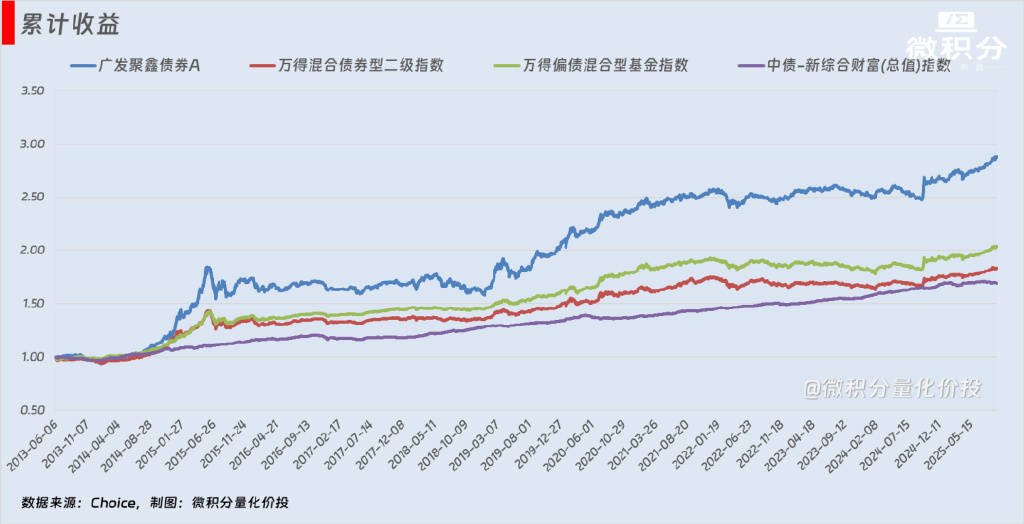
Core Viewpoint - The article analyzes the performance and strategies of the "Guangfa Juxin" fund, highlighting its long-term success and the stable management by fund manager Zhang Qian since 2015, which allows for a comprehensive understanding of its investment approach [2][29]. Group 1: Fund Performance - "Guangfa Juxin" has been established for over twelve years and has achieved an annualized return of over 9%, making it a standout in the 10-year performance category [2]. - The fund has significantly outperformed representative "fixed income +" fund indices, with an annualized excess return exceeding 4% compared to the Wind Mixed Bond Secondary Index [10][7]. - The fund demonstrates resilience, quickly recovering from downturns and consistently generating excess returns [10]. Group 2: Investment Strategy - The fund employs a dual strategy of equity and bond investments, effectively utilizing a "stock-bond seesaw" approach to mitigate volatility [13]. - The bond investment strategy focuses on leveraging, duration management, and credit risk assessment, maintaining a leverage ratio around 120% for stability [18][20]. - The equity investment strategy emphasizes growth stocks, with a concentrated portfolio that avoids mainstream sectors, instead focusing on underappreciated industries like military and Hong Kong stocks [27][31]. Group 3: Risk Management - The fund manager exhibits a cautious approach to credit risk, having shifted away from low-rated bonds post-2020, demonstrating strong risk sensitivity [24][25]. - The duration of the bond portfolio is managed to remain within a safe range, avoiding excessive risk from interest rate fluctuations [20]. Group 4: Conclusion - The fund manager is characterized as a dynamic alpha hunter, adept at navigating both equity and bond markets, with a focus on growth-oriented strategies [30][31]. - The analysis concludes that the fund's success can be attributed to its balanced approach in managing systemic risks while capitalizing on market opportunities [32].

“9·24”一周年资管变局:股债历经四阶段 权益投资偏好切换
2 1 Shi Ji Jing Ji Bao Dao· 2025-09-25 23:19
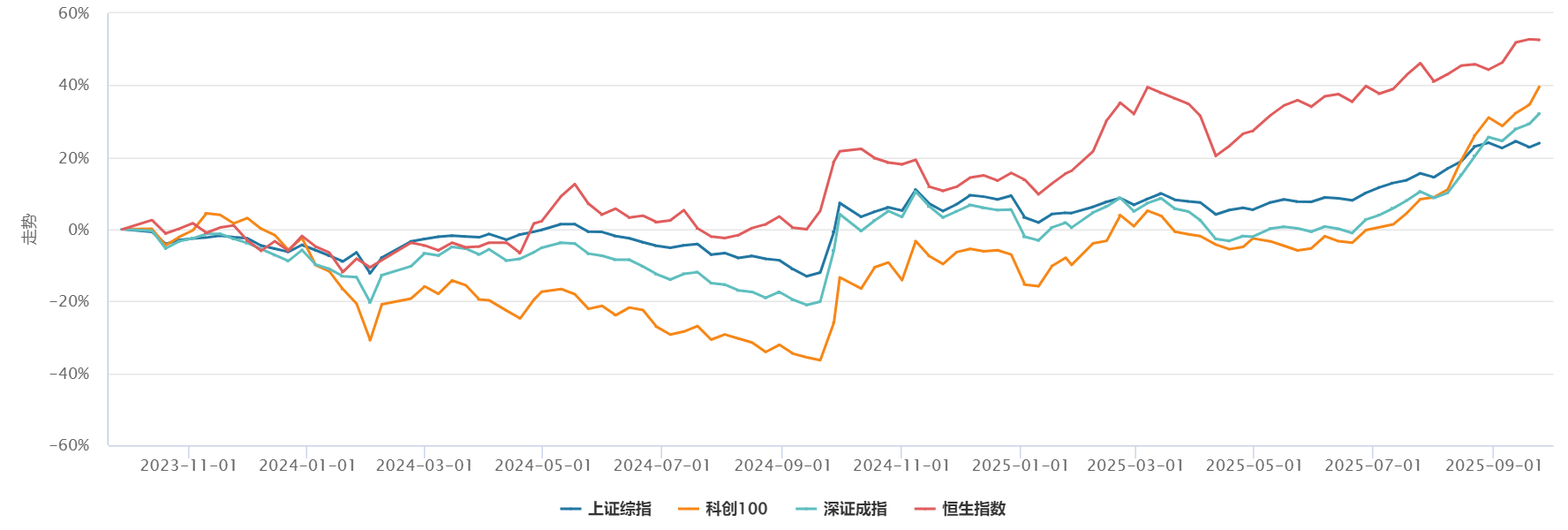
Group 1 - The announcement of significant financial policies by the central bank and regulatory bodies on September 24, 2023, marked a turning point for the A-share market, leading to substantial market gains in the following year [1] - The Shanghai Composite Index increased by 40.19%, while the Shenzhen Component Index rose by 65.23% in the year following the announcement, contrasting with declines in the previous year [1] - Trading volumes for major indices doubled after September 24, 2023, with the Shanghai Composite's trading volume reaching 165.91 trillion yuan [1] Group 2 - The low risk appetite among clients has historically limited the acceptance of equity-based financial products compared to fixed-income products, with equity products only accounting for approximately 0.23% of the total bank wealth management market as of June 2025 [2] - Following the September 24 announcement, there has been a notable increase in the hiring of positions related to equity investment and multi-asset strategies within wealth management firms [2] - The performance of equity-based financial products has improved significantly, with an average net value growth rate of 13.39% in the first eight months of the year [6] Group 3 - The bond market has experienced a bull market since 2024, with the 1-year government bond yield dropping to a record low of 0.9307% in December 2024 [3] - The bond market has shown different volatility patterns compared to the stock market, with periods of both correlation and independence in their movements [4][5] - The investment preference has shifted from dividend stocks to technology sectors, reflecting changing market dynamics [6][7] Group 4 - Despite increased interest in equity investments, clients maintain a low risk tolerance, with a significant portion of new affluent individuals unwilling to accept losses exceeding 10% [8] - The asset allocation of new affluent individuals has shifted, with a decrease in cash and fixed deposits and an increase in fund investments, indicating a growing interest in higher-risk financial assets [8]
“924”一周年资管变局:股债历经四阶段 权益投资偏好切换
2 1 Shi Ji Jing Ji Bao Dao· 2025-09-25 15:22
Core Viewpoint - The announcement of significant financial policies by the central bank and regulatory authorities on September 24, 2023, marked a turning point for the A-share market, leading to a substantial market rally and changes in investment preferences [1]. Market Performance - Before September 24, 2023, the Shanghai Composite Index decreased by 8.6%, while the Shenzhen Component Index fell by 17.12%. In contrast, after this date, the Shanghai Composite Index surged by 40.19%, and the Shenzhen Component Index increased by 65.23% [2]. - Trading volumes also doubled post-September 24, with the Shanghai Composite Index's trading volume rising from 82.09 trillion yuan to 165.91 trillion yuan [5]. Wealth Management and Investment Products - The financial policies have positively impacted wealth management companies, leading to increased interest in equity investment products, which previously had low market recognition compared to fixed-income products. As of June 2025, equity products accounted for only 0.23% of the total bank wealth management market [4]. - The average net value growth rate for equity wealth management products reached 13.39% in the first eight months of the year, significantly outperforming mixed and fixed-income products [10]. Investment Strategy Shifts - Post-September 24, there has been a noticeable shift in investment preferences from dividend stocks to technology sectors, reflecting changing market dynamics and investor sentiment [11]. - Despite increased interest in equity investments, clients maintain a low-risk appetite, with a significant portion of new affluent individuals unwilling to accept losses exceeding 10% [12]. Bond Market Dynamics - The bond market has experienced a bull market since 2024, with the one-year government bond yield dropping to a record low of 0.9307% in December 2024. However, fluctuations in bond yields have been observed, necessitating close monitoring by fixed-income investors [7]. - The relationship between stocks and bonds has shown atypical behavior, with periods of both interdependence and independence, deviating from the traditional "stock-bond seesaw" effect [8][9].
“924”一周年资管变局:股债历经四阶段,权益投资偏好切换
2 1 Shi Ji Jing Ji Bao Dao· 2025-09-25 12:08
Core Viewpoint - The announcement of significant financial policies by the central bank and regulatory authorities on September 24, 2023, marked a turning point for the A-share market, leading to a substantial market rally and increased trading volumes [1][2]. Market Performance - Prior to September 24, 2023, the Shanghai Composite Index decreased by 8.6%, while the Shenzhen Component Index fell by 17.12%. In contrast, after this date, the Shanghai Composite Index surged by 40.19%, and the Shenzhen Component Index increased by 65.23% [2]. - The trading volume for major indices doubled after September 24, with the Shanghai Composite Index's trading volume rising from 82.09 trillion yuan to 165.91 trillion yuan [4]. Wealth Management and Investment Trends - The financial policies have positively impacted wealth management companies, leading to increased interest in equity investment products, which previously had lower recognition compared to fixed-income products. As of June 2025, equity products accounted for only 0.23% of the total bank wealth management market [6]. - Following the policy announcement, there has been a notable increase in job postings for roles related to equity investment and multi-asset strategies within wealth management firms [6]. - Equity investment products have shown strong performance, with an average net value growth rate of 13.39% in the first eight months of the year, prompting wealth management companies to increase their focus on multi-asset and equity products [10]. Bond Market Dynamics - The bond market has experienced a bull market since 2024, with the one-year government bond yield dropping to a record low of 0.9307% in December 2024. However, fluctuations have been observed, necessitating close monitoring by fixed-income investors [7]. - The relationship between the stock and bond markets has evolved, with periods of both correlation and independence, indicating a departure from the traditional stock-bond "teeter-totter" effect [9]. Shifts in Investment Preferences - There has been a shift in investment preferences from dividend stocks to technology sectors post-September 24, reflecting changing market dynamics and investor sentiment [10][12]. - Despite increased allocations to high-risk financial assets, the risk appetite among new affluent individuals remains conservative, with a significant portion unwilling to accept losses exceeding 10% [12].
股债跷跷板未来如何演绎?
2025-09-24 09:35
Summary of Key Points from Conference Call Industry Overview - The conference call discusses the A-share market dynamics, macroeconomic conditions, and the bond market in China, highlighting the interplay between stock and bond investments and the impact of foreign capital inflows on the market. Core Insights and Arguments 1. **A-share Market Support Factors** The passive appreciation of the RMB, narrowing of the US-China interest rate differential, and the shift of household deposits to the stock market are key long-term supports for the A-share market. Notably, there was a significant reduction in household deposits in July and August, while non-bank financial institutions saw an increase in deposits, indicating a clear trend of funds flowing into the stock market [1][4]. 2. **Foreign Capital Inflows** In the first three weeks of September, foreign capital inflows exceeded $10 billion, reflecting optimism towards the A-share market, while sentiment towards the Hong Kong stock market remains weak. Foreign investments have been concentrated in sectors such as pharmaceuticals, finance, commodities, and consumer energy, with a notable outflow from the technology sector [1][5]. 3. **Bond Market Dynamics** The 10-year government bond yield has reached 1.8%, which has sparked a divergence of opinions among investors. The yield range for the year has been between 1.6% and 1.9%, and the current level suggests potential adjustment pressures on fixed-income products. The bond market has experienced multiple yield adjustments throughout the year, with recent trends indicating a cautious outlook [1][6][7]. 4. **Economic Growth Projections** A long-term economic growth target of around 4.5% is deemed reasonable, with a focus on expanding domestic demand, particularly in consumer and service sectors, which presents significant investment opportunities [3][13][15]. 5. **Market Trends and Strategies** The current market is characterized by a "stock-bond seesaw" effect, where the correlation between stocks and bonds has shifted from negative to positive. This indicates a potential change in pricing dynamics, suggesting that investors should maintain a neutral duration strategy for trading in a volatile market [11][12]. 6. **Policy and Economic Conditions** The economic fundamentals show insufficient domestic demand and slow recovery, with various economic indicators reflecting a slowdown. Despite a deflationary environment, there are signs of inflation expectations rising, which could influence market sentiment [8][9]. 7. **Investment in Human Capital** The call emphasizes the importance of investing in human capital through measures such as childcare subsidies and educational support, which are expected to increase in the upcoming planning period [17]. 8. **Major Projects in the 15th Five-Year Plan** The 15th Five-Year Plan will introduce significant projects in infrastructure, including transportation, water conservancy, and energy, which are expected to stimulate investment and support local debt resolution [18]. 9. **Real Estate Development Model** A new model for real estate development is being proposed, focusing on a full industry chain approach, including scientific land planning and compliance with higher construction standards, aimed at promoting healthy market development [19]. 10. **High-Quality Development of Capital Markets** The call highlights the need for high-quality development in capital markets, aiming to attract domestic and foreign investments and improve market infrastructure to foster a healthy bull market [20]. Other Important but Overlooked Content - The call discusses the necessity for monetary policy to balance domestic and international considerations, with potential room for rate cuts if economic conditions worsen. The upcoming peak in special bond issuance is also noted, which may affect liquidity in the market [9][10].
股市震荡盘整,债市再度?弱
Zhong Xin Qi Huo· 2025-09-24 07:37
1. Report Industry Investment Rating - The report does not provide a clear industry - wide investment rating. However, for specific financial derivatives: - The outlook for stock index futures is "shock - biased upward" [7] - The outlook for stock index options is "shock" [7] - The outlook for treasury bond futures is "shock - biased cautious" [9] 2. Core Viewpoints - Stock index futures witnessed the release of crowded funds in small - and micro - cap stocks. The market is in a period of shock and consolidation. The growth style can be adhered to, with appropriate profit - taking, and half - position allocation of IM long positions is recommended, waiting for an opportunity to increase positions in mid - to late October [1][7] - Stock index options should focus on hedging and defense. There is a need for short - term hedging, and a double - buying strategy can be adopted during the week before the holiday. For those with equity holdings, the defensive thinking should be maintained, and the double - selling volatility strategy is not recommended before the holiday [2][7] - The bond market weakened again. The sentiment in the bond market is still unstable. In the short term, monetary policy may mainly rely on structural policy tools, and the bond market should be treated with caution [3][8][9] 3. Summary by Relevant Catalogs 3.1 Market Views 3.1.1 Stock Index Futures - **Base and spread data**: IF, IH, IC, IM's current - month base points were - 9.58, 3.69, - 97.51, - 102.47 points respectively, with changes of 6.63, 3.26, - 15.79, - 8.59 points compared to the previous trading day. Their inter - period spreads (current - month - next - month) were 14.8, - 0.8, 86.8, 97 points respectively, with changes of 1.8, - 1.4, 21.6, 13.8 points [7] - **Position changes**: IF, IH, IC, IM positions changed by 20632, 2169, 23060, 39228 lots respectively [7] - **Logic**: The Shanghai Composite Index recovered after hitting the bottom on Tuesday, barely holding above 3800 points, with trading volume increasing to 2.5 trillion yuan. The release of crowded funds in small - and micro - cap stocks was due to entering an event - free period, early - morning sharp decline, and the breakdown of micro - cap stock indexes [1][7] 3.1.2 Stock Index Options - **Market sentiment**: Trading volume increased again. The increase in the short - term position PCR indicates an increase in the demand for put options, and there is a risk - aversion sentiment in the market. The implied volatility of CSI 1000 stock index options exceeded 30 [2][7] - **Strategy**: For those with equity holdings, maintain a defensive mindset. Do not recommend the double - selling volatility strategy before the holiday [2][7] 3.1.3 Treasury Bond Futures - **Trading data**: T, TF, TS, TL main contracts fell 0.21%, 0.13%, 0.05%, 0.67% respectively. T, TF, TS, TL current - quarter trading volumes were 110179, 81508, 38495, 154093 lots respectively, with 1 - day changes of 31082, 31191, 9637, 40402 lots. Positions were 221376, 126182, 67845, 143963 lots respectively, with 1 - day changes of - 4735, - 7155, - 1498, - 3095 lots [7][8] - **Spread data**: T, TF, TS, TL current - quarter vs. next - quarter spreads were 0.330, 0.120, 0.076, 0.320 yuan respectively, with 1 - day changes of - 0.025, - 0.010, 0.010, - 0.020 yuan. Cross - variety spreads and basis also had corresponding changes [7][8] - **Logic**: The central bank's statements and open - market operations made the market's broad - money expectations disappointed, and the market's concerns about the capital supply increased. The stock - bond seesaw effect did not occur [3][8][9] - **Strategy**: Adopt a shock - biased cautious trend strategy, pay attention to short - selling hedging at low basis levels, appropriately focus on basis widening, and expect the yield curve to remain steep [9] 3.2 Economic Calendar - On September 22, 2025, China's 1 - year loan prime rate remained at 3% [11] - On September 23, 2025, the preliminary value of the Eurozone's September manufacturing PMI was 49.5, lower than the forecast of 50.9 [11] - On September 24, 2025, the data of the annualized total number of new home sales in the US in August was yet to be released, with a previous value of 65.2 million and a forecast of 65 million [11] - On September 25, 2025, the data of the number of initial jobless claims in the US for the week ending September 20 was yet to be released, with a previous value of 23.1 million and a forecast of 23.5 million [11] 3.3 Important Information and News Tracking - **Domestic macro**: In August, China's total social electricity consumption was 1.0154 trillion kWh, a year - on - year increase of 5.0%. From January to August, the cumulative total social electricity consumption was 6.8788 trillion kWh, a year - on - year increase of 4.6% [11] - **Overseas macro**: On September 23, China's top legislator Zhao Leji met with a US congressional delegation in Beijing, emphasizing the importance of stable Sino - US relations and the Taiwan issue [12] 3.4 Derivatives Market Monitoring - The report mentions the monitoring of stock index futures, stock index options, and treasury bond futures data, but no specific data is provided in the text [13][17][29]
第二批科创债ETF上市在即,首批8只产品已进入“百亿俱乐部”
Bei Jing Shang Bao· 2025-09-23 13:25
Group 1 - The second batch of 14 Sci-Tech Bond ETFs will be listed on September 24, expanding the total number of listed Sci-Tech Bond ETFs to 24 [1][3] - The total issuance scale of the first two batches of Sci-Tech Bond ETFs has reached nearly 700 billion yuan, with the first batch alone raising 289.88 billion yuan [3][4] - The rapid expansion of the first batch's scale indicates strong market demand for policy-supported and stable-yield technology-themed bond instruments [1][5] Group 2 - As of September 22, 8 out of the 10 first batch Sci-Tech Bond ETFs have exceeded 10 billion yuan in scale, with the largest being 19.76 billion yuan [4] - The majority of the ETFs track the China Securities AAA Technology Innovation Company Bond Index, which has increased by 1.24% year-to-date [5] - The unique investment value of Sci-Tech Bond ETFs is highlighted by their ability to maintain liquidity and attract investment amid a fluctuating bond market [6][7] Group 3 - The issuance of the second batch of Sci-Tech Bond ETFs is expected to bring in continuous inflow of incremental funds, enhancing market activity [6] - The policy support for these ETFs allows them to be included as collateral for general pledged repo, improving capital efficiency for investors [6] - The current market environment suggests that the unique investment value of Sci-Tech Bonds will become more pronounced as the bond market stabilizes [7][8]

长端利率震荡下配置价值凸显,30年国债ETF(511090)盘中成交超53亿元
Sou Hu Cai Jing· 2025-09-23 05:46
Core Viewpoint - The 30-year Treasury ETF (511090) has undergone a downward adjustment, with the latest quote at 118.16 yuan, indicating active market trading and liquidity [1] Market Performance - The 30-year Treasury ETF recorded a turnover rate of 17.38% during the trading session, with a total transaction volume of 5.345 billion yuan, reflecting a vibrant market [1] - Over the past month, the average daily transaction volume for the 30-year Treasury ETF reached 10.254 billion yuan [1] Fund Size - According to Wind data, the latest size of the 30-year Treasury ETF is 30.895 billion yuan [1] Market Conditions - The bond market has not shown significant recovery as of September, with long-term bond yields remaining volatile and the yield curve spread continuing to widen [1] - New public fund fee regulations and expectations of central bank bond purchases have emerged, leading to a downward adjustment in long-term yields after breaking below 1.8%, followed by a period of volatility [1] Economic Outlook - Dongwu Securities indicates that the yield has returned to the upper range of the volatility zone, with a notable weakening of the stock-bond relationship. The impact of quarter-end fund redemptions and banks realizing profits is gradually diminishing [1] - The fundamental economic data remains weak, and expectations for the resumption of Treasury trading are increasing, alongside a higher probability of the Federal Reserve lowering interest rates within the year. However, significant upward movement in the bond market is limited in the short term [1] Index Tracking - The 30-year Treasury ETF closely tracks the China Bond 30-Year Treasury Index (Total Value) which is part of the China Bond Index family. The index consists of publicly issued and tradable 30-year government bonds with a remaining maturity of 25-30 years, excluding special government bonds, serving as a performance benchmark for this category of bonds [1]