
信用利差

Search documents
2025年第三季度债券市场信用利差分析:信用债利差整体走阔,长久期城投债信用分化缓解
Yuan Dong Zi Xin· 2025-10-17 11:04
1. Report Industry Investment Rating No relevant content provided. 2. Core Viewpoints of the Report - In Q3 2025, the credit spreads of bonds in the market generally widened across all tenors and ratings. The difference between the spreads of AA- and AAA bonds decreased, indicating a reduction in credit differentiation [2]. - For industrial bonds, the credit spreads of different industries changed variedly in Q3 2025, with overall small fluctuations. The spreads of industries such as leisure services, comprehensive, building decoration, machinery and equipment, non-ferrous metals, and mining increased significantly, while those of the banking and real estate industries narrowed. The spread of medium - rated (AA) real - estate bonds continued to widen due to the unimproved supply - demand relationship in the real - estate market [2]. - For urban investment bonds, the spreads of urban investment bonds at all tenors and ratings generally widened in Q3 2025, but the increase was limited. With the continuous progress of local debt resolution and the acceleration of the clearance of financing platforms, the credit risk of urban investment bonds was generally mitigated, and the credit spread fluctuation was relatively small. The difference in spreads between low - rated (AA -) and high - rated (AAA) 5 - year urban investment bonds narrowed, indicating a relief in credit differentiation for long - term urban investment bonds [2]. 3. Summary According to Relevant Catalogs Credit Spreads Widened Overall Spreads of All Tenors and Ratings Widened - **1 - year bonds**: Except for AA +, the spreads of 1 - year bonds of other ratings showed a similar trend. They narrowed slightly in July, then widened in August and September. Compared with the end of Q2 2025, the spreads of AA +, AA, AAA, and AA - bonds widened by 30.82BP, 8.55BP, 4.55BP, and 4.55BP respectively [5][8]. - **3 - year bonds**: The spreads of 3 - year bonds showed a differentiated trend. The spread of AA - narrowed, while those of other ratings fluctuated and widened. Compared with the end of Q2 2025, the spreads of AA, AAA, and AA + widened by 33.48BP, and the spreads of AAA and AA + had smaller increases, while the spread of AA - narrowed by 10.15BP [11][14]. - **5 - year bonds**: The spreads of 5 - year bonds generally showed an oscillating and widening trend. Compared with the end of Q2 2025, the spreads of AAA and AA + widened by 19.81BP, the spread of AA widened by 10.81BP, and the spread of AA - had a smaller increase [15][20]. The Difference between Low - and High - Rating Spreads Narrowed - In Q3 2025, the spread difference of 1 - year bonds remained relatively stable, while those of 3 - and 5 - year bonds narrowed. At the end of Q3 2025, the spread difference of 1 - year bonds was the same as that at the end of the previous quarter, while those of 3 - and 5 - year bonds decreased by 16BP compared with the end of the previous quarter, indicating a reduction in credit differentiation [21]. Industry Credit Spreads Fluctuated Slightly, and the Spread of Medium - Rated Real - Estate Industry Continued to Widen - For industrial bonds, the credit spreads of different industries changed variedly in Q3 2025, with overall small fluctuations. Industries such as building decoration, non - ferrous metals, and mining had relatively large increases in spreads, while the banking credit spread narrowed significantly [26]. - The top three industries in terms of spreads at the end of Q3 2025 were the same as those in the previous quarter, namely real estate, steel, and leisure services; the bottom three were also the same as in the previous quarter, namely power, highways, and banking. In Q3, the spreads of most industries increased compared with the previous quarter, while those of a few industries narrowed slightly [30]. - Among the eight key industries, the medium - rated spreads of building decoration, real estate, and non - bank finance widened significantly at the end of Q3 2025. The real - estate market's supply - demand relationship remained to be improved, and weak - quality real - estate enterprises still faced high credit risks [31]. Credit Spreads of Urban Investment Bonds at All Ratings Generally Widened - **1 - year urban investment bonds**: The spreads of 1 - year urban investment bonds at all ratings showed a similar trend. They narrowed slightly in July and then widened in the following two months. At the end of Q3 2025, the spreads of AAA and AA + were basically the same as those at the end of the previous quarter, while those of AA and AA - widened by 3.15BP and 4.65BP respectively [34]. - **3 - year urban investment bonds**: The spreads of 3 - year urban investment bonds at all ratings generally showed an oscillating and widening trend. At the end of Q3 2025, the spreads of AAA, AA +, AA, and AA - widened by 7.24BP, 9.74BP, 11.74BP, and 22.24BP respectively compared with the end of the previous quarter [40][42]. - **5 - year urban investment bonds**: The spreads of 5 - year urban investment bonds at all ratings generally showed an upward trend. At the end of Q3 2025, the spreads of AAA, AA +, and AA widened by 23.54BP, 26.44BP, and 30.54BP respectively compared with the end of the previous quarter, while the spread of AA - had a relatively small increase [43]. - The spread differences between low - rated (AA -) and high - rated (AAA) urban investment bonds of different tenors showed a differentiated trend in Q3 2025. The spread difference of 1 - year bonds fluctuated slightly, that of 3 - year bonds increased slightly, and that of 5 - year bonds narrowed slightly, indicating a relief in credit differentiation for long - term urban investment bonds [46].
这个大涨的市场,大机构开始撤了,甚至做空?
Hua Er Jie Jian Wen· 2025-10-16 07:46
Core Viewpoint - Major asset management firms, including BlackRock, Fidelity International, and M&G, are reducing exposure to high-risk corporate bonds due to concerns over potential sell-offs if the global economy weakens, shifting towards safer high-rated corporate bonds or government bonds [1][2]. Group 1: Market Conditions - The spread between U.S. and European investment-grade bonds and government bonds is currently about 0.8 percentage points, significantly narrowed from over 1.5 percentage points in 2022, approaching the lowest level since the 2008 financial crisis [1]. - There are concerns that the recent rally in credit markets, driven by easing trade tensions and expectations of Federal Reserve rate cuts, may have led to overly optimistic pricing regarding global economic growth [1][3]. Group 2: Investor Sentiment - Investors are showing signs of resistance in high-risk areas of the corporate bond market, with several leveraged loan deals being shelved recently, indicating a shift towards safer debt options [3]. - A high-yield bond trader noted that numerous defaults in the past weeks are shaking investor confidence [3]. Group 3: Defensive Positioning - F&C Investment Trust has reduced its credit bond positions to "neutral" and sold off high-yield bonds due to increasing costs compared to government bonds [4]. - M&G Investments is shifting towards higher-rated corporate credit and guaranteed bonds issued by life insurance companies, as the cost of selling BBB-rated unsecured bonds and buying these alternatives is at a historical low [4]. Group 4: Yield Considerations - Despite rising government bond yields, the overall yield from corporate bonds is still viewed as attractive, with the yield on U.S. investment-grade bonds at approximately 4.8% according to the Ice index [5].

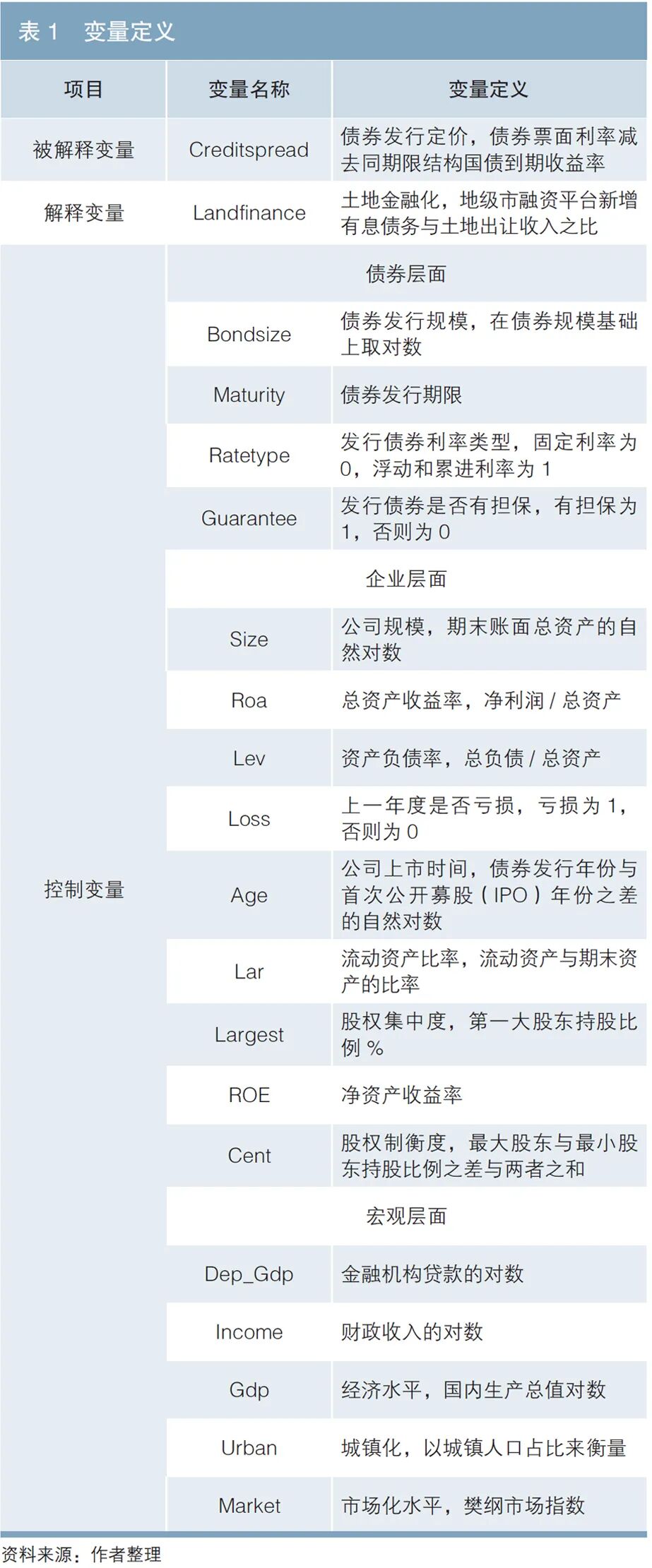
土地金融化对企业债券定价影响研究
Xin Lang Cai Jing· 2025-10-15 23:00
Core Viewpoint - The article discusses the impact of land financialization on corporate bond pricing in China, highlighting how local government actions influence credit spreads through explicit support mechanisms [1][2][3]. Group 1: Land Financialization and Bond Pricing - Land financialization is defined as the process of converting land resources into capital, which has positively contributed to urbanization and economic development in China [2][3]. - The study analyzes data from 265 prefecture-level cities in China from 2016 to 2023, focusing on the relationship between land financialization and corporate bond pricing [1][8]. - The findings indicate that land financialization increases bond credit spreads through local government revenue enhancement and expenditure reduction [1][23]. Group 2: Mechanisms of Influence - The article identifies two main mechanisms through which land financialization affects bond pricing: explicit support and implicit guarantees [2][3]. - Explicit support includes government subsidies, tax reductions, and procurement support, which can lead to over-financing by companies [2][3]. - Implicit guarantees create market expectations that the government will intervene in case of bond defaults, leading to mispricing of bonds [2][3]. Group 3: Empirical Analysis and Findings - The empirical analysis employs a fixed-effects model to assess the impact of land financialization on bond pricing, revealing a positive correlation between land financialization and credit spreads [8][16]. - The study also examines the role of non-tax expenditures and government subsidies as mediating variables, confirming that increased non-tax expenditures and reduced subsidies during land market adjustments lead to wider credit spreads [20][21]. - The results show that the effect of land financialization on credit spreads varies by ownership structure, with state-owned enterprises being more significantly affected [22][23]. Group 4: Policy Recommendations - The article suggests that local governments should adopt diversified policy tools to optimize land resource utilization and reduce financial pressures, thereby mitigating the risks associated with land financialization [23][24]. - It emphasizes the need for companies to enhance their market pricing capabilities for bonds and improve their financial structures to counteract the adverse effects of land financialization [24][25].

2025年四季度信用债市场展望:新变局下的挑战,短端为盾票息为矛
Shenwan Hongyuan Securities· 2025-10-15 06:41
1. Report Industry Investment Rating - This section is not provided in the content. 2. Core Viewpoints of the Report - Q4 credit spreads may continue to fluctuate and adjust, with greater potential pressure on the long - end [7]. - It is recommended to control duration for credit bonds, and short - end sinking and carry strategies are preferable [7]. - For financial bonds, pay attention to participation opportunities in new - bond price discovery, and the trading difficulty of Tier 2 and perpetual bonds is increasing [7]. - For general credit bonds, use short - duration as a shield and coupon as a spear to find structural opportunities [7]. 3. Summary by Relevant Catalogs 3.1 Q3 Review: Supply Weak, Credit Follow - up Adjustment, Short - end Superior 3.1.1 Primary Market - In 2025Q3, the issuance and net supply of traditional credit bonds decreased slightly. The issuance and net financing of industrial bonds decreased, while those of urban investment bonds increased. The issuance and net financing of bank Tier 2 and perpetual bonds decreased significantly, and the net financing of Tier 2 and perpetual bonds turned negative [15][20]. 3.1.2 Secondary Market - In Q3, credit bonds followed the adjustment of interest - rate bonds but did not over - adjust. The short - end performed better than the long - end. Yields generally increased, credit spreads at the 1 - year term narrowed, and those at the medium - and long - terms generally widened. Short - end rating spreads mostly widened, and medium - and long - end spreads narrowed. Term spreads generally widened, and the holding - period yield of the 1 - year term remained positive [25][28][36]. 3.2 How to Evaluate the Spread Pricing of Various Products after the New VAT Regulations? 3.2.1 Impact of ChinaBond Valuation on Spread Calculation - Since August 8, 2025, the restoration of VAT on the interest income of government bonds, local bonds, and financial bonds has different impacts on different institutions. The impact order is financial institutions' self - operation > public funds > other asset management products > qualified overseas investors [43]. - The compilation arrangement of ChinaBond bond valuation and yield curve during the transition period may affect the calculation results of credit spreads and term spreads [47]. 3.2.2 Credit Spreads - When new government - development bonds are issued, the credit spread center of general credit bonds may shift downward systematically, and the situation of financial bonds may be more complex. To eliminate the impact of VAT, adjustments can be made through the new - old bond spread of financial bonds [51][54]. 3.2.3 Term Spreads - When new financial bonds are issued, the term spread center of the corresponding new - issue term may increase in the short term and remain at a high level. To eliminate the impact of VAT, adjustments can be made through the new - old bond spread of financial bonds [57]. 3.3 Perspective of Institutional Behavior: Pay Attention to the Impact of Chip Switching on the Credit Bond Market 3.3.1 Public Funds - Due to the comparison of various asset classes and the new public fund fee regulations, the liability side of off - exchange bond funds faces significant challenges. The stock growth rate and proportion of bond - type funds have declined since July 2025, and funds may flow to bond ETFs, wealth management products, and special - account entrusted products. The demand structure of credit bonds may be reshaped [69][72]. 3.3.2 Wealth Management Products - Near the end - of - year regulatory deadline for net - value smoothing rectification, wealth management products face greater valuation fluctuations and may be more cautious in bond - allocation behavior. Although their liquidity management ability has been enhanced, the real liquidity of credit bond ETFs may not meet their needs. In the short term, the expansion of wealth management scale faces pressure, but in the long term, the new public fund fee regulations may be beneficial to the expansion of wealth management scale [5]. 3.3.3 Changes in Credit Bond Allocation Behavior of Various Institutions - Recently, the chip - switching feature of credit bonds is obvious. The buying power of public funds has weakened, while wealth management products have become a stabilizer for credit bonds. Insurance has stronger demand support, and rural commercial banks prefer general credit bonds. Long - term credit may face re - pricing [5]. 3.4 Q4 Outlook: Pressure Remains, Short - end as Shield and Coupon as Spear - Credit spreads may continue to fluctuate and adjust in Q4, with greater potential pressure on the long - end. It is recommended to control duration, and short - end sinking and carry strategies are preferable. For financial bonds, pay attention to new - bond price discovery opportunities, and be cautious about Tier 2 and perpetual bonds. For general credit bonds, look for structural opportunities in the primary market, urban investment bonds, high - grade private and perpetual bonds, and based on credit bond ETFs [7].
【机构观债】2025年9月信用债交易热度回温 市场风险偏好分层
Xin Hua Cai Jing· 2025-10-14 14:24
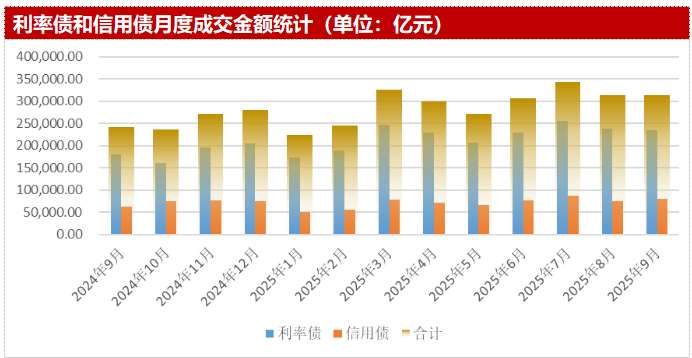
Core Insights - The credit bond secondary market showed significant recovery in September, with a layered risk preference in credit bond trading, indicating a trend of shortening duration for high-quality bonds and extending duration for low-quality bonds [1][3] - The total transaction amount in the bond secondary market for September reached 372,501.24 billion, marking a year-on-year increase of 22.12% and a slight month-on-month increase of 0.04% [1][3] Credit Bonds - In September, the transaction amount for credit bonds was 79,565.22 billion, reflecting a year-on-year growth of 27.39% and a month-on-month increase of 6.87%, indicating a notable recovery in the credit bond market [3] - The transaction characteristics of credit bonds showed a preference for high-quality bonds with shorter durations, while low-quality bonds saw an extension in duration, particularly in the case of AA-rated municipal bonds [3][4] - The industrial bonds' transaction amount slightly decreased by 1.61%, while the municipal bond sector became a highlight with a month-on-month increase of 11.83%, demonstrating sustained market enthusiasm for municipal bonds amid ongoing debt resolution efforts [3] Credit Spread - The overall credit spread continued to show narrow fluctuations, with a year-on-year contraction of 26.29 basis points and a slight month-end decrease of 0.19 basis points [4] - As of September 30, the median credit spreads for various industries showed that household appliances, real estate, and electric equipment had higher spreads, while food and beverage, media, and public utilities had lower spreads [4] - The household appliances sector experienced the largest decline in credit spread this month, benefiting from new consumption stimulus policies, although it remains at a high level [4] Municipal Bonds - The overall credit spread for municipal bonds remained relatively stable, with slight fluctuations across regions, except for Gansu Province, which saw a significant widening of spreads, indicating higher risk premium demands from investors [5] - Regions like Guizhou, Yunnan, and Liaoning experienced notable narrowing of municipal bond spreads, exceeding 100 basis points, attributed to ongoing debt resolution policies and improved market confidence [5] Future Outlook - The expectation for the fourth quarter indicates a low-level fluctuation in trading spreads but with increasing structural differentiation, particularly in industrial and municipal bonds [6] - The industrial bond spreads are expected to have limited downward space due to most industries already being at relatively low levels, while high-spread sectors like household appliances and real estate may experience volatility due to policy changes and fundamental pressures [6] - The ongoing debt resolution policies are anticipated to remain the core driving force for municipal bonds, with most regional spreads expected to maintain low-level operations after narrowing [6]
债市日报:10月14日
Xin Hua Cai Jing· 2025-10-14 14:24
Core Viewpoint - The bond market experienced significant fluctuations on October 14, with a net injection of 91 billion yuan in the open market, indicating a supportive funding environment despite ongoing trade tensions and cautious market sentiment [1][5]. Market Performance - Government bond futures opened lower but closed higher across the board, with the 30-year main contract rising by 0.34% and the 10-year main contract increasing by 0.11% [2]. - The yield curve for major interbank bonds shifted downward in the afternoon, with the 10-year government bond yield decreasing by 1 basis point to 1.752% [2]. Overseas Market Trends - In North America, U.S. Treasury yields fell across the board, with the 10-year yield dropping by 6.37 basis points to 4.053% [3]. - In the Eurozone, the 10-year French bond yield decreased by 1 basis point to 3.467%, while the German bond yield fell by 0.8 basis points to 2.635% [3]. Primary Market Activity - The Ministry of Finance's 1-year fixed-rate bond had a weighted average yield of 1.38%, with a bid-to-cover ratio of 2.22 [4]. - The China Development Bank's 2-year, 5-year, and 10-year financial bonds had respective yields of 1.6085%, 1.7564%, and 2.0008%, with bid-to-cover ratios of 2.96, 4.03, and 4.94 [4]. Funding Conditions - The central bank conducted a 910 billion yuan reverse repo operation at a rate of 1.40%, resulting in a net injection of 910 billion yuan for the day [5]. - Shibor rates showed mixed performance, with the overnight rate rising slightly while the 7-day and 14-day rates fell, indicating a divergence in short-term funding conditions [5]. Institutional Insights - Institutions expect a neutral to slightly bullish bond market in October, with potential for a smoother decline post-December [6]. - Credit spreads are anticipated to remain volatile, with a focus on short to medium-term credit bonds as the market adjusts to ongoing economic conditions [7].
信用策略周报20251012:关税2.0,信用会压利差吗?-20251013
Tianfeng Securities· 2025-10-13 11:14
Group 1 - The credit market experienced a recovery in the first week after the holiday, with yields on credit bonds across all maturities declining, particularly 2-5 year perpetual bonds leading the gains [1][8] - Long-term credit bonds continued to show weak performance, with credit spreads widening, especially for long-term urban investment bonds [1][8] - The market is currently assessing whether credit can continue to catch up with interest rates and if credit spreads will compress further [1][8] Group 2 - The recent tariff disturbances have led to increased market risk aversion, benefiting the bond market, with the 10-year government bond yield declining approximately 16 basis points over two trading days [2][16] - Short-term credit bonds have generally outperformed interest rate bonds, leading to a narrowing of credit spreads, while longer credit bonds have shown weaker performance [2][16] - The impact of the recent tariff upgrades on the bond market appears to be weaker than earlier in April, with significant uncertainty remaining [2][24] Group 3 - The current tariff disturbances may provide trading opportunities in the bond market, but the overall pricing space is expected to be smaller than the previous tariff shocks [3][28] - The execution of credit strategies should consider the limited space for interest rate declines, with the 10-year government bond yield assessed at a low of 1.70% [3][28] - The credit market is expected to see some seasonal recovery in October, with public funds showing renewed buying interest in perpetual bonds [3][29] Group 4 - The funding environment remains supportive, but the main buying power in the credit market is unlikely to expand significantly in the fourth quarter due to regulatory factors [4][28] - The new regulations on fund sales may introduce redemption friction, impacting credit spreads [4][28] - Mid-term credit bonds are currently viewed as a more suitable asset choice for institutions, especially after the market correction in September [4][28]
收益率大多下行,利差小幅波动:信用分析周报(2025/9/28-2025/10/11)-20251013
Hua Yuan Zheng Quan· 2025-10-13 05:51
Report Summary 1. Report Industry Investment Rating No specific industry investment rating is provided in the report. 2. Core Viewpoints - This week (from September 28 to October 11), the yield of most credit bonds declined, and the credit spread fluctuated slightly. The issuance volume, repayment volume, and net financing of traditional credit bonds decreased. The net financing of asset - backed securities decreased by 16.1 billion yuan. The issuance rates of AA and AA+ industrial bonds and AA+ and AAA financial bonds rose [1][2]. - Looking forward to October, the logic of loose liquidity persists, but institutional behavior and policy may restrict the performance of the credit bond market. Before the implementation of the redemption fee new rules, the credit allocation strategy should not be too radical. However, the resurgence of Sino - US trade friction may reduce market risk appetite and support the short - term credit long - making logic. It is recommended to allocate short - term bonds as the bottom position, increase the allocation of medium - and long - term credit bonds, and use bond repurchase to increase leverage to enhance portfolio returns [3][40]. 3. Summary by Directory 3.1 Primary Market - **Net Financing Scale**: The net financing of credit bonds (excluding asset - backed securities) was - 112.2 billion yuan, a decrease of 269.9 billion yuan compared with last week. The total issuance volume was 131.1 billion yuan, a decrease of 459.7 billion yuan, and the total repayment volume was 243.3 billion yuan, a decrease of 189.9 billion yuan. The net financing of asset - backed securities was - 15.5 billion yuan, a decrease of 16.1 billion yuan. By product type, the net financing of urban investment bonds, industrial bonds, and financial bonds all decreased [9]. - **Issuance Cost**: The issuance rates of AA and AA+ industrial bonds returned above 3%, and the issuance rates of AA+ and AAA financial bonds rose above 2%. The increase was mainly due to the high - interest issuance of some bonds [16]. 3.2 Secondary Market - **Trading Volume and Turnover Rate**: The trading volume of credit bonds decreased by 50.5 billion yuan compared with last week. The turnover rate of most bond types decreased, except for industrial bonds which remained unchanged [17]. - **Yield**: The yields of most credit bonds with different ratings and maturities declined, with the short - end decline greater than the medium - and long - end. By bond type, taking AA+ 5 - year bonds as an example, the yield of urban investment bonds rose, while the yields of other bond types declined [22][23]. - **Credit Spread**: The credit spread of AA commercial trade industry widened significantly, while the credit spreads of AA+ electronics and textile and clothing industries compressed significantly. The credit spreads of other industries and ratings fluctuated within 3BP. For urban investment bonds, the short - end spread compressed and the long - end spread widened. For industrial bonds, the short - end spread compressed slightly, and the spreads of other maturities widened. For bank capital bonds, the credit spreads of bank secondary and perpetual bonds with maturities below 5 years compressed, while the 10 - year credit spread widened [2][6][24]. 3.3 This Week's Bond Market Negative News - Six entities had a total of 10 bond implicit ratings downgraded, including Suning.com Group Co., Ltd., Ruikang Pharmaceutical (Shandong) Co., Ltd., etc. The bond "H1 Lvjing 01" issued by Zhengxinglong Real Estate (Shenzhen) Co., Ltd. was extended, and the bond "15 Tianan Property Insurance" issued by Tianan Property Insurance Co., Ltd. defaulted [2][36]. 3.4 Investment Recommendations - The open - market operations had a net withdrawal of 133.04 billion yuan this week. The overnight capital rate remained low. It is recommended to be cautious in credit allocation before the implementation of the redemption fee new rules and adopt a strategy of short - end sinking as the bottom position and increasing the allocation of medium - and long - term credit bonds [39][40].
【固收】信用债发行量季节性下降,各行业信用利差涨跌互现——信用债周度观察(20250928-20251011)(张旭/秦方好)
光大证券研究· 2025-10-12 23:08
Group 1: Primary Market - In the period from September 28 to October 11, 2025, a total of 119 credit bonds were issued, with a total issuance scale of 141.36 billion, representing a 75.82% decrease compared to the previous period [4] - Among the issued bonds, industrial bonds accounted for 39 issues with a scale of 64.19 billion, down 75.75%, making up 45.40% of the total issuance; local government bonds had 70 issues totaling 43.78 billion, down 72.63%, representing 30.97% of the total; and financial bonds had 10 issues totaling 33.40 billion, down 79.11%, accounting for 23.63% of the total [4] - The average issuance term for credit bonds was 2.44 years, with industrial bonds averaging 1.63 years, local government bonds 2.80 years, and financial bonds 3.16 years [4] Group 2: Secondary Market - The average issuance coupon rate for credit bonds was 2.34%, with industrial bonds at 2.12%, local government bonds at 2.45%, and financial bonds at 2.35% [5] - A total of 3 credit bonds were canceled during this period [5] Group 3: Credit Spread and Trading Volume - In terms of credit spreads, the largest increase for AAA-rated industries was in construction and decoration, up 2.6 basis points, while the largest decrease was in media, down 4 basis points; for AA+ rated industries, the largest increase was in chemicals, up 6.6 basis points, and the largest decrease was in non-ferrous metals, down 8.6 basis points [6] - The total trading volume of credit bonds was 855.28 billion, a decrease of 47.12% compared to the previous period; the top three categories by trading volume were commercial bank bonds, corporate bonds, and medium-term notes [7] - Commercial bank bonds had a trading volume of 254.91 billion, down 47.74%, accounting for 29.80% of the total; corporate bonds had 237.46 billion, down 52.14%, making up 27.76%; and medium-term notes had 177.22 billion, down 45.30%, representing 20.72% of the total [7]

债市修复短信用先受益,3Y二级与5Y永续利率大幅回落
Xinda Securities· 2025-10-12 13:45
Report Industry Investment Rating No information provided in the content. Core Viewpoints of the Report - Credit bonds follow the interest rate recovery, with short - duration and high - grade varieties benefiting first. During the National Day holiday period (from September 28 to October 11, 2025), the bond market as a whole recovered, and credit bond yields declined accordingly [2][5]. - The spreads of urban investment bonds remained generally stable. Spreads of externally rated AA + platforms generally increased by 1BP, while those of AAA and AA platforms remained flat [2][9]. - Industrial bonds showed mixed trends with limited overall changes. Spreads of mixed - ownership and private real - estate bonds continued to widen [2][19]. - The yield spreads of secondary and perpetual bonds narrowed across the board, performing better than ordinary credit bond varieties. The yields of 3Y high - grade secondary bonds and 5Y high - grade perpetual bonds declined more significantly [2][27]. - The excess spreads of industrial perpetual bonds remained stable, while those of urban investment perpetual bonds showed differentiation [2][30]. Summary by Directory 1. Credit bonds follow the interest rate recovery, with short - duration and high - grade varieties benefiting first - From September 28 to October 11, 2025, the yields of 1Y, 3Y, 5Y, 7Y, and 10Y government - developed bonds decreased by 1BP, 4BP, 4BP, 4BP, and 4BP respectively. Credit bond yields also declined, with short - duration and high - grade varieties taking the lead. For example, the yield of 1Y AAA - rated credit bonds decreased by 8BP [2][5]. - In terms of credit spreads, the spreads of 1Y bonds of all grades converged, while those of other maturities widened. For example, the spread of 1Y AAA - rated bonds decreased by 7BP [2][5]. - Regarding rating spreads, the AA/AA - spread of 1Y bonds decreased by 3BP, while others increased by 2 - 3BP. In terms of term spreads, the 3Y/1Y spread of AAA - rated bonds increased by 3BP [5]. 2. The spreads of urban investment bonds remained generally stable - Externally rated AA + platform credit spreads generally increased by 1BP, while AAA and AA platforms remained flat. For example, in AAA - rated platforms, spreads in Shanxi, Anhui, Ningxia, Gansu, and Liaoning increased by 2 - 4BP, and that in Inner Mongolia increased by 6BP [2][9]. - By administrative level, the credit spreads of provincial, municipal, and district - county platforms generally remained flat. For example, the spread of provincial platforms in Hunan decreased by 2BP, while that in Anhui increased by 2BP [2][17]. 3. Industrial bonds showed mixed trends with limited overall changes, and spreads of mixed - ownership and private real - estate bonds continued to widen - This week, the spreads of central - state - owned real - estate bonds decreased by 4BP, those of local - state - owned real - estate bonds remained flat, while spreads of mixed - ownership and private real - estate bonds increased by 12BP and 46BP respectively. For example, the spread of Longfor decreased by 1BP, while that of CIFI increased by 80BP [2][19]. - The spreads of coal bonds of all grades changed slightly within 1BP. The spread of AAA - rated steel bonds increased by 1BP, while that of AA + decreased by 1BP. The spread of AAA - rated chemical bonds decreased by 2BP, while that of AA + increased by 1BP [2][19]. 4. Secondary and perpetual bonds performed better than ordinary credit bonds, with the yields of 3Y secondary and 5Y perpetual bonds declining the most - This week, the yield spreads of secondary and perpetual bonds narrowed across the board. The yields of 3Y high - grade secondary bonds and 5Y high - grade perpetual bonds declined more significantly. For example, the yields of 1Y secondary capital bonds of all grades decreased by 6 - 8BP, and the credit spreads decreased by 5 - 7BP [2][27]. - The yields of 3Y AAA -, AA +, and AA - rated secondary capital bonds decreased by 11BP, 9BP, and 7BP respectively, and the spreads narrowed by 3 - 7BP [27]. 5. The excess spreads of industrial perpetual bonds remained stable, while those of urban investment perpetual bonds showed differentiation - This week, the excess spread of industrial AAA 3Y perpetual bonds remained the same as last week at 14.52BP, at the 37.42% quantile since 2015. The excess spread of industrial 5Y perpetual bonds decreased by 0.01BP to 12.39BP, at the 25.53% quantile since 2015 [30]. - The excess spread of urban investment AAA 3Y perpetual bonds decreased by 2.76BP to 4.82BP, at the 2.57% quantile. The excess spread of urban investment AAA 5Y perpetual bonds increased by 5.51BP to 14.47BP, at the 23.55% quantile [30]. 6. Credit Spread Database Compilation Instructions - Market - wide credit spreads, commercial bank secondary and perpetual spreads, and urban investment/industrial perpetual bond credit spreads are calculated based on ChinaBond medium - and short - term notes and ChinaBond perpetual bonds data. Historical quantiles are calculated since the beginning of 2015 [35]. - The credit spreads of industrial and urban investment individual bonds are calculated as the individual bond's ChinaBond valuation (exercise) minus the yield to maturity of the same - maturity government - developed bond (calculated by linear interpolation method), and then the industry or regional urban investment credit spreads are obtained by the arithmetic average method [37]. - The excess spreads of bank secondary capital bonds/perpetual bonds are calculated as the credit spreads of bank secondary capital bonds/perpetual bonds minus the credit spreads of the same - grade and same - maturity bank ordinary bonds. The excess spreads of industrial/urban investment perpetual bonds are calculated as the credit spreads of industrial/urban investment perpetual bonds minus the credit spreads of the same - grade and same - maturity medium - term notes [37].