反内卷

Search documents
新世纪期货交易提示(2025-12-10)-20251210
Xin Shi Ji Qi Huo· 2025-12-10 03:16
Report Industry Investment Ratings - Iron ore: Oscillating weakly [2] - Coking coal and coke: Weak [2] - Rebar: Oscillating [2] - Glass: Weak [2] - Soda ash: Weak [2] - CSI 50 Index Futures/Options: Oscillating [4] - Treasury bonds (2-year, 5-year, 10-year): Oscillating, consolidating [4] - Gold and silver: Oscillating strongly [4][6] - Logs: Oscillating at the bottom [6] - Pulp and offset paper: Oscillating [6] - Edible oils (soybean oil, palm oil, rapeseed oil): Range-bound [7] - Meal (soybean meal, rapeseed meal, soybean No.2): Oscillating weakly [7] - Live pigs: Weak [9] - Rubber: Oscillating weakly [11] - PX: Widely oscillating [11] - PTA: Oscillating [11] - MEG: Weakly oscillating [11] - PR and PF: On the sidelines [11] Core Views - The iron ore market features loose supply, low demand, and port inventory accumulation, with prices expected to oscillate weakly. The coal and coke market has short - term supply pressure, but there is support at the bottom. The steel market is in a bottom - oscillating state, and the price depends on production reduction and policy implementation. The glass market is weak, and its price depends on cold - repair progress and macro factors [2]. - The financial market shows a mixed trend. Stock index futures/options are oscillating, and treasury bonds are in a state of consolidation or small - scale rebound. The precious metals market is supported by factors such as central bank gold purchases and geopolitical risks, with prices oscillating strongly [4]. - The light industry market, including logs and pulp, is in a process of supply - demand re - balancing, with prices expected to oscillate. The edible oils and meals market has uncertain demand prospects, and prices are expected to range - bound or oscillate weakly [6][7]. - The agricultural product market, represented by live pigs, has stable supply but limited terminal demand growth, with prices expected to decline. The soft commodity market, such as rubber, has weak demand and increasing inventory, with prices oscillating weakly. The polyester market has complex supply - demand situations, and prices show different trends such as oscillation, weak oscillation, and waiting - and - seeing [9][11]. Summary by Related Catalogs Black Industry - Iron ore: In 2026, global mines will add 64 - 65 million tons, with a growth rate far exceeding that of crude steel. Current demand is weak, and prices oscillate weakly. After the inventory replenishment and sentiment boost, short - selling opportunities can be sought based on high inventory and surplus expectations [2]. - Coking coal and coke: In November, Mongolian coal imports may reach a new high this year, and there is short - term supply pressure. After the first round of coke price cuts in December, there are still expectations of further cuts. Although there is support at the bottom, the market is weak [2]. - Rebar: Downstream demand is low, and it is in an oscillating state. The key lies in steel demand, and steel prices depend on production reduction and policy implementation [2]. - Glass: The price is weak, with low processing orders and high inventory. Whether it can stop falling depends on cold - repair progress and macro factors [2]. Financial - Stock index futures/options: The previous trading day showed a decline, and the market is oscillating. High - tech industries continue to grow, and market sentiment is rising [4]. - Treasury bonds: The yield of 10 - year treasury bonds has declined, and the market is in a state of consolidation or small - scale rebound [4]. - Precious metals: Gold's pricing mechanism is shifting, and it is supported by factors such as central bank gold purchases, geopolitical risks, and increased physical demand in China. Silver is also affected by similar factors, and both are expected to oscillate strongly [4][6]. Light Industry - Logs: Port shipments have increased, but demand improvement needs to be observed. Supply pressure may gradually ease, and prices are expected to oscillate at the bottom [6]. - Pulp: The spot price is stable, but demand is weak. The cost supports the price, and it is expected to oscillate [6]. - Double - gum paper: The price is stable, with stable supply and some support from orders, but weak social demand restricts price increases, and it is expected to oscillate [6]. Oils and Fats - Edible oils: The demand for soybean oil has uncertainties, palm oil production and exports are complex, and domestic oil supply is abundant. With cost support, prices are expected to range - bound [7]. - Meals: The global soybean inventory is abundant, and the demand for US soybeans is uncertain. Domestic supply is ample, and prices are expected to oscillate weakly [7]. Agricultural Products - Live pigs: The average transaction weight shows a north - rising and south - falling trend, terminal demand growth is limited, and prices are expected to decline. The slaughter rate has increased, and the profit situation varies [9]. Soft Commodities and Polyester - Rubber: Production in some regions is affected by weather, demand is weak, and inventory is increasing. Prices are expected to oscillate weakly [11]. - Polyester: PX prices are widely oscillating, PTA prices follow the cost, MEG prices are weakly oscillating, and PR and PF markets are on the sidelines [11].
高基数下11月PPI同比降幅有所扩大,但部分行业价格呈回升态势
Sou Hu Cai Jing· 2025-12-10 03:15
国家统计局周三公布数据显示,11月工业品出厂价格(PPI)同比下降2.2%,降幅较上月扩大0.1个百分点,结束连续三个月降幅收窄进程;环比上涨0.1%, 连续两个月上涨。 国家统计局城市司首席统计师董莉娟在当天发布的新闻稿中解读称,PPI同比降幅有所扩大主要是受上年同期对比基数走高影响。我国各项宏观政策不断显 效,价格呈现积极变化。 统计局提到,随着综合整治"内卷式"竞争成效显现,相关行业价格同比降幅收窄。重点行业产能治理持续推进,市场竞争秩序不断优化,煤炭开采和洗选 业、光伏设备及元器件制造、锂离子电池制造价格同比降幅比上月分别收窄3.8个、2.0个和0.7个百分点,均已连续多个月收窄。 记者 辛圆 往后看,西南证券在最近发布的研究报告中指出,随着10月底发布的"十五五"规划推进落地,一系列扩内需与"反内卷"政策的效能将持续释放,有望推动重 点行业价格企稳回升。在宏观政策支持与供需结构改善的背景下,后续价格水平预计将延续向好态势,预计PPI同比降幅将呈现收窄态势。 不过,东方金诚首席宏观分析师王青表示,"反内卷"对年底前基础原材料和工业品价格的带动作用有待进一步观察,需求不足会继续制约工业品价格上行空 间, ...


30亿平台成立,多晶硅“反内卷”进入实质整合阶段
3 6 Ke· 2025-12-10 02:51
由行业龙头联合设立的平台公司悄然成立,宣告着中国光伏上游供给侧改革迈出关键一步。 一家注册资本达30亿元的公司——北京光和谦成科技有限责任公司在12月9日成立,专门服务于多晶硅 行业的战略整合。 价格失速与行业共识 在行业陷入"内卷"之前,多晶硅也曾经历高价周期。但当价格从2022年每吨均价超过29.5万的历史高位 一路俯冲,跌破部分企业成本线时,问题开始凸显。 到了2025年三季度,为遏制恶性价格战,行业头部企业自发达成了"产品价格不得低于成本价"的共识。 这一自律行动迅速传导至市场,中国有色金属工业协会硅业分会发布数据显示,2025年7月16日当周, 多晶硅N型复投料成交均价为4.17万元/吨,周环比上涨12.4%。 然而,短期价格修复治标不治本。根据硅业分会的数据,当前多晶硅市场供需双弱的格局并未根本改 变,高库存压力持续存在。 价格虽有所回升,但仍徘徊在5万元/吨附近,对许多高成本产能而言,这一水平依然难以覆盖成本。 更深层次的问题在于,产能的绝对过剩并未解决。行业龙头们认识到,仅仅靠口头协议约束价格难以持 久。必须在产能层面进行实质性的整合与出清,才能为行业健康、可持续发展奠定基础。 市场化收储与价 ...
早盘直击|今日行情关注
申万宏源证券上海北京西路营业部· 2025-12-10 02:31
Market Overview - After regaining the 3900-point level, the A-share market has returned to a phase of low-volume consolidation, with mixed performances across indices. The ChiNext Index continues to show upward momentum, while the Shanghai Composite Index and the Sci-Tech 50 Index have experienced slight pullbacks. Overall trading volume has decreased compared to Monday, reflecting a decline in investor enthusiasm as the year-end approaches, leading to a general trend of low-volume fluctuations [1] Future Outlook - As the year-end approaches, a cautious market sentiment prevails, with fluctuations around the 4000-point level potentially preparing the market for a new upward phase. The market has established conditions for further upward expansion following a period of sideways movement since October. A recovery in the supply-demand situation for the manufacturing sector in 2026 is likely, which could lead to a significant rebound in the earnings growth of A-share listed companies. Key focus areas for November include the impact of the 14th Five-Year Plan on industries, event-driven dynamics in the technology sector, and price increases driven by anti-involution trends, which are expected to catalyze multiple sectors and support a continued upward trend in the market [1] Sector Highlights - In December, sectors benefiting from dividends and price increases are expected to outperform, with short-term attention on banking, public utilities, coal, and non-ferrous metals. Technology will remain a key focus in 2026, with particular attention on AI, lithium batteries, military industry, and robotics. Specific areas of interest include: 1. The established trend in AI hardware, with a continued increase in token usage for major AI models, indicating a peak in AI applications by 2026, presenting opportunities for high growth in AI hardware and the transition from quantitative to qualitative changes in AI applications [2] 2. The trend of robot localization and integration into daily life is expected to continue into 2026, with robot products expanding from humanoid robots to quadrupedal and functional robots, creating recurring opportunities in sensors, controllers, and dexterous hands [2] 3. The trend towards semiconductor localization remains strong, with a focus on semiconductor equipment, wafer manufacturing, semiconductor materials, and IC design [2] 4. The military sector is expected to see a continued recovery in orders by 2026, with many sub-sectors such as ground equipment, aviation equipment, and military electronics showing signs of bottoming out as Q3 report declines narrow [2] 5. The innovative drug sector is entering a recovery phase after nearly four years of adjustment, with positive net profit growth for four consecutive quarters since Q3 2024, and an anticipated turning point in fundamentals by 2025, continuing an upward trend into 2026 [2]

中欧基金策略会揭开2026年投资蓝图:科技、消费、周期怎么投?
Xin Lang Cai Jing· 2025-12-10 02:07
Core Insights - The investment strategy for 2026 focuses on key sectors such as technology, value stocks, and leading companies, with an emphasis on the evolution of AI and its impact on market dynamics [3][4][8] Group 1: Investment Strategy and Focus - The investment outlook for 2026 is characterized by a focus on technology, value continuation, and a return to leading companies, with AI being a central theme [3] - The market is expected to shift towards economic fundamentals and corporate earnings as the main drivers of stock prices, with PPI trends being crucial [3][4] - Traditional cyclical industries, such as oil, coal, and basic metals, are anticipated to perform well, alongside sectors like insurance, internet, and renewable energy [4] Group 2: Research and Development Framework - The company emphasizes an "industrialized" research and investment framework, focusing on professionalization, industrialization, and digital intelligence to enhance investment insights [2] - The goal is to improve the "good product rate" of investments, ensuring sustainable performance for clients [2] Group 3: AI and Technology Investment - AI applications are expected to drive significant investment opportunities, particularly in consumer entertainment, business optimization, and advanced robotics [8][9] - The demand for computing power in AI training and inference is projected to rise significantly, with potential supply constraints impacting the market [9] Group 4: Global Economic Trends - The potential for "re-inflation" risks in 2026 is highlighted, driven by supply constraints, particularly in global electricity supply due to increased demand from AI data centers and re-industrialization [10][11] - Countries like India, Indonesia, and parts of Europe may face structural electricity supply shortages, which could elevate electricity prices and create investment opportunities in cyclical sectors [11] Group 5: Fixed Income and Diversified Investments - The low interest rate environment presents challenges for achieving stable returns, leading to a focus on diversified asset allocation strategies [12] - The company aims to identify high-quality assets in technology and cyclical sectors, leveraging the global expansion of Chinese companies [12][13]
通胀回归:2026年国内经济展望
CMS· 2025-12-10 01:58
Economic Outlook - The GDP growth rate for 2026 is projected to be around 5%, with a recovery pattern characterized by "front low, back high" dynamics[12] - The first quarter is expected to show a growth of 4.7%, influenced by the ongoing decline in real estate investment and seasonal factors[28] - The second quarter is anticipated to stabilize at 4.9%, driven by new policy implementations and increased manufacturing investment[28] - The third quarter is forecasted to accelerate to 5.2%, with PPI expected to turn positive, enhancing industrial production[28] - The fourth quarter is projected to maintain a growth rate of 5.0%, supported by improved corporate profits and consumer spending[29] Investment Trends - Manufacturing investment is expected to grow by 5%, driven by long-term policies and profit improvements in high-tech industries[37] - Real estate investment is projected to decline by 8%, indicating a continued natural clearing process in the market[13] - Infrastructure investment is forecasted to grow by 3%, reflecting a balance between debt management and development needs[13] Price Dynamics - CPI is predicted to rise to a central level of 0.5% in 2026, marking a reversal from near-zero growth in 2024-2025[8] - PPI is expected to turn positive in Q3 2026, with an end-of-year forecast of a 0.5% increase, signaling a significant improvement in upstream profitability[8] Consumer Behavior - Retail sales are projected to grow by approximately 4.2%, with a shift towards income distribution optimization and targeted subsidies[8] - Service consumption is anticipated to outpace goods consumption, driven by policy support and changing consumer preferences[8] Export and Import Outlook - Exports are expected to grow by 5%, supported by the U.S. inventory replenishment cycle and market diversification strategies[8] - Imports are projected to increase by 2.5%, driven by improved industrial profits and a stable RMB exchange rate[8]
行业反内卷决心明确,关注光伏50ETF(159864)
Mei Ri Jing Ji Xin Wen· 2025-12-10 01:12
Core Viewpoint - The photovoltaic (PV) sector is currently facing significant supply surplus, primarily involving private enterprises, and requires a gradual policy approach to resolve the issue, focusing on self-discipline, capacity integration, and technological iteration [1] Group 1: Industry Performance - On December 9, the photovoltaic sector showed relatively good performance, with the PV 50 ETF (159864) rising by 0.32% [1] - Since Q3 2025, the prices in the silicon material segment have stabilized and begun to rise, leading to improved profitability across the entire PV industry chain [2] - The overall price of the photovoltaic industry chain has shown a recovery trend, with multi-crystalline silicon dense material increasing from 35 yuan/kg to 52 yuan/kg, and 182N silicon wafers rising from 0.88 yuan/piece to 1.18 yuan/piece [2] Group 2: Policy and Market Dynamics - The National Development and Reform Commission (NDRC) has held discussions to address disorderly price competition among enterprises, aiming to maintain a good market price order and support high-quality development [1] - The determination to combat "involution" in the industry is clear, and as capacity reduction measures are implemented, a trend of profitability recovery is expected to emerge [2] Group 3: Technological Advancements - The perovskite photovoltaic industry in China has seen significant breakthroughs this year, with stability in lifespan being achieved, indicating rapid progress from laboratory to industrialization [3] - Perovskite technology is expected to become a core solution for space energy due to its high efficiency, low cost, flexibility, and radiation resistance, presenting investment opportunities as its industrialization accelerates [2]
中信证券徐广鸿:估值修复与结构重塑共振 2026年港股锚定四大核心赛道
Zhong Guo Zheng Quan Bao· 2025-12-09 22:44
Core Viewpoint - The Hong Kong stock market is entering a phase of valuation repair and structural reshaping, characterized by undervaluation, capital misalignment, and performance differentiation, with significant net inflows from southbound funds and a shift in foreign capital [1][2]. Valuation and Market Trends - The Hang Seng Index has experienced a cumulative decline of over 50% from early 2021 to January 2024, leading to a significant valuation gap [2]. - As of December 9, 2023, the Hang Seng Index, Hang Seng China Enterprises Index, and Hang Seng Technology Index have recorded cumulative gains of 49.20%, 22.59%, and 24.32%, respectively [2]. - By the end of 2025, the expected EPS growth for the Hang Seng Index in 2026 is projected to be 8%, with a dynamic P/E ratio of only 12 times, indicating a notable valuation gap compared to major global markets [2]. Capital Flow Dynamics - Southbound funds have seen a record net inflow of nearly 1.4 trillion HKD by the end of November 2023, marking a new high since the launch of the mutual market access mechanism [3]. - The inflow of ETFs surged to 51.3% from June to October, with August reaching 88%, indicating strong enthusiasm among domestic individual investors [3]. - Institutional investors favor sectors like non-bank themes and precious metals, while individual investors focus on growth sectors such as automotive, pharmaceuticals, and consumer goods [3]. Sector Performance and Investment Opportunities - The technology sector is expected to see significant profit growth in 2025, contrasting with traditional sectors like finance and real estate [4]. - The AI industry chain in Hong Kong is strengthening, with a positive correlation between the Hang Seng Technology Index and the USD/JPY exchange rate [4]. - For 2026, investment opportunities should focus on sectors with performance certainty and valuation elasticity, particularly technology, pharmaceuticals, resource products, and essential consumer goods [8]. Long-term Market Outlook - The market is anticipated to experience a second round of valuation repair driven by internal and external factors, including the implementation of the "14th Five-Year Plan" and easing monetary policies globally [6][5]. - The potential for external capital inflow is expected to increase as the risk premium decreases due to improved Sino-U.S. relations [6]. Specific Sector Insights - The technology sector, especially the AI industry, is expected to benefit from a virtuous cycle of investment and revenue growth, with a focus on leading companies and quality players in the computing power supply chain [8]. - The pharmaceutical sector is entering a growth phase supported by policy and industry developments, with a focus on innovative companies and those benefiting from domestic market reforms [8]. - The resource sector is supported by supply-demand mismatches and liquidity drivers, with companies in precious metals and rare earths likely to benefit from rising commodity prices [9]. - The essential consumer goods sector is poised for valuation recovery as domestic policies stimulate consumption and improve income expectations [9].

估值修复与结构重塑共振 2026年港股锚定四大核心赛道
Zhong Guo Zheng Quan Bao· 2025-12-09 20:22
● 本报记者 谭丁豪 2025年港股步入估值修复与结构重塑并行阶段,估值低估、资金错位与业绩分化成为核心特征。历经此 前三年调整,恒生指数形成显著的估值洼地,南向资金创纪录净流入与外资转向共同重塑资金格局。 日前,中信证券海外策略首席分析师徐广鸿在接受中国证券报记者专访时表示,2026年港股将在政策红 利与外部风险博弈中开启第二轮估值修复,内外因素共振有望进一步打开上行空间。在此背景下,投资 需紧扣"业绩确定性+估值弹性"主线,科技、医药、资源品与必选消费四大赛道,凭借政策支撑、产业 景气或供需优势,成为把握港股修复行情的核心方向。 估值洼地凸显 今年以来,港股三大指数震荡上行。Wind数据显示,截至12月9日,恒生指数、恒生中国企业指数、恒 生科技指数分别累计涨幅为49.20%、22.59%、24.32%。 "今年港股市场整体呈现估值修复的态势,有业绩支撑的行业估值扩张更为显著,例如原材料板块。在 此背景下,具有进一步基本面支撑的行业有望获得更大的估值上行空间。"徐广鸿说。 "当前港股正处于估值修复与结构重塑的关键阶段,估值低估、资金错位与业绩分化构成市场核心特 征。"徐广鸿表示,从估值维度看,2021年春 ...
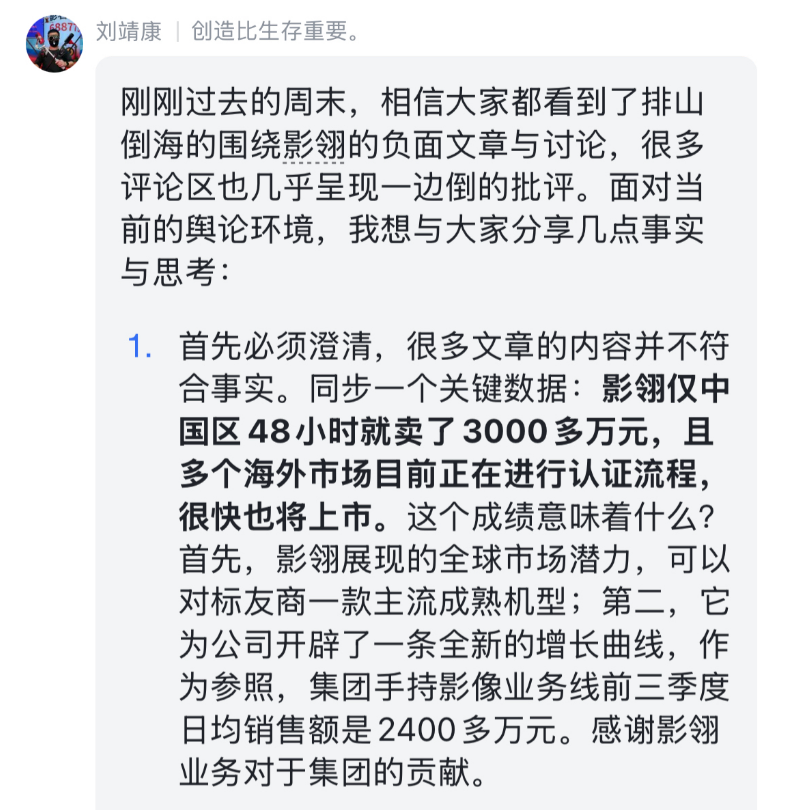
影石大疆商战升级?刘靖康称核心供应商遭“排他”压力
Guan Cha Zhe Wang· 2025-12-09 12:53
Core Viewpoint - The internal letter from Liu Jingkang, founder and CEO of Insta360, addresses recent challenges faced by the company, including negative press regarding its drone sub-brand, Yingling, and allegations of exclusive agreements affecting distributors. Liu refutes claims of poor sales, highlighting strong initial performance in China and ongoing certification processes in international markets [1][2]. Group 1: Sales Performance and Market Potential - Liu Jingkang reported that the Yingling A1 drone generated over 30 million yuan in sales within 48 hours in China, indicating significant market potential [1]. - The average daily sales for the company's handheld imaging business line in the first three quarters were approximately 24 million yuan, suggesting a strong comparative performance [1]. - Despite skepticism regarding sales figures, with estimates suggesting around 4,400 units would be needed to reach 30 million yuan, Liu maintains confidence in the product's market reception [4]. Group 2: Competitive Landscape and Challenges - Liu accused industry giants of exerting pressure on suppliers, leading to challenges in securing components for the Yingling A1 drone, which has been a recurring issue for the company [2]. - The exclusive agreements reported by distributors have raised concerns about potential monopolistic practices in the market, particularly against competitors like DJI [2]. - The competitive environment has intensified, with DJI launching aggressive pricing strategies that have affected market dynamics, prompting Liu to acknowledge the impact of these tactics on the industry [8][10]. Group 3: Product Philosophy and Pricing - Liu compared the full panorama drone to the transition from horse-drawn carriages to automobiles, emphasizing its intuitive design aimed at lowering the barriers for aerial photography [3]. - The high cost of the Yingling A1 drone is attributed to the advanced technology used in its VR glasses, which exceeds the average cost of traditional drone controllers [3]. - The company aims to reduce costs through further research and development to make the product more accessible to consumers [3]. Group 4: Market Reception and Consumer Feedback - Initial consumer feedback has highlighted performance issues with the Yingling A1, including concerns about resolution and compatibility with social media platforms [6]. - Despite the innovative concept of combining drones with VR technology, the product's high price point may deter budget-sensitive consumers [6]. - The ongoing competition between Insta360 and DJI is expected to drive technological advancements and market expansion, benefiting consumers in the long run [10].