AI投资

Search documents
国金证券:迎接2026,告别单一叙事
Xin Lang Cai Jing· 2025-12-21 09:36
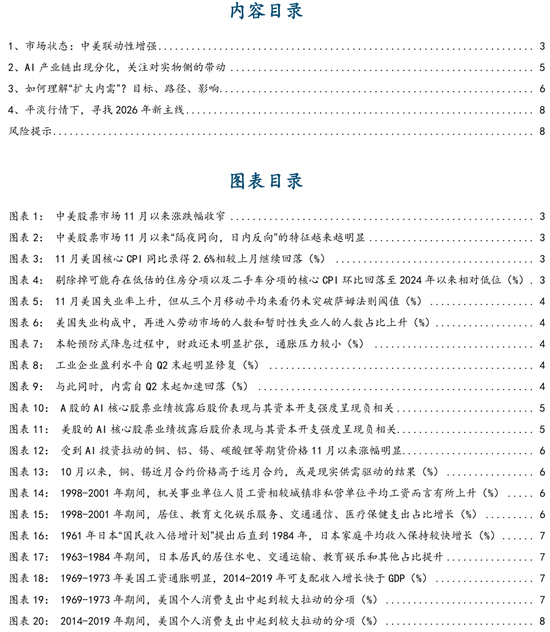
Group 1: Market Status - The correlation between A-shares and U.S. stocks has increased, with the 20-day rolling correlation of the CSI 300 and S&P 500 rising to over 90% since November, indicating a new norm of "overnight same direction, intraday reverse" [2][11][45] - Both the U.S. and Chinese economies are in a phase of "limited upward elasticity and reduced downward risk," with the U.S. core CPI falling to 2.6%, the lowest in three and a half years, and the unemployment rate rising to 4.6% primarily due to increased labor participation and temporary unemployment [2][13][47] - The Chinese economy shows signs of a bottom in corporate profits, while domestic demand is weakening, creating a favorable environment for subsequent policy support [2][13][47] Group 2: AI Industry Chain - The investment in the AI industry chain is showing two notable characteristics: first, "pan-AI" assets (copper, lithium, aluminum, energy storage, and electrical equipment) are performing better than core AI assets (computing chips, optical modules, PCB) [2][18][52] - Investors are becoming less tolerant of the contradiction between aggressive capital expenditures and the lack of revenue growth in companies within the AI industry chain, as evidenced by the negative correlation between stock performance and capital expenditure as a percentage of revenue [2][18][52] - Commodity prices for copper, aluminum, tin, and lithium carbonate have been rising since late October, driven by supply-demand dynamics, with near-term contracts for copper and tin outperforming longer-term contracts [2][19][53] Group 3: Understanding "Expanding Domestic Demand" - The articles published in "Qiushi" magazine emphasize the importance of consumer demand as a primary focus for expanding domestic demand, highlighting the need for a complete domestic demand system [3][24][58] - The strategy includes enhancing secondary distribution to increase residents' net transfer income and optimizing primary distribution to improve labor income, with potential reforms in state-owned enterprises to guide wage adjustments [3][25][58] - Historical examples from Japan and the U.S. show that periods of rising resident income lead to increased service and new-type consumption, indicating that the current "income increase plan" may boost demand for service consumption and technology-driven durable goods [3][27][58] Group 4: Preparing for 2026 - The current market conditions, characterized by limited macro elasticity and increased industry differentiation, suggest a shift in investment strategy towards "physical demand-driven" and "domestic demand policy dividends" as more certain avenues for growth [2][39][40] - Recommendations include focusing on industrial resource products (copper, aluminum, tin, lithium, crude oil, and oil transportation) that benefit from AI investment and global manufacturing recovery, as well as sectors like aviation, hotels, duty-free, and food and beverage that will benefit from increased consumer spending [2][32][39] - The non-bank financial sector (insurance, brokerage) is expected to benefit from capital market expansion and a bottoming out of long-term asset returns, alongside opportunities in China's equipment export chain and domestic manufacturing sectors [2][32][39]


付鹏:现在AI市场的焦点是“路修好了,有车跑吗”
Xin Lang Cai Jing· 2025-12-20 07:48
Core Viewpoint - The current AI market is mirroring the classic narrative of "to get rich, first build the road," indicating that the foundational infrastructure for AI is largely in place, and the focus is now on whether there are viable applications that can generate profits [1] Group 1 - The AI "road" has been largely constructed, and market attention is shifting towards the application side to see if there are "vehicles" that can run on it [1] - If enterprise-level applications can achieve scalable profitability, AI investments will enter a new phase of value realization [1] - Conversely, if downstream application scenarios fail to deliver, the substantial initial investments could lead to significant debt burdens, potentially resulting in a rapid industry bubble burst [1]
科技领跑、周期接力、慢牛到全面牛……2026年A股怎么走,十大券商策略来了
Hua Er Jie Jian Wen· 2025-12-20 04:57
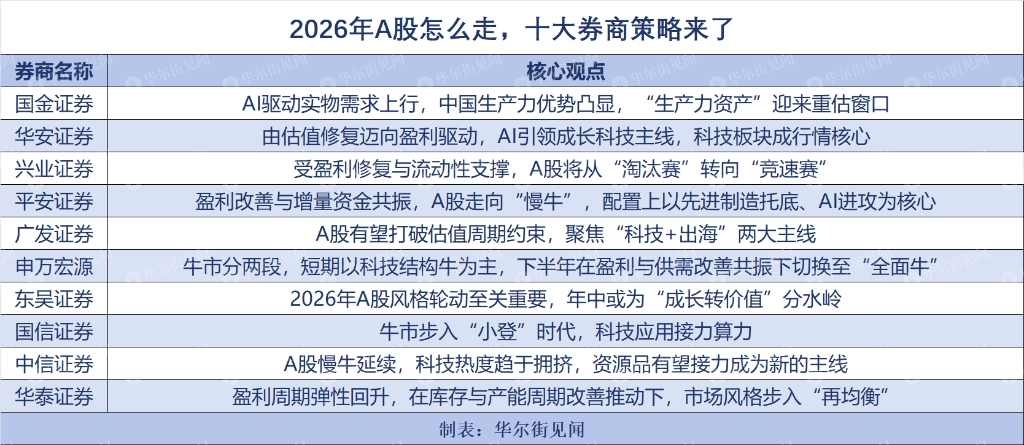
Core Viewpoint - The A-share market is transitioning from a liquidity and valuation-driven phase to a new stage that emphasizes fundamentals and profit recovery, with a projected double-digit profit growth for the entire A-share market in 2026 [1][2][4]. Group 1: Market Outlook - Most major domestic securities firms believe that the A-share market will remain in a bull market in 2026, with profit recovery being a key variable for market sustainability [1][2]. - The overall profit growth for the A-share market is expected to rise from 8.2% in 2025 to 10.3% in 2026, with the growth rate for non-financial sectors projected at 7.7% [12][64]. - The first half of 2026 is anticipated to maintain market momentum, but a significant transition may occur mid-year, particularly for sectors that have seen substantial gains [1][2][27]. Group 2: Sector Focus - The technology sector remains a consensus direction for 2026, with a shift from infrastructure investment to application and performance realization in AI, focusing on areas like robotics and smart driving [2][21]. - The "anti-involution" policy is expected to drive profit recovery in sectors such as steel, chemicals, and new energy, while resource products may present opportunities as they follow the technology sector [2][27]. - The report highlights four main areas for investment opportunities: AI, new energy, military industry, and innovative pharmaceuticals, with a focus on sectors that are expected to benefit from the "15th Five-Year Plan" [34][40][79]. Group 3: Investment Strategies - The investment strategy should prioritize "manufacturing as a shield and technology as a sword," emphasizing advanced manufacturing and AI as core components [40][44]. - The report suggests a rotation in market style from growth to value, particularly around mid-2026, as the market may shift focus based on liquidity and industry trends [68][69]. - The report emphasizes the importance of identifying high-performance sectors within the "future industries" and suggests a focus on resource security and energy [79][91]. Group 4: Financial Metrics and Predictions - The overall A-share market is expected to see a significant recovery in profitability, with non-financial net profit growth projected to rebound from 6.5% in 2025 to 16.5% in 2026 [33][64]. - The report predicts that the supply-side reforms will lead to a more balanced market, with a focus on sectors that have undergone significant price recovery and demand stimulation [27][92]. - The report indicates that the current market valuation structure remains healthy, with no signs of overheating, suggesting further upward potential [80][89].




2026年锡期货行情展望:震荡与突围:供给扰动下的再平衡
Guo Tai Jun An Qi Huo· 2025-12-19 10:05
1. Report Industry Investment Rating - Not provided in the content 2. Core Viewpoints of the Report - In 2026, it is predicted that the US dollar will remain relatively volatile, and its impact on tin prices throughout the year will be relatively neutral. The first half of 2026 will be in a shortage pattern of weak supply and demand, and there will be marginal relaxation around the middle of the year as Wa State in Myanmar resumes production. The supply side will see significant incremental releases, with marginal relaxation mainly from the resumption of production in Wa State, Myanmar, and increased production in Indonesia. Attention should also be paid to disturbances in African producing areas such as the Democratic Republic of the Congo, and the supply pattern may be tight in the first half and loose in the second half. The demand side shows that the AI sector has a fast growth rate but a small base, while most terminal demands remain sluggish. Globally, the supply in 2026 will be 369,000 tons with a growth rate of 0.3%, the total demand will be 378,000 tons with a growth rate of -0.8%, and the supply-demand balance gap will be 9,000 tons. In China, the supply will be about 182,000 tons, the demand will be about 185,000 tons, and there may be a supply-demand gap of 3,000 tons. The strategy recommends a buy-on-dip approach in the first half of the year, closely monitoring overseas production increases or disturbances, and suggests an option strategy mainly based on buying calls, as well as considering internal-external positive arbitrage and inter-month positive arbitrage strategies [2][109][111]. 3. Summary According to the Table of Contents 3.1 2025 Tin Price Trend Review - In 2025, the overall price center of Shanghai Tin showed an obvious upward trend. Frequent disruptions in major producing countries such as Myanmar, the Democratic Republic of the Congo, and Indonesia, combined with the start of the macro - interest rate cut cycle and the improvement of semiconductor prosperity, jointly drove the tin price up. By December 18, the annual increase of Shanghai Tin was 36.68%, making it the top - gainer among the six non - ferrous metals. In the overseas market, the increase of LME Tin was even stronger, with a 48.54% increase in the 3M futures by December 17. In terms of positions and trading volume, by December 12, the position of Shanghai Tin was 118,433 lots, at a high level in the past year, and the weekly trading volume was 1,606,972 lots, also at a high level compared with the same period in history. The price fluctuations can be divided into three stages: from New Year's Day to around Tomb - Sweeping Festival, the price fluctuated upward and then rose sharply; from after Tomb - Sweeping Festival to mid - year, the price dropped significantly and then recovered; in the second half of the year, the price started to rise and showed a smooth upward trend [6][11][14]. 3.2 2026 Tin Fundamental Market Outlook 3.2.1 US Dollar Index - It is expected that the US dollar will remain relatively volatile in 2026, with a relatively neutral impact on tin prices throughout the year. Attention should be paid to whether the restart of the US government in Q1 2026 can bring compensatory growth. The US dollar index is considered to be in a relatively balanced state in both the medium - long - term and short - term valuation systems, with limited one - sided driving forces. The annual fluctuation range of the US dollar index is expected to be 96 - 108, with an upward - risk bias, and the Q1 2026 fluctuation range is 97.7 - 102. The judgment on the US dollar in 2026 is based on the current balanced valuation. Factors such as economic relative strength, monetary policy expectations, carry trading, and currency group strength differentiation should be considered [18][19]. 3.2.2 Supply Side - **Myanmar Wa State**: The resumption of production in Wa State has been delayed, and the release of incremental production is slow. The current production suspension can be traced back to April 2023, lasting for more than two years. Although some mining licenses were approved in July 2025, the actual resumption progress is still slow. The factors affecting the resumption include the increase in production costs due to the 30% physical tax, the difficulty in recovering the mining scale, and short - term marginal improvement after the end of abnormal weather. It is expected that the year - on - year decline in monthly shipments will gradually narrow, and the market generally expects the resumption of production around June 2026. The estimated annual incremental import of tin ore from Myanmar to China in 2026 compared with 2025 is about 5,190 metal tons, mainly concentrated in the second half of the year [23][26][28]. - **Democratic Republic of the Congo**: The armed conflict led by the M23 armed organization has escalated, threatening the production and transportation of the Bisie tin mine. It is expected that the recent conflict will bring a marginal reduction of about 1,750 tons in 2026 production. If the impact in 2026 is similar to that in 2025, the conflict is expected to cause a marginal reduction of about 1,750 tons, and the increase in production will be hindered, with an impact of about 400 tons on China's imports [35][36]. - **Other Countries**: In 2025, the import of tin ore from some countries increased. From January to October 2025, the import of tin ore from Australia increased by 6.68% year - on - year (an increase of 1,421.49 tons), from Nigeria by 71.14% (an increase of 6,552.78 tons), and from Bolivia by 81.81% (an increase of 6,249.73 tons). In 2026, if Myanmar's imports increase year - on - year and other countries continue to grow, the overall import may have a large increase. However, there is uncertainty in Nigeria's mining suspension plan, and Bolivia is expected to achieve steady growth [42][43]. - **Global New Capacity Expansion**: In 2026, the new tin mine projects that may be put into production have an annual capacity of about 13,160 tons, and about 6,660 tons are relatively certain. In 2027, it is about 8,950 tons, and there are also 18,200 tons with undetermined production times. Some projects have a risk of delay, such as the Rentails project in Australia and the impact of the acquisition of Atlantic Tin by Xingye Yinxing on the Achmmach tin mine [56][57][59]. - **Indonesia**: In 2025, the export of tin ingots in Indonesia increased significantly. From January to October 2025, the export of tin ingots was 40,134 tons, a year - on - year increase of 14.72%. It is expected that the production of tin ingots in Indonesia will continue to grow in 2026, with the state - owned enterprise PT Timah planning a production of 30,000 tons in 2026, an increase of 8,500 tons compared with 2025. The export of tin ingots is expected to be 55,000 - 60,000 tons in 2026, with an increase of about 6,500 tons. However, the first quarter of 2026 is the seasonal off - season for tin ingot exports in Indonesia [62][63]. - **Domestic**: In 2025, the production of domestic tin ingots was restricted by raw material supply, with a year - on - year decline of 2.91% from January to November. The average operating rate of domestic refined tin enterprises in November was 66.3%, a year - on - year decline of 4.2 percentage points and a month - on - month decline of 0.51 percentage points. In 2026, the growth of tin ingot production still depends on the raw material supply led by the resumption of production in Wa State, Myanmar. The tax policy uncertainty brought by Document No. 770 has affected the production of recycled tin, and the production of recycled tin ingots from January to November 2025 decreased by 21.19% year - on - year. If the tax problem is not resolved in 2026, the production of recycled tin will still face a decline [68][69]. 3.2.3 Demand Side - **AI Field**: In 2025, the AI investment of technology giants continued to heat up, and the data center business of leading chip manufacturers achieved high growth. It is expected that this field will maintain high growth in 2026, providing an increase in demand for tin solder. The estimated tin consumption in data centers in 2026 is about 512 tons, which is not large in scale but has long - term growth potential [74][83]. - **Consumer Electronics**: In 2025, the global consumer electronics market was divided. The smartphone market was sluggish, with the global smartphone shipments increasing by only 1.56% year - on - year in the first three quarters, and it is expected to decline by 0.9% in 2026. The PC market entered an iteration cycle due to the end of Microsoft's support for Windows 10, and the shipments increased by 7.12% year - on - year in the first three quarters. In 2026, the squeezing of upstream memory capacity by AI may affect the consumer electronics market, and the increase in memory prices may lead to a small decrease of less than 1% in market demand [84][86][87]. - **Photovoltaic**: In 2025, the new policies in the photovoltaic field led to a rush - to - install boom in the first half of the year, but the new installations decreased significantly in the third quarter. In 2026, affected by the high - base effect and the promotion of electricity price marketization, the new installations in the photovoltaic field are expected to be flat. It is estimated that the new domestic photovoltaic installations in 2026 will be 200GW, a year - on - year decrease of 33%, and the new overseas installations will be 293GW, a year - on - year increase of 11%. Globally, the new installations are expected to be about 493GW, a year - on - year decrease of 13%, and the tin demand in the photovoltaic field will decrease by 18.8% [95][96][97]. - **Electric Vehicles**: In 2026, the growth rate of the global electric vehicle demand will tend to be moderate, and the improvement of the market penetration rate of the structural market is the core logic. It is estimated that the global total sales of electric vehicles will increase by 13% year - on - year to 23.75 million units, and the domestic demand in China will increase by 11% to 15.66 million units. The tin demand in 2026 is expected to increase by 3.9% year - on - year. China, Western Europe, and emerging Asian regions are the core driving regions, while the American market may have a negative impact [106].
日斗投资董事长王文:未来五到十年将是中国资本市场最好的赚钱时期,机不可失
Xin Lang Cai Jing· 2025-12-19 09:51
专题:财经年会2026:预测与战略暨2025全球财富管理论坛 《财经》年会2026:预测与战略暨2025全球财富管理论坛于2025年12月18-20日在北京举行。日斗投 资董事长王文指出,2024年可视为本轮牛市的第一年,2025年进入第二年。其所在公司过去六年复合收 益率达25%,2025年管理规模增长两倍,业绩盈利40%,但市场整体仍缺乏投资热情,这恰恰印证了牛 市早期的典型特征。行情仅在专业投资者群体中悄然推进,尚未形成全民参与热潮。 他强调,牛市的发展如同浪潮,必然会逐步覆盖所有投资者,而当前的"认知差"正是未来行情的重要支 撑。从全球视角来看,其他国家股市普遍处于高位,中国股市刚从3000点区间迈向4000点,仍处于估值 洼地,未来指数有望创历史新高,这也是对中国改革开放以来发展成就的一次市场确认。 针对热门的AI领域,王文表示,AI是重大技术浪潮,但投资需警惕"重概念、轻应用"的陷阱,商业投资 的核心是回报,缺乏应用落地的技术炒作难以持续。历史上,大量大模型项目在头部产品出现后被淘 汰,风投领域"赔钱者沉默"的现象掩盖了行业风险。 他建议,投资AI应聚焦应用端具备实力的企业如腾讯、阿里等,但同时提 ...

机械设备行业点评报告:西门子海南总装基地落地,协同国产零部件扩产缓解燃机交付压力
Soochow Securities· 2025-12-19 07:47
证券研究报告·行业点评报告·机械设备 机械设备行业点评报告 西门子海南总装基地落地,协同国产零部件 扩产缓解燃机交付压力 增持(维持) [Table_Tag] [投资要点 Table_Summary] ◼ 投资建议: 推荐高额燃机订单持续落地【杰瑞股份】、聚焦高技术壁垒透平叶片 国产替代【应流股份】、燃机缸体与环类主力供应商【豪迈科技】、卡特 彼勒供应商【联德股份】。 ◼ 风险提示: AI 投资不及预期、国际贸易摩擦、国产替代不及预期。 ◼ 事件:西门子新基地落地海南,完善燃机一体化流程 2025/12/18 官方公众号公布西门子能源在儋州设立海南公司,公司预 计于 2027 年实现其首个中国燃机总装基地及服务中心建成投运,形成覆 盖总装、应用验证、备件、运维的一体化体系,完善公司全球燃机布局。 海南自贸港全岛封关落地,通关及贸易投资便利度显著提升,具备为高端 装备制造、工程建设提供稳定环境的条件。西门子新基地将支撑海南清洁 能源岛建设,并依托本土供应链与制造能力,在燃机领域缩短交付周期、 提升项目效率,抬升海南全球能源产业链地位。 ◼ 燃机龙头产能饱和,总装&零部件扩产有望缓解交付瓶颈 燃气轮机行业核心利润 ...
美国10-11月非农数据点评:就业不温不火,降息条件未熟
Guoxin Securities· 2025-12-17 12:21
Employment Data Overview - In November, the U.S. added 64,000 non-farm jobs, exceeding the expected 50,000, while the unemployment rate rose to 4.6%, above the anticipated 4.4%[2] - October saw a decrease of 105,000 non-farm jobs, primarily due to a reduction of 157,000 jobs in the government sector[4] Sector Performance - The private sector added 52,000 jobs in October, while November saw a rebound with 69,000 jobs added, driven mainly by the education and healthcare sectors[4][6] - The service production sector contributed significantly, with 50,000 jobs added in November, while the goods-producing sector added 19,000 jobs[8] Unemployment Insights - The unemployment rate of 4.6% in November is the highest in nearly four years, indicating challenges in the labor market[14] - The labor force participation rate increased, contributing to upward pressure on the unemployment rate due to limited job absorption capacity[14] Wage Trends - Average wage growth has slowed, with service sector wages increasing by approximately 3.4% year-on-year, indicating a decrease in inflationary pressure from wages[20] - The goods-producing sector's wages remain relatively high at around 4.0% year-on-year, but show signs of stabilization[20] Monetary Policy Outlook - Following the employment data release, the market slightly raised expectations for a rate cut in January, with a 26% probability noted[23] - The Federal Reserve is expected to consider a 25 basis point rate cut in March, contingent on further employment data and inflation trends[23]
美国重磅就业数据引担心,失业率升至四年来最高
2 1 Shi Ji Jing Ji Bao Dao· 2025-12-17 12:03
Group 1 - The U.S. labor market is showing signs of weakness, with a net job loss of 105,000 in October and a modest gain of 64,000 in November, indicating a "low hiring-low layoff" environment [2][3] - The unemployment rate rose to 4.6% in November, the highest since September 2021, with a broader measure of unemployment reaching 8.7% [2][3] - Retail sales growth has slowed, with a year-on-year increase of 3.47% in October, down from 4.18% in September, and a month-on-month change of 0% [1][3] Group 2 - The affordability crisis in the U.S. is highlighted by the long-term inflation that has eroded consumer purchasing power, with only 18 months of wage growth exceeding inflation from 2020 to 2023 [4] - Household debt has reached a historical high of $18.59 trillion, with significant increases in mortgage and consumer loans, indicating ongoing economic pressure [5][6] - The Federal Reserve faces a dilemma in its monetary policy, balancing between lowering interest rates to stimulate the economy and the risk of increasing inflation [6]
长城证券“烽火杯”火热进行中 《烽火论剑》栏目解码2026资产配置主线
Zhong Zheng Wang· 2025-12-17 11:37
Group 1 - The "Fenghuo Cup" private equity selection event organized by Changcheng Securities has attracted over 600 private equity institutions and more than 1,600 products since its launch in October 2025, covering seven core strategies including stock, index enhancement, neutral, arbitrage, CTA, bond, and combination strategies [1] - The event aims to provide ample time for participating institutions to showcase their investment capabilities, with registration open until June 2026 [1] - The initiative is part of Changcheng Securities' effort to create a supportive ecosystem for quality private equity growth, offering diverse resources and platforms for trading execution, investment support, and financing solutions [1] Group 2 - In the macroeconomic context, the current economic cycle is perceived to be in a relatively early stage, with policies aimed at supply-side reform generating positive expectations, although actual progress remains to be verified [2] - The consensus among fund managers is that there are still reasonably valued targets in the market, such as the food and beverage index's price-to-earnings ratio and the Hang Seng Index's price-to-book ratio, both at historical lows [2] - Investment opportunities in the technology sector are highlighted, particularly in AI, with a focus on hardware that has reasonable valuations and is part of new major industry chains [2] Group 3 - Looking ahead to 2026, it is anticipated that more aggressive monetary and fiscal policies will be implemented, with potential further declines in risk-free interest rates and an increase in the value of credit bond allocations [3] - The stock market outlook favors relatively undervalued sectors such as banking, food and beverage, and consumer electronics, alongside technology leaders in AI chips, semiconductor equipment, and computing power [3] - The difficulty of stock selection and timing is expected to increase, making industry ETFs a more cost-effective option for investment [3]

私募股票策略年内大幅跑赢沪指!幻方量化位居百亿私募第4!
Sou Hu Cai Jing· 2025-12-17 11:07
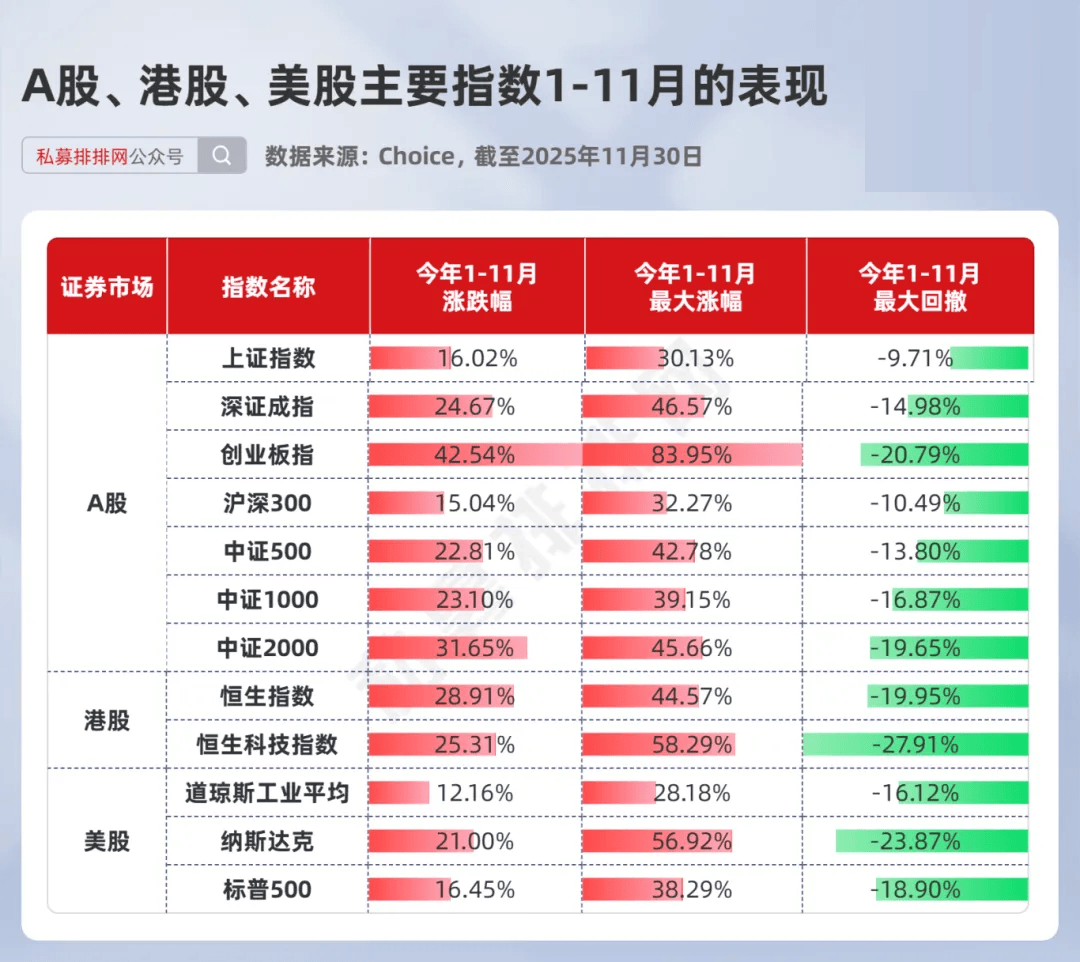
今年1-11月,A股、港股、美股虽然在年内都一度出现过较大回撤,但最终累计涨幅均表现不俗。其中,上证指数涨幅超16%,深证成指涨幅超24%,创 业板指涨幅超42%。港股的恒生指数、恒生科技涨幅分别超28%、25%;美股的道琼斯指数涨超12%,纳斯达克指数涨近21%。 | 证券市场 | 指数名称 | 今年1-11月 涨跌幅 | 今年1-11月 最大涨幅 | 今年1-11月 最大回撤 | | --- | --- | --- | --- | --- | | A股 | 上证指数 | 16.02% | 30.13% | -9.71% | | | 深证成指 | 24.67% | 46.57% | -14.98% | | | 创业板指 | 42.54% | 83.95% | -20.79% | | | 沪深300 | 15.04% | 32.27% | -10.49% | | | 中证500 | 22.81% | 42.78% | -13.80% | | | 中证1000 | 23.10% | 39.15% | -16.87% | | | 中证2000 | 31.65% | 45.66% | -19.65% | | | 恒 ...