
新型政策性金融工具

Search documents
今年1.3万亿超长期特别国债发行收官财政支出或将“赶进度”
Zheng Quan Shi Bao· 2025-10-14 23:15
Group 1 - The Ministry of Finance successfully issued 40 billion yuan of 20-year ultra-long special bonds, completing the issuance of 1.3 trillion yuan for the year [1] - The issuance of ultra-long special bonds increased by 300 billion yuan compared to last year, with 800 billion yuan allocated to support 1,459 "dual heavy" construction projects [1] - An additional 500 billion yuan of ultra-long special bonds is designated to support the implementation of "two new" policies, with funds already allocated to approximately 8,400 projects in various sectors [1] Group 2 - The last batch of 69 billion yuan for consumer product replacement subsidies was distributed before the National Day and Mid-Autumn Festival holidays, boosting consumer spending in the fourth quarter [2] - By October 14, over 670 billion yuan of new local government general bonds and over 3.7 trillion yuan of new local government special bonds had been issued, accounting for over 80% of the annual quota [2] - Despite a slowdown in government bond issuance in the fourth quarter, fiscal spending is expected to catch up, with public budget expenditure reaching about 60% of the initial budget forecast [2] Group 3 - The Minister of Finance emphasized that fiscal policy will maintain flexibility, indicating sufficient space for future fiscal policy actions [3] - Market institutions generally believe that there is no strong necessity for further expansionary fiscal policies this year, although the fourth quarter may continue with a positive fiscal stance [3] - New policy financial tools are seen as effective in supplementing major project capital and leveraging social investment, acting as a stabilizing force [3]
重大项目建设“冲刺四季度”为全年经济增长助力
Zheng Quan Ri Bao· 2025-10-14 15:44
Core Insights - Major project construction across various regions in China has accelerated significantly entering the fourth quarter, with substantial investments aimed at boosting economic growth and improving social welfare [1][2] Group 1: Project Initiatives - Fuzhou has launched 188 major projects with a total investment of 136.3 billion yuan, covering various sectors including industrial development and infrastructure [1] - Jiangsu Province emphasized the need for rapid project advancement, aiming to increase physical work output and expedite project completion [1] - Guangxi initiated seven major transportation infrastructure projects with a combined investment exceeding 71 billion yuan [1] Group 2: Economic Impact - Major project construction is expected to have a significant short-term impact on economic growth by directly stimulating large-scale investments and creating numerous job opportunities [2] - The construction initiatives are anticipated to activate economic circulation and boost demand across various industries, including steel, cement, and logistics [2] - In the long term, these projects are crucial for industrial upgrading, promoting cluster development, and optimizing industrial structure, thereby supporting high-quality economic development [2] Group 3: Financial Support - The National Development and Reform Commission has introduced a new policy financial tool with a total scale of 500 billion yuan, specifically aimed at supplementing project capital [2][3] - This financial support is designed to address capital shortages for major projects and enhance their financing capabilities, leveraging more social capital for project construction [3]
央行:将开展6000亿元买断式逆回购操作
第一财经· 2025-10-14 13:59
Core Viewpoint - The People's Bank of China (PBOC) conducted a 600 billion yuan reverse repurchase operation to maintain liquidity in the banking system and address potential tightening pressures [3][4]. Group 1: Reverse Repo Operations - On October 15, the PBOC executed a 600 billion yuan 6-month reverse repurchase operation, marking the second such operation in October [3]. - A total of 1.3 trillion yuan in reverse repos is set to mature in October, including 800 billion yuan for 3-month and 500 billion yuan for 6-month terms [3]. - The PBOC's actions are aimed at ensuring stable liquidity in the market, especially in light of significant government bond issuances and new policy financial tools [4]. Group 2: Market Analysis - Analysts suggest that the combination of 3-month and 6-month reverse repos will help stabilize the market's liquidity, particularly around the New Year [4]. - The reverse repo rates are lower than the Medium-term Lending Facility (MLF) rates, which may reduce funding costs for financial institutions and support future credit expansion [4]. - There is an expectation of 700 billion yuan in MLF maturing in October, with the market anticipating that the PBOC will continue or slightly increase the amount in future operations [4]. Group 3: Future Outlook - The PBOC is expected to utilize a mix of reverse repos and MLF to manage short- to medium-term liquidity, while also considering tools like reserve requirement ratio cuts to support long-term liquidity [4]. - The fourth quarter is seen as a critical period for growth stabilization policies, with potential resumption of government bond trading operations to maintain a reasonable yield curve [4].

全力冲刺四季度经济 哪些增量政策值得期待?
Shang Hai Zheng Quan Bao· 2025-10-14 00:55
Group 1: Economic Policy and Investment - The fourth quarter is crucial for economic work and planning for the next year, with macro policies being implemented to ensure stable economic performance, requiring approximately 15 trillion yuan in investment and 13 to 14 trillion yuan in consumption [1] - New policy financial tools amounting to 500 billion yuan are expected to support project capital, enhancing infrastructure investment in the fourth quarter [4] - Local governments are anticipated to expedite the use of remaining special bond funds, with an estimated 680 billion yuan available for investment [5] Group 2: Consumer Support Policies - The government has issued 690 billion yuan in special bonds to support consumer goods replacement programs, with over 330 million people benefiting from subsidies, leading to sales exceeding 2 trillion yuan [2] - There are expectations for further support policies for large-scale consumption, including expanded subsidies for vehicle replacements and initiatives in health, medical, and digital sectors [2][3] - The retail sales of consumer goods are projected to exceed 50 trillion yuan for the year, with consumption contributing over 50% to GDP [3] Group 3: Foreign Trade and Investment - China is set to enhance its high-level opening-up policies, with the Hainan Free Trade Port scheduled to officially operate by December 2025, easing restrictions on foreign investment in tourism [7] - The 138th China Import and Export Fair will take place from October 15 to November 4, aiming to support foreign trade enterprises amid external challenges [7] - A series of favorable policies for foreign investment are expected to be implemented, focusing on advanced manufacturing, modern services, and high-tech sectors [7][8]
铜周报:宏观扰动再起,铜价高位回调-20251013
Chang Jiang Qi Huo· 2025-10-13 07:05
Report Title - Copper Weekly Report: Macroeconomic Disturbances Resurface, Copper Prices Correct from Highs [1] Report Date - October 13, 2025 [1] Report Industry Investment Rating - Not provided in the document Core Viewpoints - The Grasberg mine in Indonesia halted production due to a mudslide accident, and Freeport expects copper production and sales in Q4 2025 to decline significantly. The long - term supply - demand outlook for copper remains optimistic, and the supply tightening will keep the copper market in a tight balance. The impact of the Grasberg shutdown on copper supply - demand and prices may be long - term, and the long - term price center will continue to rise. However, the escalation of Sino - US trade tensions has led to a sharp decline in copper prices. In the domestic market, high copper prices have weakened consumption, but the low inventory provides strong support for copper prices. Copper prices may stabilize after a short - term adjustment and maintain high - level volatility in the medium - to - long term. It is recommended to reduce long positions to avoid short - term risks [5][7] Summary by Directory 1. Main Viewpoints and Strategies - **Supply Side**: The Grasberg mine in Indonesia stopped production due to a mudslide. In September, the domestic southern crude copper processing fee was 700 yuan/ton, a decrease of 150 yuan/ton from the previous month, and the imported CIF crude copper processing fee was 85 dollars/ton, a decrease of 10 dollars/ton. As of October 10, the spot smelting fee for copper concentrate was - 40.70 dollars/ton, remaining at a historical low. The domestic copper concentrate port inventory was 50.9 tons, a 6.04% increase. In September, electrolytic copper production was 1.121 million tons, a 11.62% year - on - year increase but a 4.31% month - on - month decrease due to smelter overhauls and anode plate supply shortages [5] - **Demand Side**: The recovery of downstream consumption during the peak season was limited, and high copper prices suppressed demand. As of October 9, the weekly operating rate of major domestic refined copper rod enterprises dropped to 43.44%, a 30.34 - percentage - point decrease from the previous week and a 16.99 - percentage - point decrease year - on - year [5] - **Inventory**: Domestic copper inventory increased slightly after the holiday. As of October 10, SHFE copper inventory was 10.97 tons, a 15.42% week - on - week increase. As of October 9, domestic social copper inventory was 166,300 tons, a 12.14% week - on - week increase. LME copper inventory was 139,400 tons, a 0.77% week - on - week decrease, and COMEX copper inventory was 33,950 short tons, a 3.81% week - on - week increase [6] - **Strategy Recommendation**: Due to the Grasberg mine shutdown, copper prices initially rose sharply but then dropped significantly due to Sino - US trade tensions. Long - term supply - demand is optimistic, but short - term risks exist. It is recommended to reduce long positions to avoid short - term risks [7] 2. Macroeconomic and Industrial News - **Macroeconomic Data Overview**: New policy - based financial instruments total 500 billion yuan; China's September official manufacturing PMI rose to 49.8; the PBOC increased its gold holdings by 40,000 ounces in September; the US government "shut down" on October 1, affecting economic data release; US September ADP employment decreased by 32,000; US September ISM manufacturing PMI contracted for the seventh consecutive month [15] - **Industry News Overview**: The China Nonferrous Metals Industry Association opposes "involution - style" competition in the copper smelting industry; Goldman Sachs lowered its copper supply forecast after the Grasberg mine disruption; Peru's Antamina expects its 2026 copper production to increase to 450,000 tons; Southern Copper's Tía María copper mine project will start construction in October; Chile's Codelco's August copper production dropped 25% [16] 3. Futures and Spot Market and Positioning - **Premium and Discount**: After the holiday, the spot copper market was quiet. As the weekend approached, the spot purchasing sentiment in the Shanghai copper market picked up, and the premium stabilized. The LME copper 0 - 3 discount narrowed slightly, the New York - London copper price difference decreased, and the refined - scrap copper price difference widened slightly [19] - **Domestic and Overseas Positions**: As of October 10, the Shanghai copper futures position was 216,115 lots, a 1.05% increase from before the holiday, and the average daily trading volume was 175,142 lots, a 18.93% increase. As of October 3, the net long position of LME copper investment companies and credit institutions was 14,672.88 lots, a 146.77% week - on - week increase. As of September 23, the net long position of COMEX copper asset management institutions was 43,389 lots, a 3.07% week - on - week increase [25] 4. Fundamental Data - **Supply Side**: The Grasberg mine in Indonesia stopped production, and Q4 2025 copper production and sales are expected to decline. In September, domestic and imported crude copper processing fees decreased. As of October 10, the copper concentrate port inventory increased slightly. In September, electrolytic copper production decreased month - on - month due to smelter overhauls and anode plate supply shortages [34] - **Downstream Operating Rate**: As of October 9, the weekly operating rate of major domestic refined copper rod enterprises dropped significantly. In August, the operating rates of copper strips, copper tubes, and copper foils were 65.87%, 65.70%, and 78.44% respectively. High copper prices and trade policies affected the operating rates of some products [37] - **Imports and Exports**: As of October 10, the Shanghai - London ratio of electrolytic copper was 7.99, and the loss on copper spot imports widened slightly. In August, refined copper, scrap copper, and unforged copper and copper product imports increased year - on - year [41] - **Inventory**: As of October 10, SHFE copper inventory increased, domestic social copper inventory increased slightly, LME copper inventory decreased, and COMEX copper inventory increased [48]
9月央行各项工具净投放9268亿元 专家:预计四季度降准、降息等工具仍有操作空间
Sou Hu Cai Jing· 2025-10-13 04:50
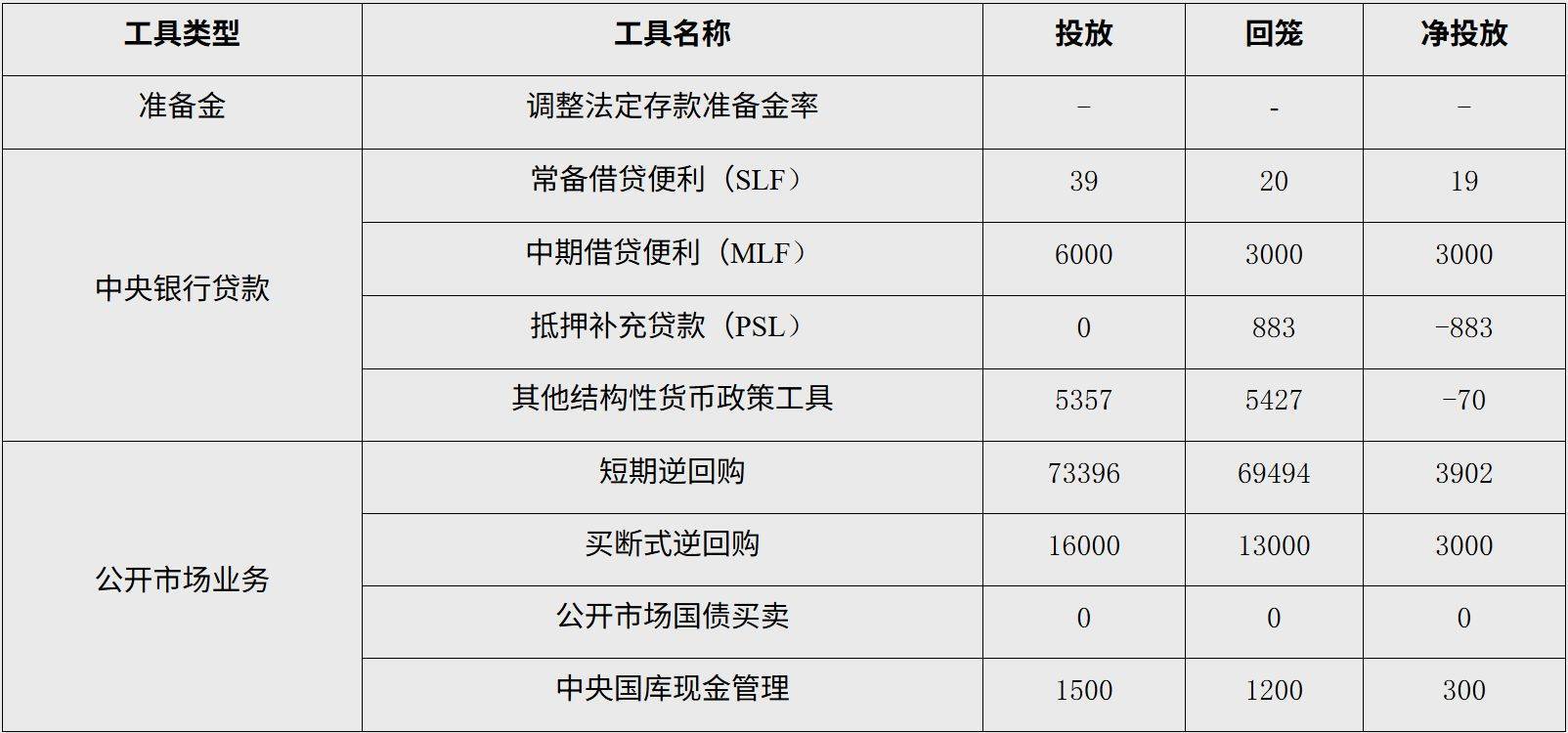
Core Viewpoint - The People's Bank of China (PBOC) has significantly increased liquidity net injection in September, amounting to 926.8 billion yuan, indicating a potential for further monetary easing in the fourth quarter, including possible reserve requirement ratio (RRR) cuts and interest rate reductions [1][4]. Group 1: Monetary Policy Tools - In September, the PBOC's liquidity injection included 19 million yuan from the Standing Lending Facility (SLF), 300 billion yuan from the Medium-term Lending Facility (MLF), and 3.9 trillion yuan from short-term reverse repos, while there was no activity in government bond transactions [3][4]. - The MLF and reverse repos can serve as substitutes for government bond transactions, reducing the necessity for the PBOC to inject liquidity through bond purchases [3][4]. - The PBOC's toolbox remains rich, with significant room for both quantity-based tools like RRR cuts and price-based tools like interest rate cuts [3][4]. Group 2: Economic Context and Future Outlook - The current macroeconomic environment is characterized by weak recovery, necessitating a continuation of a moderately loose monetary policy to address external shocks and domestic demand deficiencies [4][9]. - The introduction of 500 billion yuan in new policy financial tools is expected to be a crucial pathway for stimulating investment, with a projected leverage effect that could lead to an additional investment scale of approximately 1 trillion to 1.7 trillion yuan [4][7]. - The PBOC's approach to government bond transactions differs fundamentally from quantitative easing (QE) practices in developed economies, focusing on liquidity management rather than a large-scale, one-sided purchase of bonds [6][7]. Group 3: Market Reactions and Indicators - The market liquidity remains ample, with funding rates stabilizing around policy rates, and the PBOC is expected to maintain a balance between financial stability and economic development [3][8]. - Observations of market interest rates should focus on the weighted average of key rates rather than individual transaction rates, as fiscal factors can influence liquidity conditions [8][9]. - The anticipated gradual recovery of prices will require coordinated efforts across various sectors, with expectations for the 10-year government bond yield to trend down to around 1.6% amid ongoing economic adjustments [9].
格林大华期货早盘提示:钢材-20251013
Ge Lin Qi Huo· 2025-10-13 02:33
Report Summary 1. Report Industry Investment Rating - The investment rating for the steel sector is "oscillating" [1] 2. Core View of the Report - Due to the impact of Sino - US trade relations, the steel market is expected to be oscillating with a downward bias in the short - term. It is recommended to take short - selling operations. The expected pressure level for rebar is 3230, and the support level is 3000. For hot - rolled coils, the pressure level is 3450, and the support level is 3200 [1] 3. Summary by Relevant Catalogs Market Review - On Friday, rebar and hot - rolled coils opened higher with a gap and closed with a negative line. They closed down during the night session [1] Important Information - The Chinese government's export control is not a ban on exports. For applications that meet the regulations, permission will be granted. If the US persists in its actions, China will take corresponding measures to safeguard its legitimate rights and interests [1] - The Ministry of Housing and Urban - Rural Development stated that the approved loan amount for the national white - list projects has exceeded 7 trillion yuan, ensuring the construction and delivery of commercial housing projects. The second - hand housing market in 15 provincial - level administrative regions has a larger trading volume than the new - housing market [1] - After the National Development and Reform Commission announced that 500 billion yuan of new policy - based financial instruments will be used to supplement project capital, many regions have started to connect with these instruments to form physical work volume. Some regions have also deployed work to expand effective investment [1] - In September, the retail sales of the national passenger vehicle market reached 2.239 million units, a year - on - year increase of 6% and a month - on - month increase of 11%. Among them, the retail sales of the new - energy passenger vehicle market were 1.307 million units, a year - on - year increase of 16% and a month - on - month increase of 17% [1] Market Logic - Historical data shows that steel prices mostly declined after the National Day holiday in the past five years. Currently, the supply - demand contradiction of steel is not prominent, and steel production may decline in the later period. In terms of structure, due to the influence of steel mills' production profits, molten iron has continuously flowed to high - profit varieties. The production of building materials from blast furnaces and electric furnaces has decreased, while the production of hot - rolled coils has continued to increase. Steel apparent demand has declined, and attention should be paid to the demand in October. Inventories have continued to accumulate. The intensification of Sino - US trade risks is a short - term negative factor for the market [1] Trading Strategy - Affected by Sino - US trade relations, it is expected to be oscillating with a downward bias in the short - term. Short - selling operations are recommended. The expected pressure level for rebar is 3230, and the support level is 3000. For hot - rolled coils, the pressure level is 3450, and the support level is 3200 [1]
渤海证券研究所晨会纪要(2025.10.13)-20251013
BOHAI SECURITIES· 2025-10-13 01:35
Macro and Strategy Research - The U.S. government is in a shutdown due to a lack of agreement on a temporary funding bill, leading to a focus on private sector data as official reports are absent. The ADP employment numbers for September showed a larger-than-expected decline, indicating a continued weakening trend in employment. Manufacturing PMI has unexpectedly rebounded but remains in contraction territory, with new orders reflecting weak demand in the manufacturing sector. Non-manufacturing PMI is also not optimistic, with price components slightly rising due to tariff cost transmission [2][3] - In Europe and Japan, political instability is evident with the resignation of the French Prime Minister and the election of a right-leaning leader in Japan, creating uncertainty in the political landscape. The European Central Bank has no immediate plans for rate cuts, while the Bank of Japan's rate hike process may slow down due to policy direction [3] - Domestic consumption has been boosted by the Mid-Autumn Festival and National Day, with service consumption growing faster than goods consumption. However, the real estate market shows signs of weakness, particularly in first-tier cities, and the central bank is expected to adopt a more flexible and anticipatory policy approach in the fourth quarter [2][3] Fixed Income Research - In Q3 2025, the central bank maintained support for the market with significant net injections through reverse repos and MLF, keeping funding prices low. The issuance of government bonds decreased, but net financing remained high due to reduced maturity volumes. The bond market showed a bear steepening trend, with investor confidence in buying bonds remaining low [5][6] - Looking ahead to Q4, the bond market is expected to remain under pressure, but the situation is anticipated to improve compared to Q3. The key indicators to watch include PPI, which will influence bond pricing. The central bank's continued support and potential resumption of bond purchases are expected to stabilize interest rates [6][7] Industry Research Metal Industry - The steel industry is expected to see a gradual recovery in demand post-holiday, but supply may also increase, making significant improvements in the fundamentals unlikely. The upcoming Fourth Plenary Session of the 20th Central Committee is a key event to monitor for industry developments [8] - For copper, global supply remains tight, providing support for prices, but general demand and high prices may pressure future price increases. Aluminum prices are expected to face limitations due to high costs affecting purchasing sentiment [8][9] - Gold prices are influenced by the U.S. entering a rate cut cycle and political risks from the government shutdown. If the shutdown is resolved and economic data remains strong, gold may face short-term corrections [9][10] - Lithium supply concerns have eased with approvals for resource reports, but short-term oversupply pressures may affect prices. Rare earth prices are expected to remain volatile, influenced by domestic export policies and overseas demand [9][10] Pharmaceutical and Biotechnology Industry - The recent World Lung Cancer Conference highlighted the R&D capabilities of Chinese pharmaceutical companies. The National Medical Products Administration has initiated the 11th round of centralized drug procurement [12][13] - The medical care CPI for August showed a 0.9% year-on-year increase, while the pharmaceutical manufacturing PPI decreased by 2.9%. Cumulative revenue and profit in the pharmaceutical manufacturing sector have declined by 2.0% and 3.9%, respectively, in the first eight months of 2025 [13] - The pharmaceutical sector experienced a pullback in September, with a focus on the upcoming ESMO conference and third-quarter earnings reports. There is potential for improvement in fundamentals, particularly in innovative drugs and medical devices [14][15]
多家信托公司被要求排查逆回购杠杆率;深圳水贝三家黄金珠宝公司被查处 | 金融早参
Mei Ri Jing Ji Xin Wen· 2025-10-12 23:33
Group 1 - The central bank conducted a 116 billion yuan reverse repurchase operation to maintain liquidity and stabilize interest rates, indicating a willingness to support economic recovery [1] - The operation had a fixed interest rate of 1.40% and a full bid amount of 116 billion yuan, resulting in a net injection of 116 billion yuan for the day [1] Group 2 - Multiple trust companies received notifications to investigate their reverse repurchase leverage ratios, reflecting regulatory concerns about market risks and the need for stricter controls [2] - This move aims to standardize market operations and prevent the accumulation of high leverage risks, contributing to long-term financial market stability [2] Group 3 - Various regions are seizing the "golden period" for major project construction, with new policy financial tools being rapidly implemented to support project capital [3] - The announcement of 500 billion yuan in new policy financial tools is expected to boost infrastructure investment growth in the fourth quarter, positively impacting related industries [3] Group 4 - Three gold and jewelry companies in Shenzhen were penalized for illegal activities, including operating a gambling business, highlighting the need for increased legal awareness and risk prevention among investors [4] - The crackdown on illegal activities in the gold and jewelry market aims to enhance market transparency and credibility, promoting healthier industry development in the long run [4] Group 5 - The U.S. federal government shutdown has entered its 11th day, affecting approximately 600,000 employees who are either on unpaid leave or working without pay [5] - The shutdown has begun to result in layoffs, with over 4,000 employees from various departments facing termination [5]
全力冲刺四季度经济,哪些增量政策值得期待
Shang Hai Zheng Quan Bao· 2025-10-12 23:12
Group 1: Economic Outlook and Investment - The fourth quarter is crucial for economic work and planning for the next year, with macro policies being implemented effectively [1] - An estimated investment of around 15 trillion yuan and consumption of 13 to 14 trillion yuan is needed in the fourth quarter [1] - New policy tools are expected to stimulate investment, with a focus on major project construction and financial support [4][5] Group 2: Consumer Support Policies - A new round of consumer support policies is anticipated, including an additional 690 billion yuan in special bonds for consumption upgrades [2] - The "old for new" subsidy program has seen 330 million participants, driving sales exceeding 2 trillion yuan [2] - Policies may also support sectors like health, tourism, and digital services, with potential issuance of consumption vouchers [2] Group 3: Retail and Consumption Growth - Factors such as childcare subsidies and a recovering stock market are expected to support retail sales growth, with total retail sales projected to exceed 50 trillion yuan [3] - The contribution of consumption to GDP is expected to surpass 50% [3] Group 4: Foreign Trade Policies - Significant foreign trade policies are set to be released in the fourth quarter, with a focus on high-level opening up [6] - The Hainan Free Trade Port is on track for its official operation by December 2025, with plans to ease restrictions on foreign investment in tourism [7] - The 138th Canton Fair will introduce new measures to support foreign trade enterprises [7] Group 5: Financial and Investment Support - Local governments are expected to expedite the use of remaining special bond funds, with an estimated 680 billion yuan available [5] - New policies to encourage private investment in emerging sectors are anticipated [5] - Financial tools totaling 500 billion yuan will be used to support project capital [4]