内需修复

Search documents
港股异动丨水泥建材股普涨 东吴水泥创历史新高 华润建材科技涨超1%
Xin Lang Cai Jing· 2025-12-23 03:34
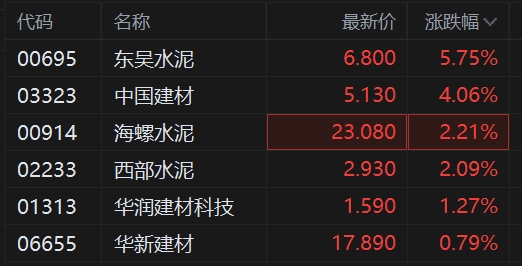
Core Viewpoint - The cement and building materials sector in Hong Kong is experiencing a rally, with significant price increases for major companies, driven by expectations of a recovery in domestic demand and improved fundamentals in the industry [1]. Group 1: Market Performance - Dongwu Cement saw a nearly 6% increase, reaching a new historical high price [1] - China National Building Material rose by 4% [1] - Anhui Conch Cement and Western Cement both increased by over 2% [1] - China Resources Cement Technology gained over 1% [1] Group 2: Economic Context - The Central Economic Work Conference held on December 10-11 emphasized the importance of domestic demand and the construction of a strong domestic market, alongside actions to boost consumption [1] - Despite a general decline in demand, the construction market remains weak, with regional disparities in infrastructure demand driven by policy [1] - The residential market shows relatively inelastic demand [1] Group 3: Industry Outlook - The cement industry is expected to see a continued decline in production capacity due to policies limiting overproduction, which will significantly enhance capacity utilization and profit elasticity [1] - The overall performance of leading building material companies has lagged, but fundamentals are stabilizing amid the downturn in the real estate sector [1] - A dual recovery in fundamentals and valuations is anticipated for 2026, as major companies reduce their reliance on the real estate sector and prices for multiple categories begin to recover [1]

港股异动丨建材水泥股普涨 东吴水泥创历史新高 华润建材科技涨超1%
Xin Lang Cai Jing· 2025-12-23 03:28
Group 1 - The core viewpoint of the article highlights a significant increase in the stock prices of cement companies in Hong Kong, driven by positive sentiment following the Central Economic Work Conference held on December 10-11, which emphasized domestic demand and consumption recovery [1] - Dongwu Cement saw a nearly 6% increase, reaching a historical high, while China National Building Material rose by 4%, and other companies like Conch Cement and Western Cement also experienced gains of over 2% [2] - The report from Zhongyou Securities suggests that despite a decline in overall demand due to seasonal factors and a weak housing market, the cement industry is expected to stabilize as leading companies reduce their reliance on the real estate sector and prices begin to recover [1][2] Group 2 - The article notes that the cement industry is currently facing a decline in demand, particularly in the housing construction market, while infrastructure demand shows regional differentiation driven by policy [1] - It is anticipated that cement production capacity will continue to decrease under policies limiting overproduction, which will significantly enhance capacity utilization and profit elasticity in the medium term [1]
经观月度观察|“反内卷”下出现新信号 政策加力稳投资促消费
Sou Hu Cai Jing· 2025-12-20 01:27
Economic Overview - "Anti-involution" has become a significant factor affecting economic operations, with fluctuations in economic data for November 2025 reflecting adjustments in industry prices and profit patterns during efforts to curb inefficient competition and promote structural optimization [2] - The current uneven pace of domestic demand recovery highlights the need for policies to focus on investment and consumption to stabilize growth [2] CPI Analysis - The CPI for November 2025 increased by 0.7% year-on-year, up from 0.2% in the previous month, marking the highest level since March 2024 [6] - Food prices rose by 0.2% year-on-year, while non-food prices increased by 0.8%, with core CPI remaining stable at 1.2% [6] - The month-on-month core CPI saw a slight decline of 0.1%, indicating a mixed trend in consumer prices [6] PPI Analysis - The PPI for November 2025 recorded a year-on-year decline of 2.2%, a slight increase in the rate of decline compared to the previous month [8] - The decrease in production materials and living materials prices reflects the impact of high base effects from the previous year [8] - The PPI remained stable month-on-month, indicating a balance in price movements across various sectors [8] PMI Insights - The manufacturing PMI for November 2025 was reported at 49.2%, showing a marginal improvement of 0.2 percentage points from the previous month [12] - Key drivers of this improvement include increases in production and new orders, alongside better external demand conditions [12] - The raw material purchase price index has been in an expansion zone for five consecutive months, suggesting a potential for improved profitability for manufacturing firms [12] Fixed Asset Investment - Fixed asset investment for January to November 2025 decreased by 2.6% year-on-year, reaching the lowest level since June 2020 [15] - The central economic work conference has proposed measures to increase central budget investments and optimize project management to reverse the declining trend in infrastructure investment [15] Credit Market - New RMB loans in November 2025 totaled 390 billion, a decrease from 220 billion in the previous month [19] - Short-term loans for residents fell significantly, reflecting weakened consumer confidence and employment expectations [19] - The real estate market continues to face challenges, with a notable decline in transaction volumes across major cities [19] M2 and Monetary Policy - The M2 growth rate for November 2025 was 8.0%, down from 8.2% in the previous month, indicating a tightening monetary environment [23] - The widening gap between M1 and M2 suggests a shift in deposit behaviors, with businesses moving funds from demand deposits to time deposits [23]

迈向十五五:稳中求进,新质领航:策略点评报告:中央经济工作会议政策解读与投资展望
Huafu Securities· 2025-12-12 01:55
Group 1 - The core conclusion of the report emphasizes a stable and progressive approach to economic development, marking the beginning of a new chapter in high-quality growth [7] - The macro policy interpretation highlights a focus on enhancing the effectiveness of economic governance and ensuring consistency in policy direction, aiming to boost social confidence and market expectations [8] - The report outlines eight key tasks for 2026, with a focus on domestic demand and innovation as primary drivers for short-term stability and long-term growth [13][14] Group 2 - The investment strategy suggests that investors should focus on two main lines: "policy support certainty" and "new quality growth space," particularly in areas such as domestic demand recovery, technological innovation, and green transformation [7][17] - Specific investment recommendations include targeting sectors that benefit from income recovery and consumption scene restoration, as well as those involved in infrastructure and public utilities with stable dividends [17][18] - The report identifies opportunities in the real estate sector, particularly in revitalizing quality assets in key cities and in financial institutions that are expected to benefit from risk mitigation efforts [16][18]
交银国际料明年港股延续 “慢牛”
Ge Long Hui A P P· 2025-12-10 04:19
Core Viewpoint - The report from CMB International indicates that global economic resilience in 2025 is expected to exceed initial forecasts, with the AI technology cycle continuing and policies remaining consistent [1] Economic Outlook - The groundwork laid in 2025 is anticipated to facilitate advancements in 2026, supported by ongoing monetary policy easing, proactive fiscal measures, and strategic industrial policies [1] - The external environment is expected to return to order, enhancing certainty and increasing risk appetite, leading to a shift in asset allocation logic towards a balanced approach [1] Hong Kong Stock Market - CMB International projects promising earnings for Hong Kong stocks, with a continuation of a slow bull market [1] - Valuations are deemed reasonable, offering significant cost-effectiveness; the liquidity environment is improving with inflows from southbound and overseas funds [1] - Structural highlights of the Chinese economy include advancements in AI technology, a reduction in excessive competition, and a recovery in domestic demand, which are expected to start reflecting in earnings [1]
国家统计局重磅经济数据即将发布
Di Yi Cai Jing· 2025-11-12 13:38
Economic Overview - The National Bureau of Statistics is set to release October economic data on November 14, with expectations of a slowdown in multiple macro indicators due to a higher base in 2024 and increased external uncertainties [2] - The latest "Chief Economist Confidence Index" from the First Financial Research Institute stands at 50.3, indicating stable economic performance and a projected annual growth target of 5% for the year [2] Industrial Growth - Economists predict a year-on-year industrial added value growth of 5.7% for October, down from 6.5% in the previous month [3] - The manufacturing PMI for October is reported at 49.0%, a decrease of 0.8 percentage points from the previous month, indicating a contraction in manufacturing activity [3][4] - High-frequency data shows a decline in production indices, with steel production maintaining a high operating rate of 84.38% in October, reflecting a strong demand in the "golden September and silver October" season [4] Consumer Spending - The forecast for year-on-year growth in social retail sales for October is 2.7%, down from 3% in the previous month [5] - The non-manufacturing business activity index for October is at 50.1%, indicating expansion, driven by holiday consumption during the National Day and Mid-Autumn Festival [5] - The "old-for-new" policy is expected to significantly boost consumption in related sectors, contributing to a high base effect for October [5] Automotive Industry - In October, China's automotive production and sales reached 3.359 million and 3.322 million units, respectively, marking year-on-year increases of 12.1% and 8.8% [6] - New energy vehicle production and sales also saw significant growth, with year-on-year increases of 33.1% and 32.7% [6] Infrastructure Investment - Fixed asset investment is projected to decline by 0.8% year-on-year for the first ten months of the year, with infrastructure investment showing signs of recovery due to new policy financial tools [7][8] - The construction PMI for the civil engineering sector has shown slight improvement, indicating potential stabilization in infrastructure investment [7] Policy Measures - The government has intensified growth stabilization policies, with 500 billion yuan in new policy financial tools fully allocated to support key investment projects [10] - Local governments are actively deploying measures to boost consumption and investment, including issuing consumption vouchers and launching major infrastructure projects [10][11]

重磅经济数据即将发布,央地加力冲刺全年经济增长目标
Di Yi Cai Jing· 2025-11-12 12:12
Economic Overview - The external environment remains complex and variable, with a focus on domestic demand recovery for the economy [1] - The Chief Economist Confidence Index from First Financial Research Institute stands at 50.3, indicating stable economic performance with a target growth rate of 5% for the year [1] Industrial Growth - The predicted year-on-year growth rate for industrial added value in October is 5.7%, down from 6.5% in the previous month [2] - The manufacturing PMI for October is reported at 49.0%, a decrease of 0.8 percentage points from the previous month, indicating a decline in manufacturing activity [2][3] - High-frequency data shows a strong production trend in the steel sector, with the average blast furnace operating rate at 84.38%, up 3.31 percentage points year-on-year [3] Consumer Spending - The forecast for year-on-year growth in retail sales of consumer goods for October is 2.7%, down from 3% in the previous month [4] - The non-manufacturing business activity index for October is at 50.1%, indicating expansion, driven by holiday consumption [4] - The automotive industry sees record production and sales figures, with October production reaching 3.359 million vehicles, a year-on-year increase of 12.1% [5] Investment Trends - Fixed asset investment is expected to decline by 0.8% year-on-year, with infrastructure investment showing signs of potential recovery due to new policy financial tools [6][7] - Real estate investment continues to face challenges, with significant declines in property transactions in major cities [6][7] Policy and Economic Goals - The government aims to achieve the annual economic growth target despite external challenges, with a focus on effective policy implementation [8] - Recent policies include the issuance of 500 billion yuan in new policy financial tools to support key investment projects [9] - Local governments are actively deploying measures to stimulate consumption and investment, including issuing consumption vouchers and launching major infrastructure projects [10]
长城基金汪立:总量平淡期,关注产业新变化
Xin Lang Ji Jin· 2025-11-10 08:45
Group 1: Market Overview - The A-share market showed overall stability with major indices mostly rising, while structural differentiation continued to manifest, with growth sectors performing flat and value styles standing out [1] - The power equipment industry continued to lead, while cyclical industries such as steel, chemicals, building materials, environmental protection, and public utilities saw consecutive gains over two weeks [1] - Sectors like computers, pharmaceuticals, beauty care, and non-bank financials experienced significant declines, with computers, pharmaceuticals, non-banking, and automobiles shifting from gains to losses week-on-week [1] Group 2: Macroeconomic Analysis - Domestic demand is recovering, with price expectations gradually stabilizing; October exports showed a year-on-year decline of 1.1% and a month-on-month decline of 7.0%, influenced by high base effects and seasonal factors [2] - The Consumer Price Index (CPI) rose by 0.2% month-on-month and year-on-year in October, while the core CPI (excluding food and energy) increased by 1.2%, marking the sixth consecutive month of growth [2] - The Producer Price Index (PPI) saw a month-on-month increase of 0.1%, the first rise of the year, while the year-on-year decline narrowed to 2.1% [2] Group 3: Global Market Sentiment - Global stock markets faced pullbacks due to heightened risk aversion stemming from concerns over AI bubbles, government shutdowns, and uncertainties from court rulings, leading to significant declines in U.S. stocks and fluctuations in bond yields [3] - Expectations for a potential end to the government shutdown in November and improvements in economic data and dollar liquidity are anticipated [3] Group 4: Investment Strategy - New emerging technologies are seen as a key investment theme, with traditional asset returns expected to decline; the "New National Nine Articles" reform is expected to enhance market investability and attract long-term capital [4] - Economic structural transformation is accelerating, with new technologies and industries emerging, suggesting a potential recovery in economic expectations and asset returns [4] - Upcoming events such as the World Internet Conference and G20 Summit are highlighted as important for market outlook [4] Group 5: Investment Focus - Investment focus includes emerging technologies, with attention on sectors like internet, robotics, semiconductors, media, computers, and communications [5] - Global expansion of Chinese enterprises is seen as a pathway to market opportunities and shareholder returns, with sectors like power equipment, consumer electronics, machinery, and innovative pharmaceuticals being of interest [5] - Cyclical consumption is viewed as transitioning, with potential opportunities in non-ferrous metals, chemicals, steel, and building materials, particularly in service and instant consumption sectors [5]
中国通胀系列十四:10月通胀回暖,关注内需修复进度
Hua Tai Qi Huo· 2025-11-10 07:57
Report's Investment Rating for the Industry - No information provided regarding the report's investment rating for the industry Core Views - In October 2025, the PPI decline continued to narrow, and the CPI turned from decline to increase. The PPI decline narrowing reflects the gradual improvement of the price environment in the industrial sector, and the CPI increase shows a mild warming trend in consumer prices. It is expected that the PPI will continue a mild recovery, and the CPI in the fourth quarter will continue the marginal improvement trend [5][6] Summary by Directory Macro Events - On November 9, 2025, the National Bureau of Statistics announced that in October 2025, the national consumer price (CPI) increased by 0.2% year-on-year, and the industrial producer price (PPI) decreased by 2.1% year-on-year, with the decline narrowing by 0.2 percentage points compared to the previous month [4] 10 - Month Inflation Warming PPI: Decline Improvement - The PPI decline continued to narrow. In October 2025, the national industrial producer price (PPI) decreased by 2.1% year-on-year, with the decline narrowing by 0.2 percentage points compared to the previous month, and the month - on - month change turned from flat to an increase of 0.1%. The price of the mid - stream manufacturing industry continued to improve, some foreign - demand industries recovered, the international input impact continued, the new - quality productivity industry maintained growth, and the price of the consumption - upgrade category continued to rise [12] CPI: Food Drag Reduction - The CPI continued to rise month - on - month, and the year - on - year decline narrowed. In October, the national consumer price (CPI) decreased by 0.1% year-on-year, with the decline narrowing by 0.2 percentage points compared to the previous month; the month - on - month increase was 0.2%. The year - on - year decline of food prices narrowed, and the month - on - month increase expanded. The non - food price increase was stable with a slight increase, and the service consumption price continued the recovery trend [32] Appendix: CPI and PPI Data for October 2025 CPI and PPI Data Overview - In October 2025, the national consumer price (CPI) increased by 0.2% year - on - year and 0.2% month - on - month. The national industrial producer price (PPI) decreased by 2.1% year - on - year, with the decline narrowing by 0.2 percentage points compared to the previous month, and the month - on - month change turned from flat to an increase of 0.1% [47][50] Interpretation by Chief Statistician Dong Lijuan - In October, policies to expand domestic demand continued to show results. The CPI increased by 0.2% both year - on - year and month - on - month, and the core CPI increased by 1.2% year - on - year. The PPI turned from flat to an increase of 0.1% month - on - month and decreased by 2.1% year - on - year, with the decline narrowing [54]
博时基金市场异动陪伴10月24日:沪指再创年内新高,创业板指涨超3.5%
Xin Lang Ji Jin· 2025-10-24 07:31
Market Performance - The A-share market showed strong performance on October 24, with the Shanghai Composite Index reaching a new high for the year and the ChiNext Index rising over 3.5% [2] Core Insights - The market rally was driven by improved policy expectations and a more favorable external environment, particularly following the release of the 20th Central Committee's Fourth Plenary Session communiqué, which emphasized high-quality development and technological self-reliance as core goals during the 14th Five-Year Plan [2] - The upcoming China-U.S. trade negotiations and positive signals from the Ministry of Commerce regarding potential resolutions to mutual concerns have alleviated fears of escalating trade tensions, leading to a quick recovery in risk appetite [2] Policy Implications - The Fourth Plenary Session reiterated the 2035 goals, including achieving a per capita GDP level of a moderately developed country and significantly enhancing technological self-reliance, highlighting the importance of economic and technological policies [2] - The 14th Five-Year Plan emphasizes domestic demand recovery and deepening reforms, with potential for continued consumer stimulus policies and monetary easing, which could stabilize the market fundamentals [2] Future Outlook - Short-term market sentiment may fluctuate between policy expectations and changes in the external environment, while the implementation of the 14th Five-Year Plan is expected to provide clear policy guidance for key areas such as technological innovation, green low-carbon initiatives, and consumer spending [3] - Investors are advised to monitor the progress of policies related to technological self-reliance, the effectiveness of domestic demand recovery measures, and developments in China-U.S. trade negotiations [3]