AI泡沫

Search documents
谁会阻止疯狂的白银?当年亨特兄弟是栽在谁手里?
美股IPO· 2025-12-27 03:11
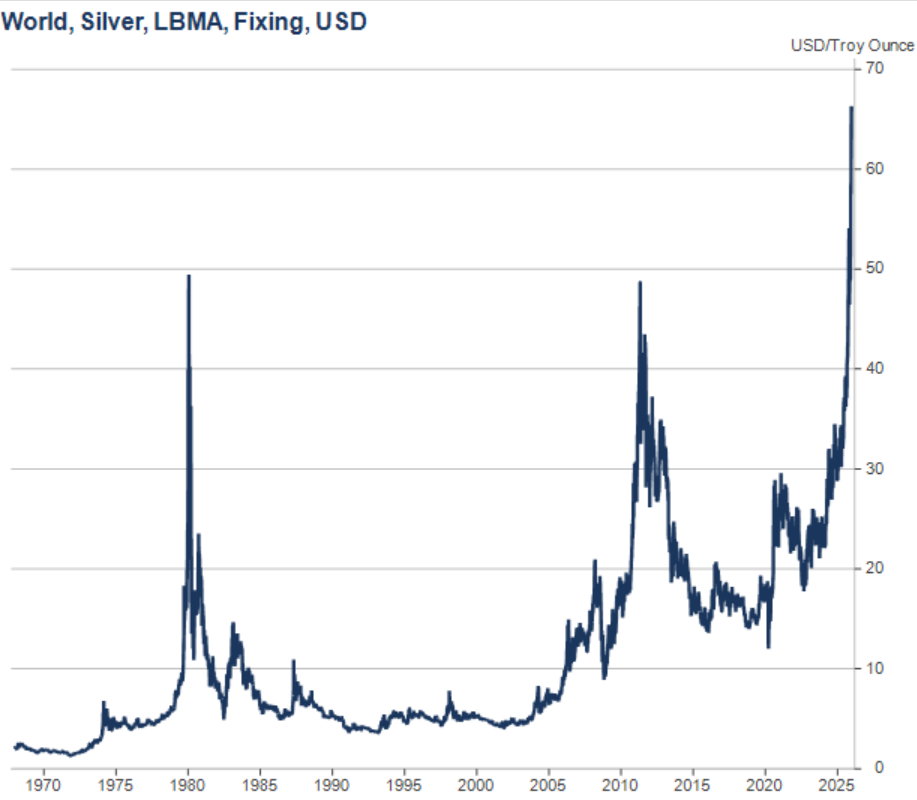
Core Viewpoint - The article discusses the recent surge in silver prices and the implications of margin increases by the CME, drawing parallels to historical events that preceded market reversals [1][3][5]. Group 1: Historical Context - The CME has raised silver margins again, reminiscent of past instances where such actions preceded market downturns, notably in 2011 and 1980 [1][3]. - In 2011, the CME raised silver margins five times in nine days, leading to a nearly 30% price drop as leveraged positions were liquidated [5]. - The Hunt Brothers' failure in 1980 was similarly triggered by regulatory changes that restricted leverage, resulting in a dramatic price decline from nearly $50 to $10 [7]. Group 2: Current Market Dynamics - On December 26, silver prices surged over 10%, nearing $80 per ounce, with COMEX silver futures rising nearly 18% for the week [3]. - The current market is characterized by a "metal frenzy," with gold surpassing $4550 and copper reaching historical highs, driven by narratives around commodity control and hedging against inflation and currency devaluation [3]. - Domestic actions include the Shanghai Futures Exchange adjusting trading limits and margin requirements for gold and silver futures, indicating a tightening of market conditions [3]. Group 3: Fundamental Drivers and Risks - Key drivers for the current silver price increase include surging industrial demand from solar panels, electric vehicles, and AI data centers [10]. - There is a persistent supply deficit in silver, with 70% of production being a byproduct, leading to inflexible supply [11]. - Investors are using precious metals as a hedge against fiscal deficits and currency depreciation [12]. - However, valuation indicators suggest risks, with the silver-to-oil ratio at historical highs, indicating potential for a correction in silver prices [13]. - Analysts warn that high leverage in the market poses significant risks, as regulatory bodies may intervene similarly to past instances, potentially leading to a market correction [13].


谁会阻止疯狂的白银?当年亨特兄弟是栽在谁手里?
Hua Er Jie Jian Wen· 2025-12-27 02:42
大洋彼岸的白银市场正陷入癫狂。12月26日周五,现货白银飙升逾10%,逼近80美元/盎司关口,COMEX白银期货周涨幅接近 18%。 然而,在疯狂的行情背后,历史的警钟已经敲响。芝加哥商品交易所(CME)已于12月12日将白银保证金上调了10%。2011年白 银崩盘与1980年亨特兄弟(Hunt Brothers)逼仓失败的历史案例表明,当交易所开始出手限制杠杆时,往往意味着狂欢接近尾 声。 与此同时,国内也已采取行动。北京时间12月26日,上海期货交易所发布通知,将黄金、白银期货合约的涨跌停板幅度调整为 15%,并相应上调交易保证金比例。这是继12月10日上调保证金、12月22日限制日内开仓数量及调整手续费之后,上期所本月内 针对白银期货出台的第三轮风控措施。 这一轮"金属狂潮"不仅局限于白银,黄金已突破4550美元,铜价跟随沪铜创下历史新高,铂金和钯金亦录得双位数涨幅。市场正 在定价"商品控制权"的新叙事,以及将其作为对冲"AI泡沫"和货币贬值的工具。 对此,中信建投期货和国信期货的分析师指出,尽管存在长线利多因素,但短期快速上涨显然过度交易了预期。资金"抢跑"导致 投机情绪高涨,市场犹如"高空走钢丝"。 ...
史诗级行情!贵金属集体狂飙创纪录,白银暴涨10%
Sou Hu Cai Jing· 2025-12-27 01:52
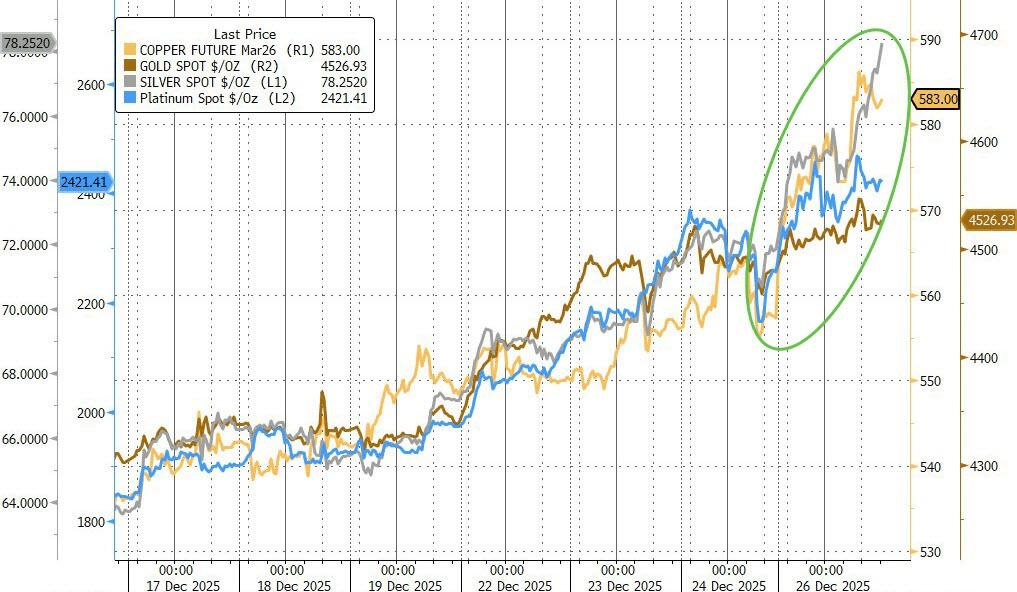
贵金属再次全面爆发。 周五黄金、白银和铂金均创历史新高, 沪铜史上首次突破10万元人民币关口, 纽铜超越了今年7月史无前例的逼空行情期间所创盘中最高纪录。 黄金现货大涨逾1%,盘中刷新历史高点至4550美元上方,现货白银站上79美元关口,COMEX铜期货涨5.01%。夜盘期货同样强势,沪银夜盘涨超 6%,首次收于19000元关口上方。 (金银铜铂金飙升) 铂族金属同样表现惊人。现货铂金大涨10%至每盎司2459.5美元,创历史新高,全年涨幅超170%,是自1990年有伦敦基准价以来最大年度涨幅;钯金 也涨逾11%至每盎司1925美元,全年涨幅已超111%。 | 名称 | 现价 | 涨跌 | 涨跌幅 | 年初至今 | | --- | --- | --- | --- | --- | | 现货铂金(美元/盎司) | 2459.50 | 231.50 | 10.39% | 172.07% | | 现货锂金(美元/盎司) | 1925.00 | 201.50 | 11.69% | 111.89% | | NYMEX铂 | 2513.9d | 266.1 | 11.84% | 176.13% | | NYMEX铝 | 2 ...
芯片的十字路口
半导体行业观察· 2025-12-27 01:33
Core Viewpoint - The global semiconductor industry is at a historic crossroads, with Q3 2025 revenue projected to reach $216.3 billion, marking the first time it surpasses $200 billion in a single quarter. The annual revenue for 2025 is expected to exceed $800 billion, representing nearly a 20% increase from 2024. However, this growth is characterized by a "K-shaped recovery," indicating a structural shift in the industry rather than uniform growth across all sectors [1][4]. Group 1: Revenue and Growth Dynamics - The $200 billion quarterly revenue figure is misleading, as it masks the profound "K-shaped recovery" within the industry. The core contradiction of this cycle is the fundamental shift in demand focus from "consumer electronics-driven volume growth" to "data center-driven price increases" [4]. - Omdia attributes the unexpected performance in Q3 2025 to accelerated industry growth, with AI and storage as the main engines. Specifically, the combination of "computing power stacking + HBM premium" has driven revenue growth, with high-end GPUs and accelerators being in high demand due to AI training and inference [4][5]. - The semiconductor equipment sales are projected to reach approximately $133 billion in 2025, with expectations of continued growth in subsequent years, indicating a long-term bet on AI demand rather than a short-term spike [5]. Group 2: Profit Distribution and Market Structure - The top four semiconductor companies, including NVIDIA and major memory firms like Samsung and SK Hynix, account for over 40% of total industry revenue, highlighting a significant profit concentration among a few players [7]. - The industry is experiencing a "profit black hole," where a small number of companies capture the majority of profits, leading to a stark divide in profit structures and creating a scenario where capital expenditures from leading firms are essential for maintaining overall industry health [7][8]. - The demand for mature processes is weak, with traditional applications struggling to recover, leading to a price war in the market. This misalignment between supply and demand is expected to result in low visibility for orders in the latter half of 2025 [10]. Group 3: AI and Market Sentiment - The semiconductor industry's true nature, excluding AI and storage, resembles a "stock game," with companies grappling with inventory reduction and price stabilization challenges [9]. - The automotive semiconductor market is projected to grow by approximately 16.5% year-on-year for 2025-2026, driven by advancements in smart driving technology, while traditional components face pricing pressures [11]. - The smartphone market is showing signs of a "moderate recovery," with a 2.6% year-on-year increase in global shipments in Q3 2025, influenced by promotions and AI feature upgrades [11]. Group 4: Concerns Over AI and Investment - The discussion around an "AI bubble" is prevalent, with concerns about whether the demand for computing power will lead to over-investment in data centers and whether the returns on these investments will materialize in a reasonable timeframe [13][15]. - Major tech companies are projected to spend around $320 billion on capital expenditures in 2025, reshaping their valuation narratives. The focus is on whether these expenditures can translate into sustainable cash flows [15]. - The financial presentation of returns is under scrutiny, as significant investments may not yield immediate returns, prompting a closer examination of profit quality and accounting practices [16].



哈佛老徐:知名AI怀疑者和信仰者的劲爆交锋,暗藏了一个巨大的机会
老徐抓AI趋势· 2025-12-27 01:04
Core Viewpoint - The dialogue between Andrew Ross Sorkin and Dario Amodei highlights contrasting perspectives on AI's future, with Sorkin expressing skepticism about a potential AI bubble, while Amodei emphasizes the tangible value and growth of AI in the industry [6][32]. Group 1: Andrew Ross Sorkin's Perspective - Sorkin views the current AI landscape as reminiscent of historical financial bubbles, suggesting that the rapid growth in AI investment and reliance on AI for GDP growth could lead to a similar collapse as seen in 1929 [33][39]. - He raises concerns about the sustainability of AI investments, questioning whether the returns justify the massive expenditures being made by companies like OpenAI [38][39]. - Sorkin's macro perspective indicates a cautious approach, focusing on the potential risks and uncertainties surrounding AI's economic impact [33][39]. Group 2: Dario Amodei's Perspective - Amodei presents a more optimistic view, citing significant revenue growth in the AI sector, with projections of annual revenues increasing from approximately $1 billion in 2023 to $80-100 billion by 2025 [34][35]. - He argues that the willingness of companies to invest substantial amounts in AI services is a direct indicator of its value, contrasting the skepticism of outsiders with the confidence of industry insiders [35][38]. - Amodei emphasizes the importance of safety and regulation in AI development, advocating for a balanced approach that ensures AI's growth does not outpace its governance [30][31]. Group 3: Industry Risks and Opportunities - Amodei warns that OpenAI could face significant financial challenges due to its aggressive investment strategy, highlighting the inherent risks in the AI industry where companies may either be overly conservative or excessively aggressive [39][42]. - The dialogue suggests that while AI may create opportunities, it will also lead to job displacement, with a focus on the need for individuals to adapt and learn to leverage AI effectively [51][53]. - The conversation underscores the importance of recognizing market fluctuations as opportunities rather than threats, encouraging a proactive approach to investment in the AI sector [53][54].
美股三大期指涨跌不一 市场静待“圣诞老人行情”
Xin Lang Cai Jing· 2025-12-26 13:54
智通财经12月26日讯(编辑 夏军雄)周五,美股三大股指期货涨跌不一,道指期货小幅下跌, 纳斯达克100指数期货小幅上涨,标普500指数期货在平盘附 近波动。 | ■ US 30 | 48,665.00 | 48 | | --- | --- | --- | | 틀 US 500 | 6,931.20 | 6 | | .. | ( | A = | (来源:英为财情) 从周度表现来看,标普500指数本周上涨1.4%,有望在最近五周内第四次实现周线上涨。道指和纳指本周迄今也均上涨逾1%。 华尔街刚刚经历了一场创纪录的交易日。周三,标普500指数盘中和收盘价均创下历史新高。由于圣诞假期,美国股市周四休市。 Fundstrat技术策略主管马克·牛顿(Mark Newton)表示:"2025年即将结束,今年利好因素略多于利空因素。尽管市场普遍围绕着'AI泡沫'、关税担忧,以及 政府停摆、关税和通胀引发的波动,但截至目前,美股市场基本无视了这些担忧,在2025年末继续走高。" 据报道,丰田汽车公司计划把2026年全球产量设定为超过1000万辆。此举旨在应对混合动力车(HV)在北美等地持续增长的需求。该汽车制造商2025年全 ...

年终盘点之海外债市:2025年“逻辑颠覆”,AI泡沫与供给狂潮正让2026年变得空前复杂?
智通财经网· 2025-12-26 12:18
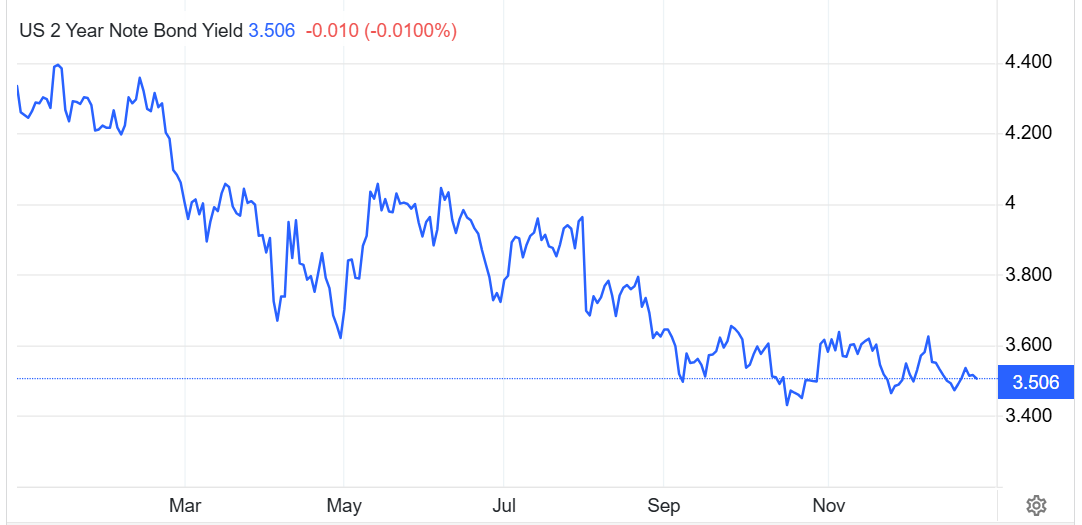
Group 1: US Bond Market Trends - The US bond market is expected to experience significant volatility in 2025, influenced by factors such as Trump's return to power, inflation pressures, and the impact of AI on market dynamics [1][8][9] - The 10-year US Treasury yield saw dramatic fluctuations, dropping to 3.8% in early April before rising to 4.6% after Trump's tariff announcements, and then stabilizing around 4.2% later in the year [1][9][11] - The 30-year US Treasury bond has shown remarkable stability, with yields remaining unchanged around 4.8% throughout 2025, despite various macroeconomic challenges [11][12] Group 2: European and Japanese Bond Markets - European bond markets are facing rising yields due to political instability and increasing debt issuance, particularly in Germany and France, where yields have reached new highs [2][14] - Japan's bond market is experiencing a surge in yields driven by the Bank of Japan's interest rate hikes and substantial fiscal stimulus, leading to a significant increase in long-term bond yields [15][17] Group 3: Corporate Bond Market Dynamics - The corporate bond market, particularly for high-rated tech companies like Oracle and Meta, has seen increased volatility, with yields rising above junk bond levels due to heavy borrowing for AI infrastructure [3][21] - Asset-backed securities (ABS) and high-yield corporate bonds have outperformed high-rated corporate bonds since November, attracting global investors seeking safer options amid market turmoil [3][35] Group 4: Future Predictions for 2026 - Predictions for 2026 suggest a shift in bond market dynamics, with long-term US Treasuries expected to outperform short-term bonds due to anticipated inflation stabilization and a potential dovish stance from the Federal Reserve [27][31] - High-yield bonds and ABS are projected to gain favor in 2026, benefiting from a macroeconomic environment characterized by soft landings and moderate interest rate cuts [33][35]
繁荣之下的“定时炸弹”!盘点2026年还需小心的十大风险
Jin Shi Shu Ju· 2025-12-26 07:06
Group 1: AI Bubble and Market Valuation - The current valuation levels of US stocks, particularly in the AI sector, are approaching those seen during the 2000 dot-com bubble, raising concerns about sustainability [2] - Analysts predict a 10-13% earnings growth for the S&P 500 in 2025, with a 15% growth expected in 2026, but there are doubts whether this growth can support current valuations [2] - If major tech companies fail to deliver expected returns from AI investments, market confidence could collapse, leading to significant economic repercussions [2][3] Group 2: Consumer Spending and Economic Resilience - The top 20% of wealthy households in the US hold 70% of financial assets, and their spending accounts for nearly half of total US consumption [3] - A collapse of the AI bubble could lead to a rapid decrease in wealth for these households, resulting in a sharp contraction in consumer spending and a potential recession [3] Group 3: Labor Market and Inflation Risks - The construction of AI infrastructure has created numerous jobs, but a sudden halt in AI investment could lead to widespread job losses and a rise in unemployment [4] - Stricter immigration policies are exacerbating labor shortages, which could lead to increased wage inflation and further economic instability [5] Group 4: Fiscal and Trade Risks - The US federal budget deficit reached $1.8 trillion in the 2025 fiscal year, raising concerns about fiscal sustainability [6][7] - Proposed "tariff rebates" by the Trump administration could exacerbate the deficit, especially if they are not supported by corresponding revenue [6][7] Group 5: Federal Reserve Independence - The potential political influence over the Federal Reserve could undermine its independence, leading to uncontrolled inflation and rising long-term interest rates [10][11] - A loss of credibility for the Federal Reserve could result in a significant decline in the value of the US dollar and increased capital flight [12] Group 6: Bond Market Trust Crisis - The US federal deficit is expected to remain high, and any loss of investor confidence could trigger a sell-off in the bond market, affecting global financial stability [13] - European countries are also facing similar challenges, with rising defense spending and increasing public debt levels [14][15] Group 7: Japanese Policy and Global Impact - Japan's recent interest rate hikes could disrupt global financial markets, particularly affecting yen carry trades that have significant implications for liquidity [16][17] - A potential "rate hike-recession" cycle in Japan could further complicate global economic conditions [17] Group 8: Gold Valuation Risks - The significant disparity between the market value and the official valuation of US gold reserves poses risks if the government decides to revalue these assets [18][19] - A revaluation could lead to inflationary pressures and undermine the independence of the Federal Reserve [19][20] Group 9: Geopolitical Risks - The shift in US foreign policy could lead to increased volatility in global markets, particularly concerning energy prices and supply chains [21][22] - Ongoing conflicts in regions like the Middle East and Africa could disrupt critical trade routes, impacting global economic stability [23][25] Group 10: European Political Fragmentation - The rise of far-right parties in Europe and the erosion of EU unity could lead to increased political instability and economic challenges [26][27] - The potential for member states to act independently could weaken the EU's collective decision-making power and exacerbate existing tensions [28] Group 11: Private Credit Market Risks - The private credit market has grown significantly, but rising default rates and financial instability could lead to a broader financial crisis [29][30] - A collapse in this market could trigger a chain reaction affecting traditional financial systems and investor confidence [30]
埃德·亚德尼论“咆哮的二十年代”:黄金和标普500指数将双双冲向10000点
Zhi Tong Cai Jing· 2025-12-26 06:36
Group 1 - Ed Yardeni is optimistic about the market, predicting the S&P 500 will reach 7,700 by 2026 and 10,000 by 2029, with gold potentially hitting $10,000 per ounce by the end of the decade [1][2] - The S&P 500's path to 10,000 is based on projected earnings growth, with expected earnings per share rising from approximately $270 this year to around $500 by 2030, applying a price-to-earnings ratio of about 20 [2][10] - Yardeni emphasizes the resilience of the economy and productivity improvements driven by the digital revolution and AI, which he believes will support higher profitability [3][4] Group 2 - Yardeni advises against over-allocating to technology stocks, suggesting a balanced approach with diversification into sectors like healthcare, industrials, and financials [6][10] - He has shifted his stance on gold, now viewing it as a strategic diversification tool due to increased central bank purchases and demand from key regions like China and India [7][8] - The relationship between gold and the S&P 500 is noted, with both potentially trending upward simultaneously, reflecting a strategic hedge in a politically and economically uncertain environment [9][10] Group 3 - Key variables that could support Yardeni's bullish outlook include avoiding recession, measurable productivity gains from AI, and managing market concentration risks through sector rotation [10][11][12] - The overall narrative suggests that while the path to 10,000 points for the S&P 500 may involve volatility and cyclical shifts, sustained earnings growth and reasonable valuation multiples are crucial [13]
年终市场“圣诞老人行情”登场!新浪财经APP帮你看懂全球股指涨跌逻辑
Xin Lang Cai Jing· 2025-12-26 01:33
Group 1: Global Market Dynamics - The global financial market experienced a "Santa Claus rally" leading up to Christmas, with the S&P 500 index reaching a record closing high of 6932.05 points on December 24 [5][17] - The traditional year-end trading period typically sees an upward trend, particularly in the last five trading days of the year and the first two trading days of the new year [5][17] - European markets showed mixed results, with the UK FTSE 100 index slightly down by 0.19% and the French CAC 40 index nearly flat [5][17] Group 2: A-Share Market Performance - The A-share market demonstrated strong performance, with the Shanghai Composite Index achieving a seven-day winning streak, closing at 3959.62 points on December 26, up by 0.47% [6][18] - The Shenzhen Component Index rose by 0.33%, and the ChiNext Index increased by 0.3% on the same day [6][18] - The trading volume in the Shanghai and Shenzhen markets exceeded 1.9 trillion yuan, indicating a simultaneous increase in both volume and price [6][19] Group 3: Industry and Company Dynamics - The aerospace, electrical machinery, papermaking, packaging materials, general equipment, automotive parts, and insurance sectors saw significant gains, while precious metals and energy metals sectors experienced declines [7][19] - The commercial aerospace and humanoid robotics sectors are identified as the current market's two main themes [7][19] - In the AI sector, the "Big Seven" U.S. tech companies have continued to lead the market due to their AI strategies [10][22] - BYD and Huoshan Engine announced a deep collaboration in the smart cockpit sector, integrating a large model into BYD's DiLink system [10][22] - In the semiconductor industry, Zhao Chi Co. reported that its 400G/800G high-speed optical modules have entered the sample testing phase with major domestic clients, with small-scale shipments expected in Q2 2026 [10][22]