
供需平衡

Search documents
大越期货碳酸锂期货早报-20251126
Da Yue Qi Huo· 2025-11-26 02:34
1. Report Industry Investment Rating No relevant content provided. 2. Core Viewpoints of the Report - The supply - side showed that last week's lithium carbonate production was 22,130 tons, a 2.71% week - on - week increase, higher than the historical average. In October 2025, the production was 92,260 physical tons, and the predicted production for next month is 92,080 physical tons, a 0.19% decrease. The import volume in October 2025 was 23,881 physical tons, and the predicted import volume for next month is 27,000 tons, a 13.06% increase. - On the demand - side, last week, the inventory of sample lithium iron phosphate enterprises was 102,584 tons, a 2.05% week - on - week decrease, and the inventory of sample ternary material enterprises was 19,290 tons, a 0.41% week - on - week increase. It is expected that the demand will strengthen next month, and the inventory may be reduced. - In terms of cost, the daily - average CIF price of 6% concentrate decreased, lower than the historical average. The cost of purchased lithium spodumene concentrate was 88,499 yuan/ton, a 1.30% daily decrease, with a profit of 89 yuan/ton; the cost of purchased lithium mica was 90,365 yuan/ton, a 3.45% daily decrease, with a loss of 4,041 yuan/ton; the production cost on the recycling side was generally higher than that on the ore side, with negative production income and low production enthusiasm; the quarterly cash production cost on the salt - lake side was 31,477 yuan/ton, significantly lower than that on the ore side, with sufficient profit margins and strong production motivation. - The main logic is the emotional fluctuations caused by news under the tight supply - demand balance. The main risk points are the impact of shutdown, production reduction, and maintenance plans, and the start time of industry clearance. [8][9][10][13][14] 3. Summary by Relevant Catalogs 3.1 Daily Viewpoints - **Supply and Demand Analysis**: The production of lithium carbonate showed an upward trend last week, and the predicted changes in production and import volume for next month indicate a complex supply situation. The demand - side inventory of different materials also changed differently, and overall demand is expected to strengthen. - **Cost Analysis**: Different raw material costs showed different trends, with the salt - lake side having obvious cost advantages. - **Market Outlook**: Lithium carbonate 2601 is expected to fluctuate in the range of 93,560 - 97,240. - **Leveraging Factors**: The shutdown and production reduction plans of lithium mica manufacturers and the decrease in the import volume of lithium carbonate from Chile. - **Negative Factors**: The continuous high supply on the ore/salt - lake side with limited decline. [8][9][10][11][12] 3.2 Fundamental/Position Data - **Market Conditions Overview**: The prices of various lithium - related products, including lithium spodumene, lithium mica, lithium carbonate, and lithium hydroxide, showed different changes. The futures closing prices of lithium carbonate also had certain fluctuations, and the basis of the 05 contract indicated that the spot price was at a discount to the futures price. - **Supply - side Data**: The weekly and monthly production, import volume, and production cost of lithium - related products showed different trends. For example, the monthly production of lithium carbonate in October 2025 was 92,260 tons, a 5.73% increase. - **Demand - side Data**: The monthly production, export volume, and battery loading volume of downstream products such as lithium iron phosphate, ternary materials, and lithium batteries showed different degrees of growth. For example, the monthly production of lithium iron phosphate was 331,470 tons, a 6.35% increase. - **Inventory Data**: The overall inventory of lithium carbonate decreased by 1.70% week - on - week, with different trends in the inventory of smelters, downstream enterprises, and other aspects. [15][17] 3.3 Supply - Lithium Ore - **Price and Production**: The price of lithium ore showed a long - term change trend, and the production of lithium spodumene and lithium mica mines in China also changed over time. - **Import and Self - sufficiency Rate**: The monthly import volume of lithium concentrate and the self - sufficiency rate of lithium ore changed in different periods. - **Inventory**: The weekly inventory of port traders and unsold lithium ore showed different trends in different years. [24] 3.4 Supply - Lithium Ore - Supply and Demand Balance Sheet The supply and demand balance of domestic lithium ore showed different situations in different months from 2024 to 2025, with fluctuations in demand, production, import, and export, resulting in different balance results. [26][28] 3.5 Supply - Lithium Carbonate - **Production and Capacity**: The weekly and monthly production, capacity, and production capacity utilization rate of lithium carbonate from different sources (lithium spodumene, lithium mica, salt - lake, and recycling materials) showed different trends. - **Import**: The monthly import volume of lithium carbonate from different countries (Chile, Argentina, etc.) and the total import volume changed over time. - **Supply and Demand Balance**: The supply and demand balance of lithium carbonate showed different situations in different months from 2024 to 2025, with fluctuations in demand, production, import, and export, resulting in different balance results. [30][35] 3.6 Supply - Lithium Hydroxide - **Production and Capacity Utilization**: The weekly capacity utilization rate, monthly production, and production capacity of domestic lithium hydroxide from different sources (smelting and causticizing) showed different trends. - **Export**: The export volume of Chinese lithium hydroxide showed different trends in different years. - **Supply and Demand Balance**: The supply and demand balance of lithium hydroxide showed different situations in different months from 2024 to 2025, with fluctuations in demand, production, import, and export, resulting in different balance results. [37][39] 3.7 Lithium Compound Cost and Profit - **Cost and Profit of Different Raw Materials**: The cost and profit of purchasing lithium spodumene concentrate, lithium mica concentrate, and recycling materials for lithium carbonate production showed different trends. - **Processing Cost Composition**: The processing cost composition of lithium mica and lithium spodumene, including energy consumption, auxiliary materials, and miscellaneous expenses, showed different proportions. - **Profit of Different Processes**: The profit of industrial - grade lithium carbonate purification, lithium hydroxide carbonization to lithium carbonate, and other processes showed different trends. [42][44][47] 3.8 Inventory The inventory of lithium carbonate and lithium hydroxide in different periods (weekly and monthly) and from different sources (smelters and downstream enterprises) showed different trends. [49] 3.9 Demand - Lithium Battery - **Price and Cost**: The price and cost of lithium batteries, including power batteries and energy - storage batteries, showed different trends in different years. - **Production and Export**: The monthly production volume, export volume, and monthly cell production of lithium batteries showed different degrees of growth. [52][54] 3.10 Demand - Ternary Precursor - **Price and Cost**: The price and cost of ternary precursors, including different series (5 - series, 6 - series, 8 - series), showed different trends in different years. - **Production and Supply - Demand Balance**: The monthly production volume and supply - demand balance of ternary precursors showed different situations in different months from 2024 to 2025, with fluctuations in demand, production, import, and export, resulting in different balance results. [58][61] 3.11 Demand - Ternary Material - **Price and Cost - Profit**: The price, cost, and profit of ternary materials, including different series (5 - series, 6 - series, 8 - series), showed different trends in different years. - **Production, Inventory, and Trade**: The weekly production capacity utilization rate, weekly inventory, and import - export volume of ternary materials showed different trends. [64][66] 3.12 Demand - Iron Phosphate/Iron Phosphate Lithium - **Price, Cost, and Profit**: The price, cost, and profit of iron phosphate and iron phosphate lithium showed different trends in different years. - **Production and Capacity Utilization**: The monthly production volume, monthly capacity utilization rate, and annual production capacity of iron phosphate and iron phosphate lithium showed different trends. [68][71] 3.13 Demand - New Energy Vehicle - **Production, Sales, and Export**: The production volume, sales volume, and export volume of new energy vehicles showed different degrees of growth in different years. - **Penetration Rate and Zero - Batch Ratio**: The sales penetration rate of new energy vehicles and the zero - batch ratios of hybrid and pure - electric vehicles of the Passenger Car Association showed different trends. [76][80]
大越期货聚烯烃早报-20251126
Da Yue Qi Huo· 2025-11-26 02:03
Report Overview - The report is a Polyolefin Morning Report dated November 26, 2025, focusing on LLDPE and PP [2] Industry Investment Rating - No investment rating provided in the report Core Viewpoints - LLDPE and PP are expected to show a volatile trend today due to factors such as oversupply, weak downstream demand, and high - neutral industrial inventories [4][6] Summary by Content LLDPE Analysis - **Fundamentals**: In October, the official PMI was 49, down 0.8 points from the previous month. After the China - US leaders' meeting, some restrictions were lifted. OPEC+ adjusted the oil market from undersupply to oversupply, causing oil prices to fall. Agricultural film demand declined, and other film demands were mainly for rigid needs. The current LLDPE delivery spot price is 6840, and the overall fundamentals are bearish [4] - **Basis**: The basis of the LLDPE 2601 contract is 78, with a premium - discount ratio of 1.2%, which is bullish [4] - **Inventory**: PE comprehensive inventory is 554,000 tons, a decrease of 25,000 tons, which is bearish [4] - **Market**: The 20 - day moving average of the LLDPE main contract is downward, and the closing price is below the 20 - day line, which is bearish [4] - **Main Position**: The net long position of the LLDPE main contract is increasing, which is bullish [4] - **Expectation**: The LLDPE main contract is expected to be volatile today due to oversupply, falling downstream demand, and high - neutral inventory [4] - **Likely Factors**: Bullish factors include new sanctions on Russian oil leading to a rebound in oil prices and the phased easing of China - US relations; bearish factors are weak demand compared to the same period and many new production projects in the fourth quarter [5] PP Analysis - **Fundamentals**: Similar to LLDPE, the economic environment is affected by PMI decline and oil market adjustment. The demand for plastic weaving is average, while the demand for pipes has increased. The current PP delivery spot price is 6380, and the overall fundamentals are bearish [6] - **Basis**: The basis of the PP 2601 contract is 63, with a premium - discount ratio of 1.0%, which is neutral [6] - **Inventory**: PP comprehensive inventory is 594,000 tons, a decrease of 26,000 tons, which is bearish [6] - **Market**: The 20 - day moving average of the PP main contract is downward, and the closing price is below the 20 - day line, which is bearish [6] - **Main Position**: The net short position of the PP main contract is increasing, which is bearish [6] - **Expectation**: The PP main contract is expected to be volatile today due to oversupply, average downstream demand, and high - neutral inventory [6] - **Likely Factors**: Similar to LLDPE, bullish factors are new sanctions on Russian oil and China - US relations easing; bearish factors are weak demand compared to the same period and many new production projects in the fourth quarter [7] Supply - Demand Balance Sheet - **Polyethylene**: From 2018 - 2024, the production capacity, output, and apparent consumption of polyethylene generally showed an upward trend, while the import dependence gradually decreased. The production capacity in 2025E is expected to reach 43.195 million tons, with a growth rate of 20.5% [13] - **Polypropylene**: From 2018 - 2024, the production capacity, output, and apparent consumption of polypropylene also showed an upward trend, and the import dependence decreased. The production capacity in 2025E is expected to reach 4.906 million tons, with a growth rate of 11.0% [15] Price and Inventory Data - **LLDPE**: The spot price of the delivery product is 6840, the price of the 01 contract is 6762, down 31. The basis is 78, and the warehouse receipt is 11,701, a decrease of 20. PE comprehensive factory inventory is 554,000 tons, and social inventory is 471,000 tons, a decrease of 15,000 tons [8] - **PP**: The spot price of the delivery product is 6380, the price of the 01 contract is 6317, down 55. The basis is 63, and the warehouse receipt is 15,668, a decrease of 65. PP comprehensive factory inventory is 594,000 tons, and social inventory is 321,000 tons [8]
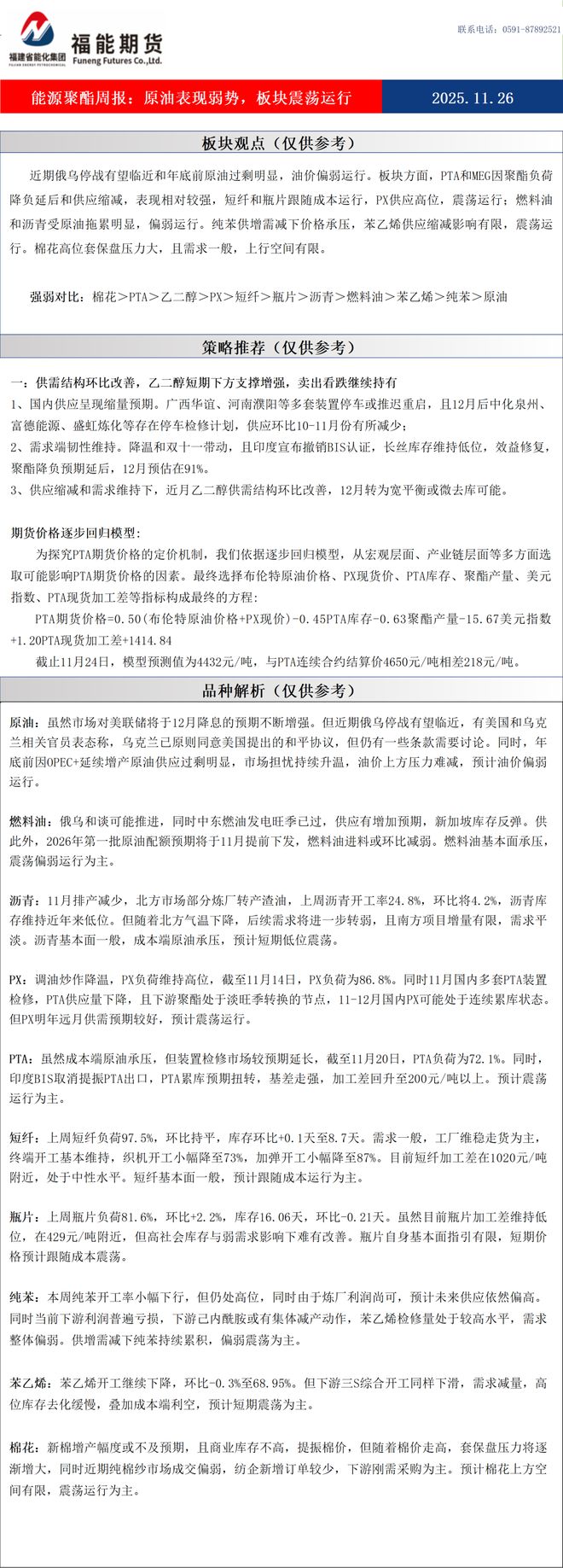
【能源聚酯周报】原油表现弱势,板块震荡运行(2025.11.26)
Xin Lang Cai Jing· 2025-11-26 01:30
Group 1: Oil and Asphalt Industry - The production of asphalt in November decreased, with a utilization rate of 24.8%, down 4.2% month-on-month, while inventory remains at historically low levels. However, demand is expected to weaken due to falling temperatures in the northern regions and limited project increments in the south, leading to a generally weak market outlook [5]. - PX production remains high at 86.8% as of November 14, but with several PTA facilities undergoing maintenance, supply is expected to decline. The PX market may face continuous inventory accumulation in November and December, although long-term supply-demand expectations for next year appear positive [5]. - PTA production is at 72.1% as of November 20, with maintenance extending longer than anticipated. The cancellation of PTA export restrictions by India has improved market conditions, leading to a stronger basis and a recovery in processing margins above 200 CNY/ton [5]. Group 2: Short Fiber and Polyester Industry - Short fiber production remains stable at 97.5%, with inventory increasing slightly to 8.7 days. Demand is moderate, with factories maintaining steady sales, while weaving and texturing operations have slightly decreased [6]. - Bottle chip production is at 81.6% with a decrease in inventory to 16.06 days. Despite low processing margins around 429 CNY/ton, high social inventory and weak demand hinder price improvements [6]. - Pure benzene production is slightly down but remains high, with downstream profits generally in the red, leading to potential production cuts in downstream products. Overall demand is weak, resulting in continued inventory accumulation and a bearish market outlook [6]. Group 3: Cotton and Yarn Market - The increase in new cotton production may not meet expectations, and with low commercial inventory, cotton prices are supported. However, as prices rise, hedging pressures will increase, and recent transactions in the pure cotton yarn market have been weak, with downstream demand primarily driven by necessity [7].

纯碱、玻璃日报-20251125
Jian Xin Qi Huo· 2025-11-25 09:12
Report Information - Report Title: Soda Ash and Glass Daily Report [1] - Report Date: November 25, 2025 [2] - Research Team: Energy and Chemical Research Team [4] - Researchers: Li Jie, Ren Junchi, Peng Haozhou, Peng Jinglin, Liu Youran, Feng Zeren [4] Industry Investment Rating - No investment rating information is provided in the report. Core Viewpoints - Soda ash continues to be in a weak pattern of supply - demand imbalance. Although weekly production and operating rate have declined, the absolute output remains high. With flat shipments, weak supply - demand in downstream float glass, and no improvement in terminal real estate and photovoltaic demand, the cost provides support but high inventory restricts price increase. Short - term trend is expected to be volatile, and medium - long term may be treated with rebound short - selling [8]. - For glass, the spot performance is lower than expected, supply is stable, inventory is high, and demand in the real estate market is weak. However, with the accelerating cold - repair due to declining profits, if about 5000 tons of production lines are cold - repaired by the end of the year, inventory can be reduced. Currently, the glass price is undervalued, and the downward space is limited. Without new market expectations, the downward trend may continue [9]. Summary by Directory 1. Soda Ash and Glass Market Review and Operation Suggestions Soda Ash - On November 24, the main soda ash futures SA601 contract rebounded slightly. The closing price was 1183 yuan/ton, up 12 yuan/ton or 1.02%, with a daily reduction of 58,280 lots [7]. - Soda ash is in a weak supply - demand imbalance. Weekly production and operating rate are down, but absolute output is still high. Downstream float glass has weak supply - demand, and terminal real estate and photovoltaic demand show no improvement. Cost supports the price, but high inventory restricts price increase. Short - term trend is volatile, and medium - long term may be rebound short - selling [8]. Glass - The spot performance is lower than expected, and the impact of concentrated production line shutdowns in Shahe is less than expected. Supply is stable, inventory is high after the holiday, and demand in the real estate market is weak. With declining profits, cold - repair is accelerating. About 5000 tons of production lines are planned for cold - repair by the end of the year. If cold - repaired, inventory can be reduced. Currently, the glass price is undervalued, and the downward trend may continue without new expectations [9]. 2. Data Overview - The report provides multiple data charts, including the price trends of active soda ash and glass contracts, soda ash weekly production, soda ash enterprise inventory, central China heavy soda market price, and flat glass production, but no specific data analysis is presented in the text [12][16][15]
备战新品种 | 一文读懂铂钯:投研框架与历史复盘
对冲研投· 2025-11-25 04:00
Core Viewpoint - The article discusses the upcoming launch of platinum and palladium futures on the Shanghai Futures Exchange, emphasizing the importance of understanding the supply-demand dynamics and historical price drivers in the platinum and palladium markets [5][6]. Group 1: Research Framework - The core framework for platinum and palladium research is based on supply-demand relationships, which are influenced by both micro-level mining costs and macroeconomic factors [6][24]. - Supply-demand balance determines the price direction of platinum and palladium, with mining supply primarily dominated by South Africa, accounting for over 70% of global supply [9][14]. - The automotive industry is the main demand driver for platinum and palladium, with platinum demand in the automotive sector projected to account for 39.85% of total platinum demand in 2024 [9][14]. Group 2: Price Influencing Factors - Mining costs provide short-term and long-term price support, with total cash costs (TCC) and all-in sustaining costs (AISC) being critical metrics for mining operations [17][24]. - The profitability of mining companies affects long-term capital expenditures, which in turn influences supply and price levels [18][19]. - Macroeconomic fluctuations and event shocks significantly impact supply-demand dynamics, thereby affecting platinum and palladium prices [22][43]. Group 3: Historical Price Trends - Historical price trends from 2000 to present are categorized into five periods, each driven by different core factors, including industrial demand and macroeconomic changes [44][45]. - The period from 2000 to 2008 saw strong industrial demand, particularly from the automotive sector, leading to significant price increases for platinum [45][48]. - The 2009 to 2015 period was characterized by macroeconomic uncertainty and supply disruptions, resulting in fluctuating prices for both platinum and palladium [49][53]. - From 2016 to 2018, structural changes in demand, particularly due to the rise of electric vehicles, negatively impacted platinum prices [54][56]. - The period from 2019 to 2022 was marked by increased volatility in palladium prices, driven by regulatory changes and supply chain disruptions due to the COVID-19 pandemic [59][60]. Group 4: Future Outlook - The outlook for platinum and palladium prices will be influenced by ongoing macroeconomic conditions, including inflation and interest rate expectations, as well as shifts in automotive demand due to electric vehicle adoption [62][63]. - The potential for a new round of price increases is anticipated as speculative demand rises, particularly in response to changes in the U.S. dollar and broader economic conditions [62][63].

黑色建材日报:宏观情绪扰动,钢价震荡运行-20251125
Hua Tai Qi Huo· 2025-11-25 03:32
Report Industry Investment Ratings - Steel: Sideways [1] - Iron Ore: Sideways with a Downward Bias [3] - Coking Coal: Sideways with a Downward Bias [5] - Coke: Sideways [5] - Thermal Coal: Sideways in the Short Term, Supply Remains Loose in the Long Term [7] Core Views - The steel market is affected by macro - sentiment, with prices oscillating. The inventory pressure of finished products has been significantly relieved, but the future demand situation needs attention [1]. - The iron ore market sentiment is positive, with prices rising slightly. However, the supply - demand imbalance is intensifying, and prices may face great pressure in the future [2]. - The coking coal and coke markets are pessimistic, with prices moving sideways. The coking coal supply is gradually recovering, and the coke cost support is weakening [4]. - The thermal coal market has increasing wait - and - see sentiment, with prices oscillating. The supply is tightening in the short term, but the long - term supply remains loose [6]. Summary by Related Catalogs Steel - **Market Analysis**: The main contract of rebar futures closed at 3089 yuan/ton, and that of hot - rolled coil at 3295 yuan/ton. The spot trading volume was good, with the national building materials trading volume at 13110 tons [1]. - **Supply - Demand and Logic**: After weeks of continuous inventory reduction, the inventory pressure of finished products has been relieved. The supply - demand fundamentals of building materials have improved month - on - month, while the high inventory of plates still suppresses prices [1]. - **Strategy**: Sideways for single - side trading, no strategies for inter - period, inter - variety, spot - futures, and options trading [1] Iron Ore - **Market Analysis**: The iron ore futures prices rose slightly. The prices of mainstream imported iron ore varieties in Tangshan ports increased slightly. The total transaction volume of major ports was 1.121 million tons, a 22.38% increase. The global iron ore shipment decreased by 6.8% to 3.278 billion tons, and the arrival volume at 45 ports increased by 24.2% to 2.817 billion tons. The inventory at 45 ports slightly increased to 15.102 billion tons [2]. - **Supply - Demand and Logic**: The supply - demand contradiction is intensifying, with the total inventory rising continuously. Downstream steel mills have started to cut production, and there is a possibility of further cuts [2]. - **Strategy**: Sideways with a downward bias for single - side trading, no strategies for inter - period, inter - variety, spot - futures, and options trading [3] Coking Coal and Coke - **Market Analysis**: The main contracts of coking coal and coke futures oscillated. The coke market was stable, but the bearish sentiment was increasing. Some coal mines in the coking coal production area resumed production, but the supply recovery was slow, and some coal mines started the second - round price cut [4]. - **Supply - Demand and Logic**: The coking coal supply increased slightly, and the short - term market was weak. The coke cost support weakened, and the market sentiment turned negative [4]. - **Strategy**: Sideways with a downward bias for coking coal, sideways for coke. No strategies for inter - period, inter - variety, spot - futures, and options trading [5] Thermal Coal - **Market Analysis**: The prices in the main production areas oscillated. The shipments of large stations and power plants were stable, and some coal mines' prices increased slightly. The port inventory was rising, and the downstream procurement was cautious. The imported coal market was strong, with obvious price advantages [6]. - **Strategy**: Sideways in the short term, with the supply remaining loose in the long term. Attention should be paid to the non - power coal consumption and inventory replenishment [7]
碳酸锂周度行情分析:需求高景气,碳酸锂偏强运行-20251125
Hai Zheng Qi Huo· 2025-11-25 02:30
Report Industry Investment Rating No relevant content provided. Core Views of the Report - Strategy: For unilateral trading, maintain a long - position mindset, monitor price movements at previous high levels (take profit if there is a sharp rally), and set stop - profit points. For options, hold out - of - the - money short put options with a light position and manage risks (rolling operations are possible). For calendar spreads, stay on the sidelines [4]. - Supply: Yichun's lithium mines are less likely to stop production. The Zhenkouli - Jianxiawo mine in Jiangxi is unlikely to resume production this year, eliminating supply concerns. Overall, supply is expected to increase steadily as expected. Also, new warehouse receipts registration volume may be a concern due to high demand and large open interest [5]. - Demand: Energy storage cell production is full, with independent energy storage contributing significant growth. New energy vehicles are in the peak production and sales season, and demand is expected to remain high in Q4 2025. Lithium prices are supported by strong demand, but supply growth may increase price volatility [5]. - Hedging: Lithium salt producers should conduct low - proportion short hedging, and downstream enterprises can conduct medium - proportion long hedging based on orders to lock in procurement costs [5]. - Basis: Hold cash - and - carry arbitrage portfolios with a light position and manage risks [5]. Summary by Related Catalogs 1. Market Review - As of November 13, battery - grade lithium carbonate increased by 3950 yuan week - on - week to 84350 yuan/ton, and industrial - grade lithium carbonate increased by 3800 yuan to 82000 yuan/ton. Battery - grade lithium hydroxide (coarse particles) increased by 500 yuan to 76180 yuan/ton. The price difference between battery - grade and industrial - grade lithium carbonate was 2350 yuan/ton, and the price difference between battery - grade lithium hydroxide and battery - grade lithium carbonate was - 8170 yuan/ton [9]. - As of November 13, the closing price of the lithium carbonate 2601 contract increased by 5540 yuan (+6.73%) week - on - week to 87840 yuan/ton, and the weighted open interest increased by 128,300 lots to 1,037,300 lots [9]. 2. Supply - Side Analysis 2.1 Lithium Ore Production and Import - In October 2025, the output of Chinese sample lithium spodumene was 7350 tons, a month - on - month increase of 550 tons (+8%); the total output of Chinese lithium mica was 12,700 tons, a month - on - month decrease of 450 tons (-3%) [12]. - In September 2025, China's lithium spodumene imports reached 711,000 physical tons, a month - on - month increase of 14.8%, equivalent to about 67,000 tons of lithium carbonate equivalent (LCE). Imports from Australia were 347,000 tons, a significant month - on - month increase of 64.1%; imports from Nigeria were about 120,000 tons, a month - on - month increase of 14.4%; imports from Zimbabwe were 109,000 tons, a month - on - month decrease of 7.8% [12]. - From November 3 to November 9, 2025, the total shipment of Mysteel's Australian lithium concentrate to China was 76,000 tons, a week - on - week decrease of 27,000 tons. The weekly average shipment to China was 68,000 tons, and the global shipment that week was 76,000 tons [12]. 2.2 Lithium Ore Price and Inventory - As of November 13, the price of Australian lithium spodumene concentrate increased by 125 dollars week - on - week to 1050 dollars/ton, and the price of lithium mica (2.0% - 2.5%) increased by 195 yuan to 2280 yuan/ton. As of November 7, the available inventory of lithium ore was 100,000 tons (82,000 tons in the previous period, increasing for three consecutive weeks) [15]. - As of November 13, the cash cost of producing lithium carbonate from imported lithium spodumene was 84,065 yuan/ton, with a production loss of 907 yuan/ton; the cash cost of producing lithium carbonate from imported lithium mica was 87,365 yuan/ton, and the loss from imported mica production was 6361 yuan/ton. The loss from producing lithium carbonate from imported raw materials deepened [15]. 2.3 Lithium Mine Project Progress - On November 6, 2025, the Natural Resources Department of Jiangxi Province released the "Public Notice of the Assessment Report on the Mining Right Transfer Income of the Zhenkouli - Jianxiawo Mine (Utilized but Unpaid Resources) in Yifeng County, Jiangxi Province". It is estimated that the probability of resuming production this year is low, and concerns about its resumption are weakened in the short term [15]. 2.4 Lithium Carbonate Production - According to SMM statistics, the weekly output of lithium carbonate in the week of November 13 was 21,545 tons, a week - on - week increase of 11 tons. Among them, the output from spodumene decreased by 220 tons to 12,904 tons (accounting for 60%), the output from mica decreased by 70 tons to 2941 tons (accounting for 14%), the output from salt lakes increased by 236 tons to 3555 tons (accounting for 17%), and the output from recycled materials increased by 65 tons to 2145 tons (accounting for 10%) [21]. - In October 2025, the monthly output of domestic lithium carbonate was 92,260 tons, a month - on - month increase of 6% and a year - on - year increase of 55%. The cumulative output from January to October was 780,000 tons, a year - on - year increase of 39%. It is expected that the output of domestic lithium carbonate in November can still maintain the production level of October, with a roughly flat month - on - month change [21]. 2.5 Lithium Carbonate and Hydroxide Import and Export - According to Chilean customs data, in October 2025, Chile exported 25,000 tons of lithium carbonate, a month - on - month increase of 56%; the amount exported to China was 16,200 tons, a year - on - year decrease of 4% and a month - on - month increase of 46%. From January to October 2025, Chile exported a total of 189,400 tons of lithium carbonate, a year - on - year decrease of 5.3%, and the amount exported to China was 137,100 tons, a year - on - year decrease of 15% [27]. - According to customs data, in September 2025, China's lithium carbonate imports were about 19,600 tons, a month - on - month decrease of 10.3%, mainly affected by previous concentrated arrivals and domestic inventory digestion rhythms. Among them, 10,800 tons were imported from Chile, accounting for 55.2%, and 6948 tons were imported from Argentina, accounting for 35.5% [27]. - According to SMM statistics, in October 2025, the output of lithium hydroxide was 29,220 tons, a month - on - month increase of 6% and a year - on - year decrease of 5%. Among them, the smelting output was 24,950 tons, and the causticizing output was 4270 tons. It is expected that the overall output of lithium hydroxide in November will have a slight upward trend, with a roughly flat year - on - year performance [28]. - According to customs data, China's lithium hydroxide imports in September 2025 were 1473 tons, a month - on - month increase of 20.3%, mainly due to the moderate recovery of high - nickel ternary material demand; exports were 6526 tons, a month - on - month increase of 15% and a year - on - year decrease of 48.7% [28]. 3. Demand - Side Analysis 3.1 New Energy Vehicle Market - In October 2025, the production and sales of new energy vehicles were 1.772 million and 1.715 million respectively, a year - on - year increase of 21.1% and 20%, and a month - on - month increase of 9.6% and 6.9% respectively. From January to October, the cumulative production and sales of new energy vehicles were 13.015 million and 12.943 million respectively, a year - on - year increase of 33.1% and 32.7% respectively [33]. - In 2025, from January to October, the sales of new energy heavy - duty trucks in China exceeded 119,600, a year - on - year increase of 198%. In September 2025, 392,000 new energy vehicles were sold in Europe, a year - on - year increase of 33% and a month - on - month increase of 62%, with a market penetration rate of 31.7% [33]. - In October 2025, new energy vehicle exports were 256,000, a month - on - month increase of 15% and a year - on - year increase of 100%. From January to October, the cumulative exports were 1.983 million, a year - on - year increase of 87.4% [33]. - As of November 13, 17 mainstream automobile brands have launched purchase tax subsidy plans, which will ease the cliff - like decline in vehicle sales across the year to some extent [33]. 3.2 Energy Storage Market - Domestic energy storage cell supply is growing steadily, and demand from diversified investment entities is increasing. Overseas energy storage orders are also growing due to tariff relief and favorable policies [36]. - The "New Energy Storage Large - scale Construction Special Action Plan (2025 - 2027)" sets a goal of reaching an installed capacity of over 180 million kilowatts by 2027, driving direct investment of about 250 billion yuan [36]. - Australia, the UK and other countries have introduced policies to support the development of energy storage, ensuring sufficient energy storage orders [36]. 3.3 Lithium Battery Production - According to SMM statistics, in October 2025, China's lithium battery output was 192.9 GWh, a month - on - month increase of 8%. Among them, the output of power cells increased by 11% to 125 GWh, the output of energy storage cells increased by 3% to 54 GWh, and the output of consumer and other cells increased by 3% to 14 GWh [43]. - From November 7, 2025, to November 10, 2026, the implementation of 6 export control measures related to strategic fields such as rare earths, lithium batteries, and super - hard materials will be suspended [43]. - According to大东时代智库, in November 2025, the production of power + energy storage batteries in Chinese battery factories was 193 GWh; the production of lithium battery A was 71.4 GWh, the production of lithium battery B was 31.4 GWh, and the production of lithium battery C was 14.9 GWh. The production of consumer - type batteries in the Chinese market was about 16 GWh. The production of power + energy storage + consumer - type batteries in the Chinese market in November 2025 was 209 GWh, a month - on - month increase of 12.4% and a year - on - year increase of 64.6% [47]. 3.4 Lithium Battery Material Market - Lithium iron phosphate: In October 2025, the output of lithium iron phosphate was 394,350 tons, a month - on - month increase of 10.5% and a year - on - year increase of 51%. It is expected that the production in November will increase by 8% month - on - month to 425,898 tons [49]. - Ternary materials: In October 2025, the output of ternary materials was 84,090 tons, a month - on - month increase of 11.6% and a year - on - year increase of 43%. It is expected that the market demand will continue to improve in November, and the production plan will continue to rise slightly, with a month - on - month increase of 1.37% and a year - on - year increase of 39.76% [49]. - According to SMM statistics, in October 2025, China's electrolyte output increased by 4.8% month - on - month to 207,580 tons, a year - on - year increase of 29%. From January to October, the cumulative output was 1.655 million tons, a year - on - year increase of 52.3% [50]. - According to SMM research, in October 2025, China's lithium hexafluorophosphate output increased by 14% month - on - month to 25,420 tons, a year - on - year increase of 29%. From January to October, the cumulative output was 200,000 tons, a year - on - year increase of 38.4% [50]. 4. Inventory Analysis - As of November 13, the lithium carbonate inventory decreased by 3481 tons week - on - week to 120,500 tons. Among them, the smelter inventory decreased by 2445 tons to 28,000 tons, the downstream inventory decreased by 3236 tons to 48,800 tons, and the inventory of other sectors such as traders increased by 2200 tons to 43,400 tons [54]. - As of November 13, the warehouse receipt volume was 26,420 tons, a week - on - week increase of 176 tons and a month - on - month decrease of 2384 tons. New warehouse receipts registration volume may be a concern due to high demand and the forced cancellation of non - compliant warehouse receipts at the end of November [54]. 5. Basis Analysis - The holding cost for 1 - month is about 1838 yuan/ton, and for 2 - month is about 2460 yuan/ton. Hold cash - and - carry arbitrage portfolios and manage risks [56]. 6. Spread Analysis - The 11 - 12 spread showed a reverse - arbitrage trend approaching the November delivery month. Pay attention to the reverse - arbitrage opportunity of the 03 - 04 spread approaching the March delivery month [58].
大越期货碳酸锂期货早报-20251125
Da Yue Qi Huo· 2025-11-25 02:20
1. Report Industry Investment Rating - Not provided in the document 2. Core View of the Report - The supply - demand of lithium carbonate is in a tight balance, and the market is affected by emotional fluctuations triggered by news. The lithium carbonate 2601 contract is expected to fluctuate in the range of 88,700 - 92,260 yuan/ton [8][10][13] 3. Summary by Relevant Catalogs 3.1 Daily View - **Supply**: Last week, the lithium carbonate production was 22,130 tons, a 2.71% week - on - week increase, higher than the historical average [8] - **Demand**: Last week, the inventory of sample enterprises of lithium iron phosphate was 102,584 tons, a 2.05% week - on - week decrease; the inventory of sample enterprises of ternary materials was 19,290 tons, a 0.41% week - on - week increase [8] - **Cost**: The cost of purchased lithium spodumene concentrate was 89,670 yuan/ton, a 1.97% daily decrease, with a profit of 1,350 yuan/ton; the cost of purchased lithium mica was 93,596 yuan/ton, a 3.56% daily decrease, with a loss of 4,836 yuan/ton. The cost of the recycling end is generally higher than that of the ore end, and the production enthusiasm is low. The quarterly cash production cost of the salt lake end is 31,477 yuan/ton, with sufficient profit margins and strong production motivation [10] - **Fundamentals**: Neutral. The basis of the 01 contract was 1,670 yuan/ton on November 24, with the spot at a premium to the futures, which is bullish. The overall inventory decreased by 1.70% week - on - week, higher than the historical average, which is neutral. The MA20 of the market is upward, and the futures price of the 01 contract closed above the MA20, which is bullish. The net short position of the main contract decreased, which is bearish [10] - **Expectation**: In October 2025, the lithium carbonate production was 92,260 physical tons, and the predicted production for next month is 92,080 physical tons, a 0.19% decrease. The import volume in October was 23,881 physical tons, and the predicted import volume for next month is 27,000 physical tons, a 13.06% increase. The demand is expected to strengthen next month, and the inventory may be reduced. The 6% concentrate CIF price decreased daily, lower than the historical average, and the demand continued to strengthen [10] - **Likely factors**: Lithium mica manufacturers' plans to stop or reduce production, and the month - on - month decline in the amount of lithium carbonate imported from Chile [11] - **Negative factors**: The supply at the ore/salt lake end remains at a high level, and the decline is limited [12] 3.2 Lithium Carbonate Market Overview - **Prices**: The prices of various lithium - related products such as lithium spodumene, lithium mica, lithium salts, cathode materials, and lithium batteries showed different degrees of increase or decrease. For example, the price of battery - grade lithium carbonate was 92,150 yuan/ton, a 0.16% decrease; the price of industrial - grade lithium carbonate was 89,750 yuan/ton, a 0.17% decrease [16] - **Registered Warehouse Receipts**: There were 26,510 lots, a 1.26% decrease [16] 3.3 Supply - Demand Data Overview - **Supply - side**: The weekly and monthly production, import, and export data of lithium carbonate, lithium hydroxide, and other products are provided. For example, the monthly production of lithium carbonate in October 2025 was 92,260 tons, a 5.73% increase; the monthly import volume was 23,880.69 tons, a 21.86% increase [20] - **Demand - side**: The monthly production, export, and inventory data of downstream products such as lithium iron phosphate, ternary materials, and lithium batteries are provided. For example, the monthly export of lithium iron phosphate in October was 5,476,869 kg, a 77.13% increase; the weekly inventory of lithium iron phosphate was 102,584 tons, a 2.06% decrease [20] 3.4 Supply - Related Data - **Lithium Ore**: The price, production, import, and self - sufficiency rate of lithium ore over the years are presented through charts. The price of lithium ore has fluctuated over time, and the production and import volume have also changed [26] - **Lithium Carbonate**: The weekly and monthly production, import, and capacity data of lithium carbonate are provided. The weekly and monthly production of lithium carbonate has shown different trends, and the import volume has also changed [32] - **Lithium Hydroxide**: The weekly capacity utilization rate, monthly production, export, and import data of lithium hydroxide are provided. The weekly capacity utilization rate of lithium hydroxide has fluctuated, and the production and export volume have also changed [39] 3.5 Cost - Profit of Lithium Compounds - The cost - profit data of various lithium compounds such as purchased lithium spodumene concentrate, purchased lithium mica concentrate, and recycled lithium carbonate are provided. The cost and profit of different raw materials and production methods vary [44][46][49] 3.6 Inventory - The inventory data of lithium carbonate and lithium hydroxide, including monthly and weekly inventory by source, are provided. The inventory of lithium carbonate and lithium hydroxide has shown different trends over time [51] 3.7 Demand - Related Data - **Lithium Batteries**: The price, production, export, and inventory data of lithium batteries are provided. The price and production of lithium batteries have changed, and the export volume has also shown different trends [54][57] - **Ternary Precursors**: The price, cost, profit, production, and supply - demand balance data of ternary precursors are provided. The price and cost - profit of ternary precursors have changed, and the supply - demand balance has also fluctuated [60][63] - **Ternary Materials**: The price, cost - profit, production, export, import, and inventory data of ternary materials are provided. The price and cost - profit of ternary materials have changed, and the production, export, import, and inventory have also shown different trends [66][68] - **Phosphoric Acid/Phosphoric Acid Lithium Iron**: The price, production cost, profit, production, and capacity data of phosphoric acid and lithium iron phosphate are provided. The price and cost - profit of phosphoric acid and lithium iron phosphate have changed, and the production and capacity have also shown different trends [70][73] - **New Energy Vehicles**: The production, sales, export, and penetration rate data of new energy vehicles are provided. The production, sales, and export of new energy vehicles have increased, and the penetration rate has also continued to rise [78][79]
大越期货沪铜周报-20251124
Da Yue Qi Huo· 2025-11-24 02:32
Report Overview - Report Title: Shanghai Copper Weekly Report (11.17 - 11.21) - Author: Zhu Senlin from Dayue Futures Investment Consulting Department - Contact: 0575 - 85226759 [1] 1. Report Industry Investment Rating - No investment rating information is provided in the report. 2. Report's Core View - Last week, Shanghai copper fluctuated and adjusted. The main contract of Shanghai copper fell 1.43% to 85,600 yuan/ton. Geopolitical factors and US tariffs affected copper prices. Global instability remains, while force majeure in Indonesian copper mines and the rise of precious metals supported copper prices. In China, it's the consumption off - season, and downstream consumption willingness is average. Domestic spot trading is mainly for rigid demand. LME copper inventory was 155,025 tons, with a slight increase last week, and SHFE copper inventory increased by 1,196 tons to 110,603 tons [4]. 3. Summary by Relevant Catalogs 3.1 Market Review - Last week, the main contract of Shanghai copper fell 1.43% to 85,600 yuan/ton. Geopolitical factors and US tariffs disturbed copper prices. Global instability persists, and force majeure in Indonesian copper mines and the rise of precious metals supported copper prices. In China, it's the consumption off - season, and downstream consumption willingness is average. Domestic spot trading is mainly for rigid demand. LME copper inventory was 155,025 tons, with a slight increase last week, and SHFE copper inventory increased by 1,196 tons to 110,603 tons [4]. 3.2 Fundamental Analysis 3.2.1 PMI - No specific PMI data or analysis is provided in the report. 3.2.2 Supply - Demand Balance - In 2024, the supply - demand is in tight balance, and in 2025, there will be an oversupply. The Chinese annual supply - demand balance table shows the production, import, export, apparent consumption, actual consumption, and supply - demand balance of copper from 2018 to 2024. For example, in 2024, production was 12.06 million tons, import was 3.73 million tons, export was 0.46 million tons, apparent consumption was 15.34 million tons, actual consumption was 15.23 million tons, and the supply - demand balance was 0.11 million tons [12][15]. 3.2.3 Inventory - LME copper inventory was 155,025 tons, with a slight increase last week. SHFE copper inventory increased by 1,196 tons to 110,603 tons. Exchange inventory is in the process of destocking, and bonded area inventory remains at a low level [4][16][19]. 3.3 Market Structure 3.3.1 Processing Fees - Processing fees are at a low level [22]. 3.3.2 CFTC Position - CFTC non - commercial net long positions are flowing out [24]. 3.3.3 Futures - Spot Price Difference - No specific analysis of the futures - spot price difference is provided in the report. 3.3.4 Import Profit - No specific analysis of import profit is provided in the report. 3.3.5 Warehouse Receipts - No specific analysis of warehouse receipts is provided in the report.
有机硅行业专家会议
2025-11-24 01:46
Summary of the Organic Silicon Industry Conference Industry Overview - The organic silicon industry is responding to weak demand by implementing a production cut of 30% as decided in the November meeting, aiming to raise DMC prices to 13,500-14,000 RMB/ton, although previous unsuccessful cuts may affect execution effectiveness [1][3][9] - The industry is experiencing increased costs due to rising electricity prices during the dry season, impacting the pricing strategy as downstream customers remain cautious about high quotes of 13,200 RMB/ton [1][6] Key Points and Arguments - **Production Cuts and Price Adjustments**: The industry plans to maintain a balance between supply and demand by controlling inventory to within 45 days, with DMC prices expected around 13,200 RMB/ton and profit margins between 1,000-1,200 RMB [2][16] - **Market Participation**: High participation from companies in the recent meetings, particularly led by He Sheng's chairman, has positively influenced the industry, although previous maintenance and restarts may hinder the effectiveness of the production cuts [1][8] - **Demand Dynamics**: Traditional demand from the real estate sector is declining, affecting construction sealant needs, while emerging sectors like electric vehicles and battery sealants are providing growth opportunities [1][12][13] - **Strategic Focus of Companies**: Companies like Luxi Chemical are focusing on downstream extension and high-end product development, indicating a shift towards higher value-added products [1][12] Additional Important Insights - **International Market Expansion**: Domestic demand for organic silicon may decline, prompting companies to explore overseas markets, especially as foreign firms like Dow and Bluestar gradually withdraw from overseas capacities due to EU carbon tariffs [1][14][16] - **Future Capacity Plans**: Several companies plan to increase production capacity, such as Yunnan Energy Investment with a planned 400,000 tons and Xinjiang Qiya aiming for the world's largest organic silicon single unit with 1.5-1.6 million tons [11][19] - **Challenges in Execution**: The effectiveness of the production cut plan is contingent on establishing a robust supervision mechanism, as previous attempts faced challenges due to trade tensions and inventory pressures [4][5] - **Market Price Formation**: Current market prices are influenced by raw material costs, particularly industrial silicon, which has seen price increases due to rising electricity costs [6][18] - **Emerging Product Opportunities**: New products like organic silicon leather show potential in various applications, indicating a diversification strategy within the industry [13] Conclusion The organic silicon industry is navigating a complex landscape of declining traditional demand and rising costs while seeking to capitalize on emerging opportunities. The focus on production cuts, strategic market expansion, and high-value product development will be crucial for maintaining profitability and market stability in the coming years.