
降准降息

Search documents
解码央行发布会:八项措施落地,全面降准降息还有多远?
Hua Er Jie Jian Wen· 2026-01-16 00:37
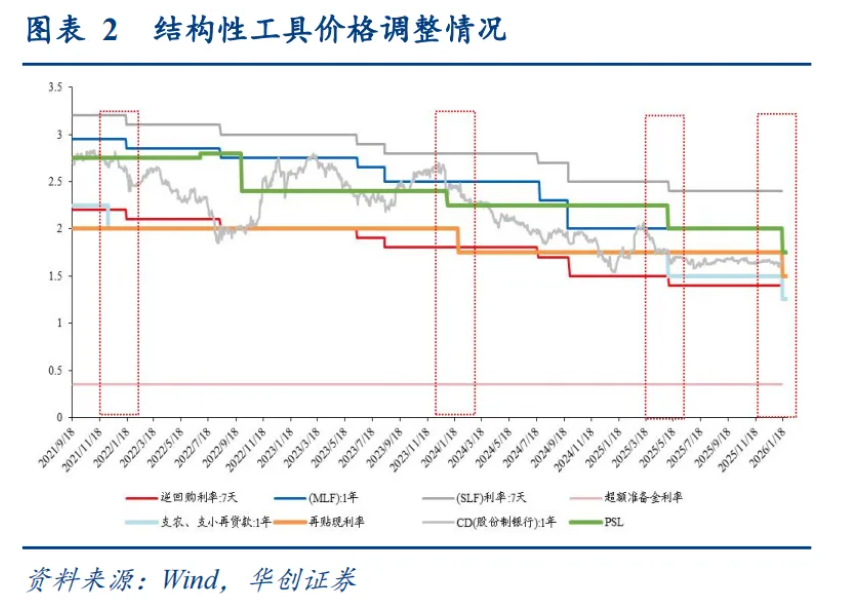
Core Viewpoint - The People's Bank of China (PBOC) has introduced a set of structural monetary policy measures, including a 0.25 percentage point reduction in various structural monetary policy tool rates, signaling a targeted approach to enhance liquidity without a broad interest rate cut [1][2][5]. Group 1: Structural Monetary Policy Measures - The PBOC announced a reduction in the one-year relending rate from 1.5% to 1.25%, and the rediscount rate from 1.75% to 1.5% [2]. - The total balance of structural monetary policy tools was approximately 5.4 trillion yuan as of Q3 2025, with the rate cut expected to save banks around 13.5 billion yuan [8]. - The measures aim to support domestic demand, technological innovation, and small and medium-sized enterprises [12]. Group 2: Specific Policy Tools - The PBOC will increase the relending quota for agricultural and small enterprise support by 500 billion yuan, with a dedicated quota of 1 trillion yuan for private enterprises [16]. - The relending quota for technological innovation and transformation will be increased by 400 billion yuan, totaling 1.2 trillion yuan [16]. - The minimum down payment ratio for commercial property loans will be lowered to 30% to support the commercial real estate market [18]. Group 3: Future Monetary Policy Outlook - The PBOC indicated that there is still room for further reductions in reserve requirement ratios and interest rates, with a potential 50 basis point cut in the first quarter of 2026 [19][20]. - Constraints on interest rate cuts are easing, with improvements in exchange rates and net interest margins noted [21]. - The PBOC aims to guide overnight rates to operate near policy rate levels, indicating a shift in monetary policy management [24][26]. Group 4: Market Implications - The structural easing is expected to positively impact various asset classes, with a potential "spring rally" in the stock market anticipated due to the release of monetary signals [29]. - The bond market is expected to remain stable, with 10-year government bond yields projected to stay between 1.6% and 1.9% [30]. - The Chinese yuan is forecasted to appreciate moderately, with expectations of reaching around 6.9 by the end of 2026 [30].

“组合拳”支持经济高质量发展:申万期货早间评论-20260116
申银万国期货研究· 2026-01-16 00:36
Core Viewpoint - The central theme of the articles revolves around the Chinese central bank's "combination punch" to support high-quality economic development through various monetary policy measures, including interest rate cuts and increased lending to small and medium-sized enterprises [1][8]. Monetary Policy Measures - The central bank has lowered the re-lending and rediscount rates by 0.25 percentage points [1][8]. - The re-lending quota for agricultural and small business support has been increased by 500 billion yuan, with a total quota of 1 trillion yuan specifically for private enterprises [1][8]. - The re-lending quota for technological innovation and transformation has been increased by 400 billion yuan, expanding the support scope [1][8]. - The minimum down payment ratio for commercial property loans has been reduced to 30% [1][8]. - The central bank indicated that there is still room for further rate cuts and reserve requirement ratio reductions this year [1][8]. International Trade and Tariffs - The U.S. plans to impose a 25% import tariff on certain semiconductor products starting January 15, which includes Nvidia's H200 chip and AMD's MI325X [1][7]. Commodity Market Trends - In the commodity market, energy products saw significant declines, with fuel oil dropping by 2.82% and various chemical products also experiencing downturns [1]. - Agricultural products mostly rose, with corn starch increasing by 0.55% [1]. Oil Market Insights - The oil market is influenced by geopolitical factors, with expectations of increased exports from Venezuela due to a stable situation [2][15]. - OPEC forecasts that global demand for oil from its member countries will remain stable, with daily demand projected to increase to 43 million barrels by 2027 [2][15]. Palm Oil Market Analysis - Malaysia's palm oil production in December was reported at 1,829,761 tons, a decrease of 5.46% month-on-month, while exports increased by 8.52% [3][27]. - Concerns about palm oil demand have arisen due to Indonesia's decision to maintain its biodiesel blending ratio at B40 instead of increasing it to 50% [3][27]. Precious Metals Outlook - Recent economic data indicates easing inflation pressures in the U.S., which supports expectations for interest rate cuts and a favorable environment for precious metals [4][20]. - Gold's long-term upward trend is expected to continue, supported by factors such as central bank purchases and weakening dollar confidence [4][20]. Financial Market Developments - The stock market is experiencing a shift from valuation-driven growth to profit-driven growth, with expectations for continued upward movement supported by policy effects and economic recovery [12]. - The financing balance in the stock market increased by 15.237 billion yuan, indicating a positive sentiment among investors [12].

中信证券:全年逆回购利率降息幅度或为10bps
Zheng Quan Shi Bao Wang· 2026-01-16 00:34
Core Viewpoint - The People's Bank of China (PBOC) has lowered the interest rates on various relending tools by 25 basis points, which is not a traditional cut in reverse repo rates or LPR, but a targeted approach through structural tools [1] Group 1: Impact on Banking Sector - This measure is expected to enhance banks' willingness to lend and promote stable credit growth, which may alleviate pressure on bank interest margins [1] - The PBOC is also expanding and innovating its relending tools, reinforcing targeted support for key sectors through a dual approach of "quantitative expansion + directional guidance" [1] Group 2: Credit Structure Optimization - The ongoing support is aimed at optimizing the credit structure towards technology, green initiatives, inclusive finance, elderly care, and digital sectors [1] Group 3: Monetary Policy Outlook - The PBOC indicated that there is still room for reserve requirement ratio (RRR) and interest rate cuts this year, but given the sustained export performance and short-term economic momentum, it is expected that short-term policy adjustments will remain restrained [1] - The anticipated reduction in reverse repo rates for the year is projected to be around 10 basis points [1]

【新华解读】开年一揽子增量货币政策率先来袭 结构性工具“加量降价”支持经济
Xin Lang Cai Jing· 2026-01-16 00:34
Core Viewpoint - The People's Bank of China (PBOC) has announced eight measures to support the real economy through structural monetary policy tools, including a 25 basis point reduction in interest rates for various structural monetary policy tools, signaling potential room for further cuts in reserve requirement ratios and interest rates throughout the year [1][2][7]. Group 1: Structural Monetary Policy Measures - The PBOC will lower the interest rates of various structural monetary policy tools by 0.25 percentage points starting January 19, with new rates for loans to agriculture and small enterprises set at 0.95%, 1.15%, and 1.25% for 3-month, 6-month, and 1-year terms respectively [2][3]. - The measures aim to reduce financing costs in specific sectors, particularly for small and micro enterprises, technology innovation, and green transformation, thereby lowering the overall financing costs for the real economy [3][4]. - The PBOC will increase the quota for loans to agriculture and small enterprises by 500 billion yuan, with a separate quota of 1 trillion yuan for private enterprises [4][5]. Group 2: Broader Economic Support - The PBOC plans to expand the scope of support for technology innovation and technical transformation loans, increasing the quota by 400 billion yuan to a total of 1.2 trillion yuan [5]. - The measures also include the integration of existing bond financing support tools for private enterprises and technology innovation, providing a combined loan quota of 200 billion yuan [5]. - The PBOC aims to enhance financial support for specific industries such as technology, consumption, and elderly care, which is expected to boost confidence among business entities and stabilize market expectations [3][5]. Group 3: Overall Monetary Policy Outlook - The PBOC has indicated that there is still room for further cuts in reserve requirement ratios, with an estimated space of 130 basis points based on the current average reserve requirement ratio of 6.3% [7][8]. - The PBOC has also utilized open market operations to inject long-term liquidity into the banking system, suggesting that monetary policy will not be constrained by reserve requirement cuts alone [7][8]. - The overall focus of the monetary policy will remain on using structural tools effectively to support the transition to new growth drivers while avoiding excessive liquidity that could lead to inflation or high debt levels [8].

财联社1月16日早间新闻精选
Xin Lang Cai Jing· 2026-01-16 00:28
Monetary Policy and Financial Support - The People's Bank of China (PBOC) has lowered the interest rates of various structural monetary policy tools by 0.25 percentage points, with the one-year relending rate decreasing from 1.5% to 1.25% [1] - The minimum down payment ratio for commercial housing loans has been reduced to 30%, and the relending quota for supporting agriculture and small enterprises has been increased by 500 billion yuan, with a total quota for private enterprises set at 1 trillion yuan [2][3] - The loan quota for technological innovation and transformation has been raised from 800 billion yuan to 1.2 trillion yuan, including support for private small and medium-sized enterprises with high R&D investment levels [2][3] Financial Market Data - As of the end of December, the broad money supply (M2) stood at 340.29 trillion yuan, reflecting a year-on-year growth of 8.5% [3] - The total social financing scale for the year 2025 reached 35.6 trillion yuan, an increase of 3.34 trillion yuan compared to the previous year, with new RMB loans amounting to 16.27 trillion yuan [3] Regulatory Developments - The Financial Regulatory Bureau has emphasized the need for effective risk resolution for small financial institutions and the establishment of a normalized financing coordination mechanism for urban real estate [5] - The Ministry of Finance announced a tax exemption policy for foreign institutions investing in the domestic bond market, effective from January 1, 2026, to December 31, 2027 [8] Corporate Announcements - China Aerospace Science and Technology Corporation has set a goal to advance reusable rocket technology and promote commercial aerospace development in 2026 [7] - Liou Technology announced a significant contract with CATL worth 120 billion yuan, but the stock will remain suspended for one additional day due to uncertainties [12] - Mu Yuan Co. has projected a net profit of 14.7 billion to 15.7 billion yuan for 2025, indicating a year-on-year decline of 12.20% to 17.79% [16] Stock Market Performance - The three major U.S. stock indices closed higher, with the Dow Jones up by 0.60%, the S&P 500 rising by 0.26%, and the Nasdaq increasing by 0.25% [17] - The Nasdaq Golden Dragon China Index fell by 0.6%, indicating a mixed performance among popular Chinese concept stocks [17]
中信证券:再贷款降息落地 降准降息还有一定空间
Di Yi Cai Jing· 2026-01-16 00:26
Group 1 - The central bank has lowered the interest rates of various relending tools by 25 basis points, which is not a traditional cut in reverse repo rates or LPR, but rather a targeted approach through structural tools [1] - This measure is expected to enhance banks' willingness to lend, promote stable credit growth, and alleviate pressure on bank interest margins [1] - The central bank is also expanding and innovating relending tools, aiming to provide targeted support to key areas such as technology, green finance, inclusive finance, elderly care, and digital sectors [1] Group 2 - The central bank indicates that there is still room for reserve requirement ratio and interest rate cuts this year, but short-term policy adjustments are expected to remain restrained due to ongoing export performance and short-term economic momentum [1] - The anticipated reduction in reverse repo rates for the year is expected to be around 10 basis points [1] - In terms of exchange rates, the central bank continues to maintain a policy of keeping the currency stable at a reasonable level, focusing on preventing excessive fluctuations and improving expectation management rather than using exchange rate adjustments to gain trade competitiveness [1]
央行:降准降息还有一定空间;今日将有1只新股申购……盘前重要消息还有这些
证券时报· 2026-01-16 00:25
Key Points - The People's Bank of China (PBOC) announced a reduction in the re-lending and re-discount rates by 0.25 percentage points, effective January 19, 2026, to enhance the effectiveness of structural monetary policy tools [4] - The average statutory deposit reserve ratio for financial institutions is currently 6.3%, indicating room for further cuts in reserve requirements and interest rates [4] - The PBOC and the Financial Regulatory Bureau have lowered the minimum down payment ratio for commercial property loans to 30% to support the real estate market [5] - As of the end of 2025, the total social financing stock was 442.12 trillion yuan, with a year-on-year growth of 8.3% [5] - The Ministry of Commerce emphasized the importance of economic globalization and trade liberalization, expressing willingness to sign bilateral and regional trade agreements [6] - The Ministry of Human Resources and Social Security and the Ministry of Finance released opinions to enhance the inclusiveness and flexibility of enterprise annuity systems [6] - From January 1, 2026, to December 31, 2027, interest income from bonds obtained by foreign institutions in the domestic bond market will be exempt from corporate income tax and value-added tax [7] - The Shanghai Futures Exchange announced adjustments to the margin requirements and trading limits for tin futures [7] - The Shenzhen Municipal Bureau of Industry and Information Technology launched an action plan to create an artificial intelligence One Person Company (OPC) entrepreneurial ecosystem by 2027 [7] - China Aerospace Science and Technology Corporation emphasized the acceleration of equipment combat capability enhancement and the promotion of commercial aerospace and low-altitude economy [8] Company News - Zhite New Materials has completed its suspension for verification and will resume trading on the 16th [10] - Saintno Bio is expected to see a net profit increase of 204.42% to 280.53% year-on-year for 2025 [11] - Xinhua Department Store denied rumors regarding the injection of semiconductor-related assets [12] - Huasheng Tiancheng reported that AI-related revenue currently constitutes a low percentage of overall revenue [13] - Leo Group will suspend trading from the 16th to verify stock trading fluctuations [14] - Zhong Rare Metals signed a strategic cooperation agreement with Xiandai Group [15] - *ST Aowei may face delisting due to stock price falling below par value [16]

央行开年即送货币金融政策大礼包支持实体经济
Shang Hai Zheng Quan Bao· 2026-01-16 00:19
八项具体举措支持实体经济 □ 下调各类结构性货币政策工具利率0.25个百分点 □ 增加支农支小再贷款额度5000亿元,单设民营企业再贷款 □ 将科技创新和技术改造再贷款额度从8000亿元增至1.2万亿元 □ 合并设立科技创新与民营企业债券风险分担工具 □ 拓展碳减排支持工具的支持领域 □ 拓展服务消费与养老再贷款的支持领域 □ 将商业用房购房贷款最低首付比例下调至30% □ 鼓励金融机构提升汇率避险服务水平 在国新办1月15日举行的新闻发布会上,中国人民银行、国家外汇局有关负责人介绍货币金融政策支持 实体经济高质量发展成效。会上宣布了年初先行出台的一批货币金融政策,包括下调结构性货币政策工 具利率、下调商业用房购房贷款最低首付比例等8项具体举措。 针对备受关注的降准降息,中国人民银行新闻发言人、副行长邹澜在发布会上表示,降准降息从今年看 还有一定空间。 多项政策快速落地。昨日晚间,中国人民银行宣布实施4项具体政策举措,包括:下调再贷款、再贴现 利率;增加支农支小再贷款额度、设立民营企业再贷款;增加科技创新和技术改造再贷款额度;拓展碳 减排支持工具支持领域。 下调结构性货币政策工具利率 完善结构性工具并加大支持 ...
央行开年即送货币金融政策大礼包支持实体经济!其中4项具体举措昨晚落地 今年降准降息还有空间
Xin Lang Cai Jing· 2026-01-16 00:06
Core Viewpoint - The People's Bank of China (PBOC) and the State Administration of Foreign Exchange (SAFE) announced a series of monetary policies aimed at supporting high-quality development of the real economy, including interest rate cuts and adjustments to loan requirements for commercial properties [1][10]. Group 1: Monetary Policy Measures - The PBOC introduced eight specific monetary policy measures, including lowering the rates of structural monetary policy tools and reducing the minimum down payment ratio for commercial property loans [1][10]. - A 0.25 percentage point reduction in various structural monetary policy tool rates was announced, with the one-year re-lending rate decreasing from 1.5% to 1.25% [2][11]. - The PBOC will increase the quota for agricultural and small business re-lending by 500 billion yuan and establish a separate re-lending quota of 1 trillion yuan for private enterprises [2][11]. - The quota for re-lending for technological innovation and technological transformation will be increased from 800 billion yuan to 1.2 trillion yuan, expanding support to high R&D investment private SMEs [2][11]. Group 2: Support for Specific Sectors - The PBOC will merge the existing private enterprise bond financing support tool and the technological innovation bond risk-sharing tool, providing a total re-lending quota of 200 billion yuan [3][12]. - The scope of carbon reduction support tools will be expanded to include energy-saving renovations and green upgrades, guiding banks to support comprehensive green transitions [3][12]. - The minimum down payment ratio for commercial property loans will be lowered to 30% to support the commercial real estate market [3][12]. Group 3: Future Monetary Policy Outlook - The PBOC indicated that there is still room for further cuts in reserve requirement ratios and interest rates, with the average reserve requirement ratio currently at 6.3% [4][14]. - The PBOC plans to maintain liquidity and promote low financing costs through various measures, including transparent loan cost disclosures [4][14]. - The PBOC will flexibly conduct government bond trading operations to ensure a suitable monetary environment for government bond issuance [6][15]. Group 4: Exchange Rate and Foreign Exchange Market - The RMB is expected to continue to fluctuate within a dual-directional range, maintaining elasticity, with recent appreciation against the USD due to improved Sino-US trade relations [7][16]. - The foreign exchange market in China has seen record trading volumes, with a significant increase in the hedging ratio for enterprises, reaching 30% in 2025 [8][17]. - The SAFE will continue to enhance monitoring of cross-border capital flows and improve macro-prudential management to maintain stability in the foreign exchange market [8][17].
央行、国家外汇局有关负责人详解货币金融政策
Xin Hua Cai Jing· 2026-01-15 23:56
2025年适度宽松的货币政策发力显效,为经济稳定增长和高质量发展创造了适宜的货币金融环境。2025 年货币信贷呈现什么特征?2026年金融举措将在哪些方面发力?在1月15日国新办举行的新闻发布会 上,中国人民银行、国家外汇管理局有关负责人详解2025年金融统计数据,并回应热点问题。 中国人民银行调查统计司司长闫先东介绍,2025年货币信贷呈现"总量增长、结构优化"的特征。2025年 企(事)业单位贷款增加15.47万亿元,是信贷增长主体。其中中长期贷款是企(事)业单位贷款增加 的主要构成,表明金融持续为实体经济提供稳定的资金来源。 记者从发布会上了解到,在金融"五篇大文章"领域,信贷总量增长较快,融资成本明显下降。截至去年 11月末,金融"五篇大文章"贷款余额107.7万亿元,同比增长12.8%;当年11月新发放贷款利率比上年同 期低0.42个百分点。 闫先东表示,2026年中国人民银行将综合运用多种货币政策工具,健全完善金融市场体制机制,推动金 融资源更精准、更高效地流向重点领域和薄弱环节。 继续实施适度宽松的货币政策 今年货币政策走向备受关注。邹澜表示,2026年要继续实施适度宽松的货币政策,加大逆周期和 ...