
关税战

Search documents
特朗普这2天冷静下来,再打关税战美国必败,主动给中国递上台阶
Sou Hu Cai Jing· 2025-10-13 12:29
Core Viewpoint - The article discusses the shifting stance of former President Trump regarding the trade war with China, indicating a potential retreat from aggressive tariff policies due to domestic economic pressures and the realization of the negative impacts of such policies on the U.S. economy [1][4][10]. Economic Impact - The Yale Budget Lab estimates that by 2025, American households will face an increased annual expenditure of $2,100 to $3,800 due to tariffs, with low-income families being disproportionately affected [6]. - The short-term price increase of goods due to tariffs is approximately 1.7% to 1.8%, resulting in an average loss of about $2,400 per household this year [6]. - The volatility in the U.S. stock market, particularly affecting tech and manufacturing sectors, reflects growing concerns over tariff policies leading to capital flight [6]. Supply Chain Challenges - Stricter origin verification mechanisms complicate global supply chains, forcing companies to adjust logistics and factory layouts, which increases overall logistics costs and compliance burdens [8]. - The article highlights that Trump's tariff policies are contributing to the fragmentation of the global economy and creating a "supply chain isolation" for the U.S., which could dilute its overall competitiveness in the long run [8]. Political and Legal Ramifications - Domestic legal challenges are emerging against Trump's tariff policies, with some companies and industry associations filing lawsuits, questioning the president's authority to impose tariffs under national security claims [16]. - If courts uphold these challenges, it could fundamentally undermine the existing tariff framework, leading to increased uncertainty in the trade environment and diminishing investment confidence [18]. International Relations - The article notes that Trump's unilateral and bullying tactics have damaged U.S.-China relations, with China responding firmly to U.S. tariffs, particularly affecting American agricultural and energy sectors [14][12]. - The article emphasizes that many countries are seeking to reduce their dependence on the U.S. market and are moving towards regional integration, while China is actively pursuing multilateral trade cooperation [18][20]. Strategic Misalignment - Trump's recent shift in tone is viewed as a tactical adjustment ahead of midterm elections rather than a genuine strategic change, as he faces increasing domestic opposition to the trade war [20]. - The article concludes that for genuine improvement in U.S.-China economic relations, the U.S. must abandon its unilateral sanctions and tariff threats, and instead engage in respectful and mutually beneficial negotiations [22].

美联楼价指数连升5周创逾1年新高 减息效应发酵有助带动香港楼市气氛
Zhi Tong Cai Jing· 2025-10-13 11:00
Core Insights - The Meilun Property Price Index has risen for five consecutive weeks, currently at 130.96 points, reflecting a weekly increase of 0.28% and a year-to-date increase of 2.21%, reaching a new high since August of the previous year [1] - The recent increase in the property price index is influenced by the resumption of interest rate cuts in mid-September and the effects of Hong Kong's Policy Address [1] - The impact of the new round of tariff wars, which began last Friday, on the property market remains to be observed, but analysts believe the effects will be temporary due to both China and the U.S. leaving room for easing tensions [1] Property Market Analysis - The Meilun Confidence Index, which reflects the selling attitude of property owners, has risen to 76.7 points, increasing by 1.5% week-on-week and remaining above 75 points for ten consecutive weeks, indicating a stable market [1] - The Confidence Index has been above the average value for 45 weeks, suggesting that property prices are likely to continue rising, with an expected increase of approximately 2% this quarter [1]
国际油价跌破60美元关口,供应过剩警报愈发刺耳
2 1 Shi Ji Jing Ji Bao Dao· 2025-10-13 10:54
Core Viewpoint - The international oil prices are under significant pressure due to a combination of oversupply, geopolitical tensions, and economic uncertainties, with WTI crude futures falling below $60 per barrel and Brent crude futures below $64 per barrel [1][2][3]. Supply and Demand Dynamics - The global oil market is facing a supply surplus, exacerbated by OPEC+ continuing to increase production, with a reported increase of 137,000 barrels per day starting in November, which is lower than market expectations of 500,000 barrels per day [4][5]. - Major institutions, including the International Energy Agency (IEA), OPEC, and the U.S. Energy Information Administration (EIA), have a pessimistic outlook for oil demand in the fourth quarter, indicating limited growth in demand [1][3][8]. Economic and Geopolitical Factors - The U.S. government's potential trade war, including threats of high tariffs on Chinese goods, is contributing to market uncertainty and rising risk aversion among investors [1][4]. - The easing of geopolitical tensions in the Middle East has led to a decrease in risk premiums, further pressuring oil prices [4]. Market Sentiment and Future Outlook - Analysts suggest that the current oversupply situation is likely to persist in the short to medium term, with oil prices facing downward pressure due to increased production and weak demand [7][8]. - The IEA predicts that global oil demand will peak by 2027, with a significant increase in oil production capacity expected, potentially leading to a prolonged period of low oil prices [8].
【公募基金】关税风波再起,后续如何应对? ——公募基金权益指数跟踪周报(2025.09.29-2025.10.10)
华宝财富魔方· 2025-10-13 09:51
Group 1 - The core viewpoint of the article highlights the recent fluctuations in the equity market, particularly influenced by trade tensions and changing investor sentiment, with a focus on resource stocks and sector rotation [4][14][17] - The article notes that the recent trade conflict, particularly the threat of increased tariffs from the U.S., has led to significant declines in risk assets, indicating a continuation of the global tariff war that began in April [4][14] - It emphasizes the potential for style rotation in the market, where the performance of cyclical stocks may depend on specific triggers such as economic policy adjustments or geopolitical factors [17] Group 2 - The article provides a review of the equity market performance during the holiday period, noting that the market reached new highs but faced challenges in sustaining upward momentum due to weaker funding support [3][14] - It discusses the performance of various active equity fund indices, with the active stock fund index declining by 1.63% last week but achieving a cumulative excess return of 13.38% since inception [5][19] - The article outlines the positioning and performance of different fund categories, including value, balanced, growth, and sector-specific indices, highlighting their respective excess returns since inception [6][8][10][11][12]
关税再升级——政策周观察第50期
Huachuang Securities· 2025-10-13 09:47
Group 1: Trade Restrictions - On October 10, President Trump announced a 100% tariff on all Chinese goods imported to the U.S., effective November 1[1] - The U.S. Department of Commerce added multiple Chinese entities to the export control "entity list" on October 8, further tightening trade restrictions[2] - China announced export controls on five categories of rare earth materials and lithium battery components, effective November 8, 2025, claiming limited impact on supply chains[1] Group 2: Regulatory Measures - The U.S. will impose port fees on Chinese vessels starting October 14, as part of the Section 301 measures targeting maritime, logistics, and shipbuilding industries[2] - China responded with its own port fees on U.S. vessels, citing legal grounds to protect its interests[2] - The State Administration for Market Regulation initiated an antitrust investigation against Qualcomm on October 12, indicating increased scrutiny on foreign companies operating in China[2] Group 3: Political Developments - The 20th Central Committee's Fourth Plenary Session is scheduled for October 20-23, focusing on economic and social development under the Party's leadership[3] - The meeting emphasized the importance of high-quality development and risk prevention in the context of the 14th Five-Year Plan[3]
量化观市:两次关税冲击下A股交易结构对比分析
Hua Yuan Zheng Quan· 2025-10-13 09:00
- The report compares the performance of the Sci-Tech Innovation Board 50 Index (STAR 50), ChiNext Index, and CSI All Share Index before and after the tariff war escalation on April 2, 2025, and October 10, 2025[7][8][9] - The report highlights the increase in the proportion of stocks hitting new highs within the past year across various indices, indicating a higher market recognition and trend strength compared to early April 2025[10][11][12] - The turnover rate of the STAR 50 Index is significantly higher, suggesting a potential overheating and correction risk, while the ChiNext Index and CSI All Share Index have moderate turnover rates[27][28][32] - The valuation metrics (PE_TTM) for the three indices have increased significantly since April 2025, indicating higher market valuations and potential short-term volatility and correction risks[33][37] - The financing balance of the three indices has increased substantially, reflecting a stronger bullish sentiment in the market, but the current market overheating level is lower compared to the 2015 bull market peak[38][39][43] - The report compares the performance of various industries before and after the tariff war escalation, noting that the computer, electronics, and media industries performed well before the escalation, while the communication, non-ferrous metals, and electronics industries performed well after the escalation[44][45][47] - The valuation levels of most industries have increased since April 2025, with the average price-to-book ratio and price-to-earnings ratio percentiles rising significantly, indicating higher market valuations and potential short-term risks for high-valuation sectors[46][48][50] - The report emphasizes the need to be cautious of sectors with high valuation percentiles and recent high trading activity, such as the computer and electronics industries, which may experience short-term volatility[46][54][55]
稀土等出口管制不是禁止出口
Bei Jing Wan Bao· 2025-10-13 08:45
Core Points - China has implemented export control measures on rare earth materials, emphasizing that these controls are not a ban on exports but a legal framework to ensure compliance with regulations [1][2] - The Chinese government aims to maintain global peace and regional stability through these measures, particularly in light of the military applications of rare earth materials [1] - The U.S. has announced a 100% tariff on Chinese rare earth exports and additional export controls on key software, which China views as a double standard and a violation of fair trade practices [1][2] Group 1 - The Chinese government will conduct licensing reviews for export applications that meet regulations, with a focus on facilitating compliant trade [1] - The U.S. has recently intensified its restrictions on Chinese entities, impacting thousands of companies and undermining the atmosphere for economic talks [2] - China maintains a consistent stance against tariff wars, expressing a willingness to engage in dialogue while also preparing to defend its interests if necessary [2] Group 2 - The U.S. has a significantly larger export control list compared to China, with over 3,000 items compared to China's 900, highlighting a disparity in trade practices [1] - The Chinese government emphasizes its commitment to international obligations and the importance of maintaining stable global supply chains [1] - China urges the U.S. to correct its approach and engage in respectful dialogue to resolve trade concerns and manage differences effectively [2]
仅仅2天,特朗普发出“可能取消对华新关税”的暗示,美股上涨!
Sou Hu Cai Jing· 2025-10-13 06:04
Core Viewpoint - The article discusses the escalating trade tensions between the U.S. and China, highlighting President Trump's fluctuating stance on tariffs and the implications for both economies [2][4][16]. Group 1: U.S.-China Trade Relations - On October 12, President Trump hinted at canceling new tariffs on China, leading to a rise in U.S. stock index futures [2][16]. - Following China's retaliatory measures, including export restrictions on rare earths and increased port fees for U.S. vessels, Trump expressed anger and threatened to impose 100% tariffs on Chinese goods starting November 1 [4][9][13]. - The article emphasizes that the U.S. and China are economically intertwined, and mutual sanctions would likely harm the U.S. more than China [21][22]. Group 2: China's Strategic Position - China remains a dominant player in global manufacturing, particularly in rare earth elements, making it difficult for other nations to replace its role [19][20]. - The new regulations on rare earth exports and increased fees for U.S. ships are seen as strategic moves to counter U.S. sanctions [5][9]. - The article suggests that China's response to U.S. actions is not merely retaliatory but a calculated strategy to maintain its economic standing [12][22]. Group 3: Market Reactions - Trump's comments on October 12 were interpreted as a signal to ease tensions, resulting in a significant uptick in U.S. stock markets [16][13]. - The article posits that the stock market serves as a barometer for economic sentiment, reflecting the interconnectedness of U.S. and Chinese economies [16][22]. - The potential for negotiation and adjustment in tariff policies is highlighted as a pragmatic approach by Trump, who is characterized as a flexible dealmaker [23][26][27].
罗志恒:关税战下的美国——关税收入、实际税率与贸易格局演变
Sou Hu Cai Jing· 2025-10-13 04:55
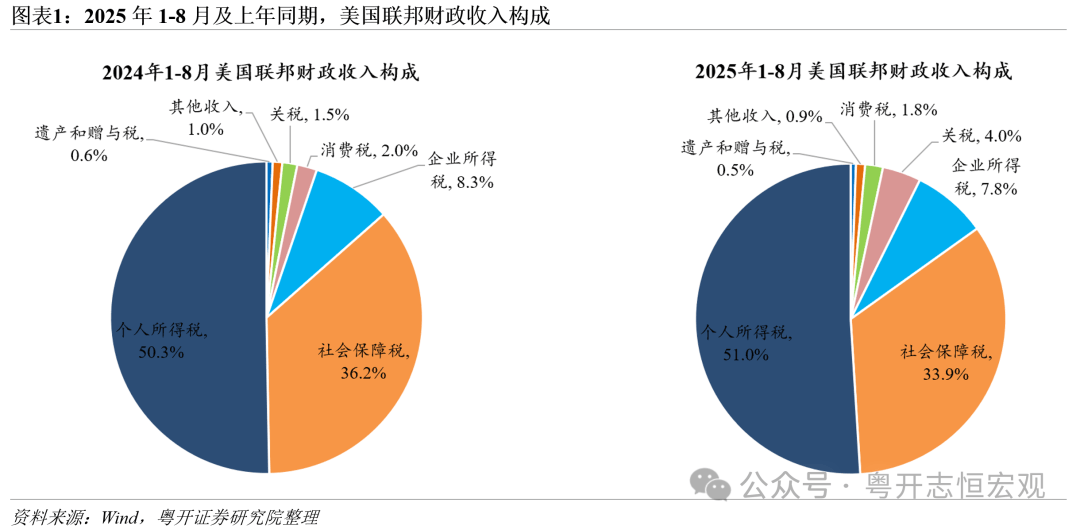
Core Viewpoint - The recent announcement by Trump to impose a 100% tariff on China and export controls on key software is seen as a significant escalation in the US-China trade conflict, which could have profound implications for bilateral trade and the global trade system [1] Group 1: Tariff Revenue and Rates - Since the onset of the trade war, US tariff revenue has surged, becoming the fourth largest source of federal revenue, following individual income tax, social security tax, and corporate income tax [6] - From January to June 2025, the average tariff rate in the US increased from 2.2% to 8.9%, with a notable rise in April due to expanded tariffs on a global scale [8][14] - By August 2025, US tariff revenue reached $144.4 billion, 2.8 times that of the previous year, accounting for 4.0% of federal revenue, an increase of 2.5 percentage points year-on-year [6] Group 2: Tariff Rates by Trade Partner - The actual average tariff rate imposed by the US on China reached 37.4% by June 2025, with significant increases observed for labor-intensive goods and products affected by Section 232 tariffs [24][29] - The average tariff rates for Japan and South Korea were 15.3% and 12.0%, respectively, while rates for the EU, Vietnam, and India ranged between 5% and 10% [24] - The US has seen a decline in its reliance on Chinese imports, with the share of imports from China dropping to 9.4% of total imports, a decrease of 3.4 percentage points year-on-year [28] Group 3: Trade Performance and Deficits - In the first seven months of 2025, US imports grew by 10.7% and exports by 4.8%, but the trade deficit expanded by 21.3% [19] - The US experienced a decline in trade volume with China and Canada, with imports from China down by 18.9% and exports down by 20.2% [19][20] - Despite high tariffs on China, the overall trade deficit with other countries has increased, indicating that the US still relies heavily on imports to meet domestic demand [20] Group 4: Future Tariff Trends - The actual tariff rates are expected to converge with nominal rates as various loopholes and exemptions are closed, leading to an increase in effective tariff rates across different economies [33][34] - Factors such as preemptive imports and exemptions for certain goods have contributed to the current lower effective tariff rates, but these are anticipated to diminish over time [33][35]
国泰君安期货所长早读-20251013
Guo Tai Jun An Qi Huo· 2025-10-13 03:41
所长 早读 国泰君安期货 2025-10-13 期 请务必阅读正文之后的免责条款部分 2025-10-13 所长 早读 今 日 发 现 万斯称"特朗普愿意与中国进行理性谈判" 观点分享: 10 月 12 日晚间,美国副总统万斯在接受采访时表示,特朗普愿意与中国进行理性谈 判。"万斯说,总统"珍视他与中方建立的友谊",但他说:"我们拥有很多筹码。我的希 望——我也知道总统的希望——是我们不必动用这些筹码。""接下来的几周,我们会看到 很多迹象。"与之相对应的是,12 日,中国商务部表示,动辄以高额关税进行威胁,不是与 中方相处的正确之道。对于关税战,中方的立场是一贯的,我们不愿打,但也不怕打。我们 认为,从上述情况及今晨美股期指、加密货币的走势等判断,市场预期"TACO"交易再次 上演的可能性较大。而从交易来说,一方面我们固然要依据各种蛛丝马迹通过逻辑分析做出 策略判断,另一方面,由于此类政治事件的高度不确定性,我们也有必要对小概率事件作出 心理预设和防控性策略。 | | | | 板块 | 关注指数 | | --- | --- | | 期指 | ★★★★ | 期指:风险暂歇,也无风雨也无晴。周一,美方再释缓和信 ...