
以旧换新政策

Search documents
沈建光:从国庆长假看消费前景
Sou Hu Cai Jing· 2025-10-22 12:30
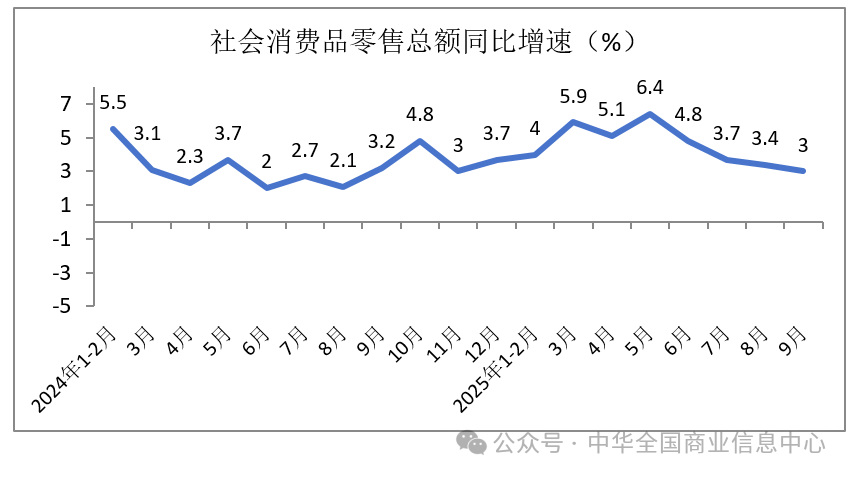
Core Insights - The travel enthusiasm during the recent National Day and Mid-Autumn Festival did not translate into strong consumer spending, indicating a weak consumption performance despite high travel activity [2][3][4]. Consumption Trends - During the holiday period from October 1 to 8, a total of 2.433 billion people traveled, with an average of 304 million daily, reflecting a 6.3% year-on-year increase compared to the same period in 2024 [3]. - However, retail and catering sales during the holiday only grew by 2.7% year-on-year, significantly lower than previous holidays [3]. - Daily sales in consumption-related industries increased by 4.5% year-on-year, which is also weaker than previous holiday periods [3]. Consumer Spending Analysis - Domestic tourism saw 888 million trips with total spending of 809 billion yuan, slightly higher than last year, but per capita spending decreased to 911 yuan, below last year's 916 yuan [4]. - The third quarter saw a slowdown in consumption growth, with retail sales growth dropping to 3.4% in August, the lowest since December 2024 [6][7]. Future Outlook - The fourth quarter is expected to face greater downward pressure on consumption due to elevated base effects from last year and the diminishing impact of trade-in policies [8]. - Key factors constraining consumption recovery include pressure on employment income, declining household wealth due to falling property prices, and weak consumer confidence [9]. Policy Recommendations - To stimulate consumption, it is suggested to expand the categories supported by trade-in policies, enhance support for service consumption, and encourage new types of consumption [10][11]. - Improving the social security system is also crucial, as current social spending is significantly lower than that of OECD countries, which limits consumption growth [12].


中华全国商业信息中心:前三季度市场销售稳步增长 实物商品网上零售额增速加快
智通财经网· 2025-10-22 11:53
Core Insights - The consumer market in China has shown stable growth in the first three quarters of 2025, with total retail sales of consumer goods reaching 365,877 billion yuan, a year-on-year increase of 4.5%, accelerating by 1.2 percentage points compared to the same period last year and 1.0 percentage point compared to the entire previous year [3][5][9] Group 1: Consumer Spending and Economic Contribution - Final consumption expenditure contributed 53.5% to economic growth, driving GDP growth by 2.8 percentage points, an increase of 9.0 percentage points compared to the previous year [2] - In the third quarter, the contribution rate of final consumption expenditure rose to 56.6%, contributing 2.7 percentage points to GDP growth [2] Group 2: Retail Sales Performance - Retail sales of consumer goods in urban areas reached 316,838 billion yuan, growing by 4.4%, while rural retail sales amounted to 49,039 billion yuan, with a growth rate of 4.6% [5] - The online retail sales of physical goods reached 91,528 billion yuan, increasing by 6.5%, accounting for 25.0% of total retail sales [9] Group 3: Product Categories and Trends - Retail sales of goods totaled 324,888 billion yuan, with a year-on-year growth of 4.6%, and retail sales in limited enterprises increased by 5.1% [7][13] - Basic living goods such as food, clothing, and daily necessities saw retail sales growth of 8.0%, 3.1%, and 7.4% respectively [13] Group 4: Service Consumption Growth - Service retail sales grew by 5.2%, outpacing goods retail sales by 0.6%, with significant growth in cultural, sports, leisure, and travel services [14] - The railway passenger volume reached 3.54 billion, a 6% increase, while box office revenue grew by 20.7% [14] Group 5: Price Trends - The overall price level in the consumer sector remained stable, with the core CPI rising by 0.6% year-on-year, an increase of 0.2 percentage points compared to the first half of the year [17]
乘联分会:10月1-19日全国乘用车市场零售112.8万辆 同比下降6%
智通财经网· 2025-10-22 09:01
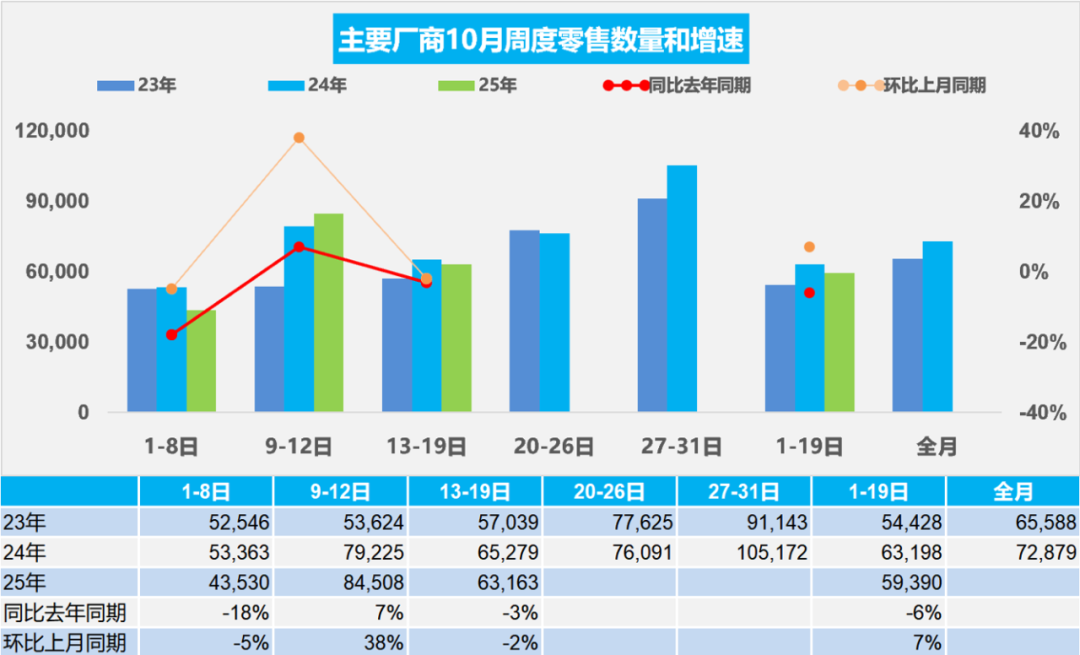
Core Insights - The retail sales of passenger cars in China from October 1 to 19 reached 1.128 million units, representing a year-on-year decline of 6% but a month-on-month increase of 7% [1][2] - Cumulative retail sales for the year reached 18.136 million units, showing a year-on-year growth of 8% [1][2] - The retail sales of new energy vehicles (NEVs) during the same period were 632,000 units, marking a year-on-year increase of 5% and a month-on-month increase of 2%, with a penetration rate of 56.1% [1][2] Passenger Car Market Overview - Retail sales from October 1 to 19 totaled 1.128 million units, down 6% year-on-year but up 7% month-on-month; cumulative sales for the year reached 18.136 million units, up 8% year-on-year [2][5] - Wholesale figures for the same period were 1.155 million units, down 5% year-on-year but unchanged from the previous month; cumulative wholesale for the year reached 22.002 million units, up 12% year-on-year [2][9] New Energy Vehicle (NEV) Insights - NEV retail sales from October 1 to 19 were 632,000 units, up 5% year-on-year and 2% month-on-month, with a cumulative total of 9.502 million units for the year, reflecting a 23% year-on-year increase [2][5] - NEV wholesale during the same period was 676,000 units, up 6% year-on-year and 5% month-on-month, with a cumulative total of 11.123 million units for the year, showing a 30% year-on-year growth [2][9] Market Trends and Influences - The market experienced a slow start in October due to holiday effects and a previous surge in September driven by government incentives [5] - The traditional peak season of "Golden September and Silver October" is expected to boost sales, although tightening subsidy standards and the impending expiration of tax incentives may affect consumer enthusiasm [5][11] - The export market for Chinese automobiles has shown positive growth, particularly in the NEV segment, with increasing competitiveness against international brands [9][11]
【周度分析】车市扫描(2025年10月13日-10月19日)
乘联分会· 2025-10-22 08:42
Group 1: Market Overview - From October 1 to 19, the national passenger car retail market sold 1.128 million units, a year-on-year decrease of 6%, but a month-on-month increase of 7%. Cumulative retail sales for the year reached 18.136 million units, up 8% year-on-year [2][5] - During the same period, wholesale of passenger cars reached 1.155 million units, down 5% year-on-year but flat compared to the previous month. Year-to-date wholesale totaled 22.002 million units, an increase of 12% year-on-year [2][8] - The penetration rate of new energy vehicles (NEVs) in the passenger car market reached 56.1% with retail sales of 632,000 units, a year-on-year increase of 5% [2][5] Group 2: Monthly Sales Trends - Daily average retail sales in the first week of October were 44,000 units, down 18% year-on-year, while the second week saw an increase to 85,000 units, up 7% year-on-year [4][5] - The third week recorded a daily average of 63,000 units, a slight decrease of 3% year-on-year [5] Group 3: Wholesale Trends - Daily average wholesale in the first week of October was 30,000 units, down 21% year-on-year, while the second week saw a slight decrease to 76,000 units, down 1% year-on-year [7][8] - The third week recorded a daily average of 87,000 units, showing a year-on-year increase of 1% [7] Group 4: Investment and Production - In the first nine months of 2025, automotive investment grew by 19%, production increased by 11%, and consumption rose by 1% [9] - The production of automobiles in September reached 3.23 million units, a year-on-year increase of 14%, with NEVs accounting for 1.58 million units, up 20% [9] Group 5: Battery Market Insights - In September, the production of power batteries reached 151 GWh, a year-on-year increase of 50%, with a cumulative production of 1,122 GWh for the first nine months, up 44% [10][11] - The market share of lithium iron phosphate batteries has increased, with CATL surpassing BYD in market share for these batteries [11] Group 6: Pickup Truck Market Analysis - In September 2025, the pickup truck market sold 46,000 units, a year-on-year decrease of 1.9% but a month-on-month increase of 14.6% [12] - Cumulative sales for the first nine months reached 432,000 units, a year-on-year increase of 11.2% [12][13]


家电行业内销增长良好,家电ETF(159996)盘中飘红
Mei Ri Jing Ji Xin Wen· 2025-10-22 06:49
Core Viewpoint - The home appliance industry is experiencing good domestic sales growth while facing a slowdown in exports as of Q3 2025, with significant variations in performance across different product categories [1]. Domestic Sales Performance - Domestic sales of home appliances have shown strong growth, with a year-on-year increase of 27% in retail sales during July and August, driven by low base effects and the "trade-in" policy [1]. - Air conditioners have performed the best in terms of domestic sales, although intense price competition has led to a decline in average prices [1]. - Small appliances have seen a significant increase in average selling prices, with online price increases for products like electric steamers and health pots ranging from 13% to 20% year-on-year [1]. Export Sales Performance - Export sales have slowed down, with a year-on-year decline of 6.7% in July and August, primarily due to fluctuating U.S. tariff policies and high base effects [1]. - Despite the overall export slowdown, categories like washing machines and refrigerators have still managed to achieve positive growth, while air conditioners have seen a year-on-year decline [1]. Industry Overview - The home appliance ETF (159996) tracks the home appliance index (930697), which includes listed companies involved in the manufacturing and sales of products like air conditioners, refrigerators, and washing machines [1]. - The index reflects the overall performance of listed companies in the home appliance sector, showcasing strong consumer attributes and cyclical characteristics that represent the development status of China's home appliance industry [1].
国联民生证券:家用空调9月内外销均走弱 关注企业经营面α
Zhi Tong Cai Jing· 2025-10-22 06:20
Core Insights - The report from Guolian Minsheng Securities indicates a weakening trend in both domestic and export sales of household air conditioners in September, influenced by base effects and policy changes [1] - Despite the overall decline, Haier has shown significant growth, suggesting a divergence in performance among leading brands [1][3] - The white goods sector has been underperforming since Q3 2025, with current relative valuations at historical lows, indicating that short-term pressures may already be priced in [1] Group 1: Production and Sales Data - In September, the production of household air conditioners reached 10.57 million units, down 13.48% year-on-year, while sales totaled 10.88 million units, down 10.24% year-on-year [1] - Domestic sales were 5.95 million units, a decrease of 2.52% year-on-year, while exports were 4.94 million units, down 18.06% year-on-year [1] - Inventory at the end of the month stood at 14.26 million units, a decline of 2.36% year-on-year [1] Group 2: Domestic Market Trends - Domestic air conditioner sales in September saw a year-on-year decline of 3%, aligning with expectations due to a high base effect [2] - The upcoming policy for replacing old units in Q4 2024 is expected to drive a significant increase in domestic sales, with projections of a 24% year-on-year growth [2] - The retail volume for online and offline sales showed a two-year CAGR of 31% and 1%, respectively, indicating stable demand despite seasonal fluctuations [2] Group 3: Brand Performance - In September, Midea and Gree experienced year-on-year sales declines of 15% and 13%, respectively, while Haier reported a 25% increase [3] - Haier's market share increased by 3.7 percentage points year-on-year, with a notable 37% growth in Q3 2025 [3] - The average retail prices for air conditioners showed a slight increase of 0.4% online but a decrease of 7.5% offline, reflecting pressure on volume sales [3] Group 4: Export Market Dynamics - Export sales of air conditioners fell by 18% year-on-year, indicating ongoing challenges in the external market [4] - There are signs of improvement in export orders for leading brands, with production guidance for October and November showing a decrease of 9.4% and 6.6% compared to the same period last year [4] - The anticipated growth in export sales for Q4 2024 is projected at 49%, although challenges remain due to trade negotiations and tariff issues [4] Group 5: Investment Recommendations - The report recommends continued investment in leading brands such as Haier Smart Home, Midea Group, Hisense Home Appliances, and Gree Electric Appliances, highlighting their resilience and high-quality attributes [5]




上汽领跑改革升级,前三季度上海汽车产业驶入“加速通道”
Xin Lang Cai Jing· 2025-10-22 03:54
Core Insights - Shanghai's economy shows resilience with industrial value-added growth of 5.2% and industrial output growth of 5.7% in the first three quarters of the year, supported significantly by the automotive sector [1] - SAIC Motor Corporation has demonstrated a strong recovery, with a 20.5% year-on-year increase in vehicle sales, reclaiming the title of China's automotive sales champion in September after 18 months [1][2] Automotive Industry Performance - The automotive manufacturing output in Shanghai increased by 11.8% year-on-year, reaching 522.35 billion yuan [1] - SAIC's self-owned brand sales surged by 50.4% in September, contributing to a total of 2.044 million units sold in the first nine months, which is a 29.2% increase [2] - The "One Price" sales strategy adopted by SAIC General has streamlined pricing and reduced competitive pressure among dealers, enhancing profitability [3][4] New Energy Transition - The introduction of the new IM LS6 range extender model marks SAIC's entry into the range extender market, achieving over 10,000 pre-orders within half an hour of launch [3] - SAIC General's Buick brand has launched the new range extender model, which features advanced technology and has received over 12,000 pre-orders within ten days [5] - The "old-for-new" policy in Shanghai has stimulated demand for new vehicles, particularly in the 100,000 yuan price segment, benefiting companies like SAIC-GM-Wuling [5] Industry Collaboration and Upgrades - Shanghai's automotive industry is undergoing a transformation, creating a complete industrial system that integrates vehicle manufacturing, parts supply, research, design, and sales [6] - This collaborative effort has strengthened the overall competitiveness of Shanghai's automotive sector and has positively impacted related industries such as steel, electronics, and logistics [6]

“双十一”国补拼手速,平台商家挖掘消费新潜力丨时报经济眼
Zheng Quan Shi Bao· 2025-10-22 00:21
Core Viewpoint - The "Double Eleven" shopping festival is gaining momentum, but many regions have increased the difficulty of claiming national subsidies, requiring consumers to act quickly to secure benefits [1][3] Group 1: National Subsidy Challenges - Multiple regions, including Hunan, Anhui, Guangdong, Chongqing, and Shanghai, have set thresholds for claiming national subsidies, implementing methods like "coupon grabbing" and "lottery draws" [1][3] - The adjustments in subsidy rules aim to optimize the distribution of funds, with some areas citing insufficient remaining funds as a reason for increased barriers [3][4] Group 2: Market Response and Strategies - Despite the challenges posed by subsidy adjustments, major platforms and merchants remain cautiously optimistic about the performance during this year's "Double Eleven," expecting growth driven by product structure optimization and enhanced multi-channel capabilities [5][6] - Leading appliance companies, such as Haier, are proactively offering corporate subsidies, providing discounts of up to 20%, and collaborating with e-commerce platforms to create a "triple subsidy" model involving government, enterprises, and merchants [5][6] Group 3: Long-term Consumer Trends - The long-term outlook suggests that the subsidy-driven model will transition to a value-driven approach, with a focus on identifying consumer trends post-policy benefits [6][7] - The government is expected to shift from short-term stimulus to long-term cultivation of consumer potential, emphasizing the need for a robust policy framework to support sustained consumption recovery [7][8]
“双十一”国补拼手速,平台商家挖掘消费新潜力丨时报经济眼
证券时报· 2025-10-22 00:09
Group 1 - The article highlights that many regions have set thresholds for national subsidies, making it more difficult for consumers to claim them, with methods like "抢券" (grabbing coupons) and "摇号" (lottery) being implemented [2][4] - The adjustments in subsidy rules aim to optimize the distribution of funds and address the insufficiency of remaining subsidy funds in some areas [4][6] - Major platforms and merchants are optimistic about the retail outlook for the upcoming "Double Eleven" shopping festival, despite the challenges posed by the subsidy policy changes [2][6] Group 2 - The article discusses the proactive measures taken by major appliance companies, such as offering up to 20% subsidies, to enhance the effectiveness of the "trade-in" policy in collaboration with e-commerce platforms [6][5] - A recent allocation of 69 billion yuan in long-term special government bonds for consumer goods trade-in subsidies is expected to support these initiatives in the fourth quarter [6][5] - The article emphasizes the need for a collaborative approach among government, enterprises, and platforms to maximize the effectiveness of subsidy policies [6][5] Group 3 - The long-term perspective indicates that the trade-in subsidy policies will eventually decline, pushing the industry towards a value-driven model rather than a subsidy-driven one [7][8] - The article stresses the importance of establishing a growth model that is less dependent on government policies, focusing on consumer trends post-policy benefits [8][7] - It also points out that enhancing public services and addressing uncertainties in social security, healthcare, and education are crucial for stimulating consumer spending [8][7]

“双十一”国补拼手速 平台商家挖掘消费新潜力
Zheng Quan Shi Bao· 2025-10-21 17:23
Core Insights - The "Double Eleven" shopping festival is experiencing increased consumer interest, but challenges in claiming national subsidies have emerged, requiring consumers to act quickly [1][2] - Various regions have implemented stricter eligibility criteria for national subsidies, including "lottery" and "coupon grabbing" methods, to ensure precise distribution of subsidy funds [1][2] - Despite the challenges posed by the reduction in national subsidies, platforms and merchants remain optimistic about the retail outlook for the year-end shopping season [1][3] Group 1: National Subsidy Challenges - Consumers in multiple regions, including Chongqing, Hunan, Guangdong, and Shanghai, are facing difficulties in claiming national subsidies due to new restrictions [2] - The adjustments in subsidy rules aim to optimize the policy and enhance fund utilization efficiency, with some regions citing insufficient remaining funds as a reason for increased barriers [2] Group 2: Market Response and Strategies - E-commerce platforms and merchants are proactively enhancing the effectiveness of trade-in policies, with some appliance companies offering additional subsidies to complement national support [3] - The introduction of a special long-term bond of 690 billion yuan for consumer trade-in subsidies is expected to provide financial support for the fourth quarter [3] Group 3: Long-term Consumer Trends - The shift from subsidy-driven growth to value-driven growth is anticipated as national subsidies gradually decline [5] - Establishing a "policy desensitization" growth model is crucial for platforms and merchants to adapt to changing consumer trends post-subsidy [5] - A robust policy framework is essential for sustaining consumer market recovery, with increased fiscal investments in social welfare expected to enhance consumer capacity [5]
