关税预期

Search documents
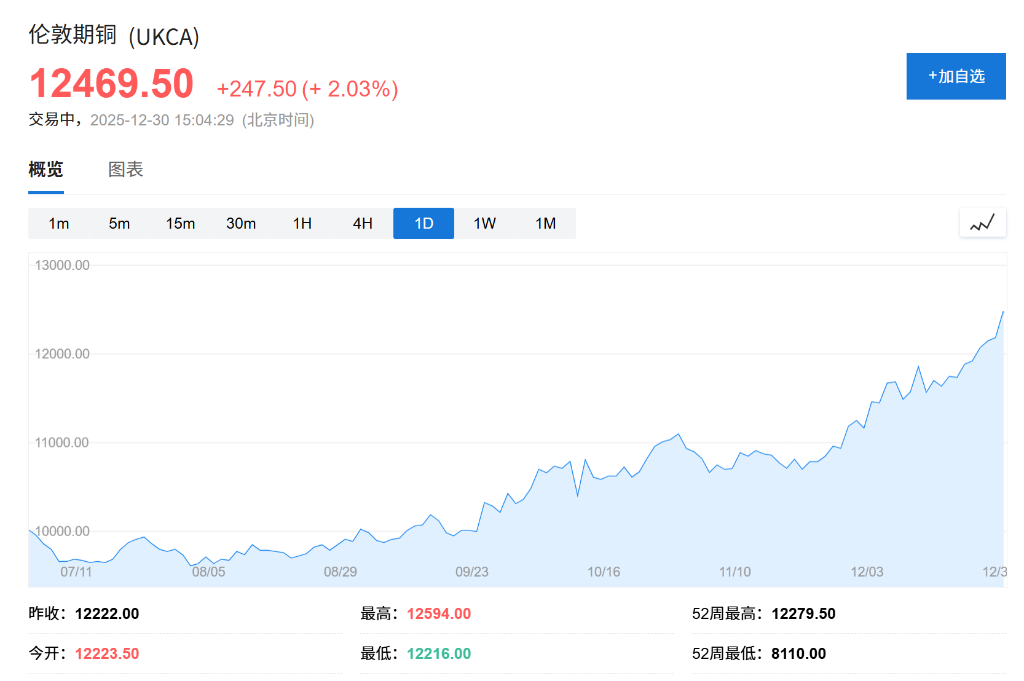
大宗商品综述:油价企稳 铜价录得2017年来最长连涨 银价回升
Xin Lang Cai Jing· 2025-12-30 21:31
Group 1: Oil Market - Oil prices remain stable as traders weigh geopolitical tensions from Venezuela, Russia, and Yemen against global supply surplus concerns [2][15] - WTI crude oil settled at approximately $58 per barrel, with a slight decline of 13 cents for February futures [16][19] - OPEC+ is expected to maintain its production freeze plan amid signs of increasing global oil supply surplus [18] Group 2: Base Metals - Copper prices recorded the longest consecutive gains since 2017, rising by 2.75% to $12,558.5 per ton, driven by expectations of supply chain pressures [5][22] - Year-to-date, copper has increased by over 40%, potentially marking the largest annual gain since 2009 [22] - The weakening dollar has contributed to the upward trend in copper prices, with a measure of dollar performance down approximately 8% [22] Group 3: Precious Metals - Silver prices rebounded after experiencing the largest single-day drop in over five years, with a monthly increase of about 35% due to ongoing supply shortages [10][27] - Silver reached over $78 per ounce, recovering from a previous 9% drop [27] - Gold prices saw a slight increase after two months of significant declines, with spot gold rising by 0.37% to $4,348.42 per ounce [12][27]
供应链担忧推动年末反弹,铜价暴涨40%创2009年来最大年度涨幅
Hua Er Jie Jian Wen· 2025-12-30 07:20
Group 1 - Copper prices are experiencing the longest consecutive rise since 2017, driven by supply chain pressures and tariff expectations, reaching a historical high of nearly $13,000 per ton [1] - The strong rebound in copper futures has resulted in an annual increase of over 40%, marking the largest annual gain since 2009, influenced by defensive buying against potential U.S. tariffs and a weaker dollar [3] - Supply disruptions globally, including incidents in copper mines in Indonesia, Chile, and the Democratic Republic of Congo, have heightened concerns about supply-side issues, affecting not only copper but also other base metals like aluminum and zinc [3][4] Group 2 - The threat of U.S. import tariffs has led to a rush to transport metals to U.S. ports, causing buyers to pay higher prices and exacerbating supply tightness globally [4] - Trade dynamics are being reshaped by inventory redistribution due to tariff policy expectations, with predictions of "extreme shortages" of copper in other regions by 2026 [4] - The London Metal Exchange (LME) has seen a notable increase in copper prices, with all base metals showing positive performance, indicating strong market reactions to supply concerns [4]

金属周报 | 挤仓风暴席卷,白银铜价共振冲高
对冲研投· 2025-12-29 06:36
Core Viewpoint - The article highlights a significant increase in copper and precious metal prices, driven by market dynamics such as tariff expectations, supply chain issues, and speculative trading, while also indicating potential risks of demand weakness in the copper market [2][4][39]. Group 1: Precious Metals Performance - Last week, COMEX gold rose by 4.42%, and silver surged by 18.22%, with SHFE gold and silver increasing by 3.71% and 19.14% respectively [4][26]. - The overall macroeconomic environment was stable, but the weakening dollar and expectations of liquidity easing contributed to the strong performance of precious metals [7][25]. - Silver's price volatility reached historical highs, driven by structural short squeezes in the market [7][25]. Group 2: Copper Market Dynamics - COMEX copper prices continued to rise, with increases of 6.71% and 5.95% in respective markets, breaking the historical 100,000 yuan mark [4][8]. - Concerns over weak domestic demand are expected to resurface as copper prices rise, with November and December consumption already showing a decline [9][39]. - The COMEX copper inventory has increased significantly, surpassing 480,000 tons, indicating a potential supply-demand imbalance [9][10]. Group 3: Market Sentiment and Strategies - The market sentiment appears exuberant, with many short positions being forced to cover, contributing to the price increases in copper and silver [2][8]. - The current contango structure in copper pricing suggests potential strategies for market participants to consider, particularly in the longer-term contracts [9][10]. - The article notes that while the immediate outlook may be bullish, caution is advised regarding potential price corrections in the near term [39].

如何理解本次铜价上涨以及注销仓单变动?
对冲研投· 2025-12-04 12:00
Core Insights - The article highlights a significant increase in the cancellation of warehouse receipts for copper at the London Metal Exchange (LME), reaching 50,725 tons, the highest level since 2013, indicating a sharp change in spot demand in Asia, particularly in Taiwan and South Korea [4][12]. Group 1: Cancellation of Warehouse Receipts - The cancellation of warehouse receipts is primarily driven by two factors: increased actual demand from downstream manufacturing and traders' expectations of rising copper prices, leading them to withdraw from the exchange inventory system [4][6]. - The cancellation ratio for copper has surged to over 35%, significantly higher than the historical average of 12-15%, reflecting a structural shift in global copper trade [14][12]. Group 2: Market Dynamics and Price Influences - The article identifies five typical market scenarios that influence copper prices, emphasizing the critical role of cancellation ratios in price movements [7][8][9][10][11]. - Current macroeconomic factors, including Federal Reserve policy expectations and geopolitical risks, have increased their explanatory power for price fluctuations to 65%, compared to a historical average of 40% [12]. Group 3: Supply Constraints and Future Outlook - Future copper supply is expected to face three main constraints: declining resource quality, lagging capital expenditures, and increased geopolitical risk premiums [30]. - The article suggests establishing a multi-dimensional monitoring system focusing on the marginal changes in LME cancellation ratios, inventory turnover rates, and macroeconomic sentiment indicators to better navigate the volatile copper market [31].

【今日关注】国内商品期市开盘多数下跌!棕榈油、铜、螺纹钢等热门品种解读!
Xin Lang Cai Jing· 2025-12-04 11:25
Group 1: Commodity Market Overview - The domestic commodity futures market opened with most contracts declining, particularly in the chemical sector where rubber fell by 1.58% [1] - Non-metallic building materials experienced a complete decline, with glass down by 1.47% [1] - Shipping futures also saw a decline, with the shipping index (European line) dropping by 1.45% [1] - Most energy products decreased, with fuel oil down by 0.45% [1] - Precious metals showed an upward trend, with silver rising by 0.31% [1] Group 2: Palm Oil Market Insights - Malaysian BMD crude palm oil futures slightly decreased, following the trend of Dalian palm oil futures, with the benchmark February palm oil contract closing down by 3 ringgit, or 0.07%, at 4,156 ringgit per ton [14] - A recent survey indicated that Malaysia's palm oil inventory in November may rise to a six-and-a-half-year high due to declining exports and record production [14] - The Malaysian Federal Land Development Authority received orders to evacuate palm oil plantation lands, which may impact operations and national production [14] Group 3: Copper Market Developments - The main copper contract on the Shanghai Futures Exchange rose by 1.74% to 90,760 yuan per ton [15] - The London Metal Exchange reported a significant increase in copper delivery applications, surging by 50,575 tons to 56,875 tons, marking the largest increase by tonnage since 2013 [15] - Ivanhoe Mines announced that the Kamoa-Kakula project aims for copper production targets of 380,000 to 420,000 tons in 2026 and 500,000 to 540,000 tons in 2027 [15] Group 4: Rebar Steel Market Outlook - Rebar prices are expected to show a strong fluctuation, with the RB2601 contract projected to rise to around 3,200 yuan [18] - The rebar market in December is relatively strong, supported by reduced production and inventory depletion, leading to shortages in some regions [18] - Despite seasonal demand weakness, construction activity in southern regions and rising winter storage expectations are expected to support rebar prices [18] Group 5: Logistics and Economic Indicators - The China Logistics and Purchasing Federation reported that the logistics industry prosperity index for November was 50.9%, a 0.2 percentage point increase from the previous month [19] - The business volume index also rose to 50.9%, indicating a balanced recovery across regions, with central and western regions exceeding the national level [19] Group 6: Global Economic Context - The U.S. ADP employment report indicated a decrease of 32,000 jobs in November, the largest drop in two and a half years, further increasing expectations for a Federal Reserve interest rate cut [20] - The probability of a 25 basis point rate cut by the Federal Reserve in December is approaching 90% [20]

新世纪期货交易提示-20251016
Xin Shi Ji Qi Huo· 2025-10-16 03:16
Report Industry Investment Ratings - Iron ore: Oscillation [2] - Coking coal and coke: Oscillation with a downward bias [2] - Rebar and wire rod: Oscillation with a downward bias [2] - Glass: Adjustment [2] - Soda ash: Adjustment [2] - CSI 300 Index Futures/Options: Oscillation [4] - SSE 50 Index Futures/Options: Oscillation [4] - CSI 500 Index Futures/Options: Rebound [4] - CSI 1000 Index Futures/Options: Rebound [4] - 2 - year Treasury Bonds: Oscillation [4] - 5 - year Treasury Bonds: Oscillation [4] - 10 - year Treasury Bonds: Uptrend [4] - Gold: Strong - biased oscillation [4] - Silver: Strong - biased oscillation [4] - Logs: Increased volatility [6] - Pulp: Consolidation [6] - Offset paper: Oscillation [6] - Soybean oil: Wide - range oscillation [6] - Palm oil: Wide - range oscillation [6] - Rapeseed oil: Wide - range oscillation [6] - Soybean meal: Oscillation with a downward bias [6] - Rapeseed meal: Oscillation with a downward bias [6] - Soybean No. 2: Oscillation with a downward bias [6] - Soybean No. 1: Oscillation [6] - Live pigs: Oscillation with a downward bias [7] - Rubber: Oscillation [7] - PX: Wait - and - see [7] - PTA: Oscillation [9] - MEG: Wait - and - see [9] - PR: Wait - and - see [9] - PF: Wait - and - see [9] Core Views - The black industry is affected by trade frictions, policy regulations, and supply - demand relationships. The prices of iron ore, coking coal, coke, rebar, etc. are expected to oscillate or adjust. The key lies in the demand for steel products in October and the implementation of relevant policies [2]. - The financial market is influenced by factors such as economic data, trade policies, and central bank operations. The market sentiment has improved, but it is still recommended to reduce risk appetite. The prices of stocks, bonds, and precious metals have different trends [4]. - The light industry and agricultural products markets are affected by supply - demand relationships, cost factors, and macro - environment. The prices of logs, pulp, oils, and agricultural products are expected to have different trends, and attention should be paid to factors such as supply changes and demand recovery [6][7]. - The polyester industry is affected by factors such as supply - demand relationships, cost support, and oil price trends. The prices of PX, PTA, MEG, etc. are expected to follow cost fluctuations or be in a wait - and - see state [9]. Summary by Categories Black Industry - **Iron ore**: Trade frictions and supply - side news affect market sentiment. The short - term price is expected to oscillate, and the key lies in the demand for steel products in October [2]. - **Coking coal and coke**: Tariff expectations and supply - side policies affect the market. The supply of coking coal has eased, and the demand for coke is strong. Pay attention to low - buying opportunities and policy implementation [2]. - **Rebar**: The supply pressure is relatively large, and the demand recovery in October is the key. The price needs to cooperate with rapid de - stocking to stabilize [2]. - **Glass**: The short - term supply - demand pattern has not improved significantly. The market expects policy implementation, but the new - start strength is difficult to recover quickly in the fourth quarter [2]. Financial Market - **Stock Index Futures/Options**: The market sentiment has improved, but it is still recommended to reduce risk appetite and control positions [4]. - **Treasury Bonds**: The market trend is slightly rebounding, and long - positions can be held lightly [4]. - **Precious Metals**: Gold and silver are expected to oscillate strongly, affected by factors such as central bank gold purchases, interest rate policies, and geopolitical risks [4]. Light Industry and Agricultural Products - **Logs**: The supply will increase after the holiday, and the demand is expected to gradually recover. The price is expected to have increased volatility, and the macro - impact may dominate [6]. - **Pulp**: The cost support for the pulp price is weakening, and the demand improvement needs to be verified. The price is expected to consolidate at the bottom [6]. - **Offset paper**: The supply is stable, and the demand is expected to improve. The price is expected to oscillate [6]. - **Oils**: The high inventory of palm oil and the supply increase of soybeans put pressure on the market. The price is expected to oscillate widely [6]. - **Meal Products**: The supply of soybean meal and rapeseed meal is expected to increase, and the demand is weak. The price is expected to oscillate downward [6]. - **Live Pigs**: The supply is sufficient, and the demand is weak. The price is expected to oscillate weakly in the short term [7]. - **Rubber**: The supply pressure has decreased, and the demand has increased. The price is expected to oscillate widely [7]. Polyester Industry - **PX**: The market is worried about future supply over - capacity, and the price follows oil price fluctuations [7]. - **PTA**: The cost support is weak, and the supply - demand relationship has marginally improved. The price follows cost fluctuations [9]. - **MEG**: The port inventory has increased, and the supply pressure is increasing. The price is affected by cost fluctuations [9]. - **PR and PF**: The market is waiting for new information, and the price is expected to be in a wait - and - see state or continue to be sorted weakly [9].
产业层?缺乏利好,铁矿难以?枝独秀
Zhong Xin Qi Huo· 2025-10-15 02:41
1. Report Industry Investment Rating - The mid - term outlook for the industry is "oscillation" [5]. 2. Core View of the Report - As the traditional peak season nears its end, the industry's terminal demand support is expected to weaken further. Future market price increases will rely more on policies and the macro - level. It is necessary to continue to monitor the possibility of positive signals from the macro and policy fronts [5]. 3. Summary by Related Catalogs 3.1 Iron and Steel and Related Products 3.1.1 Steel - Core logic: Uncertainty in Sino - US trade relations persists, cost - side support is loosening, and the futures market is weak. Spot market transactions are generally weak, with low speculative interest. Iron - water production is decreasing from a high level, electric - furnace profits are poor, and steel mills are conducting some maintenance and production conversions. After the National Day holiday, demand recovery is limited. With high supply, the inventory of five major steel products has increased significantly, and the fundamentals are weak [6]. - Outlook: Steel inventory is at a moderately high level, and the fundamentals are lackluster. Considering increased overseas risks, short - term futures prices are expected to face pressure. However, due to potential positive signals from the end - of - October meeting and the difficulty of a trend - like decline in costs under high iron - water production, the downside space is limited [6]. 3.1.2 Iron Ore - Core logic: Spot market prices have fallen significantly. Overseas mine shipments have decreased slightly, and the arrival volume at 45 ports has increased significantly. The demand - side iron - water production is still at a high level, and some steel mills plan to replenish inventory after the holiday. Port inventory has increased, and overall inventory pressure is not prominent [6]. - Outlook: There is still support for the rigid demand for iron ore, short - term supply is generally stable, and fundamental pressure is not significant. However, macro - level disturbances and uncertainties in Sino - US trade relations limit the upside space, and short - term prices are expected to oscillate [7]. 3.1.3 Scrap Steel - Core logic: The supply of scrap steel has recovered this week, approaching the same - period level in previous years. Demand has decreased as finished - product prices are under pressure and electric - furnace profits are poor. Inventory has decreased slightly during the holiday [8]. - Outlook: With insufficient fundamental drivers, scrap - steel prices are expected to follow finished - product prices in the short term [8]. 3.2 Carbon - Related Products 3.2.1 Coke - Core logic: The futures market is under pressure and oscillating. On the spot side, supply is temporarily stable, demand is supported by iron - water production, and overall inventory is at a low level. The price of coke is in a stalemate between rising and falling due to the game between coking plants and steel mills [9]. - Outlook: With rigid demand support, limited supply growth, and a healthy short - term fundamental situation, coke prices are expected to remain stable in the future [9]. 3.2.2 Coking Coal - Core logic: The futures market is under pressure and oscillating. Supply is generally stable, but imports are affected by some factors. Demand is supported by coke production, and inventory is at a low level. Spot prices are oscillating steadily [10]. - Outlook: After coal mines return to pre - holiday production levels, there is limited room for output growth. Import recovery will take time, and with high short - term coke production, the fundamental contradictions are not prominent. Considering the warm macro - environment, prices are expected to oscillate [10]. 3.3 Other Products 3.3.1 Glass - Core logic: With the approaching of important domestic meetings, the supply side has limited changes. Demand is in the peak season, but due to large intermediate - level inventory and limited restocking ability, the supply - demand fundamentals are weak. The upstream is facing pressure to increase inventory and reduce prices [11]. - Outlook: After the National Day holiday, production and sales are poor, and short - term prices are expected to oscillate weakly. In the long term, market - based capacity reduction is needed, and prices are expected to decline [11]. 3.3.2 Soda Ash - Core logic: Supply is still high, and demand is stable with some differences between heavy and light soda ash. The industry is in a bottom - clearing stage, and upstream inventory is expected to increase. Prices are expected to oscillate weakly [13]. - Outlook: The oversupply situation remains unchanged. Prices are expected to oscillate widely following macro - changes, and the price center will decline in the long term to promote capacity reduction [13]. 3.3.3 Manganese Silicon - Core logic: The terminal steel - using demand peak season is lackluster, and the manganese - silicon futures market has followed the black - goods sector. The first - round inquiry price has decreased, and the market is waiting and watching. Cost - side prices have slightly declined, demand is resilient, but supply is at a high level, and inventory - reduction difficulty is increasing [14]. - Outlook: In the short term, high costs, peak - season demand, and policy expectations support prices, but due to pessimistic supply - demand expectations, the price center may decline after the peak season [14]. 3.3.4 Ferrosilicon - Core logic: The terminal steel - using demand in the peak season is weak, and the ferrosilicon futures market has followed the black - goods sector. The first - round inquiry price has decreased, and market confidence is low. Supply is at a high level, and inventory - reduction difficulty is increasing. Demand from steel mills is resilient, but the metal - magnesium market is oversupplied [15]. - Outlook: In the short term, high costs, peak - season demand, and policy expectations support prices, but as the supply - demand relationship becomes looser, prices may decline after the peak season [15].
基本?利好有限,继续关注宏观及政策动态
Zhong Xin Qi Huo· 2025-10-14 01:50
Report Industry Investment Rating - The report gives a "neutral" rating to the black building materials industry, with a mid - term outlook of "oscillation" [5] Core Viewpoints - Affected by tariff expectations, the prices of most black building materials varieties fluctuated weakly during the day. The panic in the market was relatively limited due to the uncertainty of tariff increases and the weaker intensity compared to April. The prices continued to fluctuate weakly at night. In mid - October, the terminal demand of the industry remained poor, and the reduction of hot metal production limited the support for prices. In the fourth quarter, the influence of macro and policy factors increased, and attention should be paid to the possibility of positive signals from the macro and policy levels [1] - The current fundamental situation can hardly provide clear upward support for the prices of the sector's varieties. The tariff issue drags down the market sentiment and slightly affects the price performance of the sector. However, there are still expectations for overseas interest rate cuts and positive signals from domestic important meetings [5] Summary by Related Catalogs 1. Overall Industry Analysis - **Iron Element**: Iron ore demand is supported at a high level, supply is expected to be stable, and the price is expected to oscillate in the short term. Scrap steel has insufficient fundamental drivers and is expected to follow the price of finished products [2] - **Carbon Element**: Coke has rigid demand support from hot metal, and its price is expected to remain stable. Coking coal's fundamental contradictions are not prominent, and its price is expected to oscillate [2] - **Alloys**: Manganese silicon and ferrosilicon prices are supported in the short term but have downward pressure after the peak season [2] - **Others**: Glass may have a rebound space if post - holiday production and sales are good; otherwise, the price may be under pressure. Soda ash is in a supply - surplus pattern and is expected to oscillate widely [2][5] 2. Individual Variety Analysis - **Steel**: The inventory is at a moderately high level, the fundamentals are weak, and the overseas risks are increasing. The short - term price is under pressure, but the downward space is limited [7] - **Iron Ore**: The supply is stable, the demand is supported at a high level, and the price is expected to oscillate in the short term due to limited upside space [7][8] - **Scrap Steel**: The fundamental drivers are insufficient, and the price is expected to follow the finished products in the short term [9] - **Coke**: The fundamentals are healthy in the short term, and the price is expected to remain stable [10] - **Coking Coal**: The fundamental contradictions are not prominent, and the price is expected to oscillate [11] - **Glass**: If the post - holiday production and sales are good, there is a rebound space; otherwise, the price may decline. In the long term, it needs market - oriented capacity reduction [11][12] - **Soda Ash**: The supply - surplus pattern remains unchanged, and the price is expected to oscillate widely and decline in the long term [14] - **Manganese Silicon**: There is short - term support, but the price may decline after the peak season [15] - **Ferrosilicon**: There is short - term support, but the price may decline after the peak season [16] 3. Other Data - **Commodity Index**: On October 13, 2025, the comprehensive index of commodities, the commodity 20 index, and the industrial products index changed by +0.01%, +0.17%, and - 0.64% respectively [100] - **Steel Industry Chain Index**: On October 13, 2025, the steel industry chain index had a daily decline of - 0.33%, a 5 - day increase of +0.07%, a 1 - month decline of - 0.83%, and a decline of - 5.54% since the beginning of the year [102]
贸易摩擦加剧,有色承压运行:铜铝周报-20251013
Bao Cheng Qi Huo· 2025-10-13 09:44
Report Summary 1. Report Industry Investment Rating No information provided in the report. 2. Core Views - **Copper**: Sino-US trade friction expectations have intensified, putting pressure on copper prices. Last week, copper prices rose and then fell. LME copper once reached the $11,000 mark, and SHFE copper reached the 88,000 mark. This was due to the decline of precious metals, the rebound of the US dollar index, and strong technical pressure as copper prices were at a near 5-year high, leading to a strong willingness among short-term bulls to close positions. The sharp rise was mainly caused by supply shortages, macro and financial attributes, and demand resilience. On Friday night, the renewed rise in Sino-US trade friction expectations led to a general market decline, with the non-ferrous sector under significant pressure and copper leading the decline, with SHFE copper falling nearly 3,000 yuan/ton. After the holiday, downstream buyers were cautious at high prices, but as prices fell, industrial support may continue to strengthen. The rise in tariff expectations will affect downstream export expectations, putting pressure on the non-ferrous sector. Short-term attention should be paid to whether copper prices can stop falling and stabilize. The short-term negative impact was fully reflected in Friday's night session, and LME copper prices rebounded before the domestic market opened on Monday. Sustainable attention can be paid to the technical support at the 83,000 mark, and copper prices may continue to stabilize and rebound [4][54]. - **Aluminum**: Sino-US trade friction expectations have intensified, putting pressure on aluminum prices. Last week, aluminum prices rose and then fell. On Friday night, affected by Sino-US trade friction, aluminum prices declined significantly. Since late September, driven by the rise in copper prices, the non-ferrous sector has generally risen, and aluminum prices have followed suit. However, aluminum prices faced certain pressure at the mid-September high, and there was a strong willingness among bulls to close positions. After the holiday, downstream buyers were cautious at high prices, and the continuous increase in downstream aluminum rod inventories also put pressure on futures prices. Short-term attention should be paid to whether copper prices in the non-ferrous sector can stabilize, which largely determines the direction of the sector. Technically, SHFE aluminum can focus on the support at the late-September low [5][55]. 3. Summary by Directory 3.1 Macro Factors - On Friday night, the renewed rise in Sino-US trade friction expectations led to a general market decline, with the non-ferrous sector under significant pressure and copper leading the decline, with SHFE copper falling nearly 3,000 yuan/ton. Since late September, copper prices have recorded significant gains, so short-term bulls have a strong willingness to close positions. At the industrial level, downstream buyers were cautious at high prices after the holiday, but as prices fall, industrial support may continue to strengthen. The rise in tariff expectations will affect downstream export expectations, putting pressure on the non-ferrous sector. Short-term attention should be paid to whether copper prices can stop falling and stabilize. On Monday morning, US President Trump issued another statement, regarded by the market as a "TACO" trade [9]. 3.2 Copper - **Volume and Price Trends**: Last week, copper prices rose and then fell. LME copper once reached the $11,000 mark, and SHFE copper reached the 88,000 mark, affected by the decline of precious metals, the rebound of the US dollar index, and strong technical pressure [4][54]. - **Copper Ore Processing Fees**: Copper ore processing fees have rebounded slightly from a low level [25]. - **Electrolytic Copper De-stocking**: The pace of electrolytic copper de-stocking has slowed down [28]. - **Downstream Primary Sector**: No specific content provided in the report. 3.3 Aluminum - **Volume and Price Trends**: Last week, aluminum prices rose and then fell. On Friday night, affected by Sino-US trade friction, aluminum prices declined significantly. Since late September, driven by the rise in copper prices, the non-ferrous sector has generally risen, and aluminum prices have followed suit [5][55]. - **Upstream Industry Chain**: No specific content provided in the report. - **Electrolytic Aluminum Stockpiling**: The pace of electrolytic aluminum stockpiling has slowed down [44]. - **Downstream Primary Sector**: After the holiday, downstream buyers were cautious at high prices, and the continuous increase in downstream aluminum rod inventories put pressure on futures prices [5][55]. 3.4 Conclusion - **Copper**: Short-term attention should be paid to whether copper prices can stop falling and stabilize. Sustainable attention can be paid to the technical support at the 83,000 mark, and copper prices may continue to stabilize and rebound [4][54]. - **Aluminum**: Short-term attention should be paid to whether copper prices in the non-ferrous sector can stabilize, which largely determines the direction of the sector. Technically, SHFE aluminum can focus on the support at the late-September low [5][55].
港股异动 | 江西铜业股份(00358.HK)跌超6% 关税预期导致铜价大幅回调 高盛预计铜价短期上行空间受限
Mei Ri Jing Ji Xin Wen· 2025-10-13 04:14
Group 1 - Jiangxi Copper Co., Ltd. (00358.HK) experienced a decline of over 6%, specifically a drop of 6.15%, trading at HKD 34.18 [1] - The trading volume reached HKD 1.313 billion [1]