
再通胀交易

Search documents
ETF日报 | “反内卷”行情又来了!传统能源板块布局有何选择?
Sou Hu Cai Jing· 2025-11-27 07:36
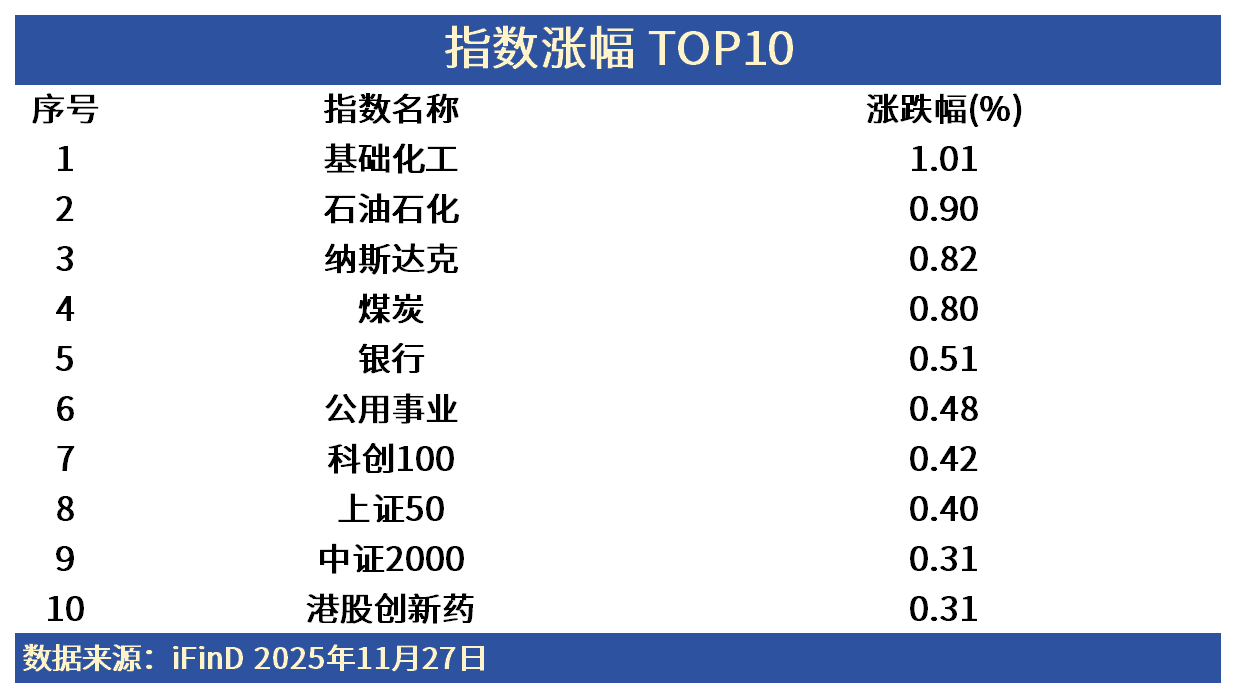
Group 1: Market Performance - As of November 27, 2025, the A-share market saw significant gains in the basic chemical, petroleum and petrochemical, and coal sectors, with increases of 1.01%, 0.90%, and 0.80% respectively [1][4] - The overall market performance indicates a recovery trend, particularly in cyclical industries such as non-ferrous metals, steel, coal, and petrochemicals, driven by improved supply-demand dynamics [3] Group 2: Policy and Industry Developments - The China Nonferrous Metals Industry Association has expressed opposition to the zero or negative processing fees in the copper smelting industry, calling for global action to address this unsustainable structural contradiction [2] - Recent government initiatives include a joint issuance of a growth support plan for the petrochemical industry, which emphasizes the renovation of old facilities and the development of coal-to-oil and gas projects [2] - The National Energy Administration has released guidelines to promote the integration of coal and new energy, encouraging innovation in carbon-based fuels and biodegradable materials [2] Group 3: Investment Opportunities - The "anti-involution" measures in the chemical industry are expected to provide a reference for other sub-industries, potentially leading to a new round of supply-side reforms and optimization of the supply-demand structure [3] - Leading companies in the chemical sector are anticipated to gain market share due to improved management practices and energy consumption control [3] - ETFs tracking energy and materials indices are gaining attention, indicating a growing interest in these sectors among investors [3]

资产配置快评2025年11月24日:全球风险资产波动加大——总量创辩第116期
Huachuang Securities· 2025-11-24 14:42
Group 1: Macroeconomic Insights - Production investment growth is a key factor affecting mid-term price equilibrium, with a significant decline observed in manufacturing investment, which has dropped by 15% compared to the peak in May[11] - October CPI rose unexpectedly by 0.2%, influenced by food prices and gold, but this increase is not expected to be sustainable[12] - Essential consumption and service consumption are showing slight recovery, with essential consumption growth at 4.2% in October, up from 3.4%[15] Group 2: Market Trends and Strategies - Global risk asset volatility is influenced by fluctuating expectations of Fed rate cuts and ongoing geopolitical tensions, particularly between the US and Japan[17] - The recent market adjustment may have reached its limit, with the Shanghai Composite Index dropping below the 60-day moving average for the first time in six months[18] - Investment strategies should focus on valuation-profit matching, AI technology rebounds, and supply-constrained cyclical industries such as metals and coal[21] Group 3: Fixed Income and Insurance Sector - The bond market is experiencing a low-interest rate environment, with insurance funds showing a decrease in bond allocation to 50.3% as of Q3 2025, while stock and fund allocations have increased[41] - The 10-year government bond yield is expected to fluctuate around 1.8% in the short term, influenced by risk appetite and new fund sales regulations[26] - Insurance companies are likely to continue increasing equity asset allocations to enhance long-term returns, despite the pressure from rising interest rates[42]
策略周聚焦:高低切背后的反内卷牛市
Huachuang Securities· 2025-11-16 14:12
Group 1 - The market is experiencing a high volatility phase driven by three main factors: profit-taking by funds, weakening economic data, and declining remaining liquidity. The trend is shifting towards large-cap stocks [1][10][12] - The current market environment reflects a "time for space" approach, lacking event catalysts for immediate pricing adjustments. The degree of industry differentiation reached a 10-year high of 69% on October 9, but has since narrowed to 53% [2][21][27] - Market transaction volume has significantly decreased since September, with the average daily trading volume dropping from approximately 3 trillion yuan to 2 trillion yuan, indicating a divergence between price increases and trading activity [3][19][30] Group 2 - The "anti-involution bull market" is characterized by a shift in valuation models, with a focus on sectors with low earnings bases. Industries such as steel, new energy, and light industry are highlighted for their cost-effectiveness [4][27][40] - Investment direction should focus on supply-tight cyclical industries, including non-ferrous metals, steel, coal, and aquaculture, as well as identifying new core assets among high-quality large-cap growth companies [5][28][29]
涨势加速后,如何判断煤价潜在上涨空间?
Changjiang Securities· 2025-11-09 09:45
Investment Rating - The report maintains a "Positive" investment rating for the coal industry [9] Core Viewpoints - The coal price has accelerated its upward trend, with the current market price for Qinhuangdao thermal coal reaching 817 RMB/ton, an increase of 47 RMB/ton week-on-week. The report suggests that the price could potentially rise to 931 RMB/ton based on profit recovery scenarios for power plants [2][6][16] - The report emphasizes the importance of understanding cyclical trends over pinpointing absolute price peaks, highlighting a favorable environment for coal investments due to global monetary easing and a rebound in the coal cycle [2][7] Summary by Sections Weekly Tracking Summary - The coal index (Yangtze) increased by 4.53%, outperforming the CSI 300 index by 3.71 percentage points. The thermal coal index rose by 4.84%, while the coking coal index increased by 1.87% [16][20] - As of November 7, the market price for Qinhuangdao thermal coal was 817 RMB/ton, with a week-on-week increase of 47 RMB/ton. The main coking coal price at Jingtang Port was 1860 RMB/ton, up 100 RMB/ton [6][16] Supply and Demand Analysis - The report notes a tightening supply due to production checks and increased winter demand, predicting that coal prices in Q4 may exceed expectations. It highlights the importance of monitoring winter storage and port inventory changes [6][17] - The daily coal consumption across 25 provinces was 511.7 million tons, a decrease of 0.5% week-on-week, while coal supply increased slightly to 547.3 million tons [34] Price Projections - The report provides calculations indicating that if the profit margins for coal-fired power plants return to long-term averages, the acceptable market price for thermal coal could rise to 789 RMB/ton or even 931 RMB/ton under certain conditions [7][12] - The report also discusses the impact of upcoming capacity price adjustments in 2026, which could further influence coal pricing dynamics [7][12] Investment Recommendations - The report suggests a comprehensive embrace of the coal sector's "Davis Double Play" bottom reversal trend, recommending a diversified selection of stocks based on different strategies: balanced, aggressive, and stable leaders [2][7]



Setup for equities into year-end is pretty positive, says Wells Fargo's Ohsung Kwon
Youtube· 2025-11-07 20:27
Group 1: Market Outlook - The stock market is expected to rally, with a target of 7100 by year-end, supported by a positive earnings season where 75% of companies beat EPS estimates, marking the broadest beat in four years [2][3] - Seasonality trends are anticipated to improve from November to December, potentially leading to a catch-up trade for lagging stocks [3] - The potential refund of tariffs if deemed illegal by the Supreme Court could enhance company margins, as companies may maintain higher prices while benefiting from reduced costs [3][4] Group 2: Economic Factors - Tax returns are projected to increase by $800 per person compared to the previous year, which could positively impact consumer spending [5] - The reopening of the government is seen as a potential positive catalyst for the equity market, as historical trends suggest it could remove overhangs for equities [6][7] Group 3: Risks and Concerns - The hyperscaler companies are facing challenges, particularly in the AI capital expenditure (capex) cycle, which is still in its early stages and may lead to reduced free cash flow [8][9] - The free cash flow conversion for these companies is expected to decline to 50%, down from 100%, indicating potential financial strain [9][10] - The multiplier effect of AI capex is considered smaller compared to traditional capex, suggesting that the economic benefits may not be as significant [11][12]

铜的思考:本轮上涨结束了吗?
对冲研投· 2025-11-05 11:25
Core Viewpoint - The article analyzes the long-term upward trend of copper prices driven by three main factors: the commodity currency logic, structural supply shortages, and new demand dynamics, while also discussing the recent price pullback and future marginal driving conditions [3][4][5]. Group 1: Reasons for Copper Price Surge - Commodity currency logic: The global monetary system's credit challenges and major central banks' large-scale easing have led to strong inflation expectations, making copper's "commodity currency" attribute a dominant price driver over its "industrial commodity" attribute [4][10]. - Structural supply shortages: Factors such as "policy-induced stockpiling," "mine production cuts," and "catalytic accidents" have created significant supply pressures, making it easy for demand increases to lead to substantial price hikes [4][28]. - New demand dynamics: The current copper price increase is driven not only by supply tightening but also by significant demand growth from AI computing power, global energy infrastructure reconstruction, and emerging technology sectors, reshaping the long-term supply-demand landscape for copper [4][29]. Group 2: Reasons for Recent Price Pullback - The relative tightening of global dollar liquidity is the main tail risk affecting copper prices, with the U.S. Treasury and the Federal Reserve withdrawing dollar funds from risk assets since October, leading to rising U.S. Treasury yields and a stronger dollar index [5][37]. Group 3: Future Marginal Driving Conditions - The medium to long-term supply-demand gap for copper is predictable, with the largest marginal variables coming from macroeconomic factors that will influence copper prices from the demand side [6][34]. - The continuation of the commodity currency logic is crucial, as the market's perception of physical asset attractiveness remains strong amid expectations of global liquidity easing [34]. - The market's expectations regarding interest rate cuts and the cessation of balance sheet reduction are significant, as they can define recovery or recession scenarios [36][37]. - The gradual reduction of risks in U.S.-China relations may also influence copper prices positively, as recent negotiations have led to a decrease in demand risk [40].

铜市十月上演“冰火两重天”:供应危机与贸易硝烟下的万元关口博弈
Sou Hu Cai Jing· 2025-10-15 16:14
Market Drivers - The current copper market is characterized by a coexistence of "macro shocks and fundamental resilience" [1] - Supply shortages are a hard constraint, with recent disruptions, particularly the shutdown of Indonesia's Grasberg copper mine, defined by Goldman Sachs as a "black swan event" impacting supply until 2027 [1] - The demand narrative presents a "now weak" versus "future strong" scenario, with high copper prices suppressing short-term consumption but long-term demand driven by AI data centers, the new energy revolution, and global grid upgrades [1] Price Dynamics - Copper prices experienced a spike, reaching over $11,000 per ton, followed by a significant pullback, with a drop exceeding 5% on October 11 due to trade tensions [3] Supply Side - Global supply is under pressure, with the Grasberg mine's shutdown expected to create a 500,000-ton supply gap, alongside reductions in Chile, Peru, and Canada [4] - The processing fee for imported copper concentrate has fallen to negative values (-$40 per ton) [4] Demand Side - There is a disparity in demand, with downstream processing companies facing high inventory levels and a "high price, low order" dilemma, while sectors like AI data centers and electric vehicles are expected to drive long-term demand [4] - Goldman Sachs has referred to copper as the "new oil" due to its critical role in future technologies [4] Macro and Policy Environment - Mixed factors are influencing the market, with expectations of Federal Reserve rate cuts and a weaker dollar providing support, contrasted by trade tensions from Trump's administration [4] - Domestic policies aimed at stabilizing growth in the non-ferrous metals industry are boosting long-term confidence [4] Inventory and Market Sentiment - There is a notable divergence in inventory levels, with global visible stocks at historically low levels, while COMEX inventories in the U.S. remain high [4] - The market is currently driven by risk-averse sentiment and speculative buying, highlighting the enhanced financial attributes of copper [4]
资配如何应对新变化——总量创辩第113期:资产配置快评
Huachuang Securities· 2025-10-14 02:45
Economic Indicators - Manufacturing investment growth is expected to be 4.0% for January to September, the first time since 2021 that it falls below GDP growth of approximately 5.1%[2] - September PPI is expected to narrow year-on-year to -2.5%, with a month-on-month decline of around -0.2%[15] - Retail sales growth for September is projected at 3.2%, while fixed asset investment growth for January to September is estimated at -0.2%[15] Policy Adjustments - Recent policy adjustments include the acceleration of 500 billion yuan in new policy financial tools and changes to real estate purchase restrictions in first-tier cities[3][13] - The government plans to enhance economic monitoring and timely policy adjustments based on economic conditions, as stated in a press conference on September 29[2] Trade Relations - The recent escalation in US-China trade tensions includes a proposed 100% additional tariff on Chinese goods starting November 1, which has led to a short-term market reaction[5][24] - Historical data suggests that trade tensions have limited long-term impacts on market pricing, primarily affecting risk preferences rather than fundamental economic growth[4][19] Market Trends - The bond market has shown a quick decline in yields following the announcement of new tariffs, with a focus on the 1.7%-1.75% yield range for future movements[5][26] - The dollar index has rebounded by 2.3% since the Federal Reserve's September meeting, driven by a decrease in short positions and increased foreign investment in US Treasury bonds[6][28] Fund Performance - The total equity fund position increased to 96.02%, up by 118 bps from the previous week, while mixed funds rose to 93.86%, an increase of 70 bps[9][35] - The average return for equity ETFs was -0.66%, while mixed bond funds performed slightly better with an average return of -0.08%[9][37]
四大证券报精华摘要:10月9日
Zhong Guo Jin Rong Xin Xi Wang· 2025-10-09 00:38
Group 1 - The global market experienced a "good start" to the fourth quarter during the National Day holiday, with a relatively stable internal and external environment, particularly in the technology sector [1][2] - Analysts predict that active funds may gather again post-holiday, leading to a potential "good start" for A-shares, with increased structural opportunities in the market [1] - The technology sector remains a core focus, as China's tech industry is at a critical breakthrough point, which may enhance the revaluation logic of Chinese assets [1] Group 2 - The A-share market welcomed its first trading day of the fourth quarter on October 9, supported by a positive external environment from overseas markets and resilient domestic consumption data during the holiday [2][3] - The National Foreign Exchange Administration reported that China's foreign exchange reserves increased by $16.5 billion to $333.87 billion by the end of September, indicating a stable economic outlook [3] - The average price of gold on the COMEX reached a historic high of over $4,060 per ounce, driven by increased global demand for safe-haven assets [4][8] Group 3 - The post-holiday period saw a surge in new fund issuances, with 23 funds launched on October 9 alone, indicating a potential influx of capital into the A-share market [5] - The automotive sector showed strong sales growth in September, particularly in the new energy vehicle segment, with companies like Seres and Great Wall Motors reporting significant year-on-year increases [5] - The humanoid robot sector has gained significant attention, with related stocks averaging an 83.6% increase this year, outperforming the Shanghai Composite Index [6] Group 4 - The State Council's five-year review of policies aimed at improving the quality of listed companies shows a 34.22% increase in the number of listed companies and a 46.92% increase in total market capitalization since the policy's implementation [7] - The technology sector now accounts for over 25% of the A-share market capitalization, surpassing traditional sectors like banking and real estate [7] - Major public fund institutions express confidence in the A-share market's stability and reasonable valuation, supporting a positive long-term outlook [7]
全球大类资产风险偏好回暖 A股“红十月”行情可期
Shang Hai Zheng Quan Bao· 2025-10-08 18:13
Group 1 - The global risk appetite has shown signs of recovery, creating a positive macro environment for the A-share market post-holiday [1][3] - Major global risk assets, including US stocks, Japanese stocks, and gold, reached historical highs during the holiday period, indicating a strong performance in the global market [2][3] - The focus of market trends during the holiday was primarily on the resource and AI sectors, with significant developments in the AI industry expected to drive growth in technology stocks in October [2][4] Group 2 - The A-share market is anticipated to experience a "red October," supported by favorable liquidity and risk appetite conditions, as well as the upcoming third-quarter earnings reports [3][5] - The traditional calendar effect suggests that markets tend to rise after holidays, and early trading activity indicates a positive sentiment among investors [3][4] - The technology growth style, particularly in AI, is expected to continue to perform well, with sectors such as AI computing, innovative pharmaceuticals, and high-end equipment manufacturing being highlighted as key areas of focus [4][5]