大宗商品市场

Search documents
中金:维持2026年美国天然气基本面偏紧的判断
智通财经网· 2026-01-21 00:13
Group 1: Natural Gas Market Outlook - The company maintains a tight outlook for the US natural gas market in 2026, expecting NYMEX gas prices to rise to a seasonal fluctuation range of $4-5 per million British thermal units (MMBtu) [1] - Despite a warm winter in Europe, low natural gas inventories will support global LNG market replenishment demand, with expectations for the Dutch TTF gas price to decrease to a range of $9-10 per MMBtu in 2026 [1][5] - Attention is drawn to potential impacts of summer hurricanes on oil production and refining in the Gulf of Mexico [1] Group 2: Climate Impact on Commodity Markets - The company identifies climate shocks as a significant risk embedded in global supply chains, with the La Niña phenomenon re-emerging and a 60% probability of El Niño occurring later in the year [3][4] - The interplay of climate uncertainty and human policy constraints, such as the EU's carbon border adjustment mechanism and local production requirements in the US, is expected to create a new phase of "risk nesting" in the commodity market by 2026 [3] Group 3: Weather's Influence on Different Commodity Sectors - In the energy sector, temperature is the core driver, with US natural gas inventories lower than the five-year average, providing a favorable condition for price increases [5] - For non-ferrous metals, heavy rainfall may disrupt production and transportation in key mining regions, affecting costs and supply [6][7] - In the agricultural sector, weather conditions directly impact crop yields, with Brazil's soybean production expected to remain strong despite La Niña, while palm oil prices may face upward pressure due to high inventory levels and Ramadan demand [9]
“战术性看涨”原油和贵金属,“结构性看涨”铝,铜价“或一个月内见顶”--这家投行的“最新商品判断”
Hua Er Jie Jian Wen· 2026-01-15 04:48
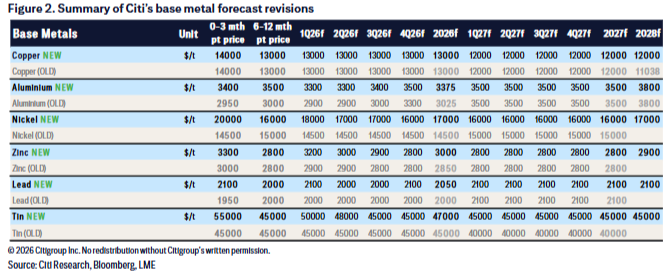
Core Viewpoint - The commodity market is at a critical turning point influenced by geopolitical tensions and supply shortages, with specific forecasts for various commodities through 2026 [1][20]. Oil Market - The short-term oil market is driven by geopolitical premiums, with a price target of $70 per barrel for Brent crude, influenced by tensions in Iran and the Russia-Ukraine conflict, as well as export disruptions in Kazakhstan and Libya [3][6]. - However, the long-term outlook is bearish due to expected supply surplus and policy pressures, particularly from the U.S. government aiming for lower oil prices [6][20]. Precious Metals - In the precious metals sector, silver is expected to outperform gold, with target prices set at $100 per ounce for silver and $5,000 for gold, driven by current market momentum and capital flows [7][20]. - The report suggests that these high price levels may trigger hedging actions from producers and central banks [7]. Base Metals - Aluminum is identified as having the most structural opportunity, facing a significant supply deficit, with short-term price targets of $3,400 per ton and mid-term targets of $3,500 [8][20]. - In contrast, copper is forecasted to reach $14,000 per ton, but the confidence in this projection has weakened significantly since December, with a warning that January may be the peak for the year [11][20]. Lithium Market - The lithium market has seen a rebound of over 50%, primarily due to supply constraints from delays in mining operations and tightening policies [12][14]. - Citigroup has raised the three-month price target for lithium carbonate to $25,000 per ton, reflecting strong demand from battery manufacturers [13][20]. - Despite the short-term strength, there is a cautious long-term outlook for lithium prices, anticipating downward pressure as supply increases [14]. Natural Gas and Agriculture - The natural gas market is expected to face long-term supply surplus challenges, with bearish views on LNG and European TTF gas prices starting from 2027 [15][20]. - In agriculture, a bullish outlook is maintained for most commodities, with sugar prices expected to rebound in 2026 due to increased demand from China and changes in Brazilian production [19][20].

有色金属日报-20260115
Wu Kuang Qi Huo· 2026-01-15 01:41
Report Summary 1. Report Industry Investment Rating No investment rating information is provided in the report. 2. Core Views - **Copper**: Despite high prices suppressing consumption and inventory accumulation pressure, due to tight mine supply and strong LME spot, copper prices are well - supported and expected to oscillate at high levels. The reference range for the SHFE copper main contract is 102,000 - 106,000 yuan/ton, and for LME copper 3M is 13,000 - 13,600 dollars/ton [3]. - **Aluminum**: With domestic inventory accumulation pressure, but supported by low overseas inventory, strong spot, stable downstream start - up, and export resilience, aluminum prices are expected to oscillate at high levels. The reference range for the SHFE aluminum main contract is 24,300 - 25,000 yuan/ton, and for LME aluminum 3M is 3,150 - 3,220 dollars/ton [6]. - **Cast Aluminum Alloy**: Supported by strong cost and supply disruptions, but with average demand. If prices remain stable in the short - term, they may strengthen further [8]. - **Lead**: The lead price is near the upper limit of the long - term oscillation range, with increased contradictions between macro and industrial funds. It is expected to oscillate widely following the non - ferrous sector sentiment [11]. - **Zinc**: Although the zinc industry situation has not improved significantly, it has significant room to catch up compared to copper and aluminum. It is expected to oscillate widely following the non - ferrous sector sentiment [12]. - **Tin**: Despite weak demand and expected supply improvement, with low downstream inventory, prices are expected to fluctuate with market sentiment. It is recommended to wait and see. The reference range for the domestic main contract is 400,000 - 450,000 yuan/ton, and for overseas LME tin is 52,000 - 56,000 dollars/ton [14]. - **Nickel**: With large excess pressure and inventory increase constraining price rise, but supported by domestic liquidity and Indonesian policies, it is expected to oscillate widely. It is recommended to wait and see. The reference range for SHFE nickel is 120,000 - 150,000 yuan/ton, and for LME nickel 3M is 16,500 - 19,000 dollars/ton [15]. - **Lithium Carbonate**: After a continuous rise, there is a risk of a significant correction. It is recommended to wait and see or take a light - position approach. The reference range for the GZEE lithium carbonate 2605 contract is 156,000 - 166,000 yuan/ton [19]. - **Alumina**: With expected decline in ore prices and over - capacity in the smelting end, it is recommended to wait and see. It may be possible to short near - month contracts at high prices. The reference range for the domestic main contract AO2605 is 2,700 - 2,900 yuan/ton [22]. - **Stainless Steel**: Supported by cost, low supply, and inventory reduction, prices are expected to oscillate at high levels. The reference range for the main contract is 13,700 - 14,900 yuan/ton [25]. 3. Summary by Category Copper - **Market Information**: LME copper 3M rose 1.09% to 13,300 dollars/ton, SHFE copper main contract reached 103,660 yuan/ton. LME copper inventory increased by 75 to 141,625 tons, SHFE daily warehouse receipts increased by 2.7 to 149,000 tons. The import loss of SHFE copper spot widened, and the refined - scrap copper price difference expanded [2]. - **Strategy**: The supply of copper ore remains tight, and short - term supply disruptions occur. Although high prices suppress consumption, copper prices are well - supported and expected to oscillate at high levels [3]. Aluminum - **Market Information**: LME aluminum fell 0.2% to 3,189 dollars/ton, SHFE aluminum main contract reached 24,665 yuan/ton. SHFE aluminum weighted contract positions decreased by 0.5 to 766,000 lots, and futures warehouse receipts increased by 3.3 to 134,000 tons. Domestic and LME aluminum inventories changed, and the spot discount expanded [4]. - **Strategy**: With domestic inventory accumulation pressure, but supported by overseas factors, aluminum prices are expected to oscillate at high levels [6]. Cast Aluminum Alloy - **Market Information**: The price of cast aluminum alloy rose 0.93% to 23,380 yuan/ton. The weighted contract positions decreased to 27,100 lots, and the trading volume was 22,000 lots. The inventory decreased by 0.03 to 43,600 tons [8]. - **Strategy**: Supported by cost and supply disruptions, prices may strengthen if they remain stable in the short - term [8]. Lead - **Market Information**: SHFE lead index rose 0.12% to 17,369 yuan/ton, LME lead 3S rose 2 to 2,056 dollars/ton. There were changes in various inventory and price indicators [9]. - **Strategy**: The lead price is near the upper limit of the long - term oscillation range, with increased contradictions between macro and industrial funds, and is expected to oscillate widely [11]. Zinc - **Market Information**: SHFE zinc index rose 0.80% to 24,470 yuan/ton, LME zinc 3S rose 17 to 3,219.5 dollars/ton. There were changes in various inventory and price indicators [12]. - **Strategy**: Although the industry situation has not improved significantly, it has significant room to catch up compared to copper and aluminum, and is expected to oscillate widely [12]. Tin - **Market Information**: SHFE tin main contract rose 8.62% to 413,170 yuan/ton. Supply and demand situations are complex, and inventory decreased last week [13][14]. - **Strategy**: Despite weak demand and expected supply improvement, prices are expected to fluctuate with market sentiment. It is recommended to wait and see [14]. Nickel - **Market Information**: SHFE nickel main contract rose 1.80% to 140,940 yuan/ton. Spot premiums were stable, and the prices of nickel ore and nickel iron changed [15]. - **Strategy**: With large excess pressure and inventory increase constraining price rise, but supported by policies, it is expected to oscillate widely. It is recommended to wait and see [15]. Lithium Carbonate - **Market Information**: The MMLC spot index fell 1.63%, and the LC2605 contract price fell 3.02% [17]. - **Strategy**: After a continuous rise, there is a risk of a significant correction. It is recommended to wait and see or take a light - position approach [19]. Alumina - **Market Information**: The alumina index rose 0.74% to 2,792 yuan/ton. There were changes in spot prices, import profits and losses, and inventory [21]. - **Strategy**: With expected decline in ore prices and over - capacity in the smelting end, it is recommended to wait and see. It may be possible to short near - month contracts at high prices [22]. Stainless Steel - **Market Information**: The stainless steel main contract rose 0.98% to 13,925 yuan/ton. Spot prices and inventory changed [24][25]. - **Strategy**: Supported by cost, low supply, and inventory reduction, prices are expected to oscillate at high levels [25].
光大期货:1月14日矿钢煤焦日报
Xin Lang Cai Jing· 2026-01-14 01:25
Rebar Steel - The rebar futures contract closed at 3158 CNY/ton, down 7 CNY/ton or 0.22% from the previous trading day, with a reduction in open interest by 38,800 contracts [3][12] - Spot prices remained stable, with Tangshan's ordinary billet price at 2970 CNY/ton and Hangzhou's Zhongtian rebar price at 3250 CNY/ton, while national construction material transaction volume was 83,600 tons [3][12] - Recent bullish sentiment in the commodity market has positively impacted the undervalued rebar, with steel mills experiencing good order conditions and some securing winter storage resources early [3][12] - However, steel mill profitability has improved, leading to a continuous increase in rebar production, while demand is weakening as temperatures drop, resulting in a shift from inventory decline to increase [3][12] - The market is currently in a situation of valuation without driving forces, with short-term price expectations leaning towards narrow fluctuations [3][12] Iron Ore - The iron ore futures contract closed at 819.5 CNY/ton, down 3 CNY/ton or 0.4% from the previous trading day, with a trading volume of 310,000 contracts and a slight reduction in open interest by 1,000 contracts [4][13] - Port prices for mainstream iron ore varieties showed slight declines, with 60.8% PB powder at 822 CNY, super special powder at 702 CNY, and 61.6% PB lump at 885 CNY [4][13] - On the supply side, shipments from Australia and Brazil continued to decline, while other countries saw slight increases, leading to a small overall decrease in global shipments [4][13] - Demand saw the addition of 11 blast furnaces undergoing maintenance and 11 blast furnaces resuming operations, with iron output increasing by 20,700 tons to 2.295 million tons [4][13] - Port inventories continued to accumulate, and steel mill inventories also increased, indicating a focus on replenishment demand in the short term [4][13] Coking Coal - The coking coal futures contract closed at 1191 CNY/ton, down 47 CNY/ton or 3.8%, with a decrease in open interest by 8,128 contracts [5][15] - In the spot market, prices for various coal types showed mixed movements, with some prices increasing slightly while others remained stable [5][15] - Supply-side issues due to underground problems in some coal mines have limited production, while others maintained normal production levels [5][15] - The recovery in iron output has led to increased demand for raw materials, with steel mills showing a low inventory of coal, thus expanding procurement needs [5][15] - Short-term expectations for coking coal prices are for continued fluctuations [5][15] Coke - The coke futures contract closed at 1745 CNY/ton, down 25 CNY/ton or 1.41%, with a reduction in open interest by 1,031 contracts [6][16] - Spot prices for coke at ports showed a decline, with the price for first-grade metallurgical coke at Rizhao Port at 1490 CNY/ton [6][16] - On the supply side, coking coal prices have stabilized, and online auction conditions have improved, leading to a slight recovery in market sentiment [6][16] - Demand has increased as most previously shut down blast furnaces have resumed operations, with some steel mills releasing replenishment demand [6][16] - The steel market is currently in a low season, with expectations for continued fluctuations in coke prices [6][16] Silicon Manganese - Silicon manganese futures prices showed a slight decline, closing at 5916 CNY/ton, down 0.37%, with an increase in open interest by 3,675 contracts to 261,000 contracts [7][17] - Prices in various regions ranged from 5650 to 5820 CNY/ton, with a 50 CNY increase in Inner Mongolia [7][17] - The overall black metal sector showed weak performance, leading to a downward shift in silicon manganese prices [7][17] - Demand during the steel bidding period provided some support, with a total of 17,000 tons bid for January, an increase of 2,300 tons [7][17] - Inventory levels among 63 sample enterprises have decreased from high levels, but year-on-year increases remain significant [7][17] Silicon Iron - Silicon iron futures prices experienced a slight decline, closing at 5682 CNY/ton, down 0.11%, with a decrease in open interest by 3,885 contracts to 220,800 contracts [8][18] - Prices across regions remained stable, ranging from 5300 to 5350 CNY/ton [8][18] - The overall black metal sector showed weak performance, leading to a slight downward shift in silicon iron prices [8][18] - Production levels for silicon iron have remained stable, with weekly output at the lowest level for the same period in five years [8][18] - Inventory levels among 60 sample enterprises increased by 4,550 tons to 68,910 tons, with relatively high inventories in Inner Mongolia [8][18]

1月14日你需要知道的隔夜全球重要信息
Jin Rong Jie· 2026-01-13 23:58
Market Performance - The Dow Jones Industrial Average closed down 0.8%, the S&P 500 fell by 0.2%, and the Nasdaq decreased by 0.1% [1] - The Nasdaq Golden Dragon China Index dropped by 1.86% [1] - Intel shares rose by 7.3%, Google increased by 1%, while Pinduoduo fell by 5.4% and JPMorgan Chase declined by 4% [1] Commodity Market - New York gold prices fell by over 0.4% [1] - The SPDR Gold Trust, the world's largest gold ETF, increased its holdings by 3.43 tons to a total of 1,074.23 tons [1] - The iShares Silver Trust, the largest silver ETF, saw a decrease in holdings by 26.79 tons, bringing the total to 16,321.16 tons [1] Technology Sector - The U.S. has relaxed export controls on Nvidia's H200 chips to China, with sales now subject to approval and security review by the U.S. Department of Commerce [1] Geopolitical Developments - Israel announced its withdrawal from several UN agencies, citing "anti-Israel bias" [1] - Iran reported the arrest of 297 individuals linked to unrest associated with the U.S. and Israel [1] - U.S. Energy Secretary Dan Brouillette stated that the U.S. would be willing to cooperate with Iran in the oil sector if the Iranian regime collapses [1] - Reports indicate that a U.S. envoy secretly met with Iran's former crown prince, as the Trump administration reassesses opposition forces [1] - President Trump mentioned that all meetings with Iranian officials have been canceled and suggested that it is a good idea for Americans to evacuate Iran [1] U.S. Domestic Policy - President Trump stated that a decision on the Federal Reserve Chair will be made in the coming weeks [1] - A senior U.S. official indicated that the U.S. may take concrete steps to acquire Greenland in the coming weeks or months, with options including direct purchase or encouraging Greenland's independence for closer ties with the U.S. [1] Oil Inventory - As of January 9, API reported U.S. crude oil inventories at 5.278 million barrels, against an expectation of a decrease of 2.238 million barrels and a previous value of a decrease of 2.766 million barrels [1]




光大期货:1月12日矿钢煤焦日报
Xin Lang Cai Jing· 2026-01-12 01:34
Group 1: Steel Market Overview - Rebar production increased by 28,200 tons week-on-week to 1.9104 million tons, but decreased by 83,700 tons year-on-year [3][16] - Social inventory of rebar rose by 75,200 tons week-on-week to 2.9018 million tons, a year-on-year decrease of 21,300 tons [3][16] - Factory inventory of rebar increased by 85,600 tons week-on-week to 1.4793 million tons, a year-on-year increase of 223,900 tons [3][16] - Rebar demand fell by 25,480 tons week-on-week to 1.7496 million tons, a year-on-year decrease of 150,900 tons [3][16] - Overall supply and demand data for rebar is weak, with inventory entering an accumulation phase [3][16] Group 2: Hot Rolled Coil Market - Hot rolled coil production increased by 10,000 tons week-on-week to 3.0551 million tons, a year-on-year increase of 16,200 tons [4][17] - Social inventory of hot rolled coil rose by 21,700 tons week-on-week to 2.9081 million tons, a year-on-year increase of 580,600 tons [4][17] - Factory inventory of hot rolled coil decreased by 50,000 tons week-on-week to 773,200 tons, a year-on-year increase of 1,700 tons [4][17] - Demand for hot rolled coil fell by 24,300 tons week-on-week to 3.0834 million tons, a year-on-year increase of 72,500 tons [4][17] Group 3: Iron Ore Market - Iron water production increased by 20,700 tons week-on-week to 2.296 million tons [5][18] - Global iron ore shipment volumes from Australia and Brazil decreased significantly, with Australia shipping 19.396 million tons, down 1.741 million tons week-on-week [5][18] - Port inventory of imported iron ore rose by 3.2265 million tons week-on-week to 170.4444 million tons [5][18] - Steel mill inventory of imported iron ore increased by 430,000 tons, mainly in North China, East China, and along the Yangtze River [5][18] Group 4: Coke Market - Coke prices in various regions decreased by 50-55 yuan/ton, while some prices increased by 30 yuan/ton [7][20] - Demand for coke remains weak, with rebar demand falling significantly [7][20] - Independent coke enterprises increased daily production by 850 tons, while steel mills' daily coke production increased by 50 tons [7][20] - Total coke inventory increased by 2,200 tons, with independent coke enterprises reducing inventory by 45,300 tons [7][20] Group 5: Scrap Steel Market - Scrap steel prices increased by 9.6 yuan/ton to 2,187.4 yuan/ton [9][22] - Daily average scrap steel arrival at steel mills decreased to 476,000 tons, a week-on-week decrease of 7,600 tons [10][23] - Scrap steel demand fell, with daily consumption decreasing to 505,000 tons [10][23] - Long-process steel mills' scrap steel inventory increased by 16,900 tons to 3.16 million tons [10][23] Group 6: Ferroalloy Market - Manganese silicon production decreased by 1.39% week-on-week to 191,000 tons [11][24] - Demand for manganese silicon remains limited, with major northern steel mills not actively purchasing [11][24] - Inventory levels remain high, with a week-on-week decrease of 11,000 tons to 382,500 tons [11][24] Group 7: Silicon Iron Market - Silicon iron production increased by 0.2% week-on-week to 99,100 tons, remaining at a five-year low [12][25] - Demand for silicon iron is limited, with consumption levels at historical lows [12][25] - Inventory increased by 4,550 tons week-on-week to 68,910 tons [12][25]
A new era of geopolitical risk is rewiring global commodity markets
Yahoo Finance· 2026-01-07 18:30
Core Insights - Investors are navigating a new era of geopolitical risk that is increasingly influencing commodity markets, with ongoing conflicts reshaping pricing mechanisms [1][2][4] Group 1: Geopolitical Risk and Commodity Pricing - Geopolitical risk is now a persistent factor in commodity pricing, embedding a risk premium due to supply-chain fragility and trade fragmentation [2][3] - The invasion of Ukraine in 2022 marked the beginning of this new era, leading to heightened tensions and conflicts that have driven commodity prices, particularly gold [4][6] Group 2: Impact on Specific Commodities - Gold has seen a significant rally as investors seek safe-haven assets amid rising geopolitical tensions, with the Middle East conflicts further enhancing its status [5][6] - Oil prices have been an outlier, experiencing a decline despite geopolitical tensions, with a notable 20% drop in 2025, indicating a complex relationship between geopolitical events and oil pricing [6]
PVC周报:冠通期货研究报告-20260105
Guan Tong Qi Huo· 2026-01-05 11:50
1. Report's Industry Investment Rating - No information provided 2. Core View of the Report - The report predicts that PVC will fluctuate. The current supply - side PVC start - up rate has increased, but the downstream start - up rate has decreased. The export situation is not good, social inventory is high, and the real estate market is still in the adjustment stage. Although the market sentiment of bulk commodities has been boosted, the overall situation is complex, leading to the expected fluctuating operation of PVC [3][4] 3. Summary According to Relevant Catalogs 3.1 Market Analysis - The calcium carbide price in the upstream northwest region is stable. The supply - side PVC start - up rate has increased by 1.40 percentage points to 78.63%, reaching a neutral level in recent years. In winter, the downstream start - up rate of PVC has decreased by 0.58 percentage points, and the orders for downstream products are not good. Last week, export orders decreased slightly. The price in the Indian market is low, and the demand in India is limited. The CFR China price of Formosa Plastics in Taiwan in January remained flat compared with the previous period, while the CFR India and CFR Southeast Asia prices decreased by $20/ton and $30/ton respectively. Social inventory continued to increase last week and is still at a high level, with relatively large inventory pressure [3] - From January to November 2025, the real estate market was still in the adjustment stage. The year - on - year decline in investment, new construction, construction, and completion areas was still large, and the year - on - year growth rates of investment, sales, new construction, and completion further declined. The weekly transaction area of commercial housing in 30 large and medium - sized cities continued to rebound but remained at the lowest level in recent years. The real estate market needs more time to improve. A new production capacity of 300,000 tons/year from Jiaxing Jiahua has recently started trial production [3] - The anti - involution sentiment has further increased. In December, China's manufacturing PMI, non - manufacturing business activity index, and comprehensive PMI output index all rose to the expansion range, which boosted the market sentiment of bulk commodities. The comprehensive gross profit of chlor - alkali decreased, and the start - up expectations of some production enterprises declined, but the current output decline is limited. The futures warehouse receipts are still at a high level, the calcium carbide price is stable, the price in the Indian market is low, and the demand in India is limited. January is the traditional off - season for domestic PVC demand. Social inventory continues to increase. After the spot price rises, the market trading is light [3] 3.2 PVC Basis - The current 05 basis is - 215 yuan/ton, and the basis is at a relatively low level [12] 3.3 PVC Start - up Rate - The start - up rate of PVC has increased. After the devices of Jiangsu Xinpu and Ningbo Hanwha resumed production, the PVC start - up rate increased by 1.40 percentage points to 78.63%, reaching a neutral level in recent years [17] 3.4 Real Estate Data - In terms of demand, the real estate market is still in the adjustment stage. The year - on - year decline in investment, new construction, and completion areas is still large, and the year - on - year growth rates of investment, sales, new construction, construction, and completion further declined. From January to November 2025, the national real estate development investment was 785.91 billion yuan, a year - on - year decrease of 15.9%. From January to November, the commercial housing sales area was 787.02 million square meters, a year - on - year decrease of 7.8%; among them, the residential sales area decreased by 8.1%. The commercial housing sales volume was 751.30 billion yuan, a decrease of 11.1%, and the residential sales volume decreased by 11.2%. From January to November, the housing new construction area was 534.57 million square meters, a year - on - year decrease of 20.5%; among them, the residential new construction area was 391.89 million square meters, a decrease of 19.9%. From January to November, the housing construction area of real estate development enterprises was 6.56066 billion square meters, a year - on - year decrease of 9.6%. From January to November, the housing completion area was 394.54 million square meters, a year - on - year decrease of 18.0%; among them, the residential completion area was 281.05 million square meters, a year - on - year decrease of 20.1%. The overall real estate market needs more time to improve [23] - As of the week of January 4, the commercial housing transaction area in 30 large and medium - sized cities decreased by 26.09% week - on - week and was at a relatively low level in recent years. Attention should be paid to whether the real estate favorable policies can boost commercial housing sales [23] 3.5 PVC Inventory - As of the week of December 31, the PVC social inventory increased by 1.45% week - on - week to 1.0766 million tons, a year - on - year increase of 36.24%. Social inventory continued to increase and is still at a high level (Longzhong increased the social storage capacity in East China and South China from 21 to 41) [24][25]
大宗商品市场景气水平继续回升 为今年经济持稳向好运行奠定良好基础
Yang Shi Wang· 2026-01-05 01:54
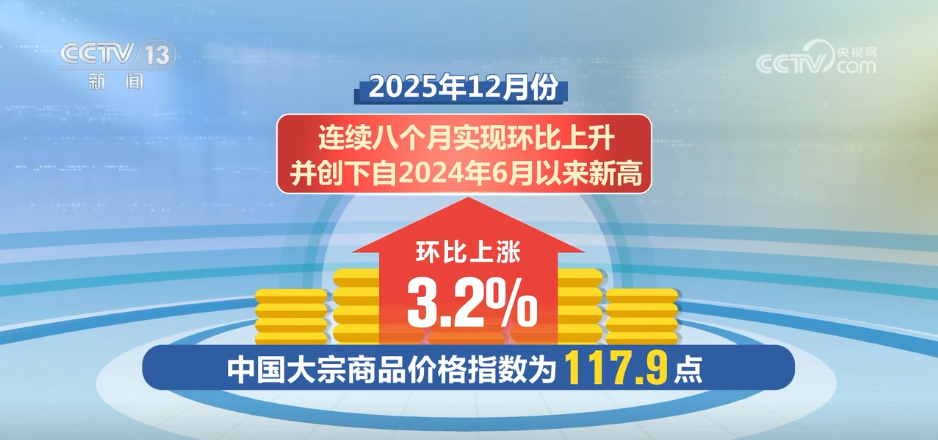
Core Viewpoint - The China Logistics and Purchasing Federation reported that the commodity price index reached 117.9 points in December 2025, indicating a continued recovery in the commodity market and improved supply-demand dynamics, which supports stable economic performance for the year [1][3]. Group 1: Commodity Price Index - The commodity price index for December 2025 was 117.9 points, reflecting a month-on-month increase of 3.2%, marking the eighth consecutive month of growth and the highest level since June 2024 [3]. - Among the 50 monitored commodities, 31 saw price increases in December, with lithium carbonate, refined tin, and apples leading the gains at 15.5%, 11.7%, and 8.5% respectively [5]. Group 2: Market Outlook - Experts predict that the overall commodity market in China will maintain a stable and positive trend in 2025, supported by proactive macroeconomic policies and structural economic upgrades that will create new demand for commodities [7]. - The price index for non-ferrous metals rose significantly by 4.9%, while agricultural products increased by 2.5%. Other indices, including mineral, black metal, and chemical prices, also saw slight increases of 0.8%, 0.4%, and 0.3% respectively [8].
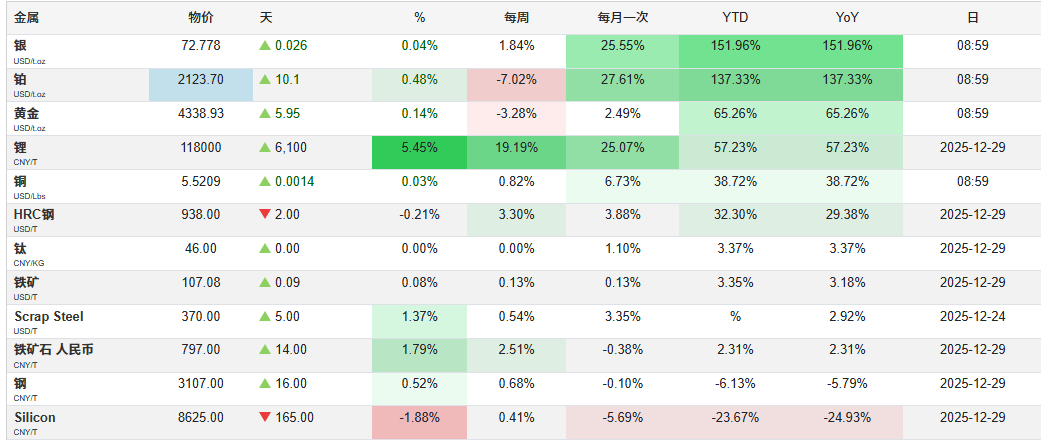
金价跌至每盎司 4346 美元,白银跌幅一度逼近 9%,为何国际金、银价格会大幅下跌?
Sou Hu Cai Jing· 2025-12-30 01:32
Core Insights - The article discusses the recent surge in precious metal prices and its impact on the real economy, particularly the consumer and manufacturing sectors, highlighting a disconnect between market sentiment and actual demand [1] - It emphasizes that the current trading environment is driven by emotions rather than logic, leading to extreme price volatility and potential market corrections [1] Group 1: Market Dynamics - The precious metals market is experiencing a speculative bubble, with significant price increases that are not supported by fundamental supply and demand metrics [7] - Regulatory measures, such as increased margin requirements by major exchanges, have triggered a forced deleveraging in the market, contributing to recent price declines [6] - Market rumors, particularly regarding the financial stability of major banks, have exacerbated volatility and led to panic selling among investors [11] Group 2: Economic Indicators - The article notes that while precious metals like silver and gold have seen substantial price increases (silver up 173% and gold up over 71% in 2025), the actual industrial demand growth for silver is only 15% [7] - There is a persistent supply shortage in the silver market, with a cumulative supply gap approaching 25,500 tons from 2021 to 2025, indicating that the fundamental demand remains strong despite price corrections [12] - The macroeconomic environment is shifting, with changing expectations around Federal Reserve interest rate policies impacting the attractiveness of precious metals as safe-haven assets [12]