
供需平衡

Search documents
《有色》日报-20251031
Guang Fa Qi Huo· 2025-10-31 02:32
1. Report Industry Investment Ratings No relevant information provided. 2. Core Views of the Report Copper - After the implementation of interest rate cuts and tariff policies, the copper market may enter a macro "vacuum period" in November. The shortage of copper ore supply strengthens the price bottom, but short - term rapid price increases may suppress demand. The long - term supply - demand contradiction supports the upward movement of the copper price bottom, and the main contract should focus on the support around 87,000 yuan/ton [1]. Aluminum and Alumina - Aluminum prices are expected to remain high and fluctuate. Macro factors such as Sino - US economic and trade consultations and domestic policies support market confidence, while the supply - demand structure shows that supply is restricted and demand has structural highlights. Alumina prices are expected to continue to be under pressure in the short term, with the main contract oscillating between 2,750 - 2,950 yuan/ton, and the market has shown signs of bottoming out [3]. Aluminum Alloy - The casting aluminum alloy market continues to oscillate at a high level. Cost support is prominent, supply is shrinking, demand is moderately recovering, and social inventory is accumulating. The price of ADC12 is expected to maintain a strong - side oscillation, with the main contract reference range of 20,200 - 20,800 yuan/ton [5]. Zinc - Zinc prices are expected to oscillate. The supply is relatively loose, but the smelting profit is compressed, and the subsequent supply increase may be limited. The demand is generally stable, and the LME has the risk of a short squeeze, which supports the zinc price. The main contract reference range is 21,800 - 22,800 yuan/ton [8]. Tin - Tin prices may decline in the short term due to the hawkish statement on interest rate cuts. The supply of tin ore is tight, but the demand is weak. If the supply in Myanmar recovers well, tin prices may weaken; otherwise, they will continue to run strongly [11]. Nickel - The nickel market is expected to oscillate. Macro factors are stable, but the inventory is accumulating, and the medium - term supply is loose. The main contract reference range is 118,000 - 126,000 yuan/ton [13]. Stainless Steel - The stainless - steel market is expected to be weak and oscillate. Macro sentiment has improved, but downstream demand during the peak season is insufficient, and the supply side has pressure from production scheduling and social inventory. The main contract reference range is 12,500 - 13,000 yuan/ton [15]. Lithium Carbonate - Lithium carbonate prices are expected to remain strong in the short term. The downstream demand is better than expected, and the industry is continuously destocking. The main contract reference range is 83,000 - 87,000 yuan/ton [17]. 3. Summary by Relevant Catalogs Copper Price and Basis - SMM 1 electrolytic copper price is 88,065 yuan/ton, up 0.34% from the previous day. The import profit and loss is - 883 yuan/ton, and the month - to - month spread shows different changes [1]. Fundamental Data - In September, electrolytic copper production was 112.10 million tons, a month - on - month decrease of 4.31%. The import volume was 33.43 million tons, an increase of 7 million tons compared with the previous month. The domestic mainstream port copper concentrate inventory decreased by 0.38% [1]. Aluminum and Alumina Price and Spread - SMM A00 aluminum price is 21,200 yuan/ton, up 0.14%. The import profit and loss is - 2,515 yuan/ton, and the month - to - month spread has different changes [3]. Fundamental Data - In September, alumina production was 760.37 million tons, a month - on - month decrease of 1.74%. Electrolytic aluminum production was 361.48 million tons, a decrease of 3.16%. The import volume increased by 13.57%, and the export volume increased by 13.07% [3]. Aluminum Alloy Price and Spread - SMM aluminum alloy ADC12 price is 21,300 yuan/ton, up 0.47%. The month - to - month spread shows different changes [5]. Fundamental Data - In September, the production of recycled aluminum alloy ingots was 66.10 million tons, a month - on - month increase of 7.48%. The production of primary aluminum alloy ingots was 28.30 million tons, an increase of 4.43%. The import volume of non - wrought aluminum alloy ingots increased by 15.77%, and the export volume decreased by 19.24% [5]. Zinc Price and Spread - SMM 0 zinc ingot price is 22,250 yuan/ton, down 0.18%. The import profit and loss is - 4,757 yuan/ton, and the month - to - month spread has different changes [8]. Fundamental Data - In September, refined zinc production was 60.01 million tons, a month - on - month decrease of 4.17%. The import volume decreased by 11.61%, and the export volume increased by 696.78% [8]. Tin Spot Price and Basis - SMM 1 tin price is 284,000 yuan/ton, down 0.42%. The LME 0 - 3 premium is 10.02 US dollars/ton, down 74.95% [11]. Fundamental Data - In September, the import of tin ore was 8,714 tons, a month - on - month decrease of 15.13%. SMM refined tin production was 10,510 tons, a decrease of 31.71%. The export volume increased by 6.59%, and the average operating rate decreased by 31.77% [11]. Nickel Price and Spread - SMM 1 electrolytic nickel price is 122,200 yuan/ton, up 0.25%. The import profit and loss is - 1,540 yuan/ton, and the month - to - month spread has different changes [13]. Supply and Inventory - The production of refined nickel products is 32,200 tons, an increase of 1.26%. SHFE inventory is 36,075 tons, an increase of 4.81%. Social inventory is 48,802 tons, an increase of 2.29% [13]. Stainless Steel Price and Basis - The price of 304/2B (Wuxi Hongwang 2.0 coil) is 12,950 yuan/ton, unchanged. The spot - futures price difference is 385 yuan/ton, up 25.40% [15]. Fundamental Data - The production of 300 - series stainless - steel crude steel in China (43 enterprises) is 182.17 million tons, an increase of 0.38%. The import volume increased by 2.70%, and the export volume decreased by 6.55% [15]. Lithium Carbonate Price and Basis - SMM battery - grade lithium carbonate average price is 80,000 yuan/ton, up 1.07%. The basis is - 1,740 yuan/ton, down 5.45% [17]. Fundamental Data - In September, lithium carbonate production was 87,260 tons, an increase of 2.37%. The demand was 116,801 tons, an increase of 12.28%. The import volume decreased by 10.30%, and the export volume decreased by 59.12% [17].
银河期货有色金属衍生品日报-20251030
Yin He Qi Huo· 2025-10-30 11:42
Group 1: Report Summary - The report provides a daily analysis of the non - ferrous metals market on October 30, 2025, covering copper, alumina, electrolytic aluminum, cast aluminum alloy, zinc, lead, nickel, stainless steel, tin, industrial silicon, polysilicon, and lithium carbonate [1]. - It includes market reviews, important information, logical analyses, and trading strategies for each metal [1][2][3]. Group 2: Market Reviews Copper - The main contract of Shanghai copper 2512 closed at 87,960 yuan/ton, down 0.1%, and the Shanghai copper index increased positions by 2,982 lots to 620,000 lots. LME closed at $11,090/ton, up 0.55%. Shanghai copper spot was at a discount of 55 yuan/ton [1]. Alumina - The alumina 2601 contract decreased by 28 yuan to 2,816 yuan/ton. The northern spot comprehensive price of alumina was 2,840 yuan, up 5 yuan [8]. Electrolytic Aluminum - The Shanghai aluminum 2512 contract decreased by 10 yuan to 21,245 yuan/ton. Spot prices in East China, South China, and Central China were 21,190 yuan (up 30), 21,070 yuan (flat), and 21,050 yuan (up 10) respectively [16]. Cast Aluminum Alloy - The cast aluminum alloy 2512 contract increased by 100 yuan to 20,750 yuan/ton. The spot price of ADC12 aluminum alloy ingots in various regions remained flat [24]. Zinc - The Shanghai zinc 2512 contract fell 0.13% to 22,365 yuan/ton, and the Shanghai zinc index increased positions by 4,449 lots to 214,800 lots. The spot price in Shanghai was 22,300 - 22,425 yuan/ton [31]. Lead - The Shanghai lead 2512 contract fell 0.06% to 17,350 yuan/ton, and the Shanghai lead index decreased positions by 2,688 lots to 119,800 lots. The average price of SMM1 lead was flat at 17,200 yuan/ton [37]. Nickel - The main contract of Shanghai nickel NI2512 decreased by 40 to 120,980 yuan/ton, and the index increased positions by 3,185 lots. The premium of Jinchuan nickel, Russian nickel, and electrowinning nickel changed to varying degrees [42]. Stainless Steel - The main contract of stainless steel SS2512 decreased by 50 to 12,725 yuan/ton, and the index decreased positions by 8,627 lots. The spot price of cold - rolled was 12,550 - 12,850 yuan/ton, and hot - rolled was 12,450 - 12,500 yuan/ton [50]. Tin - The main contract of Shanghai tin 2512 closed at 283,600 yuan/ton, down 2,650 yuan/ton or 0.93%, and the position decreased by 2,185 lots to 72,249 lots. The average spot price of tin ingots in Shanghai was 284,000 yuan/ton, down 1,300 yuan/ton [55]. Industrial Silicon - The main contract of industrial silicon decreased. The spot prices of different grades in various regions remained stable [89]. Polysilicon - The main contract of polysilicon increased. The spot prices of different types of polysilicon and related downstream product prices had minor changes [90]. Lithium Carbonate - The lithium carbonate 2601 contract increased by 980 to 83,400 yuan/ton, and the index increased positions by 36,888 lots. The spot prices of battery - grade and industrial - grade lithium carbonate increased [76]. Group 3: Important Information Macro - level - The Fed cut interest rates by 25 basis points and ended quantitative tightening, but Powell's hawkish remarks on December's interest - rate cut prospects reduced the market's expectation of a December rate cut from 95% to 65% [2]. - The Sino - US economic and trade teams reached a consensus, with the US canceling a 10% "fentanyl tariff" on Chinese goods and suspending a 24% reciprocal tariff for another year [16][24][56]. Industry - level - Chile's state - owned mining company ENAMI obtained environmental approval for a new $1.7 - billion copper smelter [2]. - Some zinc mines in Southwest, North, and Central China have production adjustments such as maintenance and resumption of production [32]. - A large alumina enterprise in North China has two roasting furnaces under maintenance due to heavy pollution weather [9]. - Some electrolytic aluminum plants overseas and in China have production cuts [17]. - Some stainless steel mills plan to cut production to relieve the supply - demand contradiction in the fourth quarter [51]. - Indonesia closed 1,000 illegal mining sites [57]. - The production of some polysilicon plants in Southwest China will be reduced in November [69]. - China will suspend the implementation of lithium - battery and its material export control measures for one year [78]. Group 4: Logical Analysis Copper - Macroscopically, the dollar strengthened due to Powell's hawkish remarks, and the Sino - US leaders' meeting was slightly disappointing. Fundamentally, the supply of copper mines is tight, and the production of electrolytic copper in October is expected to decline. The consumption is weak, and the spot has turned to a discount [3][4]. Alumina - The supply and demand of alumina are still significantly in surplus. The market expects production cuts in the future, which drives the price to rebound slightly at a low level. However, the non - implementation of production cuts and the open import window suppress the rebound [11]. Electrolytic Aluminum - Macroscopically, the market's expectation of a December Fed rate cut has decreased, and the Sino - US economic and trade consensus eases the risk - aversion sentiment. Fundamentally, overseas production cuts intensify the supply - demand tension, and the domestic consumption has resilience [18]. Cast Aluminum Alloy - Macroscopically, the Fed's hawkish remarks increase uncertainty, but the Sino - US trade negotiation is positive. Fundamentally, the supply of scrap aluminum is tight, the supply of the regenerative aluminum alloy industry is shrinking, and the demand is resilient, supporting the price [26]. Zinc - Domestically, the winter storage of smelters has increased, the processing fees have decreased, and some smelters may cut production in November. The consumption is expected to weaken. Overseas, the inventory is relatively low, and the LME zinc price is strong. The domestic export window is open [33]. Lead - Some lead - storage enterprises' orders have improved, but they have reduced production due to high lead prices. The supply side may increase production as the price of lead scrap has not risen significantly. The lead price may decline [39]. Nickel - The Fed's interest - rate cut and hawkish remarks have an impact. The LME nickel inventory is slowly increasing, and the supply - demand is loose. The price is supported by cost, and it will fluctuate widely [45]. Stainless Steel - The terminal demand in October is not optimistic, and it is the end of the peak season. The supply side has production cuts, the cost support is not strong, and the price has encountered resistance [51]. Tin - The Sino - US leaders' meeting result is slightly disappointing. The supply of tin mines is still tight, and the production of smelters in September decreased. The demand is slowly recovering, and the downstream procurement is cautious [57]. Industrial Silicon - The start - up rate of silicon plants in Northwest China is at a high level, and those in Southwest China will stop production at the end of the month. The demand for organic silicon and aluminum alloy is stable, and the production of polysilicon will be reduced in November. There may be inventory reduction [62]. Polysilicon - The production in Southwest China will be reduced in November. The demand is expected to be poor, but there is still resilience. The market will be in a tight - balance state in November. The old warehouse receipts' negative impact on the market is weakening [69]. Lithium Carbonate - The weekly production has decreased, and the inventory is being reduced. The fundamentals are healthy, attracting bullish funds. The price is expected to continue rising [78]. Group 5: Trading Strategies Copper - Unilateral: The medium - term upward trend continues. Adopt a strategy of buying on dips, but be cautious of short - term pullbacks when chasing high [5]. - Arbitrage: Hold cross - market positive arbitrage and arrange cross - period positive arbitrage after the domestic inventory starts to decline [6]. - Options: Wait and see [7]. Alumina - Unilateral: There is an expectation of further production cuts in November. The price will bottom out in the short term [12]. - Arbitrage: Wait and see [13]. - Options: Wait and see [13]. Electrolytic Aluminum - Unilateral: The aluminum price is expected to fluctuate upward after the market sentiment stabilizes [19]. - Arbitrage: Wait and see [20]. - Options: Wait and see [21]. Cast Aluminum Alloy - Unilateral: The aluminum alloy price will follow the aluminum price to adjust due to macro - sentiment and then maintain a strong trend after stabilizing [27]. - Arbitrage: Consider a long - AD short - AL arbitrage [27]. - Options: Wait and see [27]. Zinc - Unilateral: Buy on dips. Pay attention to the export volume and the commissioning of new smelters in the North [34]. - Arbitrage: Advance the operation of buying SHFE and selling LME according to the export situation [34]. - Options: Wait and see [34]. Lead - Unilateral: Partially close profitable short positions. If the resumption and increase of production of regenerative lead smelters accelerate, the lead price may fall further [40]. - Arbitrage: Wait and see [40]. - Options: Exit the position by taking profit on selling out - of - the - money call options [40]. Nickel - Unilateral: Fluctuate widely [46]. - Arbitrage: Wait and see [47]. - Options: Sell a wide - straddle combination of the 2512 contract [48]. Stainless Steel - Unilateral: Recommend short - selling on rebounds [52]. - Arbitrage: Wait and see [53]. Tin - Unilateral: Fluctuate at a high level. Pay attention to the Sino - US trade relationship [58]. - Options: Wait and see [59]. Industrial Silicon - Unilateral: Hold short - term long positions and exit near the previous high [63]. - Arbitrage: None [63]. - Options: Sell out - of - the - money put options [63]. Polysilicon - Unilateral: Partially reduce long positions to take profit and buy on dips later [72]. - Arbitrage: Reverse arbitrage on far - month contracts [73]. - Options: Hold long call options [74]. Lithium Carbonate - Unilateral: Buy on dips [80]. - Arbitrage: Wait and see [80]. - Options: Sell out - of - the - money put options [80].
广发期货《有色》日报-20251030
Guang Fa Qi Huo· 2025-10-30 06:21
1. Report Industry Investment Ratings No relevant information provided. 2. Core Views Copper - The central bank's interest rate cut and the upcoming Sino - US meeting are factors affecting the market. The shortage of copper ore supply supports the price bottom, and the psychological price ceiling of downstream buyers is rising. Although short - term price increases may suppress demand, in the long - term, supply - demand contradictions support the upward movement of the copper price bottom [1]. Aluminum - The alumina market is stabilizing at a low level, but the supply is abundant and the demand is weak, so the price is expected to be under pressure in the short - term. The aluminum price is strong, with a tight - balance fundamentals, and it is expected to maintain a high - level shock in the short - term [3]. Aluminum Alloy - The cost of aluminum alloy is rigidly supported, and the supply - demand is in a tight - balance. The price is expected to be strong in the short - term, but high inventory and policy uncertainties are constraints [5]. Zinc - The macro - environment is warm, and the supply of zinc is gradually increasing, but the increase may be limited. The demand is stable, and the LME has the risk of a short squeeze. The zinc price is expected to fluctuate in the short - term [9]. Tin - The supply of tin ore is tight, and the demand is weak. Due to the hawkish statement on interest rate cuts, the short - term tin price may fall, but it may rise if the supply from Myanmar does not recover well [11]. Nickel - The macro - environment is improving, and the cost is supported by the firm ore price. However, the inventory accumulation restricts the price increase. The price is expected to fluctuate in the short - term [13]. Stainless Steel - The macro - environment is positive, but the supply pressure is increasing, and the demand is weak. The price is expected to be weak and fluctuate in the short - term [14]. Lithium Carbonate - The fundamentals of lithium carbonate are improving, with increasing demand and tight raw material supply. The price is expected to be strong in the short - term, but there is pressure at the 83,000 level [16]. 3. Summary by Directory Copper - **Price and Basis**: SMM 1 electrolytic copper price decreased by 0.16% to 87,905 yuan/ton, and the SMM 1 electrolytic copper premium decreased by 5 yuan/ton [1]. - **Monthly Spread**: The 2511 - 2512 spread decreased by 40 yuan/ton to - 30 yuan/ton [1]. - **Fundamental Data**: In September, the electrolytic copper production decreased by 4.31% to 112.10 million tons, and the import volume increased by 26.50% to 33.43 million tons [1]. Aluminum - **Price and Spread**: SMM A00 aluminum price increased by 0.05% to 21,170 yuan/ton, and the import loss increased by 194.5 yuan/ton [3]. - **Monthly Spread**: The 2511 - 2512 spread increased by 5 yuan/ton to - 35 yuan/ton [3]. - **Fundamental Data**: In September, the alumina production decreased by 1.74% to 760.37 million tons, and the electrolytic aluminum production decreased by 3.16% to 361.48 million tons [3]. Aluminum Alloy - **Price and Spread**: The price of SMM aluminum alloy ADC12 remained unchanged at 21,200 yuan/ton, and the scrap - refined price difference in Foshan decreased [5]. - **Monthly Spread**: The 2511 - 2512 spread decreased by 10 yuan/ton to - 55 yuan/ton [5]. - **Fundamental Data**: In September, the production of recycled aluminum alloy ingots increased by 7.48% to 66.10 million tons, and the production of primary aluminum alloy ingots increased by 4.43% to 28.30 million tons [5]. Zinc - **Price and Spread**: SMM 0 zinc ingot price increased by 0.09% to 22,290 yuan/ton, and the import loss decreased by 205.67 yuan/ton [9]. - **Monthly Spread**: The 2511 - 2512 spread decreased by 15 yuan/ton to - 50 yuan/ton [9]. - **Fundamental Data**: In September, the refined zinc production decreased by 4.17% to 60.01 million tons, and the import volume decreased by 11.61% to 2.27 million tons [9]. Tin - **Spot Price and Basis**: SMM 1 tin price increased by 0.32% to 285,200 yuan/ton, and the LME 0 - 3 premium decreased by 60% [11]. - **Monthly Spread**: The 2511 - 2512 spread decreased by 160 yuan/ton to - 550 yuan/ton [11]. - **Fundamental Data**: In September, the tin ore import decreased by 15.13% to 8714 tons, and the SMM refined tin production decreased by 31.71% to 10,510 tons [11]. Nickel - **Price and Basis**: The price of SMM 1 electrolytic nickel decreased by 0.20% to 121,900 yuan/ton, and the import loss increased by 226 yuan/ton [13]. - **Cost**: The cost of integrated MHP to produce electrowon nickel decreased by 0.62% to 116,448 yuan/ton [13]. - **Supply and Inventory**: China's refined nickel production increased by 1.26% to 32,200 tons, and the SHFE inventory increased by 4.81% to 36,075 tons [13]. Stainless Steel - **Price and Spread**: The price of 304/2B (Wuxi Hongwang 2.0 coil) remained unchanged at 12,950 yuan/ton, and the 2512 - 2601 spread decreased by 5 yuan/ton [14]. - **Fundamental Data**: In September, the production of 300 - series stainless steel crude steel in China increased by 0.38% to 182.17 million tons, and the export volume decreased by 6.55% to 41.85 million tons [14]. Lithium Carbonate - **Price and Spread**: SMM battery - grade lithium carbonate price increased by 0.83% to 79,150 yuan/ton, and the 2511 - 2512 spread decreased by 320 yuan/ton [16]. - **Fundamental Data**: In September, the lithium carbonate production increased by 2.37% to 87,260 tons, and the demand increased by 12.28% to 116,801 tons [16].
2025年橡胶11月策略报告:动态介入天然胶与合成胶的结构性套利机会-20251030
Guo Lian Qi Huo· 2025-10-30 01:52
1. Report Industry Investment Rating No relevant content provided. 2. Core Viewpoints of the Report - The new supply of natural rubber is expected to increase, but weather factors may affect the tapping progress. The demand side does not seem to be the focus of trading. Currently, the rubber price has returned to a relatively reasonable level, and considering the expected inventory accumulation in the later period, the overall upward driving force is weak [3][63]. - The cost - side supply of synthetic rubber is abundant, and the supply - demand gap of butadiene is expected to gradually widen from October to November. The profit of butadiene rubber is in a loss state, with high - level production and inventory. The annual capacity growth rate of butadiene rubber is 9%, and the inventory remains high [4][65][66]. - The strategy is to dynamically intervene in buying natural rubber and selling synthetic rubber, while paying attention to risk points such as tariff policies, device commissioning and maintenance changes, extreme weather in major producing areas, oil price fluctuations, and the macro - economy [5][67]. 3. Summary According to the Directory 3.1 Rubber Market Review in October 2025 - Natural rubber: The rubber market showed a "V" - shaped trend in October. It continued to decline in the first and middle of the month, possibly due to the slightly unexpected rubber reserve release at the end of September and the expected increase in supply in October. The market rose in the later period due to the warming of macro - sentiment. As of October 29, the closing price of the RU main contract was 15,625 yuan/ton, up 250 yuan/ton (+1.6%) for the month, and the closing price of the NR main contract was 12,720 yuan/ton, up 290 yuan/ton (+2.3%) for the month [10]. - Synthetic rubber: It fluctuated following natural rubber but was weaker than natural rubber. As of October 29, the closing price of the BR main contract was 10,795 yuan/ton, down 545 yuan/ton (-4.8%) for the month [10]. 3.2 Supply Side 3.2.1 Natural Rubber: Southeast Asian New Rubber Supply May Fall Short of Expectations - Thailand: It may have entered a stable production - decline cycle. Although there is an expectation of increased production in the fourth - quarter peak season, the current new rubber supply is affected by rainy weather. The rainfall in the northeastern part of Thailand is expected to decrease seasonally, but the production there may not increase significantly. The southern part is approaching the rainfall peak, which may still affect tapping. In August 2025, Thailand's rubber production was 458,800 tons, a month - on - month decrease of 2,000 tons (-0.4%). From May to August, the production was 1.585 million tons, a year - on - year decrease of 24,600 tons (-1.5%) [13][14]. - Other major ANRPC members: Indonesia's production has increased this year, with 189,000 tons in August 2025, a month - on - month decrease of 8,500 tons (-4.3%), and a cumulative export of 1.141 million tons of natural rubber as of August 2025, a year - on - year increase of 86,300 tons (+8%). Vietnam is expected to have a slight production decrease, with 140,500 tons in August 2025, the same as the previous month, and a production of 455,500 tons from May to August, a year - on - year decrease of 50,000 tons (-10%) [15]. - China: Affected by Typhoon "Mujigae" in 2024, about 230,000 mu of rubber plantations in Hainan were damaged. In August 2025, China's production was 113,700 tons, a month - on - month increase of 12,000 tons (+12%). The rainfall in Yunnan and Hainan in October was lower than that of the previous year. African rubber is rising, with Cote d'Ivoire's cumulative exports reaching 1.05 million tons as of August 2025, a year - on - year increase of 130,000 tons (+14%) [16]. 3.2.2 Natural Rubber Import: Affected by Overseas Production Increase and EUDR Delay - Import volume is seasonally increasing with the growth of overseas output. Future imports need to pay close attention to industry policies such as EUDR, China - Thailand zero - tariff policy, and zero - tariff policy with 53 African diplomatic countries. The appreciation of the RMB against the Thai baht may put pressure on imports. EUDR implementation has been postponed. In September, 595,900 tons of rubber were imported, a month - on - month increase of 75,000 tons (+14%), higher than the average of the past five years (550,000 tons). From January to September, the cumulative import was 4.7172 million tons, a cumulative year - on - year increase of 19.65% [21][22][24]. 3.2.3 Butadiene Rubber: High Inventory - The supply - demand gap of butadiene is expected to gradually widen from November to December. The supply side includes: a certain repair of naphtha cracking ethylene profit but still in a loss state, with the weekly production rate dropping to a seasonal low due to maintenance from October to November; a 14% expected capacity growth rate of butadiene in 2025, with the production of 200,000 tons from Jilin Petrochemical and 200,000 tons from Yulong Petrochemical put into production in August - September expected to be released, and 180,000 tons from Guangxi Petrochemical planned to be put into production in the fourth quarter; although South Korea has decided to cut 25% of its naphtha cracking capacity, the import volume from South Korea has not significantly decreased, and the import volume from Europe has increased significantly. The demand side focuses on the commissioning progress of SBS and ABS. The inventory of butadiene rubber has been high this year, with Yulong Petrochemical's 150,000 - ton production capacity put into production and gradually ramping up at the beginning of the year, and a 50,000 - ton/year low - cis butadiene rubber production device of a certain petrochemical expected to start trial production in late October [37]. 3.3 Demand Side: Domestic Demand is Good, Export is Acceptable, but Trade Frictions Need Continuous Attention - Overseas demand: From January to August, EU car registrations were 7.169 million, a cumulative year - on - year decrease of 0.2%, and US car sales were 1.91 million, a year - on - year decrease of 5%. - Direct demand: The performance of all - steel tires is good. From January to September, the domestic production of semi - steel tires was 432 million, a year - on - year decrease of 0.96%; the production of all - steel tires was 95.87 million, a year - on - year increase of 0.8%. The start - up rate of semi - steel tire sample enterprises was lower than that of the previous year, and the overall enterprise inventory was high. The weekly start - up rate of all - steel tires was at a medium - to - high level in the past five years, and the inventory was at a seasonal low. - Tire export: In September, the export volume of new pneumatic tires was 760,000 tons, a month - on - month decrease of 80,000 tons. The cumulative export from January to September was 7.02 million tons, a year - on - year increase of 4.8%, with the growth rate remaining the same as the previous month. The export of new pneumatic rubber tires for motor cars was 2.5 million tons, a cumulative year - on - year increase of 1.3%, with the growth rate decreasing by 0.4% compared to the previous month. The export of new pneumatic rubber tires for trucks and buses was 3.63 million tons, a cumulative year - on - year increase of 6.7%, with the growth rate increasing by 0.3% compared to the previous month. Continuous attention should be paid to the impact of trade frictions [43]. - Terminal market: From January to September, passenger car sales were 21.2126 million, a year - on - year increase of 13.6%, with the growth rate remaining the same as the previous month. Commercial vehicle sales were 3.1118 million, a year - on - year increase of 7.6%, with the growth rate increasing by 1.4% compared to the previous month. The sales of new - energy vehicles in China continued to grow, especially the sales of pure - electric heavy - duty trucks increased rapidly. From January to September 2025, the sales of new - energy heavy - duty trucks were 135,300, a year - on - year increase of 179%. From January to September 2025, the cumulative year - on - year growth rate of highway freight turnover was 4.1%, with the growth rate increasing by 0.2% compared to the previous month [44]. 3.4 Inventory: Synthetic Rubber Inventory is High, and Natural Rubber May Have an Inventory Accumulation Expectation - Natural rubber: As of October 26, 2025, China's natural rubber social inventory was 1.039 million tons, a decrease of about 49,000 tons from the end of the previous month. The dark - colored rubber inventory was 639,000 tons, a decrease of about 22,000 tons, and the light - colored rubber inventory was 400,000 tons, a decrease of about 27,000 tons. The 20 - number rubber futures inventory was 43,800 tons, an increase of about 9,000 tons from the end of the previous month. The Shanghai rubber futures inventory was 123,300 tons, a decrease of about 26,000 tons from the end of the previous month, reaching a seasonal low [56]. - Synthetic rubber: The butadiene rubber enterprise inventory increased to 28,600 tons, and the trader inventory decreased to 4,500 tons. The total was still at a relatively high seasonal level. The BR futures inventory was 8,900 tons, a decrease of 300 tons for the month. The total inventory of styrene - butadiene rubber enterprises and traders was about 24,000 tons, at a seasonal medium level [56][57]. 3.5 Market Outlook - Natural rubber: The supply side has an unchanged expectation of increased production, but the tapping progress may be affected by rainy weather in domestic and overseas producing areas. The Southeast Asian producing areas, mainly Thailand, may have a supply increase falling short of expectations. The import is seasonally recovering, but there may be some pressure due to the postponed implementation of EUDR and the appreciation of the RMB against the Thai baht. The demand side shows good domestic demand, with relatively good performance of heavy - duty trucks and all - steel tires, but tire exports face challenges due to continuous international trade frictions. Overall, although there is an expectation of increased new rubber supply, factors such as weather may still affect the supply progress. The demand side does not seem to be the focus of trading. Currently, the rubber price has returned to a relatively reasonable level, and considering the expected inventory accumulation in the later period, the upward driving force is weak [63]. - Synthetic rubber: The cost - side supply of butadiene is abundant, and the supply - demand gap from October to November is expected to gradually widen, which may or may not affect the price of natural rubber. Butadiene rubber has a loss in profit, high - level production, and high inventory, with a 9% annual capacity growth rate and continuously high inventory [4][65][66].
茅台: 别失望,消费定海神针真快稳住了
3 6 Ke· 2025-10-29 23:30
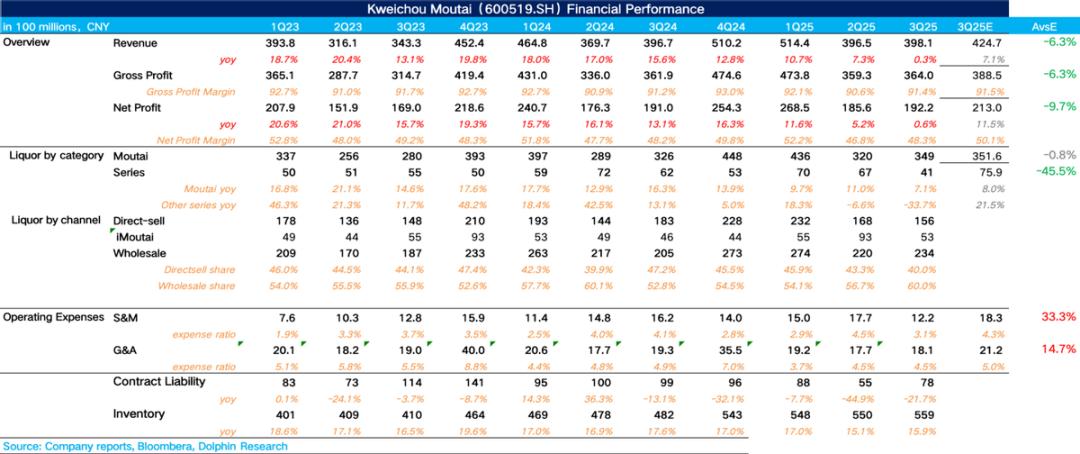
Core Viewpoint - Kweichou Moutai achieved positive growth in Q3 2025 despite a challenging environment characterized by a "ban on alcohol" and weak demand, with revenue reaching CNY 39.81 billion, a year-on-year increase of 0.3%, which was below market expectations of CNY 42.5 billion [1][11]. Financial Performance - The company reported a net profit of CNY 19.22 billion in Q3 2025, reflecting a year-on-year growth of 0.6%, slightly outpacing revenue growth [4][11]. - Moutai liquor revenue reached CNY 34.9 billion, marking a year-on-year increase of 7.1%, although there was a downward trend compared to the previous two quarters [2][15]. Market Dynamics - The decline in demand was particularly pronounced in the gifting segment, indicating weak business demand from small and medium enterprises, while banquet demand showed a less significant decline [3][15]. - Series liquor revenue fell sharply to CNY 4.1 billion, a year-on-year decrease of 33.7%, attributed to high inventory levels and weak demand [3][17]. Channel Performance - Direct sales revenue decreased by 14.8% to CNY 15.6 billion, with the direct sales channel's share dropping to 40%, reflecting the weak demand at the terminal level [4][20]. - Contract liabilities decreased to CNY 7.8 billion, down 22% year-on-year, indicating a recovery from the previous quarter's steep decline [5][22]. Profitability Metrics - The overall gross profit margin slightly improved by 0.2 percentage points to 91.4%, driven by a higher proportion of Moutai liquor sales [4][25]. - The company reduced marketing expenditures, resulting in a sales expense ratio decline of 1 percentage point to 3.1%, while management expenses remained stable [4][25]. Industry Context - The current phase of the industry is characterized by a proactive reduction of inventory, with terminal sales beginning to show improvement, suggesting a potential bottoming out of the market [6][7]. - The market's expectations regarding Moutai's pricing have stabilized, indicating that short-term price fluctuations may have a muted impact on the company's valuation [6][7].


食品饮料行业:四中全会提振消费产业预期
Dongxing Securities· 2025-10-29 02:35
Investment Rating - The report maintains a "Positive" investment rating for the food and beverage industry [2]. Core Insights - The 20th Central Committee's Fourth Plenary Session emphasized consumption as a key driver for economic growth during the "14th Five-Year Plan" period, indicating a shift in policy focus from supply-driven to a balanced supply-demand interaction [3][14]. - Future consumption policies are expected to be more targeted and sustainable, with potential measures including the issuance of consumption vouchers and subsidies for quality upgrades in the food and beverage sector [3][14]. - The report highlights a significant transformation in consumer behavior towards rational consumption, leading to the rise of new retail channels such as instant retail and membership supermarkets, which are reshaping the sales landscape of the food and beverage industry [4][15]. - Companies that can adapt to these new channels and consumer trends are expected to emerge as industry leaders, with specific recommendations for companies like Salted Fish and Ganyuan Foods in the new consumption track, and Kweichow Moutai in the cyclical sector [4][15]. Market Performance - Last week, the sub-sectors of the food and beverage industry showed varying performance, with soft drinks up by 2.05%, meat products by 2.03%, and other alcoholic beverages by 1.75%, while beer and yellow wine saw declines of -1.73% and -3.75% respectively [16][20]. - The report also notes the performance of key companies within the alcoholic beverage sector, with *ST Yedao leading with a 9.05% increase, while others like Shanxi Fenjiu and Zhujiang Beer experienced declines [20][24]. Industry Overview - The food and beverage industry comprises 126 companies with a total market capitalization of approximately 46,112.25 billion [9]. - The average price-to-earnings ratio for the industry stands at 21.31, indicating a moderate valuation level [9]. Key Company Tracking - Recent announcements include significant shareholding changes and asset restructuring activities among companies like Huangtai Liquor and Lihai Foods, indicating ongoing strategic adjustments within the industry [31][32]. - Notable performance was reported by Yangyuan Beverage, which achieved a revenue of approximately 1.44 billion, reflecting a year-on-year growth of 11.88% [34]. Future Events - Upcoming significant events in the industry include various earnings presentations and shareholder meetings for companies such as Water Well and Yili, scheduled for late October and early November [7].
工业硅期货早报-20251028
Da Yue Qi Huo· 2025-10-28 05:05
1. Report Industry Investment Rating No relevant content provided. 2. Core Viewpoints of the Report - For industrial silicon, the supply-side production schedule is increasing, and it is near the historical average level. The demand recovery is at a low level, and the cost support has increased. It is expected to fluctuate in the range of 8855 - 9075 [3][6]. - For polysilicon, the supply-side production schedule will increase in the short term and is expected to回调 in the medium term. The demand for silicon wafers, battery cells, and components will decrease in the short term and is expected to recover in the medium term. Overall, the demand shows a continuous recovery trend, and the cost support is stable. It is expected to fluctuate in the range of 53655 - 55345 [7][8]. 3. Summaries According to Relevant Catalogs 3.1 Daily Views 3.1.1 Industrial Silicon - **Fundamentals**: Last week, the supply of industrial silicon was 101,000 tons, a 2.02% increase from the previous week. The demand was 98,000 tons, with the polysilicon inventory at 254,000 tons, silicon wafers and battery cells in a loss state, and components profitable. The organic silicon inventory was 55,100 tons, with a production profit of -454 yuan/ton and a comprehensive operating rate of 70.05%, which was flat compared to the previous week and lower than the historical average. The aluminum alloy ingot inventory was 75,300 tons, and the import loss was 276 yuan/ton. The cost support in the dry season has increased [6]. - **Basis**: On October 27, the spot price of non-oxygenated silicon in East China was 9300 yuan/ton, and the basis of the 01 contract was 335 yuan/ton, with the spot at a premium to the futures [6]. - **Inventory**: The social inventory was 559,000 tons, a 0.53% decrease from the previous week. The sample enterprise inventory was 167,700 tons, a 0.17% decrease. The main port inventory was 123,000 tons, a 2.50% increase [6][15]. - **Disk**: The MA20 is downward, and the futures price of the 01 contract closed above the MA20 [6]. - **Main Position**: The main position is net short, and the short position is decreasing [6]. 3.1.2 Polysilicon - **Fundamentals**: Last week, the polysilicon production was 29,500 tons, a 4.83% decrease from the previous week. The expected production in October is 134,500 tons, a 3.46% increase from the previous month. The silicon wafer production was 14.73GW, a 2.64% increase from the previous week, but currently in a loss state. The battery cell production was in a loss state, and the component production was profitable. The average cost of N-type polysilicon was 36,050 yuan/ton, and the production profit was 15,450 yuan/ton [8]. - **Basis**: On October 27, the price of N-type dense material was 51,500 yuan/ton, and the basis of the 01 contract was -1520 yuan/ton, with the spot at a discount to the futures [8]. - **Inventory**: The weekly inventory was 258,000 tons, a 1.97% increase from the previous week, at a historical high [8]. - **Disk**: The MA20 is upward, and the futures price of the 01 contract closed above the MA20 [8]. - **Main Position**: The main position is net long, and the long position is decreasing [8]. 3.2 Market Overview 3.2.1 Industrial Silicon - Futures prices of various contracts showed an upward trend, with increases ranging from 0.34% to 0.84%. Spot prices of different types of silicon remained unchanged. The weekly social inventory decreased by 0.53%, and the sample enterprise inventory decreased by 0.18%. The main port inventory increased by 2.50%. The weekly sample enterprise production increased by 3.36%, and the production and operating rates in different regions showed different changes [15]. 3.2.2 Polysilicon - Futures prices of various contracts increased, with increases ranging from 3.09% to 5.54%. The prices of silicon wafers, battery cells, and components showed different trends. The monthly supply of polysilicon in China decreased by 1.29%, the export volume decreased by 30.00%, the consumption volume increased by 6.62%, and the import volume increased by 30.00%. The component production was profitable, and the domestic and European inventories decreased [17]. 3.3 Price - Basis and Delivery Product Spread Trends - The basis of industrial silicon and the spread between 421 and 553 silicon showed different trends over time [19][20]. - The price and basis of polysilicon also showed different trends over time [22][23]. 3.4 Inventory - The inventory of industrial silicon in different regions and at ports showed different trends over time [25][26]. - The polysilicon inventory also showed different trends over time [17]. 3.5 Production and Capacity Utilization Trends - The weekly production of industrial silicon sample enterprises in different regions and the overall production showed different trends over time [29][30]. - The monthly production of industrial silicon by specification also showed different trends over time [31]. 3.6 Cost - Sample Region Trends - The cost and profit of 421 silicon in Sichuan, Yunnan, and Xinjiang's oxygenated 553 silicon showed different trends over time [36][37]. 3.7 Supply - Demand Balance Sheets 3.7.1 Industrial Silicon - The weekly supply - demand balance of industrial silicon showed different trends over time [38][39]. - The monthly supply - demand balance also showed different trends over time, with different values for actual consumption, export, import, and other items [41][42]. 3.7.2 Polysilicon - The monthly supply - demand balance of polysilicon showed different trends over time, with different values for consumption, export, import, and supply [67][68]. 3.8 Downstream Market Trends 3.8.1 Organic Silicon - The production capacity utilization rate, profit, cost, and production of DMC in organic silicon showed different trends over time [44][45]. - The prices of downstream products such as 107 glue, silicone oil, raw rubber, and D4 also showed different trends over time [46][47]. - The import, export, and inventory of DMC also showed different trends over time [51][52]. 3.8.2 Aluminum Alloy - The waste aluminum recycling volume, social inventory, aluminum scrap import volume, and import - export situation of Chinese unforged aluminum alloy showed different trends over time [54][55]. - The production, inventory, and operating rates of primary and secondary aluminum alloy ingots also showed different trends over time [57][58]. - The production and sales of automobiles and the export of aluminum alloy wheels also showed different trends over time [59][60]. 3.8.3 Polysilicon - The cost, price, inventory, production, and demand of polysilicon showed different trends over time [64][65]. - The price, production, inventory, and demand of silicon wafers also showed different trends over time [70][71]. - The price, production, inventory, and export of battery cells showed different trends over time [73][74]. - The price, production, inventory, and export of photovoltaic components also showed different trends over time [76][77]. - The prices and import - export volumes of photovoltaic accessories such as photovoltaic coatings, photovoltaic glass, high - purity quartz sand, and soldering tapes showed different trends over time [79][80].
宁证期货今日早评-20251028
Ning Zheng Qi Huo· 2025-10-28 02:57
Report Summary Key Points of Each Product Steel Products - **Rebar**: On October 27, domestic steel prices mostly rose, with the average price of 20mm third - grade seismic rebar in 31 major cities reaching 3234 yuan/ton, up 15 yuan/ton from the previous trading day. Due to positive macro - expectations, potential balance between supply and demand, and cost support, short - term steel prices may fluctuate upward [1]. - **Iron Ore**: From October 20 - 26, the arrival volume of iron ore at 47 ports in China decreased. Considering supply, demand, inventory, and macro factors, short - term iron ore prices may fluctuate upward [4]. - **Coke**: The average national ton - coke profit is - 41 yuan/ton. With supply weakening due to cost pressure and demand slightly declining, but with relatively strong iron - water production and cost support, the coke market will fluctuate upward [5]. Energy Products - **Crude Oil**: Iraq's oil exports are 3.6 million barrels per day. The market is worried about OPEC supply. With upcoming macro - events and sanctions on Russia under observation, oil prices are likely to fluctuate upward this week, being in a stage of short - term geopolitical bullishness versus long - term supply - demand bearishness [2]. Agricultural Products - **Pig**: On October 27, the national pig price generally rose. With improved consumption due to cooling and reduced end - of - month slaughter pressure, short - term prices are expected to be strong. Pig futures prices have rebounded, but the upward momentum may be limited [6]. - **Palm Oil**: As of October 24, 2025, the commercial inventory of palm oil increased. With concerns about the B50 plan and weakening demand while production increases, palm oil prices will face downward pressure in the short term [7]. - **Soybean**: Imported soybean prices are stable, and domestic demand offsets trade - tension pressure, with short - term soybean futures (bean two) stabilizing. Domestic new - season soybeans are strong, with a bullish market sentiment [8]. Precious Metals - **Silver**: The market believes the probability of a 10 - month interest rate cut is 97%. Silver is long - term bullish but short - term downward - fluctuating, with limited downward space [9]. - **Gold**: The weakening of risk - aversion sentiment has led to a significant correction in gold prices. The expected interest rate cut has limited impact. Gold may oscillate at a high level in the medium term [9]. Financial Products - **Medium - and Long - Term Treasury Bonds**: The resumption of open - market treasury bond trading operations by the central bank is a bullish factor for the bond market. However, due to liquidity and the stock - bond seesaw effect, bond market operations are more difficult, with a mid - term slightly bullish outlook [10]. Chemical Products - **Methanol**: The domestic methanol market has high production, stable demand, and a slight increase in port inventory. The 01 contract is expected to fluctuate in the short term, with support at 2245 [11]. - **Soda Ash**: The domestic soda ash market is stable, with stable production, general demand, and a slight increase in inventory. The 01 contract is expected to fluctuate, with support at 1235 [12]. - **Plastic**: LLDPE supply is expected to remain high, while downstream demand is increasing. The L2601 contract is expected to fluctuate slightly upward in the short term, with support at 7000 [13]. Report's Core View The report analyzes multiple commodities, including steel, energy, agricultural products, precious metals, financial products, and chemical products. It assesses each commodity's supply, demand, inventory, and macro - factors to predict their short - and medium - term price trends, providing investment suggestions such as short - term trading strategies and risk - management advice. Report Industry Investment Rating The report does not provide an overall industry investment rating.
中美经贸谈判达成初步共识,油价震荡走强
Tong Hui Qi Huo· 2025-10-27 11:26
Report Industry Investment Rating No relevant content provided. Core View of the Report The short - term oil price is expected to rebound with oscillations, but the upside space remains limited. Supply - side geopolitical risk premiums and OPEC+ production cuts provide support, while long - term supply increases and demand substitution risks exist. Demand - side Asian seasonal restocking is nearing an end, and narrowing refinery profits in Europe and the United States suppress processing volume growth. Although the oil price may briefly break through the previous high under certain circumstances, it lacks continuous upward momentum due to the slowdown in global economic growth and non - OPEC supply elasticity [5]. Summary According to Related Catalogs 1. Daily Market Summary (1) Crude Oil Futures Market Data Changes - On October 24, 2025, the price of the SC crude oil futures main contract rose by 5.2 yuan/barrel (1.13%) to 464.9 yuan/barrel, continuing the recent upward oscillation trend. WTI and Brent prices remained stable at 61.75 dollars/barrel and 65.26 dollars/barrel respectively. The SC - Brent spread changed from - 0.71 dollars/barrel to 0.01 dollars/barrel, and the SC - WTI spread widened by 0.72 dollars to 3.52 dollars/barrel. The SC continuous - consecutive three spread narrowed from - 5.8 yuan/barrel to - 4.8 yuan/barrel [2]. - In the week of October 21, Brent crude oil speculative net long positions were significantly reduced by 57,085 contracts to 52,521 contracts, a recent low, and diesel net long positions decreased by 11,375 contracts, indicating weakening confidence in continuous oil price increases and weakening refined oil demand expectations [3]. (2) Industrial Chain Supply - Demand and Inventory Changes - Supply side: The pipeline fire in Iraq's Zubair Oilfield did not affect production, with September oil exports at a high of 102 million barrels. Saudi Arabia's August oil export value increased by 7% year - on - year. Russia's Ryazan refinery stopped a key processing unit due to a drone attack, which may affect refined oil exports but not crude oil production. The US opened Alaska for drilling, and India's Reliance Industries increased crude oil purchases, suggesting potential non - OPEC supply increases [4]. - Demand side: India's October services PMI preliminary value of 60.7 supported Asian crude oil import demand. However, the expected reduction in China's refined oil retail price limit may suppress refinery restocking willingness. Indonesia's plan to implement the E10 gasoline policy in 2027 may suppress traditional gasoline demand in the long term. The reduction of US diesel speculative long positions reflected weakening industrial demand expectations, and there was no significant rebound signal in EIA apparent demand [4]. - Inventory side: The Shanghai Futures Exchange's crude oil warehouse receipts remained unchanged at 5.211 million barrels, indicating limited delivery storage capacity pressure. US Cushing inventory decreased recently, but EIA commercial crude oil inventory was still at a seasonal high, and the overall OECD inventory level suppressed the upward movement of oil prices [4]. 2. Industrial Chain Price Monitoring (1) Crude Oil - Futures prices: On October 24, 2025, the SC crude oil futures price was 464.9 yuan/barrel, up 1.13% from the previous day. WTI was 61.44 dollars/barrel, down 0.50%, and Brent was 64.92 dollars/barrel, down 0.52% [7]. - Spot prices: Most crude oil spot prices showed an upward trend, with the Brent spot price rising by 1.61%, the Oman spot price rising by 1.37%, etc. [7]. - Spreads: The SC - Brent spread increased by 149.30% to 0.35 dollars/barrel, the SC - WTI spread increased by 36.79% to 3.83 dollars/barrel, and the Brent - WTI spread decreased by 0.85% to 3.48 dollars/barrel [7]. - Other assets: The US dollar index increased by 0.01%, the S&P 500 increased by 0.79%, the DAX index increased by 0.13%, and the RMB exchange rate remained unchanged [7]. - Inventory and开工: US commercial crude oil inventory decreased by 0.23%, Cushing inventory decreased by 3.50%, and the US strategic reserve inventory increased by 0.20%. The US refinery weekly开工 rate increased by 3.38%, and the crude oil processing volume increased by 3.97% [7]. (2) Fuel Oil - Futures prices: On October 24, 2025, the FU fuel oil futures price was 2,814 yuan/ton, up 2.25% from the previous day, the LU was 3,224 yuan/ton, up 0.97%, and NYMEX fuel oil was 239.7 cents/gallon, up 0.57% [8]. - Spot prices: Some fuel oil spot prices increased, such as the high - sulfur 180 in Singapore rising by 2.28%, and the Russian M100 to - shore price rising by 4.75% [8]. - Paper - cargo prices: The high - sulfur 380 in Singapore (near - month) increased by 2.51% [8]. - Spreads: The Singapore high - low sulfur spread data was not provided, and the Chinese high - low sulfur spread decreased by 7.03% [8]. - Inventory: Singapore's fuel oil inventory decreased by 8.12% [8]. 3. Industrial Dynamics and Interpretation (1) Supply - On October 26, the fire in an oil pipeline in Iraq's Zubair Oilfield did not affect production, with the current daily output remaining at 400,000 barrels. Iraq's September total oil exports were 102.15 million barrels. Saudi Arabia's August oil export value increased by 7% year - on - year [9][10]. - On October 24, Russia's Ryazan refinery stopped a key processing unit after a drone attack. India's Reliance Industries bought millions of barrels of crude oil from the Middle East and the US. Italy's Eni Group raised its 2025 oil and gas production guidance, expecting an output of 171 - 172 million barrels of oil equivalent per day in 2025 and about 1.8 million barrels of oil equivalent per day in the fourth quarter. The US announced the opening of the Alaska coastal plain for oil drilling [10]. (2) Demand - Indonesia plans to implement a policy in 2027 to make the bio - ethanol content in gasoline reach 10% [11]. (3) Inventory - On October 24, the Shanghai Futures Exchange's medium - sulfur crude oil futures warehouse receipts remained unchanged at 5.211 million barrels, the low - sulfur fuel oil futures warehouse receipts remained unchanged at 4,960 tons, and the fuel oil futures warehouse receipts decreased by 1,500 tons [12]. (4) Market Information - As of the week of October 21, diesel speculative net long positions decreased by 11,375 contracts to 45,766 contracts, and Brent crude oil speculative net long positions decreased by 57,085 contracts to 52,521 contracts [13]. - Ukrainian President Zelensky called for sanctions on all Russian oil companies, shadow fleets, and oil terminals. China's refined oil retail price limit is likely to be reduced on October 27 [13]. - India's October services PMI preliminary value was 60.7 [13]. 4. Industrial Chain Data Charts The report provides multiple data charts, including the prices and spreads of WTI and Brent first - line contracts, the SC - WTI spread statistics, US crude oil weekly production, US and Canadian oil rig numbers, OPEC crude oil production, etc., with data sources from WIND, EIA, iFinD, etc. [14][16][18]
黑色金属周报:钢材宏观预期改善,钢价低位修复-20251027
Hong Yuan Qi Huo· 2025-10-27 11:08
第一部分 结论 第二部分 供需基本面 黑色金属周报-钢材 宏观预期改善 钢价低位修复 2025年10月27日 研究所 白净 从业资格号:F03097282; 投资咨询从业证书号:Z0018999 TEL:010-82292661 目录 1 宏观预期改善 钢价低位修复 本周国内钢材现货价格小幅波动,截至周六,华东上海螺纹3170元(-);上海热卷3290元, (+20)。 五大品种钢材整体产量增8.37万吨,五大品种库存厂库环比降1.27吨,社库降26.14吨。表观 需892.73万吨,环比增17.32万吨。截至10月24日,长流程现货端,华东螺纹长流程现金含税成本 3143元,点对点利润27元左右,热卷长流程现金含税利润47元左右。电炉端,华东平电电炉成本 在3294元左右,谷电成本在3151.5左右,华东螺纹平电利润-174元左右,谷电利润-31元。 废钢端,截止10月23日,张家港废钢价格2140元/吨,环比持平。数据显示,89家独立电弧炉 企业产能利用率33.2%,环比下降1.2个百分点;255家样本钢厂日耗51.4万吨,环比下降0.94万吨; 其中,132家长流程钢厂日耗24.9万吨/天,环比下降0. ...