
供需双弱

Search documents
中国经济观测点丨供需双弱延续 1月钢市或持续震荡运行
Xin Hua Cai Jing· 2026-01-05 06:43
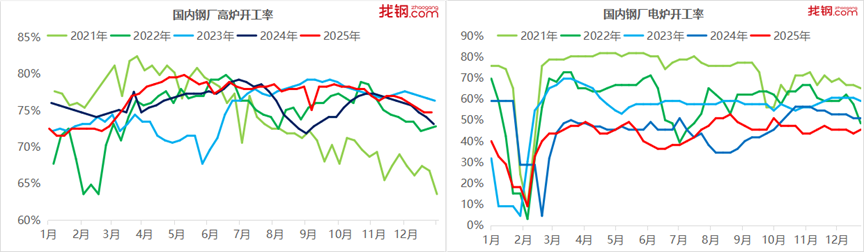
Core Viewpoint - The domestic steel market in December 2025 showed a narrow fluctuation with a significant contraction in supply and resilient demand, leading to continuous inventory reduction. The outlook for January 2026 indicates a continuation of the weak supply-demand balance, with seasonal effects from the Spring Festival putting pressure on demand, while supply may see a slight recovery due to improved profitability in steel mills. Overall, steel prices are expected to remain stable within a limited range due to cost support [2][19]. Supply and Production - Both blast furnace and electric arc furnace operating rates have declined. As of December 26, the operating rate for independent electric arc furnaces was 43.64%, down 3.64 percentage points month-on-month and down 7.27 percentage points year-on-year. The operating rate for blast furnaces was 74.76%, down 1.92 percentage points month-on-month but up 1.6 percentage points year-on-year [3]. - Steel production has decreased, with weekly total production of construction steel at 2.9269 million tons, down 1.57 million tons month-on-month and down 5.99% year-on-year. Hot-rolled coil production was 3.5509 million tons, down 0.53% month-on-month and down 2.82% year-on-year [5]. - The reduction in production and maintenance efforts in December were significantly higher than in November, with expectations for a slight easing in maintenance efforts in January [7]. Demand and Consumption - Steel consumption in December showed a slight month-on-month decline, with varied performance across different products. Hot-rolled demand increased by 0.6%, while other products like medium plates and construction materials saw declines of 0.6% and 1.1%, respectively. January's expected procurement volume remains under pressure, with anticipated declines across all product categories [9][11]. - In the construction sector, steel usage in the infrastructure industry decreased by 0.8% in December, with a further expected decline of 1.2% in January. The real estate sector also saw a decrease of 1.2% in December, with a projected decline of 2% in January [11][14]. Inventory and Pricing - Total steel inventory continued to decline in December, although it remains higher than the same period in 2024. As of December 26, the total inventory of construction steel was 5.8754 million tons, down 15.24% month-on-month but up 30.52% year-on-year. Hot-rolled coil inventory was 3.4989 million tons, down 2.85% month-on-month and up 10.87% year-on-year [15][20]. - Profitability for blast furnace steel mills improved in December, with production profits rising to 49 yuan per ton, while electric arc furnace mills continued to incur losses, albeit at a reduced rate [17][18]. Market Outlook - The steel market is expected to maintain a weak supply-demand balance in January 2026, influenced by seasonal demand pressures and uncertainties in export policies. While some steel mills may ease maintenance efforts due to improved profitability, overall production is expected to see a slight recovery. Cost factors are anticipated to provide support, limiting the downward price movement and leading to a likely continuation of range-bound trading [21][22].

成材:供需双弱震荡运行
Hua Bao Qi Huo· 2026-01-05 03:01
1. Report's Industry Investment Rating - Not provided in the given content 2. Core Viewpoints - The finished product market is in a state of weak supply and demand, with horizontal consolidation and limited price fluctuations before the festival, and the macro - market has limited impact on prices. The raw materials are in a low - level consolidation state [2][3] 3. Summary by Relevant Catalogs 3.1 Steel坯 and Steel Products - In December 2025, the resource volume of national sample steel billet circulation enterprises decreased to about 2.4 million tons, a month - on - month decrease of 7.72% and a year - on - year decrease of 6.75%. Among them, North China accounted for about 49%, and Northeast China accounted for 21% [3] - Last week, the weekly output of rebar was 1.8822 million tons, a week - on - week increase of 2.08%; the market inventory of rebar was 4.2203 million tons, a week - on - week decrease of 2.81%; the consumption was 2.0044 million tons, a week - on - week decrease of 1.11% [3] 3.2 Heavy - Duty Truck Market - In December 2025, about 95,000 heavy - duty trucks were sold in China, a month - on - month decrease of about 16% and a year - on - year increase of about 13%. The total annual sales volume in 2025 reached 1.137 million, a year - on - year increase of about 26% [3]
新能源及有色金属日报:供需双弱情况下,盘面区间震荡-20251231
Hua Tai Qi Huo· 2025-12-31 05:05
Group 1: Industry Investment Rating - No information provided Group 2: Core Views - Industrial silicon prices are expected to maintain a range-bound oscillation. In a situation of double reduction in supply and demand, the upside potential depends on the recovery of downstream demand and inventory depletion progress, while the downside is limited by cost support and production cut expectations. [3] - Polysilicon prices are expected to remain in the range of 54,000 - 60,000 yuan/ton for range-bound consolidation. The risk control measures of raising the margin by the Guangzhou Futures Exchange have raised the trading and holding threshold and affected market sentiment. Currently, it is waiting for the fundamentals to become clearer. [6] Group 3: Market Analysis - Industrial Silicon - On December 30, 2025, the industrial silicon futures price fluctuated and rose. The main contract 2605 opened at 8,705 yuan/ton and closed at 8,915 yuan/ton, a change of 95 yuan/ton (1.08%) from the previous settlement. As of the close, the main contract 2605 had a position of 216,220 lots, and the total number of warehouse receipts on December 29, 2025, was 10,027 lots, a change of 120 lots from the previous day. [1] - Industrial silicon spot prices remained basically stable. According to SMM data, the price of East China oxygenated 553 silicon was 9,200 - 9,300 (0) yuan/ton; 421 silicon was 9,500 - 9,800 (0) yuan/ton, Xinjiang oxygenated 553 price was 8,600 - 8,800 (0) yuan/ton, and 99 silicon price was 8,600 - 8,800 (0) yuan/ton. Silicon prices in Kunming, Huangpu Port, Northwest, Tianjin, Xinjiang, Sichuan, and Shanghai remained flat, and the price of 97 silicon was stable. [1] - As of December 18, the total social inventory of industrial silicon in major regions was 553,000 tons, a change of -1.43% from the previous week. Among them, the social general warehouse was 138,000 tons, an increase of 20,000 tons from the previous week, and the social delivery warehouse (including the part not registered as warehouse receipts and the spot warehouse) was 415,000 tons, a decrease of 10,000 tons from the previous week. [1] Group 4: Market Analysis - Consumption of Industrial Silicon - According to SMM statistics, the quotation of silicone DMC was 13,500 - 13,700 (0) yuan/ton. SMM reported that the weekly output of polysilicon was basically stable. The planned production of polysilicon in December was around 114,000 tons, a slight decrease from November, with limited change in the demand for industrial silicon. [2] - The weekly production schedule of silicone fluctuated slightly from the previous week. In early December, monomer plants successively reduced production, and the production schedule decreased compared to November. The reduction in industrial silicon consumption in December may be around 5,000 tons. [2] - The operating rate of aluminum - silicon alloy enterprises remained stable. The secondary aluminum enterprises in Chongqing that reduced production due to air pollution last week maintained the production - reduction state this week. The downstream demand for aluminum alloy showed marginal weakness, and it is expected that the operating rate will be mainly stable with a weak trend in the future. [2] Group 5: Strategy - Industrial Silicon - Unilateral: Short - term range operation - Inter - period: None - Inter - commodity: None - Spot - futures: None - Options: None [3] Group 6: Market Analysis - Polysilicon - On December 30, 2025, the main polysilicon futures contract 2605 fluctuated downward, opening at 56,500 yuan/ton and closing at 57,890 yuan/ton, with a closing price change of -0.19% from the previous trading day. The position of the main contract reached 83,335 (95,631 in the previous trading day) lots, and the trading volume on the day was 42,713 lots. [3] - Polysilicon spot prices strengthened slightly. According to SMM statistics, the price of N - type material was 50.00 - 55.00 (0.10) yuan/kg, and n - type granular silicon was 49.00 - 51.00 (0.00) yuan/kg. [3] - According to SMM statistics, the inventory of polysilicon manufacturers increased, and the silicon wafer inventory increased. The latest statistics showed that the polysilicon inventory was 30.30, a change of 3.40% from the previous period, the silicon wafer inventory was 21.69 GW, a change of 0.88% from the previous period, the weekly output of polysilicon was 25,300.00 tons, a change of 1.20% from the previous period, and the silicon wafer output was 10.33 GW, a change of -3.19% from the previous period. [3] - In terms of silicon wafers, the price of domestic N - type 18Xmm silicon wafers was 1.35 (0.10) yuan/piece, the price of N - type 210mm was 1.65 (0.10) yuan/piece, and the price of N - type 210R silicon wafers was 1.45 (0.10) yuan/piece. [3] Group 7: Market Analysis - Battery Cells and Components of Polysilicon - In terms of battery cells, the price of high - efficiency PERC182 battery cells was 0.27 (0.00) yuan/W; PERC210 battery cells were about 0.28 (0.00) yuan/W; TopconM10 battery cells were about 0.38 (0.02) yuan/W; Topcon G12 battery cells were 0.38 (0.02) yuan/W; Topcon210RN battery cells were 0.38 (0.02) yuan/W. HJT210 half - piece battery was 0.37 (0.00) yuan/W. [5] - For components, the mainstream transaction price of PERC182mm was 0.67 - 0.74 (0.00) yuan/W, PERC210mm was 0.69 - 0.73 (0.00) yuan/W, N - type 182mm was 0.66 - 0.68 (0.00) yuan/W, and N - type 210mm was 0.67 - 0.69 (0.00) yuan/W. [5] Group 8: Strategy - Polysilicon - Unilateral: Short - term range operation, and the main contract is expected to oscillate in the range of 54,000 - 60,000 yuan/ton - Inter - period: None - Inter - commodity: None - Spot - futures: None - Options: None [6]
广发早知道:汇总版-20251230
Guang Fa Qi Huo· 2025-12-30 01:33
1. Report Industry Investment Ratings - Not provided in the given content 2. Core Views of the Report - The market situation is complex, with different sectors showing various trends. Some sectors are affected by strong macro - expectations and weak fundamental realities, such as aluminum. Others are influenced by supply - demand imbalances, policy changes, and external events [2][25]. - In general, many sectors are in a state of volatility, and investors need to pay attention to specific factors in each sector, such as inventory changes, downstream consumption, and policy adjustments [2][70][84]. 3. Summaries by Relevant Catalogs 3.1 Daily Selections - **Aluminum**: The market is dominated by the game between strong macro - expectations and weak fundamentals. It is expected to maintain high - level wide - range oscillations, with the Shanghai Aluminum main contract operating between 21800 - 22800 yuan/ton. Long positions can be arranged at low prices [2]. - **Methanol**: Due to device disruptions, the price has strengthened. The port may face inventory accumulation in December, but the supply - demand balance sheet is expected to turn to inventory reduction in the first quarter of the next year. Pay attention to inventory reduction after the actual arrival at the port decreases [3]. - **Iron Ore**: Supported by the steel mill's restocking expectation, the price is expected to oscillate strongly. It will transition from a supply - demand surplus to a supply - demand double - weak situation. Pay attention to iron water trends, steel mill restocking rhythms, and negotiation situations [3][55]. - **Pig**: The demand supports the market, and the macro and the futures market resonate. The spot price is expected to be strong in the short term, and the futures market is expected to oscillate strongly [4][72]. 3.2 Financial Derivatives 3.2.1 Financial Futures - **Stock Index Futures**: Short - term negative factors are exhausted. It is recommended to continue holding bull spread combinations and sell a small amount of near - month out - of - the - money call options for hedging [7]. - **Treasury Bond Futures**: In the short term, it is expected to be in a wide - range oscillation. After the New Year, pay attention to the capital situation. It is recommended to wait and see for the time being [10]. 3.2.2 Precious Metals - The price dropped sharply after a high - level rise. In the short term, it is recommended to wait and see. In the medium - to - long - term, the price has an upward space. Long positions can be arranged after the callback [13][14]. 3.2.3 Container Shipping Index (European Line) - The main contract is in a consolidation stage, lacking obvious driving forces. It is expected to present an oscillatory pattern in the short term [16]. 3.3 Commodity Futures 3.3.1 Non - ferrous Metals - **Copper**: The short - term price may enter an oscillatory adjustment stage. It is recommended to take profits on long positions at high prices [20]. - **Alumina**: The policy is difficult to reverse the short - term supply - demand situation. It is recommended to wait and see in the short term and short at high prices in the medium term [22]. - **Aluminum**: It is expected to maintain high - level wide - range oscillations. Long positions can be arranged at low prices [25]. - **Aluminum Alloy**: It is expected to continue high - level range oscillations. An arbitrage strategy of going long AD03 and short AL03 can be considered [28]. - **Zinc**: The short - term price may oscillate. It is recommended to hold cross - market reverse arbitrage positions [31]. - **Tin**: It is expected to be in high - level oscillations. It is recommended to wait and see [36]. - **Nickel**: It is expected to maintain a relatively strong oscillation. Pay attention to the possibility of a callback [39]. - **Stainless Steel**: It is expected to oscillate and adjust in the short term. Pay attention to nickel ore news and steel mill production reduction implementation [42]. - **Lithium Carbonate**: It is expected to maintain wide - range oscillations before the New Year. It is recommended to wait and see [46]. - **Polysilicon**: It is in high - level oscillations. It is recommended to wait and see and pay attention to production reduction and price adjustment acceptance [49]. - **Industrial Silicon**: It is in low - level oscillations. Pay attention to the implementation of production reduction [51]. 3.3.2 Ferrous Metals - **Steel**: It continues to reduce production and inventory. The price is expected to oscillate. It is recommended to wait and see for unilateral operations [53]. - **Iron Ore**: It is expected to oscillate strongly. It is recommended to cautiously go long for short - term operations [55]. - **Coking Coal**: It is recommended to short at high prices unilaterally and consider an arbitrage strategy of going long coking coal and short coke [59]. - **Coke**: It is recommended to short the 2605 contract at high prices unilaterally and consider an arbitrage strategy of going long coking coal and short coke [61]. - **Silicon Ferrosilicon**: It is expected to oscillate in the range of 5500 - 5700. Pay attention to coal price changes [64]. - **Silicon Manganese**: It is expected to be weak in the short term. It is recommended to short when the price rebounds above the Ningxia spot cost [67]. 3.3.3 Agricultural Products - **Meal**: The US soybeans maintain a bottom - oscillating pattern. The domestic spot is loose. It is recommended to operate cautiously [70]. - **Pig**: The demand supports the market. The short - term price is expected to be strong [72]. - **Corn**: The short - term price may rise due to the resonance of futures and cash, but the sustainability of the rise is limited. Pay attention to farmers' selling attitudes and policy releases [75]. - **Sugar**: The international sugar price is in a low - level oscillating platform. The domestic market should pay attention to the actual demand after the spot price rises. It is recommended to maintain a rebound - shorting idea [76]. - **Cotton**: The short - term cotton price may oscillate steadily and strongly [78]. - **Egg**: It is expected to maintain a low - level oscillating pattern [81]. - **Oils and Fats**: Palm oil may oscillate weakly; soybean oil may oscillate in a narrow range; rapeseed oil may test the pressure level of 9200 yuan [84][85]. - **Jujube**: The market sentiment is weak, and the rebound momentum is insufficient. It is recommended to short on rebounds [86]. - **Apple**: The short - term market is in a game between the scarcity of delivery fruits and the inventory pressure of ordinary fruits. Pay attention to the actual inventory reduction progress [88]. 3.3.4 Energy Chemicals - **PX**: It is under short - term pressure. It is recommended to exit long positions, short aggressively in the short term, and go long at low prices in the medium term [90]. - **PTA**: It is under short - term pressure. It is recommended to exit long positions, short aggressively in the short term, and go long at low prices in the medium term [92]. - **Short - fiber**: It follows the raw material fluctuations. It is recommended to short when the processing fee is high [93]. - **Bottle Chips**: The short - term processing fee will be compressed. It is recommended to follow the PTA strategy and short the processing fee at high prices [96]. - **Ethylene Glycol**: The price increase has resistance. It is recommended to conduct a reverse arbitrage on EG5 - 9 at high prices [97]. - **Pure Benzene**: It is in low - level oscillations. It is expected to oscillate in the range of 5300 - 5600 [98]. - **Styrene**: The rebound space is limited. It is recommended to short at 6800 and short the processing fee at high prices [100]. - **LLDPE**: It is recommended to go long the 2605 contract in the short term [101]. - **PP**: It is recommended to pay attention to the expansion of PDH profits [102]. - **Methanol**: Pay attention to the reduction of MTO05 [103]. - **Caustic Soda**: The price may continue to decline. It is in a weak supply - demand pattern [104]. - **PVC**: It is expected to rebound and then weaken. The supply - demand is in an excess pattern [106]. - **Soda Ash**: It is recommended to short on rebounds [108]. - **Glass**: It is recommended to wait and see [109]. - **Natural Rubber**: It is recommended to hold short positions at 15700 [113]. - **Synthetic Rubber**: It is in wide - range oscillations. It is expected to oscillate between 11200 - 12000 in the short term [115].
黑色产业链周报-20251229
Hua Bao Qi Huo· 2025-12-29 12:06
1. Report Industry Investment Rating - No information provided in the content. 2. Core Viewpoints of the Report - **Overall**: The report presents a weekly analysis of the black industry chain, covering various aspects such as market trends, supply - demand dynamics, and price movements of different products including steel products, iron ore, coal - coke, and ferroalloys [1][12][13]. - **Steel Products**: The steel market shows a pattern of weak supply and demand, with prices expected to remain at a low level. The impact of short - term domestic macro - market on prices is limited [12]. - **Iron Ore**: The iron ore market has a continuously loose supply - demand situation. Although the macro - narrative is positive and the industrial chain fundamentals have improved, the price increase is limited, and it is expected to fluctuate in the short term. The price of the main contract of Dalian iron ore is expected to be in the range of 770 - 800 yuan/ton, corresponding to the foreign market (FE01) price of about 102.5 - 105.5 US dollars/ton [13]. - **Coal - Coke**: The fundamentals of the coal - coke market are still weak. Although the coal price has stopped falling and rebounded in the past two weeks, the supply - demand situation has not improved significantly. The price rebound lacks upward support, and the market is expected to fluctuate. Attention should be paid to position risk control before the New Year's Day [16]. - **Ferroalloys**: The ferroalloy market is characterized by weak supply and demand, and prices are expected to fluctuate within a narrow range. The cost side has relatively strong support, and future attention should be paid to changes in the supply side and the progress of winter storage [17]. 3. Summary by Directory 3.1 01 Week - on - Week Market Review - The report provides the closing prices, price changes, and price change rates of the futures main contracts and spot prices of various products such as rebar, hot - rolled coil, iron ore, coke, coking coal, manganese silicon, silicon iron, and scrap steel from December 19 to December 26, 2025 [8]. 3.2 02 This Week's Black Market Forecast 3.2.1 Steel Products - **Logic**: The profitability rate of 247 steel mills increased by 1.3 percentage points to 37.23%, the operating rate decreased by 0.15 percentage points to 78.32%, and the capacity utilization rate increased to 84.94%. The average daily pig iron output increased by 0.03 million tons week - on - week to 2.2658 million tons. The average capacity utilization rate of 90 independent electric arc furnace steel mills was 53.22%, a week - on - week decrease of 1.12 percentage points; the average operating rate was 67.63%, a week - on - week decrease of 1.6 percentage points. The steel market was mainly in a sideways consolidation state last week. Heavy pollution weather warnings in many places affected the supply side, but it was the off - season for demand, and the weak demand made it difficult for supply changes to drive price increases [12]. - **Viewpoint**: The price is expected to remain at a low level [12]. - **Later Concerns**: Macro - policies and downstream demand [12]. 3.2.2 Iron Ore - **Logic**: Macroeconomically, China's monetary and fiscal policies are in a period of active reserve, and the expectation of the Fed's interest rate cut is rising. The real - end of the industrial chain is in a weak equilibrium stage, and prices maintain a narrow - range fluctuation trend. The inventory pressure on the steel product side has been continuously relieved, and the valuation of the industrial chain has rebounded. The strong spot price of iron ore supports the futures market, and the upcoming steel mill restocking cycle may support prices. In terms of supply, the weekly shipment of foreign mines decreased slightly, and the arrival volume remained at a medium - to - high level and was higher than the same period last year. In terms of demand, domestic demand has stabilized and rebounded slightly, and the restocking demand is expected to be continuously released. In terms of inventory, the steel mill's imported inventory has increased, but it is still at the lowest level in the same period in recent years, and the port inventory is expected to continue to accumulate [13]. - **Viewpoint**: The price is expected to fluctuate in the short term, with the main contract of Dalian iron ore in the range of 770 - 800 yuan/ton, corresponding to the foreign market (FE01) price of about 102.5 - 105.5 US dollars/ton. The strategy is to operate within the range and sell out - of - the - money call options [13]. - **Later Concerns**: Incremental macro - policies, implementation of industrial policies, and supply recovery speed [13]. 3.2.3 Coal - Coke - **Logic**: Last week, the coal - coke futures prices fluctuated widely and closed slightly higher on a weekly basis. The coking coal prices in various regions were weakly stable, and the steel mills completed the third round of price cuts for coke, with further price cut expectations in the market. Coal mines reduced production at the end of the year, and coking enterprises started to replenish inventory moderately, but the overall market transaction was still weak, and the mine - end inventory continued to accumulate. The import volume at the Ganqimaodu Port decreased, and the port supervision area inventory was at a relatively high level. The demand was temporarily stable, and the average daily pig iron output of steel mill blast furnaces stopped falling [16]. - **Viewpoint**: The price is expected to fluctuate, and attention should be paid to position risk control before the New Year's Day [16]. - **Later Concerns**: Changes in the production rhythm of coal - coke - steel and changes in the clearance of imported coal [15]. 3.2.4 Ferroalloys - **Logic**: Macroeconomically, the US economy maintains resilience, but there are still internal contradictions. In China, Beijing optimized the purchase - restriction policy, and the central bank carried out MLF operations to release a loose signal. The black metal futures market showed a weak sideways trend last week, and the prices of manganese silicon and silicon iron futures increased slightly. In terms of supply, the production and operating rate of manganese silicon increased, but the operating rate was still significantly lower than the same period in the past five years; the production and operating rate of silicon iron continued to decline slightly. In terms of demand, the weekly demand for manganese silicon increased slightly, while the demand for silicon iron decreased slightly, and both were significantly lower than the same period in the past five years. In terms of inventory, the cost support for both manganese silicon and silicon iron was relatively strong [17]. - **Viewpoint**: The price is expected to fluctuate within a narrow range, and future attention should be paid to changes in the supply side and the progress of winter storage [17]. - **Later Concerns**: Domestic macro - policies, terminal demand, steel mill profits and production, and domestic production restrictions [17]. 3.3 03 Variety Data 3.3.1 Steel Products - **Rebar**: The output last week was 1.8439 million tons, a week - on - week increase of 0.0271 million tons and a year - on - year decrease of 0.3191 million tons; the apparent demand was 2.0268 million tons, a week - on - week decrease of 0.0596 million tons and a year - on - year decrease of 0.169 million tons. The long - process output was 1.5498 million tons, a week - on - week increase of 0.026 million tons and a year - on - year decrease of 0.3528 million tons; the short - process output was 0.2941 million tons, a week - on - week increase of 0.001 million tons and a year - on - year increase of 0.0337 million tons. The long - process factory inventory was 1.1345 million tons, a week - on - week increase of 0.002 million tons and a year - on - year increase of 0.106 million tons; the short - process factory inventory was 0.2661 million tons, a week - on - week increase of 0.0032 million tons and a year - on - year increase of 0.0787 million tons. The social inventory was 2.9419 million tons, a week - on - week decrease of 0.1881 million tons and a year - on - year increase of 0.1598 million tons; the steel mill inventory was 1.4006 million tons, a week - on - week increase of 0.0052 million tons and a year - on - year increase of 0.1853 million tons; the total inventory was 4.3425 million tons, a week - on - week decrease of 0.1829 million tons and a year - on - year increase of 0.3451 million tons [20][23][26][30]. - **Hot - Rolled Coil**: The output last week was 2.9354 million tons, a week - on - week increase of 0.0163 million tons and a year - on - year decrease of 0.136 million tons; the apparent demand was 3.0704 million tons, a week - on - week increase of 0.0876 million tons and a year - on - year decrease of 0.0229 million tons. The social inventory was 2.967 million tons, a week - on - week decrease of 0.106 million tons and a year - on - year increase of 0.6995 million tons; the steel mill inventory was 0.8052 million tons, a week - on - week decrease of 0.029 million tons and a year - on - year increase of 0.0018 million tons; the total inventory was 3.7722 million tons, a week - on - week decrease of 0.135 million tons and a year - on - year increase of 0.7013 million tons [31][36]. - **Basis**: For rebar in Shanghai, the basis for January was 193 yuan/ton last Friday, a week - on - week increase of 13 yuan/ton and a year - on - year increase of 92 yuan/ton; for May, it was 172 yuan/ton, a week - on - week decrease of 9 yuan/ton and a year - on - year increase of 77 yuan/ton; for October, it was 123 yuan/ton, a week - on - week decrease of 26 yuan/ton and a year - on - year increase of 67 yuan/ton. For rebar in Beijing, the basis for January was 133 yuan/ton last Friday, a week - on - week increase of 33 yuan/ton and a year - on - year increase of 51 yuan/ton; for May, it was 112 yuan/ton, a week - on - week increase of 11 yuan/ton and a year - on - year increase of 17 yuan/ton; for October, it was 63 yuan/ton, a week - on - week decrease of 6 yuan/ton and a year - on - year increase of 7 yuan/ton. For hot - rolled coil in Shanghai, the basis for January was - 18 yuan/ton last Friday, a week - on - week decrease of 12 yuan/ton and a year - on - year decrease of 66 yuan/ton; for May, it was - 13 yuan/ton, a week - on - week decrease of 14 yuan/ton and a year - on - year decrease of 25 yuan/ton; for October, it was - 26 yuan/ton, a week - on - week decrease of 14 yuan/ton and a year - on - year decrease of 15 yuan/ton [39][44][48]. 3.3.2 Iron Ore - **Imported Ore Port Inventory (45 Ports)**: The total imported ore port inventory this week was 158.5866 million tons, a week - on - week increase of 3.4603 million tons and a year - on - year increase of 9.956 million tons; the Australian ore inventory was 69.4126 million tons, a week - on - week increase of 2.6865 million tons and a year - on - year increase of 4.7914 million tons; the Brazilian ore inventory was 56.6956 million tons, a week - on - week decrease of 1.255 million tons and a year - on - year decrease of 0.3277 million tons; the trade ore inventory was 103.6761 million tons, a week - on - week increase of 2.6995 million tons and a year - on - year increase of 6.6771 million tons; the average daily port ore removal volume was 3.1506 million tons per day, a week - on - week increase of 0.0161 million tons and a year - on - year decrease of 0.0915 million tons [51]. - **247 Steel Mills' Imported Ore Inventory/Daily Consumption**: The inventory of 247 steel enterprises was 88.6019 million tons, a week - on - week increase of 1.3624 million tons and a year - on - year decrease of 7.1151 million tons; the inventory - to - sales ratio was 31.64, a week - on - week increase of 0.54 and a year - on - year decrease of 1.88; the daily consumption was 2.8004 million tons per day, a week - on - week decrease of 0.0054 million tons and a year - on - year decrease of 0.0554 million tons; the daily pig iron output was 2.2658 million tons per day, a week - on - week increase of 0.0003 million tons and a year - on - year decrease of 0.0129 million tons [62]. - **247 Steel Mills' Operating Rate/Profitability Rate**: The blast furnace operating rate of 247 steel enterprises was 78.32%, a week - on - week decrease of 0.15 percentage points and a year - on - year decrease of 0.39 percentage points; the iron - making utilization rate was 84.94%, a week - on - week increase of 0.01 percentage points and a year - on - year decrease of 0.61 percentage points; the profitability rate was 37.23%, a week - on - week increase of 1.3 percentage points and a year - on - year decrease of 12.55 percentage points [67]. - **Global Shipment (19 Ports)**: The total global shipment this week was 34.645 million tons, a week - on - week decrease of 1.277 million tons and a year - on - year increase of 4.027 million tons; the shipment from Australia and Brazil to the world was 27.846 million tons, a week - on - week decrease of 1.407 million tons and a year - on - year increase of 1.707 million tons; the non - mainstream shipment was 7.159 million tons, a week - on - week increase of 0.13 million tons and a year - on - year increase of 2.32 million tons [71]. 3.3.3 Coal - Coke - **Coke Inventory**: The total coke inventory (coking enterprises + steel mills + ports) last week was 9.126 million tons, a week - on - week increase of 0.1215 million tons and a year - on - year increase of 0.0772 million tons. The inventory of independent coking enterprises was 0.922 million tons, a week - on - week increase of 0.011 million tons and a year - on - year increase of 0.011 million tons; the inventory of 247 steel mills was 6.422 million tons, a week - on - week increase of 0.085 million tons and a year - on - year decrease of 0.029 million tons; the inventory of 4 ports was 1.782 million tons, a week - on - week increase of 0.0255 million tons and a year - on - year increase of 0.0952 million tons [109]. - **Coking Coal Inventory**: The total coking coal inventory (coking enterprises + steel mills + coal mines + ports + coal washing plants) last week was 27.578 million tons, a week - on - week increase of 0.3023 million tons and a year - on - year decrease of 3.5825 million tons. The inventory of independent coking enterprises was 10.397 million tons, a week - on - week increase of 0.034 million tons and a year - on - year decrease of 0.149 million tons; the inventory of 247 steel mills was 0.8067 million tons, a week - on - week increase of 0.0017 million tons and a year - on - year increase of 0.031 million tons; the inventory of 5 ports was 2.995 million tons, a week - on - week increase of 0.1
成材:基本面平稳,钢价盘整运行
Hua Bao Qi Huo· 2025-12-29 03:18
晨报 成材 原材料: 冯艳成 从业资格号:F3059529 投资咨询号:Z0018932 电话:010-62688516 有色金属:于梦雪 从业资格号:F03127144 投资咨询号:Z0020161 电话:021-20857653 成文时间: 2025 年 12 月 29 日 逻辑:1—11 月份,全国规模以上工业企业实现利润总额 66268.6 亿 元,同比增长 0.1%。1—11 月份,黑色金属冶炼和压延加工业实现利润总 额 1115 亿元,同比增长 1752.2%。上周,247 家钢厂盈利率上升 1.3 个百 分点至 37.23%,开工率下降 0.15 个百分点至 78.32%,产能利用率增至 84.94%;日均铁水产量周环比上升 0.03 万吨至 226.58 万吨。上周,90 家独立电弧炉钢厂平均产能利用率为 53.22%,环比下降 1.12 个百分点; 平均开工率为 67.63%,环比下降 1.6 个百分点。 证监许可【2011】1452 号 上周钢材以横盘整理为主,波动不大。国内多地陆续启动重污染天气 预警,对供应端带来一定扰动。但目前正值需求淡季,弱需求特征明显, 需求低迷令供应的变化未能形 ...
山金期货黑色板块日报-20251224
Shan Jin Qi Huo· 2025-12-24 01:10
Report Summary 1. Report Industry Investment Rating No information provided. 2. Core Viewpoints - The steel market is in a state of weak supply and demand during the off - season, and winter storage still needs some time. The 05 contract of rebar and hot - rolled coil has not broken out of the recent trading range. For both rebar and hot - rolled coil, it is recommended to hold long positions for medium - term trading [2]. - For iron ore, with the arrival of the consumption off - season, iron ore demand is likely to decline seasonally. The high global shipments and rising port inventories put pressure on futures prices. However, long positions can still be held for medium - term trading [4]. 3. Summary by Directory 3.1 Rebar and Hot - Rolled Coil - **Supply and Demand**: Last week, rebar production increased, hot - rolled coil production decreased, and the production of five major steel products declined. Overall inventory continued to fall. Rebar's apparent demand rebounded slightly, while the overall apparent demand of the five major products decreased. Due to the significant decline in steel mill profits and the end of the consumption peak, steel mill production is expected to continue to decline slowly [2]. - **Cost**: The sharp rebound in coking coal and coke prices in recent days has increased the cost support for the futures market [2]. - **Technical Analysis**: On the daily K - line chart, the 05 contract briefly fell below the trading range and then rebounded quickly, remaining within the recent trading range without a downward breakthrough [2]. - **Operation Suggestion**: Hold long positions for medium - term trading [2]. 3.2 Iron Ore - **Demand**: Last week, the production and apparent demand of five major steel products decreased. With the arrival of the consumption off - season, iron ore demand is likely to decline seasonally. The reduction in steel mill production suppresses raw material prices. The pre - holiday restocking demand will come later this year due to the late Spring Festival [4]. - **Supply**: Global shipments remain at a high level, and the continuous increase in port inventories suppresses futures prices [4]. - **Technical Analysis**: The 05 contract has not broken out of the wide - range trading at a relatively high level [4]. - **Operation Suggestion**: Hold long positions for medium - term trading [4]. 3.3 Industry News - In November 2025, global crude steel production was 140.1 million tons, a year - on - year decrease of 4.6%. From January to November 2025, global crude steel production was 1.6622 billion tons, a year - on - year decrease of 2%. China's steel production in November was 69.87 million tons, a year - on - year decrease of 10.9% [7]. - In mid - December, the social inventory of five major steel products in 21 cities was 7.48 million tons, a month - on - month decrease of 470,000 tons or 5.9%. The inventory decline continued to widen [7]. - The total inventory of imported iron ore at 47 Chinese ports was 164.3615 million tons, an increase of 3.4349 million tons from last Monday. Port inventory accumulation accelerated [7]. - From December 15th to 21st, 2025, the total iron ore inventory at seven major ports in Australia and Brazil was 12.247 million tons, a month - on - month increase of 527,000 tons, showing a slight rebound [7].
成材:供需双弱,震荡运行
Hua Bao Qi Huo· 2025-12-23 02:50
Group 1: Report Industry Investment Rating - No relevant content provided Group 2: Core View of the Report - The steel products are expected to trade in a low - level consolidation range [4] Group 3: Summary Based on Content Macro - Policy - Premier Li Qiang of the State Council chaired a meeting of the leading group for the preparation of the Outline Draft of the 15th Five - Year Plan, emphasizing the planning of major projects and carriers to support future development and current economic stability [3] Export Situation in November 2025 - In November 2025, most categories of China's steel exports reversed from a decline to an increase on a month - on - month basis, with an obvious rotation in the export structure. Among plates, there was a differentiation: the month - on - month export of coated sheets, which had ranked first for many months, dropped by 13.7% to 1.753 million tons, while the month - on - month export of hot - rolled sheets reversed from a decline to an increase, rising to the first place in monthly export volume [3] Market Performance - The steel products fluctuated and consolidated yesterday with a small price range, and the market contradiction was not prominent. The fundamentals showed a situation of weak supply and demand. After the domestic meetings at the end of the year, macro - disturbances will significantly decrease in the future. Without a driving force, steel prices may continue to consolidate within the current range [3]
建材期货周报:基本面驱动行情-20251219
Guo Jin Qi Huo· 2025-12-19 09:24
Group 1: Report Industry Investment Rating - No relevant content provided Group 2: Core Viewpoints of the Report - During the week of December 8 - 12, 2025, building materials continued to decline, and glass entered a state of slow decline [1]. - Short - term macro - driven factors may have ended, and the focus of price determination may return to fundamentals [1]. Group 3: Summary of Each Section Macroeconomic Situation - The Fed's interest - rate decision was announced during the week, with a 25 - basis - point rate cut as expected, and the subsequent rate - cut rhythm was dovish. China's important meeting ended, and the policies did not release much incremental information, all within market expectations [2]. Rebar Market - Steel mill profits improved, but as it entered the off - season, rebar's apparent demand decreased week - on - week. Output continued to decline, with a larger decline than apparent demand. Inventory continued to be reduced, and the overall fundamentals of rebar returned to a pattern of weak supply and demand. Without significant events, rebar may remain volatile [2]. - From the weekly building materials data, rebar output continued to decline week - on - week, apparent demand remained weak, and total inventory continued to be reduced [9]. Glass Market - One glass production line was ignited during the week but had not produced glass yet, and weekly output was basically stable. One production line is expected to undergo cold repair next week. The demand side is currently mainly rigid, and inventory decreased slightly week - on - week. The high - volatility market driven by funds may become stable. As prices continue to fall, glass factories are facing cash - flow losses, which may force them to cold - repair production lines. Under the current fundamentals - driven pattern, glass prices may continue to be weak [2]. - From the weekly building materials data, glass weekly output remained stable week - on - week, inventory decreased, and apparent demand was mainly rigid [9].
国泰君安期货研究周报-20251214
Guo Tai Jun An Qi Huo· 2025-12-14 12:33
Report Summary 1. Report Industry Investment Ratings The document does not provide industry investment ratings. 2. Core Views of the Report - **Nickel and Stainless Steel**: Nickel is expected to trade in a low - range oscillation. The structural shift in surplus and potential risks from Indonesia's policies should be noted. Stainless steel is in a state of weak supply and demand, with prices expected to oscillate at a low level. Attention should be paid to Indonesia's policy risks [4][5]. - **Industrial Silicon and Polysilicon**: Industrial silicon's inventory continues to accumulate. It is recommended to short on price increases, with the next - week's price range expected to be between 8,000 - 8,800 yuan/ton. Polysilicon is expected to oscillate at a high level, with the next - week's price range estimated to be between 55,000 - 60,000 yuan/ton [32][33]. - **Lithium Carbonate**: The market lacks new driving forces, and the high - level oscillation is expected to continue. The price of the futures main contract is expected to be in the range of 90,000 - 100,000 yuan/ton [58][59]. - **Palm Oil and Soybean Oil**: Palm oil is waiting for Malaysia's December production reduction to confirm the price bottom. It is recommended to operate with a light position. Soybean oil is expected to oscillate in a range, waiting for the overall stabilization of the oil and fat sector [91][93]. - **Soybean Meal and Soybean No.1**: Soybean meal is expected to oscillate at a low level, and soybean No.1 is expected to trade within a range. The prices of both are expected to oscillate next week [104][108]. - **Corn**: Attention should be paid to the spot market. The supply - demand mismatch has been marginally alleviated, and the near - end of the futures market remains relatively strong [122][127]. - **Sugar**: The international market is in a weak - expectation pattern and is expected to be sorted out at a low level. The domestic market is expected to operate weakly [148][150]. - **Cotton**: ICE cotton is expected to maintain a low - level narrow - range oscillation. Zhengzhou cotton futures are expected to be slightly stronger in oscillation, but the upside space may be limited [176][193]. - **Hogs**: Spot prices are expected to oscillate weakly, and the LH2601 contract in the futures market may face pressure [195][198]. - **Peanuts**: The spot price is stable, and the futures near - month contract has support, while the far - month contract has more uncertainties. Attention should be paid to the acquisition strategies of large oil mills [210][211]. 3. Summaries by Relevant Catalogs Nickel and Stainless Steel - **Fundamentals**: Nickel is in a state of weak supply and demand, with the surplus pressure structurally shifted. Stainless steel has a weak supply - demand situation, with a slight surplus and limited upside space for prices [4][5]. - **Inventory**: China's refined nickel social inventory increased by 1,729 tons to 56,707 tons this week, while LME nickel inventory decreased by 84 tons to 253,032 tons. Stainless steel inventories also showed certain changes [6]. - **Market News**: There are various news events, such as Indonesia's policy adjustments, production restrictions in some projects, and changes in the Fed's interest - rate expectations [9][10][11]. Industrial Silicon and Polysilicon - **Price Trends**: Industrial silicon's futures price first declined and then rose, with the spot price falling. Polysilicon's futures price opened low and closed high, with the spot price stable [28]. - **Supply - Demand Fundamentals**: Industrial silicon's supply has a certain increase in some regions but a decrease in the southwest. The demand is weak. Polysilicon's supply has a slight decrease in the short - term, and the demand has a certain change in silicon wafer production [29][30]. - **Inventory**: Industrial silicon's social and factory inventories have increased, and polysilicon's factory inventory has also increased [29][30]. Lithium Carbonate - **Price Trends**: Futures and spot prices have increased, and the basis has changed [56]. - **Supply - Demand Fundamentals**: The supply has a certain change in overseas shipments and domestic production, and the demand has a decline in downstream procurement willingness. The inventory is decreasing, but the rate has slowed down [57]. Palm Oil and Soybean Oil - **Last Week's Views**: Palm oil rebounded after the MPOB report, but the high - inventory situation restricted the upside. Soybean oil lacked upward driving forces and oscillated within a range [90]. - **This Week's Views**: Palm oil's high production and low demand have pushed up Malaysia's December inventory. It needs to confirm the production reduction in December to find the price bottom. Soybean oil is affected by the slow sales progress of US soybeans and is expected to oscillate [91][93]. Soybean Meal and Soybean No.1 - **Last Week's Market**: US soybean prices declined, and domestic soybean meal prices first fell and then rose, while soybean No.1 prices were relatively strong [104]. - **Next - Week's Outlook**: Both are expected to oscillate, with soybean meal affected by US soybean prices and China's procurement, and soybean No.1 affected by spot prices and market news [104][108]. Corn - **Market Review**: Spot prices slightly declined, and futures prices first declined and then rebounded. The basis has strengthened [122][123]. - **Market Outlook**: CBOT corn prices declined, wheat prices fell, and the import corn auction restarted. Corn starch inventory decreased, and attention should be paid to the spot market [124][127]. Sugar - **This Week's Market Review**: International sugar prices increased slightly, and domestic sugar prices declined. The net long position of funds increased slightly [148][149]. - **Next - Week's Market Outlook**: The international market is expected to be sorted out at a low level, and the domestic market is expected to operate weakly [150]. Cotton - **Market Situation**: ICE cotton is in a low - level narrow - range oscillation, and domestic cotton futures and spot prices are slightly stronger. The basis is relatively strong, and the increase in cotton warehouse receipts restricts the upside [176]. - **International and Domestic Fundamentals**: International cotton has various changes in production, consumption, and exports in different countries. Domestic cotton has a certain increase in prices, and the downstream situation is slightly worse [180][188]. Hogs - **This Week's Market Review**: Spot prices oscillated and adjusted, and futures prices were slightly stronger in oscillation. The basis has changed [195][196]. - **Next - Week's Market Outlook**: Spot prices are expected to oscillate weakly, and futures prices may face pressure [197][198]. Peanuts - **Market Review**: Spot prices were stable, and futures prices oscillated [210]. - **Market Outlook**: The spot price has regional differentiation, and the futures near - month contract has support, while the far - month contract has more uncertainties [211].