大宗商品市场

Search documents
年终盘点之大宗商品:能源疲软,贵金属“疯牛”!2026年“淘金热”行情转向有色?
智通财经网· 2025-12-29 14:22
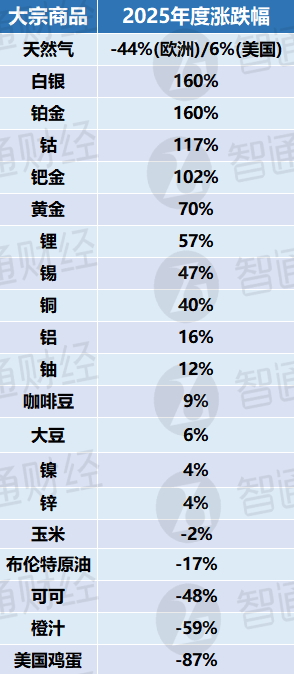
Key Insights - The global commodity market in 2025 shows a clear divergence, with energy and agricultural prices declining while precious metals (like gold and silver) and industrial metals (like copper) continue to rise and reach new highs. This situation is influenced by changes in global demand, geopolitical tensions, monetary policy adjustments, and the development of the new energy industry. This divergence is expected to persist into 2026, with energy prices anticipated to further decline due to oversupply, while precious metal prices are projected to continue rising [1]. Energy - The global crude oil market in 2025 experienced significant volatility, with Brent crude prices fluctuating between $60 and $70 per barrel by year-end. Geopolitical tensions and policy changes were key drivers of price movements, with prices peaking at $83 per barrel early in the year due to U.S. sanctions on Russia [3][5]. - In the second half of 2025, the market shifted from being geopolitically driven to one characterized by oversupply and weak demand, leading to a downward trend in oil prices. OPEC+ adjusted its strategy from production cuts to phased increases, while U.S. production reached historical highs, resulting in rapid inventory accumulation [5][6]. - For 2026, the oil market is expected to face severe oversupply pressures, with Brent crude prices projected to drop further. Analysts predict a price range of $56 to $60 per barrel, with some forecasts suggesting a potential dip to $51 per barrel in early 2026 [7]. Natural Gas - The global natural gas market in 2025 showed a "high then low" pattern, with prices initially rising due to cold weather and geopolitical factors but later declining as new U.S. production came online and demand slowed in Asia [8][10]. - In 2026, the market is expected to transition from a "tight balance" to "periodic oversupply," driven by increased LNG production from the U.S., Qatar, and Canada. Despite ample supply, demand is projected to rise by 2%, providing some price support [10]. Uranium - The uranium market in 2025 transitioned from "de-bubbling" to "structural support," with prices rebounding from a low of approximately $63 per pound to around $81-83 per pound by year-end. This was driven by renewed demand from nuclear power and AI data centers [11][13]. - For 2026, expectations are for uranium prices to accelerate upward, with forecasts suggesting prices could reach $91 per pound, with some estimates as high as $135 per pound due to increasing demand and supply constraints [14]. Precious Metals - Precious metals experienced a "historic rally" in 2025, with gold prices rising approximately 70% and silver prices soaring over 160%. This was fueled by central bank purchases, ETF inflows, and a low-interest-rate environment [15][17]. - For 2026, major financial institutions predict continued bullish trends for gold, with average prices expected to range from $4,500 to $5,000 per ounce, driven by central bank strategies and concerns over U.S. dollar credit [18][19]. Industrial Metals - The industrial metals market in 2025 was characterized by extreme differentiation, with copper prices reaching historical highs due to demand from AI data centers and global grid upgrades. Copper prices exceeded $12,700 per ton [21]. - In 2026, copper and tin are expected to remain strong, with copper potentially reaching $15,000 per ton, while tin prices may rise to $44,000 per ton due to ongoing supply constraints [28]. Agricultural Products - Cocoa prices fell significantly in 2025 after reaching a peak in 2024, while coffee prices exhibited a high-level fluctuation, with expectations for a return to balance in 2026 as supply improves [25][27]. - For 2026, cocoa is expected to see a surplus of about 150,000 tons, leading to price declines, while coffee prices are projected to drop significantly due to increased production in Brazil and Colombia [29][32].

一盎司白银罕见贵过一桶油!商品市场的“新霸主”来了?
Hua Er Jie Jian Wen· 2025-12-29 08:05
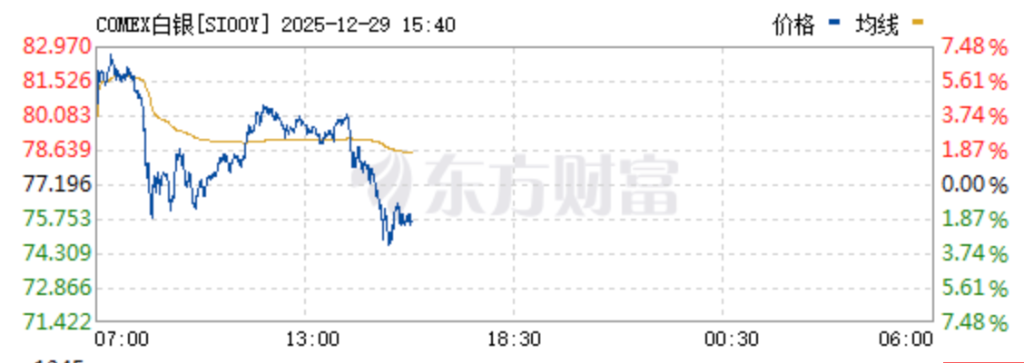
Core Viewpoint - Silver prices have surpassed a 45-year record, with expectations of doubling, creating a rare phenomenon in the commodity market where silver prices exceed those of crude oil [1][6]. Group 1: Silver Price Dynamics - As of December 29, COMEX silver prices reached $75.75 per ounce, while spot silver was at $75.89 per ounce, compared to WTI crude oil at $57.39 per barrel [1]. - The significant rise in silver prices is driven by both investment and industrial demand, with silver being used as a wealth preservation tool and a hedge against currency devaluation [7]. - Industrial applications, particularly in clean energy sectors like solar panels and electric vehicles, have led to a sustained increase in silver consumption, with the solar industry consuming nearly 30% of global silver production annually [7][8]. Group 2: Supply Constraints - The supply of silver is constrained, as global pure silver deposits are nearly exhausted, leading to silver being primarily produced as a byproduct of mining other metals [8]. - The current gold-silver ratio is around 60, indicating potential for silver prices to rise relative to gold, with some analysts suggesting that silver prices need to exceed $200 per ounce to surpass inflation-adjusted historical peaks [8]. Group 3: Oil Market Challenges - The oil market is facing a supply surplus, with international oil prices having dropped 21% since 2025, currently trading at low levels that pressure the industry [9][10]. - Analysts predict that restoring the historical price relationship between silver and oil may require a significant correction in silver prices rather than a rebound in oil prices [9]. - U.S. oil production has reached a historical high of approximately 13.5 million barrels per day, contributing to the ongoing supply imbalance in the market [10].
今日A股市场重要快讯汇总|2025年12月23日
Xin Lang Cai Jing· 2025-12-23 00:45
二、宏观经济与市场分析 纳斯达克中国金龙指数收涨0.53%,阿特斯涨10.62%,Tims中国涨7.01%,中进医疗涨5.94%。 一、上市公司重要公告 吉利汽车在港交所公告,极氪私有化交易已于2025年12月22日完成,极氪已转变为公司间接全资附属公 司,其财务业绩将继续全部并入集团综合财务报表。 商务部新闻发言人就安世半导体问题表示,中国政府已采取措施对合规民用芯片出口予以豁免,闻泰科 技与安世荷兰负责人上周举行首轮协商并同意继续沟通;指出问题根源是荷政府对企业经营的不当行政 干预,呼吁荷方撤销行政令、推动前高管撤诉,以恢复全球半导体产供链。 三、外围市场与关联资产 周一(12月22日)美股三大指数收涨,道指涨0.47%,纳指涨0.52%,标普500指数涨0.64%;大型科技 股多数上涨,美光涨超4%,甲骨文涨超3%,英伟达、特斯拉涨超1%,苹果、奈飞、英特尔跌超1%。 商务部新闻发言人就安世半导体问题表示,中国政府已采取措施对合规民用芯片出口予以豁免,闻泰科 技与安世荷兰负责人上周举行首轮协商并同意继续沟通;指出问题根源是荷政府对企业经营的不当行政 干预,呼吁荷方撤销行政令、推动前高管撤诉,以恢复全球半 ...
今年大宗商品市场总体平稳运行 我国经济结构更健康、更可持续
Yang Shi Wang· 2025-12-19 03:47
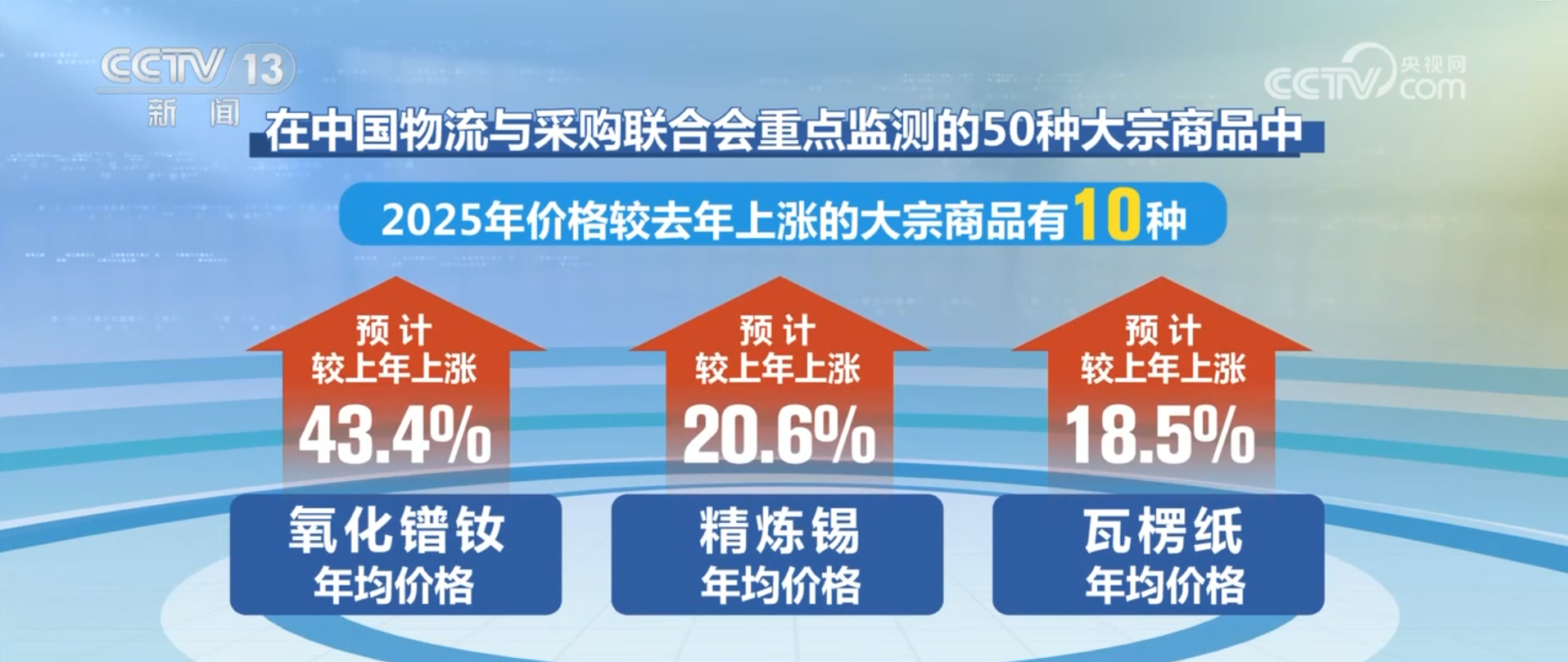
Core Insights - The report indicates that the overall operation of the bulk commodity market in China is stable, with significant characteristics of new and old energy conversion [1] Group 1: Price Index Forecast - The average price index for bulk commodities in China is expected to be 112.1 points in 2025, a decrease of 0.1% compared to the previous year [3] - Among the 50 bulk commodities monitored by the China Logistics and Purchasing Federation, 10 commodities are expected to see price increases compared to last year, including neodymium oxide, refined tin, and corrugated paper, with expected annual price increases of 43.4%, 20.6%, and 18.5% respectively [3] Group 2: Industry Analysis - The non-ferrous metal industry is expected to see a 4.2% increase compared to 2024, driven by the rapid growth of high-tech manufacturing and high-end equipment manufacturing in sectors such as new energy, photovoltaics, and wind power [4] - The average price index for agricultural products is projected to be 96.7 points, reflecting a 0.4% decrease from the previous year, with stable supply and demand for key agricultural products [4] Group 3: Economic Outlook - Experts suggest that the overall trend of the bulk commodity index in 2025 will show a pattern of low at the beginning and high at the end, indicating a stabilization and recovery, which reflects a healthier and more sustainable optimization of China's economic structure [5] - The strong resilience and significant domestic demand potential of the Chinese economy are expected to remain the most solid foundation for the bulk commodity market in 2026 [5]
对冲基金巨头纷纷涌入,Steve Cohen旗下Point 72考虑开启大宗商品交易
Hua Er Jie Jian Wen· 2025-12-18 03:18
Group 1 - Point72 Asset Management, led by billionaire Steve Cohen, is considering entering the commodities trading business to seek new revenue growth amid a trend of multi-strategy funds betting on volatile assets [1][2] - The firm has begun initial discussions with potential candidates for commodities trading but has not made any hiring decisions or allocated investment funds for this strategy yet [2][3] - If Point72 enters the commodities market, it will join other large multi-strategy funds like Citadel, Balyasny Asset Management, and Millennium Management, which have already established a presence in this area [1][3] Group 2 - Multi-strategy hedge funds are actively expanding their strategies to allocate their large capital bases, with commodities gaining interest due to their volatility [3] - Point72 manages $41.5 billion in assets, with approximately two-thirds invested in equities and the remainder in macro strategies and its quantitative trading division, Cubist [3] - The commodities market has shown mixed performance this year, with oil prices pressured by oversupply expectations while metal prices surged due to economic uncertainty [4] Group 3 - The success of commodity traders during the global energy crisis triggered by the Russia-Ukraine conflict in 2022 has further stimulated hedge funds' interest in this sector [4] - Historical trends indicate that hedge funds often flood into commodities during boom periods but quickly withdraw during price collapses, testing institutions' risk tolerance and long-term investment commitment [4]
帮主郑重:原油、铜、黄金走势“分家”,看懂全球资产的“三国演义”
Sou Hu Cai Jing· 2025-12-17 01:42
Group 1 - The current economic sentiment is described as "gray," with commodity markets reflecting this mood through diverging trends in oil, copper, and gold prices [1][4] - WTI crude oil prices have fallen below $55 per barrel for the first time since early 2021, driven by weakening demand signals from the U.S. job market and expectations of increased supply from Russia [3][4] - Copper prices are under pressure due to weak U.S. employment data, which impacts global manufacturing and construction demand, yet Goldman Sachs has raised its copper price forecast for next year due to potential supply tightening outside the U.S. [3][4] Group 2 - Gold prices have stabilized after a period of increase, reflecting market skepticism towards weak U.S. employment data and anticipation of upcoming CPI inflation data [4][5] - The divergence in commodity price movements illustrates a global economic landscape characterized by weak realities, strong speculative activities, and a search for direction [4][6] - Investment strategies should focus on three key areas: capitalizing on lower upstream costs in sectors like chemicals and transportation, being cautious with cyclical sectors closely tied to industrial metal demand, and maintaining defensive positions in portfolios [5][6]

铜的牛市&白银的逼仓:市场在下一盘什么样的大棋?
对冲研投· 2025-12-06 10:05
Group 1: Copper Market Insights - Copper prices are influenced by long-term factors such as the insufficient elasticity of copper concentrate and the rise of emerging industries, with a core supply-demand contradiction in China primarily related to copper ore [2][3] - The global copper industry faces a significant gap, with an annual increase in refined copper consumption of 800,000 tons, while the supply of copper concentrate is insufficient to meet this demand [2] - The reduction of registered copper warehouse receipts on the LME indicates potential delivery pressure and market tension, exacerbated by the flow of non-US inventories to the US [2][3] Group 2: Silver Market Dynamics - The silver market is characterized by dual drivers: the instability of the fiat currency system and the gold-silver ratio indicating a shift towards re-inflation [4][5] - The current silver bull market is in its mid-to-late stage, supported by inflation expectations and the dynamics of the gold-silver ratio, which has implications for market risk appetite [5] - The silver market's strength is primarily driven by investment demand rather than consumption, with a potential continuation of the bull market into the second half of 2026 [5] Group 3: Commodity Market Outlook - Bank of America’s commodity report suggests a diversified outlook for the commodity market in 2025, with bullish sentiments for oil, gold, and copper, while bearish on natural gas [6][8] - The report anticipates that the global economic divergence will continue to impact commodity performance, particularly in energy and agricultural sectors [8] - Industrial activity is showing mild improvement, but significant disparities exist across sectors, with high-tech exports driven by AI and data center demand experiencing growth [8] Group 4: Copper Market Risks and Strategies - The significant reduction in copper warehouse receipts in the Shanghai Futures Exchange signals a potential short squeeze risk, as the market may face delivery challenges [10][11] - The current market structure indicates that long positions have a strong incentive to take delivery, while short positions may lack the capacity to deliver, leading to heightened risks [11] - The global consensus on a shortage of refined copper in the coming years is driven by declining ore quality and insufficient capital investment in new mining projects [14] Group 5: Broader Economic Implications - China's economic landscape shows signs of overcapacity, with expectations of prolonged imbalances that may necessitate fiscal stimulus and infrastructure investment [9] - The ongoing decline in China's real estate market is likely to keep consumer confidence and domestic consumption subdued, impacting global commodity markets [9]

11月份大宗商品“成绩单”出炉 利好叠加为实现全年经济增长目标提供稳支撑
Yang Shi Wang· 2025-12-05 05:17
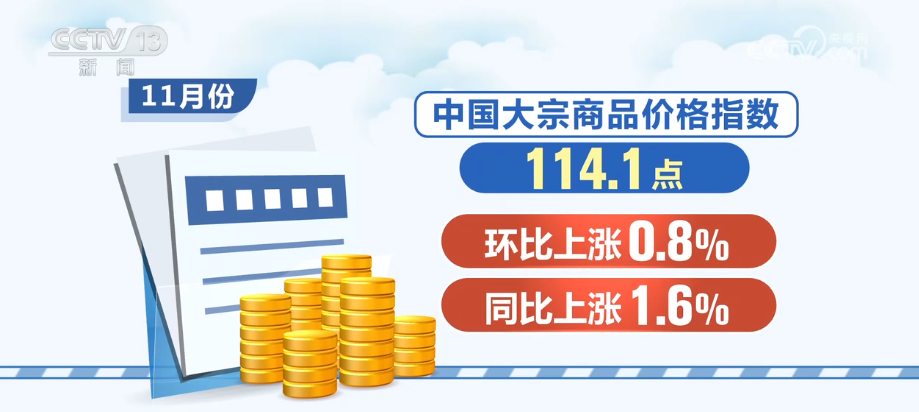
Core Insights - The China Logistics and Purchasing Federation reported that the commodity price index for November has increased for seven consecutive months, performing better than the same period in 2024 [1] Group 1: Commodity Price Index - The commodity price index for November stood at 114.1 points, reflecting a month-on-month increase of 0.8% and a year-on-year increase of 1.6% [3] - Among the 50 monitored commodities, 25 saw price increases month-on-month, with lithium carbonate, coke, and corrugated paper leading the gains at 15%, 7.2%, and 7.1% respectively [6] Group 2: Industry Performance - The non-ferrous metal price index rose by 1.4% month-on-month, driven by the rapid development of the global new energy industry and the continued expansion of domestic high-tech manufacturing [9] - The energy price index and agricultural product price index rebounded, increasing by 1.2% and 0.9% respectively, due to seasonal heating demand and tight supply of certain agricultural products [11] Group 3: Economic Outlook - Overall, the commodity market is showing a recovery in prosperity levels, indicating a stable and positive trend. This reflects the strengthening of domestic economic resilience and internal momentum, supported by various economic stabilization measures [14]
联合国报告:金融波动可能危及全球贸易
Yang Shi Xin Wen Ke Hu Duan· 2025-12-03 00:41
Core Insights - The UN Conference on Trade and Development (UNCTAD) projects global economic growth to slow to 2.6% in 2025, down from 2.9% in 2024 [1] - Financial markets are increasingly influencing global trade, with volatility in financial markets having an impact comparable to that of real economic activity [1] - The report emphasizes that over 90% of global trade relies on bank financing, highlighting the critical role of dollar liquidity and cross-border payment systems in international trade [1] Group 1 - The financial environment is becoming a dominant factor in shaping global trade dynamics, as trade is interconnected with credit limits, payment systems, currency markets, and capital flows [1] - Changes in interest rates in major financial centers or fluctuations in investor sentiment can significantly affect global trade volumes [1] - The report highlights the growing financial factors in commodity markets, particularly in food markets, where pricing increasingly reflects financial strategies rather than supply and demand [1] Group 2 - Developing economies face rising pressures due to their limited role in global financial markets, leading to higher financing costs and increased vulnerability to capital flow volatility [2] - Climate-related financial risks are exacerbating the challenges for developing economies, limiting their fiscal and investment space necessary for growth [2] - The geopolitical landscape and policy shifts are reshaping the globalization process, necessitating adjustments in the financial system to better serve the needs of the real economy [2]
供应危机以及交易员对美国联邦储备委员会即将降息的普遍押注,白银、伦铜齐创历史新高
Ge Long Hui· 2025-12-01 02:54
Core Viewpoint - Silver and copper are becoming the new focus in the commodity market due to tightening global supply and expectations of loose monetary policy, with silver prices reaching historical highs [1] Group 1: Price Movements - Spot silver prices have surpassed $57 per ounce for the first time in history, with a daily increase of approximately 1% [1] - Silver futures on the New York Mercantile Exchange hit a new high of $57.81 per ounce [1] Group 2: Market Drivers - The rapid price increase is primarily driven by deep concerns over supply shortages [1] - Traders are widely betting on an imminent interest rate cut by the U.S. Federal Reserve [1]