
资产荒

Search documents
如何看待近期债券市场行情︱重阳问答
重阳投资· 2025-07-25 06:47
Core Viewpoint - The bond market has experienced significant volatility since July, with rising yields and a downward trend, influenced by the performance of equity and commodity markets [1][2]. Group 1: Market Trends - Since July, the bond market has shown increased volatility, with the 10-year government bond yield rising over 5 basis points and the 30-year yield rising over 8 basis points, surpassing 1.9% [1]. - The adjustment in the bond market is attributed to the upward breakthrough in equity and commodity markets, with a notable shift from a two-year upward trend to a narrow range of fluctuations [1]. - The yield spread between the 10-year and 1-year government bonds remains at a historical low of 20 basis points, indicating a crowded and fragile trading structure [1]. Group 2: Economic Fundamentals - The macroeconomic fundamentals of the bond market remain stable, with structural issues in the Chinese economy still needing resolution, characterized by strong production but weak demand [2]. - The real estate market is in a phase of stabilization, and the long-term asset shortage is expected to persist, leading to a prolonged period of moderately loose monetary policy [2]. - The current dividend yield of the CSI All Share Index has dropped to around 2%, narrowing the gap with the 10-year government bond yield, thus enhancing the attractiveness of bonds [2]. Group 3: Future Outlook - The 10-year government bond yield is estimated to be reasonably priced between 1.8% and 1.9%, with a potential need for effective demand-side stimulus policies to break through this range [2]. - The bond market is expected to return to a healthier state as the central bank gradually loosens liquidity and resumes government bond trading [2].


新手入门,第一只ETF选什么? 关注银行“攻守道”
申万宏源证券上海北京西路营业部· 2025-07-25 02:41
Core Viewpoint - The article emphasizes that investing in bank sector ETFs is an ideal starting point for investors in a low interest rate environment, providing a combination of high dividends, low valuations, and solid capital support [1]. Group 1: Reasons for Choosing Bank Sector ETFs - Reason 1: High dividend yield offers stable cash flow and competitive advantage in a low interest rate environment. The current dynamic dividend yield of the bank sector is approximately 4%, significantly higher than the yield of ten-year government bonds, making it attractive for long-term institutional investors and wealth management [2]. - Reason 2: Low valuations and defensive characteristics provide a safety margin and potential for valuation recovery. The current price-to-book ratio of the bank sector is only 0.74, one of the lowest among major sectors, while the return on equity ranks favorably. This creates a dual advantage of high safety margin and potential for long-term valuation recovery [3][5]. - Reason 3: Policy and capital support strengthen medium to long-term strategic opportunities. The banking sector benefits from regulatory measures to alleviate net interest margin pressure and improve asset quality, alongside significant capital inflows into A-shares, enhancing the attractiveness of bank sector ETFs [6]. Group 2: Investment Strategy - The bank sector ETF, such as Tianhong CSI Bank ETF (515290), is positioned as an effective tool for capturing industry dividends while providing a balanced approach to stable returns and risk diversification in the current low interest rate and asset scarcity environment [6].

日度策略参考-20250724
Guo Mao Qi Huo· 2025-07-24 05:30
1. Report Industry Investment Ratings - **Macro Finance**: - Stocks: Bullish [1] - Bonds: Neutral (Oscillating) [1] - Gold: Bullish [1] - Silver: Bullish in the short - term, cautious in the medium - term [1] - **Non - ferrous Metals**: - Copper: Bullish (Oscillating upward) [1] - Aluminum: Neutral (Oscillating) [1] - Alumina: Neutral (Wide - range oscillating) [1] - Zinc: Bullish [1] - Nickel: Bullish in the short - term, cautious in the long - term [1] - Stainless Steel: Bullish (Oscillating upward) [1] - Tin: Volatile in the short - term [1] - Industrial Silicon: Bullish [1] - Polysilicon: Bullish [1] - Lithium Hydroxide: Bullish [1] - **Ferrous Metals**: - Rebar: Neutral (Oscillating) [1] - Hot - rolled Coil: Neutral (Oscillating) [1] - Iron Ore: Neutral (Oscillating) [1] - Silicomanganese: Bullish [1] - Ferrosilicon: Bullish [1] - Glass: Bullish [1] - Soda Ash: Bullish [1] - Coking Coal: Neutral (Oscillating) [1] - Coke: Neutral (Oscillating) [1] - **Agricultural Products**: - Palm Oil: Bullish, with risks [1] - Methanol: Neutral (Oscillating) [1] - Rapeseed Oil: Neutral (Oscillating) [1] - Cotton: Bullish in the short - term, limited upside for 01 contract [1] - White Sugar: Bullish, limited upside [1] - Corn: Bearish for CO1, limited upside for C09 [1] - Soybean Meal: Bullish for M01 on pullbacks, limited upside for M09 [1] - Pulp: Neutral (Oscillating) [1] - Logs: Bullish in the short - term, not advisable to chase [1] - Live Pigs: Neutral (Stable) [1] - **Energy and Chemicals**: - Crude Oil: Neutral (Oscillating) [1] - Fuel Oil: Neutral (Oscillating) [1] - Asphalt: Neutral (Oscillating) [1] - Natural Rubber: Neutral (Oscillating) [1] - BR Rubber: Neutral (Oscillating with support) [1] - PTA: Neutral (Oscillating) [1] - Ethylene Glycol: Bullish [1] - Short - fiber: Bullish [1] - Styrene: Bullish [1] - Urea: Neutral (Oscillating) [1] - PF: Neutral (Oscillating downward) [1] - DO: Bullish (Oscillating upward) [1] - PVC: Bullish (Oscillating upward) [1] - Caustic Soda: Bullish [2] - LPG: Bearish [2] - Shipping: Bearish [2] 2. Core Views - In the short term, stock indices are expected to be strong due to the "asset shortage" and "national team" support, as well as the boost from "anti - involution" and real estate policy expectations. Bond futures are favored by the "asset shortage" and weak economy, but the central bank's short - term interest rate risk warning restricts their upside. Gold and silver are expected to be strong in the short term due to market uncertainties [1]. - In the non - ferrous metals sector, "anti - involution" policies and other factors drive price movements. For example, zinc and stainless steel prices are rising, while nickel is strong in the short term but faces long - term over - supply pressure [1]. - In the ferrous metals sector, supply - side reforms drive the prices of many products such as silicomanganese, ferrosilicon, glass, and soda ash to be strong [1]. - In the agricultural products sector, different products have different trends. For example, corn has different strategies for different contracts, and soybean meal has different outlooks for M09 and M01 [1]. - In the energy and chemicals sector, factors such as supply - demand relationships, cost support, and seasonal factors affect product prices. For example, styrene is bullish due to factors such as increased device load, while LPG is bearish due to high inventory and seasonal factors [1][2]. 3. Summary by Related Catalogs Macro Finance - **Stock Indices**: Recently, stock indices have shown obvious insensitivity to negative news, with strong trading volume and market sentiment. The "asset shortage" and "national team" support increase the willingness to allocate equity assets, and "anti - involution" and real estate policy expectations boost market sentiment. In the short term, stock indices are expected to be strong [1]. - **Bond Futures**: The "asset shortage" and weak economy are favorable for bond futures, but the central bank's short - term interest rate risk warning restricts their upside [1]. - **Gold and Silver**: Market uncertainties remain, so the price of gold is expected to be strong and oscillating in the short term. Silver shows short - term resilience, but caution is needed in the medium term [1]. Non - ferrous Metals - **Copper**: The "anti - involution" theme in China is volatile, and downstream demand is fair, so the copper price is oscillating upward [1]. - **Aluminum**: The "anti - involution" theme in China is emerging, but high prices suppress downstream demand, so the aluminum price may oscillate [1]. - **Alumina**: Alumina profits are expanding, with both supply and inventory increasing, and the price is oscillating widely [1]. - **Zinc**: The "anti - involution" and capacity - reduction themes in China are emerging, infrastructure demand is boosted, and the risk of LME zinc squeeze is increasing, so the zinc price is rising. Attention should be paid to LME warehouse receipts [1]. - **Nickel**: The "anti - involution" policy in China is emerging, and the macro - sentiment is positive. Indonesia's RKAB approval quota in the first half of the year reached 364 million wet tons, and the premium of Indonesian nickel ore has slightly declined. In the short term, the nickel price is mainly driven by the macro - situation and is oscillating upward. It is recommended to wait and see and look for short - selling opportunities after the sentiment calms down. In the long term, the over - supply of primary nickel still exerts pressure [1]. - **Stainless Steel**: The "anti - involution" policy in China is emerging, and the macro - sentiment is warming up, which boosts the steel price. The price of raw material ferronickel is weak, the social inventory of stainless steel is slightly decreasing, and after profit recovery, steel mills' production cuts may be less than expected. Attention should be paid to the actual production of steel mills. The stainless steel futures are oscillating upward. It is recommended to wait and see and look for positive arbitrage opportunities between futures and spot, and pay attention to raw material changes and steel mills' production schedules [1]. Ferrous Metals - **Rebar and Hot - rolled Coil**: Strong furnace materials provide valuation support, and the prices are oscillating [1]. - **Iron Ore**: Although the commodity sentiment is positive, the fundamentals are marginally weakening, and the price is oscillating [1]. - **Silicomanganese, Ferrosilicon, Glass, and Soda Ash**: Supply - side reforms are restarted, and the prices are mainly strong [1]. - **Coking Coal and Coke**: The "anti - involution" theme is mentioned in high - level meetings. Although it cannot be compared with the 2015 supply - side reform bull market, it cannot be falsified in the short - term trading aspect. Short - selling orders should be temporarily avoided, and industrial customers should seize the opportunity of premium to establish positive arbitrage positions between futures and spot. For coke, the key is to seize the opportunity of futures premium for short - selling hedging [1]. Agricultural Products - **Palm Oil**: There is an expectation of international demand growth, and the reference price in Malaysia is raised. The risk lies in the negative impact of increased production in the producing areas and weak exports [1]. - **Cotton**: Cotton has increased positions and prices in the short term, mainly driven by the logic of squeezing the 01 contract in the near - month. The upside of the 01 contract is limited. Attention should be paid to the time window from the end of July to the beginning of August and the release of sliding - scale tariff quotas [1]. - **White Sugar**: White sugar is running strongly, with the bottom - divergence rebound of raw sugar and peak - season demand, but the upside is limited. Attention should be paid to the oscillation in the range of 5600 - 6000 [1]. - **Corn**: The supply - demand of old - crop corn is tightening, which supports the market, but the low price difference between wheat and corn squeezes the demand for corn. Under the pressure of high warehouse receipts, the rebound space of C09 is expected to be limited. The planting cost of new - season corn is reduced, and the production situation is good. It is recommended to short CO1 at high prices [1]. - **Soybean Meal**: The domestic soybean meal is in the inventory - accumulation cycle, and the basis is expected to continue to be under pressure. In the short term, the spot lacks the conditions for a sharp rise. Under the low basis, the upside of M09 is expected to be limited. Supported by the import cost, it is recommended to wait for pullbacks to buy M01 [1]. - **Pulp and Logs**: Pulp has rebounded significantly due to the strong commodity sentiment. Currently, the basis of broad - leaf pulp has weakened to - 1400 yuan/ton, and it is not recommended to chase the rise. In the short term, the main trading logic of logs may shift to the "strong expectation" of the 09 contract. After a sharp rise, it is not recommended to chase the rise [1]. - **Live Pigs**: With the continuous restoration of live - pig inventory, the slaughter weight is continuously increasing. The market expects sufficient inventory, and the futures are at a large discount to the spot. In the short term, the spot is less affected by slaughter, and the overall decline is limited, so the futures remain stable [1]. Energy and Chemicals - **Crude Oil and Fuel Oil**: The geopolitical situation in the Middle East has cooled down, and the market has returned to the supply - demand logic. OPEC+ has increased production more than expected, and short - term peak - season consumption in Europe and the United States provides support. The prices are oscillating [1]. - **Asphalt**: In the short term, the supply - demand contradiction is not prominent, and it follows the crude oil price. Cost disturbances and demand recovery balance each other, and the price fluctuation is limited [1]. - **Natural Rubber and BR Rubber**: For natural rubber, there are short - term rainfall disturbances in the producing areas, slow inventory reduction, and positive macro - sentiment in the market. For BR rubber, the cost of butadiene provides support, the fundamentals of synthetic rubber are stable, demand is weakening, the spot price is oscillating, and there will be some device maintenance of butadiene in the future with limited cargo supply, so the BR futures are expected to consolidate in stages and then have price support [1]. - **PTA**: PTA supply has shrunk, but the crude oil price remains strong. The downstream load of polyester remains at 90% despite the expectation of load reduction. In July, bottle chips and short - fibers will enter the maintenance cycle. PTA ports have slightly reduced inventory, and the replenishment willingness of polyester is not high [1]. - **Ethylene Glycol**: The coal price has risen slightly, the commodity sentiment is generally positive, overseas ethylene glycol device maintenance has been postponed, the supply has shrunk, and the market expects less arrival of goods in the future [1]. - **Short - fiber**: The registration volume of short - fiber warehouse receipts is small, and short - fiber factories' maintenance is increasing. Under the high basis, the cost of short - fiber is closely related [1]. - **Styrene**: The pure - benzene price has slightly declined, styrene sales are active, the device load of styrene has increased, the basis of styrene has significantly weakened, and there are many old - capacity issues in the pure - benzene and styrene industries [1]. - **Urea**: There is an expectation of supply contraction, and domestic demand has entered the off - season [1]. - **PF**: The macro - sentiment has faded, and it has returned to the fundamentals. There are many maintenance activities, demand is mainly for rigid needs, and the price is oscillating downward [1]. - **DO**: The downstream has entered the seasonal off - season, the supply pressure is increasing, and the price is oscillating upward [1]. - **PVC**: The prices of coking coal and other products have risen, the market sentiment is good, the maintenance has decreased compared with the previous period, and the price is oscillating upward [1]. - **Caustic Soda**: Maintenance is approaching the end, the spot price has fallen to a low level, the premium of caustic soda delivery substitutes has increased, there are many coal policies, and the sentiment is positive [2]. - **LPG**: The support from crude oil is insufficient, the international fundamentals are loose, the port propane inventory is high, the CP - FEI spread has narrowed, the LPG combustion demand is in the seasonal off - season, the chemical demand is average, the spread between industrial and civil uses has narrowed, and the domestic LPG price is running weakly [2]. - **Shipping**: The signal of freight rate peaking is emerging, European ports are still congested, and there will be many scheduled ships in August [2].
低利率时代,“红利月月享”如何破解资产荒?
Sou Hu Cai Jing· 2025-07-23 05:46
Core Viewpoint - The current low interest rate environment has led to an "asset shortage," prompting investors to seek alternative investment opportunities, with dividend-focused assets emerging as a viable solution [1][2]. Group 1: Investment Environment - The continuous decline in deposit interest rates due to multiple rate cuts by the central bank has diminished the attractiveness of traditional savings [2]. - Dividend indices currently offer yields above 4%, positioning them as core tools to replace traditional fixed-income investments in the context of economic transformation and high household savings [2]. Group 2: Dividend ETF Strategy - The "Monthly Dividend Enjoyment" combination, consisting of three dividend ETFs, allows for diversified market exposure and style variation, with a unique design for dividend distribution that enables monthly payouts [1][5]. - The combination includes the Dividend Value ETF, the Hang Seng Dividend Low Volatility ETF, and the Dividend Low Volatility ETF, which collectively enhance stability and risk diversification while aiming for improved returns [5]. Group 3: Performance Metrics - Historical backtesting shows that an equal-weighted holding of the three dividend indices results in lower volatility and maximum drawdown compared to holding a single index [5]. - The annualized returns for the Dividend Value ETF, Hang Seng High Dividend Low Volatility Index, and Dividend Low Volatility ETF are 12.5%, 18.1%, and 13.1% respectively, with an overall equal-weighted return of 14.6% [5].
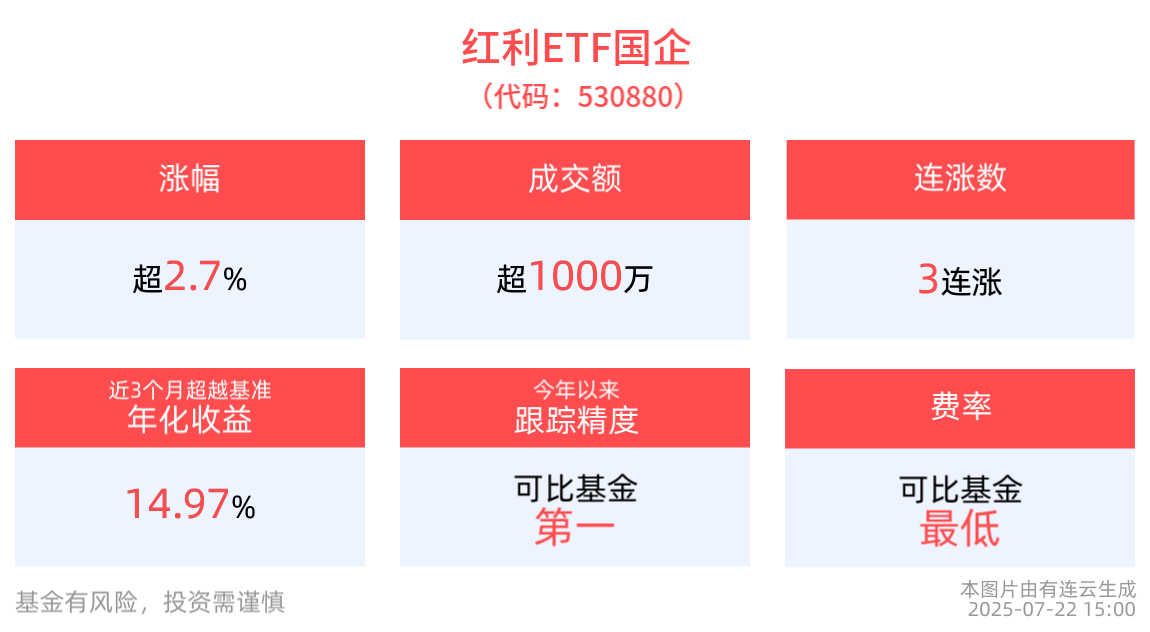
煤炭水电轮番演绎,红利ETF国企(530880)强势上涨2.80%
Sou Hu Cai Jing· 2025-07-22 07:51
Group 1 - The core viewpoint is that the Dividend ETF for State-Owned Enterprises (530880) has shown strong performance, with a 2.80% increase as of July 22, 2025, marking three consecutive days of gains [3] - Key stocks within the ETF, such as Shanxi Coal International (600546), Lu'an Environmental Energy (601699), and Huaibei Mining (600985), have all experienced significant increases, with each rising over 10% [3] - The coal sector is experiencing a surge, supported by favorable policies and structural optimization in production capacity, alongside a second round of price increases for coke expected to be implemented soon [3] Group 2 - The Dividend ETF for State-Owned Enterprises tracks the Shanghai Stock Exchange State-Owned Enterprise Dividend Index, which has a high dividend yield of 5.2%, making it one of the highest among similar A-share indices [4] - The ETF includes major state-owned enterprises from low-valuation, high-dividend sectors such as banking, coal, and transportation, which are significant contributors to A-share dividends [4] - The ETF has the lowest fee structure among similar index tracking products, enhancing its attractiveness for investors seeking stable dividend returns [4]
爆了!祖训也有不灵的时候
Datayes· 2025-07-21 11:16
Core Viewpoint - The article discusses the recent surge in A-share market driven by infrastructure projects, particularly the Yarlung Tsangpo River hydropower project, which has led to significant gains in related sectors such as construction materials and engineering machinery [1][9]. Group 1: Market Performance - The A-share market saw a collective rise in major indices, with the Shanghai Composite Index up by 0.72%, the Shenzhen Component Index up by 0.86%, and the ChiNext Index up by 0.87% [7]. - Over 4,000 stocks rose, with 130 stocks hitting the daily limit up, indicating strong market sentiment [7][9]. Group 2: Infrastructure Projects - The Yarlung Tsangpo River hydropower project is expected to have an annual investment that could reach 86.8% of Tibet's GDP, significantly impacting local economies and related industries [9]. - The project is anticipated to utilize advanced construction technologies, such as GIL technology, which will benefit companies in the supply chain [9]. Group 3: Sector Performance - The construction materials and engineering machinery sectors experienced a surge, with companies like China Power Construction and Tibet Tianlu seeing substantial stock price increases [9]. - The steel sector also showed strength, with companies like Xining Special Steel and Ba Yi Steel hitting the daily limit up, driven by government policies aimed at stabilizing growth in key industries [10]. Group 4: Policy and Economic Outlook - Analysts expect further monetary easing measures, including potential interest rate cuts and reserve requirement ratio reductions, to support economic growth [5]. - The upcoming political bureau meeting is anticipated to discuss additional stimulus measures, reflecting a proactive approach to economic management [4][5].


从“资产荒”角度看“内卷”的深层原因︱重阳荐文
重阳投资· 2025-07-21 06:07
Core Viewpoint - The article emphasizes the importance of understanding the root causes of "involution" in the context of declining investment returns and risk appetite in the capital market, suggesting that addressing these issues is crucial for effective countermeasures against involution [1]. Group 1: Declining Investment Returns - The operating profit margin of large-scale manufacturing enterprises has been on a downward trend, with figures of 5.35%, 5%, and 4.63% for 2022, 2023, and 2024 respectively, further declining to 4.25% in the first five months of this year [5]. - The revenue generated per 100 yuan of assets for large-scale manufacturing enterprises has decreased from 107 yuan in 2022 to 92.3 yuan in 2024, dropping to 85.2 yuan in the first five months of this year [5]. Group 2: Involution in Competition - Increased operational pressures have led to intensified competition among enterprises, characterized as "involutionary competition," where companies resort to price cuts to gain market share, resulting in "increased volume without increased revenue" [10]. - The Producer Price Index (PPI) has been in negative growth for 33 consecutive months since October 2022, despite the value-added growth of large-scale manufacturing enterprises being 3%, 5%, and 6.1% for 2022, 2023, and 2024 respectively, and accelerating to 7% in the first half of this year [10]. Group 3: Supply-Demand Imbalance - The root cause of "involutionary competition" is identified as an oversupply in certain industries, with capacity utilization rates for large-scale manufacturing enterprises at 75.8%, 75.28%, and 75.2% for 2022, 2023, and 2024, further declining to 74.2% in the first half of this year [18]. - Manufacturing investment growth has outpaced overall investment growth since 2021, with manufacturing investment growth rates exceeding overall investment growth by 8.6, 4, 3.5, and 6 percentage points from 2021 to 2024 [19]. Group 4: Government Influence on Investment - Local governments are incentivized to boost manufacturing investment to meet GDP targets, leading to increased investment in new industries, which has resulted in overcapacity in sectors like photovoltaics, lithium batteries, and electric vehicles [31]. - The financial support for manufacturing has increased, with long-term loans for manufacturing growing at rates exceeding 40%, providing substantial funding for investment expansion [28]. Group 5: Consumer Behavior and Economic Structure - Consumer confidence has declined, with the income confidence index dropping from 124.95 in 2019 to 95.42 in 2024, while the average wage growth for urban non-private units has slowed to 2.8% in 2024 [32]. - The high savings rate in China, at 42.49% in 2023, is attributed to a preference for low-risk assets over riskier investments, reflecting a cautious consumer sentiment [40]. Group 6: Comparison with Past Economic Reforms - The current "anti-involution" initiative is likened to the supply-side structural reforms of a decade ago, focusing on enhancing product quality and addressing low-price competition, while also emphasizing the need to stimulate consumer demand [61]. - The article suggests that the strategies for "anti-involution" should prioritize reducing excess capacity and inefficient investments while increasing household income to boost consumption [61].

中金:谁在主导港股行情?——港股流动性图景
中金点睛· 2025-07-20 23:21
Core Viewpoint - The Hong Kong stock market has remained active since early 2025, driven by new narratives such as DeepSeek, new consumption, and innovative pharmaceuticals, despite external challenges and a weakening domestic growth cycle. The market has experienced a structural rally characterized by high liquidity and asset scarcity [1][15]. Group 1: Market Activity and Liquidity - The average daily trading volume in the Hong Kong stock market reached 240.6 billion HKD, an increase of over 80% compared to 131.8 billion HKD in 2024, marking a historical high [1][2]. - Southbound capital has been consistently active, with an average daily inflow of 6.15 billion HKD, nearly double the 3.47 billion HKD average in 2024, totaling 787.7 billion HKD year-to-date, close to last year's total of 807.9 billion HKD [1][15]. - The IPO market has seen 51 companies listed in 2025, raising over 100 billion HKD, surpassing the total for 2024, with 10 A-share companies converting to H-shares, accounting for 70% of the fundraising [8][9]. Group 2: Structural Market Phenomena - A structurally active market has emerged, with sectors experiencing rotation despite overall macroeconomic weakness, highlighted by the performance of AI, new consumption, and innovative pharmaceuticals [4][15]. - The phenomenon of crowded trades has been observed, where favored stocks and sectors experience short-term expectations and valuation overshooting, as indicated by the analysis of trading volume and market capitalization [6][15]. - The average return on equity (ROE) for the market has stabilized after years of decline, indicating a stabilization in the credit cycle, with outperforming sectors including insurance, brokers, and new consumption [15][16]. Group 3: Future Trends and Market Dynamics - The macroeconomic backdrop of abundant liquidity and limited quality assets is expected to persist, influencing the flow of southbound capital and the number of companies listing in Hong Kong [21][32]. - The liquidity environment is anticipated to tighten in the third quarter due to various factors, including potential liquidity recovery by the Hong Kong Monetary Authority and external pressures from the U.S. dollar environment [39][40]. - The expected inflow of southbound capital for the year is projected to exceed 1 trillion HKD, although the pace may slow down in the second half of the year [40][41]. Group 4: Investment Strategy and Recommendations - The market is advised to focus on structural opportunities, with a "new dumbbell" strategy that balances stable dividend-paying stocks with growth-oriented sectors, particularly in AI applications and innovative pharmaceuticals [54][55]. - The banking sector may face short-term valuation pressures, suggesting a potential shift towards insurance stocks that still offer attractive dividend yields [54][55]. - The overall market sentiment indicates that while the index may oscillate around 24,000 points, a breakthrough will require additional catalysts, particularly in the context of fiscal policy and trade dynamics [51][53].

中金:A股资金面的五大变化和市场含义
中金点睛· 2025-07-20 23:21
Core Viewpoint - The A-share market is experiencing significant changes in its funding landscape, which are crucial for understanding market dynamics and future prospects [2][66]. Group 1: Changes in Funding Landscape - Change 1: The restructuring of the monetary order is leading to a shift in asset allocation, with Chinese assets benefiting relatively [5][11]. - Change 2: The proportion of individual investors in the A-share market has increased, indicating a shift in investor structure [23][24]. - Change 3: The growth in household savings, combined with an "asset shortage," is enhancing the relative attractiveness of the stock market [32][33]. Group 2: Market Dynamics and Investor Behavior - Change 4: The improvement in the funding structure and profitability effects is leading to a positive feedback loop in the market [51][56]. - Change 5: Many institutional investors have low positions in A-shares, which may present potential bullish opportunities [6][59]. Group 3: Market Valuation and Attractiveness - The current valuation of A-shares, in terms of equity risk premium and dividend yield, remains attractive compared to historical levels [37][40]. - The total market capitalization of A-shares relative to money supply and household savings is still at historically low levels, suggesting room for growth [44][45]. Group 4: Future Market Outlook - The mid-term market performance will be determined by fundamentals, but the influence of funding flows should not be underestimated, especially in the context of the current favorable funding changes [66]. - If the market continues to attract incremental capital, it may lead to an increase in risk appetite, benefiting various sectors, particularly those with high growth potential [67].

可转债周度跟踪:转债强赎意愿明显提升-20250720
ZHESHANG SECURITIES· 2025-07-20 12:51
❑ 当前转债市场建议轻指数重个券。我们认为转债的定价核心是正股基本面和主 题,正股强势的平衡型转债以及短期内不赎回的偏股型品种均能提供一定的交易 机会,建议投资者顺势操作,提高对转债价格区间的包容度,适度考察 130-150 元价格范围的转债。而偏债类转债的 YTM 已经压降至低位,纯债替代策略资金 流入拔高估值水平。如果以上标的机会有限,或对含权资产观点相对中性,也可 以考虑高切低,调整持仓结构。 证券研究报告 | 债券市场专题研究 | 债券研究 债券市场专题研究 报告日期:2025 年 07 月 20 日 转债强赎意愿明显提升 ——可转债周度跟踪 核心观点 转债指数突破新高,价格和估值处于高位,但市场交易热情仍在抬升,各类转债估值 拉伸。火热行情下,7 月转债强赎意愿明显提升。下一阶段建议投资者顺势操作,提高 对转债价格区间的包容度,适度考察 130-150 元价格范围的转债,考虑正股强势的平 衡型转债以及短期内不赎回的偏股型品种。 ❑ 风险提示 经济基本面改善不足;国内流动性收紧;海外风险事件超预期;历史经验不代表 未来 分析师:陈婷婷 执业证书号:S1230525050001 chentingting ...