
利率

Search documents
渤海证券研究所晨会纪要(2025.05.19)-20250519
BOHAI SECURITIES· 2025-05-19 01:03
Macroeconomic Environment - The US CPI and core CPI growth rates in April were lower than expected, indicating that tariffs have not significantly pushed inflation upward [2] - Retail data in April showed a substantial slowdown, likely due to a decrease in preemptive purchases by households before tariff implementation [2] - The Federal Reserve's monetary policy is expected to remain cautious, with market predictions for interest rate cuts reduced from three to two [2] - In Europe, officials indicated that US tariff policies could lead to greater recessionary pressures in the Eurozone, potentially allowing for further interest rate cuts [2] Domestic Economic Conditions - China's CPI growth rate in April was negative for the third consecutive month, primarily affected by oil prices, while core CPI remained stable [3] - The PPI decline was exacerbated by falling prices in downstream industries due to tariff impacts [3] - Financial data showed an increase in social financing in April, supported by government bond issuance and a decline in credit bond rates, although corporate and household credit demand remained weak [3] - The central bank emphasized a flexible monetary policy approach, focusing on high-quality development to address external uncertainties [3] High-Frequency Data - Real estate transactions remained weak, while agricultural wholesale prices decreased [3] - Steel prices increased, but cement prices fell [3] - Upstream, coking coal and coke prices rose slightly, while non-ferrous metal prices generally increased [3] Fixed Income Market - The trade relationship has shown temporary easing, leading to upward pressure on interest rates [5] - In April, exports to the US saw a significant decline, but transshipment trade supported exports to ASEAN, which increased by 20.8% [6] - The central bank's net withdrawal of over 400 billion yuan did not prevent a decline in funding rates, with DR007 and DR001 falling to approximately 1.50% and 1.40% respectively [6] - The primary market saw 67 new bond issues totaling 946.4 billion yuan, with net financing of 658.7 billion yuan, indicating a higher than usual issuance pace [6] Market Outlook - The upcoming months may see a further manifestation of export rush effects, but domestic inflationary pressures are expected to remain limited [7] - The easing of large-scale policy expectations following positive developments in US-China talks may temper market sentiment [7] - The recent monetary policy adjustments are anticipated to lead to a downward shift in funding rate benchmarks, potentially limiting the rise in bond market yields [8]
【UNFX课堂】美联储主席鲍威尔政策立场深度解析
Sou Hu Cai Jing· 2025-05-17 06:24
Economic Status - The U.S. economy is experiencing a complex tug-of-war, with inflation declining but facing persistent resistance, while overall growth and employment data show resilience, masking deeper structural issues [1][2] - As of March 2025, the core PCE year-on-year growth rate is approximately 2.7%-2.8%, indicating challenges in the "last mile" of inflation reduction, largely due to structural factors such as supply chain regionalization and geopolitical tensions [2] - The job market shows significant mismatches, with a low unemployment rate of about 4.2% as of April 2025, but notable layoffs in the tech sector and job shortages in manufacturing [3][4] Policy Framework Adjustments - The Federal Reserve recognizes the need for adaptive adjustments to its policy framework to better respond to complex shocks, moving from an average inflation targeting (AIT) approach to a more forward-looking range management [6][7] - Discussions around expanding liquidity support tools, including the potential expansion of the Standing Repo Facility (SRF) and the possibility of reintroducing yield curve control (YCC) under extreme market conditions, aim to enhance financial system resilience [7][8] External Shocks and Market Impact - The comprehensive tariff strategy initiated during the Trump administration is impacting the U.S. economy through direct cost transmission and supply chain restructuring, leading to varied effects across different industry sectors [8][9] - The erosion of the dollar's dominance due to emerging economies pushing for local currency settlements and central banks exploring digital currencies may increase volatility in the dollar's exchange rate and affect global asset allocation strategies [9][10] Future Outlook - The market is highly focused on when the Federal Reserve will begin to lower interest rates, with a clear "data-dependent" threshold set by Powell, emphasizing the importance of core PCE trends and labor market conditions [10][11] - The potential upward shift in the long-term neutral interest rate (r*) from around 0.5% pre-pandemic to 1.5%-2% suggests a systemic revaluation of capital markets, impacting asset valuations and increasing liquidity and repayment risks for high-leverage sectors [11][12]
贵金属数据日报-20250516
Guo Mao Qi Huo· 2025-05-16 10:41
投资咨询业务资格:证监许可【2012】31号 行判断本我告中的任何意见或建议是否符合,某掠宠状况,据此报资,责任自负。本报告仅向棕定客户推进,未经国贸联货授双许可,任何引用、转载以及句第三方传播的行为均构成对國贸联货的景观, 司将视情况追究法律责任。 期市有风险,入市需谨慎。 ll C 国贸期货 世界500强投资企业 国贸期货有限公司 流的衍生品综合服务商 D7 70 - 服 热线线 官 方 网 站 400-8888-598 www.itf.com.cn ITG国贸期货 贵金属数据日报 | | | | | | 国贸期货研究院 | | 投资咨询号: Z0013700 | | | 2025/5/16 | | --- | --- | --- | --- | --- | --- | --- | --- | --- | --- | --- | | | | | | | 宏观金融研究中心 白素娜 | | 人业资格号:F3023916 | | | | | 内外盘金 | 日期 | 伦敦金现 | | 伦敦银现 | COMEX黄金 | COMEX白银 | AU2508 | AG2508 | AU (T+D) | AG (T+D) ...
金价日内大跌鲍威尔未承诺降息
Jin Tou Wang· 2025-05-16 04:26
周五(5月16日)亚市盘中,现货黄金短线突然快速下滑,金价目前跌至3211.31美元/盎司附近,日内大跌 28美元。本交易日将迎来美国5月密歇根大学消费者信心指数初值、美国4月进口物价指数月率、美国4 月营建许可年化总数初值、美国4月新屋开工年化总数,投资者需要予以关注。另外,需要继续关注乌 克兰和俄罗斯的会谈,留意美国总统特朗普的动态消息。 【要闻回顾】 尽管关税休战最初缓解了市场对经济衰退的担忧,但MacroHive策略师本杰明·福特指出,市场已"耗尽 了"该声明带来的积极影响。 彭博社的一篇报道澄清称,美国在贸易谈判中并未寻求美元贬值,但由于市场对贸易政策波动的持续担 忧,以及全球对美资产需求下降,美元仍面临压力。安盛投资研究所重申了对美元的看跌前景,理由是 资本持续流入欧洲、亚洲和新兴市场。 在备受关注的讲话中,美联储主席鲍威尔表示,由于经济结构变化,长期利率可能维持高位。他指出, 当前环境中供应冲击更加频繁,可能导致通胀波动加剧。鲍威尔表示,尽管长期通胀预期仍锚定在美联 储2%的目标附近,但央行此前接近零利率的政策不太可能重现。 自2024年底以来,美联储一直将利率维持在4.25%-4.50%的区间 ...
关税冲突 - 宏观对冲策略
2025-05-15 15:05
Summary of Conference Call Records Industry or Company Involved - The records primarily discuss the impact of the US-China trade conflict on various industries and macroeconomic conditions. Core Points and Arguments - **Global Supply Chain Constraints**: The US faces significant challenges in adjusting global supply chains in the short term, leading to persistent price increases that cannot be resolved through supply adjustments alone. This may require agreements with other trade partners or domestic subsidies for mitigation [1][3][4] - **Tariff Measures**: The US's imposition of tariffs is driven by economic, political, and social factors. The short-term goal is to address trade deficits and increase tax revenue, while the long-term goal is partial decoupling and maintaining global dominance, making complete tariff removal unlikely [1][5] - **China's Tariff Strategy**: China has adopted a strategy of suspending or canceling certain tariffs based on negotiation outcomes, making it one of the countries with the highest tax burdens globally due to tariffs related to fentanyl and investigations [1][5] - **Projected Revenue from Tariffs**: Assuming US imports reach $3 trillion in 2025, a 10% tariff could generate at least $200 billion in additional revenue, not accounting for potential future tariff increases on certain trade partners [1][6] - **Trade Negotiation Phases**: The current phase of US-China trade negotiations is the second stage, with expectations of continued tariff increases. The first phase saw China implement comprehensive countermeasures that exceeded market expectations [1][7][8] Other Important but Possibly Overlooked Content - **Macroeconomic Impact of Tariffs**: The imposition of tariffs leads to decreased total output and increased prices in consumer countries initially, followed by rising interest rates and inflation. In producer countries, initial output declines are offset by falling prices and rising real wages [2] - **Sector Resilience**: Sectors with low trade correlation, such as consumer goods, services, and consumer banking, are expected to remain stable. Import substitution sectors like agriculture and certain chemicals show potential, while automotive parts and consumer electronics may receive exemptions [3][9] - **Commodity Price Trends**: Commodity prices are generally on a downward trend, with domestic policy support potentially weakening, leading to price volatility. Interest rates are expected to have limited downward pressure, and exchange rates may fluctuate around the 7.2 mark [10] - **Investment Strategy**: In the current economic environment, it is recommended to focus on domestic demand sectors while maintaining a defensive investment posture. A small allocation to aggressive sectors is suggested to capitalize on market volatility [11]
四月金融数据怎么看?招商宏观:社融与M2因低基数原因,增速环比明显提升
Sou Hu Cai Jing· 2025-05-15 04:23
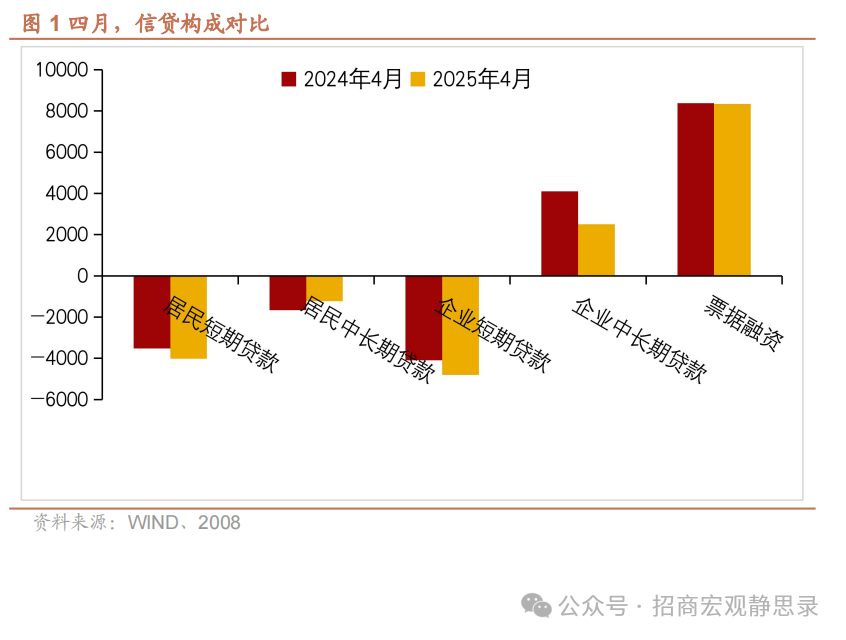
Core Viewpoint - The financial data for April indicates a significant impact on credit due to external factors, with bills becoming a major support for credit growth [2][6]. Group 1: Credit and Loans - New RMB loans in April amounted to 280 billion, a decrease of 450 billion year-on-year, falling short of market expectations [7][11]. - The corporate sector showed a more pronounced impact from tariffs, with corporate loans increasing by 610 billion, down from 860 billion year-on-year [8]. - Bills financing accounted for 297.9% of the new credit in April, highlighting its critical role in supporting credit growth [8][13]. Group 2: Deposits - Total RMB deposits decreased by 440 billion in April, with significant changes in the structure, particularly in non-bank financial institutions which saw an increase of 1.57 trillion [12]. - The increase in non-bank financial deposits is attributed to a shift in investment preferences due to volatility in the bond market [12]. Group 3: Social Financing - Social financing increased by 1.16 trillion in April, with a growth rate of 8.7%, marking a significant rise due to a low base effect [13]. - Government bonds played a crucial role, with new issuance reaching 9.76 trillion, a year-on-year increase of approximately 1.07 trillion [13]. Group 4: Conclusions and Implications - The April data reflects a seasonal decline in credit, exacerbated by tariff impacts, with expectations of a potential decline in growth rates as base effects fade [6][17]. - The central bank is responding by increasing structural relending quotas to stimulate credit demand in the service sector [17].

黄金突现暴跌行情 美国CPI数据让市场更加困惑
Jin Tou Wang· 2025-05-15 04:19
周四(5月15日)亚市盘中,现货黄金突然出现暴跌行情,金价目前报3149.79美元/盎司,跌幅0.84%,最 高上探3192.49美元/盎司,最低触及3148.90美元/盎司。 【黄金技术前景】 从技术角度来看,黄金日线图显示,金价进一步跌破目前持平的20日简单移动平均线(SMA),而技术指 标恢复在负面水平内的下滑,符合金价将出现又一波跌势的观点。 在短期内,根据4小时走势图,黄金前景看跌。金价交投在其所有移动平均线下方,20周期SMA将跌破 200周期SMA,后者位于3232美元/盎司,假如金价走势复苏,该位将构成重要阻力。最后,技术指标缺 乏方向性强度,但保持在负值水平,反映出缺乏买入兴趣。 【要闻速递】 美联储最近又一次选择了"按兵不动",将利率维持在4.25%-4.50%的区间。这已经是今年第三次保持利 率不变,显然,美联储正在小心翼翼地评估特朗普政府关税政策可能带来的经济冲击。芝加哥联储主席 古尔斯比直言,现在的经济数据充满了"噪音",美联储就像在迷雾中摸索,试图找到那条真正的主线。 最新公布的4月CPI数据让市场更加困惑——整体通胀率同比仅增长2.3%,创下四年来的最低水平,主 要得益于食品价格 ...
通胀迎来好消息?当心特朗普一嘴推翻全部
Jin Shi Shu Ju· 2025-05-14 09:22
特朗普现在可以陶醉于巨大的胜利之中。 在去年竞选时,他承诺迅速降低物价。他现在可以声称他已经做到了。最新数据显示,美国4月份通胀 率降至2.3%,基本处于正常范围。大多数物价已经稳定,始于2021年的通胀冲击已经结束。 但"得益"于特朗普本人,另一波通胀冲击可能正在到来。 尽管特朗普已撤回了他最激进的进口关税,但大量关税仍然存在。大多数经济学家预计这些作为进口税 的关税将在未来几个月提高成本并引发一轮再通胀。 在中美就贸易协议达成重要共识后,市场在5月12日飙升。目前,特朗普对大多数其他国家进口商品征 收新的10%税。此外,对进口钢铁、铝和汽车征收新的25%税。总体而言,平均进口税率已从特朗普上 任前的2.5%升至约18%。美国人将通过更高的价格支付额外成本。 一些经济学家认为关税导致的价格上涨会在4月份的通胀数据中显现,但并没有。这表明美国进口商在 关税生效前很好地建立了库存,并能够控制零售价格。 但更高的价格正在到来。穆迪分析预计到6月,通胀同比将跃升至3.8%。高盛预测2025年通胀将达到 3.6%的峰值,其他预测类似。 虽然这不像2022年高达9%的通胀那样,会严重"烧伤"消费者。但通胀回升至接近4% ...
股指期货将偏强震荡,黄金期货将偏弱震荡,铜、螺纹钢、铁矿石期货将偏强震荡,原油、PTA、乙二醇、苯乙烯、集运欧线期货将震荡偏强
Guo Tai Jun An Qi Huo· 2025-05-14 06:30
2025 年 5 月 14 日 股指期货将偏强震荡 黄金期货将偏弱震荡 铜、螺纹钢、 铁矿石期货将偏强震荡 原油、PTA、乙二醇、苯乙烯、集运 欧线期货将震荡偏强 陶金峰 期货投资咨询从业资格号:Z0000372 邮箱:taojinfeng@gtht.com 【正文】 【声明】 本报告的观点和信息仅供风险承受能力合适的投资者参考。本报告难以设置访问权限,若给您造成不 便,敬请谅解。若您并非风险承受能力合适的投资者,请勿阅读、订阅或接收任何相关信息。本报告不构 成具体业务或产品的推介,亦不应被视为相应金融衍生品的投资建议。请您根据自身的风险承受能力自行 作出投资决定并自主承担投资风险,不应凭借本内容进行具体操作。 【期货行情前瞻要点】 通过宏观基本面分析和黄金分割线、水平线、日均线等技术面分析,预期今日期货主力合约行情走势大概率如 下: 股指期货将偏强震荡:IF2506 阻力位 3876 和 3905 点,支撑位 3836 和 3822 点;IH2506 阻力位 2697 和 2719 点,支撑位 2680 和 2670 点;IC2506 阻力位 5700 和 5748 点,支撑位 5616 和 5583 点; ...
瑞达期货沪铅产业日报-20250513
Rui Da Qi Huo· 2025-05-13 10:14
1. Report Industry Investment Rating - Not provided in the content 2. Core Viewpoint of the Report - The price of Shanghai lead may rebound slightly in the short - term due to inventory reduction, but the rebound height is expected to be limited. Subsequently, it will decline from high levels due to demand. It is recommended to adopt a "high - short" trading strategy and pay attention to the new impacts brought by tax policy changes [2] 3. Summary by Relevant Catalogs 3.1 Futures Market - The closing price of the Shanghai lead main contract is 16,970 yuan/ton, down 25 yuan; the LME 3 - month lead quote is 1,977.5 dollars/ton, down 4 dollars. The 06 - 07 month contract spread of Shanghai lead is - 5 yuan/ton, down 15 yuan. The Shanghai lead position is 69,335 lots, down 3,470 lots. The net position of the top 20 in Shanghai lead is - 1,944 lots, down 181 lots. The Shanghai lead warehouse receipts are 40,961 tons, up 1,995 tons. The SHFE inventory is 49,504 tons, up 2,718 tons; the LME lead inventory is 251,800 tons, down 1,625 tons [2] 3.2 Spot Market - The spot price of 1 lead on Shanghai Non - ferrous Metals Network is 16,750 yuan/ton, unchanged; the spot price of 1 lead in the Yangtze River Non - ferrous Metals Market is 17,010 yuan/ton, unchanged. The basis of the lead main contract is - 220 yuan/ton, up 25 yuan. The LME lead premium (0 - 3) is 5.95 dollars/ton, up 1.26 dollars. The price of lead concentrate 50% - 60% in Jiyuan is 15,929 yuan, down 250 yuan. The price of domestic secondary lead (≥98.5%) is 16,690 yuan/ton, unchanged [2] 3.3 Upstream Situation - The WBMS supply - demand balance of lead is - 18,700 tons, an increase of 7,100 tons. The number of secondary lead production enterprises is 68. The capacity utilization rate of secondary lead is 54.41%, up 18.29 percentage points. The monthly output of secondary lead is 224,200 tons, down 67,500 tons. The average weekly operating rate of primary lead is 77.51%, down 1.68 percentage points. The weekly output of primary lead is 35,300 tons, down 600 tons. The processing fee of lead concentrate 60% at major ports is - 20 dollars/kiloton, unchanged. The ILZSG lead supply - demand balance is 16,400 tons, an increase of 48,800 tons. The global lead ore output is 399,700 tons, down 3,700 tons. The lead ore import volume is 119,700 tons, up 24,800 tons [2] 3.4 Industry Situation - The refined lead import volume is 815.37 tons, down 1,021.76 tons. The average domestic processing fee of lead concentrate to the factory is 720 yuan/ton, unchanged. The refined lead export volume is 2,109.62 tons, up 223.33 tons. The average price of waste batteries in the market is 10,121.43 yuan/ton, up 50 yuan [2] 3.5 Downstream Situation - The export volume of batteries is 41.45 million units, down 425,000 units. The average price of lead - antimony alloy (for batteries, containing 2% antimony) is 20,850 yuan/ton, unchanged. The Shenwan industry index of batteries and other cells is 1,690.39 points, up 42.4 points. The monthly automobile production is 3.0446 million vehicles, down 454,000 vehicles. The monthly new - energy vehicle production is 1.647 million vehicles, up 73,000 vehicles [2] 3.6 Industry News - The US Treasury Secretary will study how to solve non - tariff barriers; Trump signed an executive order to reduce drug prices and threatened car tariffs on non - price - reducing countries; US tariff revenue in April surged 130% year - on - year to 16 billion dollars. The Fed Governor Kugler supports keeping interest rates unchanged and still believes tariffs will have a significant impact. Trump announced a "grand tax - cut bill" proposing a 4 - trillion - dollar tax cut over ten years, raising the debt ceiling by 4 trillion dollars, and not mentioning a tax increase on millionaires [2]