春季行情

Search documents
如何看待近期市场的调整?| 每周研选
Shang Hai Zheng Quan Bao· 2025-11-23 15:05
Core Viewpoint - The recent global financial market is dominated by risk aversion, leading to widespread sell-offs in risk assets, including major stock markets and commodities, with A-shares also experiencing adjustments [1] Group 1: Market Adjustments - The A-share market has seen significant adjustments, with the Shanghai Composite Index falling below 3900 points, particularly in sectors like new energy, photovoltaic, and power equipment [1] - The current market adjustment is viewed as a short-term disturbance rather than a fundamental change in the upward trend of the Chinese stock market, driven by macroeconomic recovery and improved corporate fundamentals [7][11] Group 2: Investment Opportunities - The early release of risks in the market presents an opportunity for investors to reallocate assets towards A-shares and Hong Kong stocks, particularly for those looking to position for 2026 [3] - After the current adjustments, the spring market is expected to be more promising, with technology growth likely to be a key theme [4][19] Group 3: Sector Performance - Defensive sectors such as banking and insurance are expected to show resilience during the current market turbulence, while high-dividend stocks and consumer goods may present rotation opportunities [10] - The AI sector's current phase is seen as just beginning, with significant growth potential remaining, as the market transitions from hardware to application layers [15] Group 4: Future Outlook - The market is anticipated to stabilize post-adjustment, with a potential recovery in Chinese assets driven by internal factors such as new economic momentum and clear policy direction [9][18] - The historical pattern suggests that the current adjustments align with typical seasonal fluctuations, with expectations for a spring rally to commence soon [16]
六大机构,最新A股研判来了
Zhong Guo Zheng Quan Bao· 2025-11-23 14:12
Group 1 - The technology growth sector has experienced a significant pullback, leading to adjustments in the A-share market, but the downside space is considered limited after continuous adjustments, with expectations for a market recovery starting in November and an early layout window for the spring 2026 market [1][7] - Investment institutions suggest focusing on dividend stocks, cyclical stocks benefiting from rising commodity prices, as well as innovative pharmaceuticals and defense industries; there are also rebound opportunities in AI computing power, storage, energy storage, and robotics sectors [1][6][7] Group 2 - The Ministry of Industry and Information Technology is committed to advancing high-quality development of the industrial internet, emphasizing smart, green, and integrated directions to support new productive forces [2] - The State-owned Assets Supervision and Administration Commission is promoting the professional integration of central enterprises, with key project signings in critical areas such as new materials, artificial intelligence, and logistics [3] Group 3 - Sixteen hard technology-themed funds have been approved, including the first batch of AI ETFs and chip ETFs, indicating a growing interest in technology investments [4] - Market sentiment remains cautious, with a focus on dividend stocks for defensive strategies, and a potential rebound in the technology sector as concerns over AI bubbles diminish [5][6] Group 4 - The lithium battery industry chain is experiencing high demand, driven by strong market conditions in energy storage and the upcoming sales peak for new energy vehicles, with expectations for continued high prosperity [8] - The AI industry continues to show strong momentum, supported by domestic policies promoting self-innovation and new productive forces, with long-term value becoming more apparent if AI giants enhance their profitability [9][10] Group 5 - Future market outlook suggests that major A-share indices may exhibit strong oscillation patterns, with a focus on three key areas: essential resource products with rigid supply, traditional industries benefiting from supply-side reforms, and high-elasticity sectors like military and AI industry chains [11]
年末重新增配A股迎来契机?投资主线有哪些?十大券商策略来了
Feng Huang Wang· 2025-11-23 13:21
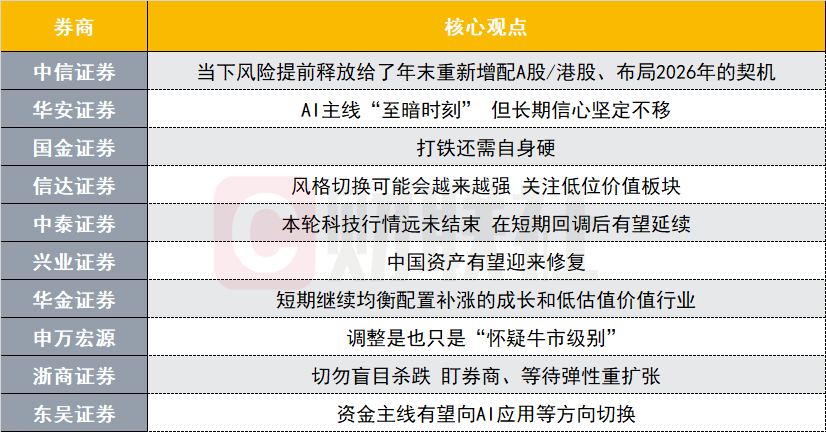
Core Viewpoints - Current risk release provides an opportunity for reallocating A-shares and Hong Kong stocks by year-end and planning for 2026 [2] - The AI sector is experiencing a "darkest hour," but long-term confidence remains unwavering [4] - The adjustment phase is merely a "doubtful bull market level" [11] Industry Insights - Focus on resource and traditional manufacturing opportunities, particularly in chemicals, non-ferrous metals, and new energy [3] - The AI industry is expected to continue its growth trajectory, with significant valuation growth potential for A-share companies [8] - The market is likely to experience a style switch, with increasing attention on low-valued sectors [6] Investment Recommendations - Emphasize sectors benefiting from physical asset consumption, such as upstream resources (copper, aluminum, lithium, oil, coal) and midstream industries [5] - Maintain a balanced allocation between growth sectors and undervalued value industries, particularly in the consumer sector as year-end approaches [10] - Focus on AI applications and sectors closely related to the "14th Five-Year Plan," such as hydrogen energy, nuclear energy, and quantum technology [14]



每周研选 | 如何看待近期市场的调整?
Sou Hu Cai Jing· 2025-11-23 12:59
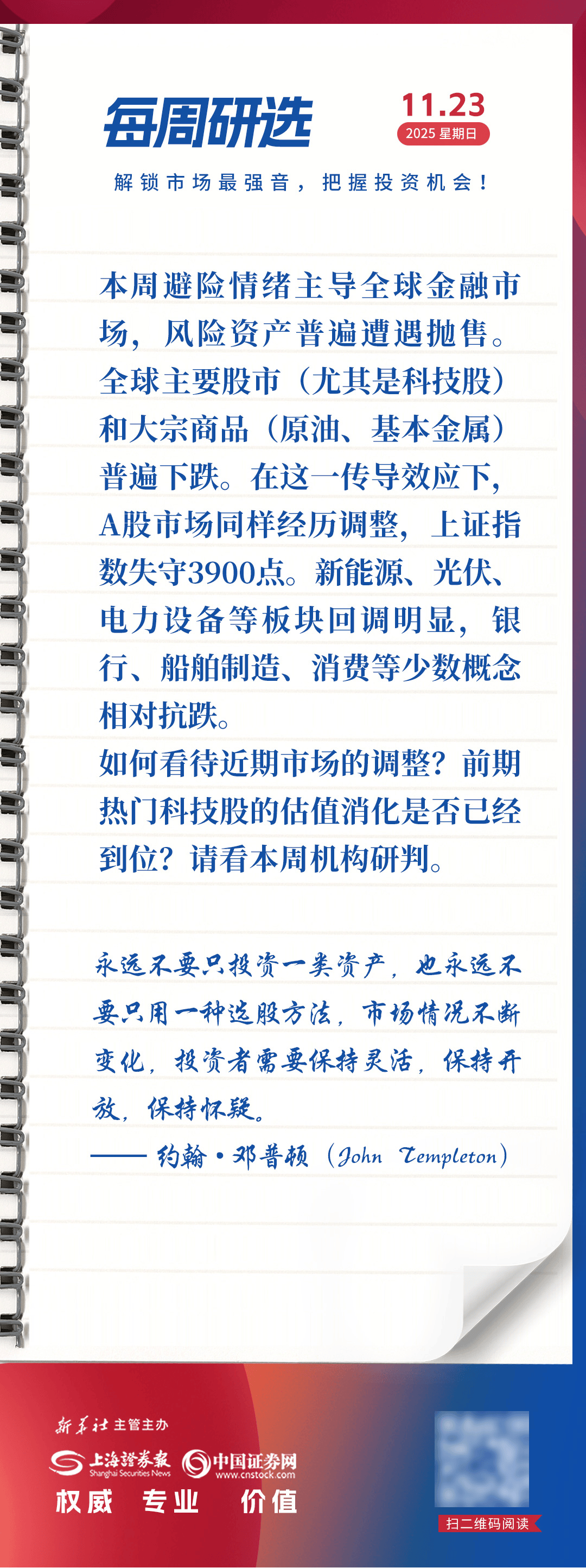
癌周研选 本周避险情绪主导全球金融市场,风险资产普遍遭遇抛售。全球主要股市(尤其是科技股)和大宗商品(原油、基本金属)普遍下跌。在这一传导效应 下,A股市场同样经历调整,上证指数失守3900点。新能源、光伏、电力设备等板块回调明显,银行、船舶制造、消费等少数概念相对抗跌。 11.23 2025 星期日 如何看待近期市场的调整?前期热门科技股的估值消化是否已经到位?请看本周机构研判。 解 锁 市场 最 强 音,把 握 投 资 机 会! 本周避险情绪主导全球金融市 场,风险资产普遍遭遇抛售。 全球主要股市(尤其是科技股) 和大宗商品(原油、基本金属) 普遍下跌。在这一传导效应下, A股市场同样经历调整,上证指 数失守3900点。新能源、光伏、 电力设备等板块回调明显,银 行、船舶制造、消费等少数概念 相对抗跌。 如何看待近期市场的调整?前期 热门科技股的估值消化是否已经 申万宏源:调整后春季行情更值得期待 9月以来AI产业链已处于高位震荡阶段。与此同时,近期美联储货币宽松低于预期,这进一步引发了全球高风险资产普跌。调整背后的本质还是资产性价 比降低,脆弱性提高,对流动性冲击的敏感度提升。对比2014年初的创业板、 ...
东吴证券:如何看待近期市场的调整
智通财经网· 2025-11-23 06:38
Core Viewpoint - Since the adjustment of A-shares began on November 14, the Shanghai Composite Index has fallen by 4.8%, with structural adjustments being more pronounced than the index itself, particularly in sectors that previously saw significant gains [2][3] Market Adjustment Factors - The current market adjustment is attributed to both external factors and internal pressures, including global liquidity tightening and concerns over an "AI bubble" affecting technology sectors [2][3] - Global liquidity has been tightening due to multiple factors, including the U.S. government shutdown and hawkish signals from the Federal Reserve, which has led to a cautious market outlook [2][3] - The tightening of liquidity is further exacerbated by Japan's proposed fiscal stimulus and mixed signals from U.S. employment data, which do not strongly indicate a need for interest rate cuts [2][3] Historical Context - Historically, the fourth quarter is a "settlement season" for A-shares, where adjustments are common before the spring rally, with maximum drawdowns often exceeding 5% even during bull markets [4][5] - The current maximum drawdown of 6.5% since October is considered relatively high compared to historical levels during bull markets [5] Future Outlook - The company anticipates that the current adjustment phase will end after November, leading to an early spring market rally, supported by solid year-end liquidity conditions [6] - The focus for the upcoming spring market is expected to shift towards AI applications and sectors closely aligned with the "14th Five-Year Plan," particularly in technology innovation and advanced manufacturing [6][7] Sector Allocation - If the market begins its spring rally in December, the main investment focus is likely to shift towards AI applications and related sectors, with a historical precedent of sector rebalancing influencing market performance [7] - Key areas of interest include AI applications in healthcare, robotics, and smart driving, as well as sectors benefiting from domestic policy support such as hydrogen energy and quantum technology [7]

如何看待近期市场的调整
Soochow Securities· 2025-11-23 04:35
随着北美大厂 AI 资本开支的步伐变的更为激进、而 AI 对经济及企业盈 利的拉动效应尚未充分展现,市场对于资本开支向 EPS 传导的评估更为 审慎、开始关注"AI 泡沫"风险。在此基础上,过去两年"科技大厂算力 军备竞赛、资本开支集中上修"即可顺利带动算力行情的模式将有所变化, 未来 AI 叙事的持续演绎,除了算力本身的旺盛需求外,可能还需要看到 AI 价值创造更为明确的信号。 ◼ 一是,全球流动性紧缩之下,A 股难以"独善其身" 近期多重因素轮番作用,全球流动性呈现紧缩态势。此前阶段,紧缩格局 主要受美国联邦政府停摆影响,TGA 账户"只进不出"大量吸收市场流动 性,对美国本土冲击更为直接,亦推动美股率先见顶回落。随着美政府重 新开门,这一流动性压力已明显缓和,当前流动性趋紧的核心驱动在于 12 月美联储大概率不降息: 基于多重原因,流动性收紧压力带动近期全球资产普遍回调,A 股市场难 以"独善其身"。 ◼ 二是,海外"AI 泡沫"焦虑、科技板块下跌,波及 A 股 证券研究报告·策略报告·策略周评 策略周评 20251123 如何看待近期市场的调整 2025 年 11 月 23 日 [Table_Summ ...
申万宏源策略一周回顾展望(25/11/17-25/11/22):调整是也只是怀疑牛市级别
Shenwan Hongyuan Securities· 2025-11-22 12:46
Core Viewpoints - The current adjustment is characterized as a "doubtful bull market level," indicating that the major trends in the AI industry chain have not ended, although there are short-term fluctuations and a temporary lack of cost-effectiveness in large trends. This situation resembles historical patterns observed in early 2014, early 2018, and early 2021 [1][3][5] - The "two-stage bull market theory" remains unchanged, suggesting that the transition from Bull Market 1.0 to 2.0 is a typical feature of the A-share bull market cycle. The transition period is expected to occur in the first half of 2026, with a full bull market potentially starting in the second half of 2026 [1][5][6] Summary by Sections Adjustment Phase - The adjustment phase is seen as a "doubtful bull market level," where the AI industry chain is experiencing a lack of cost-effectiveness, leading to a market correction. Historical experiences indicate that such adjustments are typical and often occur in quarterly cycles [3][4] - The current market conditions show that the implied equity risk premium (ERP) in sectors like telecommunications and electronics is still above historical lows, while the price-to-earnings (PE) ratios are at absolute historical highs [3][4] Spring Market Outlook - The spring market is expected to be more promising post-adjustment, with economic growth needing to maintain a high level to achieve the 2035 medium-developed country goal. The third quarter of 2025 showed weak economic performance, and December 2025 is seen as a critical window for laying out economic policies for 2026 [6][7] - The technology sector is anticipated to see a rapid improvement in cost-effectiveness, with institutional investors reducing their technology holdings in the short term. The micro-structural improvements in the technology sector are also expected to play a significant role in the spring market rotation [6][7] 2026 Industry Style and Rhythm Outlook - The transition from Bull Market 1.0 to 2.0 is expected to favor high-dividend defensive stocks. The actual improvement in economic sentiment will catalyze cyclical stocks to lead index breakthroughs, with technology trends and manufacturing global influence being the main themes of the bull market [8] - In the spring of 2026, the early validation of policy bottoms, cyclical price increases, and improved year-on-year PPI expectations will provide a foundation for cyclical assets. Key areas of focus include basic chemicals, industrial technology, innovative pharmaceuticals, and defense industries, with potential rebounds in AI computing power, storage, energy storage, and robotics [8]
申万宏源策略一周回顾展望:调整是也只是“怀疑牛市级别”
Shenwan Hongyuan Securities· 2025-11-22 11:49
Group 1 - The report indicates that the current adjustment phase is characterized as a "doubtful bull market level," with the AI industry chain experiencing a significant trend that has not yet ended, while smaller fluctuations are present and the cost-effectiveness of large trends is temporarily insufficient. This situation resembles historical patterns observed in early 2014 with the ChiNext, early 2018 with food and beverage, and early 2021 with new energy [4][6][7] - The "bull market two-stage theory" remains unchanged, confirming the high-level area of the bull market 1.0 phase. The transition from bull market 1.0 to 2.0 is expected to occur in the first half of 2026, with a focus on the accumulation of conditions for a comprehensive bull market and adjustments in industry trends to digest cost-effectiveness issues [6][7][9] - The report emphasizes that while adjustments are occurring, it is crucial to maintain a firm belief in the bull market. The adjustment phase is seen as a potential bottom, particularly when it aligns with the core track's bull-bear boundary [6][7] Group 2 - The report expresses optimism for the spring market following the adjustment, highlighting that achieving the 2035 medium-developed country goal requires maintaining a high economic growth rate. The economic performance in Q3 2025 was weak, and December 2025 is identified as a critical window for laying out economic policies for 2026, with the possibility of an early verification of the "policy bottom" [7][8] - Two key clues for the spring market are discussed: first, the management's emphasis on economic growth and the potential early verification of the "policy bottom"; second, the mid-term upward trend of the technology industry remains unchanged, with the AI industry still in "stage 3" and moving towards "stage 4," indicating non-linear growth in industry profits [8][9] - The report anticipates that the transition from bull market 1.0 to 2.0 will favor high-dividend defensive strategies, with the actual improvement in economic sentiment catalyzing a breakthrough in cyclical stocks, while the technology industry's trend and global influence of manufacturing will be the main lines of the bull market [9] Group 3 - The report outlines expectations for the 2026 industry style rhythm, indicating that cyclical stocks may serve as the foundational assets for the spring market, with basic chemicals and industrial technology being highlighted as higher elasticity directions. The technology sector is expected to rebound, focusing on innovative pharmaceuticals and national defense industries [9][10] - Specific sectors such as AI computing power, storage, energy storage, and robotics are anticipated to have rebound opportunities in the spring [9][10] - The report includes quantitative sentiment indicators and ETF tracking data, providing insights into market dynamics and investor sentiment [2][17]
早盘直击|今日行情关注
申万宏源证券上海北京西路营业部· 2025-11-20 01:53
Market Overview - The market remains in a sideways consolidation phase, with abundant liquidity and no significant outflow signals, providing stability to the major indices [1] - Investors have high expectations for the market in 2026, indicating that the current phase is primarily a layout stage for future opportunities [1] - Technical indicators show a shrinking trading volume, suggesting an increasing wait-and-see atmosphere among investors [1] Technical Analysis - The Shanghai Composite Index's daily K-line pattern may be forming a small M-top after two peaks, which requires ongoing monitoring [1] - If the index breaks below the neckline, it could lead to a moderate adjustment, with potential declines matching the height from the previous high to the neckline [1] Market Trends - There is a rotation of market hotspots, with short-term impulses driven by thematic stocks, such as shipbuilding and defense industries showing performance on specific days [1] - Recent market speculation around company names has seen rapid declines, with several stocks hitting the daily limit down [1] - Key sectors like AI computing power, new energy batteries, and basic materials continue to attract attention and inflow from major funds [1] Future Outlook - The market is expected to continue its oscillation and consolidation, focusing on stability [1] - Attention should be paid to changes in intraday hotspots and the matching of trading volume [1] - A small probability exists for a moderate adjustment if the Shanghai Composite Index loses its neckline support [1]

公司核心化工产品价格周环比涨近6%,受益于下游稀土、锂电领域高景气
摩尔投研精选· 2025-11-11 10:33
Group 1: Spring Market Outlook - The spring market may start earlier than usual, potentially in December this year, based on historical trends showing a shift in the timing of spring rallies since 2018 [1] - Historical data indicates that in 8 years since 2018, 4 years saw the spring market begin in December of the previous year, with significant gains typically occurring before the Spring Festival [1][2] - The reasons for this early start include a transformation in economic regulation and a "learning effect" among investors that encourages earlier market movements [2] Group 2: Historical Performance Analysis - The table outlines the last trading day before the Spring Festival, the start and end dates of the spring market, and the maximum gains during both pre- and post-festival periods from 2010 to 2025 [2] - Notable maximum gains before the Spring Festival include 27.89% in 2013 and 12.87% in 2020, while post-festival gains peaked at 46.94% in 2015 [2] Group 3: White Wine Industry Insights - The white wine sector is experiencing a downturn, with sales expected to decline by approximately 10% year-on-year in Q1 2025, and a more significant drop of 30%-50% in Q2 2025 [4][5] - Despite the challenges, leading brands are still showing growth, and analysts predict a potential stabilization in Q2 2026, with a recovery in demand and pricing expected in Q3 2026 [5] - Fund holdings in the white wine sector have decreased, with the market value of heavy holdings dropping to 5.52%, approaching levels seen in Q2 2017 [6]