
成本支撑

Search documents
成本端?强,??低位反弹
Zhong Xin Qi Huo· 2025-08-26 02:37
1. Report Industry Investment Rating - The report does not explicitly provide an overall industry investment rating. However, the mid - term outlook for the black building materials industry is "oscillating" [6]. For individual products, most are rated as "oscillating", including iron ore, coke,焦煤, glass,纯碱, manganese silicon, and silicon iron [8][9][11][12][13][14][15][16][17][18]. 2. Core Viewpoints of the Report - After about a week of decline, the black building materials entered the lower end of the valuation range. With supply constraints on furnace materials and expectations of stricter safety supervision, prices rebounded significantly. As the off - peak and peak seasons are approaching, the apparent demand for steel remains weak, but it's not yet the time to verify terminal demand. With low inventory pressure in each link of the black industry chain and in the pre - peak season restocking window, prices are expected to have a small rebound space. Attention should be paid to future demand performance and furnace material supply recovery [2]. - Overall, after consecutive days of decline, black prices have fallen near the cost support level, and demand negatives have been gradually digested. With supply disturbances in furnace materials and downstream restocking demand, there is a driving force for price rebound. However, the weak expectation of peak - season terminal demand remains, suppressing the upside space. Future focus should be on policy implementation and terminal demand performance [6]. 3. Summary by Related Catalogs 3.1 Iron Element - Core Logic: Overseas mine shipments decreased month - on - month, and the arrival volume at 45 ports slightly declined, close to last year's level, with relatively stable total supply. On the demand side, pig iron production increased slightly, and the end - of - month production restrictions have limited impact, so iron ore demand is expected to remain high. In terms of inventory, the iron ore ports destocked this week, with a slight decrease in total inventory. There are limited bearish drivers in the fundamentals, and the price is expected to oscillate [3]. - Outlook: With high iron ore demand, stable supply and inventory, and limited bearish fundamental drivers, the price is expected to oscillate in the future [9]. 3.2 Carbon Element - Core Logic: Some coal mines in the production area have resumed production, but some are still restricted by accidents and other factors. For example, a 3 - million - ton low - sulfur lean primary coking coal mine in Xiangning, Linfen, Shanxi has been shut down for three days. On the import side, the average daily customs clearance at the Ganqimaodu Port remains above 1,000 vehicles, but there was a short - term decline in the past two days due to the Mongolian customs system. On the demand side, the eighth round of coke price increase has started again, showing regional differentiation. In some areas, coking production is restricted, and the short - term rigid demand for coking coal has slightly declined. Downstream enterprises mainly purchase on demand, and spot transactions have weakened. Some coal mines have started to accumulate inventory, but overall, there is no obvious inventory pressure. The short - term fundamental contradictions are not prominent, and the short - term disk still has support under a healthy fundamental situation [3]. - Outlook: With continuous supply disturbances and difficult significant supply increase before the parade, short - term fundamental contradictions are not prominent, and the short - term disk still has support under a healthy fundamental situation [13]. 3.3 Alloys 3.3.1 Manganese Silicon - Core Logic: Yesterday, the coking coal futures price rose significantly, and the black sector was strong, with manganese silicon oscillating strongly. Manganese silicon manufacturers stocked up on raw materials before the parade, and the restocking is nearly over. With increased arrivals and rising supply pressure, the port ore price has weakened from its high level. In terms of supply and demand, steel mills have good profits, and finished product output remains high. Under the environment of industry profit repair, the resumption of production by manufacturers continues, and the supply - demand relationship of manganese silicon may gradually become looser. In the medium - to - long - term, there may be downward pressure on the manganese silicon price [3]. - Outlook: Currently, the market inventory pressure is controllable, and the cost provides support, so the short - term downward space for the manganese silicon price is limited. But in the medium - to - long - term, as the supply - demand relationship becomes looser, the price may decline. Attention should be paid to the reduction in raw material costs [17]. 3.3.2 Silicon Iron - Core Logic: The current market inventory pressure of silicon iron is not large. In the short - term, the silicon iron price is expected to oscillate. However, in the future, the supply - demand gap will gradually be filled, and there are hidden concerns in the fundamentals. The upside space of the price is not optimistic. Attention should be paid to the dynamics of the coal market and the adjustment of electricity costs [3]. - Outlook: Currently, the market inventory pressure is not large, and the cost provides support, so the short - term downward adjustment space for the silicon iron price is limited. But the medium - to - long - term supply - demand outlook is pessimistic, and the price center is expected to move down. Attention should be paid to the coal market dynamics and the adjustment of electricity costs in the main production areas [18][20]. 3.4 Glass - Core Logic: After the glass futures price fell, the sentiment in the spot market declined, with mid - stream shipments and a significant decline in upstream production and sales. On the supply side, there is still one production line waiting to produce glass, and the overall daily melting volume is expected to remain stable. The upstream has slightly accumulated inventory, with no prominent self - contradictions but more market sentiment disturbances. Recently, the rising coal price has strengthened the cost support, but the fundamentals are still weak [3]. - Outlook: The actual demand is weak, but the policy expectation is strong, and the raw material price is strong. After the transaction of delivery contradictions, the far - month contract still gives a premium. In the medium - to - long - term, market - oriented capacity reduction is still needed, and if the price returns to fundamental trading, it is expected to oscillate downward [15]. 3.5 Steel - Core Logic: There are still contraction disturbances in the supply of coking coal and iron ore. Under the background of high pig iron production, the cost has an upward driving force, and the disk has strong support. The overall spot steel transactions are average, mainly at low prices, and the market sentiment is still cautious. Last week, the production of rebar decreased, and the production of hot - rolled coils increased. As the off - peak season ends, mid - and downstream enterprises are restocking before the parade. The apparent demand for rebar has improved month - on - month, and inventory accumulation has slowed down. The demand for hot - rolled coils remains highly resilient, and inventory continues to accumulate under high production. The supply - demand fluctuations of medium - thick plates and cold - rolled products are limited, with both supply and demand of the five major steel products increasing, and the inventory accumulation speed slowing down [8]. - Outlook: As the off - peak season ends, steel inventory continues to accumulate, and the market is still cautious about the peak - season demand. Both supply and demand will be affected before and after the parade. The blast furnace production restriction situation needs to be tracked, and there may be shutdowns of construction sites and factories in Beijing and surrounding areas. The pre - parade restocking of raw materials may end. Recently, there are continuous disturbances in the cost supply side. The short - term disk is expected to oscillate widely. Future focus should be on steel mill production restrictions and terminal demand performance [8]. 3.6 Coke - Core Logic: In the futures market, the eighth round of coke price increase has started again, combined with continuous rumors of production restrictions and strengthened cost support from coking coal, coke prices were strong yesterday. In the spot market, the quasi - first - grade coke price at Rizhao Port is 1480 yuan/ton (+10). On the supply side, the seventh round of price increases has been fully implemented, and coking enterprise profits have quickly recovered. As the parade approaches, coking production in some areas is gradually restricted, while others maintain normal production. On the demand side, downstream steel mills have good profits and are actively producing. Affected by the parade, transportation in some areas is restricted, so local steel mill inventories are still low, and some coking enterprises have started to accumulate inventory. Currently, the inventory of upstream coking enterprises is still at a low level, and under simultaneous production restrictions on coking and steel, the short - term supply - demand remains tight [12]. - Outlook: As the parade approaches, the expectation of coke production restrictions may be stronger than that of steel mills. The short - term tight supply situation will continue. With the start of the eighth round of price increases and strengthened cost support from coking coal, the short - term disk has strong support [12]. 3.7 Scrap Steel - Core Logic: The average tax - excluded price of crushed scrap in East China is 2174 (+5) yuan/ton, and the rebar - to - scrap price difference in East China is 1032 (+24) yuan/ton. In terms of supply, the arrival volume of scrap steel decreased month - on - month this week. In terms of demand, the profit of electric arc furnaces is low due to the pressure on finished products recently. The profit and loss of electric arc furnaces during off - peak electricity hours in East China is at a tight balance, and there are losses in many other areas during off - peak hours. The daily consumption of scrap steel in electric arc furnaces has decreased month - on - month. In the blast furnace sector, pig iron production has slightly increased, and the daily consumption of scrap steel in long - process production has also slightly increased. The total daily consumption of scrap steel in both long - and short - process production has increased slightly. In terms of inventory, the factory inventory has slightly increased, and the available inventory days have dropped to a relatively low level [10]. - Outlook: The fundamental contradictions of scrap steel are not prominent. The pressure on finished product prices has led to low electric arc furnace profits, but resources are still tight. The price is expected to oscillate in the short - term [10]. 3.8 Sodium Carbonate - Core Logic: The delivered price of heavy - quality sodium carbonate in Shahe is 1230 - 1280 yuan/ton (-). The domestic commodity market sentiment has improved, and as the delivery approaches, the fundamental logic returns, with a neutral macro - environment. On the supply side, the production capacity has not been cleared, and there is still long - term suppression. The production is at a high level, and supply pressure remains. There is no short - term disturbance to production, and production is expected to continue to increase. On the demand side, heavy - quality sodium carbonate is expected to maintain rigid - demand procurement. There are still ignition production lines that have not produced glass, the float glass daily melting volume is expected to be stable, and the daily melting volume of photovoltaic glass is expected to bottom out initially, currently at 86,500 tons. The demand for heavy - quality sodium carbonate is flat. In the light - quality sodium carbonate sector, downstream procurement is flat, but the overall downstream restocking sentiment is weak, and there is resistance to high prices. Sentiment affects the disk. As the shipping problem eases, mid - stream inventory accumulates, and downstream acceptance is weak [16]. - Outlook: The oversupply pattern remains unchanged. After the disk price drops, there is a small increase in spot - futures transactions. It is expected to oscillate widely in the future. In the long - term, the price center will continue to decline to promote capacity reduction [16].
供需边际改善,关注上下游装置变动能源化工
Hong Yuan Qi Huo· 2025-08-25 14:23
1. Report Industry Investment Rating No relevant content provided. 2. Core Viewpoints of the Report 2.1 Weekly Summary - PX prices fluctuated upward this week due to cost support. International oil prices showed a slight upward - fluctuating trend, and the domestic PX devices operated stably. The demand side of PTA performed well, and the polyester industry maintained high - level operation. Also, news of possible naphtha production cuts in South Korea and petrochemical industry policy news boosted the PX price [9]. - PTA prices went up due to cost support and unplanned device shutdowns. The news of possible naphtha production cuts in South Korea pushed up the PX market, which was beneficial to PTA. A 5 - million - ton PTA device in South China shut down unexpectedly, leading to inventory reduction from August to September. Traders were reluctant to sell, and the spot basis strengthened. Meanwhile, the polyester industry gradually increased its operation rate in anticipation of the peak demand season [9]. 2.2 Future Market Forecast - Strategy recommendation: Stay on the sidelines. - Crude oil: Geopolitical conflicts will increase market uncertainty, and the market will mainly choose to wait and see. Oil prices are expected to fluctuate widely. - PX: A total of 1.6 - million - ton PX devices in South China are planned to start operation successively this week. The rigid demand for spot purchases from newly - put - into - operation PTA devices will support PX demand. - PTA: A 2.2 - million - ton PTA device in East China will restart, but it cannot offset the impact of the shutdown of a 5 - million - ton PTA device in South China. In addition, the low processing fees of PTA continue, and there may be other unplanned device overhauls. - Polyester: There is no clear plan for polyester device overhauls next week. As the traditional peak demand season approaches, manufacturers' tolerance for inventory increases, and the market supply pressure of polyester factories will be low in the future. - Weaving: Demand is marginally improving, and there are expectations for the peak season. - Overall: PX will fluctuate strongly in the range of 6,850 - 7,050 yuan/ton; PTA will also fluctuate strongly in the range of 4,750 - 4,950 yuan/ton [11][12]. 3. Summary According to the Main Sections of the Report 3.1 Price Situation 3.1.1 PX Futures - The news of naphtha production cuts in South Korea boosted the PX futures price. From August 15th to August 22nd, the closing price of the PX main contract rose from 6,688 yuan/ton to 6,966 yuan/ton, an increase of 278 yuan/ton, with a change rate of 4.16%. The settlement price rose from 6,682 yuan/ton to 6,966 yuan/ton, an increase of 284 yuan/ton, with a change rate of 4.25%. - From August 18th to August 22nd, the average basis of the main contract was - 171 yuan/ton; the average domestic spot price of PX was 6,689.4 yuan/ton, a month - on - month increase of 29 yuan/ton, with a change rate of 0.44% [15][17][19]. 3.1.2 PTA Futures - The unplanned device overhauls boosted the PTA futures price. From August 15th to August 22nd, the closing price of the PTA main contract rose from 4,716 yuan/ton to 4,868 yuan/ton, an increase of 152 yuan/ton, with a change rate of 3.20%. The settlement price rose from 4,708 yuan/ton to 4,864 yuan/ton, an increase of 156 yuan/ton, with a change rate of 3.34%. - From August 18th to August 22nd, the average basis of the main contract was - 45 yuan/ton. The average weekly CIF price of PTA in the Chinese market was 604 US dollars/ton, an increase of 9.2 US dollars/ton compared with the previous period, with a change rate of 1.55%. The average spot price of PTA in the East China market was 4,744.8 yuan/ton, an increase of 63 yuan/ton compared with the previous period, with a change rate of 1.35% [21][23][26]. 3.2 Device Operation Situation 3.2.1 PX Device - Domestic PX device operation: Devices of many enterprises such as Ningbo Daxie, Shenghong Refining & Chemical, and Zhejiang Petrochemical are operating at different loads. Some devices have experienced load changes, shutdowns, and restarts. - Asian other PX device operation: Devices of enterprises in many countries and regions such as Indonesia, Malaysia, and South Korea have different operation statuses, including normal operation, shutdown for maintenance, and load changes. - The domestic PX device operating rate has recovered. From August 18th to August 22nd, it was 85.22%, compared with 84.97% from August 11th to August 15th [31][33][35]. 3.2.2 PTA Device - Multiple PTA devices are under maintenance, including those of Ningbo Taihua, Hainan Yisheng, and Fuhai Chuang. The planned maintenance period ranges from several months to more than a month. - Unplanned device overhauls have led to a slight price increase, and the weekly operating rate has decreased by 1.21% [38][39]. 3.3 Fundamental Analysis 3.3.1 Cost - Crude oil: Affected by the Russia - Ukraine conflict, international oil prices fluctuated this week. On August 22nd, the futures settlement price of WTI crude oil was 63.66 US dollars/ton, an increase of 0.86 US dollars/ton compared with August 15th; the futures settlement price of Brent crude oil was 67.22 US dollars/ton, an increase of 1.37 US dollars/ton compared with August 15th. - Naphtha: The average weekly CFR price of naphtha in Japan was 578.45 US dollars/ton, and the average weekly production profit was 49.78 US dollars/ton. The supply in Asia has generally shrunk, and demand has been supported, leading to an increase in prices. - PX spot: The average weekly CFR price of PX in the Chinese main port was 843.36 US dollars/ton, a change of 1.55% compared with the previous period; the average weekly FOB price in South Korea was 819 US dollars/ton, a change of 1.61% compared with the previous period. The trading volume increased by 65,000 tons compared with the previous period [46][54][57]. 3.3.2 Supply - PX processing margin: The weekly average value of PXN was 265.50 yuan/ton, a month - on - month change of 2.13%. The PX - MX continued to rise, with a weekly average value of 135.50 US dollars/ton. - PTA processing fee: From August 18th to August 22nd, the average spot processing fee of PTA was 202.93 yuan/ton, slightly lower than the previous week's average of 206.76 yuan/ton. It has not returned to the industry's average break - even point. - Inventory: As of August 22nd, the PTA social inventory was 4.468 million tons, a decrease of 34,000 tons compared with the previous week, with a change rate of - 0.58%. The inventory days of PTA factories and polyester factories have increased. As of August 21st, the average inventory usage days of domestic PTA manufacturers were 3.71 days, and the raw material inventory days of polyester factories were 7.35 days [60][64][69]. 3.3.3 Demand - Polyester: The prices of some polyester products such as semi - dull POY150D/48F, DTY150D/48F, and FDY150D/96F have increased. The average weekly polyester production and sales rate from August 18th to August 22nd was estimated to be 60%. The average weekly load of polyester factories was 87.17%, and the average weekly load of Jiangsu and Zhejiang looms was 58.45%. - Weaving: The downstream has replenished inventory due to price expectations. The inventory of filament yarn has continued to transfer downward. As of August 21st, the average inventory days of POY, FDY, and DTY were 13.80 days, 22.70 days, and 27.80 days respectively. The domestic weaving market has gradually started, but the export orders are still relatively dull. The profit of grey fabric production has been compressed, but it is expected to improve in the future [76][82][90].
预测:淡季效应明显 钢市震荡下滑
Sou Hu Cai Jing· 2025-08-25 01:11
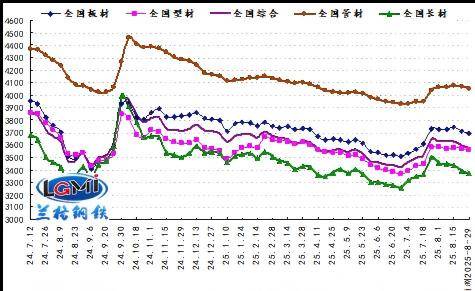
Group 1 - The core viewpoint of the article indicates that the domestic steel market is expected to experience fluctuations and potential weakness in the upcoming week due to various factors including external economic conditions, production limitations, and seasonal demand effects [4][5]. Group 2 - The Lange Steel National Absolute Price Index for the week of August 18-22, 2025, is reported at 3593 yuan, reflecting a decrease of 0.9% from the previous week and an increase of 2.9% year-on-year [1]. - The Lange Steel Long Product Absolute Price Index is at 3388 yuan, down 1.3% week-on-week and up 1.1% year-on-year [1]. - The Lange Steel Profile Absolute Price Index stands at 3571 yuan, with a week-on-week decrease of 0.2% and a year-on-year increase of 1.1% [1]. - The Lange Steel Plate Absolute Price Index is recorded at 3708 yuan, showing a decrease of 0.9% from the previous week and an increase of 5.7% year-on-year [1]. - The Lange Steel Pipe Absolute Price Index is at 4067 yuan, down 0.2% week-on-week and down 0.4% year-on-year [1]. Group 3 - The black futures market shows a slight overall decline, with the main rebar contract closing at 3119 yuan, down 11 points for the day and 69 points from the previous Friday [4]. - The latest open interest for the main rebar contract is 1.41 million lots, with a daily reduction of 26,000 lots and a total reduction of 207,000 lots from the previous Friday [4]. - The steel market is experiencing weakened demand due to regional production restrictions and seasonal effects, leading to a noticeable decrease in market transactions [5].

黑色建材日报-20250825
Wu Kuang Qi Huo· 2025-08-25 00:58
1. Report Industry Investment Rating No information provided in the report regarding the industry investment rating. 2. Core Viewpoints - The overall demand for steel products is weak, with the inventory accumulation rate accelerating, and the steel mills' profit is gradually shrinking. If the demand fails to improve effectively, the price may continue to decline. Attention should be paid to the potential impact of safety inspections and environmental protection restrictions [3]. - For iron ore, although the supply pressure is not significant during the traditional shipping off - season, the contradiction between high hot metal production and weak terminal demand needs attention. The price is expected to fluctuate strongly in the short term [6]. - For ferrous alloys, the prices are affected by emotions in the short term. It is not recommended for speculative funds to participate excessively. Hedging funds can seize opportunities according to their own situations. The fundamental problems of over - supply in manganese silicon and silicon iron still exist [10][11]. - For industrial silicon and polysilicon, industrial silicon is expected to fluctuate strongly, and polysilicon will maintain a pattern of "weak reality, strong expectation" and high - volatility operation [16][17]. - For glass and soda ash, glass is expected to fluctuate weakly in the short term, and soda ash is expected to fluctuate. In the long term, the price center of soda ash may gradually rise, but the upward space is limited [19][20]. 3. Summary by Related Catalogs Steel - **Market Quotes**: The closing price of the rebar main contract was 3119 yuan/ton, down 2 yuan/ton (- 0.06%) from the previous trading day. The closing price of the hot - rolled coil main contract was 3361 yuan/ton, down 14 yuan/ton (- 0.41%) [2]. - **Fundamentals**: Rebar production decreased significantly this week, demand had a slight recovery but remained weak, and inventory continued to accumulate. For hot - rolled coils, demand continued to rise, production increased rapidly, and inventory had increased for six consecutive weeks [3]. Iron Ore - **Market Quotes**: The main contract (I2601) closed at 770.00 yuan/ton, with a change of - 0.32% (- 2.50). The weighted position was 82.93 million hands. The spot price of PB powder at Qingdao Port was 767 yuan/wet ton, with a basis of 44.71 yuan/ton and a basis rate of 5.49% [5]. - **Fundamentals**: Overseas iron ore shipments and arrivals both increased. The daily average hot - metal output was 2.4075 million tons, basically unchanged from the previous period. Port inventory continued to rise slightly, and steel mills' imported ore inventory decreased slightly [6]. Ferrous Alloys - **Market Quotes**: On August 22, the manganese silicon main contract (SM601) closed down 0.10%, and the silicon iron main contract (SF511) closed up 0.07% [8][9]. - **Fundamentals**: The over - supply pattern of manganese silicon remained unchanged, and production continued to rise. There was no obvious contradiction in the fundamentals of silicon iron, and the supply also showed a continuous recovery trend [11]. Industrial Silicon and Polysilicon - **Industrial Silicon** - **Market Quotes**: The closing price of the main contract (SI2511) was 8745 yuan/ton, up 1.27% (+ 110). The weighted contract position decreased by 5333 hands to 523742 hands [13]. - **Fundamentals**: The problems of over - capacity, high inventory, and insufficient effective demand remained. Production continued to rise, and the demand support for prices was limited [15][16]. - **Polysilicon** - **Market Quotes**: The closing price of the main contract (PS2511) was 51405 yuan/ton, down 0.24% (- 125). The weighted contract position decreased by 8014 hands to 327469 hands [16]. - **Fundamentals**: The production continued to increase, and the number of warehouse receipts increased rapidly. It maintained a pattern of "weak reality, strong expectation" [17]. Glass and Soda Ash - **Glass** - **Market Quotes**: The spot price in Shahe was 1147 yuan, and in Central China was 1060 yuan, both unchanged from the previous day [19]. - **Fundamentals**: Production remained high, inventory pressure increased slightly, and downstream real - estate demand did not improve significantly. It was expected to fluctuate weakly in the short term [19]. - **Soda Ash** - **Market Quotes**: The spot price was 1220 yuan, up 15 yuan from the previous day [20]. - **Fundamentals**: Supply decreased, inventory pressure increased, and downstream demand was difficult to improve quickly. It was expected to fluctuate in the short term, and the price center might gradually rise in the long term [20].
纯苯、苯乙烯日报:纯苯供需双增叠加油价反弹,苯乙烯弱势反弹待考-20250822
Tong Hui Qi Huo· 2025-08-22 07:57
Group 1: Report Industry Investment Rating - No relevant content provided Group 2: Core Views of the Report - The pure benzene market maintains a pattern of increasing supply and demand. The supply is driven by the stable operation of refineries and the recovery of hydrobenzene plants, while the demand shows a mixed performance. Overall, the short - term fundamentals have marginally improved, but the contradiction between high latent inventory and insufficient terminal demand remains [3]. - The styrene market rebounded with the cost in the short - term. However, the medium - term trend depends on the implementation of maintenance and the recovery of terminal demand. The supply is currently high, and the demand improvement is limited, but the situation may marginally ease in September [4]. Group 3: Summary of Each Section 1. Daily Market Summary (1) Fundamentals - **Price**: On August 21, the styrene main contract closed up 0.05% at 7289 yuan/ton with a basis of 26 (+36 yuan/ton), and the pure benzene main contract closed down 0.08% at 6200 yuan/ton [2]. - **Cost**: On August 21, Brent crude closed at 62.7 (+0.9 dollars/barrel), WTI at 66.8 (+1.1 dollars/barrel), and the spot price of East China pure benzene was 6110 yuan/ton (+5 yuan/ton) [2]. - **Inventory**: Styrene sample factory inventory was 20.3 tons (-0.3 tons, -1.1% MoM), Jiangsu port inventory was 16.2 tons (+1.3 tons, +8.5% MoM), and pure benzene port inventory was 14.4 tons (-0.2 tons, -1.1% MoM) [2]. - **Supply**: Styrene production may decrease in late August due to plant maintenance. Currently, the weekly output is 37.1 tons (+0.2 tons), and the plant capacity utilization rate is 78.5% (+0.3%) [2]. - **Demand**: The capacity utilization rates of downstream 3S vary. EPS is 61.0% (+2.9%), ABS is 71.1% (+0%), and PS is 57.5% (+1.1%), showing a continuous increase [2]. (2) Views - **Pure benzene**: The supply is relatively stable with some increase, and the demand shows a mixed trend. The cost is supported by the short - term oil price rebound, but the long - term oil price may face pressure. Overall, the short - term fundamentals improve, but problems remain [3]. - **Styrene**: It rebounded with the cost in the short - term. The supply is high, and the demand improvement is limited. In September, the supply may contract due to maintenance, and the demand may enter the peak season, which may ease the supply - demand contradiction [4]. 2. Industry Chain Data Monitoring - **Price**: The prices of styrene and pure benzene futures and spot, as well as related spreads, are presented, showing different trends of increase and decrease. For example, the styrene futures main contract increased by 0.05%, and the pure benzene futures main contract decreased by 0.08% [6]. - **Output and Inventory**: The output of styrene and pure benzene in China increased slightly, and the inventory situation varied. Styrene port inventory increased, while factory inventory and pure benzene port inventory decreased [7]. - **Capacity Utilization Rate**: The capacity utilization rates of styrene and its downstream products, as well as pure benzene downstream products, changed. Some increased, such as EPS and PS, while others decreased, such as aniline and caprolactam [8]. 3. Industry News - China's shale cracking raw material supply affects the cost of naphtha, and the import volume is expected to reach a record high in 2025 [9]. - The global diesel shortage supports refinery profits, having a structural impact on the crude oil and chemical chains [9]. - India plans to accelerate the expansion of petrochemical production to cope with China's leading position in the global petrochemical market [9]. 4. Industry Chain Data Charts - The report provides multiple charts showing the historical data of pure benzene and styrene prices, spreads, inventory, and capacity utilization rates, with data sources from iFinD and Steel Union data [14][21]
供给过剩格局不改,价格偏弱运行
Hua Tai Qi Huo· 2025-08-22 05:25
Group 1: Nickel Market Analysis - On August 21, 2025, the main contract of Shanghai nickel 2510 opened at 120,010 yuan/ton and closed at 119,830 yuan/ton, down 0.30% from the previous trading day, with a trading volume of 90,715 lots and an open interest of 102,385 lots [1]. - In the night session, the main contract of Shanghai nickel opened at 120,430 yuan/ton, then quickly rose to 121,080 yuan/ton, but then fell under pressure, reaching a minimum of 119,620 yuan/ton and finally closing at 120,060 yuan/ton, down 550 yuan/ton or 0.46%, with a trading volume of 77,982 lots. The daily session opened at 120,010 yuan/ton, fluctuated between 119,780 - 120,590 yuan/ton, and closed at 119,830 yuan/ton, down 360 yuan/ton or 0.30% from the previous settlement price, with an enlarged trading volume of 90,715 lots. The LME nickel price fell to 15,050 US dollars/ton during the daily session, intensifying the bearish sentiment in the domestic market [2]. - Jinchuan Group's sales price in the Shanghai market was 122,300 yuan/ton, up 100 yuan/ton from the previous trading day. The procurement enthusiasm of downstream enterprises slightly improved. The spot premiums of various refined nickel brands were basically stable. Jinchuan nickel's premium changed by 100 yuan/ton to 2,500 yuan/ton, imported nickel's premium changed by 50 yuan/ton to 400 yuan/ton, and nickel beans' premium was 2,450 yuan/ton. The previous trading day's Shanghai nickel warehouse receipts were 22,588 (29.0) tons, and LME nickel inventory was 209,598 (252) tons [3]. Strategy - The pattern of oversupply remains unchanged. The production capacity of nickel intermediate products continues to be released, and the price of the ore end is loosening. In the short term, the nickel price will mainly fluctuate and move closer to the cost below. The recommended strategy is mainly range - bound operation for single - side trading, and no operations for inter - period, cross - variety, spot - futures, and options trading [4]. Group 2: Stainless Steel Market Analysis - On August 21, 2025, the main contract of stainless steel 2510 opened at 12,830 yuan/ton and closed at 12,795 yuan/ton, with a trading volume of 99,736 lots and an open interest of 138,810 lots [4]. - In the night session, the main contract of stainless steel opened at 12,870 yuan/ton, rose to 12,895 yuan/ton, then fell under pressure, reaching a minimum of 12,765 yuan/ton and finally closing at 12,820 yuan/ton, down 105 yuan/ton or 0.81%, with a trading volume of 149,736 lots. The daily session opened at 12,830 yuan/ton, fluctuated between 12,785 - 12,860 yuan/ton, and closed at 12,795 yuan/ton, down 35 yuan/ton or 0.27% from the previous settlement price, with an enlarged trading volume of 99,736 lots. The spot market prices in Wuxi and Foshan were 13,050 yuan/ton, and the 304/2B premium was 330 - 530 yuan/ton. The ex - factory tax - included average price of high - nickel pig iron changed by 0.50 yuan/nickel point to 928.0 yuan/nickel point [4][5]. Strategy - Currently in the traditional off - season of consumption, demand is weak, and affected by macro news, it is expected that the stainless steel price will fluctuate weakly in a range in the near future. The recommended strategy is mainly range - bound operation for single - side trading, and no operations for inter - period, cross - variety, spot - futures, and options trading [6].
黑色建材日报-20250822
Wu Kuang Qi Huo· 2025-08-22 00:38
Report Summary 1. Industry Investment Rating No industry investment rating is provided in the report. 2. Core Viewpoints - The overall atmosphere in the commodity market was weak yesterday, and the prices of finished steel products continued to decline in a volatile manner. The demand for finished steel products is weak, the profits of steel mills are gradually shrinking, and the weakness of the futures market is becoming more prominent. If the demand cannot be effectively improved in the future, the prices may continue to decline. The raw material end is more resilient than the finished product end, and attention should be paid to the potential impact of safety inspections and environmental protection production restrictions [4]. - The prices of iron ore, manganese - silicon, and silicon - iron are affected by supply, demand, and policy sentiment. The short - term prices of iron ore may continue to adjust, and for manganese - silicon and silicon - iron, it is recommended that speculative funds wait and see, while hedging funds can seize hedging opportunities according to their own situations [7][10][11]. - The prices of industrial silicon are expected to fluctuate weakly, and the prices of polysilicon are expected to fluctuate widely. The prices of glass are expected to fluctuate weakly in the short term and follow macro - sentiment fluctuations in the long term. The prices of soda ash are expected to fluctuate in the short term and the price center may gradually rise in the long term, but the upward space is limited [16][17][19][20]. 3. Summary by Category Steel - **Futures Market**: The closing price of the rebar main contract was 3121 yuan/ton, down 11 yuan/ton (- 0.35%) from the previous trading day. The closing price of the hot - rolled coil main contract was 3375 yuan/ton, down 27 yuan/ton (- 0.79%) from the previous trading day [3]. - **Spot Market**: The rebar price in Tianjin was 3280 yuan/ton, unchanged from the previous day; the price in Shanghai was 3300 yuan/ton, up 10 yuan/ton. The hot - rolled coil price in Lecong was 3410 yuan/ton, down 10 yuan/ton; the price in Shanghai was 3420 yuan/ton, down 10 yuan/ton [3]. - **Fundamentals**: Rebar production decreased significantly this week, demand improved slightly but remained weak overall, and inventory continued to accumulate. For hot - rolled coils, demand continued to recover, production increased rapidly, and inventory increased for six consecutive weeks. The overall steel production is still at a high level, while the demand - side support is insufficient [4]. Iron Ore - **Futures Market**: The main contract of iron ore (I2601) closed at 772.50 yuan/ton, up 0.46% (+ 3.50), and the position increased by 11185 lots to 451,600 lots [6]. - **Spot Market**: The price of PB fines at Qingdao Port was 769 yuan/wet ton, with a basis of 44.42 yuan/ton and a basis rate of 5.44% [6]. - **Fundamentals**: The overseas iron ore shipments and arrivals both increased in the latest period. The daily average pig iron output was 240,750 tons, basically unchanged from last week. The port inventory continued to rise slightly, and the steel mill's imported ore inventory decreased slightly. The short - term upward increase of pig iron may be limited [7]. Manganese - Silicon and Silicon - Iron - **Futures Market**: On August 21, the main contract of manganese - silicon (SM601) closed slightly up 0.03% at 5838 yuan/ton. The main contract of silicon - iron (SF511) closed up 0.28% at 5638 yuan/ton [9][10]. - **Spot Market**: The spot price of 6517 manganese - silicon in Tianjin was 5700 yuan/ton, down 100 yuan/ton from the previous day. The spot price of 72 silicon - iron in Tianjin was 5830 yuan/ton, unchanged from the previous day [9][10]. - **Fundamentals**: The over - capacity pattern of manganese - silicon has not changed. The production of manganese - silicon has shown an upward trend recently, and the supply - side pressure remains. The demand for silicon - iron and the entire black sector may weaken marginally in the future [12]. Industrial Silicon and Polysilicon - **Industrial Silicon** - **Futures Market**: The main contract of industrial silicon (SI2511) closed at 8635 yuan/ton, up 2.92% (+ 245), and the position increased by 2630 lots to 529,075 lots [14]. - **Spot Market**: The price of 553 non - oxygen - blown industrial silicon in East China was 9050 yuan/ton, unchanged from the previous day, with a basis of 415 yuan/ton. The price of 421 was 9600 yuan/ton, unchanged from the previous day, with a basis of 165 yuan/ton [14]. - **Fundamentals**: The problems of over - capacity, high inventory, and insufficient demand have not fundamentally changed. The production is expected to increase in August, and the demand can provide some support, but the prices are expected to fluctuate weakly [15][16]. - **Polysilicon** - **Futures Market**: The main contract of polysilicon (PS2511) closed at 51,530 yuan/ton, down 0.67% (- 345), and the position decreased by 1672 lots to 335,483 lots [16]. - **Spot Market**: The average price of N - type granular silicon was 46 yuan/kg, up 1.5 yuan/kg; the average price of N - type dense material was 48 yuan/kg, up 2 yuan/kg; the average price of N - type re - feeding material was 49 yuan/kg, up 2 yuan/kg, with a basis of - 2530 yuan/ton [16]. - **Fundamentals**: The production increased week - on - week, and the inventory reduction was limited. The prices are expected to fluctuate widely [17]. Glass and Soda Ash - **Glass** - **Spot Market**: The spot price in Shahe was 1147 yuan, down 9 yuan from the previous day, and the price in Central China was 1060 yuan, unchanged from the previous day. The total inventory of national float glass sample enterprises was 63.606 million weight boxes, up 0.28% from the previous week [19]. - **Fundamentals**: The glass production remains at a high level, the inventory pressure has increased slightly, and the downstream real - estate demand has not improved significantly. The prices are expected to fluctuate weakly in the short term and follow macro - sentiment fluctuations in the long term [19]. - **Soda Ash** - **Spot Market**: The spot price was 1205 yuan, unchanged from the previous day. The total inventory of domestic soda ash manufacturers was 1.9108 million tons, up 0.71% from last Thursday [20]. - **Fundamentals**: The downstream demand has little fluctuation, and the production of soda ash devices fluctuates slightly. The prices are expected to fluctuate in the short term, and the price center may gradually rise in the long term, but the upward space is limited [20].
基本面支撑下PTA反弹或延续
Qi Huo Ri Bao· 2025-08-21 23:27
Core Viewpoint - The PTA industry is experiencing tight supply and low processing fees, with expectations for a price rebound due to cost support and supply-demand improvements [1][5]. Group 1: PTA Production and Supply - As of early August, domestic PTA processing fees dropped to a historical low of 126 CNY/ton, recently recovering to around 200 CNY/ton, but still low [2]. - The production cost of PTA is approximately 4500 CNY/ton, with companies facing a loss of about 265 CNY/ton [2]. - Domestic PTA production enterprises have shown some operational resilience, with several plants undergoing maintenance and restarts, leading to a slight increase in operating rates [2]. - As of August 20, the operating load of domestic PTA production enterprises was 78.62%, down 4.47 percentage points year-on-year, with a production volume of around 1.38 million tons and a demand of approximately 1.42 million tons, resulting in a supply gap of about 35,000 tons [2]. Group 2: PTA Inventory and Market Conditions - Due to the supply gap, domestic PTA inventory is declining, with social inventory at 3.6952 million tons as of August 15, down 36,300 tons week-on-week and 0.97% lower year-on-year [3]. - Factory inventory of PTA is at 3.66 days, down 0.16 days year-on-year, while polyester factory PTA raw material inventory is at 7.15 days, down 1.06 days year-on-year [3]. Group 3: Polyester Industry and Demand - The polyester industry is currently in a loss state, but conditions have improved, particularly for polyester filament, which has moved from a loss of 200-300 CNY/ton to a near breakeven point [4]. - As of August 20, the operating load of the domestic polyester industry was 86.46%, down 2.83 percentage points year-on-year, with expectations for a slight increase in operating rates due to recent improvements [4]. - Polyester long filament inventory remains high, with significant de-stocking pressure; however, recent price reductions by some polyester companies have led to a decrease in inventory levels [4]. Group 4: Overall Market Outlook - Overall, the PTA supply is tight, production companies are facing increased losses, and there is a demand for price rebound. The processing fees are low and need to be repaired, while the supply side shows lower operating loads and declining inventories, indicating a potential for price rebound supported by costs [5].
总体看短线供需面尚可 PTA期货盘面表现偏强
Jin Tou Wang· 2025-08-21 06:09
Group 1 - The core viewpoint indicates that PTA futures are showing a strong performance, with the main contract reaching 4844.00 yuan/ton, reflecting a 2.15% increase [1] - As of August 20, 2025, the average processing range for PTA in China is 189.6 yuan/ton, with a month-on-month decrease of 1.91% and a year-on-year decrease of 44.24% [2] - The social inventory of PTA has a usable days count of 10.81 days, with a slight decrease of 0.19 days, while the factory inventory has 3.66 days available [2] Group 2 - According to Dongwu Futures, the supply of PX is limited due to ongoing maintenance, which provides some cost support for PTA, but this is not enough to fully offset the downward pressure from crude oil [3] - Helen's new capacity is running stably, and the overall supply of PTA is expected to maintain a growth trend, despite weak price increases for polyester products [3] - Hualian Futures notes that while the supply side saw a slight increase in production, the demand side remains stable with a modest recovery in terminal weaving rates, indicating a weak recovery trend [3]
LPG:近月挤仓风险仍在,丙烯:成本支撑偏弱
Guo Tai Jun An Qi Huo· 2025-08-20 02:10
Report Summary 1. Report Title and Date - The report is titled "LPG: Near-term Squeeze Risk Still Exists" and was published on August 20, 2025 [1]. 2. Analysts and Contact Information - Chen Xinchao, with investment consulting qualification number Z0020238, is the main analyst, and his email is chenxinchao@gtht.com. Zhao Shucen, with futures qualification number F03147780, is the contact person, and his email is zhaoshucen@gtht.com [2]. 3. Core Viewpoints - The near - term squeeze risk for LPG still exists, and the cost support for propylene is weak [1][2]. 4. Fundamental Data 4.1 Futures Prices | Contract | Yesterday's Closing Price | Daily Increase | Night - session Closing Price | Night - session Increase | | --- | --- | --- | --- | --- | | PG2509 | 3,851 | - 0.26% | 3,843 | - 0.21% | | PG2510 | 4,319 | - 0.30% | 4,277 | - 0.97% | | PL2601 | 6,451 | - 0.63% | 6,378 | - 1.13% | | PL2602 | 6,500 | - 0.38% | 6,433 | - 1.03% | [2] 4.2 Trading Volume and Open Interest | Contract | Yesterday's Trading Volume | Change from Previous Day | Yesterday's Open Interest | Change from Previous Day | | --- | --- | --- | --- | --- | | PG2509 | 66,824 | - 9147 | 64,241 | - 9558 | | PG2510 | 45,607 | - 1640 | 98,096 | 615 | | PL2601 | 1,369 | 580 | 4,036 | - 96 | | PL2602 | 13 | 6 | 857 | - 2 | [2] 4.3 Price Spreads | Spread Type | Yesterday's Spread | Previous Day's Spread | | --- | --- | --- | | Guangzhou domestic gas to PG09 contract spread | 599 | 569 | | Guangzhou imported gas to PG09 contract spread | 679 | 639 | | Shandong propylene to PL01 contract spread | - 41 | - 67 | | East China propylene to PL01 contract spread | - 26 | - 67 | | South China propylene to PL01 contract spread | - 76 | - 117 | [2] 4.4 Key Industrial Chain Data | Data Type | This Week | Last Week | | --- | --- | --- | | PDH operating rate | 76.3% | 73.8% | | MTBE operating rate | 63.4% | 66.6% | | Alkylation operating rate | 49.0% | 50.0% | [2] 5. Trend Intensity - LPG trend intensity is 0, and propylene trend intensity is 0. The range of trend intensity is an integer in the [- 2,2] interval, with - 2 being the most bearish and 2 being the most bullish [6]. 6. Market Information 6.1 Saudi CP Expectations - On August 18, 2025, the September Saudi CP expectation for propane was 517 dollars/ton, down 2 dollars/ton from the previous trading day; for butane, it was 487 dollars/ton, also down 2 dollars/ton. The October Saudi CP expectation for propane was 532 dollars/ton, unchanged from the previous trading day; for butane, it was 502 dollars/ton, also unchanged [7]. 6.2 Domestic PDH Device Maintenance Plans - Multiple domestic enterprises have PDH device maintenance plans, including Henan Huasong New Material Technology Co., Ltd., Jiangsu Yanchang Zhongran Chemical Co., Ltd., etc., with different start and end dates [8]. 6.3 Domestic LPG Factory Device Maintenance Plans - Many domestic LPG factories have device maintenance plans, such as Shengli Oilfield in Shandong, Zhenghua Petrochemical in Shandong, etc., with different start and end dates and production losses [8].