
成本支撑

Search documents
五矿期货能源化工日报-20250808
Wu Kuang Qi Huo· 2025-08-08 00:34
Report's Industry Investment Rating No relevant information provided. Core Viewpoints of the Report - The current fundamental market of crude oil is healthy. With low inventories in Cushing, combined with hurricane expectations and Russia - related events, crude oil has upward momentum. However, the seasonal demand decline in mid - August will limit its upside, and a short - term target price of WTI at $70.4/barrel is given. It is recommended to go long at low prices and take profits, and to position for the Russian geopolitical expectations in September and the hurricane - induced supply disruption season when oil prices drop significantly [2]. - Methanol's valuation is still high, downstream demand is weak, and prices face pressure. It can be considered as a short - position variety within the sector [4]. - Urea's overall valuation is low, and the room for further decline is limited. It is advisable to pay attention to going long at low prices and wait for potential positive factors [6]. - For natural rubber, after a significant decline, the price rebounds. A neutral - to - bullish short - term trading strategy with quick entry and exit is recommended, and a long - short spread trading between RU2601 and RU2509 can be considered [10]. - PVC has a poor fundamental situation with strong supply, weak demand, and high valuation. It is recommended to wait and see [10]. - For benzene - ethylene, the BZN spread is expected to repair, and after the high - level port inventory is reduced, the price may follow the cost side to fluctuate upward [13]. - For polyethylene, the price in the short - term will be determined by the game between the cost side and the supply side. It is recommended to hold short positions [15]. - For polypropylene, the cost side will dominate the market, and the price in July is expected to fluctuate strongly following crude oil [16]. - For PX, it is recommended to pay attention to short - term long - position opportunities following crude oil at low prices [19]. - For PTA, it is recommended to pay attention to long - position opportunities following PX at low prices [20]. - For ethylene glycol, the short - term valuation has a downward pressure [21]. Summary by Related Catalogs Crude Oil - **Market Quotes**: WTI main crude oil futures closed down $0.45, a 0.70% decline, at $63.82; Brent main crude oil futures closed down $0.55, an 0.82% decline, at $66.41; INE main crude oil futures closed down 4.90 yuan, a 0.97% decline, at 501 yuan [1]. - **Data**: Singapore ESG weekly oil product data showed that gasoline inventories increased by 0.26 million barrels to 13.01 million barrels, a 2.02% increase; diesel inventories increased by 0.22 million barrels to 8.67 million barrels, a 2.54% increase; fuel oil inventories increased by 1.65 million barrels to 26.32 million barrels, a 6.69% increase; total refined oil inventories increased by 2.12 million barrels to 48.00 million barrels, a 4.63% increase [1]. Methanol - **Market Quotes**: On August 7, the 09 contract fell 8 yuan/ton to 2388 yuan/ton, and the spot price fell 6 yuan/ton, with a basis of - 6 [4]. - **Analysis**: Domestic methanol production resumed its decline this week, but corporate profits remained high. Future supply is likely to increase marginally. Port inventories are increasing faster due to faster unloading and shutdown of port MTO units. Inland inventories are decreasing due to olefin procurement, with relatively low pressure [4]. Urea - **Market Quotes**: On August 7, the 09 contract fell 13 yuan/ton to 1737 yuan/ton, and the spot price remained unchanged, with a basis of + 42 [6]. - **Analysis**: Domestic urea production continued to decline, and corporate profits were still at a low level but are expected to bottom out and rebound. Overall supply is relatively abundant. Domestic agricultural demand is ending, and subsequent demand will mainly come from compound fertilizers and exports. Current domestic demand is weak, and inventory reduction is slow [6]. Rubber - **Market Quotes**: NR and RU rebounded and then fluctuated [8]. - **Analysis**: Bulls believe that weather and rubber forest conditions in Southeast Asia, especially Thailand, may lead to rubber production cuts, and the price usually turns upward in the second half of the year. Bears think that macro - expectations are uncertain, demand is in the seasonal off - season, and the production cut may be less than expected. As of August 7, 2025, the operating rate of all - steel tires in Shandong was 60.98%, down 0.08 percentage points from last week but up 8.72 percentage points from the same period last year. The operating rate of semi - steel tires was 74.53%, down 0.10 percentage points from last week and 4.21 percentage points from the same period last year. Semi - steel tire factories have inventory pressure [9]. PVC - **Market Quotes**: The PVC09 contract fell 5 yuan to 5046 yuan, the spot price of Changzhou SG - 5 was 4910 (- 10) yuan/ton, the basis was - 136 (- 5) yuan/ton, and the 9 - 1 spread was - 126 (+ 12) yuan/ton [10]. - **Analysis**: The cost of calcium carbide increased, the overall operating rate of PVC was 76.8%, up 0.05%. The downstream operating rate was 42.1%, up 0.2%. Factory inventories were 34.5 (+ 1.2) million tons, and social inventories were 72.2 (+ 3.9) million tons. The overall situation is strong supply, weak demand, and high valuation. It is necessary to observe whether exports can reverse the domestic inventory accumulation pattern [10]. Benzene - Ethylene - **Market Quotes**: Spot and futures prices of benzene - ethylene rose, and the basis strengthened [12]. - **Analysis**: The macro - market sentiment is good, and there is still support on the cost side. The BZN spread is at a relatively low level compared to the same period, with a large upward repair space. The supply of pure benzene is still abundant, and the operating rate of benzene - ethylene continues to rise. Port inventories are decreasing significantly, and the short - term BZN spread is expected to repair [12][13]. Polyethylene - **Market Quotes**: The futures price of polyethylene fell [15]. - **Analysis**: The market is expecting favorable policies from the Chinese Ministry of Finance in the third quarter, and there is still cost support. The spot price remained unchanged, and the valuation has limited downward space. Trade inventories are at a high level and have a weak supporting effect on prices. In August, there is a large planned production capacity release. It is recommended to hold short positions [15]. Polypropylene - **Market Quotes**: The futures price of polypropylene fell [16]. - **Analysis**: The profit of Shandong refineries stopped falling and rebounded, and the operating rate is expected to gradually recover. The downstream operating rate is seasonally declining. In August, there is only a small planned production capacity release. Under the background of weak supply and demand, the cost side will dominate the market, and the price in July is expected to fluctuate strongly following crude oil [16]. PX - **Market Quotes**: The PX09 contract fell 38 yuan to 6756 yuan, and PX CFR fell 4 dollars to 840 dollars. The basis was 152 (- 1) yuan, and the 9 - 1 spread was 46 (- 4) yuan [18]. - **Analysis**: PX operating rates in China and Asia increased. Some PTA units had short - term maintenance, but PTA inventories are low, and the negative feedback pressure on PX is small. New PTA units are being put into production, and PX is expected to continue to reduce inventories. The current valuation is at a neutral level [18][19]. PTA - **Market Quotes**: The PTA09 contract fell 36 yuan to 4688 yuan, the East China spot price rose 20 yuan to 4690 yuan, the basis was - 20 (+ 1) yuan, and the 9 - 1 spread was - 38 (- 8) yuan [20]. - **Analysis**: The PTA operating rate increased. Downstream operating rates also increased slightly. Supply is expected to increase due to new unit launches, but demand from the polyester and terminal sectors is about to end the off - season. The inventory level is low, and the negative feedback pressure is small [20]. Ethylene Glycol - **Market Quotes**: The EG09 contract fell 18 yuan to 4396 yuan, the East China spot price fell 5 yuan to 4486 yuan, the basis was 73 (- 7) yuan, and the 9 - 1 spread was - 34 (- 13) yuan [21]. - **Analysis**: The production of ethylene glycol decreased slightly. Downstream operating rates increased slightly. Import arrivals are expected to increase, and port inventories are expected to gradually increase. The current valuation is relatively high compared to the same period, and the fundamentals are expected to weaken [21].
广发期货日评-20250807
Guang Fa Qi Huo· 2025-08-07 07:03
Report Summary 1. Report Industry Investment Ratings No specific overall industry investment ratings are provided in the report. However, specific investment suggestions are given for each variety: - **Buy Suggestions**: Index futures (sell far - month contracts), Treasury bonds (buy on dips), Precious metals (low - buying for silver, hold gold long - positions), Iron ore (buy on dips), Coking coal (buy on dips, 9 - 1 calendar spread), Coke (buy on dips, 9 - 1 calendar spread), Copper (hold), Aluminum (range - trading), Zinc (range - trading), Nickel (range - trading), Urea (buy on dips, quick profit - taking), PTA (range - trading, TA1 - 5 reverse spread, expand processing margin), PP (range - trading, stop - loss for previous short - positions), Maize (long - position for 01 contract), Industrial silicon (hold call options), Polysilicon (hold call options) [2] - **Sell Suggestions**: Gold (sell put options below 760 yuan), Steel (sell on rallies), Container shipping index (sell on rallies), Alumina (range - trading), Crude oil (wait for geopolitical clarity), Caustic soda (hold short - positions), PVC (stop - loss for short - positions), Pure benzene (observe or short - term long), Styrene (range - trading), Synthetic rubber (observe), LLDPE (short - term long), Cotton (reduce near - month short - positions, hold 01 short - positions), Eggs (long - term short), Apples (observe around 7800), Glass (hold short - positions), Carbonate lithium (observe cautiously) [2] 2. Core Views - **Market Environment**: The second round of China - US trade talks extended tariff exemption clauses, and the Politburo meeting's policy tone was consistent with the previous one, causing short - term market expectation differences. The policy negatives were exhausted in early August, and the capital market became looser [2]. - **Market Trends**: Index futures continued to rise, TMT regained popularity; Treasury bonds were expected to oscillate upward; Precious metals' upward trend slowed down; The container shipping index was expected to be weak; Steel and iron ore prices fluctuated; Non - ferrous metals were supported by fundamentals; Energy and chemical products showed different trends; Agricultural products were affected by factors such as production expectations and inventory; Special and new energy products had their own characteristics in price movements [2]. 3. Summary by Variety **Financial** - **Index Futures**: Continued to rise, with TMT heating up again. Recommended selling far - month contracts and shorting MO put options with strike prices of 6300 - 6400, with a mild bullish view [2]. - **Treasury Bonds**: With policy negatives exhausted and loose funds, they were expected to oscillate upward. Suggested buying on dips and paying attention to July economic data [2]. - **Precious Metals**: Gold's upward trend slowed down, and silver was affected by market sentiment. Gold long - positions were held above 3300 dollars (770 yuan), and silver was bought at low levels around 36 - 37 dollars (8700 - 9000 yuan) [2]. **Industrial** - **Container Shipping Index (EC)**: Expected to be weakly oscillating, with a strategy of selling on rallies [2]. - **Steel and Iron Ore**: Steel turned to oscillation, and iron ore followed steel price fluctuations. Suggested buying on dips for iron ore and using a long - coking coal and short - iron ore strategy [2]. - **Non - ferrous Metals**: Copper was supported by fundamentals, and the price range was 77000 - 79000; Aluminum was oscillating, and the range was 20000 - 21000; Zinc was oscillating in a narrow range, and the range was 22000 - 23000; Nickel was oscillating strongly, and the range was 118000 - 126000 [2]. **Energy and Chemical** - **Crude Oil**: Weakly oscillating, with a strategy of waiting for geopolitical clarity. Support levels were [63, 64] for WTI, [66, 67] for Brent, and [490, 500] for SC [2]. - **Urea**: There was a game between export drive and weak domestic consumption. The short - term strategy was to buy on dips and take quick profits, and exit long - positions if the price did not break through 1770 - 1780 [2]. - **PTA**: With low processing fees and limited cost support, it was expected to oscillate in the range of 4600 - 4800. TA1 - 5 was treated with a reverse spread, and the processing margin was expanded at a low level (around 250) [2]. **Agricultural** - **Soybean Meal and Maize**: Maize was oscillating weakly, and the 01 contract of soybean meal was held long due to import concerns [2]. - **Palm Oil**: The price pulled back due to expected inventory increases. Observed whether P09 could stand firm at 9000 [2]. - **Cotton**: The downstream market was weak. Near - month short - positions were reduced, and 01 short - positions were held [2]. **Special and New Energy** - **Glass**: The spot sales weakened, and the contract was held short [2]. - **Industrial Silicon and Polysilicon**: Both were oscillating upward, and call options were held [2]. - **Carbonate Lithium**: The price was pulled up by news, but there were uncertainties in the mining end. It was mainly observed cautiously [2].
夜盘价格有所回落,焦煤大幅上涨还能支撑玻璃走多远?
Jin Shi Shu Ju· 2025-08-06 16:52
Core Viewpoint - The domestic glass market continues to show weakness, with price adjustments observed in various regions due to supply and demand dynamics, particularly influenced by the real estate sector's ongoing downturn [1] Supply and Demand Dynamics - In the Hebei region, some manufacturers have lowered prices by 1-1.5 yuan per weight box, while in South China, prices decreased by 1 yuan per weight box due to slow sales caused by heavy rain [1] - The current market is transitioning from expectation-driven to a focus on actual supply and demand fundamentals, with supply pressures increasing despite seasonal maintenance leading to some supply contraction [1] - As of July 31, 2025, the national float glass daily production reached 159,600 tons, a slight increase of 180 tons year-on-year, with total production in July at 4.91 million tons, reflecting a month-on-month growth of 4.72% and a capacity utilization rate of 79.20% [1] Impact of Real Estate Sector - The persistent downturn in the real estate sector is a key factor suppressing glass demand, with the area of completed constructions declining by 5.0% year-on-year, leading to weak growth in rigid demand for glass [1] - The current real estate situation remains bleak, with downstream processing orders showing only a slight increase, primarily driven by essential needs [1] - The average order days for float glass processing enterprises is only 9.55 days, indicating a continued low operating status [1] Inventory and Supply Chain Issues - Although glass production enterprise inventory decreased by 1.56 million weight boxes to 51.78 million weight boxes last week, significant inventory pressure remains [1] - The completion of a round of stocking in mid to late July is expected to slow down purchasing in August, with processing enterprises showing reduced willingness to accept orders due to compressed profits [1] - The market is constrained by weak spot demand and ineffective inventory transfer to downstream sectors, making it difficult for apparent inventory reductions to translate into substantial price support [1] Cost Support Factors - Rising coal and raw material prices are currently the main supportive factors for market costs, providing a bottom support for prices [1] - While the price of soda ash is steadily rising, its impact on glass production costs is limited [1] - There is a notable profit disparity among glass enterprises based on fuel types, with those using natural gas facing significant losses, while coal gas enterprises enjoy relatively better profits, complicating unified production reduction efforts [1] Market Outlook - Most institutions maintain a cautious outlook for the short-term market, with recommendations to consider low-positioned long positions while being mindful of operational risks [1] - The forecast indicates that the supply increase and weak demand in the float glass market will persist in August, with prominent inventory pressures and limited price upward movement, necessitating vigilance regarding potential price-cutting strategies for inventory clearance [1] - The focus should remain on the speed of inventory digestion and potential policy stimulus until there is a substantial improvement in demand [1]
五矿期货能源化工日报-20250805
Wu Kuang Qi Huo· 2025-08-05 00:59
Report Industry Investment Rating No relevant content provided. Core Viewpoints of the Report - The current fundamental market of crude oil is healthy. With low inventories in Cushing, combined with hurricane expectations and Russia - related events, crude oil has upward momentum. However, the seasonal demand decline in mid - August will limit its upside. A short - term target price of $70.4/barrel for WTI is given, suggesting short - term long positions and profit - taking on dips, and left - side trading for Russia's geopolitical expectations in September and the hurricane supply - disruption season when oil prices drop significantly [2]. - Methanol is currently over - valued, with supply pressure increasing as enterprise profits are high and production starts to recover, while demand is weak due to port olefin shutdowns and the traditional off - season. High inventory and weakening supply - demand fundamentals put pressure on prices [4]. - Urea is in a low - valuation and weak - supply - demand pattern. Although the current price is not high and the room for further decline is limited, it is not advisable to be overly bearish. After the cooling of the domestic commodity sentiment, volatility is expected to gradually decline [6]. - For rubber, there are different views from bulls and bears. Bulls focus on potential production cuts in Southeast Asia, seasonal price increases in the second half of the year, and improved demand expectations in China, while bears are concerned about uncertain macro - expectations, seasonal off - season demand, and potential under - performance of production cuts. It is recommended to adopt a neutral approach and trade quickly in the short - term [8][10]. - PVC has a poor fundamental situation with strong supply, weak demand, and high valuations. It is necessary to observe whether exports can reverse the domestic inventory build - up situation. After the anti - involution sentiment fades, prices have dropped significantly in the short - term [10]. - For benzene styrene, the BZN spread is expected to repair, and after the high - level port inventory is reduced, the price is expected to follow the cost side and oscillate upwards [13]. - Polyethylene prices will be determined by the game between the cost side and the supply side in the short - term, with high production capacity release pressure in August. It is recommended to hold short positions [15]. - Polypropylene prices are expected to follow crude oil and oscillate higher in July, with the cost side likely to dominate the market under the background of weak supply and demand in the seasonal off - season [16]. - PX is expected to continue de - stocking. With a neutral valuation, there are short - term opportunities to go long on dips following crude oil [19]. - PTA is expected to continue to accumulate inventory, but due to low inventory levels and the approaching end of the off - season for polyester and terminal production, the negative feedback pressure on PX is small. There are opportunities to go long on dips following PX [20]. - Ethylene glycol's fundamentals are expected to weaken from strong. With high overseas device loads and expected increases in arrivals, there is short - term pressure on valuation decline [21]. Summary by Related Catalogs Crude Oil - **Price:** WTI main crude oil futures fell $1.02, or 1.52%, to $66.24; Brent main crude oil futures fell $0.84, or 1.21%, to $68.68; INE main crude oil futures fell 13.60 yuan, or 2.58%, to 514.3 yuan [1]. - **Data:** China's weekly crude oil data showed that crude oil arrival inventory increased by 1.37 million barrels to 207.19 million barrels, a 0.67% increase; gasoline commercial inventory decreased by 1.07 million barrels to 90.85 million barrels, a 1.17% decrease; diesel commercial inventory increased by 0.72 million barrels to 102.78 million barrels, a 0.70% increase; total refined oil commercial inventory decreased by 0.36 million barrels to 193.64 million barrels, a 0.18% decrease [1]. Methanol - **Price:** On August 4, the 09 contract fell 3 yuan/ton to 2390 yuan/ton, and the spot price fell 15 yuan/ton, with a basis of - 20 [4]. - **Fundamentals:** Affected by overall commodity sentiment, it will gradually return to its own fundamentals. Supply pressure will increase as enterprise profits are high and production starts to recover. Demand is weak due to port olefin shutdowns and the traditional off - season. Port inventory is increasing rapidly, and the basis and inter - month spread are falling [4]. Urea - **Price:** On August 4, the 09 contract rose 24 yuan/ton to 1733 yuan/ton, and the spot price remained unchanged, with a basis of + 17 [6]. - **Fundamentals:** Supply is slightly decreasing but still at a relatively high level year - on - year. Enterprise profits are poor, and production is expected to increase gradually. Export demand is lower than expected, and domestic agricultural demand is entering the off - season. Compound fertilizer production for autumn is starting, and enterprise inventories are increasing [6]. Rubber - **Price:** NR and RU rebounded after a decline [8]. - **Fundamentals:** Bulls and bears have different views. Bulls expect production cuts and improved demand, while bears are concerned about uncertain macro - expectations and seasonal off - season demand. Tire factory operating rates are decreasing, and natural rubber inventories are increasing [8][9]. - **Operation Suggestion:** Adopt a neutral approach and trade quickly in the short - term. Consider long positions in RU2601 and short positions in RU2509 for opportunistic band trading [10]. PVC - **Price:** The PVC09 contract fell 34 yuan to 4981 yuan, the Changzhou SG - 5 spot price was 4960 (+40) yuan/ton, the basis was - 121 (- 26) yuan/ton, and the 9 - 1 spread was - 137 (- 1) yuan/ton [10]. - **Fundamentals:** Cost is stable, overall production capacity utilization is 76.8%, with an increase of 0.05%. Downstream demand is weak, and inventories are increasing. Enterprises' comprehensive profits are at a high level, and valuations are under pressure [10]. Benzene Styrene - **Price:** The spot price remained unchanged, the futures price fell, and the basis strengthened [12]. - **Fundamentals:** The BZN spread is at a relatively low level and has room for upward repair. Cost support exists, supply is increasing, port inventory is decreasing significantly, and demand is oscillating upwards in the off - season [12][13]. Polyethylene - **Price:** The futures price fell [15]. - **Fundamentals:** Market expects an improvement in China's PMI in July, and cost support exists. Spot prices are falling, and inventory pressure is loosening. Demand is weak in the off - season, and there is high production capacity release pressure in August [15]. - **Operation Suggestion:** Hold short positions [15]. Polypropylene - **Price:** The futures price fell [16]. - **Fundamentals:** Shandong refinery profits are rebounding, and production capacity utilization is expected to increase. Demand is weak in the off - season, and cost is likely to dominate the market. There is limited planned production capacity release in August [16]. PX - **Price:** The PX09 contract fell 58 yuan to 6754 yuan, PX CFR fell 8 dollars to 838 dollars, the basis was 142 (- 18) yuan, and the 9 - 1 spread was 26 (+4) yuan [18]. - **Fundamentals:** PX production capacity utilization is high, downstream PTA short - term maintenance is increasing, and overall production capacity utilization is decreasing, but PTA inventory is low, and polyester and terminal production are approaching the end of the off - season. PX is expected to continue de - stocking [18][19]. PTA - **Price:** The PTA09 contract fell 46 yuan to 4698 yuan, the East China spot price fell 60 yuan to 4690 yuan, the basis was - 15 (- 2) yuan, and the 9 - 1 spread was - 34 (+4) yuan [20]. - **Fundamentals:** PTA production capacity utilization is decreasing, and new devices are being put into operation. Supply is expected to increase, but due to low inventory levels and the approaching end of the off - season, the negative feedback pressure on PX is small [20]. Ethylene Glycol - **Price:** The EG09 contract fell 16 yuan to 4389 yuan, the East China spot price fell 25 yuan to 4455 yuan, the basis was 78 (+5) yuan, and the 9 - 1 spread was - 28 (+6) yuan [21]. - **Fundamentals:** Production capacity utilization is slightly decreasing, overseas device loads are high, and arrivals are expected to increase. Downstream demand is gradually recovering from the off - season, but inventory de - stocking is expected to slow down, and valuations are under pressure [21].
钢材期货周度报告:宏观预期降温,关注限产扰动-20250804
Ning Zheng Qi Huo· 2025-08-04 10:25
Report Overview - Report Title: Steel Futures Weekly Report (August 04, 2025) [1] - Report Author: Cong Yanfei [2] - Report Publisher: Ningzheng Futures Investment Consulting Center [2] 1. Industry Investment Rating - No investment rating for the industry is provided in the report. 2. Core Viewpoints - This week, steel prices fluctuated and declined, with the average national rebar price dropping by 75 yuan/ton week-on-week. The macro positive expectations faded, and demand continued to decline seasonally. The market sentiment shifted from strong expectations to weak reality. However, raw materials still provided some bottom support, and the market sentiment was lukewarm. [2][4] - Next week, high temperatures, heavy rainfall, and typhoon weather will continue to suppress construction progress, and the actual terminal demand is expected to weaken further. However, the special bonds in July did not meet the plan, and infrastructure investment may have some support in August. [2][4] - The steel market fundamentals show a pattern of weak supply and demand. It is currently the off - season for consumption, inventory is starting to accumulate, and market sales pressure has increased. [9] - In the short term, steel prices are expected to fluctuate weakly. The steel fundamentals show some contradictions but still have cost support. [26] 3. Summary by Directory 3.1 This Week's Market Review - Steel prices fluctuated and declined this week, with the average national rebar price dropping by 75 yuan/ton week - on - week. The macro positive expectations faded, and demand continued to decline seasonally. The market sentiment shifted from strong expectations to weak reality. Raw materials provided some bottom support, and the market sentiment was lukewarm. [2][4] - Next week, adverse weather will suppress construction progress, and terminal demand is expected to weaken further. However, infrastructure investment may have some support in August due to the unfulfilled special bond plan in July. [2][4] 3.2 Macro and Industry News - The central government emphasizes continuous and timely efforts in macro - policies in the second half of the year, focusing on expanding domestic demand, boosting consumption, and promoting economic circulation. [6] - The 20th Fourth Plenary Session will be held in October to study the suggestions for formulating the 15th Five - Year Plan for National Economic and Social Development. [6] - China and the US held a new round of economic and trade talks, and both sides agreed to extend the suspension of some reciprocal tariffs and counter - measures for 90 days. [6] - From January to June 2025, the total profit of industrial enterprises above the national scale was 3436.5 billion yuan, a year - on - year decrease of 1.8%. The profit of the ferrous metal smelting and rolling processing industry increased 13.7 times year - on - year. [6] - In July 2025, China's manufacturing PMI was 49.3%, a seasonal decline of 0.4 percentage points month - on - month. The non - manufacturing and composite PMI output indices were 50.1% and 50.2% respectively, down 0.4 and 0.5 percentage points from the previous month. [7] - In June 2025, China's steel exports were 967800 tons, a month - on - month decrease of 8.5%, the first month - on - month decline since March. The export average price was 687.1 US dollars/ton, a slight month - on - month decrease of 1.6%. From January to June, the cumulative steel exports were 58.147 million tons, a year - on - year increase of 8.9%, and the export average price was 699.3 US dollars/ton, a year - on - year decrease of 10.2%. In June, China's steel imports were 47000 tons, a month - on - month decrease of 2.4%, and the import average price was 1712.5 US dollars/ton, a month - on - month decrease of 2.1%. From January to June, the cumulative steel imports were 3.023 million tons, a year - on - year decrease of 16.4%, and the import average price was 1686.4 US dollars/ton, a year - on - year increase of 2.2%. [7] 3.3 Fundamental Analysis - According to Mysteel's survey of 237 mainstream traders, the average daily trading volume of building materials from Monday to Friday this week was 94100 tons, lower than last week's 114700 tons. The fundamentals maintain a pattern of weak supply and demand. It is currently the consumption off - season, inventory is starting to accumulate, and market sales pressure has increased. [9] 3.4 Market Outlook and Investment Strategies - Supply: Steel mills' overall profits are acceptable, and their production willingness has not significantly decreased. It is expected that production will continue to increase. [26] - Demand: The demand contradiction in the off - season is gradually emerging, consumption has declined month - on - month, and consumption sustainability is weak. [26] - Cost: The fourth round of coke price increase has been implemented, and the fifth round has started. The game between coke and steel mills has intensified, and cost support still exists. [26] - Overall: The steel fundamentals show some contradictions but still have cost support. It is expected that steel prices will fluctuate weakly in the short term. [26] - Investment Strategies: For single - sided trading, focus on range operations; for inter - period arbitrage, adopt a wait - and - see approach; for the coil - rebar spread, wait and see; for steel profits, wait and see; for options, use a wide - straddle consolidation strategy. [2][26][27]
铸造铝合金产业链周报-20250803
Guo Tai Jun An Qi Huo· 2025-08-03 06:06
1. Report Industry Investment Rating No information provided in the given content. 2. Core Viewpoints of the Report - The price of cast aluminum alloy futures fluctuated downward this week, reaching a low of 19,800 yuan/ton. The traditional off - season characteristics of the market are becoming more obvious, with downstream enterprises on high - temperature holidays, which drags down the orders of recycled aluminum. Although some small and medium - sized enterprises have reduced or stopped production, large factories maintain stable production. The cost support logic still exists, and it is expected that the price of cast aluminum alloy will maintain a narrow - range fluctuation in the short term [6]. - As of August 1st, the inventory of aluminum alloy ingots (factory + social) increased by 0.32 million tons to 11 million tons compared with the previous week, remaining at a high level. The upstream waste aluminum supply is tight, and the downstream automotive sales in July, as a traditional off - season, face growth pressure [6]. 3. Summary According to Relevant Catalogs Supply - end: Waste Aluminum - Waste aluminum production is at a high level, and social inventory is at a historically medium - high level. The import of waste aluminum is also at a high level, with a relatively fast year - on - year growth rate. For example, in June 2025, the import of aluminum scrap and waste was 1.556 million tons, a year - on - year increase of 11.45% [9][14]. - The refined - scrap price difference shows an oscillatory trend [18]. Supply - end: Recycled Aluminum - The spot price of cast aluminum alloy decreased slightly, and the gap between ADC12 and A00 converged. The regional price difference of cast aluminum alloy weakened and showed certain seasonal patterns [26][31]. - The weekly operating rate of cast aluminum alloy decreased slightly, while the monthly operating rate increased. The cost of ADC12 is mainly composed of waste aluminum, and currently, it is estimated to be in an average loss state [36][37]. - The factory inventory of cast aluminum alloy decreased rapidly, while social inventory continued to accumulate. The import window of cast aluminum alloy is temporarily closed [42][44]. - For recycled aluminum rods, information on production and inventory is provided. For example, in terms of production, data from different periods are presented, and the inventory situation in factories is also shown with relevant proportion information [47][49]. Demand - end: Terminal Consumption - The production of fuel vehicles has recovered, which has been transmitted to the die - casting consumption. In July 2024 (July 21 - July 27), the total sales volume of domestic passenger cars reached 467,000, a year - on - year increase of 4.71% and a month - on - month increase of 14.74%. However, in July, as a traditional automotive consumption off - season, there is pressure on automotive sales growth [6][55].
黑色系商品价格突然暴跌,发生了什么?
Zheng Quan Shi Bao· 2025-08-01 13:02
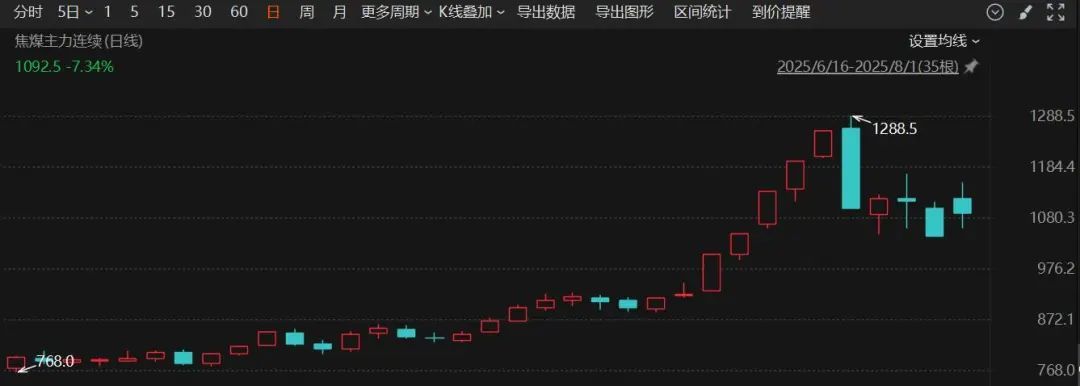
Group 1 - The black commodity prices have significantly declined this week due to a retreat in market bullish sentiment, with coking coal futures dropping by 7.34% on the first trading day of August and a cumulative decline of nearly 20% for the week [1] - In the coal-coke-steel industry chain, coking coal prices have shown a strong upward trend, with the main factory price for Shanxi coking coal rising by 110 yuan/ton to a range of 1410 to 1480 yuan/ton, reflecting an increase of 8.24% compared to the previous week [3] - The overall steel market has experienced a rebound in July, with the national steel price averaging 3677 yuan/ton, an increase of 247 yuan/ton or 7.2% month-on-month [4] Group 2 - Analysts expect that infrastructure investment growth will remain resilient in August, driven by increased fiscal support and the commencement of major projects, which may lead to improved supply-demand dynamics in the steel market [5] - Despite the recent price increases, there are concerns about demand sustainability, as social steel inventories have risen by 7.8% month-on-month to 859.9 million tons by the end of July [4] - The market is anticipated to experience a correction in August due to rapid price increases, with potential for a rebound following the implementation of relevant policy measures [5]

碳酸锂:上市以来行情回顾
Wu Kuang Qi Huo· 2025-08-01 02:39
Report Summary 1. Report Industry Investment Rating No information provided. 2. Core View of the Report The report reviews the six unilateral market trends of lithium carbonate futures contracts since their listing on the Guangzhou Futures Exchange in July 2023, and summarizes the driving factors and main industrial contradictions at each time point. As of July 30, 2025, the lithium carbonate contract index has declined by 71.3% since listing, with a maximum decline of about 76%, and experienced four significant rebounds, three of which were around 30% [3]. 3. Summary by Relevant Catalogs 3.1 Excess Expectation Dominance & Oversold Rebound - After the withdrawal of the new - energy vehicle purchase subsidy policy at the end of 2022, the downstream of the lithium - battery industry chain actively destocked from January to April 2023, and the price of battery - grade lithium carbonate dropped to 170,000 yuan/ton. It rebounded in late April due to downstream restocking, then fell again from early July [4]. - From July to December 2023, the market was dominated by the expectation of oversupply of lithium resources. Global sample mines increased production by about 1.02 million tons of lithium carbonate equivalent (LCE) in 2023, a 32% increase from 2022. Although global lithium - battery shipments maintained a 27% growth, supply increased more rapidly. The lithium price declined smoothly, with limited supply disturbances and rebound heights [4]. - In mid - November 2023, the lithium carbonate contract accelerated its decline. In early December, it reached the expected cost - support range of 80,000 - 100,000 yuan, then the main contract LC2401 rebounded from around 85,000 yuan to 115,000 yuan and fluctuated in the range for three months [5]. 3.2 Phased Supply - Demand Mismatch - Around the Spring Festival in 2024, low lithium prices reduced the salt factory's production enthusiasm. The domestic lithium carbonate enterprise's February开工率 was about 35%, a significant drop from 43% in January. However, lithium - battery material enterprises were approaching the production peak season, resulting in a short - term supply - demand mismatch. After the Spring Festival, lithium - battery enterprises rushed to buy lithium carbonate, and on February 21, news of environmental disturbances in Jiangxi mines boosted the price. The lithium carbonate index rebounded by about 28.4% in 10 days until March 1 [6]. 3.3 Continuous Inventory Accumulation Suppresses Price - After the rebound in 2024, the lithium carbonate price fluctuated between 110,000 - 120,000 yuan per ton from March to April. Lithium salt factories' production enthusiasm increased due to improved profits. From March, domestic lithium carbonate production increased continuously, with monthly环比增速 of 31.8%, 23.6%, and 18.2% from March to May. After the May Day holiday, downstream demand entered the off - season, and inventory reached a new high on May 9. The lithium carbonate contract entered a new decline cycle, with an index decline of about 36% from May 10 to September 6, 2024 [8][10]. 3.4 Exceeding Demand Expectation & Early Stockpiling - From October 22 to November 13, 2024, the lithium carbonate index rose about 20%. The extension of the lithium - battery material production peak season and early stockpiling by downstream enterprises were the main drivers. The new - energy vehicle production and sales increased significantly in September and October 2024, and lithium - battery enterprises may have rushed to export products to avoid potential US tariffs. As of November 7, 2024, the domestic lithium carbonate inventory had decreased by nearly 22,000 tons from the August peak. Some downstream enterprises stockpiled in advance, and some lithium resource enterprises lowered their production and sales targets, boosting market sentiment [13][14]. 3.5 Cost Collapse & Commodity Pessimism Resonance - From March to June 2025, the pressure on lithium salt processing profits was transmitted to the mining end, and the price of lithium concentrate dropped nearly 30% in three months. The prices of lithium ore and lithium salt declined spirally, and cost support failed. Macroeconomic expectations weakened, and the demand for lithium carbonate was affected by Trump's tariff policy, the end of the "Green New Deal," and domestic policy adjustments. From March 20 to June 23, 2025, the lithium carbonate index declined by about 21.6% [18]. 3.6 Sentiment Boost for Oversold Varieties - The lithium carbonate index rebounded on June 23, 2025, with a range increase of 34.5% until July 25, approaching the annual high. The supply - demand relationship did not reverse significantly, but the commodity market had strong repair expectations, and long - position funds dominated the market. Some commodities started to rebound in June, and events in the mining end, such as lithium mica nuclear storage in Jiangxi and mine shutdowns, boosted sentiment. The lithium carbonate contract index rose about 24% from July 14 to July 25, then declined due to increased market risk [19].
乙二醇短期去库支撑延续,中期关注累库风险
Tong Hui Qi Huo· 2025-07-29 10:06
Report Industry Investment Rating - No relevant information is provided in the report Core Viewpoints - Ethylene glycol may maintain a fluctuating and relatively strong pattern in the short term, but its upward space is limited in the medium term. Cost - side support has marginally improved, and port inventory has been continuously decreasing, providing upward momentum for prices. However, downstream polyester and loom loads remain stable, lacking demand growth, and the increase in arrival volume may gradually turn into inventory pressure. If the price fluctuations of crude oil and coal intensify, the cost center of ethylene glycol may shift down again, and there is a risk of the price falling after a spike [3] Summary by Directory 1. Daily Market Summary Futures Market Data Changes - The price of the ethylene glycol futures main contract has risen for three consecutive days, from 4,453 yuan/ton to 4,543 yuan/ton, an increase of about 2%. The spot price in East China remained stable at 4,595 yuan/ton, causing the basis to narrow from 64 yuan/ton to 37 yuan/ton, and the discount range decreased, reflecting a stronger sentiment in the futures market. The 1 - 5 spread rebounded from - 39 yuan/ton to - 23 yuan/ton, and the pressure on the far - month contract was slightly relieved [1] - The trading volume of the main contract increased to 316,600 lots, reaching a recent high, indicating increased market activity and a stronger willingness of long - position funds to enter the market [1] Supply - demand and Inventory Changes in the Industrial Chain - Supply: The overall ethylene glycol operating rate remained stable at 62.96%, and the operating rates of coal - based and oil - based plants were maintained at 61.51% and 63.94% respectively, with no obvious increase in supply. The loss of naphtha - based production profit narrowed slightly to - 79.67 US dollars/ton, and the coal - based production profit remained at - 110 yuan/ton. Cost - side pressure still existed but did not worsen further [2] - Demand: The load of polyester factories remained stable at 89.42%, and the load of looms in Jiangsu and Zhejiang remained at 63.43%. Terminal demand showed no obvious change, and downstream replenishment was mainly for rigid demand [2] - Inventory: The inventory at the main ports in East China decreased by 19,000 tons week - on - week to 475,000 tons, and the inventory in Zhangjiagang decreased by 9,000 tons to 148,000 tons, with short - term destocking accelerating. However, the arrival volume increased by 27,000 tons month - on - month to 159,000 tons, and the subsequent inventory accumulation pressure may gradually appear [2] 2. Industrial Chain Price Monitoring - Futures: The main contract price of MEG futures decreased by 79 yuan/ton to 4,464 yuan/ton, a decrease of 1.74%. The trading volume decreased by 75,533 lots to 241,057 lots, a decrease of 23.86%. The open interest decreased by 21,692 lots to 258,742 lots, a decrease of 7.74% [5] - Spot: The spot price in the East China market decreased by 95 yuan/ton to 4,500 yuan/ton, a decrease of 2.07% [5] - Spreads: The MEG basis increased by 79 yuan/ton to 116 yuan/ton, an increase of 213.51%. The 1 - 5 spread decreased by 13 yuan/ton to - 36 yuan/ton, a decrease of 56.52%. The 5 - 9 spread increased by 43 yuan/ton to 64 yuan/ton, an increase of 204.76%. The 9 - 1 spread decreased by 30 yuan/ton to - 28 yuan/ton, a decrease of 1,500.00% [5] - Profits: The naphtha - based production profit decreased by 9 US dollars/ton to - 92 US dollars/ton, a decrease of 10.82%. The ethylene - based production profit remained unchanged at - 586 yuan/ton. The methanol - based production profit increased by 177 yuan/ton to - 1,096 yuan/ton, an increase of 13.88%. The coal - based production profit remained unchanged at - 110 yuan/ton [5] - Operating Rates: The overall ethylene glycol operating rate, coal - based operating rate, oil - based operating rate, polyester factory load, Jiangsu and Zhejiang loom load, ethylene - based operating rate, and methanol - based operating rate all remained unchanged [5] - Inventory and Arrival Volume: The inventory at the main ports in East China decreased by 19,000 tons to 475,000 tons, a decrease of 3.85%. The inventory in Zhangjiagang decreased by 9,000 tons to 148,000 tons, a decrease of 5.73%. The arrival volume increased by 27,000 tons to 159,000 tons, an increase of 20.45% [5] 3. Industry Dynamics and Interpretations - On July 28, in the morning, the negotiation in the East China US - dollar market moved down, with near - month shipments negotiated in the range of 526 - 530 US dollars/ton, and no transactions were heard. In the afternoon, the center of the East China US - dollar market fluctuated narrowly, with near - month shipments negotiated in the range of 527 - 530 US dollars/ton, and no transactions were heard [6] - On July 28, the spot price of the ethylene glycol market in Shaanxi was raised, with the market average price around 4,000 yuan/ton for self - pick - up. There was still pressure on spot transactions, but the price of Shaanxi supplies was raised due to the continuous increase in coal prices [6] - On July 28, the mainstream market performed poorly, and the price in the South China market followed the decline. Near the end of the month, the enthusiasm of downstream factories to purchase goods was limited, and no transactions were heard in the market, with the current price around 4,550 yuan/ton for delivery [6] - On July 28, the oil price fell over the weekend, and the market recovered in the morning, but the impact of the cost side was limited. The ethylene glycol market opened lower. Affected by the macro - environment, commodities collectively corrected, and the current negotiation price in East China was around 4,510 yuan/ton [6] 4. Industrial Chain Data Charts - The report includes charts such as the closing price and basis of the ethylene glycol main contract, ethylene glycol production profit, domestic ethylene glycol plant operating rate, downstream polyester plant operating rate, ethylene glycol inventory statistics at the main ports in East China (weekly), and total ethylene glycol industry inventory [7][9][11]
下游市场的采购节奏放缓 热卷期货盘面高位遇阻
Jin Tou Wang· 2025-07-29 07:24
Group 1 - The core viewpoint indicates that the hot-rolled coil futures market is experiencing a strong upward trend despite weak demand from the real estate sector and a slight increase in social inventory [1][2] - The hot-rolled coil main contract opened at 3398.00 yuan/ton and reached a high of 3505.00 yuan, reflecting an increase of approximately 1.83% [1] - Supply and demand fundamentals show that iron ore and coke prices are weakening, leading to insufficient cost support for hot-rolled coil prices [1][2] Group 2 - The Ministry of Industry and Information Technology has outlined eight key tasks for the second half of the year, including enhancing the adaptability of consumer goods supply and demand to boost consumption [2] - Weekly production of hot-rolled coil continues to decline, with a capacity utilization rate of 81.11%, while total inventory has increased by 22,500 tons [2] - Technical analysis indicates that the HC2510 contract's MACD indicator shows downward adjustments, suggesting caution in trading [2]
