
反内卷

Search documents
A股、港股升势,有望延续至农历新年?现货黄金站上4800美元,有色ETF华宝(159876)大涨3%续创历史新高!
Xin Lang Ji Jin· 2026-01-21 11:25
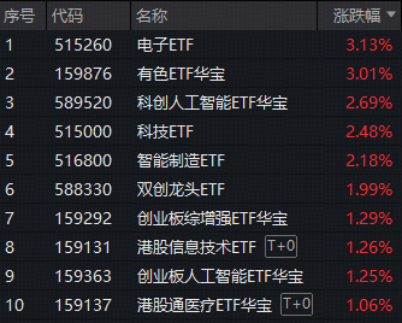
Market Overview - A-shares saw a collective rise, with the Sci-Tech Innovation Board leading with over 3% increase [1] - The total trading volume in Shanghai, Shenzhen, and Beijing reached 2.62 trillion yuan, a decrease of 180.4 billion yuan from the previous day [1] Sector Performance - The semiconductor sector experienced significant gains, with the electronic sector attracting a net inflow of 39.254 billion yuan, the highest among 31 primary industries [1] - Precious metals saw gold prices surpassing 4,800 USD for the first time, leading the non-ferrous metals sector to outperform the market, with five stocks hitting the daily limit [1][3] - The electronic ETF (515260) surged by 3.13%, while the non-ferrous ETF (159876) rose by 3.01%, both reaching historical highs [2][3] AI and Technology Trends - The AI narrative remains strong, with expectations for sustained high demand in computing hardware, particularly in the domestic AI industry chain [1] - The Sci-Tech Artificial Intelligence ETF (589520) saw a price increase of 2.69%, with a net inflow of 150 million yuan over the past ten days [1] - The market consensus indicates that CPO (Chiplet Packaging Option) is becoming a necessary technology, with rapid growth expected in 800G and 1.6T optical modules by 2026 [1] Investment Opportunities - The non-ferrous ETF (159876) has seen significant capital inflow, with a net subscription of 18.6 million units and a total of 635 million yuan over the past ten days [4] - The healthcare sector is experiencing a boost due to new policies from the National Medical Insurance Administration, which are expected to enhance innovation and profitability in high-end medical devices and robotic surgeries [18][19] - The Hong Kong medical ETF (159137) rose by 1.06%, ending a four-day decline, with significant gains in leading medical stocks [16][19]


中国经济复盘与展望:“反内卷”与结构突围
Guoxin Securities· 2026-01-21 11:06
Economic Performance - In 2025, China's GDP grew by 5.0% year-on-year, achieving the expected target but showing a "high first, low second" trend throughout the year[1] - The GDP deflator index stabilized in the second half of 2025 due to "anti-involution" policies, indicating initial success in stabilizing prices[1] Economic Structure - The second industry saw a slowdown, while the third industry experienced growth, effectively offsetting each other, which is a positive structural change[2] - Final consumption contributed approximately 2.6% to GDP growth, an increase of 0.4 percentage points from 2024, while capital formation's contribution fell to about 0.8%, down 0.5 percentage points[20] Demand and Supply Dynamics - Domestic demand (consumption + investment) was at a historically low level, highlighting the ongoing issue of insufficient domestic demand[2] - The service sector's value-added share is significantly lower than that of high-income countries, indicating a lag in service sector development relative to production efficiency[23] Future Outlook - In 2026, China's GDP growth is expected to slightly decline to 4.8%, with a focus on optimizing economic structure and enhancing internal circulation[37] - The government is likely to continue supporting the development of new productive forces and modern service industries to stimulate consumption and employment[36] Risks - There are risks associated with reduced policy stimulus and uncertainties in overseas economic policies[4]
黑色金属日报-20260121
Guo Tou Qi Huo· 2026-01-21 11:06
Report Industry Investment Ratings - Thread: ★★★ [1] - Hot Rolled Coil: ★★★ [1] - Iron Ore: ★★★ [1] - Coke: ★☆☆ [1] - Coking Coal: ★☆☆ [1] - Silicon Manganese: Not provided - Silicon Iron: ★☆☆ [1] Core Views - The steel market is in a weak demand situation with low production and inventory accumulation. The iron ore market has a relatively loose supply - demand relationship and is expected to fluctuate in the short - term. The coke and coking coal markets are likely to be weakly volatile due to sufficient carbon supply and low downstream demand. The silicon manganese and silicon iron markets are suggested to be shorted on rebounds [2][3][4][6][7][8] Summary by Related Catalogs Steel - The steel futures market fluctuates mainly. In the off - season, thread demand declines, production remains low, and inventory accumulates. Hot - rolled coil demand is still resilient, but de - stocking is slow. Steel mill profits are marginally repaired, but blast furnace复产 slows down, and hot metal production declines. Domestic demand is weak, while steel exports remain high. The market is expected to fluctuate in a range [2] Iron Ore - The iron ore futures market is weakly volatile. Global shipments decline month - on - month but are stronger than the same period last year. Domestic arrivals decrease, but port inventories continue to increase. Terminal demand improves in the off - season, and steel mill复产 is disturbed. Steel mill import ore inventories increase but are still low, and there is an expectation of winter storage replenishment. The market is expected to fluctuate in the short - term [3] Coke - Coke prices rebound slightly. Coking profits are average, and daily production decreases slightly. Coke inventories increase slightly, and traders' purchasing willingness improves slightly. Carbon supply is sufficient, downstream hot metal production is at an off - season level. The market expects relevant policies, but prices are likely to be weakly volatile due to high coking coal inventories and high Mongolian coal customs clearance data [4] Coking Coal - Coking coal prices rebound slightly. The customs clearance volume of Mongolian coal is 1371 vehicles. Coking coal mine production increases significantly, and spot auction transactions improve. Terminal inventories increase significantly, and total coking coal inventories rise slightly. Carbon supply is sufficient, downstream hot metal production is at an off - season level. The market expects relevant policies, but prices are likely to be weakly volatile due to high inventories and high Mongolian coal customs clearance data [6] Silicon Manganese - Silicon manganese prices decline in a volatile manner. Manganese ore spot prices rise due to the futures market rebound. There are structural problems in manganese ore port inventories. Iron water production decreases seasonally, silicon manganese weekly production and inventories decline slightly. It is recommended to short on rebounds [7] Silicon Iron - Silicon iron prices decline in a volatile manner. Affected by relevant policies, prices are relatively strong. There are expectations of a decline in power costs and semi - coke prices. Iron water production rebounds to a high - level range, export demand decreases, and metal magnesium production increases. Silicon iron supply decreases significantly, and inventories decline slightly. It is recommended to short on rebounds [8]
一周一刻钟 大事快评(W141):永达汽车、天准科技、隆盛、银轮、天成、福达
Xin Lang Cai Jing· 2026-01-21 10:30
Group 1 - Yongda Automotive shows strong recovery potential in luxury car dealership performance, supported by cash flow and dividend yield attractiveness [1] - The company benefits from BMW's support in new car gross profit, alongside the clearing of inefficient dealerships in the luxury car sector [1] - The new energy business is expected to contribute significantly, with a projected net cash flow exceeding 1.1 billion yuan in the first half of 2025 [1] Group 2 - Tianzhun Technology's core business is experiencing strong growth, but the industry faces cost pressures due to memory shortages [2] - The company focuses on intelligent driving and embodied intelligence, with significant growth momentum [2] - The shortage of high-end DDR5 memory and rising DRAM prices are impacting the cost structure for automotive manufacturers [2] Group 3 - Longsheng Technology has significant untapped potential in the commercial aerospace sector, with its subsidiary positioned in precision welding components [3] - The traditional business remains a core pillar of performance, while the robotics segment has clear long-term growth logic [3] - Yinxun shares are expected to see substantial market value elasticity due to the data center liquid cooling module as a core growth driver [3] Group 4 - Fuda shares have issued convertible bonds, signaling positive developments, with strong performance expected in 2026 due to scarce production capacity [3] - The company is involved in the drafting of national standards for robotic components, with overseas client validation progressing [3] - Tiancheng Self-Control is positioned as a key player in the low-altitude economy, with significant market share potential as the industry matures [3]


大宗商品框架系列(三):解构石化化工链:传统产业中的新机遇
Ping An Securities· 2026-01-21 10:27
Core Insights - The petrochemical industry in China is transitioning from a price cycle bottom to the beginning of a new price cycle, with expectations of a gradual recovery in market conditions as inventory cycles shift from passive destocking to active restocking [3][11] - The demand for traditional refined products like gasoline and diesel has peaked earlier due to the accelerated penetration of new energy sources, leading to a slowdown in refining capacity growth and a shift towards supply integration and optimization [3][13] - The global petrochemical supply landscape is being reshaped, with a significant shift of the industry focus towards China as European and Korean producers reduce capacity due to high costs and low demand [3][18] Group 1: Industry Overview and Future Outlook - The petrochemical industry is expected to enter a new phase of price and inventory cycles, with policies promoting domestic demand and supply-side reforms supporting this transition [3][11] - The refining sector is moving towards high-quality development, with smaller, outdated refineries being phased out in favor of larger, more efficient operations [3][13] - The supply of petrochemical products is tightening due to geopolitical tensions, particularly the ongoing conflict in Ukraine affecting Russian production and exports [3][30] Group 2: Investment Opportunities - Key investment themes include the "anti-involution" policy that aims to control capacity and improve supply conditions, the transition of traditional petrochemical products towards high-end applications, and the rise of new materials driven by technological advancements [4][6] - Specific sectors to watch include the PX/MEG-PTA-PET polyester chain, polyurethane raw materials, and organic silicon, which are positioned to benefit from supply-side reforms and improved pricing dynamics [4][6] - The report suggests focusing on companies with strong integration in refining and petrochemical operations, such as China National Petroleum Corporation and Hengli Petrochemical, which are expected to show resilience and potential for valuation increases as market conditions improve [4][6]
12月经济数据点评:稳中提质在路上
LIANCHU SECURITIES· 2026-01-21 09:27
Economic Growth - The actual GDP growth in Q4 was 4.5%, achieving an annual growth rate of 5.0%, meeting the annual target[3] - Nominal GDP grew by 3.8% year-on-year, with an annual cumulative growth of 4.0%[3] - The GDP deflator index was -1.0%, slightly narrowing compared to previous figures[3] Investment Trends - Fixed asset investment saw a significant decline, with a cumulative year-on-year decrease of 3.8% for 2025, a drop of 7.0 percentage points from the previous year[4] - Infrastructure investment (narrow and broad) fell by -2.2% and -1.5% respectively, marking a notable slowdown compared to 2024[4] - Manufacturing investment increased by only 0.6% in December, down 1.3 percentage points from the previous month and down 8.6% from 2024[4] Consumer Behavior - Retail sales of consumer goods grew by 3.7% year-on-year for 2025, a slight increase of 0.2 percentage points from 2024[5] - December retail sales showed a year-on-year growth of 0.9%, down 0.5 percentage points from the previous month, indicating a slow recovery[5] - Subsidized consumption remained a key support, with household appliances and furniture seeing annual growth rates of 11.0% and 14.6% respectively[6] Real Estate Market - Real estate development investment decreased by 17.2% year-on-year, with December's decline expanding to 35.8%[4] - New construction area in December fell by 19.4%, but the decline was less severe than the previous month, indicating potential stabilization[4] - The sales area and sales revenue of commercial housing showed a narrowing decline of -15.6% and -23.6% respectively in December, suggesting marginal improvement[4]
投资好时节!嘉实基金2026投资策略峰会即将启幕
Zhong Guo Zheng Quan Bao· 2026-01-21 08:46
Core Viewpoint - The investment landscape in 2026 is characterized by a clear trend towards allocating quality equity assets, driven by China's economic transition towards high-quality development and structural transformation [1] Group 1: Investment Strategies and Opportunities - The upcoming "Investment Good Season" strategy summit by Harvest Fund on January 23 will feature discussions with economists, investment professionals, and industry leaders to explore wealth creation and market opportunities [1][2] - The summit will address asset allocation strategies, including equity, fixed income, and multi-asset approaches, emphasizing the importance of a stable foundation and quality equity allocation in uncertain times [2] - Key speakers at the summit include senior executives from Harvest Fund who will share insights on strategy research, ETF investments, and multi-strategy approaches [2] Group 2: AI and Technology Investment - The AI sector is highlighted as a key focus for investment, with advancements in large model capabilities and increased capital expenditure driving discussions about the commercialization of AI applications [3] - A roundtable discussion will feature experts from Harvest Fund discussing the global AI industry's development and the implications of potential market bubbles [3] Group 3: Economic Policies and Consumer Demand - The optimization of supply and demand structures is expected to create new opportunities, with "de-involution" policies and "expanding domestic demand" being prioritized in economic strategies [4] - Experts from Harvest Fund will engage in dialogues about potential beneficiaries and investment rhythms in the context of macroeconomic trends [4][5] Group 4: Consumer Trends and Investment Insights - The summit will also focus on consumer investment trends, with discussions on various topics such as resource investments and dividend strategies, appealing to the interests of younger investors [6] - Insights will be shared on specific consumer trends, including the resurgence of tangible lifestyle investments and the growing popularity of gold and rare metals [6]
日度策略参考-20260121
Guo Mao Qi Huo· 2026-01-21 07:29
Report Industry Investment Ratings - Bullish: Palm oil, soybean oil [1] - Bearish: Industrial silicon [1] - Neutral: Most other industries are rated as "oscillating" [1] Core Views of the Report - Policy aims to achieve a "slow bull" in the stock market, with short - term oscillations in the stock index and long - term opportunities for long - position layout. Asset shortage and weak economy benefit bond futures, but short - term interest rate risks are signaled by the central bank [1]. - Different metals and commodities have various trends. For example, copper prices are in high - level oscillations, aluminum prices are falling from high levels, and nickel prices are in high - level oscillations with supply concerns and inventory constraints [1]. - Precious metals are supported by geopolitical and trade tensions, but the suspension of key - mineral tariff hikes by the US may cause price fluctuations. Platinum and palladium are expected to have wide - range oscillations in the short term, and a long - term strategy of buying platinum and shorting palladium can be considered [1]. - In the agricultural and energy - chemical sectors, different products are affected by factors such as supply - demand relationships, policies, and international situations, resulting in different price trends and investment strategies [1]. Summary by Related Catalogs Macro Finance - Stock index: Policy cools market speculation, with short - term oscillations and long - term opportunities for long - position layout [1] - Bond futures: Asset shortage and weak economy are beneficial, but short - term interest rate risks are signaled by the central bank, and the Japanese central bank's interest - rate decision should be monitored [1] Non - ferrous Metals - Copper: Downstream demand is under pressure, and with the suspension of key - mineral tariffs by the US, short - term copper - hoarding concerns are alleviated, and prices are in high - level oscillations [1] - Aluminum: Limited industrial drivers and weakening macro sentiment lead to aluminum prices falling from high levels [1] - Alumina: Supply exceeds demand in the domestic market, and prices are under pressure, but they are near the cost line and expected to oscillate [1] - Zinc: The cost center is stable, but inventory pressure is evident, and prices fluctuate within a range due to repeated macro sentiment [1] - Nickel: The 2026 RKAB target of Indonesian nickel ore is about 260 million wet tons, but the supply is still tight. Global nickel inventory accumulation may restrict price increases, and short - term prices are in high - level oscillations. Short - term long - position trading on dips is recommended, but over - chasing highs should be avoided [1] - Stainless steel: The price of raw - material nickel iron is rising, social inventory is slightly decreasing, and steel - mill production in January is increasing. Futures prices are in high - level oscillations, and short - term long - position trading on dips is recommended [1] - Tin: Short - term macro sentiment is repeated, and prices have corrected. However, due to the fragile supply of tin ore, there is still upward momentum, and low - buying opportunities should be monitored [1] Precious Metals and New Energy - Gold and silver: Geopolitical and trade tensions boost prices, and they are expected to be strong in the short term, but price fluctuations may be intense due to the suspension of key - mineral tariff hikes by the US [1] - Platinum and palladium: Geopolitical and trade tensions support prices, but the suspension of key - mineral tariff hikes by the US may suppress price drivers. Short - term wide - range oscillations are expected, and a long - term strategy of buying platinum and shorting palladium can be considered [1] Industrial and Building Materials - Industrial silicon: Production increases in the northwest and decreases in the southwest, and the planned production of polysilicon and organic silicon in December decreases [1] - Polysilicon: It is in the off - season for new energy vehicles, but energy - storage demand is strong, and there is a battery export rush with a large increase in price [1] - Lithium carbonate: Expectations are strong, but the spot market is weak, and the upward momentum is insufficient [1] - Rebar and hot - rolled coil: High production and inventory suppress price increases, and the transmission of futures price increases to the spot market is not smooth. Unilateral long positions should be closed, and cash - and - carry arbitrage can be considered [1] - Iron ore: There is obvious upward pressure, and chasing highs is not recommended [1] - Coke and coking coal: If the "capacity reduction" expectation continues to ferment, there may be room for price increases, but the actual increase is difficult to judge, and large fluctuations after a significant increase require caution [1] - Glass: Short - term market sentiment is warming, and supply - demand provides support, but medium - term supply exceeds demand, and prices are under pressure [1] - Soda ash: It follows glass prices, and medium - term supply - demand is looser, with prices under pressure [1] Agricultural Products - Palm oil: The purchasing rhythm of major consuming countries is starting, production areas are expected to reduce production and inventory, and with the possibility of biodiesel themes fermenting, prices are expected to oscillate strongly [1] - Soybean oil: It has a strong fundamental situation, and long - position allocation in oils is recommended, and a strategy of buying soybean oil and shorting other oils can be considered [1] - Rapeseed oil: Tariff - adjustment expectations for Canadian rapeseed and customs - clearance expectations for Australian rapeseed are bearish, but it is difficult to decline smoothly, and it is recommended to wait and see due to large recent price fluctuations [1] - Cotton: There is strong domestic new - crop production expectation, but the purchase price of seed cotton supports the cost of lint. Downstream operation rates are low, but yarn - mill inventory is not high, and there is rigid restocking demand. Future factors such as the central government's No.1 Document in the first quarter of next year, planting - area intentions, weather during the planting period, and peak - season demand should be monitored [1] - Sugar: There is a global surplus and an increase in domestic new - crop supply, and there is a consensus among short - sellers. If prices continue to fall, there is strong cost support, but there is a lack of continuous short - term fundamental drivers, and changes in the capital side should be monitored [1] - Corn: The grain - selling progress in Northeast China is fast, port inventory is low, and there is restocking demand before the festival. Short - term spot prices are firm, and futures prices are expected to oscillate within a range [1] - Soybeans: As the Brazilian harvest progresses, the CNF premium reflects the selling pressure of a bumper harvest. Dry weather in Argentina should be monitored, and short - term prices are expected to oscillate weakly [1] - Pulp: Affected by the decline in the commodity macro - environment, prices have fallen but remain within the oscillation range. Due to large short - term commodity - sentiment fluctuations, it is recommended to wait and see cautiously [1] - Logs: Spot prices have shown signs of bottom - rebounding, and the further decline in futures prices is limited. However, the January overseas offer has slightly decreased, and there is a lack of upward - driving factors, with prices expected to oscillate between 760 - 790 yuan/m³ [1] - Hogs: Spot prices are gradually stabilizing, demand provides support, and production capacity still needs to be further released [1] Energy and Chemicals - Crude oil: OPEC+ has suspended production increases until the end of 2026, the uncertainty of the Russia - Ukraine peace agreement, and US sanctions on Venezuelan oil exports affect prices [1] - Fuel oil: Short - term supply - demand contradictions are not prominent and follow crude - oil prices. The "14th Five - Year Plan" rush - work demand is likely to be falsified, and the supply of Marey crude oil is sufficient, with high asphalt profits [1] - Shanghai rubber: Raw - material cost support is strong, the futures - spot price difference has rebounded significantly, and mid - stream inventory has increased significantly [1] - BR rubber: There is a phased correction, high - price spot transactions are blocked, the cost of butadiene has strong bottom - support, overseas cracking - unit production capacity is cleared, and the domestic market is expected to benefit in the long term. The market will return to fundamental - driven in the short term [1] - PTA: The PX market has risen rapidly, and the market is expected to tighten in 2026. Domestic PTA maintains high - level operation, and the high gasoline spread supports aromatics [1] - Ethylene glycol: Two sets of MEG plants in Taiwan, China, plan to shut down next month. Prices have rebounded rapidly due to supply - side news, and downstream polyester operation rates are above 90% [1] - Short - fiber: Prices continue to closely follow cost fluctuations [1] - Styrene: The supply - demand fundamentals have improved, futures prices have rebounded rapidly, the Asian market has stabilized, and the price difference between styrene and benzene has widened, with inventory being depleted [1] - Urea: Export sentiment has eased, there is limited upward space due to insufficient domestic demand, and there is support from anti - involution and cost [1] - PVC: Global production is expected to be low in 2026, but the current fundamentals are poor. The cancellation of export tax - rebates may lead to a rush to export, and differential electricity prices in the northwest may force out inefficient production capacity [1] - LPG: The February CP is expected to rise, the cost of imported gas is strongly supported, the geopolitical conflict in the Middle East has cooled, inventory is being depleted, domestic PDH maintains high - level operation but is in deep loss, and the heating market is expected to start [1] Others - Container shipping on the European route: It is expected to peak in mid - January, pre - festival restocking demand still exists, and airlines are still cautious in their trial re - flights [1]
锐科激光:抵制恶意低价销售、非正规渠道销售激光器等扰乱市场价格行为
Zheng Quan Shi Bao Wang· 2026-01-21 05:17
Core Viewpoint - Ruike Laser (300747) has announced measures to implement the national "anti-involution" requirements, aiming to resist market disruption and malicious competition in the laser industry [1] Group 1: Company Actions - The company will firmly resist malicious low-price sales, false advertising, and sales of laser devices through irregular channels that disrupt market prices [1] - Ruike Laser plans to establish a regular supervision mechanism through big data monitoring, regional market inspections, and channel traceability checks [1] - Upon discovering any behavior that disrupts market order, the company will take corresponding control measures, including stopping official after-sales services and pursuing legal liability for breaches of contract [1]

高盛沟通会:超配中国,2026年股票是“明确高配”的资产
Hua Er Jie Jian Wen· 2026-01-21 04:03
Group 1: Market Outlook - Goldman Sachs views Chinese stocks as a key focus area within its global asset allocation strategy for 2026, indicating a bullish outlook for the Chinese stock market [1] - The firm anticipates a sustained "slow bull" market in China, benefiting insurance companies' allocation to equity assets, which is expected to enhance overall investment returns [1] - The current global economic environment, characterized by no recession in the U.S. and ample liquidity, historically favors stock markets [2] Group 2: Earnings Growth Drivers - Goldman Sachs identifies three main themes driving earnings growth in China: AI, overseas expansion, and anti-involution [4][5] - AI is projected to contribute approximately 2% to 3% annual earnings growth for the entire market over the next 3 to 5 years as Chinese tech companies benefit from its application [4] - The overseas revenue share for Chinese companies is currently around 16%, indicating significant room for growth compared to the 28% for S&P 500 companies [5] Group 3: Valuation and Market Performance - The MSCI China Index's current dynamic P/E ratio is approximately 13, aligning with historical averages, while the CSI 300 Index is around 15, also near its historical median [3] - Goldman Sachs forecasts an overall return range of 15% to 20% for the year, driven primarily by earnings growth rather than valuation expansion [3] - The firm expects a substantial inflow of capital into the stock market, estimating around $200 billion in southbound capital flow into Hong Kong stocks this year [6] Group 4: Investment Themes and Strategies - Goldman Sachs maintains a high allocation to AI-related sectors, including software, internet, and hardware, while also favoring materials and insurance [8] - The firm emphasizes the importance of shareholder returns through dividends and buybacks, which have proven effective in other markets [8][9] - The insurance sector is highlighted as a favorable investment due to its stable returns and potential for higher equity asset allocation in a slow bull market [9] Group 5: Investor Sentiment and Behavior - There is a growing interest among overseas investors in the Chinese market, although actual investment actions have yet to materialize [6][7] - The firm notes that personal investors currently allocate only about 10% of their assets to stocks, suggesting a potential shift towards higher equity allocation if the market enters a sustained bull phase [10] - The anticipated improvement in inflation expectations may further drive demand for risk assets among individual investors [10]
