
风险偏好

Search documents
如何看待当前市场显著分化行情?
ZHONGTAI SECURITIES· 2026-01-24 11:03
Group 1 - The A-share market is currently experiencing a significant divergence, with major indices showing mixed performance. The Wind All A Index increased by 1.81%, while the Shanghai Composite Index rose by 0.84%, and the CSI 300 Index slightly declined by 0.62%. The small-cap index, CSI 2000, outperformed with a rise of 4.04% [2][8] - Market liquidity remains robust despite a 19.22% decrease in average daily trading volume to approximately 2.80 trillion yuan, indicating that funds have not significantly withdrawn from the market [2][8] - The market's profitability effect has notably improved, with an average of 59.84% of stocks rising during the week, a significant increase compared to the previous week [2][8] Group 2 - The divergence in the A-share market has intensified, with small-cap stocks significantly outperforming large-cap stocks, and growth stocks outperforming value stocks. The preference for high-beta and high-elasticity assets is becoming more pronounced [3][9] - The current market dynamics are driven by changes in risk appetite, liquidity conditions, adjustments in funding structures under counter-cyclical regulation, and the timing of earnings disclosures [3][10] - The risk appetite has rebounded, supported by a relatively loose liquidity environment, which has strengthened support for high-elasticity sectors. The recent appreciation of the RMB against the USD has also improved the attractiveness of Chinese assets for cross-border capital [10][13] Group 3 - Short-term market divergence is expected to continue, supported by the ongoing profitability effect in high-elasticity sectors, while the overall liquidity environment remains relatively loose [4][10] - The market is currently in a signal vacuum regarding fundamentals, lacking substantial information shocks, which allows for potential valuation increases in high-growth sectors [4][10] - The geopolitical landscape and resource security issues are also influencing the A-share market, with rising global commodity prices benefiting cyclical sectors [14][10] Group 4 - Investment strategies should adopt a segmented and dynamic approach, focusing on high-elasticity sectors such as robotics in the short term, while shifting attention to the overseas computing power industry chain as earnings expectations improve post-Spring Festival [5][15] - After the Two Sessions, there should be a gradual increase in defensive allocations, particularly in undervalued, high-dividend sectors like banking [5][15] - It is recommended to adjust portfolio structures flexibly according to the core themes of different stages, while increasing the focus on earnings realization and valuation alignment [5][15]

股市关注涨价链条,债市多空博弈
Zhong Xin Qi Huo· 2026-01-23 01:25
Group 1: Report Industry Investment Rating - Not provided Group 2: Core Views of the Report - The stock market focuses on the price - rising chain, and the bond market is in a long - short game. The stock index futures are desensitized to negative factors, the stock index options should appropriately supplement call options for defense, and the bond market in the treasury bond futures has a long - short game with a slight decline [1]. - For stock index futures, the equity market oscillated upward on Thursday. The market is desensitized to the sporadic selling of broad - based ETFs. The ChiNext and STAR Market are the best in style, while the SSE 50 is weak. Resource stocks have become market hotspots, and the value of resource products is re - evaluated. In the future, institutional funds are expected to take over the pricing power, and the CSI 500 and ChiNext/STAR Market styles have comparative advantages [1][7]. - For stock index options, the trading volume of each option variety mostly declined, while the open interest increased. Some investors may trade call options for hedging. It is recommended to sell call options for covered增厚 and appropriately supplement call options for defense in the short term [1][7]. - For treasury bond futures, the main contracts of treasury bond futures closed down. The bond market sentiment cooled but was not very weak. After the market closed, the central bank's MLF over - renewal and the statement about the space for reserve requirement ratio and interest rate cuts improved the sentiment of the ultra - long - term bond market. After the MLF over - renewal and the end of the large tax period, the capital may be relaxed [2][8]. Group 3: Summary According to Relevant Catalogs Stock Index Futures - **View**: Desensitized to negative factors [7] - **Logic**: The equity market oscillated upward on Thursday. The market is desensitized to the sporadic selling of broad - based ETFs. The ChiNext and STAR Market are the best in style, while the SSE 50 is weak. The impact of the adjustment of implicit margin for margin trading is weakening. Resource stocks have become market hotspots, and the value of resource products is re - evaluated. In the future, the influence of regulatory cooling will gradually weaken, and the market will be driven by funds. Institutional funds are expected to take over the pricing power, and the CSI 500 and ChiNext/STAR Market styles have comparative advantages [1][7] - **Operation Suggestion**: Hold IC [7] - **Outlook**: Oscillate strongly [7] Stock Index Options - **View**: Supplement call options for defense in the short term [7] - **Logic**: The trading volume of each option variety mostly declined, while the open interest increased. Considering the weak option sentiment index and the strengthening of implied volatility, it is speculated that some investors trade call options for hedging. It is recommended to sell call options for covered增厚 and appropriately supplement call options for defense in the short term [1][7] - **Operation Suggestion**: Covered strategy [7] - **Outlook**: Oscillate [7] Treasury Bond Futures - **View**: Long - short game, slight decline in the bond market [8] - **Logic**: The main contracts of treasury bond futures closed down. The bond market sentiment cooled but was not very weak. The improvement of the equity market sentiment, the tightening of the overnight capital due to the tax payment and the small net injection of reverse repurchase by the central bank, and the stable open interest of the main futures contracts and the support from the cash bond allocation disk led to a limited adjustment. After the market closed, the central bank's MLF over - renewal and the statement about the space for reserve requirement ratio and interest rate cuts improved the sentiment of the ultra - long - term bond market. After the MLF over - renewal and the end of the large tax period, the capital may be relaxed [2][8] - **Operation Suggestion**: Trend strategy: oscillate; Hedging strategy: pay attention to short - hedging at the low basis; Basis strategy: pay attention to the positive arbitrage opportunity of TL; Curve strategy: the curve may flatten first and then steepen [8] - **Outlook**: Oscillate [8]
美银1月基金经理调查 除了乐观还是乐观【播客】
Datayes· 2026-01-21 10:54
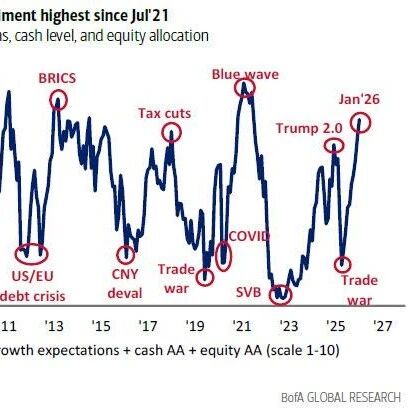
Core Insights - The sentiment among fund managers is extremely optimistic, with a significant shift in macroeconomic expectations from "recession" to "prosperity" [1][2] - Global growth expectations have risen to 38%, an increase of 20 percentage points, marking the highest level since July 2021, while the probability of recession has dropped to 9%, the lowest since January 2022 [1] - Profit expectations are also high, with a net 44% of managers optimistic about EPS over the next 12 months, the highest since July 2021 [2] - Concerns about stagflation have decreased from 58% to 39%, with 34% anticipating a "prosperity" scenario and 18% a "golden age" [3] - Inflation expectations driven by tariffs have significantly declined, with a net 3% believing CPI will decrease [4] Asset Allocation - There is a strong preference for equities and commodities, while bonds are being abandoned [5] - Stock allocation is at a net overweight of 48%, the highest since December 2024, and commodity allocation is at 26%, the highest since June 2022, while bond allocation is at a net underweight of 35%, the highest since September 2022 [12] - The banking sector has become the most overweight industry, while consumer staples are at their largest underweight since February 2014 [12] - High-yield bonds are expected to outperform investment-grade bonds for the first time [12] - The most crowded trade is long gold, with 51% of managers favoring it, surpassing the "Seven Sisters" trade at 27% [12] Risk Landscape - The primary risks identified are geopolitical tensions and the potential for an AI bubble, with geopolitical conflict cited by 28% of respondents and AI bubble concerns by 27% [5][6] - Credit events are anticipated to be triggered by private equity/private credit (39%) and large-scale capital expenditures in AI (35%) [6] - Political expectations for the 2026 midterm elections are nearly evenly split between "red wave" and "blue wave" scenarios [7] - There is a notable division regarding AI stocks, with 55% believing they are "not in a bubble" [8] Market Sentiment - The bull-bear indicator stands at 9.4, indicating a deep "sell" zone, with cash levels at 3.2%, a historical low [11] - A record 48% of respondents are "zero hedged" against market downturns, the highest since January 2018 [11] - Risk appetite is above normal by 16%, the highest in four years, with 49% of managers expecting an "impossible landing" scenario for the global economy [11] Strategic Insights - Michael Hartnett warns that in a world filled with good news, low hedging may seem harmless, but any unexpected negative turn could amplify impacts, highlighting current market fragility [9]

20260119多资产配置周报:风偏继续向中间集中
Orient Securities· 2026-01-20 05:50
Group 1: Market Overview - The report maintains a bullish outlook on A-shares, commodities, and gold, with domestic risk assessments steadily declining, favoring A-shares[7] - A-shares and commodities continue to show strong trends, while the mid-term uncertainty for commodities has increased, whereas A-shares and gold remain stable[42] Group 2: Economic Indicators - In December 2025, the social financing data showed a significant drop, with a year-on-year decrease of 646.2 billion yuan, indicating a tightening in financing demand[15] - The U.S. inflation data remains relatively mild, with the December 2025 CPI growth at 2.7% and core CPI at 2.6%, leading to a reduced expectation for interest rate cuts[16] Group 3: Regulatory Environment - Regulatory measures have been implemented to manage market expectations, including increasing the margin ratio for financing from 80% to 100% to curb excessive speculation[20] - The regulatory approach aims to stabilize the market and prevent extreme fluctuations, indicating an improvement in the governance of the capital market[20] Group 4: Asset Performance - A-shares showed a weekly decline of 0.45% for the Shanghai Composite Index, while the CSI 500 index increased by 2.18%[11] - Gold prices increased by 2.23% over the week, maintaining a strong trend alongside commodities[11]

20260119多资产配置周报:风偏继续向中间集中-20260120
Orient Securities· 2026-01-20 05:25
Group 1 - The report maintains a bullish outlook on A-shares, commodities, and gold, with expectations favoring risk assets as domestic risk evaluations steadily decline, making A-shares relatively superior [7][21] - The trend for A-shares, commodities, and gold remains strong, although the medium-term uncertainty for commodities has increased, while A-shares and gold show stable medium-term uncertainty [42][7] - The report highlights a concentration of risk preference towards mid-cap stocks, with a focus on opportunities in sectors such as electric power equipment, basic chemicals, electronics, and non-ferrous metals [7][42] Group 2 - Recent financial data indicates a decline in social financing, with a year-on-year decrease of 646.2 billion yuan in December, primarily due to policy adjustments, while financing demand remains concentrated in technology and policy-prioritized sectors [15][13] - U.S. inflation pressures are relatively mild, with December's CPI showing a year-on-year increase of 2.7%, leading to a cooling of interest rate cut expectations [16][18] - Regulatory measures are effectively managing market expectations, with recent adjustments aimed at preventing excessive speculation and ensuring that funds flow towards quality assets, thereby stabilizing risk preferences [20][21] Group 3 - The report notes that the trend for A-shares has strengthened, while the trends for gold and commodities remain stable, amidst overall fluctuations in U.S. stocks and a weakening trend in U.S. bonds [22][24] - The report identifies a strong trend in the basic chemicals sector, with electric power equipment, non-ferrous metals, and defense industries also showing robust trends [25][22] - Short-term sentiment for commodities is rising, while medium-term uncertainty is increasing; gold shows rising short-term sentiment but stable medium-term uncertainty; A-shares exhibit a decline in short-term sentiment with stable medium-term uncertainty [28][30]
赢家的诅咒:为什么冠军基金总在第二年崩盘?
3 6 Ke· 2026-01-20 00:12
Group 1 - The core argument of the article is that luck plays a significant role in investment outcomes, contrasting it with the certainty found in medical procedures [1][2] - The stock market often creates an illusion of easy profits, especially during bull markets, leading many inexperienced investors to participate in what is essentially a professional activity [5][6] - The article compares the influence of luck in sports, noting that in football, luck accounts for approximately 60% of outcomes, while in basketball, it is only about 12% [4] Group 2 - The concept of "winner's curse" is discussed, where funds that perform well in one year may not sustain that performance due to luck and risk preference rather than skill [9][12] - High-risk preference among fund managers often leads to short-term gains, but this can result in significant losses during downturns [11][12] - The article suggests that investors should focus on long-term performance and avoid funds that have recently performed exceptionally well, as these may be more influenced by luck [13]

如何定价地方债?
Sou Hu Cai Jing· 2026-01-16 03:20
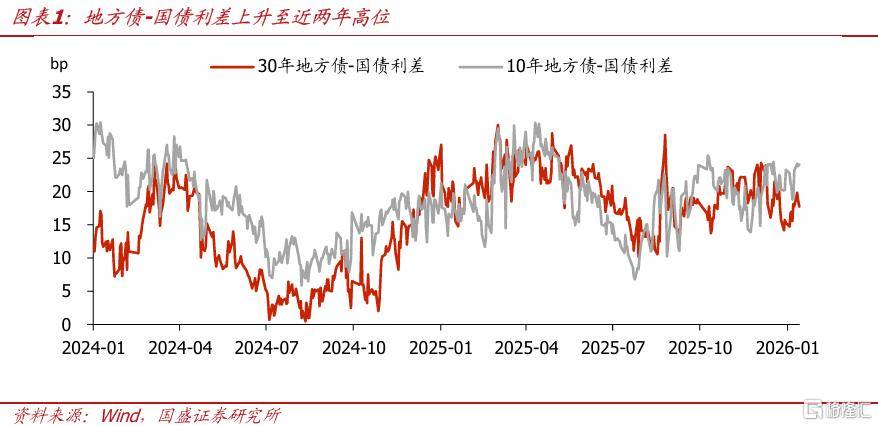
Core Viewpoint - Recent fluctuations in 30-year government bonds have been significant, while local government bonds remain stable, raising market concerns about the future trajectory of local bonds [1][5]. Group 1: Factors Influencing Local Government Bonds - The local government bond and government bond yield spread is influenced by multiple factors, including the risk-free interest rate anchor, funding costs, institutional behavior, risk appetite, local bond supply, and trading liquidity [2][8]. - The risk-free interest rate anchor reflects the macro interest rate environment and directly affects the valuation of interest rate bonds, with a negative correlation between the risk-free rate and the local bond-government bond spread [8]. - Short-term funding costs, indicated by the rise in DR007, lead to increased marginal costs for institutions, causing a preference for more liquid government bonds and widening the local bond-government bond spread [10]. Group 2: Market Dynamics and Predictions - The model indicates that the current 10-year local bond-government bond spread is close to its fitted value, while the 30-year spread is significantly above it, suggesting that the long-end local bonds are undervalued with limited upward space [3][30]. - Predictions for 2026 suggest that the average spreads for 10-year and 30-year local bonds will be lower than current levels, at approximately 14.3bps and 14.9bps respectively, indicating limited risk for further increases in spreads [31]. - The current market environment presents both challenges and opportunities for local bonds, with rising bond yields improving relative value, and a shift in supply dynamics observed in the issuance schedule [34].
大摩-因果与外汇-委内瑞拉-石油与货币
2026-01-12 01:41
Summary of Conference Call Notes Industry Overview - The notes primarily discuss the oil industry in Venezuela and its implications for the broader Latin American market and currency dynamics, particularly focusing on the relationship between the U.S. and various Latin American countries [1][2][3]. Key Points and Arguments - **U.S. Relations with Latin America**: The U.S. adopts a differentiated strategy towards Latin American countries, maintaining close ties with Brazil and Uruguay while having a more strained relationship with Mexico and Colombia, which may lead to tougher trade negotiations [1][2]. - **Venezuela's Oil Industry Recovery**: The U.S. plans to restructure Venezuela's oil sector, with short-term expectations of a quick recovery in oil production. In an optimistic scenario, production could rise to 2 million barrels per day, contingent on government stability, sanctions, and fiscal terms [1][4]. - **Impact on Global Oil Market**: The production of heavy crude oil in Venezuela is expected to significantly influence the global oil market. Canada, as a major exporter of heavy sour crude, may face challenges if the U.S. adopts a tougher stance in USMCA negotiations due to increased oil imports from Venezuela [1][5]. - **Canadian Dollar Vulnerability**: The Canadian dollar may depreciate due to concerns over increased Venezuelan oil production and its impact on the price differential between Western Canadian Select (WCS) and West Texas Intermediate (WTI) crude [1][5]. - **Emerging Market Currency Outlook**: The situation in Venezuela could lead to a weaker U.S. dollar, benefiting non-U.S. currencies such as the euro and Asian currencies. Emerging market currencies are generally expected to appreciate due to low inflation driven by supply-side factors and improved risk appetite [3][6]. Other Important Insights - **Geopolitical Risks**: The U.S. government's focus on Latin America is likely to increase geopolitical risk premiums, although the direct impact on markets may be limited. Countries like Argentina and Ecuador may benefit from favorable trade agreements and financial support, while Mexico and Colombia may face tougher negotiations [2]. - **Long-term Investment Opportunities**: Despite potential short-term declines due to the Venezuelan situation, the overall outlook for emerging market assets remains positive, with investors encouraged to seek related investment opportunities [3][6].
2026年的第一周 全球风险资产齐涨 投资者“情绪高涨”
智通财经网· 2026-01-10 23:36
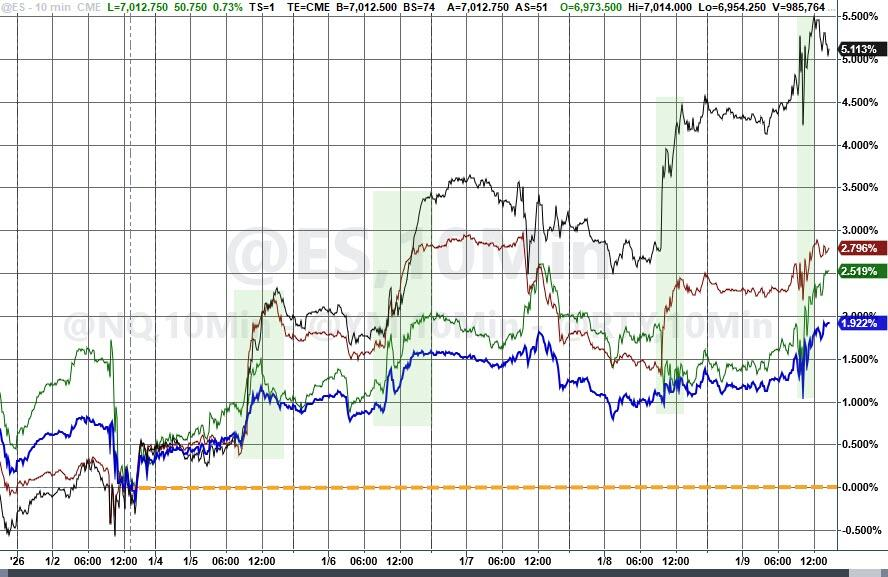
Group 1: Market Overview - Global financial markets exhibit strong risk appetite, with major stock indices reaching historical highs as investors shift from defensive assets to cyclical sectors and high-risk assets [1][4] - The S&P 500 index increased by 1.6%, while the Russell 2000 index surged by 4.6%, indicating broad market participation [1] - The A-share market in Asia also saw significant gains, with the Shanghai Composite Index breaking the 4100-point mark and achieving a remarkable "16 consecutive days of gains" [2][10] Group 2: Commodity Market Performance - The commodity market performed well, driven by geopolitical factors and inflation expectations, with oil prices experiencing the largest single-day increase since October of the previous year [4][13] - Silver prices rose by 10% over the week, while gold approached historical highs, reflecting strong demand despite a strengthening dollar [4][14] Group 3: Credit Market Dynamics - The credit market joined the bullish trend, with junk bond spreads narrowing by 10 basis points, encouraging new corporate borrowing [8] - The U.S. administration's policies, including support for the real estate market, contributed to the upward momentum in the markets [8][9] Group 4: Economic Indicators - Despite a slight miss in U.S. non-farm payroll data, service sector activity expanded at its fastest pace in over a year, and productivity increased significantly [10][12] - The anticipated liquidity influx of $600 billion in the first quarter is expected to return basic liquidity to comfortable levels [6] Group 5: Investor Sentiment and Risks - Investor sentiment is high, with significant capital flowing into high-beta assets, as evidenced by the Vanguard S&P 500 ETF attracting $10 billion in just a few days [6] - However, there are concerns regarding the sustainability of this optimism, with some analysts questioning the market's speculative nature and potential risks associated with high valuations [19]
申万宏源策略一周回顾展望(26/01/05-26/01/10):赚钱效应扩散尚不充分
申万宏源研究· 2026-01-10 15:03
Group 1 - The report emphasizes that the spring market has a continuous favorable time window for bullish strategies, with a significant increase in risk appetite. There are no major downside risks, only short-term adjustments after market performance is fully realized. Overall profit-making effects may continue to expand to higher levels, indicating that the short-term market performance is not yet fully realized [4][5]. - The report reaffirms the logic of the spring market, highlighting that there is ample liquidity and favorable conditions for bullish strategies. Key factors include ETF inflows, insurance sector performance, and expectations of foreign capital inflows, which have accelerated the inflow of retail investors and increased trading activity [4][5]. - The report identifies specific time windows in the spring that are conducive to market performance, including potential rebounds before the Lunar New Year in February, policy catalysts from the National People's Congress in March, and the anticipated visit of Trump to China in April, which could stabilize market expectations [4][5]. Group 2 - The report discusses the marginal trading funds and dominant market styles, noting that the net inflow of the CSI A500 ETF has plateaued. The expected incremental inflows are primarily from the insurance sector and foreign capital, while retail investor inflows and increased trading activity are contributing to faster growth in marginal trading funds [8]. - The report maintains that industry themes, such as commercial aerospace, robotics, and nuclear fusion, remain the strongest directions for profit-making effects. The report also highlights the high elasticity of venture capital and pre-IPO technology leaders, which are benefiting from mid-term bull market expectations [12]. - The report predicts that the second quarter of 2026 will still exhibit a volatile pattern, with technology and advanced manufacturing sectors likely to lead the market ahead of a full bull market in the second half of 2026 [12].