关税

Search documents
巴克莱:美股不便宜,但科技股不贵
Hua Er Jie Jian Wen· 2025-09-03 07:57
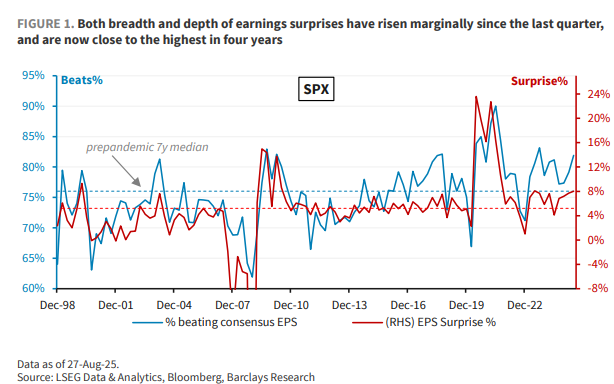
Core Insights - Despite the high valuation of the S&P 500 at 22-22.5 times earnings, it is not considered overvalued, particularly in the technology sector, which still has room for growth [1][5] - The second quarter earnings season showed strong performance, with S&P 500 earnings per share (EPS) growing by 10.6% and sales increasing by 6.1%, although this growth is heavily concentrated in a few sectors, mainly large tech and financials [3][4] Valuation Analysis - Large tech stocks are trading at approximately 29 times forward earnings, which is still below the expected level at the end of 2024 and lower than their historical premium over the S&P 500 [2][5] - In contrast, industrial stocks are considered overvalued, trading at 25 times earnings, driven by aerospace and defense and electrical equipment sectors [5] Earnings Performance - The second quarter earnings season exceeded expectations, with the breadth and depth of earnings surprises being the highest in four years [3] - Large tech stocks saw EPS growth of 27.6%, while other tech stocks grew by 19.7%, significantly above their long-term average of 8.7% [4] Sector Performance - The communication services sector showed remarkable growth of 24.8%, while consumer, materials, and utility sectors lagged behind, with earnings growth falling short of their long-term growth rates [4] - The financial and communication services sectors demonstrated the most significant improvement in profit margins, being the only two sectors to achieve positive operating leverage [4] Market Sentiment and Concerns - Concerns regarding tariffs have eased, with discussions about tariffs among executives decreasing from 90% to 76% in earnings calls, indicating a shift towards a more positive outlook on inventory levels [10] - Approximately 55% of executives discussed artificial intelligence (AI) topics in earnings calls, reflecting a growing trend, with a focus on efficiency improvements rather than cost [10]

世贸组织总干事:关税对国际贸易体系造成二战来最严重破坏
Sou Hu Cai Jing· 2025-09-03 04:54
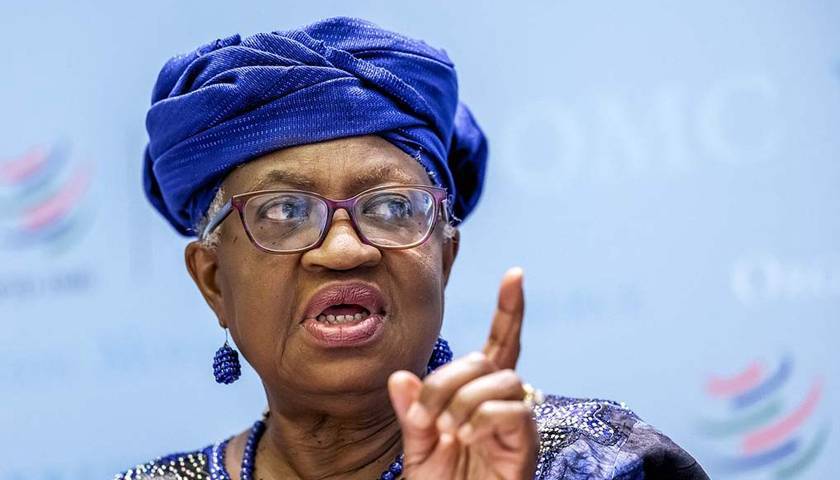
Group 1 - The WTO Director-General warns that tariffs are causing unprecedented damage to the international trade system, with global trade under WTO rules dropping to 72% and expected to decline further [1] - The WTO predicts that global goods trade volume will grow by only 0.9% in 2025, a significant downgrade from the previous forecast of a 2.7% increase, and 2026 growth expectations have been reduced from 2.5% to 1.8% [1] - Brazil has requested dispute consultations with the WTO regarding the U.S. tariff measures, indicating rising tensions in international trade relations [1] Group 2 - South Korea's exports to the U.S. have slowed significantly, with August exports growing by only 1.3%, down from 5.9% in July, and 11 out of 15 major export categories to the U.S. experiencing declines [2] - Japan's exports to the U.S. have also been negatively impacted, with a 10.1% year-on-year decrease in July, marking the largest drop in over four years, particularly in the automotive sector [2] Group 3 - The U.S. manufacturing sector is showing signs of contraction, with the ISM manufacturing index at 48.7 in August, indicating economic activity is shrinking [3] - The Producer Price Index (PPI) in the U.S. rose by 0.9% in July, significantly exceeding market expectations, suggesting inflationary pressures in the upstream supply chain [3] Group 4 - A report from the U.S. Congress warns that ongoing economic uncertainty from tariffs could lead to a 13% average annual reduction in manufacturing investment, totaling a potential loss of $490 billion by 2029 [5] - The tax burden from tariffs is projected to increase, with each American household paying an average of $1,304 in 2023, rising to $1,588 by 2026, which could result in a 1.5% decline in market income [5]
特朗普现在火气很大,对莫迪撂下一句狠话,关键时刻,印度承诺对美零关税,为时已晚!
Sou Hu Cai Jing· 2025-09-03 03:40
Group 1 - The core issue revolves around the tension between the U.S. and India, particularly in the context of tariffs and trade relations, highlighted by Trump's aggressive stance on imposing a 50% tariff on certain Indian exports [1][3][5] - Trump's comments reflect frustration over India's increasing alignment with China and Russia, which undermines U.S. strategic interests in the Indo-Pacific region [3][5][6] - India's response to U.S. tariffs indicates a strategic pivot towards expanding its own markets and strengthening ties with China and Russia, showcasing its independent foreign policy [5][6] Group 2 - The U.S. is concerned about losing its influence over India, as evidenced by internal criticisms within the Trump administration regarding India's dealings with Russia [6] - The relationship between the U.S. and India is characterized by a complex interplay of cooperation and competition, with both nations seeking to maximize their respective interests [5][6] - The evolving dynamics suggest that the U.S. may need to reassess its approach to India, moving away from coercive tactics towards more constructive engagement [6]

股指期货将偏强震荡,黄金期货将震荡偏强,白银、铜、螺纹钢、铁矿石、焦煤、玻璃、纯碱、原油期货将偏强震荡
Guo Tai Jun An Qi Huo· 2025-09-03 02:49
Report Industry Investment Rating No relevant information provided. Core Viewpoints - Through macro - fundamental and technical analysis, the report predicts the trend of today's futures main contracts. Index futures are expected to oscillate strongly, gold futures will oscillate with an upward bias, and silver, copper, rebar, iron ore, coking coal, glass, soda ash, and crude oil futures are likely to oscillate strongly [2]. Summary by Related Catalogs Futures Market Outlook - **Index Futures**: IF2509, IH2509, IC2509, and IM2509 are expected to oscillate strongly on September 3, with specific resistance and support levels provided. For the whole month of September 2025, these contracts are also expected to oscillate strongly with corresponding resistance and support levels [2][17][18]. - **Treasury Futures**: The 10 - year Treasury futures main contract T2512 and the 30 - year Treasury futures main contract TL2512 are likely to oscillate widely on September 3, with resistance and support levels given [2][37][41]. - **Precious Metals Futures**: The gold futures main contract AU2510 is expected to oscillate with an upward bias on September 3 and in September 2025, with resistance and support levels provided. The silver futures main contract AG2510 is likely to oscillate strongly on September 3 and in September 2025, and may hit a new high since listing [2][43][50]. - **Base Metals Futures**: Copper, aluminum, industrial silicon, and polycrystalline silicon futures main contracts are expected to have different trends on September 3 and in September 2025, including strong oscillation, oscillation consolidation, and wide - range oscillation, with corresponding resistance and support levels [3][53][58]. - **Energy and Chemical Futures**: Rebar, hot - rolled coil, iron ore, coking coal, glass, soda ash, crude oil, PTA, PVC, and methanol futures main contracts are likely to oscillate strongly on September 3, with resistance and support levels provided. The trends in September 2025 vary for different contracts [3][4][6]. - **Agricultural Futures**: Soybean meal, soybean oil, and palm oil futures main contracts are expected to oscillate strongly on September 3, with resistance and support levels [6]. Macro News and Trading Tips - China and Russia strengthen cooperation in multiple fields, including signing over 20 bilateral cooperation documents and China implementing a visa - free policy for Russia. The central bank's MLF has a net investment of 300 billion yuan, PSL has a net withdrawal of 160.8 billion yuan, and the outright reverse repurchase has a net investment of 300 billion yuan. The Ministry of Finance and the State Taxation Administration introduce 4 tax - exemption measures to support the operation and management of state - owned equity and cash income transferred to enrich the social security fund [7]. - Some cities may face the possibility of merger or integration due to single industrial structure. Trump will appeal to the US Supreme Court regarding the global tariff case. The Bank of Japan's deputy governor believes that continued interest - rate hikes are appropriate. The US August ISM manufacturing index is slightly up but still below the boom - bust line, and the eurozone's August CPI rises year - on - year [8][9]. Commodity Futures - Related Information - On September 2, gold futures prices broke through upward, with London spot gold breaking through the $3,500 per ounce mark and COMEX gold futures hitting a new high. COMEX silver futures also rose. Geopolitical risks pushed up oil prices, and LME base metals showed mixed trends [9][10]. Stock Market Information - On September 2, the A - share market adjusted, with most indexes falling. The Shanghai Composite Index dropped 0.45%, and the Shenzhen Component Index fell 2.14%. A - share trading volume reached 2.91 trillion yuan. The number of new A - share accounts in August reached 2.6503 million, a significant increase compared to the same period last year. As of September 1, the margin trading balance in the A - share market exceeded the historical peak in 2015 [13][14]. - The Hong Kong Hang Seng Index fell 0.47% on September 2, and the US and European stock markets also closed down. Southbound funds had a net purchase of HK$9.281 billion [16][17].
X @外汇交易员
外汇交易员· 2025-09-03 01:00
特朗普称,政府最快将于当地时间周三向最高法院提出上诉,并警告若早前上诉法院的裁决生效,“将对我们国家造成毁灭性打击”。特朗普表示,“我们将请求最高法院加速裁决,需要尽早获得判决。”“股市下跌正是因为市场需要关税措施,他们渴望关税。”外汇交易员 (@myfxtrader):美国上诉法院裁定特朗普政府征收的全球关税多数不合法,法院认为他在征收这些关税时超越了自己的权限。华盛顿的一个法官小组周五维持了国际贸易法院先前的一项裁决,认为特朗普错误地援引了紧急法律来实施关税。不过,上诉法院同意在10月14日前不执行该裁决,以便给特朗普政府时间向最高法院上诉。 https://t.co/9SnRPgVNng ...
三大指数9月“开门黑”英伟达(NVDA.US)股价四连跌
Zhi Tong Cai Jing· 2025-09-02 22:26
Market Overview - Major U.S. indices closed lower due to rising Treasury yields, causing investor concerns [1] - In August, the Dow Jones increased over 3%, S&P 500 rose nearly 2%, and Nasdaq gained 1.6%, marking the fourth consecutive month of gains for the S&P 500 [1] - As of Tuesday's close, the Dow fell 249.07 points (0.55%) to 45295.81, Nasdaq dropped 175.92 points (0.82%) to 21279.63, and S&P 500 decreased 44.72 points (0.69%) to 6415.54 [1] European Market - European indices also experienced declines, with Germany's DAX30 down 534.22 points (2.22%) to 23488.84, UK's FTSE 100 down 83.99 points (0.91%) to 9112.35, and France's CAC40 down 53.65 points (0.70%) to 7654.25 [1] Asian Market - Asian markets showed positive performance, with Japan's Nikkei 225 up 0.29%, South Korea's KOSPI up 0.94%, and Indonesia's composite index up 0.85% [2] Commodities - Crude oil prices increased, with NY light crude for October delivery rising $1.58 to $65.59 per barrel (2.47% increase) and Brent crude for November up $0.99 to $69.14 per barrel (1.45% increase) [2] Currency - The U.S. dollar index rose 0.69% to 98.382, with the euro trading at 1.1645 USD, the pound at 1.3386 USD, and the yen at 148.28 USD [2] Cryptocurrency - Bitcoin rose 1.66% to $111074.1, while Ethereum increased 0.34% to $4329.05 [3] Precious Metals - Gold prices reached a new historical high, with futures hitting $3600 per ounce, up 2.39%, and spot gold rising 1.64% to $3533.85 [3] - The increase in gold prices is attributed to heightened demand for safe-haven assets amid market uncertainties and expectations of U.S. interest rate cuts [3] U.S. Treasury Yields - The yield on the 10-year U.S. Treasury rose by 3.30 basis points to 4.2614%, while the 2-year yield increased by 2.25 basis points to 3.6392% [3] Corporate News - Google (GOOGL.US) was ruled not to divest Chrome and Android systems but must share data with competitors to enhance market competition [6] - Apple (AAPL.US) continues to experience talent loss in its AI division, with key personnel moving to Meta Platforms (META.US) [7] - Nvidia (NVDA.US) faced a decline in stock price, dropping 4% to $167.22, marking its fourth consecutive day of losses and breaching the 50-day moving average [8] Analyst Ratings - D.A. Davidson raised the target price for Alphabet (GOOGL.US) to $190 [9] - Haitong International increased the target price for Baidu (BIDU.US) from $85 to $95 [9]

美国8月ISM制造业PMI连续六个月萎缩,新订单改善,价格指数再回落
Sou Hu Cai Jing· 2025-09-02 20:05
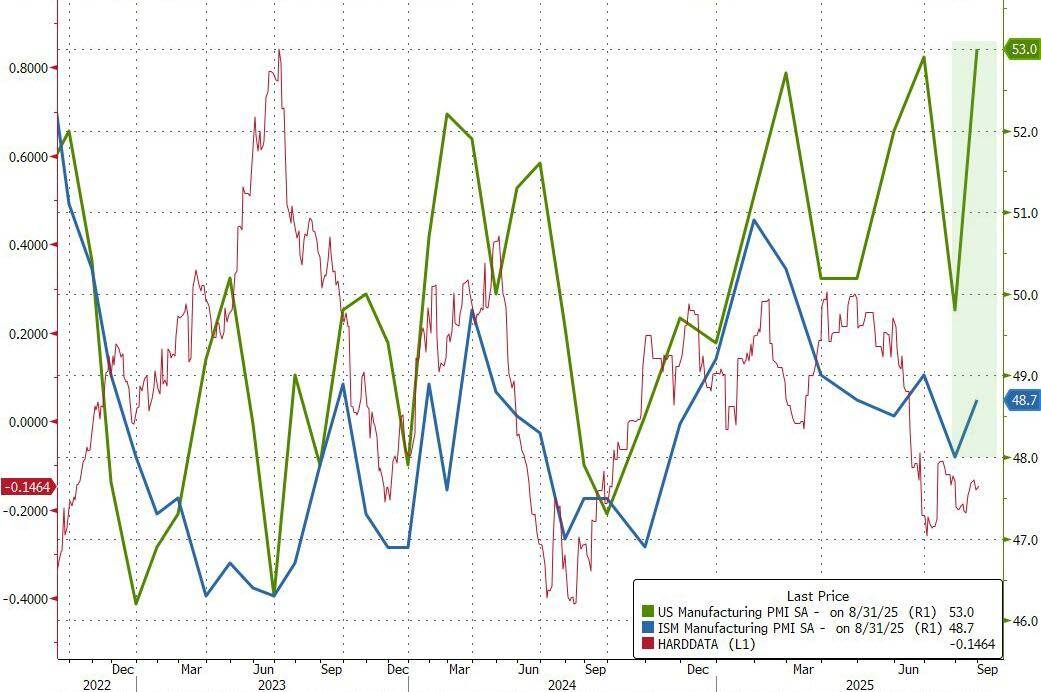
Core Insights - The ISM reported that U.S. manufacturing activity contracted for the sixth consecutive month in August, primarily due to a decline in output, indicating ongoing challenges in the manufacturing sector [1] - However, the new orders index expanded for the first time since the beginning of the year, and the prices index reached its lowest level since February, suggesting a reduction in price volatility caused by tariffs [1] Manufacturing Index Summary - The ISM manufacturing index for August was 48.7, below the expected 49 and previous value of 48, indicating continued contraction as it remains below the neutral level of 50 [1] - The new orders index rose to 51.4, significantly above the expected 48 and previous 47.1, marking the largest monthly increase since early last year [3] - The output index fell to 47.8, dropping 3.6 points and indicating a return to contraction for the first time in three months [3] - The employment index slightly increased to 43.8 but remains one of the weakest levels since the pandemic, below the expected 45 and previous 43.4 [3] - The prices paid index was 63.7, lower than the expected 65 and previous 64.8, indicating a decrease in price pressures [3] Industry Performance - The ISM survey indicated that 10 industries experienced contraction, particularly in paper products, wood, plastics and rubber, and transportation equipment manufacturing, while 7 industries showed expansion [5] - The overall demand remains weak due to tariff uncertainties, with 69% of manufacturing GDP in contraction, although the proportion of industries in severe contraction has slightly decreased [6] Economic Context - Consumer spending in July grew at the fastest pace in four months, driven mainly by expenditures on big-ticket items like automobiles [7] - The Markit manufacturing PMI for August was reported at 53, slightly below the expected 53.3, indicating a robust performance in the manufacturing sector [8] - The chief economist at S&P Global noted that the manufacturing sector showed strong expansion over the summer, with increased hiring to meet new orders and backlogs, suggesting potential economic uplift in Q3 [9]
特朗普引发资本大转向?私募巨头曝料:亚洲和中东客户正抛弃美国
Jin Shi Shu Ju· 2025-09-02 06:04
Group 1 - The impact of the Trump administration's policies is causing top investors from Asia and the Middle East, including sovereign funds, to seek to avoid U.S. assets [2] - Partners Group, managing over $170 billion in assets, reports that many Asian investors are increasingly looking towards non-U.S. assets due to uncertainties related to tariffs and potential trade restrictions [2] - Discussions regarding the avoidance of U.S. exposure have emerged this year, driven by the U.S. government's policies, with some investors requesting to open euro accounts instead of dollar accounts [2] Group 2 - The global financial system is expected to become more fragmented and less integrated as a result of these investment shifts [2] - The CEO of Partners Group emphasizes the importance of stability in U.S. policies for maintaining investor confidence, noting that the current period is critical for demonstrating such stability [2][3] - Despite the challenges posed by U.S. tariffs, the U.S. remains an attractive destination for capital investment in key sectors such as technology and healthcare, according to the private equity business head at Partners Group [3]
人民币破7仍需要更多催化
citic securities· 2025-09-02 03:11
Market Overview - In September, the Chinese stock market opened positively, with A-shares rising, led by gold stocks; the Hang Seng Index experienced fluctuations, with Alibaba (9988 HK) surging 18.5% due to strong earnings[3] - European stock markets closed higher, driven by defense and healthcare sectors; US markets were closed for Labor Day[3][9] Currency and Commodities - The USD/CNY exchange rate reached a year-low of 7.126 on August 29, indicating a strong short-term outlook for the RMB, although further catalysts are needed for it to break below 7[5] - Oil traders expect OPEC+ to maintain current production levels in their upcoming meeting, with crude oil futures showing slight fluctuations[3][27] Fixed Income - US financial markets were quiet due to the holiday, with optimistic sentiment regarding a potential Fed rate cut this month; European bond yields rose amid positive economic data[3][30] - Asian bond markets saw light trading, with Chinese investment-grade bond spreads remaining stable[3] Stock Performance - The A-share market saw the Shanghai Composite Index rise 0.46% to 3,875 points, with a total trading volume of CNY 2.78 trillion; gold futures hit historical highs, boosting gold stocks significantly[17] - In the Hong Kong market, the Hang Seng Index increased by 2.15%, with major tech stocks leading the gains[11] Sector Insights - The electronics sector is experiencing robust growth driven by strong AI demand and domestic substitution; key segments include PCB, domestic chip leaders, and IoT[20] - In the US, companies are absorbing tariff costs rather than passing them on to consumers, which may lead to localized price increases in consumer goods later this year[8]
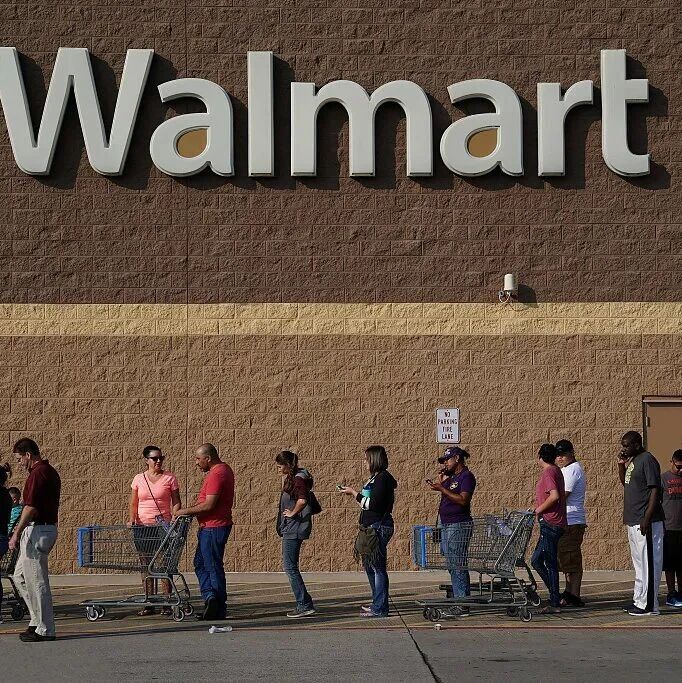
迎接“最糟糕的局面”!美国零售巨头集体警告:关税影响仍在升级,涨价不可避免
美股IPO· 2025-09-02 00:58
Core Viewpoint - The article highlights the escalating pricing pressures faced by U.S. retailers due to tariffs, indicating that the worst may still be ahead for consumers and businesses as higher-cost inventory arrives [1][3][4]. Group 1: Pricing Pressure and Tariffs - Major retailers like Walmart, Target, and Best Buy have reported that tariff-related price increases are beginning to affect food, household goods, and electronics [1][3]. - J.M. Smucker warned of a 22% profit drop in its U.S. coffee business due to tariffs, leading to further price hikes [3]. - Hormel Foods experienced a 12% stock drop after reporting underperformance attributed to rising commodity input costs [3]. Group 2: Economic Uncertainty - A federal appeals court ruling allowed tariffs to remain in effect while the government appeals, creating uncertainty for retailers and consumers regarding future import costs [3]. - Retail executives are concerned about how much cost they can absorb versus how much must be passed on to consumers [4]. Group 3: Consumer Sentiment and Behavior - Consumer confidence has declined, with a nearly 6% month-over-month drop in the University of Michigan's consumer confidence index, and a year-over-year decline exceeding 14% [6][7]. - High-income consumers are still supporting the economy, while low-income consumers are feeling the pinch from tariffs and inflation [6]. Group 4: Shift in Consumer Spending - Consumers are increasingly opting for lower-end products, indicating a shift towards value shopping [8]. - Discount retailers like Dollar Tree, Five Below, and TJX Companies have reported increased demand, with stock prices rising approximately 45%, 37%, and 14% respectively since the beginning of the year [8].