
反内卷政策

Search documents
公募最新策略看好结构性行情
Zhong Guo Zheng Quan Bao· 2025-10-26 21:06
Group 1 - The A-share market is showing resilience amid a complex environment, with a focus on AI technology, cyclical stocks, and large-cap blue chips as key investment directions [1] - The overall liquidity in the domestic market is balanced and slightly loose, leading to a structural market driven by liquidity, with significant trading volume in Q3 [1] - The Hang Seng Index and the US dollar index have a typical negative correlation, with the weakening dollar supporting the Hong Kong stock market [2] Group 2 - Two types of equity assets are highlighted for their investment value: high-dividend blue-chip stocks and high-growth stocks in sectors like renewable energy and AI [2] - The technology sector is expected to see structural opportunities, particularly in AI and robotics, as the government continues to promote technological innovation [3] - The bond market is anticipated to remain volatile, with a focus on defensive strategies and potential opportunities in credit bonds due to a favorable supply-demand dynamic [4]
日度策略参考-20251024
Guo Mao Qi Huo· 2025-10-24 05:40
Report Industry Investment Ratings - No specific industry investment ratings are provided in the text. Core Views of the Report - The short - term outlook for the stock index is expected to be volatile. As the negative factors of trade frictions gradually ease, the stock index is expected to return to the upward channel. Even if short - term macro uncertainties increase, the adjustment space of the stock index is expected to be limited. The strategy is to go long on the stock index when opportunities arise [1]. - Different commodities have different trends. Some are expected to be volatile, some are expected to be strong, and some are influenced by multiple factors such as supply - demand, policies, and geopolitical situations [1]. Summary by Industry Macro - finance - **Stock Index**: Short - term volatility, expected to return to the upward channel later, with limited adjustment space. Strategy: go long when opportunities arise [1]. - **Treasury Bonds**: Volatile. Asset shortage and weak economy are favorable for bond futures, but the central bank's short - term interest rate risk warning suppresses the upward space [1]. - **Gold**: Short - term wide - range volatility. Geopolitical uncertainties and potential Fed rate cuts support the price, but the new round of Sino - US consultations limit the rise [1]. - **Silver**: Volatile in the short - term, and the physical situation in London needs to be monitored [1]. Non - ferrous Metals - **Copper**: Short - term price fluctuations are intensified, but with continuous supply disturbances and an increasing Fed rate - cut expectation, it is expected to be strong [1]. - **Alumina**: With production still profitable, domestic alumina production capacity continues to be released, and production and inventory are increasing. The spot price is under pressure, and cost support needs attention [1]. - **Zinc**: After a short - term rebound, the export window closes again. It is expected to fluctuate within a range, and changes in domestic and foreign inventories need attention [1]. - **Nickel**: Short - term volatility is mainly influenced by the macro situation and may be strong, but high inventory still suppresses the price. Suggestion: short - term low - buying within the range, and there is still pressure from long - term excess of primary nickel [1]. - **Stainless Steel**: The macro situation improves, and the trade friction eases. The stainless steel futures may rebound in the short - term. It is recommended to operate in the short - term and wait for short - selling opportunities at high prices [1]. - **Tin**: Although the short - term impact of the Indonesian ore ban is not significant, the supply risk is high, and there is demand support. It is recommended to pay attention to long - buying opportunities at low prices in the long - term [1]. Black Metals - **Rebar and Hot - rolled Coil**: The industrial driving force is unclear, and the futures valuation is low. Directional trading is not recommended [1]. - **Iron Ore**: The near - month contract is restricted by production cuts, but the commodity sentiment is good, and the far - month contract still has upward potential [1]. - **Silicon Manganese**: Direct demand is good, but supply is high, and inventory is at a high level. The price is under pressure and volatile [1]. - **Silicon Iron**: Short - term production profit is poor, but cost support is strengthening, and direct demand is good. The price is expected to be volatile and the downward space is limited [1]. - **Soda Ash**: Follows the glass market, with a large supply - surplus pressure, and the price is under pressure [1]. - **Coking Coal and Coke**: After the price rebounded to fill the gap, it reached a relatively high level. It may challenge previous highs, but the breakthrough is difficult. It may be in a wide - range volatile market if there is no new policy on "anti - involution" [1]. Agricultural Products - **Palm Oil**: Indonesia's plan to regulate exports is favorable for the far - month contract. The near - month contract lacks new drivers, and it is advisable to wait for the production area to reduce production and destock [1]. - **Soybean Oil**: The pressure from US soybean prices and the support from domestic de - stocking expectations coexist. There is a lack of new drivers, and it is advisable to wait and see [1]. - **Canola Oil**: The negotiation on Canadian canola anti - dumping may bring negative news. The domestic canola is in short supply, and the inventory is decreasing. It is advisable to wait and see for single - side trading, and the inter - month positive spread is expected to rise [1]. - **Cotton**: There is uncertainty in new - year cotton demand. The downside space of the futures is limited, but the basis and the futures may be under pressure due to high production [1]. - **Sugar**: In the short - term, sugar prices are seasonally strong due to typhoon impacts and the gap between old and new crops. In the medium - term, the rebound space is limited after new sugar is listed [1]. - **Corn**: The current stage still focuses on the selling pressure in November. The C01 contract is expected to be in low - level volatility [1]. - **Methanol**: The MO1 contract is expected to be volatile. It is recommended to wait and see or go long in the short - term, and pay attention to Sino - US trade negotiations and South American weather [1]. - **Paper Pulp**: The trading logic is related to the old warehouse receipts of the 11 - contract. With weak downstream demand, it is recommended to do a 11 - 1 reverse spread [1]. - **Logs**: The log fundamentals have declined, and the spot price is firm. It is advisable to wait and see after a sharp decline in the futures [1]. - **Live Pigs**: The spot price has stabilized, but the futures still have a premium. It is necessary to wait for changes in the slaughter volume and weight, and the short - term trend is volatile [1]. Energy and Chemicals - **Fuel Oil**: Influenced by US sanctions on Russia, geopolitical tensions, and the US attitude towards China's tariffs [1]. - **Bitumen**: Short - term supply - demand contradictions are not prominent, following the trend of crude oil. The "14th Five - Year Plan" construction demand is likely to be disproven, and the supply of Ma Rui crude oil is sufficient [1]. - **SBS Rubber**: Supported by strong raw material costs, decreasing intermediate inventory, and a positive commodity market atmosphere [1]. - **BR Rubber**: The cost support is weak, and the supply of synthetic rubber is loose. Attention should be paid to inventory de - stocking [1]. - **PTA**: The price rebounds slightly due to factors such as a decline in domestic production caused by equipment inspections [1]. - **Ethylene Glycol**: The port inventory in East China is low, the cost support is strengthening, and the polyester market has not declined significantly [1]. - **Short - fiber**: Factory equipment is gradually resuming operation, the basis is strengthening, and the price follows the cost [1]. - **Styrene**: The Asian benzene price is weak, the arbitrage window to the US is closed, and domestic styrene plant inspections are increasing [1]. - **Urea**: The export sentiment eases, and domestic demand is insufficient. There is an upper limit to the price, but there is support from "anti - involution" and cost [1]. - **PE**: The price is volatile and slightly strong due to a slight downward adjustment in the crude oil price center, weakened inspection efforts, and slowly increasing downstream demand [1]. - **PP**: The inspection support is limited, the downstream improvement is less than expected, and the price is volatile and weak [1]. - **PVC**: The supply pressure is large, there are many near - month warehouse receipts, and the price is volatile and weak [1]. - **LPG**: There are problems such as planned alumina production in Guangxi, decreasing inspection concentration, and difficult digestion of warehouse receipts. The international oil and gas fundamentals are loose, and the domestic fundamentals are also loose [1].
文字早评:宏观金融类-20251024
Wu Kuang Qi Huo· 2025-10-24 02:25
Report Summary 1. Investment Ratings The provided content does not mention any industry investment ratings. 2. Core Views - The stock market has seen rapid rotation of hot sectors recently, with reduced risk appetite and short - term uncertainty, but the long - term policy support for the capital market remains unchanged, suggesting a long - term strategy of buying on dips [4]. - The bond market may face short - term risk preference decline, which is conducive to its repair. In the fourth quarter, it is necessary to focus on the fundamentals and institutional allocation power. The overall situation may be volatile, and it may repair if the stock market cools down and the allocation power increases [7]. - For precious metals, the Fed's monetary policy is in the early stage of the easing cycle. It is recommended to maintain a long - position strategy, buying on dips [9]. - In the non - ferrous metals market, most metal prices are expected to be strong due to factors such as trade negotiation sentiment improvement and supply - side constraints [12][14]. - In the black building materials market, steel prices may be weak in the short term but have long - term upward potential. Iron ore prices will oscillate due to the tug - of - war between weak reality and macro expectations [33][36]. - In the energy and chemical market, different products have different trends. For example, rubber prices may turn neutral, and crude oil prices are recommended to be observed in the short term [54][56]. - In the agricultural products market, the prices of various products such as hogs, eggs, and grains are affected by supply and demand factors, and corresponding trading strategies are proposed [79][81]. 3. Summary by Category Macro - financial - **Stock Index** - **Market Information**: The Fourth Plenary Session of the 20th Central Committee put forward the main goals for economic and social development during the "15th Five - Year Plan" period. There will be economic and trade consultations between China and the US. The R & D of new - generation batteries is being promoted [2]. - **Strategy**: Short - term uncertainty exists, but long - term buying on dips is recommended [4]. - **Treasury Bond** - **Market Information**: Bond prices declined on Thursday. There will be China - US economic and trade consultations, and the central government held a symposium on the "15th Five - Year Plan" for central enterprises. The central bank conducted reverse repurchase operations with a net withdrawal of funds [5][6]. - **Strategy**: The short - term risk preference decline is beneficial to the bond market repair. The fourth - quarter situation may be volatile, and attention should be paid to the stock - bond seesaw effect [7]. - **Precious Metals** - **Market Information**: Gold and silver prices rose. The US will release September CPI data, and it is expected that the data may be lower than expected, which will support precious metal prices [8]. - **Strategy**: Maintain a long - position strategy and buy on dips [9]. Non - ferrous Metals - **Copper** - **Market Information**: Copper prices rose. LME copper inventory increased, while domestic warehouse receipts decreased. The import of copper spot was at a loss [11]. - **Strategy**: Due to potential supply tightening and improved trade negotiation sentiment, copper prices may remain strong [12]. - **Aluminum** - **Market Information**: Aluminum prices continued to rise. Domestic aluminum ingot and aluminum rod inventories decreased, and the external LME aluminum inventory also decreased [13]. - **Strategy**: With the easing of trade tensions and low domestic inventory, aluminum prices may rise further [14]. - **Zinc** - **Market Information**: Zinc prices rose. Domestic zinc ingot inventory increased, and overseas registered zinc warehouse receipts were at a low level [15]. - **Strategy**: The domestic zinc concentrate inventory decreased, and the overseas market had structural risks. Zinc prices are expected to be strong in the short term [17]. - **Lead** - **Market Information**: Lead prices rose. The lead ore port inventory increased, and the lead ingot social inventory decreased [18]. - **Strategy**: With the improvement of downstream demand and the reduction of inventory, lead prices are expected to be strong in the short term [18]. - **Nickel** - **Market Information**: Nickel prices fluctuated narrowly. The cost of nickel ore was stable, and the price of nickel iron was weak [19]. - **Strategy**: In the short term, it is recommended to wait and see, and consider buying on dips if the price drops significantly [20][21]. - **Tin** - **Market Information**: Tin prices declined slightly. The supply of tin ore was tight, and the demand from traditional industries was weak [22]. - **Strategy**: In the short term, tin prices may remain high and volatile, and it is recommended to wait and see [22]. - **Carbonate Lithium** - **Market Information**: The price of carbonate lithium rose, and the inventory decreased [23]. - **Strategy**: The downstream demand is strong, and the price may face pressure from supply recovery and hedging. It is necessary to pay attention to market changes [24]. - **Alumina** - **Market Information**: The price of alumina rose slightly. The overseas price decreased, and the inventory increased [25]. - **Strategy**: The ore price may be under pressure after the rainy season, and the production capacity of alumina is excessive. It is recommended to wait and see in the short term [26]. - **Stainless Steel** - **Market Information**: The price of stainless steel rose. The social inventory decreased slightly [27]. - **Strategy**: The market confidence has recovered, and the subsequent trend depends on the release of downstream demand [28]. - **Cast Aluminum Alloy** - **Market Information**: The price of cast aluminum alloy rebounded, and the inventory increased [29]. - **Strategy**: The cost supports the price, but the high warehouse receipts limit the upward space [30]. Black Building Materials - **Steel** - **Market Information**: The prices of rebar and hot - rolled coil fluctuated slightly. The inventory of rebar decreased, and the inventory of hot - rolled coil decreased marginally [32]. - **Strategy**: In the short term, steel prices are weak, but in the long term, they may rise due to the loosening of the macro environment [33]. - **Iron Ore** - **Market Information**: Iron ore prices rose. The overseas shipment increased, and the iron water output decreased [34][35]. - **Strategy**: The demand for iron ore is weakening, and the inventory is increasing. The price will oscillate due to the influence of macro expectations [36]. - **Glass and Soda Ash** - **Market Information**: Glass prices rose, and the inventory increased. Soda ash prices rose slightly, and the inventory also increased [37][38]. - **Strategy**: Glass prices are expected to be weak in the short term, and soda ash prices will continue to oscillate weakly [37][38]. - **Manganese Silicon and Ferrosilicon** - **Market Information**: The prices of manganese silicon and ferrosilicon rose slightly. The spot prices were higher than the futures prices [39]. - **Strategy**: The impact of trade frictions may ease. It is recommended to look for opportunities to rebound in the black sector [42][43]. - **Industrial Silicon and Polysilicon** - **Market Information**: Industrial silicon prices rose, and polysilicon prices also rose. The supply of industrial silicon increased, and the polysilicon supply may decrease in the future [44][47]. - **Strategy**: Industrial silicon prices will oscillate, and polysilicon prices will be affected by supply and policy expectations [45][48]. Energy and Chemical - **Rubber** - **Market Information**: Rubber prices rose due to typhoon and stock market factors. The demand is in a seasonal off - season [50]. - **Strategy**: It is recommended to gradually exit short - term long positions and adopt a neutral strategy [54]. - **Crude Oil** - **Market Information**: Crude oil and refined oil prices rose. The US crude oil inventory decreased, and the SPR inventory increased [55]. - **Strategy**: In the short term, it is recommended to wait and see and test OPEC's export price - support intention [56]. - **Methanol** - **Market Information**: Methanol prices rose. The port inventory increased slowly, and the domestic start - up rate decreased [57][58]. - **Strategy**: It is recommended to wait and see due to potential supply disturbances and high port inventory [58]. - **Urea** - **Market Information**: Urea prices rose slightly. The supply increased, and the demand also increased [59][60]. - **Strategy**: It is recommended to wait and see or look for long - position opportunities at low prices [60]. - **Pure Benzene and Styrene** - **Market Information**: Pure benzene prices decreased, and styrene prices increased. The supply of pure benzene was abundant, and the demand for styrene increased [61]. - **Strategy**: The price of styrene may stop falling in the short term due to inventory reduction and seasonal demand [62]. - **PVC** - **Market Information**: PVC prices rose. The production was high, and the demand was weak [63]. - **Strategy**: The supply is strong and the demand is weak. It is recommended to short on rallies in the medium term [64][65]. - **Ethylene Glycol** - **Market Information**: Ethylene glycol prices rose. The supply was high, and the inventory increased [66]. - **Strategy**: It is recommended to short on rallies due to expected inventory accumulation [67]. - **PTA** - **Market Information**: PTA prices rose. The supply increased slightly, and the demand remained stable [68]. - **Strategy**: It is recommended to wait and see due to weak processing fees and uncertain terminal demand [69]. - **Para - xylene** - **Market Information**: PX prices rose. The load was high, and the downstream demand was weak [70][71]. - **Strategy**: It is recommended to wait and see as there is no obvious driving force and it mainly follows the crude oil trend [72]. - **Polyethylene (PE)** - **Market Information**: PE prices rose. The inventory decreased, and the demand increased seasonally [73]. - **Strategy**: PE prices may remain low and oscillate due to high - level warehouse receipts and cost factors [74]. - **Polypropylene (PP)** - **Market Information**: PP prices rose. The supply pressure was high, and the demand rebounded seasonally [75]. - **Strategy**: The overall inventory pressure is high, and the cost supply surplus suppresses the price [76]. Agricultural Products - **Hogs** - **Market Information**: Hog prices fluctuated. The supply and demand were in a stalemate [78]. - **Strategy**: In the short term, hog prices may be strong, but in the medium term, it is recommended to short on rallies [79]. - **Eggs** - **Market Information**: Egg prices were stable with slight increases. The supply was normal, and the demand was average [80]. - **Strategy**: The spot price may have limited upward space, and it is recommended to wait and see [81]. - **Soybean Meal and Rapeseed Meal** - **Market Information**: Soybean meal prices rose. The domestic soybean inventory was high, and the import of US soybeans was uncertain [82]. - **Strategy**: In the short term, there is support, but in the medium term, it is recommended to short on rallies due to the expected abundant supply [84]. - **Oils and Fats** - **Market Information**: Oil prices fell. The palm oil production in Malaysia and Indonesia was high, and the supply pressure was large [85]. - **Strategy**: It is recommended to wait and see for a clearer production signal [86]. - **Sugar** - **Market Information**: Sugar prices rebounded. The production in Brazil is expected to increase, and the prices of domestic processing factories decreased [87]. - **Strategy**: It is recommended to short on rallies in the fourth quarter as the overall supply is expected to increase [89]. - **Cotton** - **Market Information**: Cotton prices rebounded. The new cotton purchase price increased, but the demand was weak [90]. - **Strategy**: The upward space of cotton prices is limited due to weak fundamentals [91].
新能源及有色金属日报:库存小幅增加,短期工业硅多晶硅基本面一般-20251024
Hua Tai Qi Huo· 2025-10-24 01:50
Report Industry Investment Rating No relevant content provided. Core Viewpoints - The fundamentals of industrial silicon and polysilicon are currently average. For industrial silicon, the inventory increased in October, but the supply - demand situation may improve after the southwest region starts to cut production at the end of October. For polysilicon, the overall inventory pressure is high, the production reduction in October was less than expected, and the production in November may decrease, but the downstream production schedule may also weaken [3][7]. - The industrial silicon and polysilicon futures markets are mainly affected by overall commodity sentiment, policy - side news, and anti - involution policies. The market fluctuates greatly, and participants need to pay attention to risk management [3][7]. - The industrial silicon valuation is currently low. If there are relevant capacity - exit policies, the industrial silicon futures market may have room to rise. For polysilicon, it is suitable to layout long positions at low prices in the medium - to - long - term [3][7]. Summary by Relevant Catalogs Industrial Silicon Market Analysis - On October 23, 2025, the industrial silicon futures price showed a strong and volatile trend. The main contract 2511 opened at 8,505 yuan/ton and closed at 8,705 yuan/ton, up 205 yuan/ton (2.41%) from the previous settlement price. The position of the main contract 2511 was 76,195 lots, and the number of warehouse receipts was 48,371 lots, a decrease of 367 lots from the previous day [1]. - The spot price of industrial silicon remained stable. The price of East China oxygen - containing 553 silicon was 9,300 - 9,400 yuan/ton, 421 silicon was 9,500 - 9,800 yuan/ton, Xinjiang oxygen - containing 553 silicon was 8,600 - 8,800 yuan/ton, and 99 silicon was 8,600 - 8,800 yuan/ton. The silicon prices in Kunming, Huangpu Port, the Northwest, Tianjin, Xinjiang, Sichuan, and Shanghai remained slightly stable, and the price of 97 silicon also remained slightly stable [1]. - As of October 23, the total social inventory of industrial silicon in major regions was 559,000 tons, a decrease of 3,000 tons from last week. Among them, the social general warehouse inventory was 123,000 tons, an increase of 3,000 tons from last week, and the social delivery warehouse inventory was 436,000 tons, a decrease of 6,000 tons from last week. Recently, some goods in Xinjiang warehouses have been transferred to Tianjin, resulting in significant regional inventory changes [1]. Consumption End - The quoted price of silicone DMC was 11,000 - 11,300 yuan/ton, a decrease of 150 yuan/ton from last week. The mainstream transaction was concentrated at 11,000 - 11,100 yuan/ton, and the average market price decreased week - on - week. However, the quoted prices of Shandong monomer enterprises and other domestic monomer enterprises remained stable compared to last week [2]. Strategy - The current fundamentals are average. The recent increase in the start - up rate in the Northwest and the fact that the southwest region has not reached the dry season have led to a large increase in inventory in October. The intraday rebound was mainly driven by the sharp rise of commodities such as coking coal. Starting from the end of October, the southwest region will start to cut production, and the supply - demand pattern may improve. The industrial silicon futures market is mainly affected by overall commodity sentiment and policy - side news [3]. - Short - term: Operate within a range. For contracts during the dry season, consider going long on dips [3]. Polysilicon Market Analysis - On October 23, 2025, the main polysilicon futures contract 2511 showed a volatile trend, opening at 50,225 yuan/ton and closing at 50,760 yuan/ton, a change of 1.05% from the previous trading day. The position of the main contract reached 45,407 lots (49,016 lots the previous trading day), and the trading volume was 86,148 lots [4][5]. - The spot price of polysilicon remained stable. The price of N - type material was 50.95 - 55.00 yuan/kg, and the price of n - type granular silicon was 50.00 - 51.00 yuan/kg [5]. - The inventory of polysilicon manufacturers and silicon wafers increased. The latest polysilicon inventory was 25.80 (with a month - on - month change of 1.98%), the silicon wafer inventory was 18.47GW (a month - on - month increase of 6.70%), the weekly polysilicon output was 29,500 tons (a month - on - month decrease of 4.84%), and the silicon wafer output was 14.73GW (a month - on - month increase of 2.65%) [5]. - The prices of domestic N - type 18Xmm silicon wafers were 1.35 yuan/piece, N - type 210mm were 1.70 yuan/piece, and N - type 210R silicon wafers were 1.39 yuan/piece. The polysilicon output in October is expected to be about 133,500 tons, an increase from September, exceeding market expectations. In November, the production in the southwest region will be significantly reduced, and the output is expected to decline [5]. - The prices of battery cells and components remained stable. For example, the price of high - efficiency PERC182 battery cells was 0.27 yuan/W, and the mainstream transaction price of PERC182mm components was 0.67 - 0.74 yuan/W [6]. Strategy - The supply - demand fundamentals of polysilicon are average, with large overall inventory pressure. The production reduction in October was less than expected, and the output in November may decrease month - on - month, but the downstream production schedule may also weaken. The warehouse receipts in November will face cancellation, which will have a certain impact on the futures market. The futures market is currently affected by anti - involution policies and weak market realities, and the policy is still being promoted, resulting in large market fluctuations [7]. - Short - term: Operate within a range. The main contract 11 will fluctuate between 49,000 - 53,000 yuan/ton, and the contract 12 is expected to fluctuate between 50,000 - 57,000 yuan/ton [7].
山西证券研究早观点-20251024
Shanxi Securities· 2025-10-24 01:00
Group 1: Market Trends - The domestic coal price increased in September 2025, leading to a rise in coal imports, with a month-on-month increase of 7.63% despite a year-on-year decrease of 3.34% [5] - The overall market indices showed slight increases, with the Shanghai Composite Index closing at 3,922.41, up 0.22% [2] Group 2: Coal Industry Insights - The coal import volume continued to show a contraction trend, with a cumulative year-on-year decrease of 11.1% from January to September 2025, although the rate of decline is slowing [5] - The domestic coal price is expected to support import demand due to a persistent domestic supply gap, with the price difference between domestic and imported coal likely to widen [5] - Investment opportunities in the coal sector are anticipated for Q4 2025, with expectations of better performance compared to Q3 [5] Group 3: Communication Industry Developments - Broadcom launched the first 800G AI Ethernet network interface card, Thor Ultra, which supports advanced AI networking capabilities [6] - The introduction of the 102.4T CPO switch, TH6-Davisson, is expected to mark 2026 as a significant year for CPO scale shipments, enhancing link stability and energy efficiency [6] - The ESUN Ethernet supernode alliance was introduced, aiming to challenge proprietary high-speed interconnect markets in AI clusters [7] Group 4: Agricultural Sector Analysis - Wens Foodstuff Group reported a year-on-year increase in pig sales by 28.32% for the first three quarters of 2025, with a total of 27.67 million pigs sold [11] - The company’s chicken sales for the same period reached 948 million, reflecting a year-on-year growth of 8.9% [12] Group 5: Tire Industry Overview - Taike Ying specializes in the design and production of tires for mining and construction, with a significant increase in production and export rates from 2016 to 2022 [14] - The company is recognized as a national-level "specialized and innovative" small giant, focusing on user-specific product development [14] Group 6: Ultrasonic Technology Sector - The ultrasonic technology platform company has seen significant growth in revenue, with a 32.5% year-on-year increase in the first half of 2025 [17] - The company is expanding its applications in various sectors, including lithium batteries and semiconductors, benefiting from the acceleration of domestic production [20]
重磅会议闭幕,关注后续政策端利好
Zhong Xin Qi Huo· 2025-10-24 00:52
1. Report Industry Investment Rating - The report does not explicitly provide an overall investment rating for the black building materials industry. However, for individual varieties, the mid - term outlook for most is "oscillation", including steel, iron ore, scrap steel, coke, coking coal, glass, soda ash, ferromanganese, and ferrosilicon [7][8][10]. 2. Core Viewpoints - The black building materials industry chain operates stably. Coal mine supply recovery is slower than expected, supporting coking coal and coke prices, but it's difficult to spread the impact to other varieties in the sector. Meanwhile, with continuous macro and policy expectations, short - term prices of sector varieties will remain oscillating, and attention should be paid to rebound opportunities under the background of policy introduction [2][3]. 3. Summary by Relevant Catalogs 3.1 Iron Element - **Iron Ore**: Overseas mine shipments have slightly increased, and the arrival volume at 45 ports has declined from a high level. The sample daily average output of hot metal continues to decline, and the market's expectation of weakening hot metal has increased. Port inventory continues to accumulate, and the pressure is not significant. The short - term price is expected to oscillate [8]. - **Scrap Steel**: Supply has decreased significantly this week, and demand has also declined. Steel mills' inventories are slightly reduced. The short - term price is expected to follow the trend of finished products [10]. 3.2 Carbon Element - **Coke**: The second round of price increase is likely to be implemented. With short - term rigid demand from steel mills and strong raw materials, the price is expected to oscillate [2]. - **Coking Coal**: Supply is frequently disrupted, and mid - and downstream procurement is active. The fundamentals are healthy, but the upward driving force of furnace materials is limited under the pressure of steel products. The price is expected to oscillate [2]. 3.3 Alloys - **Ferromanganese**: Cost reduction is limited, steel production is at a high level, and macro - policy expectations support the price, but the market supply - demand expectation is pessimistic, and the medium - and long - term price center may decline [2]. - **Ferrosilicon**: High finished product output and stable cost support the price, but the market supply - demand relationship is relatively loose, and the expected upward price limit is limited [2]. 3.4 Glass and Soda Ash - **Glass**: Upstream inventory continues to accumulate, and the short - term price shows an oscillating and weakening trend. In the medium and long term, market - oriented capacity reduction is needed, and the price may continue to oscillate downward [3][12]. - **Soda Ash**: The supply surplus pattern remains unchanged. It is expected to follow macro fluctuations and oscillate widely, and the long - term price center will decline [3]. 3.5 Steel - The inventory of steel continues to decrease, but it is at a moderately high level. The contradiction in the fundamentals needs time to ease. The short - term disk is expected to oscillate at a low level, and attention should be paid to the sustainability of the strengthening of the spread between hot - rolled coils and rebar [7]. 3.6 Commodity Index - On October 23, 2025, the comprehensive index, including the commodity index, commodity 20 index, industrial products index, and PPI commodity index, showed an upward trend, with increases of 0.70%, 0.58%, 1.12%, and 0.86% respectively. The steel industry chain index increased by 0.93% on that day, 2.20% in the past 5 days, decreased by 2.29% in the past month, and decreased by 4.73% since the beginning of the year [102][103].
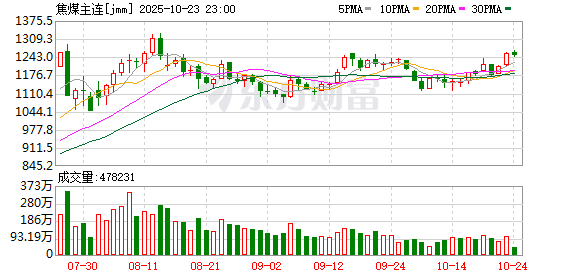
焦煤一周涨逾10%!原因是
Qi Huo Ri Bao· 2025-10-23 23:55
Core Viewpoint - Recent surge in coking coal futures prices, with the main contract rising over 10% since October 15, driven by supply concerns and reduced production from key regions [1][3]. Supply and Demand Dynamics - Significant reduction in Mongolian coal production and customs clearance has raised supply concerns, with domestic coal mine operating rates declining [3]. - A recent report indicated that some coal mines in the Uihai region have ceased operations, affecting approximately 28.3 million tons of capacity, further tightening supply expectations for Q4 [3]. - The overall supply-demand balance has shifted to a tight equilibrium, with prices remaining strong despite recent increases in futures prices [3][4]. Production Statistics - As of October 22, coal mine capacity utilization was reported at 85.1%, down 2.3 percentage points week-on-week, with daily raw coal production at 1.91 million tons, a decrease of 51,000 tons week-on-week [4]. - Raw coal inventories decreased by 183,000 tons to 4.431 million tons, while premium coal production also saw a decline [4]. Market Sentiment and Future Outlook - The trading logic in the coking coal market is shifting from production recovery and weak steel demand to improved macro expectations and policy support [5]. - Anticipation of price increases in coking coal and coke, with potential for further price hikes as downstream steel mills prepare for winter stockpiling [5]. - Analysts expect the upward trend in coking coal prices to continue, driven by macroeconomic factors and supply constraints [5].


焦煤一周涨逾10%!发生了什么?
Qi Huo Ri Bao· 2025-10-23 23:55
Core Viewpoint - Recent surge in coking coal futures prices, with the main contract rising over 10% since October 15, driven by supply concerns and reduced production from Mongolia [2] Group 1: Supply and Demand Dynamics - Significant reduction in Mongolian coal production and customs clearance has raised supply concerns, with domestic coal mine operating rates declining [2] - As of October 22, coal production capacity utilization in China was reported at 85.1%, down 2.3 percentage points week-on-week, with daily raw coal output at 191.0 million tons, a decrease of 5.1 million tons [3] - The supply-demand balance has shifted to tight equilibrium, with prices remaining strong despite recent increases in futures prices [2][3] Group 2: Market Reactions and Future Outlook - The market's trading logic is shifting from expectations of increased coal production and weak steel demand to improved macroeconomic expectations and policy support [4] - Anticipation of further price increases for coking coal and coke, with potential for a third round of price hikes from major coking enterprises [4] - Analysts expect continued upward trends in coking coal prices as downstream steel mills prepare for winter stockpiling [4][5]
大宗商品专场 - 2025秋季策略会 登高望远 穿云破雾
2025-10-23 15:20
Summary of Key Points from Conference Call Industry Overview - **Commodity Market**: The coal market has shown signs of a mid-term bottom, with expectations for a gradual upward trend, providing support for energy prices. The oil and gas markets continue to exhibit a mid-term downward trend, but the decline may be limited due to coal's stabilizing effect [1][2]. Core Insights and Arguments - **Oil Market Dynamics**: The oil market has entered a loose phase, with a shift to a backwardation structure, indicating increased bearish risks. OPEC+ has increased production significantly, and geopolitical tensions have eased, but sanctions have limited actual supply impacts [3][4][5]. - **Demand Weakness**: Oil demand is relatively weak, with a notable decline in China's gasoline and diesel demand, which has contracted by approximately 3% and 5% year-on-year, respectively. This has led to increased pressure on refined oil inventories in Q4 [7][8]. - **Coal Market Stability**: The supply of thermal coal remains stable, with a reduction in imports and a slowdown in the growth of renewable energy substitutes. Non-electric demand for coal is strong, and there is an upward price risk in Q4, with prices expected to peak around 800 RMB/ton [14][15]. Additional Important Insights - **Geopolitical Risks**: Geopolitical risks have been fully priced into the oil market, presenting opportunities for short positions. The mid-term supply-demand balance remains unclear, with non-OPEC production growth expected to decline [10]. - **U.S. Shale Oil Production**: U.S. shale oil production costs are around $50/barrel, with slight increases expected in production this year. A significant reduction in production may not occur until 2026, indicating ongoing competition between OPEC+ and U.S. producers [6]. - **Refined Oil Inventory Pressure**: There is an increasing pressure on refined oil inventories, with a notable accumulation observed in Q4, driven by seasonal factors and reduced operational rates at refineries [8]. Market Trends and Predictions - **Price Forecasts**: Brent crude oil is projected to find support around $57, while WTI is expected to stabilize near $52. The market is currently at a critical juncture, with potential for further declines limited by geopolitical risk premiums [9][10]. - **Fuel Oil Market**: The fuel oil market is characterized by a strong high-sulfur segment, with geopolitical factors influencing prices. However, the low-sulfur segment faces oversupply issues [11][12]. - **Asphalt Market**: The asphalt market is expected to weaken due to reduced demand from the construction sector, with supply constraints anticipated in Q4 [13]. Conclusion - The commodity markets are experiencing significant shifts, particularly in coal and oil, with geopolitical factors and demand dynamics playing crucial roles. Investors should remain vigilant regarding inventory pressures and potential price movements, particularly in the context of ongoing geopolitical developments and market adjustments.
王晋斌:中国经济进入供需再平衡关键期
Zheng Quan Shi Bao Wang· 2025-10-23 13:44
Core Insights - The analysis from the China Macro Economic Forum indicates that China's economy is undergoing a significant structural transformation and upgrading, entering a critical phase of supply-demand rebalancing [1] Economic Indicators - In September, the Consumer Price Index (CPI) decreased by 0.3% year-on-year, with tailing effects dragging down by approximately 0.8 percentage points, while new price changes contributed about 0.5 percentage points [1] - The Producer Price Index (PPI) showed a narrowing year-on-year decline, remaining stable for three consecutive months, indicating reduced downward pressure on industrial prices [1] - The average wage income per capita for residents in the first three quarters was 18,659 yuan, reflecting a growth of 5.4%, which is 0.3 percentage points faster than the overall income growth rate [2] Employment and Income - The nominal wage growth outpaced nominal GDP growth, supporting consumer spending [2] - The proportion of wage income in disposable income stands at 57.4% [2] Financial Market Trends - The yield spread between 10-year government bonds and AAA-rated corporate bonds has shown a narrowing trend, indicating increased risk tolerance in the financial market [2] Production and Sales - Data indicates that industrial production and sales are approaching a favorable state, with improvements in expected cash flow [2] Policy Recommendations - The company suggests four key policy recommendations: 1. Anchor macro policies to gradually raise prices, ensuring continuity in "anti-involution" policies and supporting employment and real estate stabilization [3] 2. Encourage a moderate increase in risk appetite through sustainable equity valuations and potential monetary easing [3] 3. Leverage innovation as a key driver for high-quality economic rebalancing, with continued support for enterprise innovation [3] 4. Balance external demand and unleash internal demand by optimizing the business environment [3]