信用利差

Search documents
【固收】信用债成交活跃度有所上升,信用利差整体呈现走阔态势——信用债月度观察(2025.12)(张旭/秦方好)
光大证券研究· 2026-01-04 23:04
Summary of Key Points Core Viewpoint - The report highlights the current state of credit bond issuance and maturity in China, indicating a decrease in issuance and a mixed performance in net financing across different types of bonds [4][5]. Group 1: Credit Bond Issuance and Maturity - As of December 31, 2025, the total outstanding credit bond balance in China is 31.29 trillion yuan. In December 2025, a total of 1,089.23 billion yuan in credit bonds was issued, representing a month-on-month decrease of 17.19%. The total repayment amount was 912.56 billion yuan, resulting in a net financing of 176.67 billion yuan [4]. - The outstanding balance of local government financing bonds (城投债) is 15.37 trillion yuan. In December 2025, the issuance of local government bonds reached 371.72 billion yuan, which is a month-on-month decrease of 9.19% and a year-on-year decrease of 22.55%. The net financing amount for local government entities was 44.42 billion yuan [4]. - The outstanding balance of industrial bonds (产业债) is 15.92 trillion yuan. In December 2025, the issuance of industrial bonds was 717.52 billion yuan, showing a month-on-month decrease of 20.8% but a year-on-year increase of 22.17%. The net financing for industrial entities was 132.25 billion yuan [4]. Group 2: Credit Bond Transactions and Spreads - In December 2025, the transaction volume of local government bonds was 1,101.40 billion yuan, showing a month-on-month increase but a year-on-year decrease. The turnover rate for local government bonds was 7.17% [5]. - The transaction volume of industrial bonds in December 2025 was 1,473.46 billion yuan, with both month-on-month and year-on-year increases. The turnover rate for industrial bonds was 9.23% [5]. - The credit spreads for local government bonds across various ratings widened compared to the previous month, indicating increased risk perception. Similarly, the credit spreads for industrial bonds also widened across all ratings [5].


【光大研究每日速递】20260105
光大证券研究· 2026-01-04 23:04
Group 1 - The A-share market experienced a steady upward trend in December, with major indices showing increased trading volume and a gradual recovery in market sentiment, indicating a shift from trading factors to fundamental factors dominating the market [4] - The total outstanding credit bonds in China reached 31.29 trillion yuan by the end of December 2025, with a net financing of 176.67 billion yuan for the month, despite a 17.19% month-on-month decline in issuance [4] - The new public fund sales regulations released by the China Securities Regulatory Commission on December 31, 2025, are expected to impact bank wealth management asset allocation behaviors, with public funds held amounting to 1.34 trillion yuan as of Q3 2025 [5] Group 2 - The Hong Kong insurance sector is anticipated to benefit from a strong "opening red" performance, driven by favorable sales in January and a positive investment return outlook due to a stable equity market [6] - The direct and indirect exports of steel, copper, and aluminum are projected to account for 24%, 17%, and 21% of domestic production in 2024, with expectations of improved export conditions in 2026 due to easing US-China trade tensions [6] - The annual long-term electricity price in Guangdong for 2026 is expected to reflect current operating costs of thermal power, with average profitability estimated at 0.02 yuan per kilowatt-hour based on average coal prices from 2025 [7] Group 3 - Tesla's Q4 2025 deliveries fell short of expectations, while NIO regained the top position among new energy vehicle manufacturers in December, with the continuation of the trade-in subsidy policy likely to boost sales in 2026 [8]


史海钩沉系列:“亲历”一次科网泡沫,我们能学到什么?
Minsheng Securities· 2025-12-31 00:42
Market Overview - The tech bubble from 1995 to 2000 was driven by technological advancements, macroeconomic changes, regulatory relaxations, and shifts in monetary policy frameworks[6] - The NASDAQ Composite Index peaked at 5048.62 on March 10, 2000, before a significant sell-off began due to external economic shocks[9] Economic Factors - Labor productivity in the U.S. increased significantly during this period, breaking the long-standing relationship of "low unemployment and high inflation" and contributing to economic resilience[6] - The rapid increase in productivity led to a contraction of the output gap, with inflation remaining subdued despite declining unemployment rates[17] Monetary Policy - The Federal Reserve, under Alan Greenspan, adopted a technology-friendly monetary policy framework, maintaining low interest rates to support economic growth while being cautious about inflation[22] - The Fed's approach evolved to focus on maintaining overall price stability and managing the consequences of asset bubbles rather than attempting to burst them[23] Investment Trends - The number of tech IPOs surged from 1995, peaking in 1999, reflecting a growing investor appetite for technology stocks[9] - In 1998 and 1999, tech stocks experienced a significant rally, with the information technology sector showing returns of 77.64% and 78.44% respectively[32] Risk Factors - The report highlights that excessive liquidity and regulatory relaxation were common characteristics of bubbles, with the potential for chaotic leverage expansion being a critical concern[6] - The experience of the tech bubble serves as a cautionary tale, emphasizing that historical patterns cannot be solely relied upon for future investment decisions[2]
信用债周报:成交规模继续增长,信用利差分化-20251230
BOHAI SECURITIES· 2025-12-30 08:13
Report Industry Investment Rating No information provided in the given content. Core Viewpoints - The issuance guidance rates announced by the National Association of Financial Market Institutional Investors during the period from December 22 to December 28, 2025, showed a differentiated trend, with most high - grade rates declining and most medium - and low - grade rates rising, with an overall change range of - 3 BP to 2 BP [1][15][63]. - The issuance scale of credit bonds decreased compared with the previous period. Corporate bonds remained at zero issuance, the issuance amounts of corporate bonds and private placement notes decreased, while the issuance amounts of medium - term notes and commercial paper increased. The net financing of credit bonds decreased compared with the previous period [1][13][63]. - In the secondary market, the trading volume of credit bonds increased compared with the previous period. The trading volumes of corporate bonds, corporate bonds, medium - term notes, and private placement notes increased, while the trading volume of commercial paper decreased [1][19][63]. - The yields of most credit bonds declined during this period. The credit spreads of medium - and short - term notes, corporate bonds, and urban investment bonds were differentiated, with most 1 - year and 7 - year spreads widening and most 3 - year and 5 - year spreads narrowing [1][22][63]. - From the perspective of absolute return, the shortage of supply and relatively strong allocation demand will promote the continued recovery of credit bonds. In the long run, the yields are still in a downward channel, and the idea of increasing allocation during adjustments is still feasible. From the perspective of relative return, although the compression space of credit spreads at all tenors is insufficient, the probability of unilateral callback in the short term is also small. Therefore, it is still possible to achieve the coupon strategy through credit downgrade and extending the duration [1][63]. Summary by Directory 1. Primary Market Situation 1.1 Issuance and Maturity Scale - From December 22 to December 28, 2025, a total of 211 credit bonds were issued, with an issuance amount of 254.432 billion yuan, a 2.51% decrease compared with the previous period. The net financing of credit bonds was 42.433 billion yuan, a decrease of 18.343 billion yuan compared with the previous period [13]. - Corporate bonds had zero issuance, with a net financing of - 6.252 billion yuan, an increase of 0.498 billion yuan compared with the previous period. Corporate bonds issued 74 bonds, with an issuance amount of 49.363 billion yuan, a 46.55% decrease compared with the previous period, and a net financing of 15.757 billion yuan, a decrease of 29.511 billion yuan compared with the previous period. Medium - term notes issued 66 bonds, with an issuance amount of 109.469 billion yuan, a 30.15% increase compared with the previous period, and a net financing of 78.532 billion yuan, an increase of 37.169 billion yuan compared with the previous period. Commercial paper issued 60 bonds, with an issuance amount of 90.117 billion yuan, a 23.36% increase compared with the previous period, and a net financing of - 44.152 billion yuan, a decrease of 25.187 billion yuan compared with the previous period. Private placement notes issued 11 bonds, with an issuance amount of 5.483 billion yuan, a 52.24% decrease compared with the previous period, and a net financing of - 1.452 billion yuan, a decrease of 1.312 billion yuan compared with the previous period [13]. 1.2 Issuance Interest Rates - The issuance guidance rates announced by the National Association of Financial Market Institutional Investors were differentiated, with most high - grade rates declining and most medium - and low - grade rates rising, with an overall change range of - 3 BP to 2 BP. By tenor, the 1 - year variety had an interest rate change range of - 2 BP to 0 BP, the 3 - year variety had an interest rate change range of - 3 BP to 2 BP, the 5 - year variety had an interest rate change range of - 3 BP to 2 BP, and the 7 - year variety had an interest rate change range of - 2 BP to 1 BP. By grade, the key AAA - grade and AAA - grade varieties had an interest rate change range of - 3 BP to - 1 BP, the AA + - grade variety had an interest rate change range of - 1 BP to 2 BP, the AA - grade variety had an interest rate change range of 0 BP to 2 BP, and the AA - - grade variety had an interest rate change range of 0 BP to 1 BP [15]. 2. Secondary Market Situation 2.1 Market Trading Volume - From December 22 to December 28, 2025, the total trading volume of credit bonds was 1.030617 trillion yuan, a 7.72% increase compared with the previous period. Corporate bonds, corporate bonds, medium - term notes, commercial paper, and private placement notes traded 28.754 billion yuan, 446.075 billion yuan, 347.636 billion yuan, 145.597 billion yuan, and 62.555 billion yuan respectively [19]. 2.2 Credit Spreads - In medium - and short - term notes, the credit spreads of each variety were differentiated. The 1 - year credit spreads widened; among the 3 - year notes, the credit spreads of AA - grade and AA - - grade widened, while the spreads of AAA - grade and AA + - grade narrowed; the 5 - year credit spreads narrowed; among the 7 - year notes, the credit spread of AAA - grade narrowed, while the spread of AA + - grade widened [22]. - In corporate bonds, the credit spreads of each variety were differentiated. The 1 - year AAA - grade credit spread narrowed, while the spreads of other varieties widened; among the 3 - year notes, the credit spreads of AAA - grade and AA + - grade narrowed, while the spreads of AA - grade and AA - - grade widened; the 5 - year credit spreads narrowed; among the 7 - year notes, the credit spread of AAA - grade narrowed, while the spreads of other varieties widened [27]. - In urban investment bonds, the credit spreads of each variety were differentiated. The 1 - year credit spreads widened; the 3 - year credit spreads narrowed; among the 5 - year notes, the credit spreads of AAA - grade and AA + - grade narrowed, while the spreads of AA - grade and AA - - grade widened; among the 7 - year notes, the credit spread of AAA - grade narrowed, while the spreads of other varieties widened [37]. 2.3 Term Spreads and Rating Spreads - For AA + medium - and short - term notes, the 3Y - 1Y term spread narrowed by 1.20 BP, the 5Y - 3Y term spread narrowed by 3.20 BP, and the 7Y - 3Y term spread widened by 3.22 BP. The 3Y - 1Y term spread was at a low - to - middle historical percentile (21.6%), the 5Y - 3Y term spread was at a low - to - middle historical percentile (34.5%), and the 7Y - 3Y term spread was at a historical median (41.9%). In terms of rating spreads, the (AA - )-(AAA) spread of 3 - year medium - and short - term notes widened by 3.00 BP, the (AA)-(AAA) spread widened by 3.00 BP, and the (AA + )-(AAA) spread widened by 2.00 BP [47]. - For AA + corporate bonds, the 3Y - 1Y term spread narrowed by 3.69 BP, the 5Y - 3Y term spread widened by 3.12 BP, and the 7Y - 3Y term spread widened by 8.55 BP. The 3Y - 1Y term spread was at a historical low (12.2%), the 5Y - 3Y term spread was at a low - to - middle historical percentile (36.3%), and the 7Y - 3Y term spread was at a historical median (42.9%). In terms of rating spreads, the (AA - )-(AAA) spread of 3 - year corporate bonds widened by 6.00 BP, the (AA)-(AAA) spread widened by 6.00 BP, and the (AA + )-(AAA) spread remained unchanged from the previous period [52]. - For AA + urban investment bonds, the 3Y - 1Y term spread narrowed by 0.72 BP, the 5Y - 3Y term spread narrowed by 1.67 BP, and the 7Y - 3Y term spread widened by 2.25 BP. The 3Y - 1Y term spread was at a low - to - middle historical percentile (20.3%), the 5Y - 3Y term spread was at a low - to - middle historical percentile (31.2%), and the 7Y - 3Y term spread was at a historical median (46.8%). In terms of rating spreads, the (AA - )-(AAA) spread of 3 - year urban investment bonds narrowed by 1.00 BP, the (AA)-(AAA) spread widened by 1.00 BP, and the (AA + )-(AAA) spread remained unchanged from the previous period [54]. 3. Credit Rating Adjustment and Default Bond Statistics 3.1 Credit Rating Adjustment Statistics - From December 22 to December 28, 2025, a total of 2 companies had their ratings (including outlooks) adjusted, both of which were upgrades. They were Wenzhou Transportation Development Group Co., Ltd. and Guangxi Energy Group Co., Ltd. [60]. 3.2 Default and Extension Bond Statistics - There were no credit bond defaults during the period from December 22 to December 28, 2025. One issuer, Bohai Leasing Co., Ltd., had its credit bonds extended, namely "18 Bojin 03" and "18 Bozu 05", with a total bond balance of 823 million yuan at the time of extension [62]. 4. Investment Viewpoints - The overall idea is to continue to be optimistic about the credit bond market in the long term, but pay attention to short - term fluctuations. In terms of configuration, the coupon strategy can be moderately optimistic, and the trading strategy can be kept optimistic. When selecting bonds, focus on the trend of interest - rate bonds and the coupon value of individual bonds. At the same time, it is possible to achieve the coupon strategy through credit downgrade and extending the duration according to one's own capital characteristics, but pay attention to the rhythm [1][63].
2025年11月银行间本币市场运行报告
Sou Hu Cai Jing· 2025-12-30 03:21
Group 1: Money Market Overview - The average daily trading volume in the money market increased to 7.86 trillion yuan in November, a 2.3% month-on-month rise, with total trading volume reaching 157.2 trillion yuan, up 13.7% month-on-month [2] - The central bank conducted a net injection of 600 billion yuan in medium to long-term funds, maintaining a balanced and accommodative liquidity environment, while the main repo rates saw a slight increase [3] - The average daily balance in the money market decreased to 12.5 trillion yuan, down 1.7% month-on-month, with net lending balances from large commercial banks and policy banks also declining by 11.3% and 3% respectively [5] Group 2: Bond Market Activity - The issuance of bonds in the primary market increased to 4.7 trillion yuan in November, a 21.2% month-on-month rise, with net financing reaching 2.18 trillion yuan, up 119.3% month-on-month [6] - The trading volume of bonds also saw an increase, with 30.3 trillion yuan in total transactions, reflecting a 3% month-on-month growth [7] - Long-term bond yields experienced fluctuations, with the 10-year government bond yield mostly ranging between 1.8% and 1.85%, and the yield curve steepening [8] Group 3: Interest Rate Swaps - The interest rate swap curve shifted upward, with the 6-month, 1-year, and 5-year SHIBOR 3M swap rates increasing by 2 and 6 basis points respectively [9] - The average daily transaction volume in the RMB interest rate swap market decreased by 7.8% month-on-month, with a total nominal principal of 3.7 trillion yuan [9]

信用债市场动态跟踪:年末再看产业债市场
EBSCN· 2025-12-29 10:27
Group 1: Report Industry Investment Rating - Not mentioned in the provided content Group 2: Core Viewpoints of the Report - The report conducts a comprehensive analysis of the primary and secondary markets of industrial bonds in 2025, as well as a financial analysis of different industries, aiming to provide investors with a reference for investment decisions [1][34][61] Group 3: Summary by Directory 1. Primary Market - As of December 26, 2025, a total of 15,700 narrow - caliber credit bonds have been issued in 2025, with a total scale of 13.91 trillion yuan. After excluding urban investment bonds, 7,440 industrial bonds have been issued, with a total scale of 8.60 trillion yuan, covering 29 Shenwan primary industries [1][10] - 16 industries have an annual issuance scale exceeding 100 billion yuan, with the top - ranked industries in terms of issuance scale being public utilities (1.95 trillion yuan/1,060 bonds), non - bank finance (1.38 trillion yuan/1,407 bonds), and transportation (1.00 trillion yuan/805 bonds) [1][13] - In terms of bond types, medium - term notes, short - term financing bills, and corporate bonds have relatively high issuance amounts, accounting for 41.3%, 34.6%, and 23.0% respectively. Among special varieties, the annual issuance scale of science and technology innovation bonds accounts for over 20%, and that of green bonds accounts for 4% [16] - The scale of industrial bonds issued by central and local state - owned enterprises accounts for over 90%, and the issuers' credit ratings are mainly concentrated at the AAA level. Geographically, Beijing has the largest issuance scale, followed by Guangdong, Shanghai, and Jiangsu [20] - In terms of issuance term, the issuance scale of industrial bonds with a term of 1 year or less is the largest, accounting for 35.7%, followed by 1 - 3 years (35.1%) and 3 - 5 years (19.8%) [28] - In terms of issuance interest rate, the proportion of industrial bonds with a coupon rate of 2% or less is the highest, reaching 57%, followed by 2% - 3% (40%), and the average annual issuance coupon rate is 2.15% [31] 2. Secondary Market 2.1 Trend Review - Since the beginning of the year, affected by policies, funds, and market preferences, the yield of credit bonds has experienced two rounds of first rising and then falling, showing an M - shaped trend, which can be divided into four stages [34] - From the beginning of the year to mid - March, the yield rose rapidly, and the credit spread widened to the highest level of the year. From late March to early July, the yield declined continuously, and the credit spread narrowed. From mid - July to the end of September, the yield rose again, and the credit spread widened. From October to now, the yield has declined fluctuantly, and the credit spread first narrowed and then widened [34][35][36] 2.2 Overview of Outstanding Industrial Bonds - As of December 26, 2025, there are 13,625 outstanding industrial bonds in the narrow - caliber credit bond market, with a total scale of 15.39 trillion yuan, covering 29 Shenwan primary industries [39] - The public utilities and non - bank finance industries have an outstanding industrial bond scale of over 2 trillion yuan, significantly leading other industries. The issuers of outstanding industrial bonds are mainly concentrated in high - grade central and local state - owned enterprises [39][41] - The weighted average remaining term of outstanding industrial bonds is 3.08 years. Industries with a longer weighted average remaining term include comprehensive, communication, and coal, while industries with a shorter term include media, light manufacturing, and national defense and military industry [46][49] - In terms of implicit ratings, AA(2) and AA - rated industrial bonds account for 25% in total, ranking first, followed by AA+ (24%) and AAA (19%) [52] - Taking AAA - rated industrial bonds as an example, industries such as real estate, coal, and pharmaceutical biology have relatively high spreads, with certain yield - mining potential [58] 3. Industry - Specific Financial Analysis 3.1 Profitability - In the first three quarters of 2025, the total revenue of industrial bond issuers reached 53.88 trillion yuan, a year - on - year decrease of 3.50%. Among the 29 industries, 11 industries achieved year - on - year positive growth in total revenue, with machinery and equipment and computer industries leading in revenue growth [62] - The total net profit of industrial bond issuers reached 2.43 trillion yuan, a year - on - year decrease of 3.32%. 16 industries achieved year - on - year positive growth in total net profit, with textile and apparel and steel industries leading in growth [62] - The non - bank finance industry has a net profit margin of over 30%, far higher than other industries, followed by environmental protection and public utilities industries, with a net profit margin of over 10% [62] 3.2 Debt Situation - As of the end of the third quarter of 2025, industries such as building decoration and real estate have relatively high debt pressure, with an asset - liability ratio of over 70%, while industries such as national defense and military industry and media have relatively low debt pressure, with an asset - liability ratio of less than 50% [64] - The total interest - bearing debt of industrial bonds reached 86.35 trillion yuan, a year - on - year increase of 8.58%. Only 4 industries, including communication, textile and apparel, electronics, and real estate, saw a year - on - year decrease in total interest - bearing debt [64] - Industries such as non - bank finance, public utilities, and social services have a relatively high proportion of interest - bearing debt to total liabilities, over 70%, while industries such as automobile and national defense and military industry have a relatively low proportion, less than 45%, with relatively low debt - repayment pressure [64] 3.3 Debt - Repayment Ability - As of the end of the third quarter of 2025, industries with strong short - term debt - repayment ability include textile and apparel, national defense and military industry, media, and light manufacturing, with a coverage ratio of monetary funds to short - term debt of over 100%, while industries such as non - bank finance, steel, and petroleum and petrochemical have relatively weak short - term debt - repayment ability, with a coverage ratio of less than 50% [66] 3.4 Cash Flow Situation - In the first three quarters of 2025, the net inflow of operating cash flow of industrial bond issuers increased by 18.40% year - on - year. Among the industries with positive operating cash flow, 12 industries, including comprehensive and real estate, achieved year - on - year positive growth [68] - The net inflow of financing cash flow of industrial bond issuers increased by 145.37% year - on - year. Among the industries with positive financing cash flow, 6 industries, including electronics and environmental protection, achieved year - on - year positive growth [68] - The net outflow of investment cash flow of industrial bond issuers increased by 14.33% year - on - year, with an overall increase in investment expenditure. All 29 industries had a net outflow of investment cash flow, and 19 industries, including comprehensive and computer, saw an increase in investment expenditure [68]
2026年趋势与策略:“十五五”开局下的信用债图景:2026年趋势与策略
Zhong Cheng Xin Guo Ji· 2025-12-29 09:01
Group 1 - The credit bond market is expected to experience moderate growth in issuance, with a projected net financing scale of 1.8 to 2.3 trillion yuan and total issuance between 16.9 to 17.4 trillion yuan in 2026, reflecting a year-on-year increase of approximately 3% to 6% [4] - The issuance of industrial bonds has been robust, with a total issuance of 8.13 trillion yuan from January to November 2025, representing a year-on-year increase of 14.52%, while the net financing scale reached 2.05 trillion yuan, up 52.24% [16] - The issuance of innovative bond varieties has significantly expanded, with a total issuance of 30.24 trillion yuan from January to November 2025, an increase of 122.1 billion yuan year-on-year, driven by the establishment of the "Technology Board" [22][23] Group 2 - The secondary market for credit bonds has shown steady trading activity, with total bond transactions reaching 384.89 trillion yuan from January to November 2025, a 0.91% increase from the previous year [33] - Credit spreads have narrowed to historical lows, with the spreads for various grades of bonds generally decreasing by 3 to 74 basis points compared to the beginning of the year, indicating a tightening of credit risk premiums [42] - The yield on credit bonds has exhibited an "M-shaped" fluctuation pattern, with yields remaining at relatively low levels, particularly for AAA-rated short-term notes, which are below the 25th percentile since 2014 [36][40]
信用分析周报(2025/12/22-2025/12/26):年末信用利差低位窄幅波动-20251229
Hua Yuan Zheng Quan· 2025-12-29 05:01
1. Report Industry Investment Rating The document does not provide the industry investment rating. 2. Core View of the Report The report analyzes the credit market from December 22 - December 26, 2025. It shows that the primary - market credit bond issuance and net financing increased, while the repayment decreased, and the asset - backed securities' net financing decreased. In the secondary market, the trading volume of credit bonds increased, and the yield and credit spread of different bonds fluctuated. There were also negative credit events. Investment suggestions are provided for different types of bonds in 2026 [3][5][6]. 3. Summary by Relevant Catalogs 3.1 This Week's Credit Hot Events - "22 Vanke MTN005" multiple extension proposals were not approved, and only the extension of the principal and interest payment grace period to 30 trading days was agreed. The grace period for the bond with a scale of 3.7 billion yuan expires on February 10, 2026. Vanke's debt disposal for public and non - standard debts may be different, and a lack of clear credit enhancement for public debts may lead to increased risks [9][10][12]. - The Shanghai Stock Exchange issued the "Shanghai Stock Exchange Bond Continuation Business Guide No. 5 - Corporate Bond Trustee Management", aiming to clarify trustee responsibilities, encourage active credit management, and improve business quality and efficiency [13]. 3.2 Primary Market 3.2.1 Net Financing Scale - Credit bond (excluding asset - backed securities) net financing was 213.8 billion yuan, an increase of 98.7 billion yuan. The total issuance was 421.3 billion yuan (up 56.9 billion yuan), and the total repayment was 207.5 billion yuan (down 41.8 billion yuan). Asset - backed securities' net financing was 20.6 billion yuan, a decrease of 2.9 billion yuan [15]. - By product type, the net financing of urban investment bonds was 28.6 billion yuan (up 8.4 billion yuan), industrial bonds was 68.3 billion yuan (down 2.6 billion yuan), and financial bonds was 117 billion yuan (up 92.9 billion yuan) [15]. - In terms of issuance and redemption quantity, urban investment bonds' issuance decreased by 14 and redemption decreased by 22; industrial bonds' issuance decreased by 42 and redemption increased by 7; financial bonds' issuance increased by 4 and redemption decreased by 17 [17]. 3.2.2 Issuance Cost - The issuance rate of AA financial bonds remained above 3%, while the rates of AA + urban investment bonds and AAA financial bonds increased slightly. Other bonds' rates decreased to varying degrees. Specifically, the rates of AA urban investment bonds and AA + financial bonds dropped by 53BP and 50BP respectively [21]. 3.3 Secondary Market 3.3.1 Trading Situation - The trading volume of credit bonds (excluding asset - backed securities) increased by 83.7 billion yuan. Urban investment bonds' trading volume was 285.6 billion yuan (up 26.2 billion yuan), industrial bonds was 364.7 billion yuan (down 2.7 billion yuan), and financial bonds was 687.7 billion yuan (up 60.2 billion yuan). Asset - backed securities' trading volume was 20.4 billion yuan (down 5.1 billion yuan) [22]. - Regarding turnover rate, the overall credit bond turnover rate showed mixed changes. Urban investment bonds' turnover rate was 1.83% (up 0.17pct), industrial bonds was 1.88% (down 0.02pct), financial bonds was 4.43% (up 0.37pct), and asset - backed securities was 0.52% (down 0.15pct) [23]. 3.3.2 Yield - The yield of credit bonds with different ratings and maturities fluctuated within 4BP. For example, the yields of 1 - year AA, AAA -, and AAA + credit bonds fluctuated within 1BP, and the yields of 5 - year AA, AAA -, and AAA + credit bonds compressed by 3BP, 4BP, and 2BP respectively [25]. 3.3.3 Credit Spread - Overall, the credit spread of the AA + textile and apparel industry compressed by 12BP, while the spreads of the AAA real estate and AA + pharmaceutical and biological industries widened by 7BP and 9BP respectively. Other industries' spreads fluctuated within 5BP [30]. - For urban investment bonds, the short - term (within 1Y) spread widened by 4BP, and other maturities' spreads fluctuated within 2BP. Regionally, most urban investment bond spreads in different regions widened slightly [32][34]. - For industrial bonds, the short - term credit spread widened significantly, while the spreads of bonds over 1Y compressed to varying degrees [38]. - For bank capital bonds, the spreads of bank Tier 2 and perpetual bonds within 5Y widened significantly, while the spreads of long - term bonds over 5Y fluctuated within 2BP [40]. 3.4 This Week's Bond Market Negative News Two entities' four bond implicit ratings were downgraded, and Bohai Leasing Co., Ltd.'s two bonds announced extensions [4][41]. 3.5 Investment Suggestions - For urban investment bonds, short - duration (within 2Y) bonds can be used as a base position, and high - quality urban investment entities with a duration of 3 - 5Y can be selected to increase returns [6]. - For industrial bonds, high - quality central and state - owned enterprise bonds can be used as a base position with a longer duration, and industries with marginal improvement should be focused on [6]. - For Tier 2 and perpetual bonds, trading opportunities of bonds with good liquidity (preferably 3 - 5Y AAA -) should be grasped, and bonds of high - quality city commercial banks and rural commercial banks in economically developed and debt - resolution - advanced regions should be considered [6].

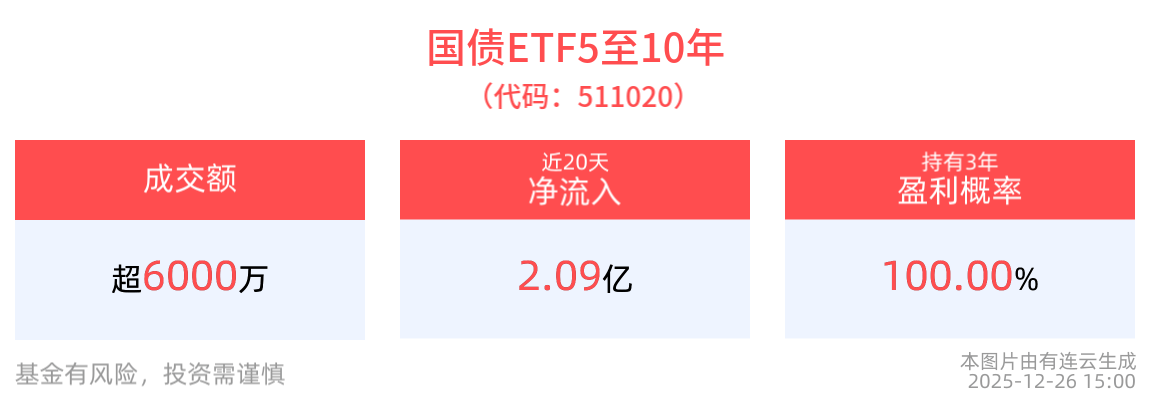
成交额超6000万元,国债ETF5至10年(511020)近20个交易日净流入2.09亿元
Sou Hu Cai Jing· 2025-12-29 01:51
Group 1 - The current futures IRR level is above 1.7%, slightly higher than funding rates and certificate of deposit rates, indicating that the cost of hedging is not high amid concerns about bond market adjustment risks [1] - Two strategies for national bond futures are suggested: 1) Opportunities in short-end credit spreads under loose funding conditions, such as hedging strategies between short-end credit and medium-term national development bonds with TF/TS; 2) Observing the central bank's bond purchases and easing conditions to identify opportunities for flattening the yield curve as short-end rates decline [1] - For medium to long-term bonds, attention should be paid to the convexity points around 8 years for national development bonds, and around 5 years for medium-term bonds [1] Group 2 - As of December 26, 2025, the active bond index for 5-10 year national bonds increased by 0.03%, while the national bond ETF for the same duration rose by 0.05%, with the latest price at 115.37 yuan [3] - The trading volume for the national bond ETF 5-10 years was 3.28% with a transaction value of 60.14 million yuan, and the average daily transaction over the past month was 794 million yuan [3] - The latest scale of the national bond ETF 5-10 years reached 1.84 billion yuan, with a net outflow of 1.73 million yuan recently, but a total inflow of 20.9 million yuan over the last 20 trading days [3] Group 3 - The national bond ETF 5-10 years has seen a net value increase of 21.17% over the past five years, ranking 32 out of 189 in index bond funds, placing it in the top 16.93% [3] - The fund has recorded a maximum monthly return of 2.58% since inception, with the longest consecutive monthly gains lasting 10 months and a maximum increase of 5.81% [3] - The historical probability of profit over three years is 100%, with a monthly profit probability of 70.39% [3] Group 4 - The maximum drawdown for the national bond ETF 5-10 years in the last six months was 1.09%, with a relative benchmark drawdown of 0.58% [4] - The management fee for the national bond ETF 5-10 years is 0.15%, and the custody fee is 0.05% [4] - The tracking error for the national bond ETF 5-10 years over the last two months was 0.022%, closely tracking the active bond index for 5-10 year national bonds [4]
300亿信任托付,稳见投资每一步——公司债ETF(511030)与您共赴星辰大海
Sou Hu Cai Jing· 2025-12-29 01:45
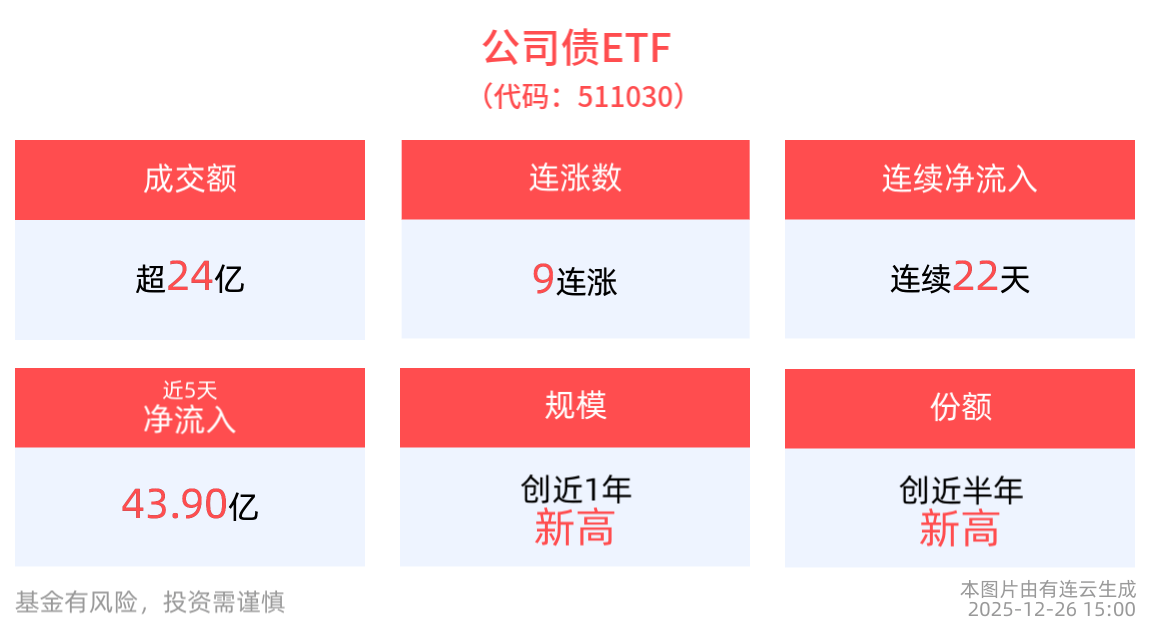
Group 1 - The core viewpoint of the articles indicates a downward trend in credit bond yields, with a notable performance in the 3-5 year segment, while the 1-year credit spread has widened [1][2] - The credit bond yield has generally decreased, with specific declines in AA- rated urban investment bonds and AAA rated medium-term notes by -3.86 and -3.21 basis points respectively [1] - The 5-year credit spreads for AAA rated urban investment bonds and medium-term notes have narrowed by -4.53 and -4.41 basis points respectively, while the 1-year credit spreads for AAA and AA+ rated perpetual bonds have widened by +6.03 basis points [1] Group 2 - Market analysts suggest focusing on the certainty of the carry value of medium to short-term credit bonds amidst increased volatility in the bond market [2] - The primary factors influencing the bond market include supply-demand imbalance, policy expectation discrepancies, and mid-term inflation expectations, with fundamentals and liquidity not being the main drivers [2] - There is a recommendation to consider high-grade credit bonds with maturities of 3-5 years, especially in light of the upcoming open periods for amortized bond funds [2] Group 3 - The company bond ETF has seen a 0.02% increase, marking a nine-day consecutive rise, with a year-to-date increase of 1.61% [5] - The trading volume for the company bond ETF reached 24.07 billion yuan, with a turnover rate of 7.55% [5] - The latest scale of the company bond ETF has reached 31.858 billion yuan, a new high in nearly a year, with a total of 2.98 billion shares, also a recent high [5] Group 4 - The company bond ETF closely tracks the China Bond - High-Grade Corporate Bond Spread Factor Index, which serves as a benchmark for investing in high-grade corporate bonds [6] - The index is based on AAA-rated corporate bonds and is adjusted quarterly to reflect market conditions [6]