
股债性价比

Search documents
周观:从股债性价比角度看债市点位(2025年第35期)
Soochow Securities· 2025-09-07 09:35
1. Report Industry Investment Rating - No relevant information provided 2. Core Viewpoints of the Report - This week (2025.9.1 - 2025.9.5), the yield of the 10 - year active treasury bond decreased by 1.25bp to 1.7675%. The stock - bond relationship remains an important theme this year. The ERP indicator is used to measure the stock - bond cost - performance. It is expected that the ERP will fall back to the central value, and the 10Y treasury bond yield will rise moderately, with the top at 1.85% [1][10][14] - Gold has strong allocation value currently. The short - end of US bonds has higher winning probability, and the long - end has higher odds. The long - end's higher volatility and long - duration may become the key to allocation [1][15] - The US ISM manufacturing PMI has been contracting for six consecutive months, while the service PMI has expanded at the fastest pace in half a year, exceeding market expectations. The US labor market is cooling, strengthening the market's expectation of the Fed's interest rate cut this month [17][18][20] 3. Summary by Relevant Catalogs 3.1 One - Week Viewpoints - **Stock - Bond Cost - Performance Assessment**: This week, the 10 - year active treasury bond yield decreased from 1.78% to 1.7675%. The daily fluctuations were affected by factors such as regulatory statements, capital conditions, stock market trends, and policy expectations [10][11] - **Analysis of US Bond Yield Trends**: Gold has strong allocation value. The short - end of US bonds has higher winning probability, and the long - end has higher odds. The US ISM manufacturing PMI has contracted for six consecutive months, and the service PMI has expanded rapidly. The labor market is cooling, and the market expects the Fed to cut interest rates this month [15][17][20] 3.2 Domestic and Foreign Data Summaries 3.2.1 Liquidity Tracking - **Open - Market Operations**: From 2025/09/01 - 2025/09/05, the total net investment in open - market operations was - 12047 billion yuan, showing a net withdrawal of funds [29] - **Interest Rate Changes**: Various money market interest rates such as R, DR, and SHIBOR have changed to different degrees, with most showing a downward trend [31] 3.2.2 Domestic and Foreign Macroeconomic Data Tracking - **Real - Estate Market**: The total commercial housing transaction area has declined across the board [50][51] - **Commodity Prices**: Steel prices have declined across the board, while LME non - ferrous metal futures official prices have shown mixed trends [52] 3.3 Local Bond One - Week Review 3.3.1 Primary Market Issuance Overview - **Issuance Scale**: This week, 19 local bonds were issued, with a total issuance amount of 933.91 billion yuan, a repayment amount of 566.83 billion yuan, and a net financing amount of 367.09 billion yuan [80] - **Provincial Distribution**: Five provinces and cities issued local bonds, with Hebei, Henan, Heilongjiang, Hubei, and Shandong ranking in the top five in terms of issuance amount [82] 3.3.2 Secondary Market Overview - **Transaction Volume and Turnover Rate**: The current stock of local bonds is 53.08 trillion yuan, with a trading volume of 3601.18 billion yuan and a turnover rate of 0.68% [100] - **Regional and Maturity Distribution**: The top three provinces with active local bond transactions are Jiangsu, Anhui, and Sichuan, and the top three active maturities are 5Y, 30Y, and 10Y [100] 3.3.3 This Month's Local Bond Issuance Plan - No specific plan details are provided, only a related chart is mentioned [107] 3.4 Credit Bond Market One - Week Review 3.4.1 Primary Market Issuance Overview - **Total Issuance and Net Financing**: This week, 177 credit bonds were issued, with a total issuance amount of 1366.97 billion yuan, a total repayment amount of 1919.64 billion yuan, and a net financing amount of - 552.67 billion yuan, a decrease of 248.59 billion yuan compared with last week [107] - **Sub - category Issuance and Net Financing**: The net financing of urban investment bonds was - 377.95 billion yuan, and that of industrial bonds was - 174.72 billion yuan. By bond type, short - term financing bonds had a net financing of - 239.53 billion yuan, medium - term notes had a net financing of - 241.28 billion yuan, enterprise bonds had a net financing of - 89.04 billion yuan, corporate bonds had a net financing of 48.46 billion yuan, and private placement notes had a net financing of - 31.27 billion yuan [108][112][113] 3.4.2 Issuance Interest Rates - The issuance interest rates of short - term financing bonds decreased by 4.26bp, those of medium - term notes increased by 2.94bp, and those of corporate bonds decreased by 14.97bp [118] 3.4.3 Secondary Market Transaction Overview - The total trading volume of credit bonds this week was 4606.97 billion yuan, with different trading volumes for different bond types and credit ratings [119] 3.4.4 Maturity Yields - The maturity yields of national development bonds generally decreased. The yields of short - term financing bonds and medium - term notes generally decreased, while the yields of enterprise bonds and urban investment bonds showed a differentiated trend [120][121][123] 3.4.5 Credit Spreads - The credit spreads of short - term financing bonds and medium - term notes showed a differentiated trend, while the credit spreads of enterprise bonds widened across the board, and the credit spreads of urban investment bonds generally widened [127][130][133] 3.4.6 Rating Spreads - The rating spreads of short - term financing bonds and medium - term notes generally narrowed, the rating spreads of enterprise bonds showed a differentiated trend, and the rating spreads of urban investment bonds generally widened [136][139][143] 3.4.7 Trading Activity - The top five most actively traded bonds of each bond type this week are presented in a table, but specific details are not provided in the text [148]
螺丝钉股市牛熊信号板来啦:当前还在低估吗|2025年9月份
银行螺丝钉· 2025-09-03 05:10
Core Viewpoint - The article discusses the current state of the stock market, focusing on the bull-bear signal board for September 2025, which includes both quantitative and qualitative indicators to assess market conditions and potential investment opportunities [1]. Quantitative Signals - The Buffett Indicator, which measures the total market capitalization of listed companies against GDP, indicates that a value below 80% suggests the market is undervalued, while values above 100% indicate overvaluation. As of September 2025, the indicator is at 80.89% [3][23]. - The Price-to-Book (P/B) ratio percentile shows the current P/B ratio's position relative to historical data. A lower percentile indicates cheaper valuations. As of September 2025, the large-cap value and growth styles are at 67.71% and 50% respectively, while small-cap styles are at 74.55% and 50.74% [4][25]. - The stock-bond yield ratio, which compares the earnings yield of the CSI All Share Index to the yield of 10-year government bonds, is currently at 2.56. A ratio above 2 typically indicates a favorable investment opportunity in stocks [4][27]. - The current financing balance in the A-share market is 22,808 billion yuan, indicating a relatively low market activity level, which can suggest a bearish sentiment [4][32]. Qualitative Signals - The trading volume percentile is at 99.80%, indicating that current trading activity is significantly higher than historical averages, suggesting a more active market [5]. - The number of new stock issuances and the rate of initial public offering (IPO) failures are also monitored. A high failure rate typically indicates a bearish market. Recent trends show a decrease in new stock issuances, which is common during bear markets [5][38]. - The relationship between the CSI All Share Index total return and M2 money supply indicates market liquidity. A closer alignment to the M2 bottom suggests a bearish market condition [5][40]. - The scale of existing funds has decreased significantly, with many funds down by 50-60% compared to their peak in 2021, indicating a lack of investor confidence [5][43]. - The issuance of new funds has been at historical lows, with a notable increase in the issuance of A500 index funds recently, but still far from the peak levels seen in 2021 [5][48]. Summary - The article provides a comprehensive overview of the current market conditions through various quantitative and qualitative signals, indicating a mixed sentiment with some signs of undervaluation and low market activity, while also highlighting recent increases in trading volume and specific fund issuances [58][59].


行情稳步上行,如何看待后市?
Shang Hai Zheng Quan Bao· 2025-08-31 14:15
Group 1 - The core viewpoint is that the current equity market valuation is still within a reasonable pricing range, and future market trends depend on fundamental improvements to digest existing valuations [1][2] - As of August 22, the Shenyin Wanguo A-share index's price-to-earnings (P/E) ratio is 21.68 times, which is at the 76th percentile of the past 10 years and the 65th percentile of the past 20 years, indicating a relatively high P/E ratio despite the price-to-book (P/B) ratio being at a historical median level [1] - The stock-bond valuation ratio has fallen below the 40th percentile, suggesting that equity assets still hold certain allocation value [1] Group 2 - Recent disclosures of listed companies' semi-annual reports indicate an improvement in performance compared to the same period in the previous two years, suggesting a potential bottoming out of fundamentals [2] - The market style is expected to shift from the previous "dividend + small-cap" structure to high-growth sectors if fundamentals confirm a recovery [2] - Overall, the market is likely to continue a "central oscillation with an upward shift" in its operational rhythm in the near term [2]

头部券商最新研判:国内财政政策保持多样性 A股ROE拐点或在四季度出现
Shang Hai Zheng Quan Bao· 2025-08-29 00:02
Group 1 - The 2025 Autumn Investment Summit held by Huatai Securities focused on long-term planning and new opportunities in growth sectors such as digital assets, AI+, and innovative pharmaceuticals [1] - Huatai's Chief Macro Economist Yi Han indicated that domestic fiscal policy will maintain diversity and that the U.S. may continue a trend of monetary easing, contributing to global economic resilience [1] - Yi Han warned investors about the declining credibility of the U.S. dollar and suggested a more open attitude towards asset allocation, particularly in scarce assets like equities [1] Group 2 - Huatai Securities' Head of Research Zhang Jiqiang noted that the price-performance ratio between stocks and bonds is narrowing, with a focus on whether corporate earnings can follow market recovery [2] - Zhang expressed confidence in the long-term revaluation of Chinese assets, despite potential volatility in the stock market [2] - From a quantitative perspective, Huatai's Chief of Financial Engineering Lin Xiaoming advised caution regarding U.S. equities, which are at a cyclical high, while suggesting opportunities in U.S. Treasuries as the economic cycle shifts [2] Group 3 - The commodity market is experiencing a pause in the long-term upward trend of gold, with a recommendation for investors to adopt a wait-and-see approach, while still recognizing its hedging value [3] - Copper prices may decline if the global economy enters a downturn, while black commodities and crude oil are currently at relatively low levels, expected to experience wide fluctuations [3] Group 4 - Huatai's Chief Strategist He Kang suggested that the A-share market may see a return on equity (ROE) turning point in the fourth quarter, with a shift from liquidity-driven to fundamentals-driven market dynamics [4] - He recommended focusing on sectors that have shown signs of overbuying while reserving some capital to manage potential future volatility [4] Group 5 - Huatai's Analyst Li Yujie highlighted the increasing importance of the Hong Kong stock market, emphasizing that it should not be viewed merely as an extension of the A-share market but as a distinct market with core and scarce assets [5] - The advantages of the Hong Kong market lie in sectors such as internet and software, new consumption, and innovative pharmaceuticals, which are currently experiencing positive trends [5]

当下几类资产的相对性价比如何?
HTSC· 2025-08-27 13:33
1. Report's Industry Investment Rating No industry investment rating was provided in the report. 2. Core Views of the Report - The relative value advantage of the domestic stock market over bonds has declined but remains relatively high compared to historical levels. Strategically, investors can continue to rely on the negative correlation between stocks and bonds for portfolio allocation, and tactically, the dynamic weight allocation still favors overweighting stocks [1][2][8]. - Since August, the increase in Hong Kong stocks has significantly lagged behind that of A - shares, possibly due to liquidity differences. There may be potential catch - up opportunities for Hong Kong stocks when the Fed turns dovish, and the indicative significance of the AH premium may be weakened [2][19]. - Globally, A - share valuations are still relatively low and may have significant room for improvement from perspectives such as the stock market capitalization/GDP ratio [2][27]. - In the US stock market, during the interest - rate cut cycle, small - and medium - cap and cyclical sectors, which are more sensitive to interest rates, may perform relatively well in the short term, while leading technology stocks with strong earnings may remain the long - term main theme [1][2][33]. 3. Summary by Relevant Catalogs Market Condition Assessment - Domestic: New and second - hand housing transactions have marginally stabilized, export throughput has maintained resilience, and price trends are differentiated. The central bank has continuously supported the liquidity, and the Fed's expected interest - rate cut provides room for subsequent incremental monetary policies. Fiscal policy may see a window of opportunity around the junction of the third and fourth quarters. Real estate policies continue to boost demand [3][45][47]. - Overseas: The US economy has maintained resilience. Powell's dovish speech signaled a possible interest - rate cut in September. The US 8 - month Markit composite PMI reached a 9 - month high [46]. Configuration Suggestions - **Large - scale assets**: The Fed's dovish stance steepens the US Treasury yield curve, benefiting global cyclical assets. It is advisable to use gold as a defensive position. A - shares are expected to be active in the short term and re - evaluated in the long term. The US Treasury yield curve is more likely to steepen, and short - end operations have higher certainty. The volatility of US stocks may increase in the short term, and it is recommended to hedge risks. Commodity sentiment has generally improved [4][39]. - **Domestic bond market**: The current bond market has weak coupon protection, high speculation, and strong sentiment - driven characteristics. Interest rates are likely to have an upper limit. It is recommended to look for opportunities after October and focus on curve steepening transactions. Avoid some volatile bond varieties [39]. - **Domestic stock market**: Near - term events may disrupt the market, but the overall environment remains favorable. Investors are advised to focus on the "hard technology" theme and explore "anti - involution" sub - themes. Increase trading flexibility if certain signals appear [40]. - **US Treasury bonds**: The market's expectation of an interest - rate cut has increased. It is expected that there will be at least two interest - rate cuts this year. Short - term trading may revolve around interest - rate cut expectations, and long - term, the probability of a steepening yield curve is higher. Band trading is recommended, with higher certainty at the short end [41]. - **US stocks**: After the Fed turns dovish, cyclical sectors may perform well in the short term, but there may be回调 risks. Technology stocks may remain the long - term main theme. It is recommended to hedge risks and wait for opportunities after Nvidia's earnings report [41]. - **Commodities**: The expectation of interest - rate cuts and the weakening of the US dollar have warmed commodity sentiment. Mineral stocks may have greater elasticity. Gold is expected to be strong, oil prices have bottomed out but are bearish in the long term, and copper prices may fluctuate in the short term [44]. Follow - up Concerns - **Domestic**: China's official and S&P Global manufacturing PMI for August, and the Shanghai Cooperation Organization Tianjin Summit [61]. - **Overseas**: The US second - quarter real GDP annualized quarterly rate revision, July existing home sales index monthly rate, July core PCE price index annual and monthly rates, and other economic data from the US, Eurozone, UK, and Japan [61].
固定收益周报:债市调整压力仍存,警惕潜在负反馈效应-20250827
Shanghai Aijian Securities· 2025-08-27 05:22
1. Report Industry Investment Rating - No relevant content provided 2. Core Viewpoints of the Report - The bond market is under phased pressure, and potential negative feedback effects should be vigilant. The recent bond market has been under continuous pressure, mainly disturbed by three factors: the strengthening of M1 year - on - year data, the significant recovery of market risk appetite, and the "anti - involution" policy expectation. The stock - bond cost - performance index shows that the bond allocation value is accumulating but has not reached the threshold for asset re - allocation. In the short term, the strong performance of the equity market is the biggest risk for the bond market, and investors are advised to maintain a defensive stance and a short - duration strategy [5]. 3. Summary According to the Table of Contents 3.1 Bond Market Weekly Review - From August 18th to 22nd, the yields of treasury bonds fluctuated upwards, and the stock - bond seesaw effect dominated the bond market trend. The yields of 1 - year and 10 - year treasury bonds increased by 0.42bp and 3.53bp respectively, closing at 1.3707% and 1.7818%. The bond market was affected by factors such as tax payment, LPR quotes, and equity market trends during the week [2][10]. 3.2 Bond Market Data Tracking 3.2.1 Funding Situation - From August 18th to 22nd, the central bank's open - market operations had a net injection of 12,652.00 billion yuan. The central bank conducted 20,770.00 billion yuan in reverse repurchases and had 7,118.00 billion yuan in maturities. The funding rates first increased and then decreased. R001, DR001, R007, and DR007 all increased compared to the previous week, and the funding situation remained in a tight balance. The central bank is expected to continue to maintain liquidity injection next week, and the funding rate center may remain flat [4][23]. 3.2.2 Supply Side - From August 18th to 22nd, the total issuance volume of interest - rate bonds increased, and the net financing amount increased. The total issuance scale of interest - rate bonds was 13,099.50 billion yuan, an increase of 1,335.28 billion yuan from the previous week. The government bond issuance scale decreased, and the net financing amount decreased. The issuance scale of inter - bank certificates of deposit decreased, and the net financing amount decreased [39][42]. 3.3 Next Week's Outlook and Strategy 3.3.1 Next Week's Outlook - The supply pressure of treasury bonds will ease next week. There are no treasury bond issuance plans, and the planned issuance of local government bonds is 3,515.97 billion yuan. Facing the cross - month disturbance and large - scale reverse repurchase maturity pressure, the central bank is expected to continue to maintain a stance of protecting liquidity, and the funding rate center may remain flat [3][60]. 3.3.2 Bond Market Strategy - The bond market is under phased pressure, and potential negative feedback effects should be vigilant. The recent bond market has been under pressure due to factors such as the strengthening of M1 data, the recovery of market risk appetite, and policy expectations. The stock - bond cost - performance index shows that the bond allocation value is accumulating. In the short term, the strong performance of the equity market is the biggest risk for the bond market. Investors are advised to maintain a defensive stance and a short - duration strategy [5]. 3.4 Global Major Assets - U.S. Treasury yields generally declined. As of August 22, 2025, the yields of 1Y, 2Y, 3Y, 5Y, 10Y, and 30Y U.S. Treasuries decreased compared to August 15. The U.S. dollar index declined, and the central parity rate of the U.S. dollar against the RMB decreased slightly. Gold, silver, and crude oil prices generally rose [69][70].
张瑜:居民存款的“存”与“搬”——五大指标助观察
一瑜中的· 2025-08-26 01:44
Core Viewpoints - The transition of household deposits from "excessive defensive deposits" to "normal deposits" is a two-step process, currently in the first step [4] - The shift from "excessive defensive deposits" to "normal deposits" requires tracking household cash flow statements, with the ratio of new deposits to income increasing from approximately 14% (2016-2019) to 22% (2022-2024) [4][8] - Five macro-level high-frequency alternative indicators are proposed to track the progress of household deposit migration [4][10] Group 1: Deposit Scale - The ratio of household deposits to GDP in China has increased significantly, reaching 112% by the end of 2024, with an estimated excess deposit of around 40 trillion yuan [21][23] - Historical data shows that the average ratio of household deposits to GDP in China from 2010 to 2019 was 78%, with a peak of 82% [21][23] - The current household deposit level is approximately 160 trillion yuan, significantly higher than the expected range of 110 to 120 trillion yuan based on pre-pandemic trends [6][7] Group 2: Deposit Flow - The current macroeconomic challenge is the transition of excessive deposits to normal deposits, which can be accurately tracked through household cash flow statements [34] - The ratio of new deposits to disposable income has increased from 14% (2016-2019) to 22% (2022-2024), indicating a shift towards normal deposits [35][36] - The concept of "excess savings" is rejected; instead, it is defined as "defensive deposits" due to reduced investment spending in a declining asset price environment [9][36] Group 3: High-Frequency Tracking Indicators - The first indicator, the difference between current and fixed-term deposits, shows that a higher current deposit ratio indicates a weaker defensive saving intention [10][42] - The second indicator, the ratio of new household currency to new M2, indicates that a lower ratio suggests funds are flowing more towards enterprises and non-bank sectors, improving monetary turnover efficiency [11][12][44] - The third indicator, the difference between enterprise and household deposit growth rates, serves as a leading indicator for economic activity, with current levels indicating a recovery from the most pessimistic economic phase [13][48] Group 4: Defensive Deposits and Financial Markets - The fourth indicator measures the scale of non-bank institutions' financing from the real economy, which has reached historical highs, indicating a significant flow of household deposits into non-bank institutions [14][51] - The fifth indicator compares household deposits to the market capitalization of stocks, with a current ratio of approximately 1.71, suggesting that household purchasing power is still sufficient to support stock market transactions [16][56]

为什么涨得最好的,总是买得最少?
天天基金网· 2025-08-25 11:06
Core Viewpoint - The article discusses the common sentiment among investors regarding missed opportunities in high-performing funds, exploring the reasons behind this phenomenon and emphasizing the importance of understanding investment strategies and personal risk tolerance [2][3]. Group 1: Investment Experiences - An investor shared their experience with an innovative drug fund, noting that despite initial gains, they sold off their position too early due to a lack of deep understanding of the sector, resulting in minimal profits [4]. - Another investor reflected on their successful investments, highlighting a FOF strategy that consistently outperformed the market, and a timely purchase during a market dip that led to gains [7]. - A different investor mentioned their successful investment in an ETF linked to the North Stock Index, which was based on a perceived safety margin after a significant drop in index points [8]. Group 2: Investment Strategies and Mindset - The article emphasizes that many investors struggle with industry rotation strategies, as historical data shows that even experienced fund managers find it challenging to consistently profit from such approaches [5]. - It is suggested that investors should focus on understanding their risk tolerance and maintaining a balanced portfolio to manage emotions during market fluctuations [9]. - The importance of recognizing one's investment strengths and avoiding areas that require excessive intelligence or effort to succeed is highlighted, advocating for a "weakness mindset" to achieve consistent benefits [17]. Group 3: Asset Selection and Timing - Investors are encouraged to prioritize assets that generate stable cash flow, such as bonds, which provide predictable returns, thereby fostering trust in those investments [12]. - The article discusses the significance of evaluating asset valuations rather than predicting market movements, suggesting that investors should assess whether an asset is currently overvalued or undervalued [14]. - It is noted that the current market environment may favor active management strategies over passive ones, as there is potential for excess returns in the A-share market due to its less efficient pricing [18].

华福证券:八个维度看本轮牛市的高度与长度
智通财经网· 2025-08-19 23:12
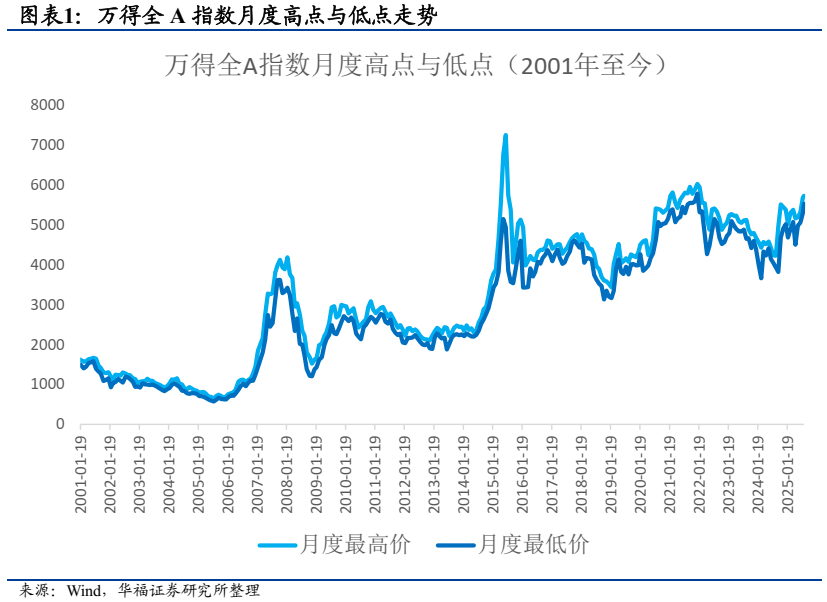
Group 1 - The Chinese capital market has shown signs of recovery since February 2024, with a significant upward trend starting from September 2024, as evidenced by the Shanghai Composite Index rising from below 2700 points to over 3600 points by August 2025, marking an increase of over 35% [1][4] - The current A-share market is characterized by a "slow bull" trend, with monthly lows consistently rising, indicating a potential for further growth as the market approaches previous bull market highs [5][7] - The market capitalization to GDP ratio for A-shares reached 64.1% by June 2025, indicating that there is still a considerable gap compared to historical bull market peaks, suggesting room for growth [7][9] Group 2 - A-share market cycles exhibit a clear pattern, with the current cycle being the fifth since 2001, typically lasting between 3 to 5 years, which implies that the current bull market may have a substantial duration ahead [9][10] - Valuation levels in the A-share market are highly differentiated, with most indices showing healthy valuations but some reaching historical extremes, indicating potential volatility in the future [11][12] - The leverage level in the A-share market has increased significantly, with financing balances reaching 20,462.4 billion yuan as of August 13, 2025, suggesting a high-risk environment [15][16] Group 3 - Corporate earnings have shown significant growth during previous bull markets, particularly in 2005-2007, 2009, and 2020-2021, which were marked by substantial profit increases, contrasting with other periods lacking such improvements [16][20] - The risk premium of A-shares compared to bonds remains above the median, indicating that equities still offer a favorable risk-return profile despite recent market gains [23][24] - Certain industries consistently outperform during bull markets, with sectors like defense and non-ferrous metals showing strong performance, while transportation and utilities tend to lag behind [27]
沪深300指数仍有上行空间
Qi Huo Ri Bao· 2025-08-19 22:37
Group 1 - A-shares have accelerated upward, with the Shanghai Composite Index breaking the high of 3731.69 points from February 2021, reaching 3741.29 points, marking a new high since August 2015 [1] - Since the beginning of 2025, global stock markets have shown strong performance, with the Korean Composite Index rising by 32.4%, the Hang Seng Index by 25.6%, and the German DAX by 22.1% [1] - The current low-risk interest rate environment, with the 10-year government bond yield between 1.65% and 1.80%, has driven A-share market performance, supported by dividend advantages and policy-driven capital inflows [1] Group 2 - The dynamic price-to-earnings (P/E) ratios for the CSI 300 Index and the SSE 50 Index are currently 13.5 times and 11.6 times, respectively, which are at the 75% to 85% historical percentile levels [2] - Compared to major overseas indices, A-share core indices have relatively low absolute P/E ratios, with the S&P 500 at 28.6 times and the FTSE 100 at 20 times [2] - The ChiNext Index and the STAR 50 Index have P/E ratios of 37.1 times and 149.5 times, respectively, indicating that domestic technology and growth sectors do not have a significant valuation advantage compared to overseas counterparts [2] Group 3 - The risk premium for the CSI 300 Index is currently at 5.6%, which is at a high historical percentile of 64.7%, indicating a favorable investment return compared to government bonds [3] - The dividend yield for the CSI 300 Index is 2.69%, which is at the 68.1% historical percentile, suggesting attractive dividend returns for core A-share assets [3] - Historical trends show that a declining dividend yield often accompanies a strengthening market, and the current yield remains significantly higher than the 10-year government bond yield [4] Group 4 - The current low interest rate environment enhances the attractiveness of A-shares for institutional investors seeking stable returns, with potential for significant upward movement in the CSI 300 Index if valuations align with overseas markets [4] - If the dividend yield of the CSI 300 Index approaches the current risk-free rate of around 1.75%, it could correspond to an index level of 6500 points, indicating substantial upside potential [4] - The analysis suggests that the current A-share market rally is primarily driven by valuation, with strong dividend appeal and policy support for capital inflows [4]