
结构性牛市

Search documents
基金经理年底调仓现分歧:“高切低”与“看长做长”
2 1 Shi Ji Jing Ji Bao Dao· 2025-11-19 11:48
Core Viewpoint - The A-share market is experiencing a significant style shift as fund managers face year-end performance assessments, leading to a "high cut low" strategy where funds are reallocating from high-performing technology sectors to undervalued cyclical sectors like coal, banking, and steel [1][2][3] Group 1: Market Dynamics - The technology sector, previously leading the market, has seen a notable decline, with the electronic sector down nearly 8% and both media and computer sectors down over 5% since the beginning of the fourth quarter [2] - In contrast, cyclical sectors such as coal and oil have surged, with both sectors gaining over 11%, while banking and steel sectors have increased by more than 7% [2] - There is a clear trend of capital outflow from high-performing technology stocks into lower-valued sectors, indicating a shift in investor sentiment [2] Group 2: Fund Manager Behavior - Fund managers are engaging in a complex game of balancing long-term investment strategies with short-term performance pressures, leading to varied approaches to year-end reallocation [1][3] - The "high cut low" strategy is primarily aimed at locking in profits and managing rankings, with fund managers reducing exposure to high-flying tech stocks while increasing positions in undervalued assets [3][4] - Some fund managers choose to maintain their positions in technology stocks, believing that recent declines are merely profit-taking rather than a sign of a market downturn [4][5] Group 3: Institutional Investor Actions - Insurance funds are also adjusting their strategies, often focusing on stability in the fourth quarter due to their annual performance assessments, which differ from public funds [8][9] - Some insurance institutions are taking advantage of the market's shift by increasing their positions in growth stocks while others are moving towards value stocks [9][10] Group 4: Future Market Outlook - Analysts predict that the market may experience increased volatility as it prepares for a potential transition from a structural bull market to a comprehensive bull market in 2026, with opportunities across both technology and traditional sectors [11][12] - The investment strategy is shifting towards a "rebalancing" approach, focusing on both cyclical sectors and undervalued technology stocks, aiming for a balanced portfolio to mitigate risks [11][12]
杨德龙:2026年本轮牛市行情将延续有望从结构牛走向全面牛
Xin Lang Ji Jin· 2025-11-19 09:56
从全球局势来看,G2格局逐步确立,未来国际格局中,中美有望出现你追我赶、齐头并进的发展态 势,而非美国在科技上遥遥领先的局面。未来,中美在经贸领域还会继续在合作中竞争、在竞争中发 展。我国在硬件和软件两个方面均实现突破,特别是DeepSeek大模型横空出世,以及在芯片、半导体 方面实现的突破,都提升了全球资本对于中国科技创新的信心,这也是这轮牛市以科技为主线的重要原 因。虽然前期科技板块涨幅较大,一些投资者选择暂时获利了结,导致科技板块出现调整,但科技牛市 预计并没有结束。人工智能带来的科技进步以及生产力提升的趋势将会延续。结构性牛市以科技为主, 主要体现在资金集中投资于少数科技创新板块,如机器人、芯片、半导体、算法创新、固态电池等;到 了全面牛市阶段,更多板块可能会出现上涨,这或将会给市场带来赚钱机会。因此,预计2026年市场的 赚钱效应可能比今年更强,投资机会可能也更多,投资者的体验也可能会更好。 2025年,市场虽走出了牛市走势,但呈现出典型的哑铃型结构:一头是以银行为代表的低估值、高股息 板块,部分个股甚至创新高;另一头是代表新质生产力的科技股大幅上涨,而大多数板块没有明显表 现。2026年,如基本面 ...
这轮牛市券商涨不过银行和保险?真相和机会来了!
Ge Long Hui A P P· 2025-11-19 09:28
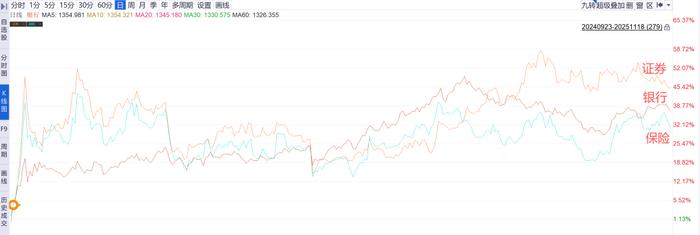
最近后台被问爆了:"明明是牛市,怎么手中券商股涨得磨磨唧唧,反倒银行保险一路飘红?慢牛格局 下,啥时候券商股会再来行情?" 不少散户朋友盯着账户犯嘀咕,当初满仓券商盼着"牛市旗手"发力,结果看着隔壁农业银行接连创新 高,心里那叫一个急。 先别慌着换仓,今天咱们把这事说透——券商不是涨得少,是前面冲得太猛,你刚好错过了它的"热身 赛"。 所谓"券商涨不过银行保险",本质上是个"视觉误差"。 咱们先把尺子亮出来,用数据说话才靠谱。记住两个关键时间点:2024年9月24日,还有2025年4月7日 的特朗普黄金坑,这都是本轮行情的两个重要起点。 从2024年9月24日算起,到昨天券商板块整体涨幅超过47%,而银行板块超36%,保险板块略超33%。 再看2025年4月7日以来的这波反弹,券商也以14%的涨幅,跑赢了银行的9%和保险的5%,而需要注意 的是这区间农业银行区间涨幅接近57%,远超其他大金融个股,后面我们再会详细讲讲它的影响。 这么一看是不是很清晰?券商压根没输,甚至一直是"隐形冠军"。 那为啥大家总觉得银行保险更能打?这就得说说三类资产的"性格"差异了。本质是券商整体行业β要高 于银行和保险,所以大振幅下对 ...

杨德龙:一轮持续两三年以上的牛市可以有效拉动消费
Xin Lang Ji Jin· 2025-11-18 08:27
Group 1 - The recent fluctuations around the 4000-point mark in the market have raised concerns about the sustainability of the technology-driven rally, particularly among the "Seven Sisters" of U.S. tech stocks [1][2] - The current market structure is characterized as a "dumbbell" model, with low valuation, high dividend sectors like banks on one end and high-growth tech stocks on the other, both showing strong performance this year [2][3] - The adjustment in tech stocks is seen as a normal profit-taking phase rather than an end to the bull market, with expectations for a gradual transition to a broader bull market by 2026 [2][3] Group 2 - The influx of new capital is expected to shift towards "mid-dumbbell" stocks, which are anticipated to outperform traditional "old-dumbbell" stocks as economic fundamentals improve [3][4] - A healthy bull market is viewed as a key driver for consumer spending, with the potential for sustained wealth effects that could enhance consumer confidence and expenditure [4][5] - The market is expected to experience increased volatility as the year-end approaches, with a recommendation for investors to maintain a balanced portfolio across different sectors to mitigate risks [5][6]
东吴证券晨会纪要-20251114
Soochow Securities· 2025-11-14 02:04
Group 1: Macro Strategy - The current A-share market resembles the early stages of the 2020-2021 bull market, indicating a slow bull phase driven by strategic funds, similar to the role of foreign capital in early 2020 [1][11] - The market is expected to follow a structural "innovation bull" trend in 2026, as new funds and improved performance from domestic institutions emerge [1][11] - The macroeconomic environment in 2025 shows a mild recovery driven by policy support, with significant similarities to the early 2020 recovery phase [1][11] Group 2: Fixed Income Market - The bond market remains in a box range, with the central bank maintaining liquidity through reverse repos and net purchases of government bonds [2][12] - The introduction of new redemption fee regulations is anticipated to cause volatility in the bond market, but a cautious optimism is advised as the impact will be spread over time [2][12] - The 10-year government bond yield is expected to continue a narrow range of fluctuations, with potential entry points if rates rise sharply due to new regulations [2][12] Group 3: Industry Insights - Aojie Technology is a rare domestic wireless communication baseband chip manufacturer, focusing on four main product categories, including baseband chips and ASICs [6][22] - The company is in a technology accumulation phase, with expectations of turning profitable as technology matures and product lines expand [6][22] - The market for cellular IoT is projected to enter a rapid expansion phase over the next six years, driven by advancements in 5G technology [6][22] Group 4: Company Performance - Baiji Shenzhou's core product, Zebutinib, is experiencing significant growth, with revenue projections for 2025-2027 revised upwards, indicating strong profit potential [7][9] - The company is expected to achieve rapid profit release in the coming years due to scale effects and improved cost management [7][9] - Baiji Shenzhou is positioned as a leading domestic innovative drug company, with a strong global commercialization capability [7][9]
杨德龙:牛市下半场宜采取均衡配置策略
Xin Lang Ji Jin· 2025-11-13 08:08
Core Viewpoint - The market is currently at a critical juncture around the 4000-point level, with differing opinions on whether it marks the end or the beginning of a new bull market phase [1][2]. Market Sentiment - Investors are divided on the significance of the 4000-point level, with pessimists viewing it as a potential peak and optimists seeing it as a starting point for further gains [1]. - Recent data indicates a significant increase in new stock accounts, surpassing 25 million this year, suggesting a shift of household savings into the capital market [2]. Sector Focus - The technology sector has been the primary beneficiary of market funds, with a notable performance in hardware companies compared to software firms [3][5]. - Investment interest is shifting towards specific sub-sectors such as humanoid robots, semiconductor technology, and innovative pharmaceuticals, which are expected to drive future growth [3]. Investment Strategy - The current market phase is characterized by a structural bull market, with expectations of transitioning to a more comprehensive bull market in the coming year [2][5]. - Investors are advised to balance their portfolios between high-growth technology stocks and traditional blue-chip stocks, particularly as market conditions evolve [6][7]. Long-term Outlook - The long-term trajectory of the humanoid robot industry is anticipated to follow a similar path to that of the electric vehicle sector, with significant production goals set by companies like Tesla [4]. - The market is expected to maintain a slow bull trend through 2026, encouraging investors to adopt a value investment approach for sustainable growth [7].

银行股、消费股逆势走强,农行总市值突破3万亿元,三元股份3连板
21世纪经济报道· 2025-11-12 04:13
Market Overview - The A-share market experienced a decline in early trading on November 12, with the Shanghai Composite Index down 0.23%, the Shenzhen Component Index down 1.07%, and the ChiNext Index down 1.58% [1][2] - The total trading volume reached 1.27 trillion yuan, with over 4,000 stocks declining [1][2] Index Performance - Shanghai Composite Index: 3993.35, down 9.40 points (-0.23%) [2] - Shenzhen Component Index: 13146.42, down 142.59 points (-1.07%) [2] - ChiNext Index: 3084.70, down 49.62 points (-1.58%) [2] - The trading volume was predicted to be 1.98 trillion yuan, a decrease of 34 billion yuan from previous estimates [2] Sector Performance - The oil and gas, insurance, and pharmaceutical sectors showed strong gains, while the banking sector also performed well [2][3] - Notable stocks included Agricultural Bank of China, which saw its market capitalization exceed 3 trillion yuan, and both Agricultural Bank and Bank of China experienced significant price increases [3][4] Consumer Sector Activity - The consumer sector, particularly food and beverage stocks, was active, with companies like Zhongrui Co. and San Yuan Co. achieving consecutive gains [4] - Economic scholar Pan Helin noted that the consumer sector's activity is supported by positive policy signals aimed at boosting domestic demand and favorable macroeconomic data from October [4] Technology Sector Insights - Pan Helin emphasized that technology sectors such as computing power, robotics, and AI remain the main focus of the current bull market, despite recent pullbacks [5] - The valuation of computing power is considered high, but demand for computing chips remains strong, particularly from companies like OpenAI [5]







每日钉一下(大盘上涨了,为啥还有人亏钱?)
银行螺丝钉· 2025-11-10 14:05
Group 1 - The article emphasizes that different regional stock markets do not move in unison, and understanding multiple markets can provide investors with more opportunities [2] - Global investment can significantly reduce volatility risk, suggesting that investors should consider diversifying their portfolios internationally [2] - A free course is offered to educate investors on how to invest in global stock markets through index funds, highlighting the potential long-term benefits of global market investments [2][3] Group 2 - Despite a generally bullish market in 2025, a significant proportion of retail investors are still experiencing losses, with over 40% reporting negative returns [4][5] - Historical data shows that during previous bull markets (2013-2017), many investors also faced substantial losses despite overall market gains, indicating a recurring trend [5][6] - The article points out that the primary reasons for investor losses include chasing trends and frequent trading, which often lead to poor decision-making during market fluctuations [9][10]

基民短线操作增多绩优基金C份额规模飙升
Zheng Quan Shi Bao· 2025-11-02 18:16
Core Insights - The surge in C-class shares of high-performing funds indicates a growing preference for short-term trading among investors [1][4][5] - C-class shares have outperformed A-class shares in terms of net subscriptions, highlighting a shift in investor behavior towards more frequent trading [2][3] Fund Performance - Many high-performing funds saw significant growth in their C-class shares, with examples like Yongying Technology Select Fund, which increased from 700 million shares to 3.466 billion shares in Q3, driven largely by C-class subscriptions [2][6] - C-class shares of various funds, including Zhonghang Opportunity Navigator and Debang Xinxing Value C, also experienced substantial net subscriptions exceeding 10 billion shares in Q3 [2][3] Investor Behavior - The increase in C-class shares reflects a trend towards short-term investment strategies, with investors favoring quick entry and exit, as evidenced by over 92 billion shares being purchased and more than 70 billion shares redeemed in Q3 [2][4] - The fee structure of C-class shares, which does not charge a subscription fee and allows for flexible redemption, appeals to younger investors who prefer high-frequency trading [4][5] Distribution Channels - The growth of C-class shares is partly attributed to the preference of online distribution channels, which are more adept at promoting C-class shares compared to traditional banks that favor A-class shares [5][6] - The sales service fee structure of C-class shares incentivizes distribution channels to promote these shares more aggressively [5][6] Fund Management Strategies - Fund companies are increasingly introducing C-class shares to meet diverse investor needs and adapt to market changes, enhancing product competitiveness [6] - The addition of C-class shares is seen as a cost-effective marketing strategy for fund companies, allowing them to leverage existing products and their performance history without incurring the costs associated with launching new funds [6]
前海开源基金董事总经理杨德龙:牛市的下半场将会从现在的结构性牛市走向全面牛市
Xin Lang Zheng Quan· 2025-11-02 07:12
Core Viewpoint - The current market is in the first half of a bull market, with the index just reaching 4000 points, and it is expected to transition into a full bull market next year [1][2]. Group 1: Market Conditions - The market is currently experiencing a shift, with a focus on small-cap stocks, while clean energy funds are nearing record highs, indicating a rotation of capital among sectors [1]. - There is a significant amount of household savings, amounting to 170 trillion yuan, as many investors struggle to find good investment channels due to a sluggish real estate market [1]. Group 2: Future Predictions - In the coming year, external funds are expected to accelerate their entry into the market, particularly benefiting traditional blue-chip stocks and sectors such as consumer goods and innovative pharmaceuticals, which are anticipated to have high future demand [2]. - The transition from a structural bull market to a full bull market is predicted for next year, as more investors gain confidence in the market's upward trajectory [2].