
供给侧改革

Search documents
宝城期货甲醇早报-20250707
Bao Cheng Qi Huo· 2025-07-07 02:04
Report Summary 1. Report Industry Investment Rating No investment rating information is provided in the report. 2. Report's Core Views - The methanol 2509 contract is expected to run weakly, with short - term, medium - term, and intraday trends being oscillatory, oscillatory, and oscillatory - weak respectively [1][5]. - Due to the continuous release of domestic methanol production capacity and increasing overseas shipments, supply pressure is rising while downstream demand enters the off - season, leading to a loose supply - demand structure [5]. - After the previous sharp correction, the bearish sentiment has been released. A new round of supply - side reform may boost domestic commodity futures, but the methanol futures 2509 contract is still likely to maintain an oscillatory - weak trend on Monday [5]. 3. Summary by Related Content Price and Market Trends - On the night of last Friday, domestic methanol futures maintained an oscillatory - weak trend, with the futures price slightly down 0.58% to 2401 yuan/ton [5]. Supply - Demand Situation - Domestic methanol production capacity is continuously released, increasing internal supply pressure. Overseas shipments are arriving, and external supply is expected to increase. Ports are in a inventory - building cycle, while downstream demand has entered the off - season, resulting in a loose supply - demand structure [5]. Policy Impact - The recent high - level domestic meeting has set the tone for governance of low - price disorderly competition and promotion of the orderly exit of backward production capacity. A new round of supply - side reform may boost domestic commodity futures [5].
宝城期货橡胶早报-20250707
Bao Cheng Qi Huo· 2025-07-07 02:00
投资咨询业务资格:证监许可【2011】1778 号 晨会纪要 宝城期货橡胶早报-2025-07-07 品种晨会纪要 时间周期说明:短期为一周以内、中期为两周至一月 | 品种 | | 短期 | 中期 | 日内 | 观点参考 | 核心逻辑概要 | | --- | --- | --- | --- | --- | --- | --- | | 沪胶 | 2509 | 震荡 | 震荡 | 震荡 偏弱 | 偏弱运行 | 供需结构偏弱,沪胶震荡偏弱 | | 合成胶 | 2509 | 震荡 | 震荡 | 震荡 偏弱 | 偏弱运行 | 供需结构偏弱,合成胶震荡偏弱 | 备注: 1.有夜盘的品种以夜盘收盘价为起始价格,无夜盘的品种以昨日收盘价为起始价格,当日日盘收盘 价为终点价格,计算涨跌幅度。 2.跌幅大于 1%为下跌,跌幅 0~1%为震荡偏弱,涨幅 0~1%为震荡偏强,涨幅大于 1%为上涨。 3.震荡偏强/偏弱只针对日内观点,短期和中期不做区分。 主要品种价格行情驱动逻辑—商品期货能源化工板块 沪胶(RU) 日内观点:震荡偏弱 中期观点:震荡 ------------------------------------------ ...
股指期货:震荡偏多格局
Guo Tai Jun An Qi Huo· 2025-07-07 01:30
Report Investment Rating - The investment rating for the stock index futures is a fluctuating and moderately bullish pattern [1] Core Viewpoints - The market's center of gravity continued to rise last week, with a late - stage rally followed by a decline. The core driver of last week's market was the China Central Finance and Economics Commission meeting on the 1st, which emphasized "anti - involution" through the construction of a unified market, leading to a sharp increase in market expectations for a new round of supply - side reform. The value style outperformed last week, with IH and IF stronger than IC and IM, mainly due to the rise of cyclical products. Overseas, the US "Great Beauty Act" was passed, non - farm payroll data was better than expected, and tariff negotiations were underway, causing the S&P 500 and Nasdaq to reach new highs [1] - Currently, the external geopolitical situation is calm, global risk assets are performing strongly, and the domestic economic outlook has shifted from pessimistic to stable, with structural reforms starting to take effect. The risk appetite in the stock market continues to recover, which is an important basis for the current long - position pattern of stock index futures. However, there is a lack of momentum for marginally positive surprises. As long as there are no unexpected changes in external forces and no intensification of domestic structural adjustments, the current pattern of fluctuating upward is expected to continue [2] Summary by Directory Market Review and Outlook - **Market Performance**: Last week, the market's center of gravity rose, with a late - stage rally followed by a decline. In terms of sectors, steel, building materials, and banks led the gains, while computer, non - bank finance, and beauty care led the losses. The value style outperformed, with IH and IF stronger than IC and IM, mainly due to the rise of cyclical products. Overseas, the US "Great Beauty Act" was passed, non - farm payroll data was better than expected, and tariff negotiations were underway, causing the S&P 500 and Nasdaq to reach new highs [1] - **Future Outlook**: The current external geopolitical situation is calm, global risk assets are performing strongly, and the domestic economic outlook has shifted from pessimistic to stable, with structural reforms starting to take effect. The risk appetite in the stock market continues to recover, which is an important basis for the current long - position pattern of stock index futures. However, there is a lack of momentum for marginally positive surprises. As long as there are no unexpected changes in external forces and no intensification of domestic structural adjustments, the current pattern of fluctuating upward is expected to continue. This week, attention should be paid to the release of June economic data in China [2] - **Factors to Watch**: Domestic economy and overseas tariff negotiation progress [3] Strategy Recommendations - **Short - term Strategy**: For intraday trading, refer to the 1 - minute and 5 - minute K - line charts. Set stop - loss and take - profit levels for IF, IH, IC, and IM at 76 points/95 points, 58 points/31 points, 66 points/121 points, and 84 points/142 points respectively [4] - **Trend Strategy**: Adopt a strategy of buying on dips. The core operating range for the IF2507 main contract is between 3826 and 4024 points; for the IH2507 main contract, between 2649 and 2772 points; for the IC2507 main contract, between 5646 and 6025 points; and for the IM2507 main contract, between 5970 and 6372 points [4] - **Cross - variety Strategy**: Due to the frequent switching between value and growth styles recently, it is advisable to wait and see [5] Spot Market Review - **Global Stock Index Performance**: Last week, the Dow Jones Industrial Average rose 2.3%, the S&P 500 rose 1.72%, and the Nasdaq rose 1.62%. In Europe, the UK's FTSE 100 rose 0.27%, Germany's DAX fell 1.02%, and France's CAC 40 rose 0.06%. In the Asia - Pacific market, Japan's Nikkei 225 fell 0.85%, and the Hang Seng Index fell 1.52% [8] - **Domestic Index Performance**: Since 2025, major domestic indices have risen. Last week, all major domestic indices also showed an upward trend [8] Index Valuation Tracking - As of June 27, the TTM price - to - earnings ratio of the Shanghai Composite Index was 14.93 times, the TTM price - to - earnings ratio of the CSI 300 Index was 13.02 times, the TTM price - to - earnings ratio of the SSE 50 Index was 11.18 times, the TTM price - to - earnings ratio of the CSI 500 Index was 27.66 times, and the TTM price - to - earnings ratio of the CSI 1000 Index was 36.02 times [19][20] Market Capital Flow Review - **Investor and Fund Data**: The number of new investors in the two markets and the share of newly established equity - biased funds are presented in relevant charts. Last week, the capital interest rate declined, and the central bank had a net withdrawal of funds [22]
【申万宏源策略 | 一周回顾展望】去产能是慢变量,去产量是快变量
申万宏源研究· 2025-07-07 01:27
Core Viewpoint - The current anti-involution policies are expected to strengthen the trend of "reducing capital expenditure," leading to a more certain and sustained supply-demand turning point starting in mid-2026 [1][4]. Group 1: Anti-Involution Policies - The anti-involution policies are reminiscent of the supply-side reforms from 2016-2017, which can be broken down into three core elements: "reducing capacity," "reducing output," and demand-side stimulation [2]. - "Reducing capital expenditure" is an inevitable trend, with the current growth rate of capital expenditure in the midstream manufacturing sector reaching a new low since 2012 [3]. - The impact of "reducing capacity" will manifest in three ways: delayed effects from reduced capital expenditure, abandonment of existing projects, and guiding the survival of the fittest among existing enterprises [3][4]. Group 2: Supply-Demand Dynamics - The most significant impact of the current anti-involution is that by mid-2026, the growth rate of fixed asset formation in midstream manufacturing will be lower than the nominal GDP growth rate, enhancing the visibility of the supply-demand turning point [4]. - The current low capacity utilization and weak internal investment willingness among enterprises suggest further room for decline in capital expenditure growth [4]. Group 3: Market Outlook - The improvement in the supply-demand dynamics in midstream manufacturing and the easing of the anti-involution narrative are seen as crucial components for a bull market expected in 2026-2027 [8]. - The recent breakthrough of the Shanghai Composite Index has become an investment narrative, enhancing risk appetite, although the current fundamental expectations and profit accumulation are not yet at bull market levels [8][9]. - The focus on high-dividend stocks, including bank shares, is deemed a long-term correct strategy, but short-term dynamics indicate that this trend may not be sustainable [10]. Group 4: Sector Performance - The sectors currently showing significant profit expansion include banking, steel, and electricity equipment, while sectors like defense and non-ferrous metals are experiencing contraction [14]. - The short-term market focus is on sectors such as steel, building materials, and electrical equipment, with expectations of improved profitability in various manufacturing sub-sectors by Q4 2025 [11]. Group 5: Investment Strategy - The investment strategy should consider the anticipated structural changes in the market, with a focus on sectors that will benefit from the anti-involution policies and the expected recovery in profitability [11][14]. - The Hong Kong stock market is expected to perform well in the potential bull market, driven by factors such as concentrated IPOs and early dividends [11].


煤炭拐点清晰,反内卷下的供给变化和新能源新政的对火电影响详解
2025-07-07 00:51
Summary of Conference Call Records Industry Overview - The conference call primarily discusses the **coal industry** in China, focusing on supply-demand dynamics, pricing trends, and the impact of government policies on coal and energy production [1][2][3][4][5][6][7][8][9]. Key Points and Arguments 1. **Coal Consumption and Demand Forecast**: - Daily coal consumption is expected to exceed **2.3 million tons** this year, with peak demand in July and August likely to surpass expectations due to rising temperatures [1][3]. 2. **Coal Price Trends**: - Coal prices have declined to **640-650 CNY/ton**, influenced by increased imports and domestic supply from Inner Mongolia and Xinjiang, alongside low electricity demand during a warm winter [1][4][7]. - The price is projected to rebound to **670-680 CNY/ton** as temperatures rise, with a stable bottom expected between **610-650 CNY/ton** [1][8]. 3. **Future of Thermal Power and New Energy Installations**: - New energy installations are expected to peak in **2024** at approximately **350 GW**, but policy changes and subsidy withdrawals may suppress future growth [5]. - The most significant pressure on thermal power is anticipated in **2025**, with a gradual easing of pressure expected by **2026** and potential growth in **2027** [5]. 4. **Impact of Leadership Changes in Xinjiang**: - Recent leadership changes in Xinjiang may affect coal production capacity expansion, potentially leading to a reduction in new coal capacity in the medium to long term [6]. 5. **Supply and Import Dynamics**: - Domestic coal supply is stabilizing but slightly declining, with imports expected to total **450-460 million tons** for the year, reflecting a year-on-year decrease of **8-9 million tons** [7]. 6. **Market Supply-Demand Situation**: - The coal market is characterized by stable supply and rising demand, with a price bottom forming in early **2025** [8]. 7. **Government Policies on Market Competition**: - The Central Financial Committee's recent discussions emphasize the need to combat low-price competition and promote orderly market conditions, marking a shift towards market-driven adjustments rather than strict regulatory measures [2][9]. 8. **Lessons from the Cement Industry**: - The cement industry has successfully implemented collaborative production strategies to enhance profitability, which could serve as a model for other cyclical industries facing similar challenges [10][11]. Additional Important Insights - The coal industry is experiencing a **prisoner's dilemma** scenario, where companies continue production despite losses to maintain market share, complicating efforts to reduce supply and stabilize prices [12][13][14]. - The unique characteristics of the cement industry, such as lower transportation costs and easier production adjustments, contrast sharply with the complexities faced by the coal and other heavy industries [15]. - The steel market is currently viewed as the most favorable among commodity sectors, while the coking coal market faces significant challenges, with over **90%** of companies reporting losses in the second quarter [16][17]. Investment Recommendations - Short-term investment strategies should focus on leading companies in the coal sector, such as **Shaanxi Coal and Chemical Industry**, **China Shenhua Energy**, **China Coal Energy**, and **Jin控煤业**, as they align with current market trends and investment logic [18].
申万宏源证券晨会报告-20250707
Shenwan Hongyuan Securities· 2025-07-07 00:44
Core Insights - The report emphasizes the distinction between "capital expenditure reduction," "capacity reduction," and "output reduction" in the context of anti-involution policies, drawing parallels to supply-side reforms from 2016-2017 [1][10] - The current anti-involution policies are expected to lead to a significant decline in capital expenditure growth in the midstream manufacturing sector, with the growth rate hitting a new low since 2012 [2][10] - The report predicts that by mid-2026, the fixed asset formation growth rate of listed midstream manufacturing companies will fall below the nominal GDP growth rate, indicating a visible turning point in supply-demand dynamics [3][10] Summary by Sections Section 1: Anti-Involution Policies - The report identifies three core elements of the supply-side reform experience from 2016-2017: "capacity reduction," "output reduction," and the significant impact of demand-side stimulation [1][10] - The current anti-involution policies are seen as a systematic correction of excessive investment in advanced manufacturing driven by local government subsidies from 2022-2024 [2][10] - The report suggests that the current environment is not conducive to strict "output reduction" policies due to the lack of mechanisms for implementation in privately-owned advanced manufacturing sectors [2][10] Section 2: Market Trends and Predictions - The report anticipates that the supply-demand dynamics in the midstream manufacturing sector will improve significantly by 2026, with a focus on sectors such as electric equipment, steel, and building materials [3][10] - The report maintains a bullish outlook for the Hong Kong stock market, despite concerns over liquidity fluctuations [3][10] Section 3: Outdoor Apparel Industry - The outdoor apparel market in China is projected to reach a scale of 102.7 billion yuan in 2024, with a year-on-year growth of 17%, driven by factors such as increased health awareness and a shift towards experiential consumption [15][16] - The brand "Berghaus" has shown remarkable growth, with a projected revenue of 1.77 billion yuan in 2024, reflecting a year-on-year increase of 94.5% [15][16] - The report highlights the competitive landscape of the outdoor apparel industry, noting that the top ten brands account for only 27.2% of the market, indicating significant room for growth [15][16]
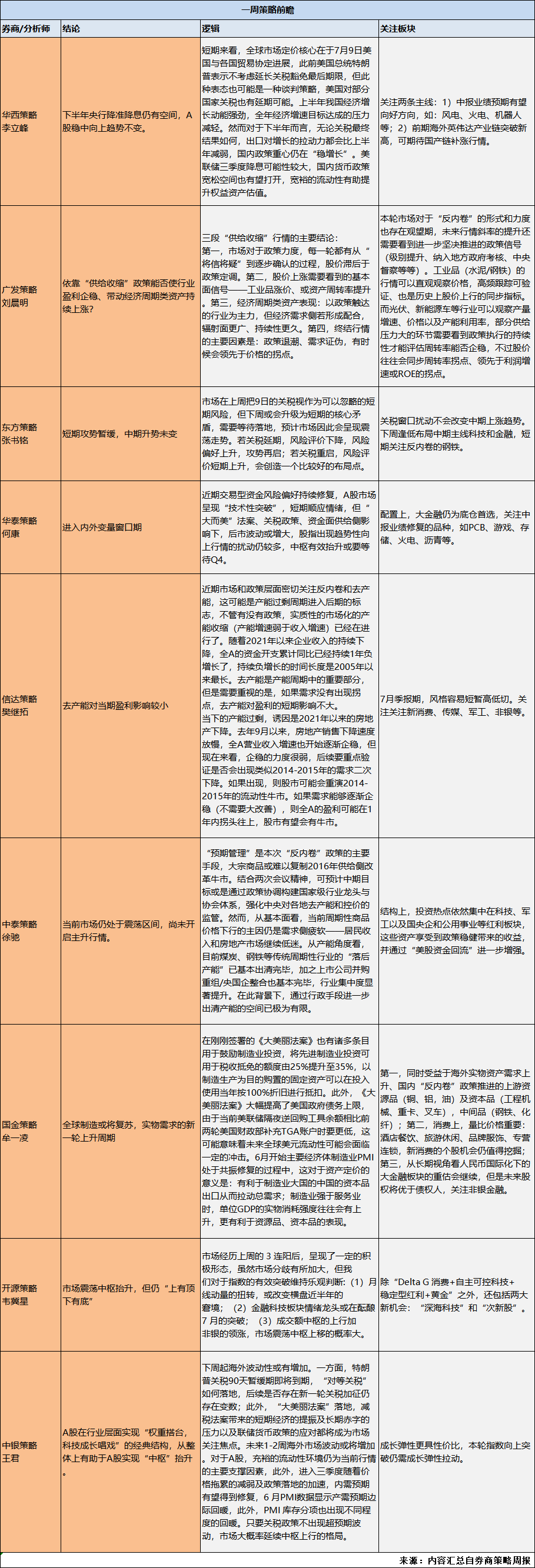
A股分析师前瞻:贸易协定进展是下周的关注焦点
Xuan Gu Bao· 2025-07-06 13:56
Group 1 - The focus of the brokerage strategy discussions this week is on the upcoming trade agreement progress and the sustainability of the "anti-involution" sector [1][2] - The Huaxi strategy team indicates that the core pricing in the global market is centered around the trade agreement progress on July 9, with potential tariff extensions being a negotiation tactic [1][3] - The A-share market is expected to maintain an upward trend, with two main lines of focus: positive mid-term performance expectations in sectors like wind power, thermal power, and robotics, and the potential for domestic chains to catch up following Nvidia's overseas breakthroughs [1][3] Group 2 - The Dongfang strategy team notes that the market previously viewed the July 9 tariff as a negligible short-term risk, but it may escalate into a core issue next week, leading to a volatile market [1][3] - The Zhongyin strategy team emphasizes that the current liquidity environment supports the market, and as the third quarter progresses, domestic demand expectations may improve if tariff policies do not experience unexpected fluctuations [1][3] - The Xuch team's analysis suggests that "expectation management" is a key tool in the "anti-involution" policy, with limited space for further capacity clearance in traditional cyclical industries like coal and steel due to already high industry concentration [2][4] Group 3 - The market is currently in a state of fluctuation, with the potential for increased volatility in the coming weeks due to the expiration of the 90-day tariff grace period and the implications of the "Great Beautiful Act" [5] - The overall sentiment in the A-share market is that the liquidity environment remains a primary support factor, with expectations for recovery in domestic demand as price pressures ease and policies are implemented [5] - The current cycle of capacity reduction is crucial, but its short-term impact on profitability may be limited if demand does not show signs of recovery [4][5]
新材料与投资品产业链点评:“反内卷”政策下,能源及材料投资机会梳理-20250706
Shenwan Hongyuan Securities· 2025-07-06 13:50
2025 年 07 月 06 日 "反内卷"政策下,能源及材料投 资机会梳理 看好 ——新材料与投资品产业链点评 本期投资提示: 行 业 研 究 / 行 业 点 评 证券分析师 宋涛 A0230516070001 songtao@swsresearch.com 陆灏川 A0230520080001 luhc@swsresearch.com 马天一 A0230525040004 maty@swsresearch.com 任杰 A0230522070003 renjie@swsresearch.com 郭中伟 A0230524120004 guozw@swsresearch.com 陈松涛 A0230523090002 chenst@swsresearch.com 刘子栋 A0230523110002 liuzd@swsresearch.com 严天鹏 A0230524090004 yantp@swsresearch.com 联系人 赵文琪 (8621)23297818× zhaowq@swsresearch.com 本研究报告仅通过邮件提供给 中庚基金 使用。1 券 研 究 报 告 请务必仔细阅读正文之后的各项 ...
周观点:“反内卷”有望带来细分板块景气修复-20250706
GOLDEN SUN SECURITIES· 2025-07-06 12:20
Investment Rating - The industry investment rating is maintained as "Increase" [5] Core Viewpoints - The "anti-involution" policy is expected to lead to a recovery in the sub-sectors of the basic chemical industry [2] - The geopolitical situation in the Middle East has caused fluctuations in oil prices, with Brent crude oil returning to the range of $60-70 per barrel [1] - The agricultural chemical sector is anticipated to see a recovery in demand due to the "anti-involution" policy and environmental safety regulations [3] Summary by Sections Oil and Gas Sector - Brent crude oil prices peaked at $78.85 per barrel during the escalation of the Israel-Iran conflict but have since returned to $68.30 per barrel as of July 4, indicating a reversion to fundamental pricing [1] - Global oil demand is projected to increase by 720,000 barrels per day according to IEA, while OPEC anticipates a supply increase of 1.3 million barrels per day, leading to a supply-demand imbalance [1] Basic Chemical Sector - The central government has emphasized the need to eliminate low-price disorderly competition, which is expected to accelerate the exit of outdated production capacity in the chemical sector [2] - The growth rate of ongoing projects in the basic chemical sector is projected to fluctuate, with a decline expected in Q1 2025 [2] Agricultural Chemical Sector - China's total pesticide production is expected to increase by 24% in 2024, with significant growth in herbicides and insecticides [3] - Recent incidents have impacted the supply of certain products, leading to price increases of 87% and 35% for specific chemicals [3] - The ongoing litigation involving Bayer and glyphosate may significantly affect the supply and pricing of glyphosate and its alternatives [4]
供给侧改革预期升温,关注水泥、玻璃积极变化
GOLDEN SUN SECURITIES· 2025-07-06 12:14
Investment Rating - The report maintains a positive outlook on the construction materials sector, with specific buy and hold recommendations for various companies [9][12]. Core Viewpoints - The construction materials sector has shown resilience, with a 3.50% increase in the sector index from June 30 to July 4, 2025, outperforming the Shanghai and Shenzhen 300 index by 2.33% [12]. - The central government's focus on stabilizing the real estate market and promoting high-quality development is expected to positively impact demand for construction materials [2][12]. - The cement industry is experiencing a supply-side reform, with increased efforts to reduce overcapacity and stabilize prices [2][3]. Summary by Sections Cement Industry Tracking - As of July 4, 2025, the national cement price index is 350.38 CNY/ton, down 1.32% week-on-week, with a total cement output of 2.76 million tons, also down 1.67% [3][17]. - The construction sector remains a key demand driver for cement, but short-term growth is constrained by weather and funding issues [17]. - The report highlights a significant year-on-year decline of 26.01% in cement output for housing construction, indicating a challenging market environment [6][17]. Glass Industry Tracking - The average price of float glass is 1201.02 CNY/ton, with a slight decrease of 0.13% from the previous week, while inventory levels have decreased slightly [33]. - Demand remains under pressure, and the report anticipates challenges in maintaining sales momentum due to high production capacity and ongoing order shortages [33][34]. Fiberglass Industry Tracking - The fiberglass market is experiencing stable pricing, with no significant changes in supply or demand noted in the short term [7]. - The report indicates that demand for wind power fiberglass is relatively strong, providing some support to the market [7]. Consumer Building Materials - The consumer building materials segment is benefiting from improved second-hand housing transactions and consumption stimulus policies, with a recommendation to focus on companies like Beixin Building Materials and Weixing New Materials [2][9]. Carbon Fiber Industry Tracking - The carbon fiber market is seeing a gradual recovery in downstream demand, with production costs remaining high and profit margins under pressure [8].


