债券

Search documents
固收指数月报 | 中国债市回暖!债券回购市场开放举措或成关键
彭博Bloomberg· 2025-11-17 11:54
Core Insights - Bloomberg is the first global index provider to include Chinese bonds in mainstream global indices, offering a unique perspective on the Chinese bond market through the Bloomberg China Fixed Income Index series [3] - The Bloomberg China Aggregate Index recorded a return of 0.65% in October, with a year-to-date return of 0.71% [5] - The return for the China Treasury and Policy Bank Index in October was 0.66%, while the year-to-date return for the Chinese yuan measured in local currency was 0.60%, improving its ranking from 26th to 25th among 27 currencies [5] Index Performance - Long-term bonds outperformed short-term bonds in October, with returns for various maturity indices as follows: - 1-3 years: 0.28% - 3-5 years: 0.45% - 5-7 years: 0.60% - 7-10 years: 0.83% - 10+ years: 1.54% [5][7] - The China Aggregate Index level stands at 244.67, with a year-to-date return of 0.71% [7] Market Dynamics - In August, the total outflow of funds from the Chinese bond market reached 99.7 billion yuan, a decrease from the record 303.8 billion yuan in July [13] - The outflow from Chinese government bonds slowed to 14.5 billion yuan, while foreign capital outflow from negotiable certificates of deposit (NCD) decreased to 67.8 billion yuan [13] - The opening of the bond repurchase market to foreign investors may help alleviate short-term outflows and support the long-term internationalization of the Chinese bond market [13] Credit Market Insights - Recent credit events in the U.S. have impacted Asian credit spreads, which widened to 66 basis points, indicating a potential risk in the market [13] - The geopolitical landscape, including U.S.-China trade tensions and the Dutch government's intervention in ASML, adds uncertainty to the global economic outlook [13]

宏观与大宗商品周报:冠通期货研究报告-20251117
Guan Tong Qi Huo· 2025-11-17 11:48
1. Report Industry Investment Rating No relevant content provided. 2. Core Viewpoints of the Report - Recently, after the U.S. government ended its shutdown, market sentiment varied, and asset trends diverged. The controversy over AI bubble resurfaced, and the high - level decline of safe - haven assets such as gold and Bitcoin raised market concerns, resulting in a decline in investors' risk appetite and a slight increase in the VIX volatility index. Global major stock markets showed mixed performance, with A - shares leading the decline after reaching a high, while the Hang Seng Index had a relatively large increase. The BDI index rose, U.S. bond yields increased, the U.S. dollar index slightly declined, and most non - U.S. currencies strengthened. Most commodities rose [4][8]. - In the domestic market, the bond market mostly closed down with short - term weakness and long - term strength, and most stock indices declined. The commodity sectors showed mixed performance but generally closed up, with the Wind Commodity Index having a weekly change of 3.92%. Among the 10 commodity sub - sector indices, 6 closed up and 4 closed down. Commodity futures generally maintained the pattern of strong agricultural products and weak industrial products [4][13]. - The probability of the Fed cutting interest rates by 25bp to 3.5 - 3.75% in December decreased to 39.8%, significantly lower than last week's 61.9%, while the probability of keeping the interest rate unchanged at 3.75 - 4% increased significantly [5][68]. 3. Summary by Relevant Catalogs Market Overview - Global asset trends: Global major stock markets showed mixed performance, A - shares led the decline after reaching a high, the Hang Seng Index rose, the BDI index increased, U.S. bond yields went up, the U.S. dollar index slightly declined, and most non - U.S. currencies strengthened. Most commodities rose, with precious metals stabilizing, rebounding, and then fluctuating at a high level, and copper and oil prices slightly rebounding [4][8]. - Domestic market performance: The domestic bond market mostly closed down with short - term weakness and long - term strength, and most stock indices declined. The commodity sectors showed mixed performance but generally closed up. The Wind Commodity Index had a weekly change of 3.92%. Commodity futures maintained the pattern of strong agricultural products and weak industrial products, with precious metals leading the rise, followed by significant increases in the agricultural products, grains, and oilseeds sectors. The non - ferrous and chemical sectors slightly closed up, while other sectors all closed down, with the coal, coking, steel, and mining and energy sectors having the largest declines [4][13]. - Futures market capital flow: The overall capital in the commodity futures market slightly flowed in. The precious metals, non - metallic building materials, oilseeds, and non - ferrous sectors had obvious capital inflows, while the soft commodities, coal, coking, steel, and mining, and chemical sectors had obvious capital outflows [4][15]. - Commodity volatility: The volatility of the international CRB Commodity Index significantly increased, while the volatility of the domestic Wind Commodity Index and Nanhua Commodity Index showed a divergent performance of one rising and one falling. Most of the commodity futures sub - sector volatilities declined, with the oilseeds, non - ferrous, soft commodities, and coal, coking, steel, and mining sectors having the largest decline in volatility, and the energy sector having the most obvious increase in volatility [5][22]. Variety Performance - The domestic major commodity futures showed mixed performance in the recent week. The top - rising commodity futures varieties were Shanghai silver, lithium carbonate, and apples, while the top - falling varieties were glass, coke, and red dates [18][21]. Data Tracking - International commodities: International major commodities generally closed up, the BDI slightly increased, the CRB was flat, soybeans and corn rose, and copper, oil, gold, and silver all closed up, with the silver price rising more and the gold - silver ratio significantly declining [26]. - Domestic data: Asphalt production rate continued to decline, real - estate sales were weakly bottom - seeking, freight rates rebounded with differentiation, and short - term capital interest rates fluctuated downward [41]. Macro Logic - Stock market: The domestic four major stock indices fluctuated and declined last week. In terms of style, value stocks were obviously more resistant to decline, while growth - style stock indices were relatively weaker. The valuation of stock indices declined, and the equity risk premium (ERP) changed little [30][31]. - Commodities: The commodity price index fluctuated and rebounded, and the inflation expectation was under downward pressure [34]. - U.S. bonds: U.S. bond yields rebounded, the term structure steepened bearishly, the term spread changed little, the real interest rate rebounded, and the gold price rebounded and then declined [49]. - U.S. economic indicators: The U.S. high - frequency "recession indicator" weakened, the Citi Economic Surprise Index showed differentiation, and the 10Y - 3M U.S. bond spread fluctuated in positive territory [60]. Fed Interest Rate Expectation The probability of the Fed cutting interest rates by 25bp to 3.5 - 3.75% in December decreased to 39.8%, significantly lower than last week's 61.9%, while the probability of keeping the interest rate unchanged at 3.75 - 4% increased significantly [5][68]. This Week's Focus - Monday (November 17): Canada's October CPI monthly rate, U.S. November New York Fed Manufacturing Index [73]. - Tuesday (November 18): U.S. October Import Price Index monthly rate, U.S. October Industrial Production monthly rate, U.S. November NAHB Housing Market Index, Minneapolis Fed President Kashkari hosts a fireside chat, Reserve Bank of Australia releases November Monetary Policy Meeting Minutes, Saudi Crown Prince Mohammed visits the White House and meets with U.S. President Trump [73]. - Wednesday (November 19): U.S. API crude oil inventory for the week ending November 14, UK October CPI monthly rate, Eurozone October CPI annual rate final value, U.S. October New Housing Starts annualized, U.S. EIA crude oil inventory for the week ending November 14, U.S. EIA crude oil inventory in Cushing, Oklahoma for the week ending November 14 [73]. - Thursday (November 20): China's October Swift RMB share in global payments, China's one - year loan prime rate as of November 20, Germany's October PPI monthly rate, Switzerland's October trade balance, U.S. initial jobless claims for the week ending November 15, U.S. November Philadelphia Fed Manufacturing Index, Eurozone November Consumer Confidence Index preliminary value, U.S. October Existing Home Sales annualized, U.S. October Conference Board Leading Index monthly rate, U.S. EIA natural gas inventory for the week ending November 14, Fed releases Monetary Policy Meeting Minutes, New York Fed President Williams gives a speech, September non - farm payroll data [73]. - Friday (November 21): Japan's October core CPI annual rate, UK November Gfk Consumer Confidence Index, UK November Manufacturing PMI preliminary value, Canada's September retail sales monthly rate, U.S. November S&P Global Manufacturing PMI preliminary value, U.S. November University of Michigan Consumer Confidence Index final value, U.S. November one - year inflation rate expectation final value, Chicago Fed President Goolsbee gives a speech, Philadelphia Fed President Patrick Harker gives a speech on the economic outlook, European Central Bank President Lagarde gives a speech, New York Fed President Williams gives a speech [73].
只有中国敢这么干!美债狂揽1182亿,华尔街沉默,美联储头疼了
Sou Hu Cai Jing· 2025-11-17 10:07
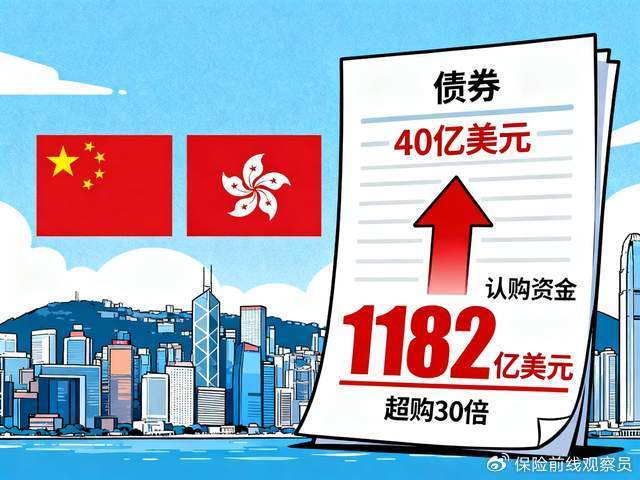
Core Viewpoint - The issuance of a $4 billion sovereign bond by the Chinese Ministry of Finance in Hong Kong attracted a staggering $118.2 billion in subscriptions, indicating a 30-fold oversubscription, which is rare in the international market [1][3]. Group 1: Market Dynamics - The interest rates for the issued bonds were nearly on par with U.S. Treasury bonds, with the three-year bond at 3.646% and the five-year bond at 3.787% [3]. - Asian investors accounted for 53% of the subscriptions, while European investors contributed 25%, and the Middle East and Americas made up 22% [3]. - Sovereign investments represented 42% of the subscriptions, with banks and insurance institutions at 24%, and funds and asset management at 32% [4]. Group 2: Credit Rating Perception - Despite international credit ratings for China being lower than those for the U.S. (A1 vs. AA1), the market response was contrary, with significant capital inflow indicating strong investor confidence [3][5]. - Investors are focusing on China's solid economic fundamentals, including over $3 trillion in foreign exchange reserves, a growing trade surplus, and stable policies [7]. Group 3: Implications for Global Finance - The successful bond issuance signals a shift in the global financial landscape, suggesting that emerging markets can establish their own dollar credit benchmarks [10][20]. - This event may encourage other emerging markets to enter the dollar bond market, leading to a diversification of dollar pricing power [10]. - The issuance reflects a broader trend of financial openness from China, showcasing its market credibility to global investors [14][16]. Group 4: Future Outlook - The bond's performance in the secondary market will serve as a key indicator of China's creditworthiness [12]. - The event highlights China's financial resilience and market responsiveness, which could influence its future interactions in international capital markets [13][18]. - The global capital market's reaction indicates a growing recognition of China's financial strength and its potential to challenge the dominance of U.S. Treasury bonds [20].
美债将录得2020年来最佳表现?本轮涨势仍面临这些风险
第一财经· 2025-11-17 10:02
Core Viewpoint - Recent optimism among U.S. Treasury traders regarding potential interest rate cuts by the Federal Reserve has overshadowed concerns about the U.S. fiscal deficit, leading to expectations that U.S. Treasuries may achieve their best annual performance since 2020 [3][4]. Group 1: Market Performance - The Bloomberg U.S. Aggregate Bond Index has returned approximately 6.7% year-to-date, potentially marking its best annual return since 2020 [5]. - In 2023, the index's return was 5.5%, with a stagnation expected in 2024, contrasting with previous years where short-term U.S. Treasuries were preferred for risk diversification [6]. Group 2: Federal Reserve and Economic Outlook - The Federal Reserve's recent FOMC meeting saw a division among officials regarding interest rate cuts, with some advocating for a 50 basis point cut, while others opposed any cuts [7]. - Despite a weak employment trend, the likelihood of a rate cut in December remains high, suggesting that long-term interest rates may not sustain upward momentum [7]. Group 3: Fiscal Concerns - The U.S. government's budget deficit for fiscal year 2025 is projected at $1.8 trillion, unchanged from 2024, which could exert pressure on the bond market [9]. - The futures market indicates a 46% probability of a Federal Reserve rate cut, down from 67% a week prior, highlighting uncertainty around future monetary policy [9]. Group 4: Corporate Bond Market Risks - Analysts express concerns that the rising U.S. credit market may mask risks associated with historically high valuations of corporate bonds, leading to insufficient risk premiums for investors [10]. - The spread between investment-grade U.S. corporate bonds and U.S. Treasuries narrowed to 0.72 percentage points in September, the lowest since the late 1990s, indicating potential over-speculation in the market [10].

利率债周报:“股债跷跷板”效应仍在,上周债市窄幅震荡-20251117
Dong Fang Jin Cheng· 2025-11-17 09:20
Report Industry Investment Rating No information provided in the content. Core Viewpoints - The bond market was narrowly fluctuating last week, dominated by the stock - bond seesaw effect. The weak financial and macro data in October confirmed the economic downward expectation in Q4, but the market reaction was flat, and the bond market sentiment was mainly driven by the stock market, being more sensitive to stock market rises. The stock market first adjusted, then rose and fell back, and declined overall last week, leading to bond market fluctuations with only a slight decline in long - term bond yields. Short - term bond yields rose slightly as the tax period approached, and the yield curve continued to flatten [3]. - This week (the week of November 17), the bond market will continue the oscillating pattern. The market's expectation of a reserve requirement ratio cut in the short term has cooled, and the expectation of an interest rate cut is still weak. With the macro data in a vacuum period, the bond market will continue to oscillate, and stock market fluctuations will continue to dominate market sentiment. The new regulations on public fund redemption fees may be implemented soon, but since the market has priced them fully, they may cause market fluctuations in the short term but with limited amplitude. Overall, with multiple factors such as weak fundamentals, low expectation of loose policies, the central bank's care for the capital market, the stock market entering an oscillating rest period, and the unimplemented new regulations on public fund redemption fees, the bond market is unlikely to break the deadlock and will probably continue the narrow - range oscillating pattern [3]. Summary by Directory 1. Last Week's Market Review 1.1 Secondary Market - The bond market was narrowly fluctuating last week, with long - term bond yields slightly declining. The 10 - year Treasury bond futures main contract fell 0.06% in the whole week. On Friday, the 10 - year Treasury bond yield decreased by 0.02bp compared with the previous Friday, and the 1 - year Treasury bond yield increased by 0.59bp, with the term spread continuing to narrow [4]. - On November 10, affected by the warming of October inflation data, the bond market was weakly oscillating in the morning, but the long - term bonds recovered in the afternoon as the stock market fell, while short - term bonds were still weak due to tightened capital. The yields of major inter - bank interest - rate bonds mostly declined, with the 10 - year Treasury bond yield slightly decreasing by 0.03bp, and most of the Treasury bond futures main contracts of all tenors closed up, with the 10 - year main contract rising 0.01% [4]. - On November 11, the bond market was generally warming and oscillating. The yields of major inter - bank interest - rate bonds mostly declined, with the 10 - year Treasury bond yield slightly decreasing by 0.20bp, and all Treasury bond futures main contracts of all tenors closed up, with the 10 - year main contract rising 0.02% [4]. - On November 12, the central bank's Q3 monetary policy report mentioned stabilizing growth again and deleted the "anti - arbitrage" statement. The market's loose expectation remained, driving the bond market to be generally warming and oscillating. The yields of major inter - bank interest - rate bonds mostly declined, with the 10 - year Treasury bond yield decreasing by 0.48bp, and all Treasury bond futures main contracts of all tenors closed up, with the 10 - year main contract rising 0.02% [4]. - On November 13, the stock market hit a new high, and the stock - bond seesaw effect was obvious. The bond market generally weakened. The yields of major inter - bank interest - rate bonds generally rose, with the 10 - year Treasury bond yield rising 0.55bp, and all Treasury bond futures main contracts of all tenors closed down, with the 10 - year main contract falling 0.10% [4]. - On November 14, the capital tightened marginally and the stock market declined. The bond market was narrowly oscillating. The yields of major inter - bank interest - rate bonds mostly rose, with the 10 - year Treasury bond yield rising 0.14bp, and the closing prices of Treasury bond futures main contracts of all tenors were mixed, with the 10 - year main contract remaining flat [4]. 1.2 Primary Market - Last week, 100 interest - rate bonds were issued, 43 more than the previous week, with a issuance volume of 7269 billion, an increase of 2129 billion compared with the previous week, and a net financing amount of 3903 billion, an increase of 1020 billion compared with the previous week. In terms of bond types, the issuance volumes of Treasury bonds, policy - financial bonds, and local government bonds increased month - on - month; the net financing amounts of Treasury bonds and local government bonds increased month - on - month, while that of policy - financial bonds decreased month - on - month [10]. - The overall subscription demand for interest - rate bonds last week was acceptable. Six Treasury bonds were issued, two of which were savings Treasury bonds, and the average subscription multiple of the remaining Treasury bonds was 3.39 times. Twenty - one policy - financial bonds were issued with an average subscription multiple of 3.83 times, and 73 local government bonds were issued with an average subscription multiple of 20.09 times [14]. 2. Last Week's Important Events - In October, the policies to stabilize growth drove up entrusted loans, and M1 continued to grow rapidly. In October 2025, new RMB loans were 220 billion, 280 billion less year - on - year; new social financing scale was 815 billion, 597 billion less year - on - year. At the end of October, M2 increased 8.2% year - on - year, 0.2 percentage points lower than at the end of last month; M1 increased 6.2% year - on - year, 1.0 percentage point lower than at the end of last month [14]. - In October, the year - on - year growth of RMB loans decreased due to weak domestic demand, declining external demand, and the continuous downward pull of implicit debt replacement on new medium - and long - term corporate loans. The year - on - year growth of social financing continued to decline, mainly affected by the significant year - on - year decrease in government bond financing and RMB loans to the real economy. Due to the higher base in the same period last year, the growth rate of M2 declined at the end of October but remained at a relatively fast level. The growth rate of M1 declined as the low - base effect weakened, but it still grew rapidly due to the increase in current deposits of urban investment platform enterprises during debt replacement and the increase in current deposits of small and medium - sized enterprises [14]. - The macro data in October continued to decline. The year - on - year actual growth rate of industrial added value above designated size in October was 4.9%, down from 6.5% previously; the cumulative year - on - year actual growth rate of industrial added value above designated size in the first 10 months was 6.1%, compared with 5.8% in the whole year of 2024. The year - on - year growth rate of total retail sales of consumer goods in October was 2.9%, down from 3.0% previously; the cumulative year - on - year growth rate of total retail sales of consumer goods in the first 10 months was 4.3%, compared with 3.5% in the whole year of 2024. From January to October 2025, the cumulative year - on - year decline of national fixed - asset investment was 1.7%, compared with a decline of 0.5% previously and a growth of 3.2% in the whole year of 2024 [14]. - The industrial production growth rate declined rapidly in October due to different working days compared with last year, negative export growth, weak domestic consumption and investment momentum, and the weakening of the pulling effect of policies to boost domestic demand. The year - on - year growth rate of total retail sales of consumer goods continued to decline in October mainly because the effect of the subsidy policy for trade - in weakened, the base in the same period last year increased, and the accelerated decline of the real - estate market dragged down real - estate - related consumption. The year - on - year growth rate of fixed - asset investment from January to October was - 1.7%, with negative cumulative year - on - year values for two consecutive months, mainly due to the slowdown of infrastructure, manufacturing, and real - estate investment. Overall, affected by weak external demand, weakening domestic consumption and investment growth momentum, and the time needed for policies to stabilize growth to take effect, the macro - economic operation in October continued the weakening trend since Q3 [15]. 3. Real - Economy Observation - Last week, the high - frequency data on the production side showed mixed performance. The blast furnace operating rate and the operating rate of petroleum asphalt plants both declined slightly, while the daily average molten iron output increased slightly, and the semi - steel tire operating rate was basically the same as the previous week. On the demand side, the BDI index continued to rise, and the China Containerized Freight Index (CCFI) also continued to increase. The sales area of commercial housing in 30 large and medium - sized cities increased slightly. In terms of prices, the pork price declined slightly, while most commodity prices rose, including the prices of rebar, copper, and crude oil [16]. 4. Last Week's Liquidity Observation - The central bank's net injection of funds through open - market operations last week was 626.2 billion. The R007 and DR007 both increased; the issuance interest rate of inter - bank certificates of deposit of joint - stock commercial banks increased; the direct discount rates of state - owned and joint - stock banks of all tenors decreased slightly; the trading volume of pledged repurchase decreased slightly; the leverage ratio in the inter - bank market fluctuated and decreased slightly [26][29][32].
利率周报(2025.11.10-2025.11.16):10月主要经济指标走弱,降准降息可期-20251117
Hua Yuan Zheng Quan· 2025-11-17 08:43
1. Report Industry Investment Rating - The report is bullish on the bond market, predicting that the 10Y Treasury yield will return to around 1.65%, the 30Y Treasury yield to reach 1.9%, and the 5Y major bank Tier 2 capital bonds to reach 1.9% (all referring to bonds without VAT) [4][68][71]. 2. Core View of the Report - In October, major economic indicators weakened, and there are expectations for reserve requirement ratio cuts and interest rate cuts. The "troika" supporting the economy is under pressure. Policy rate cuts and the implementation of incremental tools may be the key means to support the economy. The bond market has prominent allocation value, and bond yields may decline in a volatile manner [2][68]. 3. Summary by Related Catalogs 3.1 Macro News - In October, the total retail sales of consumer goods were 4.6 trillion yuan, a year-on-year increase of 2.9%, 0.1 percentage points lower than the previous month, and have been falling for five consecutive months. From January to October, fixed - asset investment decreased by 1.7% year - on - year, 1.2 percentage points lower than the first nine months. In October, the added value of industrial enterprises above the designated size increased by 4.9% year - on - year, 1.6 percentage points lower than September [4][10]. - In the first 10 months of 2025, the cumulative increase in social financing scale was 30.9 trillion yuan, 3.83 trillion yuan more than the same period last year. At the end of October 2025, the stock of social financing scale was 437.72 trillion yuan, a year - on - year increase of 8.5%. At the end of October, the balance of broad money (M2) was 335.13 trillion yuan, a year - on - year increase of 8.2% [12]. - The central bank's "2025 Q3 China Monetary Policy Implementation Report" shows a more pessimistic view of the world and domestic economic environment compared to the Q2 report. The next - stage monetary policy emphasizes "counter - cyclical and cross - cyclical adjustment" [16]. 3.2 Meso - level High - frequency Data - **Consumption**: As of November 9, the average daily retail volume of passenger car manufacturers decreased by 18.8% year - on - year, and the average daily wholesale volume decreased by 22.1% year - on - year. As of November 7, the total retail volume of three major household appliances decreased by 21.8% year - on - year, and the total retail sales decreased by 34.6% year - on - year [18][22]. - **Transportation**: As of November 9, the weekly container throughput of ports increased by 6.5% year - on - year. The weekly postal express pick - up volume increased by 6.2% year - on - year, and the delivery volume increased by 3.3% year - on - year. The weekly railway freight volume decreased by 0.1% year - on - year, and the highway truck traffic volume decreased by 0.7% year - on - year [25][27]. - **Capacity Utilization**: As of November 12, the blast furnace capacity utilization rate of major steel enterprises was 76.7%, a year - on - year increase of 0.6 percentage points. As of November 13, the average asphalt capacity utilization rate was 21.0%, a year - on - year decrease of 3.0 percentage points. The soda ash capacity utilization rate was 84.5%, a year - on - year increase of 0.7 percentage points, and the PVC capacity utilization rate was 77.7%, a year - on - year increase of 0.6 percentage points [29][32]. - **Real Estate**: As of November 14, the total commercial housing transaction area of 30 large - and medium - sized cities in the past 7 days decreased by 28.5% year - on - year. As of November 7, the second - hand housing transaction area of 9 sample cities decreased by 28.5% year - on - year [34][37]. - **Prices**: As of November 14, the average wholesale price of pork decreased by 25.0% year - on - year and 1.0% compared to four weeks ago. The average wholesale price of vegetables increased by 13.5% year - on - year and 15.3% compared to four weeks ago. The average wholesale price of 6 key fruits decreased by 0.7% year - on - year and increased by 0.8% compared to four weeks ago [41]. 3.3 Bond and Foreign Exchange Markets - On November 14, overnight Shibor and various short - term interest rates such as R001, R007, DR001, DR007, IBO001, and IBO007 all declined compared to November 10. Most Treasury yields declined. On November 14, the 1 - year/5 - year/10 - year/30 - year Treasury yields were 1.41%/1.58%/1.81%/2.15% respectively, with changes of +0.8BP/ - 0.6BP/ - 0.1BP/ - 1.1BP compared to November 7 [47][51]. - As of November 14, 2025, the 10 - year Treasury yields of the United States, Japan, the United Kingdom, and Germany were 4.1%, 1.7%, 4.5%, and 2.8% respectively, with increases of 3BP, 2BP, 7BP, and 4BP compared to November 7. On November 14, the central parity rate and spot exchange rate of the US dollar against the Chinese yuan were 7.08/7.10, down 11/218 pips compared to November 7 [60][63]. 3.4 Institutional Behavior - Since the beginning of 2025, the duration of medium - and long - term pure bond funds for interest - rate bonds has shown a trend of first decreasing, then increasing, and then decreasing. In recent months, it has continued to decline. On November 14, 2025, the estimated average duration was around 4.9 years, and the median duration was around 4.2 years, a decrease of about 0.15 years compared to November 7. The duration of medium - and long - term pure bond funds for credit bonds has shown a volatile trend. In recent months, it has increased and then rapidly decreased. On November 14, the estimated average and median durations were around 2.1 years, a decrease of about 0.01 years compared to November 7 [66][67]. 3.5 Investment Recommendations - The bond market has prominent allocation value, and bond yields may decline in a volatile manner. Due to the weakening of economic indicators and the opening of the Fed's interest - rate cut cycle, the policy rate may be cut by 20BP in the next six months. The bond market in the fourth quarter may turn favorable. It is predicted that the 10Y Treasury yield will return to around 1.65%, the 30Y Treasury yield to reach 1.9%, and the 5Y major bank Tier 2 capital bonds to reach 1.9% (all referring to bonds without VAT) [4][68][71].
债市日报:11月17日
Xin Hua Cai Jing· 2025-11-17 08:27
Market Overview - The bond market showed a strong consolidation on November 17, with all major government bond futures closing higher, and interbank bond yields declining by approximately 0.5-1 basis points [1][2] - The central bank conducted a net injection of 163.1 billion yuan in the open market, with funding rates collectively rising due to tax period disturbances [1][6] Bond Futures Performance - The 30-year main contract rose by 0.33% to 116.45, the 10-year main contract increased by 0.09% to 108.485, the 5-year main contract went up by 0.05% to 105.905, and the 2-year main contract gained 0.03% to 102.48 [2] Yield Movements - Major interbank bond yields generally declined, with the 10-year government bond yield falling by 0.35 basis points to 1.8015%, and the 30-year government bond yield decreasing by 1 basis point to 2.1385% [2] International Bond Market Trends - In North America, U.S. Treasury yields rose across the board, with the 10-year yield increasing by 2.71 basis points to 4.146% [3] - In Asia, Japanese bond yields generally increased, with the 10-year yield rising by 3 basis points to 1.73% [4] - In the Eurozone, 10-year bond yields also saw increases, with French yields up by 4.3 basis points to 3.457% [4] Primary Market Activity - Agricultural Development Bank's financial bonds had successful bids with yields of 1.3849% for 1.074 years, 1.6197% for 3 years, and 1.7076% for 5 years, with bid-to-cover ratios of 3.6, 7.53, and 1.24 respectively [5] Funding Conditions - The central bank conducted a 7-day reverse repo operation with a fixed rate of 1.40%, resulting in a net injection of 163.1 billion yuan after accounting for maturing repos [6] Institutional Insights - Institutions suggest that the current market conditions may lead to continued downward pressure on yields due to insufficient financing demand and ongoing asset scarcity, with a focus on the allocation opportunities towards the end of the year and early next year [1][7] - The tightening supply of convertible bonds has led to increased valuations, with recommendations for investors to focus on mid-to-large cap, relatively low-priced securities while taking profits on high-priced, overvalued stocks [8]
投顾观市:降息预期升温,股市跳水源于债券价格飙升?
Sou Hu Cai Jing· 2025-11-17 03:53
投机大拿注意到,上周四人民币对美元出现了较大幅度的升值,从7.12升至7.09左右,这一升值幅度已 经相当可观,从而引发了降息预期升温。此前,外管局一直强调要保持人民币汇率的相对稳定,但由于 市场预期美联储将进一步降息,未来人民币升值的压力相对较大,因此为了保证币值稳定,未来大概率 会有降息政策出台。 11月17日,和讯投顾投机大拿在今日市场分析中指出,上周五A股在2点之后出现了一波跳水,叠加周 末的各种消息频发,市场早盘出现了明显的恐慌情绪。 投机大拿认为,这种恐慌情绪本身是没必要的,分析原因,周五A股的跳水大致是从下午2点之后开始 的,而与此同时,可以看到30年期国债在这个时间节点出现了较大幅度的回升。债券价格上涨,而股票 下跌,这种现象并不罕见。很多投资者都知道,股债走势通常是相悖的,例如,在最近的三季度,股市 上涨的同时,债市是下跌的。 那么,债券为什么会在这一刻突然上涨呢?投机大拿表示,债券价格上涨的核心原因通常是降息预期。 债券,尤其是国债,其收益率与存款利率基本相当,因为它们的风险水平相近,收益差距也不会太大。 在这种情况下,降息预期很可能是推动债券价格上涨的主要因素。那么,接下来是否真的会降息 ...
渤海证券研究所晨会纪要(2025.11.17)-20251117
BOHAI SECURITIES· 2025-11-17 03:41
Macroeconomic Environment - The US government has ended its longest shutdown, with a temporary funding bill supporting most government departments until January 30, 2026, requiring further negotiations thereafter [3] - Economic data releases in the US are delayed, with upcoming non-farm payroll data expected to show a significant cooling in the job market, potentially leading to another interest rate cut by the Federal Reserve in December [3][4] - In Europe, industrial production has underperformed expectations, but economic sentiment indicators are improving, with the European Central Bank focusing on economic recovery while expressing concerns about inflation [4] Domestic Economic Conditions - In China, new social financing in October decreased year-on-year, impacted by the real estate cycle and local government debt repayments, leading to suppressed corporate loans [4] - Monetary aggregates M1 and M2 have slowed in growth, with ongoing issues such as slow fiscal fund disbursement and a decline in fixed asset investment growth [4] - High-frequency data indicates a decline in real estate transactions, while agricultural wholesale prices have slightly increased; upstream prices for coking coal and coke have dropped, while non-ferrous metals and gold prices have strengthened [4] Financial Data and Market Trends - October's credit data was weak, aligning with the third-quarter monetary policy report indicating a decrease in indirect financing ratios; a new 500 billion yuan policy financial tool is expected to boost credit demand [8] - The bond market has seen a narrow fluctuation in yields, with a total issuance of 98 bonds amounting to 679.6 billion yuan during the reporting period, indicating an increase in both national and local special bond issuance [9] - The market outlook suggests that while inflation data has shown some improvement, credit data remains weak, and the bond market is currently desensitized to fundamental data [10]
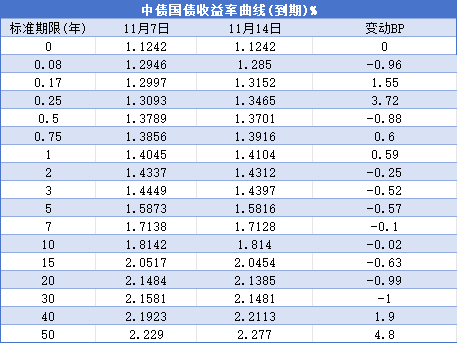
【债市观察】债市低波横盘交投情绪谨慎 十债困于1.80%
Xin Hua Cai Jing· 2025-11-17 03:02
Core Viewpoint - The bond market experienced marginal tightening in liquidity last week, with the 10-year government bond yield closing at 1.805%, showing a slight decrease of 0.1 basis points, and the overall market remains in a sideways trend awaiting clearer signals [1][4]. Market Review - The yield changes for various maturities from November 7 to November 14, 2025, were as follows: 1-year (+0.59 BP), 2-year (-0.25 BP), 3-year (-0.52 BP), 5-year (-0.57 BP), 7-year (-0.1 BP), 10-year (-0.02 BP), 30-year (-1 BP), and 50-year (+4.8 BP) [2][3]. - The 10-year government bond yield fluctuated between 1.8% and 1.8125% during the week, ultimately closing at 1.805% [4]. Primary Market - A total of 100 bonds were issued last week, amounting to 726.87 billion yuan, including 6 government bonds worth 309.32 billion yuan, 21 policy bank bonds worth 132.48 billion yuan, and 73 local government bonds worth 285.07 billion yuan [7]. - For the upcoming week (November 17 to November 21), 60 bonds are planned for issuance, totaling 400.66 billion yuan [7]. International Market - The U.S. government shutdown ended, leading to concerns about economic impacts and a downward adjustment in expectations for a Federal Reserve rate cut in December. The 10-year U.S. Treasury yield rose to 4.15%, an increase of approximately 5 basis points for the week [8][10]. Monetary Policy - The People's Bank of China (PBOC) conducted a total of 1.122 trillion yuan in 7-day reverse repos last week, resulting in a net injection of 626.2 billion yuan [12]. - The PBOC plans to conduct an 800 billion yuan reverse repo operation on November 17 to maintain liquidity in the banking system [12]. Institutional Perspectives - Tianfeng Securities noted that the bond market remains in a narrow trading range, with both bulls and bears exercising caution. The potential for a seasonal rally at year-end may not materialize due to uncertainties in the banking sector and insurance liabilities [19]. - Huaxi Securities suggested that with financial data indicating a need for broader monetary easing, the likelihood of a rate cut by year-end or early next year is increasing, with the possibility of the PBOC prioritizing bond purchases to create a more accommodative environment [20]. - Industrial perspectives from Xingye Securities indicated that the current state of the bond market may not change soon, and investors should remain patient for improved opportunities [21].