
建材

Search documents
243项化工/冶金/有色金属/建材/机械等行业报批意见稿公示
仪器信息网· 2026-02-27 09:05
Core Points - The Ministry of Industry and Information Technology has released a public notice soliciting opinions on 243 industry standards, including the "Technical Specification for Energy Conservation Supervision in the Sulfuric Acid Industry" [2][3] - The standards cover various sectors, including chemical, black metallurgy, non-ferrous metals, building materials, machinery, and shipbuilding, with a total of 243 standards being reviewed [2][3] Chemical Industry - The "Technical Specification for Energy Conservation Supervision in the Sulfuric Acid Industry" outlines the content, methods, and procedures for energy conservation supervision in sulfuric acid production enterprises [5] - The "Technical Specification for Energy Conservation Supervision in the Polyvinyl Chloride Industry" provides similar guidelines for PVC resin production enterprises [5] Black Metallurgy Industry - The "Artificial Intelligence Empowered Waste Steel Intelligent Classification System Technical Requirements" specifies the system architecture, equipment requirements, data requirements, and system performance for intelligent classification of scrap steel [6] - The "Artificial Intelligence Empowered Online Detection System for Iron and Steel Ladle Erosion State" details the system architecture and performance requirements for detecting the erosion state of ladles in steel production [6] Non-Ferrous Metals Industry - The "Technical Specification for Wastewater Recycling in Cobalt Smelting Enterprises" outlines the overall requirements for wastewater treatment and recycling processes in cobalt smelting [7] - The "Technical Specification for Wastewater Recycling in Nickel Smelting Enterprises" provides similar guidelines for nickel smelting operations [7] Building Materials Industry - The "Technical Specification for Alkali-Resistant Glass Fiber Roving" includes classification, requirements, testing methods, and storage guidelines for alkali-resistant glass fibers [8] - The "Technical Specification for Water-Based Epoxy Modified Cement Floor Materials" details the classification, requirements, and testing methods for these materials used in construction [8] Machinery Industry - The "Technical Guidelines for Energy Conservation Diagnosis in the Heat Treatment Industry" establishes the principles and procedures for conducting energy conservation diagnostics in heat treatment enterprises [11] - The "Technical Specification for Filter Bag Frames for Bag Dust Collectors" specifies the classification and technical requirements for manufacturing filter bag frames [11] Additional Standards - The standards also include various technical specifications for other industries, such as lithium-ion battery materials, construction materials, and environmental protection equipment [9][10][12]


中观洞察系列之一:碳排放双控制度落地,影响几何?
CMS· 2026-02-27 09:02
Group 1: Policy Transition - The transition from energy consumption dual control to carbon emission dual control is driven by the need for more precise governance and alignment with carbon neutrality goals[9] - The new carbon emission control system aims to replace the broad energy consumption metrics that previously included non-fossil energy sources, which hindered renewable energy development[10] - By 2026, local government reports will largely phase out references to energy consumption reduction per GDP, focusing instead on carbon intensity[7] Group 2: Implementation and Targets - To meet the 2030 target of reducing carbon emissions by over 65% from 2005 levels, an average annual reduction of approximately 5% is required from 2025 to 2030, exceeding the original plan of 3.7%[12] - During the 12th Five-Year Plan, carbon intensity decreased by 20%, surpassing the planned 17% reduction, demonstrating the effectiveness of stringent assessment mechanisms[26] - The carbon emission dual control system will focus on key industries such as electricity, steel, chemicals, and construction materials, which are identified as high carbon emitters[31] Group 3: Economic Impact and Industry Opportunities - The implementation of carbon emission controls is expected to create structural adjustment pressures on production, potentially leading to a rise in the Producer Price Index (PPI)[33] - Historical data indicates that approximately 70% of industries reduced carbon emissions during the previous assessment period from 2014 to 2017, coinciding with a recovery in PPI[33] - Industries with high carbon emissions, such as steel and non-metallic minerals, show a significant negative price elasticity, suggesting that supply reductions will support price increases[34]
午评:沪指震荡微跌,半导体等板块走低,算力概念爆发
Sou Hu Cai Jing· 2026-02-27 04:18
Market Overview - The Shanghai Composite Index experienced a slight decline of 0.17%, closing at 4139.53 points, while the Shenzhen Component fell by 0.68% and the ChiNext Index dropped by 1.46% [1] - Over 2900 stocks in the A-share market were in the red, indicating a broad market weakness [1] - The total trading volume across the Shanghai, Shenzhen, and North markets reached approximately 1.6 trillion yuan [1] Sector Performance - Sectors such as paper, semiconductors, and building materials saw declines, while power, coal, non-ferrous metals, steel, and agriculture sectors experienced gains [1] - Emerging sectors like computing power, AI applications, and rare earth concepts showed active performance [1] Economic Outlook - Dongguan Securities highlighted that by 2026, macroeconomic policies will focus on the "14th Five-Year Plan" with an emphasis on fiscal and financial collaboration to expand domestic demand [1] - The coordinated efforts in monetary policy, fiscal policy, import-export regulation, and the real estate market aim to stabilize short-term growth while fostering long-term momentum [1] - The implementation of structural monetary policy tools and direct fiscal subsidies is expected to continuously release domestic demand potential, laying a solid foundation for qualitative and reasonable quantitative economic growth in the first year of the "14th Five-Year Plan" [1] Investment Recommendations - Key sectors to focus on include dividends, TMT (Technology, Media, and Telecommunications), and power equipment [1]
券商晨会精华 | 全球燃机新签订单有望实现双位数同比增速
智通财经网· 2026-02-27 00:41
Market Overview - The market showed mixed performance with the three major indices fluctuating, where the ChiNext index dropped over 1% at one point. The total trading volume in the Shanghai and Shenzhen markets reached 2.54 trillion yuan. The computing hardware sector led the gains, with strong performances in PCB, CPO, liquid cooling servers, and computing chip concepts. Conversely, the film and television, insurance, and real estate sectors experienced notable declines. By the market close, the Shanghai Composite Index fell by 0.01%, the Shenzhen Component Index rose by 0.19%, and the ChiNext Index decreased by 0.29% [1]. Group 1: Global Engine Orders - Huatai Securities predicts that global new orders for gas turbines are expected to achieve double-digit year-on-year growth. Siemens Energy anticipates a 38% increase in new orders to 36 GW for the fiscal year 2026, indicating a potential high-level year-on-year order growth for the calendar year 2026. General Electric's pre-booked agreements of 43 GW until the end of 2025 could lead to a 44% increase in new orders for 2026 if fully converted [2]. Group 2: Cyclical Sector Outlook - CITIC Construction Investment expresses optimism regarding the cyclical sector, highlighting opportunities for heavy asset industries to reverse their current challenges. Factors contributing to this include rising inflation expectations, continuous recovery in PPI, and increasing commodity prices, which benefit the balance sheets of heavy asset companies. Additionally, industries such as chemicals and building materials have undergone capacity clearing, and policies aimed at controlling growth and stabilizing prices are enhancing profitability. The stabilization of real estate in first-tier cities is expected to boost domestic demand and industry chain recovery, with a focus on chemicals, building materials, and electrical equipment sectors [3]. Group 3: Green Energy Transition - Everbright Securities notes that the transition from energy consumption dual control to carbon emission dual control in China, along with the implementation of the EU carbon tariff, will lead to a revaluation of carbon costs. Assets with low or negative carbon attributes, such as green aluminum, green hydrogen, and zero-carbon parks, are expected to gain a green premium. Non-electric applications in shipping fuel green alcohol, hydrogen storage, and carbon capture green ammonia, as well as hydrogen metallurgy, are likely to benefit from this trend [4].
券商晨会精华:全球燃机新签订单有望实现双位数同比增速
Xin Lang Cai Jing· 2026-02-26 23:53
Group 1: Market Overview - The market experienced a mixed performance with the three major indices showing varied results, where the ChiNext index fell over 1% at one point, and the total trading volume in the Shanghai and Shenzhen markets reached 2.54 trillion [1] - The strength in the market was led by sectors such as computing hardware, with strong performances in PCB, CPO, liquid cooling servers, and computing chip concepts, while sectors like film and television, insurance, and real estate saw declines [1] Group 2: Analyst Insights - Huatai Securities anticipates that global new orders for gas turbines are expected to achieve double-digit year-on-year growth [2] - CITIC Construction Investment is optimistic about the cyclical recovery opportunities in heavy asset industries, driven by rising inflation expectations and improving PPI, which benefits heavy asset companies [2] - Everbright Securities notes that the transition from energy consumption dual control to carbon emission dual control will lead to a revaluation of carbon costs, favoring non-electric applications of green electricity [3] Group 3: Sector-Specific Forecasts - Siemens Energy projects a 38% year-on-year increase in new orders to 36 GW for the fiscal year 2026, indicating a strong outlook for the gas turbine market [1] - The chemical and building materials industries are expected to see enhanced profitability due to capacity clearing and policies aimed at stabilizing prices [2] - Non-electric applications in shipping fuels, hydrogen storage, and hydrogen metallurgy are likely to benefit from the green premium associated with low-carbon assets [3]
中国建材(03323.HK)遭贝莱德减持268.2万股
Ge Long Hui· 2026-02-26 13:56
Group 1 - BlackRock, Inc. reduced its stake in China National Building Material (03323.HK) by selling 2.682 million shares at an average price of HKD 6.2764 per share, amounting to approximately HKD 16.83 million [1] - Following the sale, BlackRock's total holdings decreased to 296,151,229 shares, representing a reduction in ownership from 8.04% to 7.97% [1][3] - The transaction occurred on February 20, 2026, as per the latest disclosure from the Hong Kong Stock Exchange [1][2]

嘉实基金尚可:资源品上涨逻辑发生质变 或开启数年级别的长周期
Zhong Zheng Wang· 2026-02-26 13:33
Core Viewpoint - The core logic behind the rise in resource stocks has fundamentally changed, shifting from being primarily driven by economic cycles to being driven by "safety" and "shortage" due to supply-side constraints, new demand paradigms, and geopolitical security premiums [1] Group 1: Market Dynamics - The current market trend is expected to be a long-term cycle lasting several years, with a significant differentiation and rotation anticipated starting in 2026 [1] - Among various cyclical industries, non-ferrous metals and chemicals are performing significantly better than real estate, steel, building materials, and construction machinery due to their lower correlation with real estate and infrastructure and smaller supply elasticity [1] Group 2: Investment Perspective - Investors are advised to adopt a long-term perspective to identify structural opportunities within the ongoing long-cycle market [1]
贝莱德减持中国建材(03323)268.2万股 每股均价约6.28港元
智通财经网· 2026-02-26 11:08
Group 1 - BlackRock reduced its stake in China National Building Material (03323) by 2.682 million shares at an average price of HKD 6.2764 per share, totaling approximately HKD 16.8333 million [1] - After the reduction, BlackRock's latest shareholding stands at approximately 296 million shares, representing a holding percentage of 7.97% [1]
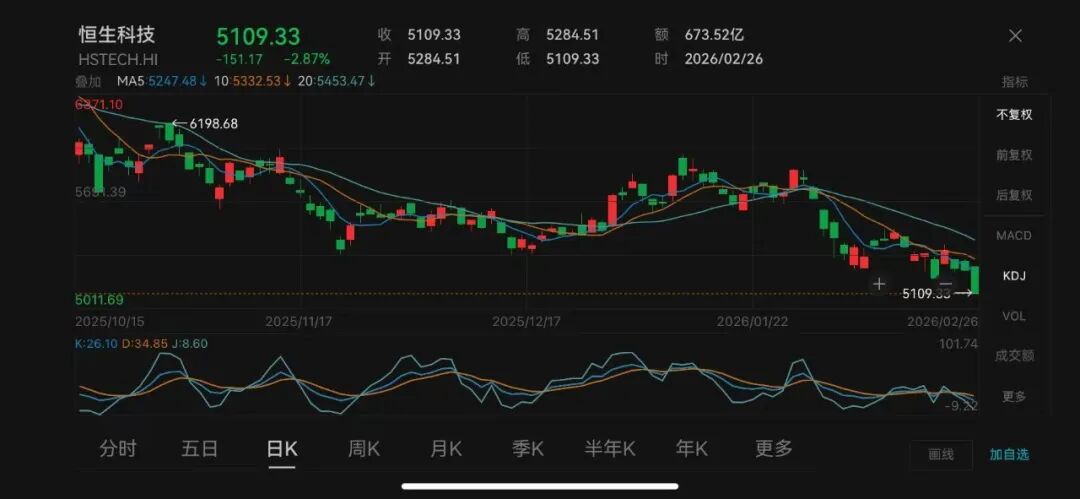
恒生科技重挫2.87%,自去年高点累计回调超20%,多个互联网龙头大跌!主板千股飘绿,南向资金净流出74亿港元
Mei Ri Jing Ji Xin Wen· 2026-02-26 10:03
Core Viewpoint - The Hong Kong stock market experienced a decline, with the Hang Seng Index falling by 1.44% and the Hang Seng Tech Index dropping by 2.87%, indicating a bearish trend in the market [1][2]. Market Performance - Over 1,000 stocks in the Hong Kong main board fell, and there was a net outflow of HKD 7.4 billion from southbound funds [1]. - The Hang Seng Tech Index has seen a cumulative decline of over 20% since its peak on October 2 of the previous year [5]. Key Stock Movements - Major tech stocks experienced significant declines: Alibaba down 3.57%, Baidu down 4.27%, Tencent down 2%, Meituan down 2.72%, JD down 2.62%, and Xiaomi down 1.18% [2][4]. - The performance of other notable stocks included XPeng down 5.06%, Huahong Semiconductor down 4.82%, and Li Auto down 4.45% [4]. Sector Analysis - The semiconductor sector showed some resilience, with stocks like Days Smart Chip rising over 20% [7][8]. - Other sectors, including construction materials, electrical equipment, and pharmaceuticals, also faced declines, with respective drops of 4.85%, 4.32%, and 4.12% [7].

东方雨虹涨10.01%封板!绿色建材新公司落地,格局优化叠加需求转变迎发展契机
Jin Rong Jie· 2026-02-26 06:26
Core Viewpoint - The stock of Dongfang Yuhong experienced a significant increase, driven by market speculation around its green building materials strategy, overseas capacity expansion, and the optimization of industry dynamics [1] Company Summary - Dongfang Yuhong's stock rose by 10.01% to a price of 18.91 yuan, with a total market capitalization of 45.17 billion yuan and a trading volume of 1.256 billion yuan [1] - The company established a green building materials technology company in Guangxi, focusing on new material technology promotion, research and development, and sales of waterproofing materials, fully owned by Dongfang Yuhong [1] Industry Summary - The building materials industry is witnessing a consolidation as weaker players exit the market, creating opportunities for leading companies like Dongfang Yuhong [1] - The demand structure in the industry is shifting, with growth in demand related to urban renewal and export chains, providing new development support for companies [1]
