
大宗商品

Search documents
海外高频 | 特朗普解雇理事库克,金银价格共振大涨(申万宏观·赵伟团队)
Sou Hu Cai Jing· 2025-09-01 16:24
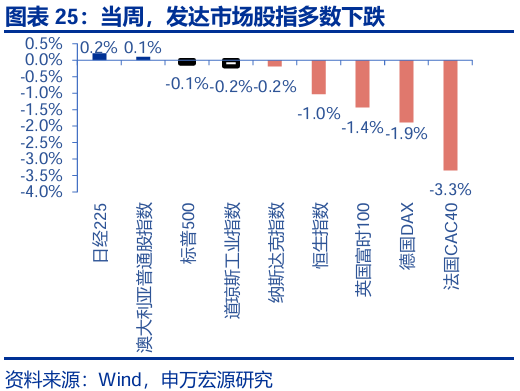
Group 1: Major Asset Movements - The Chinese Yuan has rapidly appreciated, leading to a significant increase in gold and silver prices. COMEX gold rose by 3.0% to $3,475.5 per ounce, while COMEX silver surged by 6.7% to $40.3 per ounce [1][40]. - The S&P 500 index fell by 0.1%, while the French CAC40 dropped by 3.3%. In contrast, emerging market indices showed mixed results, with Brazil's IBOVESPA rising by 2.5% [1][2]. - The WTI crude oil price increased by 0.5% to $64.0 per barrel, and Brent crude rose by 0.6% to $68.1 per barrel [34][35]. Group 2: Economic Indicators - The U.S. PCE price index for July showed a year-on-year increase of 2.6%, aligning with market expectations. The core PCE index rose by 2.9% year-on-year [79]. - Initial jobless claims in the U.S. for the week ending August 23 were reported at 229,000, lower than the expected 230,000 [82]. - The cumulative fiscal deficit for the U.S. in 2025 reached $1.14 trillion, with total expenditures of $5.31 trillion and tax revenues of $3.29 trillion [51]. Group 3: Political and Geopolitical Events - French Prime Minister Borne announced a trust vote on September 8 to push through a €44 billion austerity plan, causing significant market concerns and leading to a drop in the CAC 40 index [47]. - The geopolitical tensions, particularly the ongoing Russia-Ukraine conflict, are expected to exacerbate volatility in oil prices and disrupt global inflation control efforts [87]. Group 4: Federal Reserve Developments - President Trump dismissed Federal Reserve Governor Cook, which has led to a temporary decline in U.S. stock and bond rates. Cook has filed for a temporary injunction to remain in her position [62][71]. - Fed officials, including Waller, expressed support for a potential rate cut of 25 basis points in September, with expectations for further cuts in the following months [75][76].

美国PCE指数符合预期,国内反内卷初现成效
Guo Mao Qi Huo· 2025-09-01 06:57
1. Report Industry Investment Rating No relevant content provided. 2. Core Views of the Report - This week, the commodity index rose and then fell, with both industrial and agricultural products weakening. The main reason for the decline from the high was the weak fundamentals and prominent supply - demand contradictions of most commodities, despite positive macro sentiment [4]. - The US economy showed resilience in 25Q2, with the revised real GDP seasonally - adjusted quarterly - on - quarterly annualized rate up 0.3 percentage points to 3.3% and the year - on - year growth rate up 0.1 percentage points to 2.1%. The implementation of the "Big and Beautiful Act" is expected to make the contribution of private non - residential investment to real GDP year - on - year more prominent [4]. - US inflation pressure rebounded in July, with the core PCE year - on - year growth rate reaching 2.9%. The Fed needs to balance inflation control and employment market risks when considering interest rate cuts. The market generally expects a rate cut in September [4]. - The number of initial jobless claims in the US decreased again, but the University of Michigan consumer confidence index in August dropped to 58.2, indicating weakened consumer confidence [4]. - Japan's Tokyo core CPI (excluding fresh food and energy) decreased by 0.1 percentage points to 3.0% in August, and the year - on - year growth rate of commodity retail sales in July dropped by 1.7 percentage points to 0.2%, showing weak domestic demand [4]. - China's manufacturing PMI index rebounded slightly in August, indicating improved economic sentiment, but it has been in the contraction range for 5 consecutive months. The service PMI index rebounded more significantly and remained above the boom - bust line. The capital market is expected to inject vitality into the service industry and the overall economy in the third quarter [4]. - The slight recovery of industrial enterprise profits in July in China was due to the governance of disorderly price competition and the reduction of operating costs. However, effective domestic demand is still insufficient, and enterprise revenue growth is declining [4]. - Commodities are expected to fluctuate in the short term due to the game between expectations and reality. They are supported by macro expectations but face pressure from weak real - world supply - demand contradictions, especially in the real estate chain and the crude - oil sector [4]. 3. Summary by Relevant Catalogs PART TWO: Overseas Situation Analysis - **US GDP in 25Q2**: The revised seasonally - adjusted quarterly - on - quarterly annualized rate of real GDP was 3.3%, an increase of 0.3 percentage points from the initial value, and the year - on - year growth rate was 2.1%, an increase of 0.1 percentage points. The contribution of private non - residential investment to real GDP year - on - year is expected to be more prominent [4][8]. - **US PCE in July**: The core PCE year - on - year growth rate reached 2.9%, mainly affected by rising service costs and tariff cost transmission. The Fed needs to balance inflation control and employment market risks when considering interest rate cuts. The market generally expects a rate cut in September [4][11]. - **US Initial Jobless Claims and Consumer Confidence**: The number of initial jobless claims decreased again, but the University of Michigan consumer confidence index in August dropped to 58.2, the first decline in four months, indicating weakened consumer confidence [4][14]. - **Japan's CPI and Retail Sales**: Japan's Tokyo core CPI (excluding fresh food and energy) decreased by 0.1 percentage points to 3.0% in August. The year - on - year growth rate of commodity retail sales in July dropped by 1.7 percentage points to 0.2%, the lowest since March 2022, showing weak domestic demand [4][17]. PART THREE: Domestic Situation Analysis - **China's PMI in August**: The manufacturing PMI index rebounded slightly, with most sub - indicators improving, indicating improved economic sentiment. However, it has been in the contraction range for 5 consecutive months. The service PMI index rebounded more significantly and remained above the boom - bust line, and the capital market is expected to inject vitality into the service industry and the overall economy in the third quarter [4][22]. - **China's Industrial Enterprise Profits in July**: The slight recovery was due to the governance of disorderly price competition and the reduction of operating costs. However, effective domestic demand is still insufficient, and enterprise revenue growth is declining [4][25]. PART FOUR: High - Frequency Data Tracking - **Industrial开工率**: On August 29, the开工率 of PTA in the polyester industry chain was 70%, that of POY was 86%, and that of weaving was 62%. The national blast furnace开工率 (247) was 83.18% [32]. - **Automobile Sales**: From August 1 to 31, the year - on - year growth rates of automobile factory wholesale and retail were 2.8% and 9.2% respectively; from August 1 to 22, the year - on - year growth rates were 6.2% and 2.0% respectively [39]. - **Agricultural Product Prices**: On August 29, the price increase rates of 28 kinds of key - monitored vegetables, pork, and 6 kinds of key - monitored fruits were 1.74%, 0.78%, and 0.67% respectively compared with the previous day, and 0.49% compared with the previous week [40].
S&P-To-Gold Ratio Flashes Generational Alarm
Benzinga· 2025-08-28 17:23
Market Overview - U.S. equities are reaching new highs despite numerous fundamental and technical indicators signaling potential issues, including a significant increase in bankruptcy filings with 446 large companies collapsing in 2025 and market breadth at levels not seen since 2008 [1] - Valuations are extremely high, with Robert Shiller's CAPE ratio near dot-com peaks and Warren Buffett's market cap-to-GDP gauge indicating caution [1] Bubble Timing and Historical Context - The current market conditions reflect exuberant optimism, but experts warn about the risks of timing the market, as historical data shows poor outcomes for those who attempt to time their entry and exit [2] - The S&P 500-to-Gold ratio is signaling a potential major market shift, with only three previous instances of such a signal occurring in 1929, 1971, and 2000, each marking significant economic transitions [3][4] Technical Indicators - Recent technical indicators, including RSI and MACD on the S&P/Gold ratio, have crossed lower, suggesting a shift in market cycles where gold may outperform equities in the coming years [5] - Historical precedents indicate that such crossovers have led to significant declines in stock values while gold prices surged [7] Macro Economic Conditions - Current macroeconomic data shows a concerning trend with diminishing market breadth, increasing corporate defaults, and acknowledgment from tech leaders of a potential bubble, leading to predictions of a "deflationary bust" where stocks and real estate may falter under debt pressure while gold retains value [8] - The rising U.S. dollar is expected to exacerbate these conditions, aligning with the Dollar Milkshake Theory, which posits that a slowing global economy typically results in a stronger dollar [9][10] Implications for Gold and Equities - A stronger dollar is likely to create pressure on emerging markets, global trade, and commodities, making the S&P-to-Gold ratio crucial for understanding which assets will hold value during economic turmoil [11] - Historical patterns suggest that a breakdown in the S&P-to-Gold ratio indicates that gold may outperform equities, not through immediate explosive growth, but as equities lose their dominance [11]

宏观和大类资产配置周报:下一个重要时点或在三季度中下旬-20250819
Bank of China Securities· 2025-08-19 09:20
Macro Economic Overview - The report indicates that the next important time point may be in the late third quarter of 2025, with a suggested asset allocation order of stocks > commodities > bonds > currency [2][4] - In the first half of 2025, China's actual GDP grew by 5.3% year-on-year, laying a good foundation for achieving the annual target of 5.0% [2][4] - Economic data from July shows signs of growth pressure, including weakened external demand due to increased tariffs from the US and sluggish domestic consumption [2][4] Asset Performance - The A-share market saw an increase, with the CSI 300 index rising by 2.37% and the CSI 300 stock index futures up by 2.83% [11][12] - Commodity futures showed mixed results, with coking coal futures up by 0.33% and iron ore down by 1.65% [11][12] - The yield on ten-year government bonds rose by 6 basis points to 1.75%, while active ten-year government bond futures fell by 0.26% [11][12] Policy Insights - The report emphasizes the importance of expanding domestic demand in the second half of the year, suggesting that policies should be implemented to enhance efficiency and release domestic demand [2][4] - It is noted that the fiscal policy may have room for further adjustments within the year, particularly in light of external pressures easing due to potential interest rate cuts by the Federal Reserve [2][4] Sector Performance - The report highlights that the TMT sector has shown significant growth, with the ChiNext index leading with an 8.58% increase, followed by the Shenzhen Component Index at 4.55% [35][36] - The report also notes that the banking sector has faced declines, with a drop of 3.22% [35][36] Financial Data - In July, new social financing amounted to 1.13 trillion yuan, while new RMB loans decreased by 500 million yuan, indicating weak financing demand in the real economy [4][17] - The M2 money supply grew by 8.8% year-on-year, reflecting a relatively strong liquidity environment despite weak economic indicators [4][17]
期债 短线震荡思路对待
Qi Huo Ri Bao· 2025-08-13 05:23
Group 1: Macroeconomic Trends - Recent fluctuations in treasury futures are driven by macroeconomic data and policy changes, with the Ministry of Finance announcing the resumption of VAT on interest income from newly issued government bonds starting August 8, leading to increased demand for older bonds [1] - Domestic economic resilience is evident, with a rising risk appetite in the A-share market and the central bank maintaining ample liquidity, while the Federal Reserve keeps interest rates unchanged, causing upward momentum in treasury futures to weaken [1] Group 2: Trade Performance - In July 2025, China's total import and export volume reached $545.32 billion, a year-on-year increase of 5.9%, with exports at $321.78 billion, up 7.2%, outperforming market expectations [2] - The increase in exports is attributed to fluctuating U.S. tariff policies, leading to a "rush to export" effect, particularly with accelerated growth in exports to the EU, South Korea, Taiwan, and Belt and Road countries, despite a significant decline in exports to the U.S. [2] Group 3: Import Dynamics - Import growth continued to rebound in July, driven by rising prices of bulk commodities, with the CRB index increasing from 3.5% in June to 6.0% year-on-year, positively impacting both import volume and value [3] - The decline in imports from the U.S. narrowed from 15.5% to 10.3%, indicating a slight alleviation of the overall import pressure [3] Group 4: Price Levels - The Consumer Price Index (CPI) remained flat year-on-year in July, with a slight decrease in the growth rate compared to June, while the core CPI increased by 0.1 percentage points to 0.8%, the highest since March 2024 [4] - Food prices showed a moderate improvement, with the year-on-year growth rate of fresh vegetables and pork prices contributing to a downward adjustment in CPI [4] Group 5: Producer Price Index (PPI) Trends - The Producer Price Index (PPI) decreased by 3.6% year-on-year in July, consistent with June, reflecting low construction industry sentiment and price pressures in export-oriented sectors due to international trade uncertainties [5] - Recent government meetings emphasized maintaining a "moderately loose" monetary policy, indicating that the foundation for a "bull market" in bonds remains solid, although upward momentum in the bond market may weaken due to economic resilience and commodity price recovery [5]
【宏观经济】一周要闻回顾(2025年8月6日-8月12日)
乘联分会· 2025-08-12 08:41
Core Viewpoint - In the first seven months of 2025, China's total goods trade value reached 25.7 trillion yuan, reflecting a year-on-year growth of 3.5%, with exports increasing by 7.3% and imports decreasing by 1.6% [5]. Trade Performance - Total goods trade value for July 2025 was 3.91 trillion yuan, marking a growth of 6.7%, with exports at 2.31 trillion yuan (up 8%) and imports at 1.6 trillion yuan (up 4.8%) [5]. - General trade and processing trade both saw increases, with general trade at 16.44 trillion yuan (up 2.1%) and processing trade at 4.6 trillion yuan (up 6.3%) [5][6]. Trade Partners - ASEAN emerged as China's largest trading partner with a total trade value of 4.29 trillion yuan (up 9.4%), followed by the EU at 3.35 trillion yuan (up 3.9%) and the US at 2.42 trillion yuan (down 11.1%) [5][6]. Enterprise Contributions - Private enterprises contributed significantly with a total trade value of 14.68 trillion yuan (up 7.4%), accounting for 57.1% of total foreign trade [6]. - Foreign-invested enterprises had a trade value of 7.46 trillion yuan (up 2.6%), while state-owned enterprises saw a decline to 3.49 trillion yuan (down 8.8%) [6]. Export Composition - Mechanical and electrical products constituted 60% of exports, totaling 9.18 trillion yuan (up 9.3%), with notable growth in integrated circuits (up 21.8%) and automobiles (up 10.9%) [6]. - Labor-intensive products saw a slight decline in exports, totaling 2.41 trillion yuan (down 0.8%) [6]. Import Trends - Major bulk commodity prices fell, with iron ore imports at 6.97 million tons (down 2.3%) and crude oil at 3.27 million tons (up 2.8%) [7]. - Imports of mechanical and electrical products increased to 4.09 trillion yuan (up 5.8%) [7].

“反内卷”行情持续 期债承压
Qi Huo Ri Bao· 2025-08-11 23:29
Group 1 - Recent decline in government bond futures prices, with 10-year government bond yields rising above 1.7% due to increased market risk appetite driven by strong commodity prices and improved economic data [1][2] - Strong performance in commodity prices, particularly polysilicon, coking coal, and lithium carbonate, influenced by "anti-involution" policies aimed at enhancing product quality and phasing out outdated capacity [2] - July PPI showed a narrowing decline of 0.2% month-on-month, the first contraction reduction since March, driven by stabilizing prices in coal and steel industries [3] Group 2 - July's import and export data exceeded expectations, with total trade reaching $545.32 billion, a year-on-year increase of 5.9%, supported by strong exports to emerging markets despite a significant drop in exports to the U.S. [4] - The central bank's monetary policy remains relatively loose, with net withdrawals totaling 932.6 billion yuan, while maintaining liquidity to support short-term bond prices [5] - The "anti-involution" policy continues to influence market dynamics, leading to a divergence in bond prices and increased pressure on long-term bonds following the resumption of VAT on government and financial bonds [5]
张瑜:“估值-股息”四象限看各行业位置
一瑜中的· 2025-08-11 15:17
Core Viewpoint - The "valuation-dividend" quadrant analysis framework indicates that industries with low valuation (P/E percentile < 50%) and high dividend yield (> 3%) (Quadrant II) exhibit significant excess returns, while high valuation and low dividend yield industries (Quadrant IV) face notable correction risks. The food and beverage industry has transitioned from a high valuation trap (Quadrant IV) in 2021 to a low valuation and high dividend yield zone (Quadrant II) after four years of valuation digestion, enhancing its investment attractiveness and safety margin due to a low valuation level (12.0% historical percentile) and a relatively high dividend yield (3.6%) [2][6]. Group 1: Valuation-Dividend Quadrant Model - The "valuation-dividend" quadrant model is constructed using valuation and dividend dimensions to assess industry allocation value. The horizontal axis represents the P/E percentile, calculated using dynamic historical percentiles from the past 20 years, while the vertical axis represents the rolling dividend yield from the past 12 months. Quadrant I includes high valuation (historical percentile > 50%) and high dividend yield (> 3%) industries, Quadrant II includes low valuation (historical percentile < 50%) and high dividend yield (> 3%) industries, Quadrant III includes low valuation (historical percentile < 50%) and low dividend yield (< 3%) industries, and Quadrant IV includes high valuation (historical percentile > 50%) and low dividend yield (< 3%) industries. Historically, industries in Quadrant II tend to have better risk-return ratios and allocation value, while Quadrant IV industries require caution [4][15]. Group 2: Historical Validation - As of the end of 2023, the banking industry was in Quadrant II, with a dividend yield of 6.0% and a P/E percentile of only 0.3%. This configuration highlighted the industry's allocation value, leading to a significant outperformance of the banking sector, which rose by 52.83% from early 2024 to August 8, 2025, outperforming the broader market by 30.64 percentage points [18]. - In contrast, during the market peak in Q3 2021, the food and beverage and power equipment industries were in Quadrant IV, with dividend yields of 1.1% and 0.4%, and P/E historical percentiles of 78.0% and 82.3%, respectively. These industries subsequently underperformed the market, with returns from Q4 2021 to August 8, 2025, being -34.82% and -34.75%, lagging the broader market by approximately 35 percentage points [19]. Group 3: Food and Beverage Industry Transition - The food and beverage industry has transitioned from a risk zone to a value zone, entering Quadrant II as of August 8, 2025, with a P/E percentile of 12.0% and a dividend yield of 3.6%. This shift signifies a qualitative change, as the current low valuation level and relatively high dividend yield enhance the industry's allocation cost-effectiveness and safety margin [22]. Group 4: Weekly Economic Observation - The Huachuang Macro WEI index rose to over 7%, reaching 7.28% as of August 3, 2025, up from 6.35% on July 27, 2025. The increase is primarily driven by infrastructure (asphalt operating rate) and durable goods consumption (passenger car sales) [7][25]. - In real estate, the decline in residential sales has narrowed, with a year-on-year decrease of -17% in the first week of August across 67 cities, compared to -22% in July [8][29]. - The operating rate of asphalt facilities was 31.7% as of August 6, 2025, showing a year-on-year increase of 5.2%, while cement dispatch rates were at 39.2%, slightly down from the previous week but better than the same period last year [33].

每日投行/机构观点梳理(2025-08-06)
Jin Shi Shu Ju· 2025-08-06 12:09
Group 1: Market Outlook - HSBC raised the year-end target for the S&P 500 index to 6400 points, citing optimism from artificial intelligence and reduced policy uncertainty in the U.S. [1] - Morgan Stanley reported a significant net inflow of foreign capital into the Chinese stock market in July, with passive funds contributing $3.9 billion while active funds saw a $1.2 billion outflow [2] Group 2: Economic Indicators - Jefferies indicated that the Federal Reserve's actions may lead to a shift in market dynamics, with small-cap stocks expected to outperform large-cap tech stocks [3] - Deutsche Bank noted that oil prices are under pressure due to demand concerns, but potential sanctions on Russian oil could limit further declines [4] Group 3: Commodity Insights - Deutsche Bank highlighted that the copper market is awaiting direction, with recent earthquakes in Chile impacting supply and supporting prices [5] - Wells Fargo expressed concerns about the future of the U.S. dollar, suggesting that investors may prefer to sell at highs due to structural worries [6] Group 4: Sector Analysis - CITIC Securities recommended focusing on high-temperature superconducting materials, anticipating rapid growth driven by downstream applications [7] - Guotai Junan Securities emphasized the importance of monitoring the sustainability of retail investor trends in the market [8] - Huatai Securities identified opportunities in data center hardware, drawing parallels to the early growth of the lithium battery sector [9] - Huatai Securities also noted that recent agricultural policies may benefit leading pesticide companies by optimizing market order [10] - China Merchants Securities reported that the all-solid-state battery industry is accelerating, with sulfide electrolyte routes becoming mainstream [11]
洪灏:牛市的逻辑
2025-08-05 03:15
Summary of Key Points from Conference Call Industry or Company Involved - The discussion primarily revolves around the macroeconomic strategies and market conditions in the United States and China, with a focus on the implications for various asset classes, including equities and commodities. Core Insights and Arguments 1. **US-China Trade Relations**: The recent US-China trade talks in Stockholm were constructive, with both sides agreeing to extend discussions on tariffs and countermeasures for 90 days, indicating a potential easing of trade tensions [1] 2. **US Economic Expansion**: The US economy has been expanding for 63 consecutive months, avoiding recession, but the growth rate has been declining over the decades, currently averaging around 2% [2] 3. **Labor Productivity and AI**: The US labor productivity cycle appears to be at a low point but is expected to improve due to the ongoing AI revolution, which could increase demand for precious metals [2] 4. **Market Speculation**: There are signs of increased speculation in the US market, with a surge in penny stocks and call options, indicating a potential market top [3] 5. **Dollar Dynamics**: The relationship between the US dollar and long-term inflation expectations has changed since the Fed's rapid interest rate hikes began in 2021, with the dollar now seen as a high-yield investment rather than just a currency [6] 6. **China's Economic Outlook**: China's economy performed better than expected in the first half of the year, but there are concerns about growth pressures in the second half, leading to increased government spending and subsidies [7] 7. **Commodity Prices**: Upstream commodity prices are rising, although recent corrections may be due to regulatory guidance to prevent excessive price increases [7] 8. **Inflation Transmission**: Historical data shows that changes in upstream inflation eventually affect downstream consumer prices, indicating that expectations, rather than current prices, drive market behavior [8] 9. **Stock Market Performance**: If deflationary expectations are curbed, it could positively impact stock market performance, as upstream price increases lead to improved profit margins across the capital market [10] 10. **Market Sentiment and Strategy**: There is a prevailing market sentiment that the state may reduce holdings if the index exceeds 3500, but this logic may not hold if the market continues to rise [12] Other Important but Potentially Overlooked Content - The analysis suggests that the current market conditions are characterized by high liquidity, which may support continued market activity despite signs of overbought conditions [12] - The discussion emphasizes the importance of changing expectations in the market, which can lead to shifts in demand and price levels, rather than just focusing on current price movements [8]