有色金属

Search documents
“科技牛”拯救发起式基金!首发与持营不再“窘迫”
Sou Hu Cai Jing· 2026-02-09 09:35
Group 1 - The core viewpoint of the articles highlights the significant growth of initiation funds in the "tech bull" market, where many funds have not only increased their net value but also overcome size challenges, transforming from several million to tens of billions in scale due to investments in sectors like artificial intelligence [1][2] - Several initiation funds, such as the China Europe Information Technology fund, have seen remarkable growth, with the fund's size increasing from 24.4 million to 7.433 billion within nine months, demonstrating the potential for rapid expansion in favorable market conditions [2][3] - The "slow bull" market has alleviated the pressure on fund launches, allowing for larger initial fundraising amounts, such as the Penghua Qihang Quantitative Stock Selection fund, which raised 2.98 billion, compared to previous smaller fund sizes [3][4] Group 2 - Despite the favorable market conditions, some initiation funds have struggled to meet the 200 million threshold, leading to several funds announcing their exit after three years due to insufficient scale [6][7] - The operational costs associated with smaller funds can hinder their growth, making them reliant on institutional investments, which may affect their investment strategies [6] - Some funds have managed to "rescue" themselves by temporarily surpassing the 200 million threshold through increased subscriptions, indicating a dynamic market environment where fund performance can fluctuate significantly [7]
【公募基金】节前震荡下行,风格短期切换——公募基金指数跟踪周报(2026.02.02-2026.02.06)
华宝财富魔方· 2026-02-09 09:27
Equity Market Review and Outlook - The Shanghai Composite Index fell by 1.27%, the CSI 300 dropped by 1.33%, and the ChiNext Index decreased by 3.28% during the week of February 2-6, 2026, amid significant volatility in global resource futures and earnings disclosures from major US tech companies [1][4] - A-shares experienced increased volatility, with a notable drop of 100 points on Monday, followed by a recovery on Tuesday, and a shift to a fluctuating market for the rest of the week, influenced by upstream resource stocks and internet giants [4][5] - The market's risk appetite was constrained, with an average daily trading volume of 24,032 billion, reflecting a decrease from the previous week [4] - The technology sector is becoming increasingly sensitive to negative news, with potential pressure on tech styles as positive factors may be realized following the Two Sessions after the Spring Festival [5] Fixed Income Market Review and Outlook - The bond market saw a flattening yield curve during the week, with the 1-year government bond yield rising by 1.80 basis points to 1.32%, while the 10-year and 30-year yields fell to 1.81% and 2.25%, respectively [2][6] - The bond market is currently experiencing a strong oscillation, with some risk-averse funds flowing into bonds due to increased stock market volatility before the holiday [6][7] - The People's Bank of China has been actively injecting liquidity, with a net injection of 700 billion yuan through MLF in January, and the bond market is expected to remain stable without significant fluctuations in the short term [7] REITs Market Overview - The CSI REITs total return index fell by 0.91% to 1,042.84 points during the week, with most sectors declining, particularly consumption, data centers, and industrial parks [8] - Four new public REITs made progress in the primary market, indicating ongoing developments in the sector [8] Fund Index Performance Tracking - The monetary enhancement strategy index increased by 0.03% for the week, while the short-term bond fund index rose by 0.04% [11] - The mid-to-long-term bond fund index saw a gain of 0.09%, while the low-volatility fixed income plus fund index decreased by 0.04% [11] - The REITs fund index experienced a significant drop of 1.86%, reflecting the overall market trend [11] Investment Strategy Indices - The active stock fund selection index focuses on 15 funds with equal weight, emphasizing performance competitiveness and style stability [12] - The value stock fund selection index includes deep value and quality value styles, assessing companies based on absolute valuation levels and cash flow efficiency [14] - The growth stock fund selection index aims to capture high-growth opportunities, focusing on companies with significant future potential [17] Industry Theme Indices - The pharmaceutical stock fund selection index is constructed based on the intersection of fund holdings and representative indices, ensuring a minimum purity of 60% [19] - The consumer stock fund selection index targets funds with significant holdings in consumer-related sectors, maintaining a minimum purity of 50% [21] - The technology stock fund selection index is based on funds with substantial investments in technology sectors, also ensuring a minimum purity of 60% [24] Other Fixed Income Indices - The convertible bond fund selection index focuses on funds with a high proportion of convertible bonds, assessing performance and risk management [43] - The QDII bond fund selection index includes overseas bonds, prioritizing funds with stable returns and good risk control [44] - The REITs fund selection index emphasizes funds with stable cash flows from quality infrastructure projects [46]


港股收评:恒生指数涨1.76% 半导体板块涨幅领先
2 1 Shi Ji Jing Ji Bao Dao· 2026-02-09 08:52
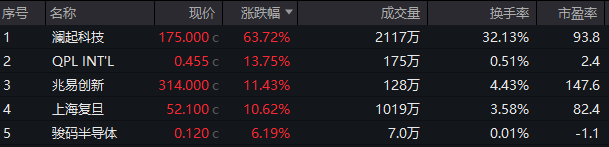
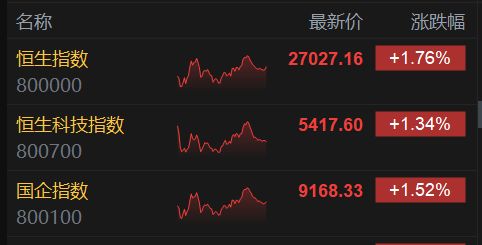
Market Overview - The Hong Kong stock market indices showed a collective rebound, with the Hang Seng Index rising by 1.76% to close at 27,027.16 points, the Hang Seng Tech Index increasing by 1.34% to 5,417.6 points, and the National Enterprises Index up by 1.52% to 9,168.33 points [1] Semiconductor Sector - The semiconductor sector led the gains, with notable increases including: - Lanqi Technology up by 63.72% to 175.000 HKD - QPL International rising by 13.75% - Zhaoyi Innovation increasing by 11.43% to 314.000 HKD [2] Durable Consumer Goods Sector - The durable consumer goods sector also performed well, highlighted by: - Yingsheng Science rising nearly 16% - Nanhua Group Holdings increasing by nearly 12% - Shetu Holdings up by nearly 10% [3] Non-Ferrous Metals Sector - The non-ferrous metals sector saw significant gains, with: - China Metal Utilization up by over 10% to 0.540 HKD - Southern Manganese Industry increasing by over 9% - CGN Mining rising by nearly 9% to 4.550 HKD [4][5] Telecommunications Sector - The telecommunications sector experienced declines, with: - Zhonggan Communication falling over 12% to 0.450 HKD - Huanlian Lianxun down over 6% - Asia Pacific Satellite decreasing by nearly 3% [6] Individual Stock Movements - Zhipu saw a significant increase, with its stock price rising over 32% to reach a high of 287.8 HKD, closing at 276.8 HKD, marking a 36.22% increase [6] - Zhipu's business model is supported by a comprehensive product matrix, with projected revenue of 190 million HKD in the first half of 2025, indicating strong commercial capabilities [7] - Lanqi Technology officially listed on the Hong Kong Stock Exchange, with its H-shares closing at 175 HKD, reflecting a 63.72% increase from its issue price of 106.89 HKD [7]
港股收评:恒指涨1.76%重回二万七上方,科技与金融普涨,AI应用概念股大幅拉升
Xin Lang Cai Jing· 2026-02-09 08:29
来源:格隆汇APP 格隆汇2月9日|港股三大指数集体上涨,恒生指数涨1.76%重回27000点上方,国企指数、恒生科技指 数分别上涨1.52%及1.34%。上周五美股大涨,以及金银等大宗商品止跌回升,市场情绪转好。 具体盘面上,大型科技股、大金融股(保险、券商)等权重多数活跃带领大市走俏,其中百度盘中涨幅约 4%,中国平安涨近5%领衔内险股上涨;马斯克表示3年内太空会是部署AI最便宜的地方,智谱一度飙 升超40%领衔AI应用概念股,且股价创上市新高,金山云、迈富时、美图公司皆走强;国泰海通指关注 企稳后的有色金属布局机会,黄金股带领有色金属股齐涨;半导体股、风电股、重型机械股、濠赌股、 煤炭股、餐饮股、内房股等纷纷上涨。 另一方面,三大运营商逆市受压,中国电信跌近3%,上周五拉升的茶饮料概念股多股走低,美伊谈判 重启,油价震荡波动,三桶油皆有跌幅。此外,澜起科技上市首日大涨近64%。(格隆汇) ...
港股收评:恒指涨1.76%重回二万七关口,科技逾金融普涨,AI应用概念股大幅拉升
Ge Long Hui· 2026-02-09 08:25
Core Viewpoint - The Hong Kong stock market experienced a collective rise, with the Hang Seng Index increasing by 1.76% to surpass the 27,000-point mark, driven by positive market sentiment following a significant rise in US stocks and a rebound in commodities like gold and silver [1] Group 1: Market Performance - The Hang Seng Index rose by 1.76%, while the Hang Seng China Enterprises Index and the Hang Seng Tech Index increased by 1.52% and 1.34%, respectively [1] - Major technology and financial stocks were active, contributing to the market's upward movement, with Baidu rising approximately 4% and China Ping An leading insurance stocks with a nearly 5% increase [1] Group 2: Sector Highlights - AI application stocks surged, with Zhizhu Technology soaring over 40% to reach a new high following Elon Musk's statement about AI deployment in space [1] - Gold stocks led a rally in the metals sector, with a focus on opportunities in non-ferrous metals as indicated by Guotai Junan [1] - Other sectors such as semiconductors, wind power, heavy machinery, gambling, coal, dining, and domestic real estate stocks also saw gains [1] Group 3: Underperforming Stocks - The three major telecom operators faced pressure, with China Telecom declining nearly 3% [1] - Several beverage stocks that had risen previously experienced declines, and the oil prices showed volatility amid renewed US-Iran negotiations, affecting the three major oil companies [1] - Lanke Technology saw a significant increase of nearly 64% on its first trading day [1]

每日报告精选(2026-02-06 09:00——2026-02-09 15:00)-20260209
GUOTAI HAITONG SECURITIES· 2026-02-09 08:23
Group 1: Macro Overview - The macroeconomic environment shows a continuation of the "Spring Festival effect," with consumer demand recovering but still needing stabilization [5][6] - Investment indicators are showing a marginal decline due to the approaching holiday, but real estate sales and land premiums are improving, likely influenced by seasonal factors and policy support [6] - External demand is mixed, with manufacturing sentiment in the US and Europe improving, while export freight rates are declining [6][8] Group 2: Strategy Insights - The report emphasizes maintaining stock positions during the holiday, despite recent market volatility and pessimism [10][11] - The Chinese government is shifting focus towards domestic demand, which is expected to enhance economic prospects and asset returns [11][12] - The report suggests that the current market conditions present a good opportunity for increasing holdings, particularly in sectors benefiting from domestic consumption [11][12] Group 3: Industry Analysis - The restaurant industry is experiencing a slowdown in price wars, with new subsidies expected to boost sales during the Spring Festival [25][26] - The steel industry is facing a seasonal inventory increase, but overall stock levels remain historically low, indicating potential for recovery [28][29] - The non-ferrous metals sector is advised to focus on stabilization opportunities, with copper prices showing resilience despite macroeconomic pressures [32][34] Group 4: Investment Recommendations - In the restaurant sector, companies like Gu Ming and Mi Xue Group are recommended due to ongoing subsidies and improved competitive dynamics [25][26] - For the steel industry, companies with strong product structures and cost advantages, such as Baosteel and Hualing Steel, are highlighted as key investment opportunities [30] - In the non-ferrous metals sector, firms like Zijin Mining and Huayou Cobalt are suggested due to their strategic positioning and market conditions [34][35]
短期避险情绪升温
Qi Huo Ri Bao· 2026-02-09 07:11
Market Overview - The A-share and stock index futures market are exhibiting distinct "pre-holiday characteristics" as the Spring Festival approaches, aligning with historical patterns of risk aversion and market sentiment contraction [1] - Trading volume has significantly shrunk, with the average daily trading volume in the Shanghai and Shenzhen markets dropping to around 2.5 trillion yuan in February, down from 3 trillion yuan in January [1] - The market is experiencing a cautious sentiment, with traders preferring short-term speculative trades rather than long-term holdings, reflecting increased uncertainty [1] Trading Behavior - The last week before the holiday is expected to see a continued decline in average daily trading volume due to traders' inclination to secure profits and a lack of willingness for new capital to enter the market [2] - The margin financing scale has also decreased, indicating a decline in risk appetite and cautious trading sentiment ahead of the holiday [2] - The current margin financing balance accounts for only 2.62% of the A-share market's circulating market value, suggesting a healthy market structure [2] Industry Performance - In the first week of February, there was a notable divergence in industry performance, with food and beverage, beauty care, transportation, and banking sectors showing gains, while sectors like non-ferrous metals, telecommunications, electronics, and petrochemicals faced declines [3] - Defensive sectors such as food and beverage and banking are performing better, aligning with the trend of risk-averse capital seeking stable returns [3] - The market sentiment has shifted from previous exuberance to a more rational phase, with long-term investors focusing on valuation and earnings certainty [3] Futures Market Dynamics - The significant divergence in performance among stock index futures is attributed to the varying styles in the spot market, with the price spread between IC and IH narrowing after reaching a historical high [4] - The price spread is expected to continue contracting in February, aligning with the mean reversion logic of stock index futures [4] - Post-holiday, there is a strong likelihood of a "New Year rally," driven by the return of previously withdrawn funds and positive market sentiment [4]
——金属周期品高频数据周报(2026.2.2-2026.2.8):有色金属价格普跌,但金、钨、钼、钒价格环比上涨-20260209
EBSCN· 2026-02-09 07:10
Investment Rating - The report maintains an "Accumulate" rating for the steel and non-ferrous metals sector [5] Core Insights - The report highlights a general decline in non-ferrous metal prices, while gold, tungsten, molybdenum, and vanadium prices have increased on a month-on-month basis [1] - The liquidity environment for small and medium enterprises has improved, with the BCI index rising by 6.62% to 50.27 in January 2026 [11] - The construction and real estate sectors are experiencing low inventory levels for hot-rolled steel, indicating potential supply constraints [21] Summary by Relevant Sections Liquidity - The BCI index for small and medium enterprises increased to 50.27, reflecting a positive shift in financing conditions [11] - The M1 and M2 growth rate difference was -4.7 percentage points in December 2025, indicating a contraction in liquidity [11] Infrastructure and Real Estate Chain - Weekly inventory levels for hot-rolled steel are at a five-year low, with rebar prices down by 0.93% [21] - The national average capacity utilization rate for blast furnaces was 86%, unchanged from the previous week [9] Industrial Products Chain - The operating rate for semi-steel tires is at a five-year high, while the prices for cold-rolled, copper, and aluminum have decreased [2] - The price of electrolytic aluminum is 23,110 CNY/ton, down 6.21% from the previous week [2] Valuation Metrics - The Shanghai Composite Index fell by 1.33%, with the engineering machinery sector showing the best performance at +4.35% [4] - The PB ratio for the steel sector relative to the broader market is currently at 0.50, indicating potential undervaluation [4] Real Estate Completion Chain - The prices of titanium dioxide and glass remain low, with the glass operating rate at 73.89% [1][76] - The cumulative year-on-year change in completed residential area was -18.10% for 2025 [76]
金银强势反弹!有色ETF汇添富(159652)涨超2%,冲击两连阳!紫金矿业大涨超4%,官宣铜、金产量剑指全球前三!关注有色产业长期配置价值
Sou Hu Cai Jing· 2026-02-09 06:17
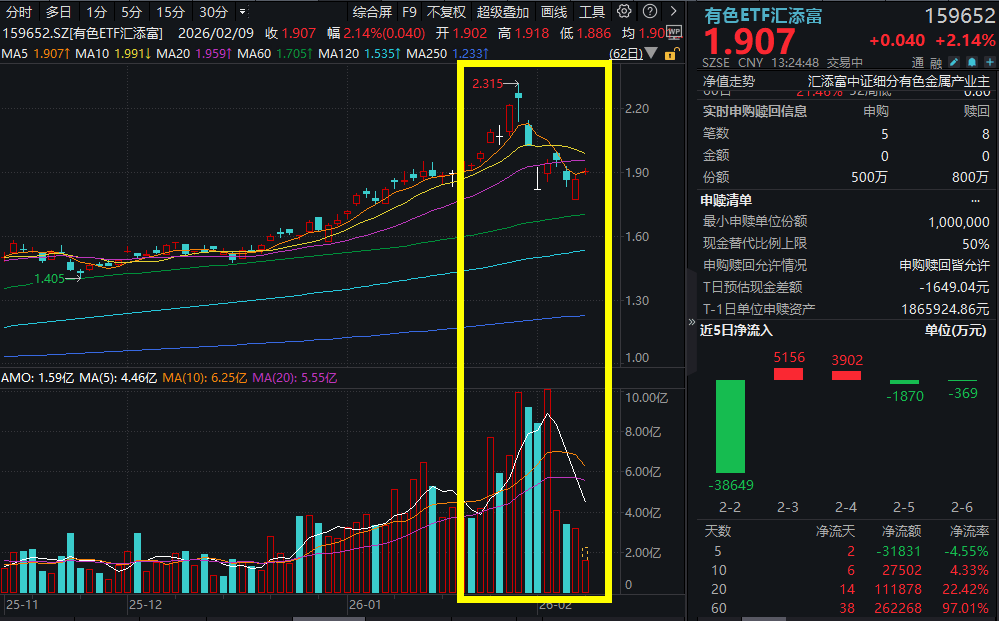
Core Viewpoint - The prices of gold and silver continue to rebound, with copper prices also rising, leading to a strong performance in the non-ferrous metal sector, as evidenced by the performance of the ETF Huatai-PineBridge Nonferrous Metals (159652) [1][5] Group 1: Market Performance - As of 13:25, the non-ferrous ETF Huatai-PineBridge (159652) has seen a fluctuation increase of over 2%, aiming for a second consecutive day of gains [1] - The majority of the index component stocks for the non-ferrous ETF have risen, with North Rare Earth increasing by over 5%, and Zijin Mining and Xingye Silver Tin both rising by over 4% [2][3] Group 2: Key Component Stocks - The top ten component stocks of the non-ferrous ETF include: - Chongqing Mining: +4.52% (14.74% estimated weight) - North Rare Earth: +5.57% (5.10% estimated weight) - Zijin Mining: +4.10% (2.83% estimated weight) [4] Group 3: Future Outlook - Zijin Mining announced a three-year production plan (2026-2028) aiming to enhance its resource reserves and production capacity, targeting to rank among the top three globally for copper and gold production by 2028 [5] - Despite recent volatility in the international metal market, many institutions remain optimistic about the long-term upward trend of non-ferrous metals [5][6] Group 4: Investment Strategy - Zhongyou Securities suggests that the high volatility in the non-ferrous metal sector is subsiding, recommending to buy on dips [6] - The report indicates that copper prices are expected to recover due to improved demand from downstream sectors and a favorable purchasing sentiment [6] Group 5: Long-term Investment Logic - According to Fangzheng Securities, the long-term logic for non-ferrous metals remains intact despite short-term fluctuations, with a focus on the strategic value of key mineral resources [7][8] - The non-ferrous ETF Huatai-PineBridge (159652) is highlighted for its comprehensive coverage of various metal sectors, including gold, copper, aluminum, lithium, and rare earths, positioning it well for the upcoming super cycle in non-ferrous metals [8][10]

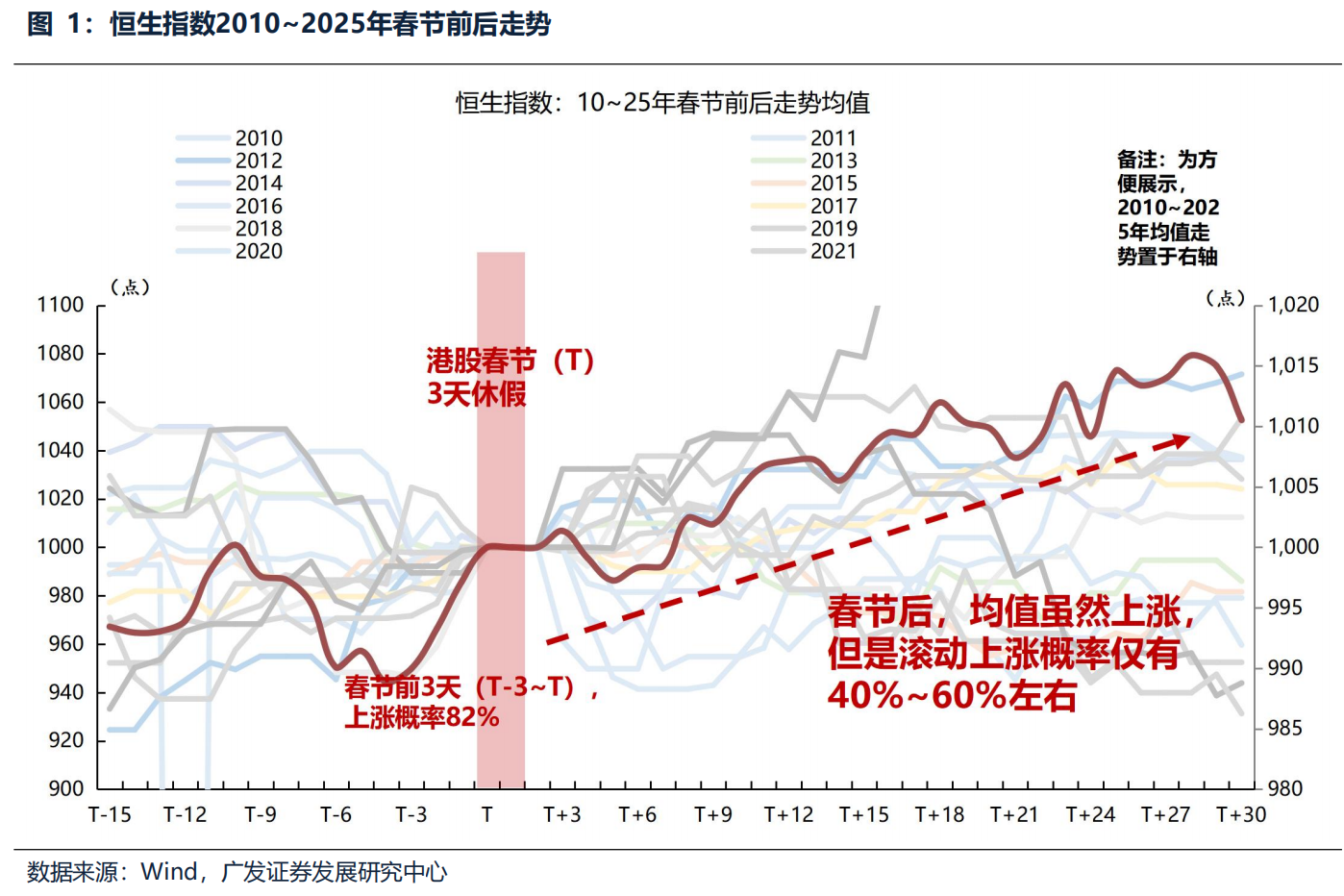
港股“春季躁动”遇上“解禁高峰”投资者将如何应对?
Feng Huang Wang· 2026-02-09 06:07
春节将至,投资者普遍关注节前节后港股市场表现规律。对此广发证券指出,历史数据显示,恒生指数在春节前3个交易日上涨概率高达82%,且上涨幅度 普遍较大。这反映出节前资金行为趋同,短期做多情绪明显。 图 2:春季~两会,A股上涨明显;港股没有明显的目历效应 St Friday ■ 上涨概率:春节->两会(2010年~2015年 100% 93.8% -93.8% 93.8% 87.5% 90% 81.39 it 80% 72.7% ter 2 5: 70% 62.5% 62.5% 56.3% 54 .! 60% 50% 40% 30% 20% 10% 0% el ck 02月 717 班 极 | 上涨概率 | 圣诞节-春节前 | 春节后-两会 | 两会期间 | 两会-3月底 | 1月 | | --- | --- | --- | --- | --- | --- | | 恒生科技 | 72.7% | 72.7% | 45.5% | 50.0% | 63.6% | | 恒生指数 | 80.0% | 46.7% | 40.0% | 42.9% | 73.3% | | 恒生中国企业指数 | 73.3% | 40.0% | ...