公用事业
Search documents
两轮贸易摩擦,信用债投资复盘与展望
Changjiang Securities· 2025-05-05 23:31
1. Report's Investment Rating for the Industry No investment rating for the industry is provided in the report. 2. Core Viewpoints of the Report - From August 2017 to January 2020, the credit bond market evolved in four stages under the intertwined influence of Sino - US trade frictions and policy hedging, presenting a pattern of "strengthened safe - haven properties of interest - rate bonds and re - structured risk pricing of credit bonds" [3][21]. - The market logic gradually returned to fundamental verification in the later stage, with external shocks having a diminishing marginal impact. Policy hedging effectiveness, credit repair rhythm, and cross - border capital flows became key variables affecting the market trend [12]. - After the implementation of the 54% tariff policy on April 2, 2025, the core logic of the credit bond market shifted to "safe - haven trading + policy hedging". Short - term high - grade varieties are favored, and in the short - term, safe - haven sentiment will dominate the market. In the medium - term, attention should be paid to economic data and the possible impact of the valuation repair of Chinese dollar - denominated bonds [100][105]. 3. Summary by Directory First Stage: Anticipation Disturbance Period (August 2017 - June 2018) - **Interest Rate Curve Differentiation and Credit Risk Pricing Re - structuring**: The bond market was in a "loose money, tight credit" policy combination. The short - end of the interest - rate bond market benefited from the targeted RRR cut in April 2018, while the long - end was suppressed by factors such as rising international oil prices, Fed rate hikes, and regulatory tightening. Private enterprise default amounts increased, and investors' behaviors diverged. The inability to transform "loose money" into "loose credit" intensified the structural contradictions in the credit bond market [22][24][25]. - **Credit Bond Financing Fluctuations due to Trade Friction Evolution**: Credit bond financing fluctuated. It declined initially due to trade friction concerns and financial risk prevention policies, then rebounded briefly in early 2018 due to liquidity release policies, and finally decreased again after the addition of tariffs and the implementation of the asset management new rules [29][30]. - **Overall Rise in Credit Bond Yields and Widening of Credit Spreads**: Credit bond yields rose overall, and credit spreads widened. Market concerns about credit risks spread from local industries to the whole market, especially in export - oriented industries. Although the targeted RRR cut in April 2018 curbed risk spread, private enterprise default events increased, and the pricing logic of the credit bond market became more complex [36][37]. - **Initial Appearance of Credit Bond Default Pressure with Wide Industry Distribution**: Credit bond defaults and extensions increased slightly. Defaults were no longer concentrated in traditional over - capacity industries but spread to more sectors. Policy uncertainties affected corporate financing efficiency and solvency [42][43]. Second Stage: Policy Hedging Period (July - November 2018) - **Differentiated Efficiency of Interest - Credit Transmission under Policy Hedging**: As Sino - US trade frictions escalated, domestic policies shifted. The central bank's RRR cut pushed short - term interest rates down, but long - term interest rates rebounded due to factors such as local government bond issuance and CPI increase. The "bull - steep" market of interest - rate bonds and the financing repair of credit bonds diverged [48]. - **Industry Financing Differentiation between Trade Pressure and Domestic Demand Hedging**: Different industries' credit bond financing showed a differentiated trend. Export - oriented industries such as commercial trade and light manufacturing saw a decline in net financing, while the public utility industry benefited from domestic demand support and had an increase in net financing [51]. - **Overall Decline in Credit Bond Yields and Narrow - range Fluctuation of Credit Spreads**: After the formal implementation of tariffs, the market's pricing of trade frictions became less sensitive. Credit bond yields declined, and credit spreads fluctuated within a narrow range. Although trade frictions escalated again in September 2018, the bond market reacted calmly. Low - grade industrial bond credit spreads widened, and the impact of domestic policies on the bond market gradually exceeded external shocks [55]. - **Relative Advantage of Non - standard Bonds of Urban Investment Entities after Trade Friction Upgrade**: Credit bond defaults increased, mainly among private enterprises. Non - standard bonds of non - urban investment entities had a significant increase in default cases, while those of urban investment entities were relatively stable, reflecting the positive role of local policy coordination [61][62]. Third Stage: Wide - Credit Verification Period (December 2018 - April 2019) - **"Time Difference" Game between Liquidity Drive and Credit Repair**: The bond market was driven by both the easing of trade frictions and domestic policy loosening. Although the G20 Summit in December 2018 and the central bank's full - scale RRR cut in January 2019 boosted market sentiment, private enterprise credit spreads remained high. The bond market turned bearish in April 2019 as economic fundamentals improved [69]. - **Differentiated Financing between State - owned and Private Enterprises under Tariff Easing and Policy Loosening**: State - owned enterprises benefited from policy loosening and had an increase in net financing, while private enterprises were still affected by the lagged impact of previous tariffs. Their net financing showed a fluctuating trend [72]. - **Credit Bond Yields Oscillated and Industrial Bond Spreads of Different Industries Differentiated**: As trade frictions eased, credit bond yields oscillated, and credit spreads differentiated. The market logic shifted to fundamental verification. Industries such as electrical equipment and chemical industry, which were affected by tariffs, had a slower credit spread repair than the overall market [74][78]. - **Credit Bond Default Situation Remained Flat Year - on - Year with Insufficient Improvement for Private Enterprises**: During the negotiation easing period, the number of credit bond extensions and defaults remained basically the same as the previous stage. Financial institutions preferred high - credit entities, and private enterprises still faced challenges in financing [81]. Fourth Stage: Resonance Period of Liquidity Stratification and Cross - border Capital Pricing (May 2019 - January 2020) - **Dual Pricing Logic of Credit Risk Events and Foreign Capital Safe - haven**: The takeover of Baoshang Bank in May 2019 led to concerns about liquidity stratification. Foreign capital increased its allocation of interest - rate bonds, and the bond market showed a pattern of safe - haven interest - rate bonds and differentiated credit bonds. The bond market was driven by both "safe - haven sentiment" and "foreign capital allocation" [85]. - **Increased Financing of Urban Investment Bonds with Swinging Trade Friction Expectations**: During the liquidity stratification stage, urban investment bond net financing continued to grow. Regulatory policies relaxed the "borrowing new to repay old" restrictions, and the central bank's policies provided a low - cost replacement space for urban investment platforms [88]. - **Overall Decline in Credit Bond Yields with Intensified Structural Differentiation**: Credit bond yields declined overall, but the market showed intensified structural differentiation. Yields of some industries such as electronics and automobiles increased, while those of infrastructure - related industries remained stable. High - grade state - owned enterprise industrial bond credit spreads narrowed, while those of AA + private enterprise industrial bonds widened [90][93]. - **Credit Bond Defaults under the Prolonged Trade Friction**: Under the continuous impact of trade frictions, credit bond defaults increased, mainly due to factors such as the slowdown of the macro - economic environment, the adjustment of corporate profit growth, and the impact on export - oriented enterprises. Non - standard bonds of urban investment platforms had relatively stable repayment performance [96]. Outlook on Credit Bond Trends in the Current Trade Friction - After the implementation of the 54% tariff policy on April 2, 2025, the credit bond market's core logic shifted. Interest - rate bonds reacted first, and the steep downward movement of the interest - rate curve opened up the valuation space for credit bonds. High - grade varieties are favored, and in the short - term, safe - haven sentiment will dominate. In the medium - term, attention should be paid to economic data and the possible impact of the valuation repair of Chinese dollar - denominated bonds. It is recommended to adopt a strategy of "moderately extending duration" + "moderately lowering credit quality" [100][105].
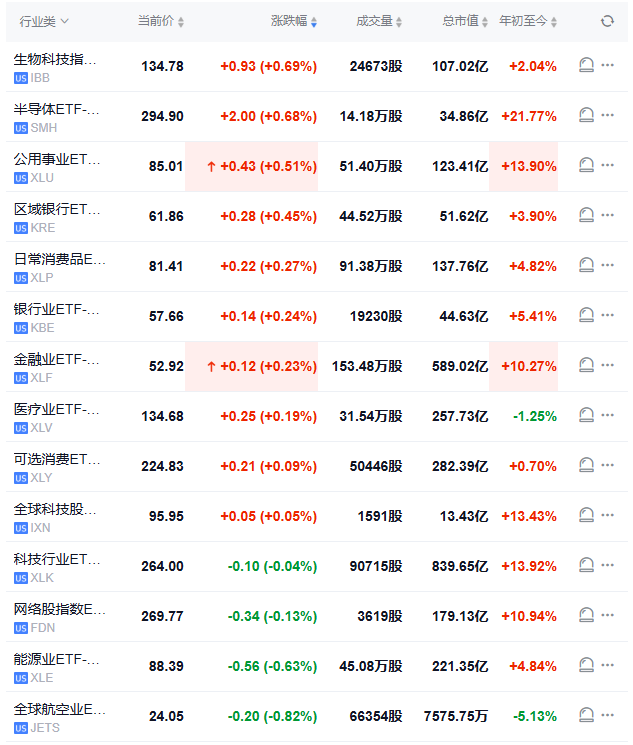
美股盘初,主要行业ETF普跌,能源业ETF跌2%,金融业ETF、可选消费ETF跌超1%。
news flash· 2025-05-05 13:52
Market Overview - Major industry ETFs in the US stock market experienced declines, with the energy sector ETF dropping by 2%, and both the financial and consumer discretionary ETFs falling by over 1% [1] Energy Sector - The energy sector ETF is priced at 80.34, reflecting a decrease of 1.64, or 2.00% [2] - The total market capitalization for the energy sector ETF is 201.19 billion, with a year-to-date change of -5.48% [2] Financial Sector - The financial sector ETF is currently at 49.19, down by 0.57, or 1.16% [2] - This ETF has a total market capitalization of 547.45 billion, showing a year-to-date increase of 2.14% [2] Consumer Discretionary Sector - The consumer discretionary ETF is priced at 199.31, down by 2.13, or 1.05% [2] - The total market capitalization for this ETF is 250.33 billion, with a year-to-date decline of 10.92% [2] Utility Sector - The utility sector ETF is at 79.01, down by 0.74, or 0.93% [2] - It has a total market capitalization of 114.70 billion, with a year-to-date increase of 5.13% [2] Technology Sector - The technology sector ETF is priced at 215.56, reflecting a decrease of 1.05, or 0.48% [2] - The total market capitalization for the technology sector ETF is 685.60 billion, with a year-to-date decline of 7.13% [2] Biotechnology Sector - The biotechnology index ETF is at 126.09, down by 0.51, or 0.40% [2] - Its total market capitalization is 100.12 billion, with a year-to-date decrease of 4.54% [2] Semiconductor Sector - The semiconductor ETF is priced at 218.32, down by 0.71, or 0.32% [2] - The total market capitalization for this ETF is 25.81 billion, with a year-to-date decline of 9.85% [2] Regional Banks - The regional bank ETF is at 56.07, down by 0.17, or 0.30% [2] - It has a total market capitalization of 46.79 billion, with a year-to-date decrease of 6.47% [2] Global Technology Sector - The global technology ETF is priced at 79.42, down by 0.15, or 0.19% [2] - Its total market capitalization is 11.12 billion, with a year-to-date decline of 6.29% [2] Global Airline Sector - The global airline ETF is at 21.07, up by 0.19, or 0.91% [2] - The total market capitalization for this ETF is 663.70 million, with a year-to-date decline of 16.88% [2]
量化择时周报:模型提示市场情绪指标进一步回升,红利板块行业观点偏多-20250505
Shenwan Hongyuan Securities· 2025-05-05 09:41
Quantitative Models and Construction Methods 1. Model Name: Market Sentiment Timing Model - **Model Construction Idea**: The model is built from a structural perspective to quantify market sentiment using various sub-indicators[7] - **Model Construction Process**: - The model uses sub-indicators such as industry trading volatility, trading crowding, price-volume consistency, Sci-Tech Innovation Board (STAR 50) trading proportion, industry trend, RSI, main buying force, PCR combined with VIX, and financing balance ratio[8] - Each sub-indicator is scored based on its sentiment direction and position within Bollinger Bands. Scores are categorized as (-1, 0, 1)[8] - The final sentiment structural indicator is the 20-day moving average of the summed scores. The indicator fluctuates around 0 within the range of [-6, 6][8] - **Model Evaluation**: The model effectively captures market sentiment trends and provides actionable insights for timing decisions[8] 2. Model Name: Moving Average Scoring System (MASS) - **Model Construction Idea**: This model evaluates long-term and short-term trends of indices using N-day moving averages to generate timing signals[18] - **Model Construction Process**: - For N moving averages (N=360 for long-term, N=60 for short-term), scores are assigned based on the relative position of adjacent moving averages. If a shorter moving average is above a longer one, it scores 1; otherwise, it scores 0[18] - The scores are standardized to a 0-100 scale and averaged to derive the trend score at a specific time point[18] - Long/short-term timing signals are generated based on the crossover of the trend score with its 100/20-day moving average[18] - **Model Evaluation**: The model provides clear signals for sector rotation and market style preferences, favoring value and defensive sectors in the current environment[18] 3. Model Name: RSI Style Timing Model - **Model Construction Idea**: The model uses the Relative Strength Index (RSI) to compare the relative strength of different market styles (e.g., growth vs. value, small-cap vs. large-cap)[22] - **Model Construction Process**: - For two indices A and B, calculate the standardized ratio of their net values over a fixed period[22] - Compute the average gain (Gain) and average loss (Loss) over N days, where gains on down days are treated as 0 and losses on up days are treated as 0[22] - RSI formula: $ RSI = 100 - 100 / (1 + Gain / Loss) $ - RSI values range from 0 to 100, with values above 50 indicating stronger buying pressure[22] - The model calculates 5-day, 20-day, and 60-day RSI values. When the 20-day RSI exceeds the 60-day RSI, the numerator style is favored; otherwise, the denominator style is favored[22] - **Model Evaluation**: The model effectively identifies style dominance, currently favoring large-cap and value styles while noting short-term strengthening of growth and small-cap styles[22] --- Model Backtesting Results 1. Market Sentiment Timing Model - Sentiment indicator value as of April 30, 2025: 0.8, indicating a recovery in market sentiment[9] 2. Moving Average Scoring System (MASS) - Short-term signals: Positive for sectors like beauty care (72.88), utilities (86.44), banking (74.58), and oil & petrochemicals (22.03)[19] - Long-term signals: Positive for sectors like banking (95.54), machinery (78.55), and steel (51.25)[19] 3. RSI Style Timing Model - Growth/Value (300 Growth/300 Value): RSI 20-day = 53.02, RSI 60-day = 50.42, favoring value[25] - Small-cap/Large-cap (SW Small/SW Large): RSI 20-day = 48.84, RSI 60-day = 53.62, favoring large-cap[25] --- Quantitative Factors and Construction Methods 1. Factor Name: RSI - **Factor Construction Idea**: Measures the relative strength of buying and selling forces over a specific period[22] - **Factor Construction Process**: - Calculate the average gain (Gain) and average loss (Loss) over N days[22] - Formula: $ RSI = 100 - 100 / (1 + Gain / Loss) $ - RSI values range from 0 to 100, with higher values indicating stronger buying pressure[22] - **Factor Evaluation**: Provides a robust measure of market momentum and style preferences[22] --- Factor Backtesting Results 1. RSI - Growth/Value (300 Growth/300 Value): RSI 20-day = 53.02, RSI 60-day = 50.42, favoring value[25] - Small-cap/Large-cap (SW Small/SW Large): RSI 20-day = 48.84, RSI 60-day = 53.62, favoring large-cap[25]
巴菲特的最后豪赌:“囤钱”、看好日本为哪般?
Sou Hu Cai Jing· 2025-05-05 09:24
Core Viewpoint - Warren Buffett announced his plan to retire by the end of 2025, recommending Greg Abel as his successor as CEO of Berkshire Hathaway [3] Group 1: Financial Performance - As of Q1 2025, Berkshire Hathaway's cash position reached a record high of $347.7 billion, up from $334.2 billion at the end of Q4 2024 [5] - The company's net profit for Q1 2025 was $4.603 billion, a 64% decrease from $12.702 billion in the same quarter the previous year [9][15] - Total revenues for Q1 2025 were $89.725 billion, slightly down from $89.869 billion in Q4 2024 [15] Group 2: Investment Strategy - Since Q2 2023, Buffett's investment strategy has shifted towards cash and U.S. government bonds, outperforming the annualized return of the S&P 500 [12] - The company experienced an investment net loss of $50.38 billion in Q1 2025, contrasting sharply with a profit of $14.8 billion in the same period last year [9][16] - Buffett's cautious stance on AI investments reflects a broader strategy of avoiding high-risk ventures while focusing on stable returns [18] Group 3: Market Outlook - Buffett expressed optimism about the long-term prospects of the Japanese market, despite global economic uncertainties, with Berkshire's investments in Japan valued at approximately $20 billion [19][21] - The Japanese companies in which Berkshire has invested are characterized by low valuation metrics and high dividend yields, making them attractive for long-term investment [24][26] - The current low-interest-rate environment in Japan provides Berkshire with a favorable financing cost, enhancing the profitability of its investments [26]
美联储按兵不动?鲍威尔这次要放什么信号?
Sou Hu Cai Jing· 2025-05-05 08:26
Core Viewpoint - The market is closely watching the Federal Reserve's interest rate decision, with a high probability of maintaining rates in May due to strong employment data and easing inflation pressures [3][4]. Group 1: Federal Reserve's Decision - The probability of the Federal Reserve maintaining interest rates in May exceeds 96%, indicating a strong consensus in the market [3]. - April's non-farm payrolls increased by 177,000, significantly surpassing the expected 138,000, reflecting a robust labor market [3]. - The March PCE price index rose by 2.3% year-over-year, with core PCE dropping to 2.6%, suggesting reduced short-term pressure for rate hikes [3]. Group 2: Political and Economic Context - Recent tensions between the White House and the Federal Reserve have emerged, with President Trump suggesting that the Fed should lower rates, which could undermine the Fed's independence [3][4]. - The upcoming press conference is crucial for understanding Fed Chair Powell's stance on inflation, economic outlook, and political pressures [4]. Group 3: Market Implications - A hawkish signal from Powell could lead to a rebound in the dollar index, putting short-term pressure on the Chinese yuan, while long-term trends will depend on domestic economic resilience [5]. - If the Fed signals a stable liquidity environment without aggressive rate hikes, technology stocks may continue to perform well, driven by AI trends [5]. - Gold prices are sensitive to interest rates; maintaining current rates could enhance its appeal as a safe-haven asset, while oil prices will depend on the Fed's economic outlook [5]. Group 4: Future Considerations - Current market expectations indicate a 35% probability of a rate cut in June, suggesting that most believe the Fed will adopt a wait-and-see approach [5]. - The focus should be on whether the Fed's policy logic shifts from "anti-inflation priority" to "balancing growth and inflation," which will influence asset allocation strategies in the coming months [5].
美联储降息预期降温,波折与反复
HWABAO SECURITIES· 2025-05-05 05:11
Group 1 - The report highlights that the expectation for the Federal Reserve to cut interest rates has cooled, leading to market fluctuations and uncertainties [9][10][12] - The U.S. GDP contracted by 0.3% in Q1 2025, marking the first decline since Q1 2022, which may impact market sentiment [9] - The non-farm payroll data exceeded expectations with 177,000 new jobs added in April, while the unemployment rate remained at 4.2%, indicating a mixed economic outlook [9] Group 2 - In the bond market, there is an expectation for macroeconomic data to be released soon, with a focus on holding bonds as yields may decline further [10][12] - The stock market is expected to experience short-term disturbances, but sectors with strong earnings performance, particularly high-dividend defensive sectors like banks and utilities, are likely to be favored [3][12] - The report suggests monitoring sectors influenced by national subsidies, such as consumer electronics and home appliances, as well as non-energy cyclical sectors like steel and non-ferrous metals [3][12] Group 3 - The report indicates that the market is currently in a cautious state, with a preference for defensive positions in both the bond and stock markets [15] - The A-share market is experiencing a mixed performance, with a decline in average daily trading volume to 1,103.9 billion yuan, reflecting a low market sentiment [20] - The report emphasizes the importance of upcoming economic data releases, including the Federal Reserve's interest rate decision and China's CPI and PPI data [21]
“股神”也有失手时? 巴菲特一季度投资亏了50亿美元
Sou Hu Cai Jing· 2025-05-04 08:51
Core Insights - Berkshire Hathaway reported a significant decline in operating profit for Q1 2025, dropping to $9.641 billion from $11.222 billion year-over-year [1] - The company's net profit attributable to shareholders fell by 63% to $4.6 billion, despite revenue remaining stable at $89.7 billion [1] - Investment losses amounted to $5.038 billion, primarily due to market volatility and unfavorable exchange rates [2] Financial Performance - Operating profit decreased to $9.641 billion from $11.222 billion year-over-year [1] - Revenue for Q1 2025 was $89.7 billion, roughly unchanged from the previous year [1] - Net profit attributable to shareholders was $4.6 billion, a 63% decline compared to the same quarter last year [1] Business Segments - The insurance segment faced challenges, incurring a loss of $1.3 billion due to wildfires in Southern California [1] - Energy business performed well, with net profit increasing by nearly 50%, although natural gas profits were impacted by high interest rates [1] - The investment segment suffered the most, with a total loss of $5.038 billion attributed to stock market fluctuations and currency issues [2] Market Sentiment - Despite the investment losses, Berkshire's stock price increased by 18.86% year-to-date, marking ten consecutive months of gains [3] - The price-to-book ratio reached 1.79, the highest since 2007, and the projected P/E ratio for 2025 is 25, above the S&P 500's approximate 20 [3] - The market continues to show confidence in Berkshire's long-term fundamentals, reflecting institutional trust in the company's management [3] Strategic Considerations - Berkshire holds $347.7 billion in cash, maintaining its status as a "cash king" [2] - The company expressed concerns over the uncertainty brought by the Trump administration's tariff policies and geopolitical risks, affecting product costs and supply chains [2] - Warren Buffett emphasized the importance of not using trade as a weapon, advocating for a wealthier world that benefits all [3]
宁泉资产李源海:科技投资应尽量避免追逐估值过高的热门标的
news flash· 2025-05-04 08:09
宁泉资产李源海:科技投资应尽量避免追逐估值过高的热门标的 智通财经5月4日电,由兴证全球基金、智通财经、腾讯新闻共同主办的"投资·可为|2025年度中国投资人 峰会"奥马哈场正在进行中。宁泉资产研究总监兼投资经理李源海提到,在本轮科技浪潮中聚焦AI应用 进展。他认为,一个新的技术革命,最终要体现在提高人类效率上,体现在相关产品的收入实现情况 上,因此在投资品种选择上会尽量避免追逐估值过高的热门标的,更偏好技术成熟、业务模式简单并且 现金流稳定的科技公司。目前,宁泉资产在行业和板块配置上,重点侧重于内需增长相关领域,如地产 物业、公用事业、家电消费、化工以及新能源等。(记者 周晓雅) ...
5万字,32个问题!2025巴菲特股东大会全程实录(建议收藏)
格隆汇APP· 2025-05-04 05:58
十大讲话要点: 1、谈接班人: 计划在年底退休,阿贝尔在各方面都做好了担任伯克希尔哈CEO的准备,将建议董事会在年底前任命阿贝尔为公司CEO。 2、谈对公司的持股 :无意出售伯克希尔的任何一股股票,但会逐步捐赠出去。 3、谈关税问题: 关税政策"让75亿人不满",美国应该寻求与世界其他国家进行贸易,不应该把贸易当成武器,通过加征关税激怒全球,这是 一个重大错误,这种做法已经扰乱了全球市场。 4、谈美国财政政策: 美国的财政问题令我害怕,但这也不是美国独有的问题。美国的财政赤字是不可持续的,可能会变得无法控制,担心政 府作出的决定会导致美元走弱。 5、关于美国的经济前景: 不会为美国的现状感到沮丧,美国的财政政策是我最担忧的问题,但这也不是美国独有的问题。 6、谈美股大幅波动: 与历史上的大崩盘相比,过去几十天的下跌根本不算什么。 7、谈人工智能: AI将会成为一夜改变游戏规则的工具,我们要改变做事的方式评估风险,对风险进行评价。我不会把所有的东西绕着AI进行 投资和发展;如果AI里面有选择的话,应该让阿吉特·贾恩来选择。 8、谈日本市场: 不会卖掉手里的5家日本贸易公司股票,在未来50年我们希望公司是由它们经 ...
巴菲特旗下伯克希尔·哈撒韦公司一季度投资净亏损超50亿美元
Zheng Quan Shi Bao· 2025-05-03 15:13
Core Viewpoint - Berkshire Hathaway reported a significant decline in net earnings for Q1 2025, primarily due to losses in its investment portfolio and challenges in its insurance business [2][5]. Financial Performance - Total revenues for Q1 2025 were $89.725 billion, nearly flat compared to $89.869 billion in Q1 2024 [3][5]. - Net earnings attributable to Berkshire shareholders were $4.603 billion, a substantial decrease of 63% from $12.702 billion in the previous year [5]. - Operating profit for the quarter was $9.641 billion, down from $11.222 billion year-over-year [5]. Business Segment Analysis - In the insurance segment, net profit decreased by $1.3 billion due to the impact of wildfires in Southern California [5]. - The energy segment saw a 53% increase in net profit, with U.S. utility operations growing by 13.8% due to rising electricity prices, increased customer base, and tax credits [5]. - Investment losses amounted to $5.038 billion, primarily driven by fluctuations in equity securities and foreign exchange rates, compared to a gain of $1.48 billion in the same period last year [5]. Investment Portfolio - The current investment portfolio includes $305.5 billion in short-term government bonds, a 6.6% increase year-over-year, and $263.73 billion in equity securities, with the top five holdings accounting for 69% of the equity portfolio [5]. - The concentration of equity investments has slightly decreased from 71% at the end of 2024 [5]. Shareholder Meeting Insights - The annual shareholder meeting attracted a record attendance of 19,700 participants, highlighting its significance in the investment community [9]. - Buffett emphasized the negative implications of using trade as a weapon, advocating for a more cooperative global economy [10]. Stock Performance - Berkshire's Class A shares have seen an 18.86% increase year-to-date, with the price-to-book ratio reaching 1.79, the highest since 2007 [10].