
债券

Search documents
周观:10年期国债利率在1.7%附近形成新的震荡中枢(2025年第31期)
Soochow Securities· 2025-08-11 02:33
1. Report Industry Investment Rating - Not provided in the content 2. Core Viewpoints of the Report - The one - time impact of the "anti - involution" policy on the bond market has ended, raising the oscillation center of the 10 - year Treasury bond yield from 1.65% to 1.7%, and it is expected to maintain a high - level oscillation pattern. The bond yield is driven by upward and downward forces, and will remain relatively balanced and return to a narrow - range oscillation state. The increase in social financing and social retail growth rates due to the "anti - involution" policy has limited impact on the bond market this year, but risks in the fundamental verification period next year need to be guarded against. It is recommended to appropriately reduce leverage and duration [1][16]. - Overseas, the U.S. bond market continues the previous week's trend, with the short - end rising less than the long - end. The global is facing challenges of regional supply - demand imbalance during the "re - globalization" process. The Fed's expectation of interest rate cuts has increased, and there is a high probability of interest rate cuts in the near future, with the second half of the year being a key period for policy adjustment [2][4]. 3. Summary by Relevant Catalogs 3.1 One - Week Views 3.1.1 Domestic Bond Market - From August 4 - 8, 2025, the yield of the 10 - year Treasury bond active bond decreased by 0.4bp from 1.695% to 1.691%. The yield was affected by various factors such as tax policies, stock - bond seesaw effects, news events, and import - export data throughout the week [1][11]. 3.1.2 U.S. Bond Market - From August 4 - 8, 2025, overseas continued the previous week's trend, with U.S. bonds falling and U.S. stocks flat. The short - end of U.S. bonds rose less than the long - end. The U.S. jobless claims, manufacturing new orders, and service PMI data showed a weakening economic situation, and the Fed's expectation of interest rate cuts has increased [2][4]. 3.2 Domestic and Overseas Data Aggregation 3.2.1 Liquidity Tracking - The net investment in the open market from August 4 - 8, 2025, was - 5365 billion yuan. The money market interest rates showed a certain degree of decline [30]. 3.2.2 Domestic and Overseas Macroeconomic Data Tracking - Domestic: The total transaction area of commercial housing increased overall. Steel prices fluctuated, and LME non - ferrous metal futures prices rose. - Overseas: U.S. jobless claims increased, manufacturing new orders declined, and service PMI decreased. The yield of U.S. bonds changed, with the short - end rising and the long - end falling [51][58][2]. 3.3 Local Bond One - Week Review 3.3.1 Primary Market Issuance Overview - From August 4 - 8, 2025, 32 local bonds were issued in the primary market, with an issuance amount of 165.459 billion yuan, a repayment amount of 82.611 billion yuan, and a net financing amount of 82.848 billion yuan. The top three provinces in terms of issuance amount were Hunan, Tianjin, and Hebei [82][85]. 3.3.2 Secondary Market Overview - As of this week, the local bond stock was 52.61 trillion yuan, the trading volume was 302.322 billion yuan, and the turnover rate was 0.57%. The top three provinces in terms of trading activity were Sichuan, Jiangsu, and Yunnan, and the top three trading - active maturities were 30Y, 10Y, and 20Y [100]. 3.3.3 This Month's Local Bond Issuance Plan - The issuance plan of local bonds in the future shows the planned issuance amounts of different provinces on different dates [106]. 3.4 Credit Bond Market One - Week Review 3.4.1 Primary Market Issuance Overview - This week, 441 credit bonds were issued in the primary market, with a total issuance amount of 370.193 billion yuan, a total repayment amount of 172.857 billion yuan, and a net financing amount of 197.336 billion yuan, an increase of 13.19 billion yuan compared to last week [107]. 3.4.2 Issuance Interest Rates - The actual issuance interest rates of various bond types this week showed different degrees of change, with short - term financing bills increasing by 41.49bp, medium - term notes increasing by 3.60bp, and corporate bonds increasing by 4.39bp [117]. 3.4.3 Secondary Market Transaction Overview - The total trading volume of credit bonds this week was 242.326 billion yuan, with different trading volumes for different bond types and ratings [120]. 3.4.4 Maturity Yields - The maturity yields of various bond types such as government - owned development bonds, short - term financing bills, medium - term notes, corporate bonds, and urban investment bonds showed different degrees of decline this week [120][121][124]. 3.4.5 Credit Spreads - The credit spreads of short - term financing bills, medium - term notes, corporate bonds, and urban investment bonds all narrowed this week [132][134][139]. 3.4.6 Grade Spreads - The grade spreads of short - term financing bills and medium - term notes generally narrowed, those of corporate bonds generally widened, and those of urban investment bonds showed a differentiated trend [142][145][149]. 3.4.7 Trading Activity - The top five most actively traded bonds of each bond type this week are presented in a table [153].
重要会议稳定预期,债市拐点将至?
Mei Ri Jing Ji Xin Wen· 2025-08-11 02:07
Group 1: Bond Market Insights - The core viewpoint for the bond market is summarized as "supportive factors, mid-term positive" [2] - Three main reasons are identified: real demand mismatch, policy support, and emotional adjustment [2] - The current demand and supply mismatch remains unresolved, with PPI being negative for 33 consecutive months, indicating a need for demand-side cooperation with supply-side reforms [2] - Recent political meetings emphasized the need for sustained macro policies, including proactive fiscal measures and moderately loose monetary policies to support the bond market [2] - Market sentiment has adjusted, with a significant opportunity for rebound in the ten-year government bond ETF (511260) after a nearly 1% maximum drawdown in less than 20 trading days [2] Group 2: Equity Market Insights - The core viewpoint for the equity market is "normal pullback, bullish trend" [3] - The equity market shows a strong upward trend, with the Shanghai Composite Index closing above the 5-day moving average for ten consecutive trading days, indicating strong market momentum [3] - The current pullback is seen as a normal reaction to rapid gains, with market consensus on long-term confidence in the economy and the potential positive impact of "anti-involution" policies [3] - Technical analysis indicates multiple support levels, with the market forming a "slow bull" pattern after breaking through the 3600-point mark [3] Group 3: Investment Opportunities - Both equity and bond markets present significant investment opportunities despite recent pullbacks, driven by different underlying logic [4] - For bond market investments, the recommendation is to allocate to the ten-year government bond ETF (511260), which is considered to have good allocation value due to its benchmark status [4] - Investors are advised to be cautious with longer-duration and higher-volatility products, as they may carry certain risks [4]
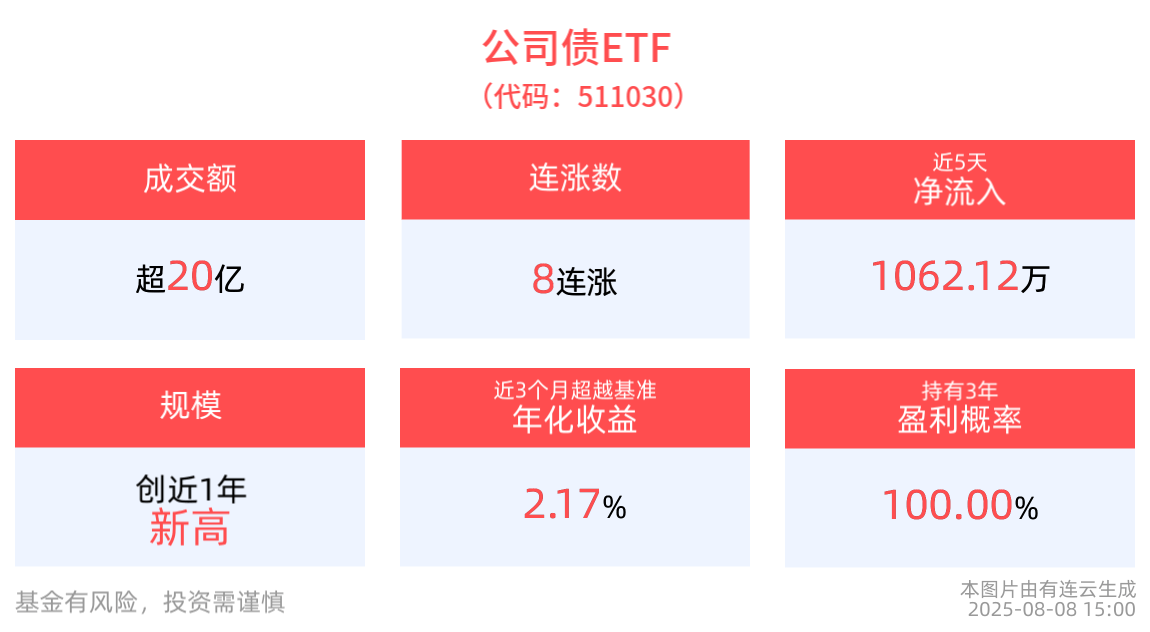
机构继续看多债市,成交额超20亿元,公司债ETF(511030)实现8连涨
Sou Hu Cai Jing· 2025-08-11 01:57
Group 1 - The core viewpoint of the news is the introduction of new underwriting regulations by the China Interbank Market Dealers Association to curb low-price competition in the bond market, particularly in the financial bond sector [1] - The new regulations prohibit lead underwriters from quoting below cost in bond project bidding, aiming to address the long-standing issue of unhealthy competition [1] - The recent low-price bidding incident involving Guangfa Bank's subordinated capital bonds served as a significant trigger for these regulatory changes [1] Group 2 - In the past three months, the issuance of Sci-Tech bonds has exceeded 880 billion yuan, with financial institutions accounting for nearly 36% of the new issuance [1] - The average coupon rate for newly issued Sci-Tech bonds in the last three months was 1.9282%, with some bonds having rates as low as 0.01% [1] - The market is expected to see more supply of new varieties of bonds in the second half of the year, with some private enterprises returning to the issuance market through the "Technology Board" [1] Group 3 - Institutions remain optimistic about the bond market in August, with low yield spreads between new and existing government bonds benefiting existing bonds [4] - The latest company bond ETF has seen a price increase of 0.01%, marking its eighth consecutive rise, with a year-to-date increase of 1.15% [4] - The company bond ETF's latest scale reached 22.364 billion yuan, a new high in nearly a year, with a trading volume of 20.57 billion yuan [4] Group 4 - Leverage funds continue to invest in the company bond ETF, with a net buying amount of 499.56 million yuan on the previous trading day [5] - The company bond ETF has achieved a net value increase of 13.68% over the past five years, with a maximum monthly return of 1.22% since its inception [5] - The management fee rate for the company bond ETF is 0.15%, and the tracking error for this year is 0.013% [6]

银河证券:美联储人事变动预期升温 市场押注9月降息
Zhi Tong Cai Jing· 2025-08-11 00:51
Group 1: Global Economic Overview - The first meeting between US and Russian leaders in four years is scheduled for August 15, which may impact geopolitical dynamics [1] - The US has imposed additional tariffs on India, leading to a pause in defense cooperation [1] - The Federal Reserve's personnel changes are raising expectations for interest rate cuts in September, while the Bank of Japan hints at potential future rate hikes [1] Group 2: Domestic Economic Indicators - July's CPI remained flat year-on-year, while core CPI has risen for three consecutive months, indicating a mild improvement in macroeconomic conditions [1] - The decline in PPI has narrowed, reflecting the effects of policies aimed at expanding domestic demand [1] - Foreign trade growth reached a year-to-date high, with both imports and exports showing year-on-year increases [1] - The A-share market is experiencing a recovery in sentiment, with margin trading balances returning to 2 trillion yuan [1] Group 3: Commodity Market Insights - Gold prices experienced fluctuations but ended higher, driven by a weakening labor market and expectations of Fed rate cuts, alongside increased demand for safe-haven assets due to geopolitical risks [1] - Oil prices saw a decline due to heightened trade tensions between the US and India, raising concerns over demand, while OPEC+ continues to increase production [1] Group 4: Bond Market Analysis - US Treasury yields rose slightly as Fed officials maintained a cautious stance on monetary policy, increasing uncertainty around rapid rate cuts [2] - Chinese bond yields fell slightly due to stable inflation indicators, supporting expectations for moderate monetary easing [2] Group 5: Currency Market Trends - The US dollar index fell as July non-farm payroll growth slowed and unemployment rose to 4.3%, reinforcing expectations for a rate cut in September [3] - The USD/JPY pair saw fluctuations, supported by the US 10-year Treasury yield maintaining an advantage over Japanese bonds [3] Group 6: Equity Market Performance - Global stock markets performed well, buoyed by weaker US non-farm data that enhanced expectations for Fed rate cuts, boosting risk appetite [3] - US tech giants reported better-than-expected earnings, particularly in AI and cloud sectors, further supporting market confidence [3]
2025年8月小品种策略:关注市场配置力量回归节奏
Orient Securities· 2025-08-10 13:13
Group 1 - The report emphasizes the return of market allocation forces, suggesting a cautious increase in credit positions, particularly in the 2-3 year range, with a potential configuration window around mid-August [4][10][11] - The expectation for the second half of the year remains a "dual bull market" for stocks and bonds, with stocks outperforming bonds, driven by market allocation dynamics [9][10] - The corporate perpetual bond market shows limited potential for excess returns in August, recommending a conservative approach with a focus on larger issuers [11][18] Group 2 - In the primary market for corporate perpetual bonds, issuance volume increased, with a total of 158 bonds issued in July, raising 171.5 billion yuan, a 9% increase from the previous month [18][19] - The financing cost for AAA and AA rated bonds decreased, with rates at 2.12% and 2.35% respectively, down 11 basis points and 18 basis points [18][19] - The sectors leading in issuance include public utilities, urban investment, and construction, with Jiangsu, Zhejiang, and Guangdong being the top provinces for new bond issuance [20][21][22] Group 3 - In the secondary market, the yield on corporate perpetual bonds showed mixed results, with short-term yields remaining stable while medium to long-term yields increased, leading to passive compression of spreads [28][30] - The report notes that the majority of urban investment perpetual bonds maintained stable or slightly compressed spreads, while industrial bonds experienced slight widening [30][33] - The report highlights that the risk profile of asset-backed securities (ABS) remains attractive, with a focus on standardized underlying assets, despite limited opportunities in August [13][14]
债券周报:增值税新规一周,市场百态-20250810
Huachuang Securities· 2025-08-10 10:54
1. Report Industry Investment Rating No relevant content provided. 2. Core Views of the Report - Maintains the view that August - October is a headwind period for the bond market. Currently, it has entered the starting point of the second stage of the bond market's three - step process in the second half of the year. August is regarded as an oscillatory adjustment period after redemption, but the market has not shown a trend improvement in the quarterly dimension [26]. - In the short term, there may be a small - band long - trading window in the first half of August. New bond issuance pressure is low, the VAT policy still benefits old bonds, large banks' bond - allocation power is strong, funds are loose, upcoming weak financial data may provide a profit - taking window, and historically, policy windows usually occur in the second half of August [28]. - For trading portfolios, seize the sentiment - repair period in the first half of August for small - band trading. Take profit at around 1.65% and pay attention to spread opportunities brought by the VAT policy [45]. - For allocation portfolios, wait for new bonds to adjust to more suitable positions, and consider old bonds at curve convex points, such as 6y CDB, 7y ADBC, 10y CDB, and 15y treasury bonds [48]. 3. Summary by Relevant Catalogs 3.1 Value - added Tax New Rule: One - week Market Conditions - **Emotional Impact Stage (August 1st, 4th)**: The "old - new cut - off" of the VAT policy led to tax - exemption advantages for old bonds. Institutions rushed to buy old bonds, with the yield of the 10y treasury active bond dropping from 1.715% to 1.68%, then rising back to around 1.7% due to profit - taking and a strong stock market [13]. - **Bank Bond - buying Stage (August 5th - 7th)**: Banks continued to buy bonds, with the intensity weakening. On August 6th, the Agricultural Development Bank and the Export - Import Bank rushed to issue tax - exempt bonds. The auction results started to price in negative factors as investors awaited higher - yielding new bonds [16][19]. - **New Bond Issuance Stage (August 8th)**: The first batch of local bonds in Hebei and Hubei were auctioned. The adjustment of Hebei bonds was large, attracting more investors to Hubei bonds. The overall impact of VAT on new bonds was controllable, with the adjustment range mostly within the 3 - 6% tax rate [22][24]. 3.2 Bond Market Strategy - **Quarterly Dimension**: Maintains that August - October is a headwind period for the bond market. The bond market is in a difficult trading situation, and accounts need to gradually increase liquidity [26]. - **Short - term (First Half of August)**: There may be a small - band long - trading window. New bond issuance pressure is low, funds are loose, weak financial data may provide a profit - taking window, and policy windows usually occur in the second half of August [28]. - **Trading Portfolios**: Seize the sentiment - repair period in the first half of August. Take profit at around 1.65% and pay attention to spread opportunities [45]. - **Allocation Portfolios**: Wait for new bonds to adjust and consider old bonds at curve convex points [48]. 3.3 Interest - rate Bond Market Review - **Overall Situation**: The central bank's support and the VAT new policy had limited impact. Long - term bonds fluctuated within a narrow range. The yield curve steepened, with the 1y treasury active bond yield down 1.5BP, the 10y down 0.4BP, and the 30y up 1.8BP [9]. - **Funding**: The central bank's OMO had a large - scale net withdrawal, but the funding was balanced and loose. DR001 and DR007 were at low levels, and the central bank's front - loaded 3M term repurchase operations showed a supportive attitude [10]. - **Primary Issuance**: Net financing of treasury bonds, policy - financial bonds, and inter - bank certificates of deposit increased, while that of local bonds decreased [69]. - **Benchmark Changes**: The term spreads of treasury bonds and CDB bonds widened. Short - term bond yields performed better than long - term ones [63].
信用债系列专题报告:调整之后,超长信用债买机到来?
Hua Yuan Zheng Quan· 2025-08-10 09:55
Group 1: Report Industry Investment Rating - Not mentioned in the report Group 2: Core Views of the Report - The ultra - long - term credit bond market has strong supply and demand in the primary market, and the issuance scale in 2025 may exceed 1 trillion yuan. The secondary market trading volume has increased significantly, but the buying sentiment has room for repair. It is recommended to pay attention to the allocation and trading opportunities of ultra - long - term credit bonds [2][8][48] - According to the credit spread percentile, the compression degree of the ultra - long - term credit bond spread is not as low as last year. The low - valuation transaction volume and TKN volume in the secondary market have rebounded, but the bullish sentiment in the bond market has declined, indicating that the buying sentiment has room for repair. The "asset shortage" may drive the market to long - duration assets [2][48] - The allocation value of ultra - long - term credit bonds is ranked as 15Y>20Y>10Y>30Y. Some issuers of industrial bonds, urban investment bonds, and bank secondary capital bonds are recommended for investors' reference [3][50][56] Group 3: Summary by Directory 1. Increment and Stock of Ultra - long - term Credit Bonds 1.1 Increment: Strong Supply and Demand in Primary New Issuance - Supply side: Since early 2023, the issuance interest rate of credit bonds has been in a downward channel, and the issuance cost has decreased, which has attracted more issuers. The issuance scale in 2024 was 1.21 trillion yuan, and the issuance in the second half of the year is usually faster. The issuance scale in 2025 may exceed 1 trillion yuan [7][8] - Demand side: Since early 2021, the primary subscription multiple of ultra - long - term credit bonds has shown an overall upward trend. From late 2023 to July 2024, the subscription multiple increased steeply; from August 2024 to Q1 2025, it decreased rapidly; since April 2025, it has rebounded [10][12][13] 1.2 Stock: Analysis from Different Perspectives - By original issuance term: 10Y and 15Y are the mainstream issuance terms. The balance of bonds with a term of ≥20Y accounts for less than 10% of the total [15] - By implied rating: High - rated bonds account for a high proportion, with AAA -, AAA, and AAA+ bonds accounting for 81% of the total [16] - By bond type: Medium - term notes, bank capital bonds, and corporate bonds have the highest stock balances, accounting for 96% of the total [18] - By industry distribution: The stock scale of industrial bonds>bank secondary capital bonds>urban investment bonds. The weighted average exercise valuations of urban investment, comprehensive, and non - bank finance industries are relatively high [21] 2. Fluctuations in Secondary Trading of Ultra - long - term Credit Bonds 2.1 Significant Increase in Secondary Trading Volume This Year - Since early 2024, the primary market of ultra - long - term credit bonds has expanded significantly, and the secondary market activity has increased. In mid - June 2025, the weekly trading volume reached a peak [24] 2.2 Changes in Buying Sentiment - Since February 2025, the buying sentiment of ultra - long - term credit bonds has been continuously boosted, and the monthly TKN ratio of industrial bonds, bank secondary capital bonds, and urban investment bonds has remained above 62% [25] - Since February 2025, the proportion of low - valuation transactions has rebounded but has not reached the high point of last July. In the first half of 2025, the low - valuation transaction deviation of ultra - long - term industrial bonds, urban investment bonds, and bank perpetual bonds has narrowed compared with the same period last year [30][31] 3. Who Buys Ultra - long - term Credit Bonds? - Banks have been net sellers of ultra - long - term credit bonds since 2025, mainly due to underwriting and regulatory restrictions [37] - Insurance companies, wealth management subsidiaries, and wealth management products are the main allocation funds for ultra - long - term credit bonds this year. Insurance companies show a "buy low, sell high" strategy, and wealth management products have strong allocation attributes [37][39] - Fund companies and products have stronger trading attributes. They were net sellers during the bond market adjustment in Q1 2025 and have significantly increased their allocation since March [39] 4. Investment Recommendations - Based on the credit spread and secondary market trading sentiment, it is recommended to pay attention to the allocation and trading opportunities of ultra - long - term credit bonds [48] - The allocation value of ultra - long - term credit bonds is ranked as 15Y>20Y>10Y>30Y [50] - Some issuers of industrial bonds, urban investment bonds, and bank secondary capital bonds are recommended, such as Chengtong Holdings, Shenzhen Metro, etc. [56]
机构行为跟踪周报20250810:等待含税新券的一周-20250810
Tianfeng Securities· 2025-08-10 09:42
1. Report Industry Investment Rating No relevant content provided. 2. Core Viewpoints of the Report After a period of volatile market conditions, interest rates declined slightly in a narrow range this week, and institutional behavior stabilized overall, lacking a clear willingness to go long or short. Funds showed a more stable willingness to net - buy credit bonds than interest - rate bonds. The issuance of the first batch of tax - increased local bonds was smooth, and subsequent observation is needed to see if institutional bullish sentiment will increase [10]. 3. Summary by Relevant Catalogs 3.1 Overall Sentiment: Decline in Bond Market Vitality Index - As of August 8, the bond market vitality index decreased by 35 pcts to 14% compared to August 1, and the 5D - MA decreased by 19 pcts to 26%. Indicators of bond market vitality cooling include the decline in the trading volume of 10Y CDB active bonds/9 - 10Y CDB bond balance, the decrease in the inter - bank bond market leverage ratio, the change in the median duration of medium - and long - term pure bond funds, the decline in the implied tax rate of 10Y CDB bonds, and the decrease in the turnover rate of 30Y treasury bonds [1][11][13]. 3.2 Institutional Behavior: Bond Market Stabilized, Institutions Remained on the Sidelines 3.2.1 Buying and Selling Strength and Bond Selection: Light Trading of Interest - Rate Bonds, Continuous Net Buying of Credit Bonds by Funds - In the current bond market, the order of net - buying strength in the cash bond market is: funds > other product types > wealth management > insurance > overseas institutions and others; the order of net - selling strength is: joint - stock banks > city commercial banks > rural commercial banks > securities firms. For ultra - long bonds (bonds with a maturity of over 15 years), the order of net - buying strength is: funds > insurance > rural commercial banks > overseas institutions and others; the order of net - selling strength is: large - scale banks > joint - stock banks > other product types > city commercial banks > securities firms [23]. - Different institutions have different main bond types. For example, large - scale banks focus on interest - rate bonds within 1Y, 1 - 3Y, and 5 - 7Y; funds focus on certificates of deposit, credit bonds within 1Y, and 1 - 3Y credit bonds [2][28]. 3.2.2 Trading Portfolio: Slight Increase in Durations of Credit Bond Funds and Interest - Rate Bond Funds, Smaller Duration Adjustments for High - Performing Bond Funds - As of August 8, the mean and median durations of the full - sample medium - and long - term pure bond funds increased by 0.04 years and 0.03 years respectively compared to August 1, reaching 4.56 years and 4.42 years, at the 98.7% quantile over the past two years. Among them, the median durations of pure interest - rate bond funds, interest - rate bond funds, and credit bond funds increased by 0.06 years, 0.03 years, and 0.03 years respectively. High - performing bond funds had smaller duration adjustments [41][44]. 3.2.3 Allocation Portfolio: Wealth Management Extended Duration in the Secondary Market, Rural Commercial Banks and Insurance Deployed Ultra - Long Bonds - **Primary Market**: This week, the primary - market subscription demand for treasury bonds decreased, while that for policy - financial bonds increased. The weighted average full - coverage multiples of treasury bonds and policy - financial bonds changed accordingly [58]. - **Large - scale Banks**: As of August 8, the cumulative net - buying scale of 1 - 3Y treasury bonds this year was close to the same period last year. Although large - scale banks increased their net - buying of short - term treasury bonds since June, the cumulative net - buying scale was still lower than that in 2024 [66]. - **Rural Commercial Banks**: The cumulative net - buying scale of cash bonds by rural commercial banks this year was significantly weaker than in previous years, mainly due to the weak net - buying of short - term bonds within 1Y. However, the net - buying strength of 7 - 10Y and over - 10Y bonds was higher than in previous years [78]. - **Insurance**: The net - buying strength of cash bonds by insurance this year was significantly higher than in previous years, mainly due to the strong buying of ultra - long bonds over 10Y. As of August 8, the ratio of cumulative net - buying of cash bonds to cumulative premium income exceeded that at the end of August last year [86]. - **Wealth Management**: Since June, the cumulative net - buying scale of cash bonds by wealth management has continued to rise. This week, the duration of net - bought cash bonds in the secondary market decreased slightly but remained at a relatively high level since February 23, 2024 [95][97]. 3.3 Asset Management Product Tracking: More than Half of Credit Bond Funds Had Positive Returns in the Past Month - **Wealth Management**: As of the week of August 3, the wealth management scale decreased by 900 million yuan in August, far lower than the estimated value based on the average monthly growth rate in the past three years. The fixed - income wealth management products decreased by 1.99 billion yuan. The wealth management break - even rate increased [98]. - **Bond Funds**: Since August, the scale of bond funds increased by 3.83 billion yuan, higher than that of equity funds. The newly established bond funds this week had a relatively large scale, ranking second - highest this year. This week, the net values of all types of bond funds continued to rise, with credit bond funds performing better [109].
超8800亿元!新政落地三月,科创债市场持续扩容
券商中国· 2025-08-10 05:54
截至目前,科创债新政落地已有三月。 据券商中国记者统计,在这三个月内,新发科创债发行规模高达8806.59亿元。其中,银行、券商等金融机构 新发债券规模占比36%。 券商中国记者统计数据进一步发现,当前科创债发行主体虽然仍以央国企、大型机构为主,但越来越多的中小 机构、民营企业也参与其中。从票面利率来看,近三个月新发科创债发行票面利率均值为1.8994%,最低甚至 能到0.01%。 展望后市,华泰证券认为,科创债等新品种会在下半年迎来更多供给,部分民企债也在通过科技板回归发行市 场。 三个月内科创债新发规模超8800亿元 5月7日,央行、证监会联合发布《关于支持发行科技创新债券有关事宜的公告》,提出了一系列鼓励债市"科 技板"建设的政策。券商、银行等相关各方迅速行动起来,科创债市场持续扩容。 数据显示,5月7日到8月7日,全市场以公募形式累计新发的科技创新债券共有698只,计划发行规模高达 8806.59亿元。而据Wind统计,上年同期全市场共发行了187只科技创新债券,发行总规模为1976.08亿元。两 相对比,足可见政策效应显著。 科创债新政的一大看点在于新增支持商业银行、证券公司、金融资产投资公司、股权 ...

债市晴雨表:基金久期基本持平
CMS· 2025-08-09 14:12
Report Summary 1. Report Industry Investment Rating No relevant information provided. 2. Core Viewpoints The report comprehensively analyzes the bond market situation through multiple indicators, showing that last week the bond market sentiment recovered slightly, while the trading activity in the secondary market decreased. The bond - fund issuance increased significantly, and there were changes in the bond - buying behavior of different institutions. The relative valuation of bonds also showed certain fluctuations [1][2]. 3. Summary by Directory 3.1 Bond Market Sentiment - The bond market sentiment index last week was 114.8, up 0.1 from the previous value; the bond market sentiment diffusion index was 50.1%, up 1.3 percentage points from the previous value [1]. 3.2 Institutional Duration - Last Friday, the fund duration was 2.21 years, up 0.01 years from the previous Friday; the rural commercial bank duration was 3.12 years, up 0.02 years; the insurance duration was 6.93 years, down 0.01 years [1]. 3.3 Leverage Ratio - Last week, the pledged repurchase balance was 11.9 trillion yuan, up 0.5 trillion yuan from the previous value; the large - bank net lending balance was 5.0 trillion yuan, up 1.0 trillion yuan; the bond market leverage ratio was 103.8%, up 0.2 percentage points [1]. 3.4 Secondary Market Transactions - Last week, in terms of turnover rate, the 30Y Treasury bond turnover rate was 2.3%, down 1.0 percentage point; the 10Y Treasury bond turnover rate was 0.7%, down 0.2 percentage points; the 10Y China Development Bank bond turnover rate was 28.7%, down 0.5 percentage points; the ultra - long - term credit bond turnover rate was 0.38%, down 0.06 percentage points [1]. 3.5 Institutional Allocation Power - Last week, the newly issued bond - fund shares were 25.1 billion yuan, up 22 billion yuan from the previous value. The stock market risk premium was 1.17%, up 0.02 percentage points; the US dollar index was 98.4, down 0.9. The rural commercial bank bond - allocation index was - 33.3%, up 19.3 percentage points; the insurance bond - allocation index was 50.1%, down 21.4 percentage points; the money - market fund bond - allocation index was 30.1%, down 16.1 percentage points; the insurance's allocation index for Tier 2 and perpetual bonds was - 10.2%, down 18.8 percentage points [2]. 3.6 Primary Market Subscription - Last week, the full - field multiple of Treasury bonds decreased by 1.2 times to 3.1 times, the full - field multiple of local government bonds decreased by 0.4 times to 23.3 times, and the full - field multiple of China Development Bank bonds was 3.5 times, remaining the same as the previous value [2]. 3.7 Relative Valuation - Last week, the spread between 10 - year China Development Bank bonds and Treasury bonds widened by 2.0bp to 8.3bp, the spread between 30 - year and 10 - year Treasury bonds widened by 1.4bp to 25.7bp, the spread between old and new 10 - year China Development Bank bonds narrowed by 0.9bp to 1.2bp, and the spread between 10 - year local government bonds and Treasury bonds widened by 2.1bp to 12.5bp [2].