
房地产

Search documents
2025年11月经济数据点评:分化延续,政策需加力
Haitong Securities International· 2025-12-24 14:34
Economic Overview - The national economy in November 2025 showed characteristics of "stable production, differentiated consumption, and pressured investment" with industrial production recovering to normal levels after holiday disruptions[2] - Emerging industries continue to be the main support for production and investment, although industrial growth has slightly slowed down, indicating significant industry differentiation[6] Production Insights - The industrial added value in November increased by 4.8% year-on-year, a slight decrease of 0.1 percentage points from the previous month, while month-on-month growth improved by 0.44 percentage points[8] - The production-sales rate for industrial enterprises was 96.5%, showing a month-on-month increase of 0.1 percentage points, with the export delivery value decline narrowing from 2.1% to 0.1%[8] Consumption Trends - Retail sales growth in November was 1.3% year-on-year, marking a continuous decline for six months, with large-scale retail sales dropping by 2.0%[20] - The promotional season had limited impact on consumer spending, with online retail growth decreasing from 8.1% to 5.4%[22] Investment Analysis - Fixed asset investment from January to November decreased by 2.6% year-on-year, with November showing a month-on-month decline of 12.0%[26] - Manufacturing, broad infrastructure, and real estate investments saw declines of -4.5%, -11.9%, and -30.3% respectively, indicating a challenging investment environment[26] Risk Factors - There is an increasing uncertainty in external trade and a potential unexpected decline in domestic demand, which could further pressure economic growth[37]
荣盛发展:2025年12月29日召开2025年度第六次临时股东会
Zheng Quan Ri Bao Wang· 2025-12-24 13:13
证券日报网讯12月24日,荣盛发展(002146)发布公告称,公司将于2025年12月29日15:00召开2025年 度第六次临时股东会。 ...

2025深度复盘,2026策略前瞻
2025-12-24 12:57
Summary of Key Points from Conference Call Records Industry Overview - **A-shares and Hong Kong Market Performance**: In 2025, A-shares showed significant structural differentiation, with the metals and TMT sectors outperforming, while domestic consumption and real estate sectors lagged. The Hong Kong pharmaceutical industry, particularly innovative drugs, performed better than A-shares [1][3][4]. Core Insights and Arguments - **Commodity Prices and Economic Conditions**: The price of rebar in the domestic commodity market weakened in 2025, contrasting with the previous seven years of a bull market. The bond market also showed overall weakness, with interest rates trending upwards. The RMB depreciated against the USD but is expected to maintain strength in the future [1][5]. - **Export Strategy Adjustments**: China has diversified its export targets, significantly increasing exports to countries along the "Belt and Road" initiative while decreasing its reliance on the US market. This indicates a strategic adjustment in response to changes in the international trade environment [1][6][7]. - **Economic Outlook for 2026**: The macroeconomic environment in China is expected to remain stable, with a growth target of around 5%. Strong stimulus policies are unlikely, with a focus on structural optimization and alleviating internal pressures [1][10][11]. Important but Overlooked Content - **Market Sentiment and Liquidity Concerns**: By late 2025, the market experienced a prolonged adjustment period, particularly in growth sectors. Despite a rebound in the ChiNext board, the overall market sentiment remained cautious, with potential liquidity issues anticipated by year-end [1][9]. - **Investment Focus Areas for 2026**: Key sectors to watch include AI, innovative pharmaceuticals, and non-ferrous metals, as well as industries benefiting from cultural exports and manufacturing [1][12][19]. - **Valuation Metrics**: The current price-to-book ratio for public fund heavyweights is around 8 times, indicating that the market is not yet in a bubble phase, as historical peaks have reached 14 to 15 times [1][21]. Future Market Trends - **Sector Performance Predictions**: The performance of the innovative drug sector is expected to continue its upward trend, driven by technological advancements and cost advantages. However, high valuations may limit future performance, suggesting a need for tactical investment strategies [1][25]. - **Asset Allocation Strategies**: For 2026, a balanced approach between growth and value stocks is recommended, with a focus on sectors like AI and cyclical industries. The use of a "barbell strategy" is suggested, combining growth tech stocks with value stocks [1][27]. Conclusion - **Overall Economic and Market Dynamics**: The Chinese economy is undergoing complex adjustments, with various factors influencing asset performance. Investors should remain vigilant about macroeconomic developments and adjust their strategies accordingly to capitalize on emerging opportunities while managing risks [1][8][26].
稳中求进、行稳致远的中国宏观经济
2025-12-24 12:57
Summary of Key Points from Conference Call Records Industry Overview - The macroeconomic environment in China for 2025 shows a mix of supply-side strengths and weak domestic demand, with industrial value added expected to grow by 6.0% and retail sales by 4.0%, while fixed asset investment is projected to decline by 2.6% [1][17] - The GDP growth rate for the fourth quarter is anticipated to be 4.4%, leading to an annual GDP growth of 4.9%, slightly below the target of 5% [1][17] - Inflation is expected to be around -1% [1][17] Key Economic Indicators - In November, the total social financing increased by 416.9 billion yuan, driven mainly by corporate bond issuance, while government bond issuance decreased [1][8] - The Consumer Price Index (CPI) rose by 0.7% year-on-year, marking the highest increase of the year, primarily due to rising food prices [1][8] - The Producer Price Index (PPI) fell by 2.2% year-on-year, influenced by a high base from the previous year [1][8] Industrial Performance - In November, industrial production showed a year-on-year increase of 4.8%, with mining, manufacturing, and utilities growing by 6.3%, 4.6%, and 4.3% respectively [2][3] - The manufacturing PMI slightly rebounded to 49.2, indicating a modest recovery in manufacturing activity [11] Investment Trends - Fixed asset investment continued to decline, with a 2.6% year-on-year drop for the first ten months of 2025 [4] - Infrastructure investment saw a slight increase of 0.13%, while real estate investment faced a significant decline of 15.9% [4] Consumer Market Insights - Retail sales in November grew by 1.3% year-on-year, but the growth rate decreased by 1.6 percentage points [5][6] - Online retail sales increased by 9% year-on-year, indicating a shift towards e-commerce [6] Trade Performance - In October, China's total imports and exports reached $549 billion, with exports growing by 5% and imports by 19% [7] - Exports to ASEAN countries surged by 82%, while exports to the U.S. declined by 18% [7] Macroeconomic Challenges - Key challenges include insufficient domestic demand, declining optimism regarding income, and the impact of new consumption policies on prices [14][20] - The government is advised to focus on enhancing traditional industries, expanding effective investment, and improving consumer capacity [15][20] Policy Recommendations - Emphasis on optimizing traditional industries and fostering emerging sectors to enhance industrial quality [15] - Recommendations for fiscal policy include maintaining a reasonable deficit and optimizing expenditure structures to stimulate economic growth [21][40] Future Economic Outlook - The global economic growth rate for 2026 is expected to remain stable at 3.4%, with potential risks from geopolitical tensions and trade uncertainties [18] - The Chinese economy is projected to grow between 4.5% and 5.0% in 2026, with a focus on innovation and deep integration of technology and industry [20][27] Conclusion - The current economic landscape in China reflects a complex interplay of growth opportunities and challenges, necessitating targeted policy interventions to stimulate demand and investment while navigating external uncertainties.
2026年A股投资展望:中国资产价值重估慢牛强化再上台阶
Dongxing Securities· 2025-12-24 12:12
Group 1 - The core viewpoint is that there is significant room for the revaluation of Chinese assets, with the stock market expected to enter a slow bull market in 2025, reflecting a process of asset revaluation in China [3][17] - Since 2021, China has entered a real estate downturn, leading to increased downward pressure on the asset side of government and household balance sheets, indicating a transition period for Chinese assets [3][19] - The structure of China's economy is changing, with the tertiary industry increasing its share, and low-end manufacturing gradually moving overseas, indicating a shift towards high value-added services [3][21][25] Group 2 - Liquidity is expected to support the upward trend of the stock market, with the US remaining in a rate-cutting cycle and China having limited room for rate cuts, projected to implement 1-2 cuts in 2026 [4][47] - There are signs of domestic residents' deposits migrating towards the stock market, with a trend of "savings migration" expected to continue as the stock market enters a long-term slow bull phase [4][55] - Institutional investment from long-term entities like insurance and securities firms is gradually increasing, which will further release investment space in the stock market [4][59] Group 3 - A turning point in performance is anticipated, with the overall ROE of A-shares entering a downward cycle since Q2 2021, showing signs of bottoming out in 2025 and expected to rebound in 2026 [5][63] - The profit structure of the A-share market is uneven, with non-bank sectors contributing nearly 60% of total profits, while sectors like real estate and coal show negative contributions [5][65] - The expected profit growth rate for the A-share market in 2026 is around 12%, with significant contributions from sectors like power equipment and electronics [5][69] Group 4 - The year 2026 marks the first year of the 14th Five-Year Plan, emphasizing the importance of technological innovation and the establishment of a modern industrial system, which will guide economic development [6][79] - There is an increasing likelihood of transitioning from a passive destocking cycle to an active restocking cycle, which will support both the economy and the stock market [6][18] - The relationship between PPI and industrial enterprise profits indicates that PPI typically leads profit growth by 1-2 quarters, suggesting a potential upward trend in profits as PPI rises [6][20] Group 5 - Investment styles are expected to shift from structural to balanced, with a recovery in consumption likely as the economy enters a phase of restorative growth [7][21] - The investment strategy for 2026 should focus on maintaining confidence in the bull market and leveraging the narrative of long-term investment opportunities [7][23] - Key sectors to watch include technology and overseas expansion opportunities, particularly in areas like artificial intelligence, commercial aerospace, and renewable energy [7][24][8]
最低只需1年社保或个税缴纳,北京重磅出手!放宽非京籍家庭购房条件
Jin Rong Jie· 2025-12-24 10:50
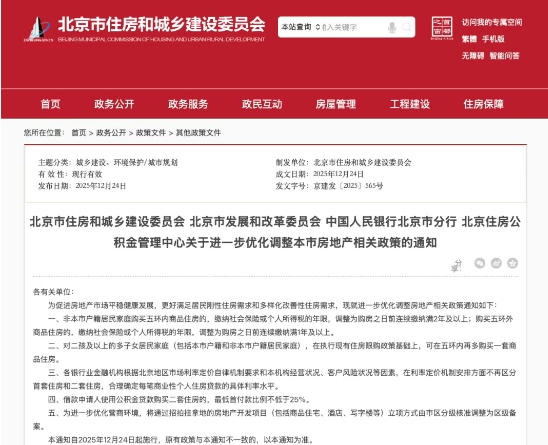
Group 1 - Beijing has announced a significant adjustment to its housing policies, reducing the social security or individual tax payment requirements for non-Beijing households to purchase homes within the city [1] - Non-Beijing families can now buy homes in the inner city with only 2 years of social security or tax payments, and just 1 year for homes outside the inner city [1] - Families with two or more children will have increased purchasing power, allowing them to buy additional properties in the inner city [1] Group 2 - Financial institutions in Beijing will no longer differentiate between first and second home loans in their interest rate pricing, with a minimum down payment of 25% for second home purchases using public housing funds [3] - In November, new residential prices in 70 cities showed slight improvement, with new homes decreasing by 0.4% month-on-month, while second-hand homes fell by 0.7% [3] - First-tier cities are experiencing a more significant decline in second-hand home prices, with a 1.1% drop, while second and third-tier cities are seeing smaller declines [3] Group 3 - Experts predict that other first-tier cities like Shanghai and Shenzhen may follow Beijing's lead in relaxing housing purchase restrictions [4] - The recent central government guidelines emphasize the need for a new model in real estate development and the removal of unreasonable consumption restrictions [4] - The housing supply structure is under scrutiny, with a focus on meeting the long-term housing needs of new urban residents and young people [5] Group 4 - By 2026, real estate companies may enter a critical phase of balance sheet recovery, with some firms potentially reaching a profitability bottom [5] - Companies that have strategically positioned themselves in well-performing cities and hold valuable real estate assets are expected to recover more effectively [5]

北京楼市新政:商贷利率不再区分首套住房和二套住房
Xin Jing Bao· 2025-12-24 09:40
编辑 白爽 校对 张彦君 新京报讯(记者曹晶瑞)12月24日,市住房城乡建设委、市发展改革委、人民银行北京市分行、北京住 房公积金管理中心等4部门联合印发《关于进一步优化调整本市房地产相关政策的通知》(以下简称 《通知》),自2025年12月24日起施行。通知明确,商业性住房贷款利率将不再区分首套住房和二套住 房。 首套房贷和二套房贷执行不同的利率。目前,北京地区商贷首套房贷利率为3.05%,购买五环内二套房 商贷利率为3.45%,五环外二套房贷为3.25%。此次调整后,首套房贷和二套房贷利率将不再区分,具 体利率多少,由银行根据利率定价机制安排,不得低于首套房贷利率。 ...
港股本周圣诞提前休市!港股红利ETF基金(513820)溢价走阔达0.73%,资金连续17日涌入超6亿元!跌出性价比?中信建投:开启中期配置窗口
Sou Hu Cai Jing· 2025-12-24 08:57
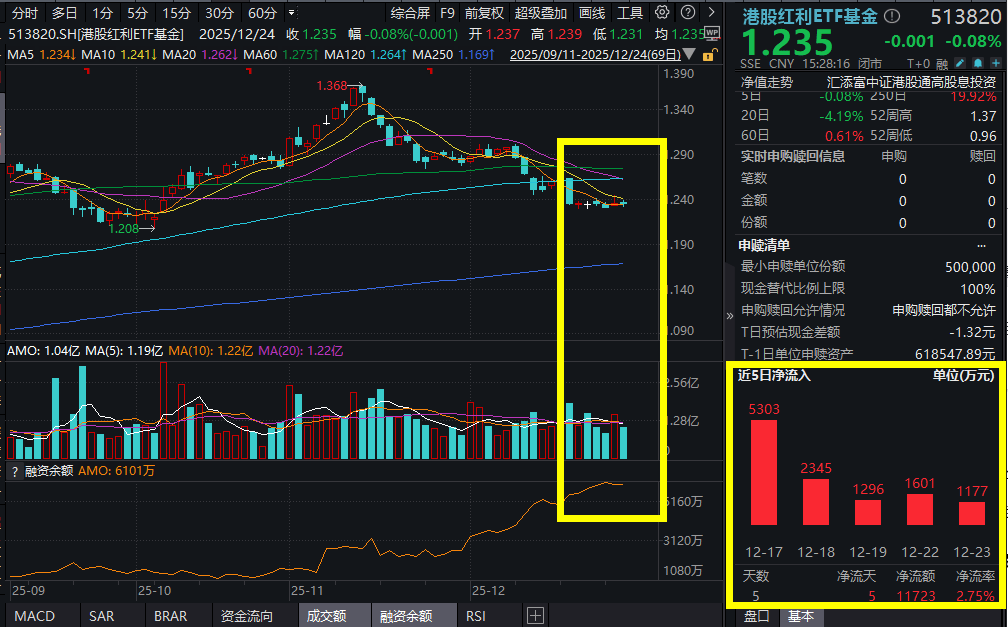
Core Viewpoint - The Hong Kong stock market is experiencing a mixed performance, with the high dividend ETF fund (513820) showing resilience and attracting significant capital inflows, indicating strong investor interest in dividend-yielding assets [1][5]. Group 1: Market Performance - The Hong Kong stock market showed a mixed trend in early trading on December 24, with the CSI Hong Kong Stock Connect High Dividend Index down by 0.42% [1]. - The Hong Kong Dividend ETF fund (513820) recorded a slight decline of 0.08%, with a premium widening to 0.73% by the end of the trading session, reflecting active buying interest [1][3]. - The fund has seen a strong inflow of over 600 million yuan for 17 consecutive days, bringing its total size to over 4.3 billion yuan, significantly outperforming other ETFs in the same index [1][5]. Group 2: Fund Composition and Performance - The majority of the constituent stocks of the Hong Kong Dividend ETF fund (513820) experienced declines, with notable exceptions like HSBC Holdings, which rose over 1% [3][4]. - The top ten constituent stocks of the fund include China Pacific Insurance, China Telecom, and Agricultural Bank of China, with varying performance among them [4]. - The fund's index has a dividend yield of 7.25%, which is higher than similar indices in both Hong Kong and A-shares, establishing it as a leading choice for dividend investors [8][9]. Group 3: Investment Strategy and Outlook - Multiple factors are contributing to the opening of a mid-term trading window for Hong Kong stocks, including a market adjustment that has increased safety margins and a continued net inflow of southbound funds [5]. - The current environment suggests a focus on high-quality dividend stocks with sustainable payouts and stable earnings, as the defensive attributes of dividend investments may weaken in a rising interest rate environment [6]. - The Hong Kong Dividend ETF fund (513820) is positioned as a "pure high dividend" strategy, which is expected to perform well in the current market conditions, especially as institutional demand for dividend assets increases [10][11].

守牢安全底线,稳妥化解风险
Xin Hua She· 2025-12-24 08:45
Group 1 - The central economic work meeting emphasizes the importance of balancing development and security, identifying risk prevention as a key task for the upcoming year [1] - The meeting highlights the need for a proactive approach to risk management, focusing on high-quality development and safety as mutually reinforcing goals [1] - The current development environment in China is characterized by both strategic opportunities and significant risks, necessitating improved risk prevention capabilities [1] Group 2 - China's urbanization is transitioning from rapid development to stable development, requiring the real estate market to adapt to new conditions [2] - The real estate sector must balance development and risk prevention, with policies aimed at stabilizing the market and promoting affordable housing [2] - Local government debt risks need to be addressed through optimized restructuring and management practices, ensuring compliance and preventing new hidden debts [2] Group 3 - The emphasis on historical proactive spirit is crucial for overcoming challenges and risks in the economic and social development goals for the coming year [3] - There is a call for unity and strategic determination to navigate risks and transform challenges into opportunities, ensuring a new security framework supports the new development framework [3]
2026:经济温和修复,股市长牛继续
Dong Zheng Qi Huo· 2025-12-24 07:44
Report Industry Investment Rating - Stock index: Bullish [6] Core View of the Report - The report is cautiously optimistic about China's macro - economy in 2026 but positive about the A - share market. It predicts that the A - share market will shift from valuation - driven to a mode of both valuation and profit contribution, with an expected annual index increase of about 10%. The long - term bull market in A - shares may continue throughout the "14th Five - Year Plan" period [4][103]. Summary by Directory 1. 2025 Year Review: A Feast of Equities - In 2025, it was a feast for equity assets globally. Global stock markets generally rose, supported by three common factors: global fiscal and monetary "double - easing", the AI industry trend, and the "de - dollarization" narrative [16]. - In China's A - share market, it showed a diverse and hot state. Most indices rose by over 20%, with micro - cap stocks performing best. The significant difference in performance between micro - cap stocks and blue - chip weight indices was mainly due to institutional behavior and capital attributes [24]. 2. 2026 Domestic Macroeconomic Outlook: Moderate Recovery and Deepening Differentiation 2.1 Exports: Room for Surplus Remains, and Resilience Continues in 2026 - In 2025, China's exports grew strongly, with a trade surplus reaching a record high. The market has debated the balance of the trade surplus, but China's trade surplus/GDP still has room to expand [30][31]. - In 2026, although global demand may slow down, China's active economic and trade policies and the certainty of Chinese enterprises going global will support exports. The export growth rate is predicted to be around 3 - 4% [42]. 2.2 Real Estate: In the Stock Era with Moderate Policies, It May Still Decline in 2026 - The real estate industry has entered the stock era, with the housing supply approaching saturation. It still has a strong financial attribute, and the pessimistic market expectations may lead to a continued decline in 2026 [43][45]. - The continuous adjustment of the real estate industry will affect residents' wealth and total demand, putting pressure on domestic demand [50]. 2.3 Fiscal Policy: Small - scale Total Growth and Possible Structural Re - equilibrium - In 2025, China's fiscal policy was more active, with an increased deficit rate and special bonds. The fiscal expenditure structure shifted towards people - oriented investment, weakening investment in infrastructure [56][58]. - In 2026, the fiscal policy will maintain an active tone but with limited expansion. The structure may be re - balanced, and the pace will be front - loaded, with obvious guidance on industrial policies [62]. 2.4 Monetary Policy: Limited Easing Space, More Focus on Flexibility and Precision - In 2025, the central bank's monetary easing had limited impact on credit expansion. Constrained by factors such as low corporate returns and high mortgage rates, the central bank's further interest rate cuts are restricted [63]. - In 2026, the central bank will maintain a loose policy, use various policy tools more flexibly, and support industrial upgrading and domestic demand expansion [69]. 2.5 Inflation: The Contradiction between Capacity Reduction and Capacity Increase - In 2026, China's industrial production capacity is still in a state of over - supply. The "anti - involution" policy aims to reduce capacity, but it faces challenges in implementation [71][73]. - At the same time, new fixed - asset investments will increase production capacity. On the consumer side, the expansion of service consumption will support CPI. It is predicted that PPI will recover to around - 1% and CPI to around 0.8% [74][81]. 3. 2026 Stock Index Outlook: The Long - term Bull Market Continues - The current A - share market valuation is not low, and the space for further valuation expansion in 2026 is limited, with the target P/E ratio estimated to be between 20 - 24x [96]. - It is predicted that the profit growth rates of the entire A - share market, non - financial stocks, and financial stocks in 2026 will be 4.5%, 8.4%, and 1.0% respectively, showing an N - shaped trend throughout the year [100]. - In terms of capital preferences, technology stocks and blue - chip growth stocks are expected to outperform in 2026 [102]. 4. Investment Advice: Continue to Hold the Long - Position Strategy for Stock Indices - Be cautiously optimistic about China's macro - economy in 2026 but positive about the A - share market. The long - term bull market in A - shares will continue, and the long - position strategy is recommended [4][103]. - Favor the CSI 1000 Index Futures (IM) with a high proportion of technology stocks and the SSE 50 Index Futures (IF) with more blue - chip stocks. The performance of the CSI 500 Index Futures (IC) may be weaker in 2026 [105].