
建材

Search documents
金融工程日报:沪指震荡微升,周期股走强、热点题材调整-20260211
Guoxin Securities· 2026-02-11 14:55
- The report does not contain any quantitative models or factors for analysis [1][2][3][4]
债市基本面高频数据跟踪:2026年2月第1周:生产较往年节前坚挺
SINOLINK SECURITIES· 2026-02-11 14:24
1. Report Industry Investment Rating No relevant information provided. 2. Core Viewpoints - The overall production is more robust than in previous years before the Spring Festival, but there are differences in various production indicators; the improvement trend of the new - house sales volume in 30 cities has weakened; the decline of pig prices has widened; and oil prices have risen [2][3][4]. 3. Summary by Directory 3.1 Economic Growth: Production is More Robust than in Previous Years before the Spring Festival 3.1.1 Production - **Power plant daily consumption shows seasonal decline**: On February 10, the average daily consumption of 6 major power - generating groups was 792,000 tons, a 2.8% decrease from February 3; on February 8, the daily consumption of power plants in eight southern provinces was 2.03 million tons, an 8.6% decrease from January 30 [4][11]. - **Blast furnace operating rate rises before the festival**: On February 6, the national blast furnace operating rate was 79.6%, a 0.5 - percentage - point increase from January 30; the capacity utilization rate was 85.7%, a 0.3 - percentage - point increase. The blast furnace operating rate of Tangshan steel mills was 92.3%, a 2.5 - percentage - point increase [4][16]. - **Tire operating rate is more robust than in previous Spring Festivals**: On February 5, the operating rate of all - steel truck tires was 60.7%, a 1.7 - percentage - point decrease from January 29; the operating rate of semi - steel car tires was 72.8%, a 2.1 - percentage - point decrease. The operating rate of looms in the Jiangsu - Zhejiang region shows a seasonal decline [4][18]. 3.1.2 Demand - **The improvement trend of new - house sales volume in 30 cities weakens**: From February 1 - 10, the average daily sales area of commercial housing in 30 large - and medium - sized cities was 185,000 square meters, a 27.3% increase from January, a 116.3% increase from February last year, and a 3.2% increase from February 2024 [4][23]. - **The retail growth of the auto market strengthens**: In February, retail sales increased by 54% year - on - year, and wholesale sales increased by 46% year - on - year [4][25]. - **Most steel prices decline**: On February 10, compared with February 3, the prices of rebar, wire rod, hot - rolled coil, and cold - rolled coil were flat, down 1.3%, down 0.6%, and down 0.1% respectively [4][31]. - **The decline of cement prices slows down before the festival**: On February 10, the national cement price index decreased by 0.3% compared with February 3 [4][32]. - **Glass prices fluctuate within a narrow range**: On February 10, the active futures contract price of glass was 1,079 yuan/ton, a 0.6% increase from February 3 [4][38]. - **The decline of the container shipping freight rate index slows down**: On February 6, the CCFI index decreased by 4.5% compared with January 30, and the SCFI index decreased by 3.8% [4][42]. 3.2 Inflation: The Decline of Pig Prices Widens 3.2.1 CPI - **The decline of pig prices widens**: On February 10, the average wholesale price of pork was 18.3 yuan/kg, a 1.6% decrease from February 3 [4][47]. - **The agricultural product price index declines moderately**: On February 10, the agricultural product wholesale price index decreased by 0.3% compared with February 3 [4][53]. 3.2.2 PPI - **Oil prices rise**: On February 10, the spot prices of Brent and WTI crude oil were $72.4 and $64.0 per barrel respectively, a 3.6% and 1.2% increase from February 3 [4][55]. - **Copper and aluminum prices decline**: On February 10, the prices of LME 3 - month copper and aluminum decreased by 2.0% and 0.7% respectively compared with February 3 [4][59]. - **The domestic commodity index turns to decline month - on - month**: On February 10, the Nanhua Industrial Products Index increased by 0.01% compared with February 3, and the CRB index decreased by 0.4% [4][59].
PPI上行验证,继续重视涨价链
Ge Long Hui· 2026-02-11 14:09
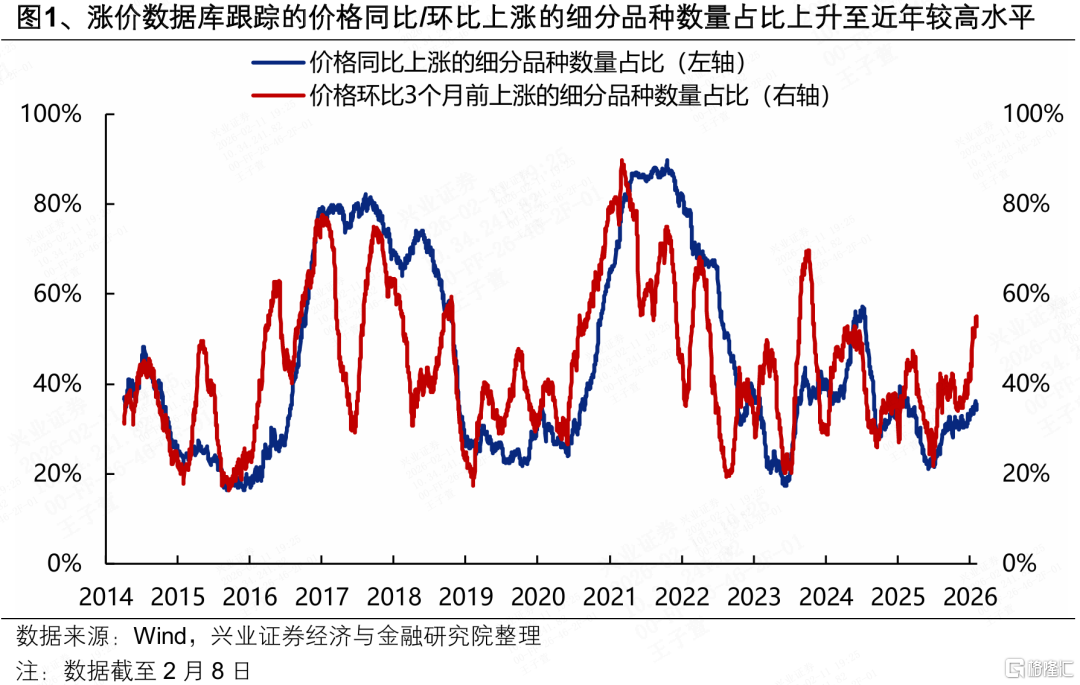
Core Viewpoint - The recovery of prices is identified as the most critical logic supporting corporate profit improvement in 2026, which may also influence market styles [1]. Price Trends and Data Analysis - The first inflation data of the year validates the momentum of price improvement, with the Producer Price Index (PPI) reaching a year-on-year high not seen since August 2024 and a month-on-month high since October 2023 [1]. - The proportion of price-increasing subcategories in the comprehensive price database has risen to a relatively high level, indicating a strong correlation with the month-on-month PPI trends [1]. - Recent price increases are characterized by a broader range and richer clues, driven by international commodity price transmission, favorable policies, and trends in the technology industry [4]. Sector-Specific Insights - The sectors with significant month-on-month PPI increases in January include non-ferrous metals, non-metallic mineral products (such as building materials), black metals, technology manufacturing, chemical fibers, and agricultural processing [4]. - The price increases in these sectors correspond with the high-frequency tracked price subcategories, indicating a robust link between input inflation and domestic price recovery [4]. Price Increase Clues - The proportion of subcategories with price increases over the past three months is at its second-highest level since 2016, only surpassed by the supply-side reform period in 2017 and the significant inflation period in 2021 [4]. - A detailed table shows various subcategories with significant price increases in January, such as oxygen pressure (62.5%), lithium concentrate (52.3%), and DRAM index (35.7%), indicating strong upward price trends across multiple sectors [6][7]. Future Outlook - The post-holiday period is seen as a critical window for validating price increases, with expectations for further price clues to emerge as the spring construction season begins and policies are implemented after the March meetings [9]. - Historical data suggests that the first quarter is typically a key period for PPI acceleration during inflation cycles, indicating a potential for sustained price increases [9]. Sector Performance Expectations - The relative performance of sectors such as TMT (Technology, Media, and Telecommunications), advanced manufacturing, and resource & infrastructure chains is expected to be strong post-Spring Festival, with higher win rates anticipated [10]. - A statistical analysis shows that industries with a positive correlation to PPI include chemicals, steel, building materials, transportation, petrochemicals, non-ferrous metals, and coal, among others [14].

历史的“春节后”
Guotou Securities· 2026-02-11 10:42
Group 1 - The report highlights a high probability of style switching in A-shares around the Spring Festival, with a historical tendency for value and large-cap stocks to dominate before the festival, while growth and small-cap stocks tend to perform better afterward [1][8][23] - From 2010 to 2025, there were only two years (2020 and 2022) without a clear switch between growth and value styles, indicating a strong historical pattern of style rotation [8][18] - The report identifies that in 62.5% of the years analyzed, there was a significant switch from large-cap to small-cap stocks after the Spring Festival, suggesting a high likelihood of this trend continuing [1][8] Group 2 - Historical analysis shows that the sectors leading in performance before the Spring Festival often do not repeat their success in the following month, indicating a high probability of sector rotation [2][8] - The report notes that in years where value stocks led after the Spring Festival (2011, 2016, 2021), there were common factors such as liquidity tightening or unexpected risk events that suppressed growth stocks [2][23] - The macro environment in 2015 and 2019, characterized by ample liquidity and weak fundamentals, is compared to the upcoming 2026 Spring Festival, suggesting potential for similar market dynamics [2][3] Group 3 - The report assesses that the current market style is shifting towards value before the 2026 Spring Festival, with technology and growth stocks receding [3][4] - It suggests that if the value style continues post-festival, it will be driven by expectations of domestic economic recovery and policy support, although there are concerns regarding inflation metrics [3][4] - The analysis indicates that the performance of small-cap stocks is expected to rebound significantly after the Spring Festival, driven by liquidity recovery and risk appetite [18][19]
突破1000亿元,建材龙头涨停!世界白银协会发声,银价大反弹,多只概念股获融资客加仓
Xin Lang Cai Jing· 2026-02-11 10:16
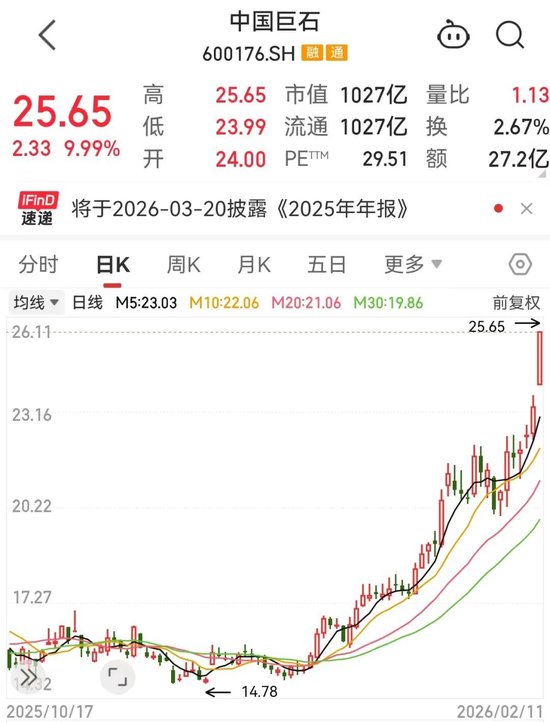
Group 1: Market Overview - International silver prices have rebounded, with the London silver price reaching $83.666 per ounce, an increase of 3.61% [3][15] - The A-share market saw a rise in cyclical sectors, with the building materials sector leading, highlighted by China Jushi's stock price hitting a historical high and a market capitalization exceeding 100 billion yuan [1][13] Group 2: Silver Supply and Demand - The World Silver Association forecasts a continued shortage in global silver supply through 2026, with an expected supply gap of approximately 67 million ounces [5][17] - Despite a projected 1% increase in mine production to 820 million ounces, high prices are expected to reduce global jewelry and silverware demand by about 17% [5][17] Group 3: Company Performance - Hunan Silver has seen a cumulative increase of 105.06% in stock price, with projected net profits for 2025 estimated between 285 million to 385 million yuan, reflecting a year-on-year growth of 67.88% to 126.78% [6][18] - Zijin Mining has received a net buy of 4.322 billion yuan in financing, with expected net profits for 2025 between 51 billion to 52 billion yuan, indicating a growth of approximately 59% to 62% [11][23] Group 4: Stock Adjustments - Over 80% of silver concept stocks have retraced more than 20% from their year-to-date highs, with some stocks like Silver Yunnan and Shengda Resources experiencing declines exceeding 30% [6][18] - Silver Yunnan has the largest retracement at 35.68%, with projected losses for 2025 between 450 million to 675 million yuan, marking a shift from profit to loss [7][19] Group 5: Valuation and Investment Trends - As of February 11, 11 silver concept stocks have a rolling P/E ratio below 30, with Fuchun Environmental Protection having the lowest at 20.26 [10][22] - 18 silver concept stocks have seen net purchases exceeding 100 million yuan since the beginning of the year, with Zijin Mining and Jiangxi Copper among those with significant net buy amounts [10][22]
亚泰集团:拟为所属子公司提供担保
Mei Ri Jing Ji Xin Wen· 2026-02-11 09:54
Group 1 - Company announced the provision of joint liability guarantees for various subsidiaries' working capital loans totaling approximately 29.89 million yuan, 7 million yuan, and 3 million yuan, among others [1] - The total amount of guarantees provided by the company and its subsidiaries is approximately 150.53 billion yuan, which accounts for 541.33% of the company's audited net assets attributable to the parent company as of December 31, 2024 [2] - The guarantees are exclusively for the company's consolidated subsidiaries, indicating a strong inter-company support structure [2]

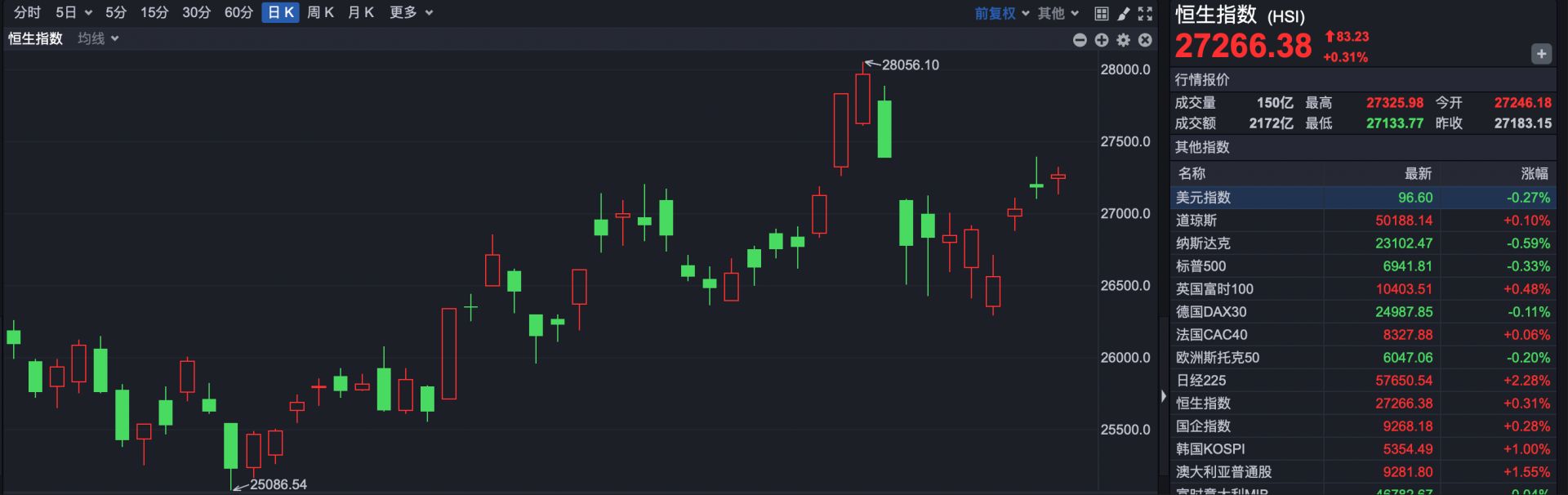
恒生指数上涨0.31% 恒生科技指数上涨0.90%
Xin Hua Cai Jing· 2026-02-11 09:44
整体来看,黄金、有色金属、新能源车企、科网、建材水泥等股多为上涨,新消费、生物医药、券商、 银行、房地产等股有涨有跌,商业航天、芯片、航空等股多有下跌。 个股方面,中芯国际跌2.17%,泡泡玛特跌5.49%,紫金矿业涨2.84%,美团涨0.06%,长飞光纤光缆跌 5.70%,比亚迪股份涨3.50%,中国人寿跌3.94%,赣锋锂业涨5.15%,建设银行涨0.37%,小鹏汽车涨 1.88%,汇丰控股跌0.36%,国泰君安国际涨4.85%,荣昌生物跌1.03%,中国石油股份涨0.75%。 成交额前三的个股中,腾讯控股跌0.54%,成交约130亿港元;阿里巴巴跌0.25%,成交超83亿港元;小 米集团涨4.27%,成交82亿港元。 新华财经香港2月11日电(记者林迎楠)11日,港股主要指数小幅高开后震荡上行,截至收盘,恒生指 数上涨0.31%至27266.38点,恒生科技指数上涨0.90%至5499.99点,国企指数上涨0.28%至9268.18点。 当日恒指高开63.03点,开报27246.18点,开盘后震荡上行,午后在高位窄幅整理,最终恒指涨83.23 点,主板成交超2172亿港元。当日,港股通(南向)净流入超4 ...
财政"万亿级"弹药就位!基建复苏打响估值修复战,建材ETF(159745)锁仓顺周期龙头
Sou Hu Cai Jing· 2026-02-11 09:28
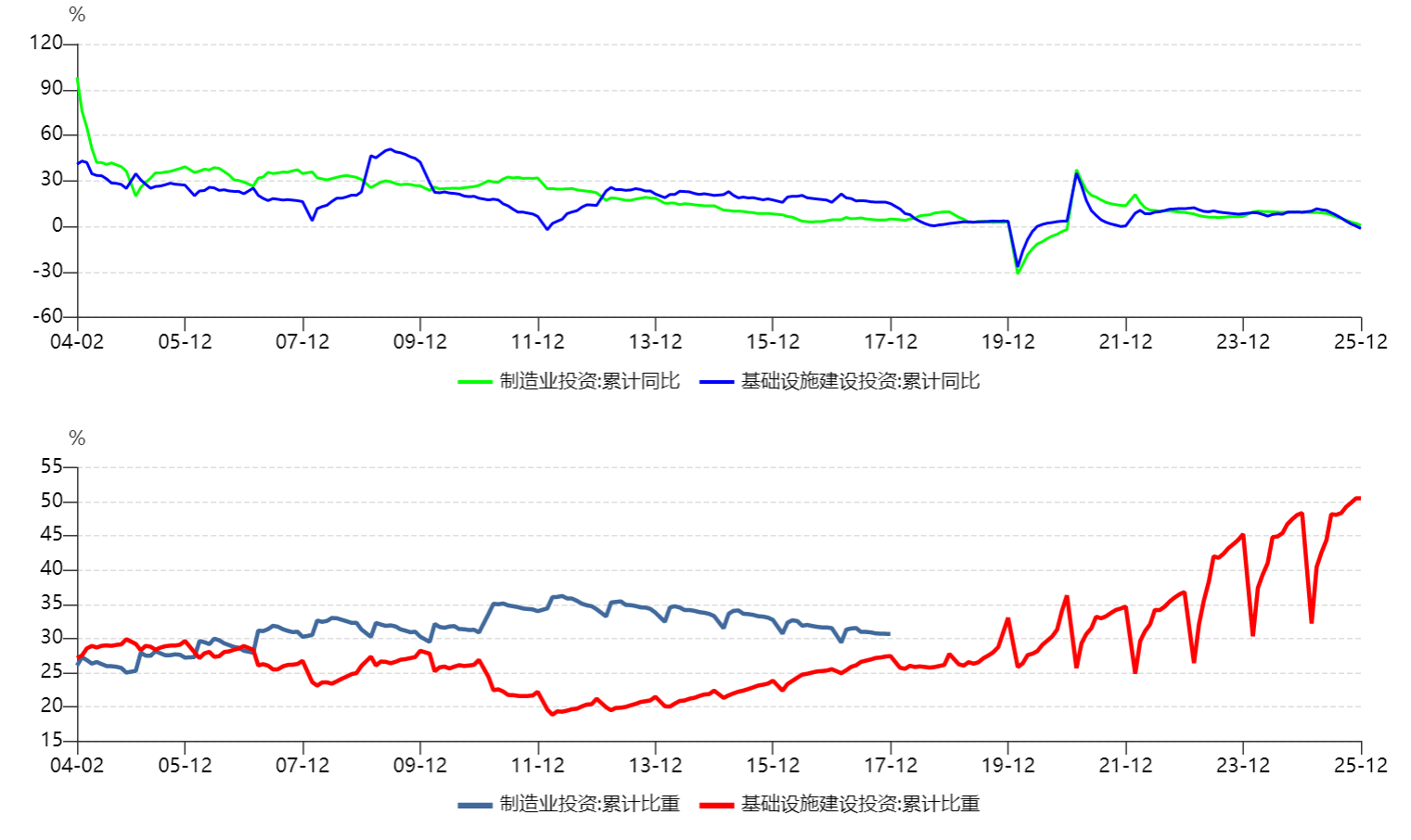
Core Viewpoint - Current infrastructure investment is becoming a crucial support for the economy, with fiscal policies continuously strengthening, leading to a configuration window driven by infrastructure recovery in the building materials sector [1] Group 1: Infrastructure Investment Dynamics - The "14th Five-Year Plan" is entering its final year, accelerating the implementation of major engineering projects, which is providing solid support for the improvement of the industry fundamentals through the demand pull of infrastructure [1] - Since the second half of 2024, active fiscal policies have significantly increased, with the pace of special bond issuance accelerating and the launch of ultra-long special government bonds injecting ample funds into infrastructure investment [1] - Infrastructure investment has a clear policy orientation and planning, unlike the endogenous fluctuations of real estate investment, with 2025 being a key year for the transition between the "14th" and "15th" Five-Year Plans [1][4] Group 2: Investment Trends and Performance - Despite a year-on-year decline in cumulative infrastructure construction investment to -1.48% in December, the cumulative proportion of infrastructure investment remained high at 50.49% in December 2025, reflecting its significant position in fixed asset investment [1][4] - Key areas for current infrastructure investment include urban agglomerations, metropolitan areas, and the connectivity of infrastructure along the "Belt and Road" [4] - Major infrastructure projects are expected to drive demand for cement, pipes, waterproof materials, and other building materials, with a focus on water conservancy and disaster prevention projects [4][5] Group 3: Building Materials Sector Outlook - The building materials industry is currently in a low operating state after inventory destocking, and the concentrated release of infrastructure demand is expected to trigger price elasticity [5] - The profitability transmission from infrastructure recovery is anticipated to drive the development of the building materials sector, with a notable improvement in gross profit margins due to supply-side discipline and cost pressure relief [6] - The building materials sector is characterized by "valuation repair + profit improvement," with the risk of a cliff-like decline in demand eliminated by infrastructure support, leading to a systematic uplift in valuation [8] Group 4: Investment Vehicles and Strategies - The building materials ETF (159745) tracks the CSI All-Share Building Materials Index, covering leading enterprises across the entire industry chain, providing an efficient tool for investors to layout in the building materials sector [8][9] - The top ten holdings in the ETF reflect a high concentration in leading companies across various segments of the building materials industry, accounting for over 60% of the total holdings [9] - The building materials sector is highlighted as a core cyclical investment, with low valuations and high dividends, making it attractive for investors during market shifts towards cyclical stocks [12]



港股复盘 | 港股温和走高 黄金股卷土重来
Mei Ri Jing Ji Xin Wen· 2026-02-11 09:21
Market Overview - The Hong Kong stock market experienced a mild increase, with the Hang Seng Index closing at 27,266.38 points, up 83.23 points, a rise of 0.31% [1] - The Hang Seng Tech Index closed at 5,499.99 points, increasing by 48.96 points, a rise of 0.90% [3] Sector Performance - Gold stocks showed strength after previous adjustments, with Zijin Mining International (HK02259) rising over 9%, Lingbao Gold over 6%, Shandong Gold over 4%, and Zijin Mining over 3% [5] - Wells Fargo noted that the recent pullback in gold prices is a healthy correction after significant increases, with spot gold prices down over 10% from record highs at the end of January, primarily due to profit-taking after a rise of over 30% above the 200-day moving average. The bank raised its 2026 gold price target to $6,100 to $6,300 per ounce, indicating over 20% upside potential due to geopolitical risks, market volatility, and strong central bank demand [7] - In the building materials sector, China National Building Material (HK03323) rose over 11%, China Resources Cement over 5%, and Western Cement over 3% [5] Future Outlook - Zhongyou Securities believes that the building materials sector will see significant valuation elasticity by 2026, with industries like waterproofing, coatings, and cement entering a phase of improvement. Price turning points are expected for gypsum boards, pipes, and glass as real estate and economic conditions improve. Short-term demand is currently weak, with a focus on post-Spring Festival demand and price increases [9] - According to招商证券, the recent volatility in the Hong Kong tech sector, represented by the Hang Seng Tech Index, is due to liquidity shocks, but the fundamental and bullish logic remains unchanged. A series of favorable factors are accumulating, and if the US dollar index begins to decline, the Hong Kong market will benefit from improved liquidity expectations [11] - 广发证券 anticipates a peak in lock-up stock releases from late February to early March, which could impact market liquidity. If the market adjusts before these releases, it may create a temporary bottom, suggesting potential investment opportunities following the Spring Festival [11]
港股收评:恒生科技指数涨0.9%,建材板块走强
2 1 Shi Ji Jing Ji Bao Dao· 2026-02-11 08:57
Market Overview - The Hang Seng Index closed up 0.31%, the Hang Seng Tech Index rose 0.9%, and the Hang Seng China Enterprises Index increased by 0.28% [1] Construction Sector - The construction sector showed strong performance, with China National Building Material rising over 11%, Huaneng International up over 6%, and China Resources Cement Technology increasing by over 5% [1] - Key stock movements include: - China National Building Material (3323) at 6.320 HKD, up 11.46% [1] - Huaneng International (1102) at 0.047 HKD, up 6.82% [1] - China Resources Cement Technology (1313) at 1.980 HKD, up 5.32% [1] Metals Sector - The metals sector also saw gains, with Jiaxin International Resources up over 11%, Xinjiang Xin Mining up over 10%, and Xinyuan Wanheng Holdings increasing by 10% [2] - Notable stock performances include: - Jiaxin International Resources (3858) at 92.200 HKD, up 11.22% [2] - Xinjiang Xin Mining (3833) at 2.730 HKD, up 10.08% [2] - Xinyuan Wanheng Holdings (2326) at 0.011 HKD, up 10% [2] Chemical Sector - The chemical sector experienced a strong rally, with Zhongwei New Materials rising over 11%, Zhongqi Group up over 7%, and Ximei Resources increasing by over 6% [3] - Key stock movements include: - Zhongwei New Materials (2579) at 37.820 HKD, up 11.50% [3] - Zhongqi Group (1932) at 0.290 HKD, up 7.41% [3] - Ximei Resources (dasse) at 10.230 HKD, up 6.23% [3] Consumer Durables Sector - The consumer durables sector weakened, with Han Cheng Development Holdings, Baiyue Group, and Pop Mart all declining over 5% [4] - Key stock performances include: - Han Cheng Development Holdings (0361) at 0.085 HKD, down 5.56% [4] - Baiyue Group (8545) at 0.034 HKD, down 5.56% [4] - Pop Mart (9992) at 255.000 HKD, down 5.49% [4] Individual Stock Movements - Yueda Group fell over 8%, reaching a low of 39.88 HKD per share, following a profit warning indicating a projected loss of approximately 750 million to 850 million RMB for 2025 [4] - The loss is attributed to goodwill impairment from the acquisition of New Classics Media in 2018, which is a non-cash expense and will not affect cash flow [4] Strategic Partnerships - InSilico Medicine saw a midday surge of nearly 8%, closing at 73.2 HKD after announcing a strategic partnership with Kangzheng Pharmaceutical for drug development in central nervous system and autoimmune diseases [5] - The collaboration will involve at least two AI-enabled drug development projects, with potential funding of several tens of millions of HKD for each project [5]
