
建筑业

Search documents
固定收益点评报告:制造业PMI重返扩张区间
Huaxin Securities· 2025-12-31 10:33
Report Overview - The report is a fixed - income review report focusing on the PMI data in December 2025 [1] Industry Investment Rating - No industry investment rating is provided in the report Core Viewpoints - In December, the manufacturing PMI reached 50.1, rising by 0.9 and returning to the expansion range for the first time since April; the non - manufacturing PMI was 50.2, up 0.7 month - on - month. The PMI data shows that under the influence of pre - holiday effects, domestic demand expansion policies, and price transmission due to anti - involution deepening, enterprises' operating pressure, production expectations, demand side, and production expansion willingness have all improved. It is necessary to continuously monitor the sustainability of domestic demand improvement and policy strength [2][4] Section Summaries Manufacturing - **Business Conditions**: The production index increased significantly by 1.7 to 51.7, and the new order index rose by 1.6 to 50.8, with the new export order index up 1.4 to 49. Enterprises' production and operation enthusiasm increased notably, with the raw material inventory rising 0.5 to 47.8, the procurement volume up 0.6 to 51.1, and the production and operation activity expectation up 2.4 to 55.5. From an industry perspective, industries such as农副 food processing, textile and clothing, and computer communication and electronic equipment had both production and demand above 53, while industries like non - metallic mineral products and ferrous metal smelting and rolling processing had both indexes below the critical point [3] - **Profitability**: The purchase price of raw materials decreased by 0.5, and the ex - factory price index increased by 0.7, indicating marginal improvement in corporate profits [3] - **Enterprise Size**: The business conditions of large enterprises rebounded above the boom - bust line. In December, the PMIs of large, medium, and small enterprises changed by 1.5, 0.9, and - 0.5 respectively, reaching 50.8, 49.8, and 48.6 [3] - **Key Industries**: The PMIs of high - tech manufacturing, equipment manufacturing, consumer goods industries, and raw material industries changed by 2.4, 0.6, 1.0, and 0.5 respectively, reaching 52.5, 50.4, 50.4, and 48.9 [3] Non - manufacturing - **Construction Industry**: In December, the business activity index of the construction industry was 52.8, up 3.2 month - on - month, and returned above the boom - bust line, showing strong resilience [3] - **Service Industry**: The business activity index of the service industry was 49.7, up 0.2, indicating some pressure [3] Investment Suggestions - The December PMI data shows comprehensive improvement in enterprises' operating pressure, production expectations, demand side, and production expansion willingness. It is recommended to continuously monitor the sustainability of domestic demand improvement and policy strength [4]
住建部:在更大范围推广智能建造、绿色建造、装配式装修
Zheng Quan Shi Bao Wang· 2025-12-31 10:22
Core Viewpoint - The Ministry of Housing and Urban-Rural Development has released opinions aimed at enhancing housing quality, emphasizing the development of new construction methods [1] Group 1: New Construction Methods - Accelerate the integration of the construction industry with advanced manufacturing technologies and next-generation information technologies [1] - Promote intelligent construction, green construction, and prefabricated decoration on a broader scale [1] Group 2: Digital Technology and BIM - Expand the application scenarios of digital technology in engineering and advance the use of Building Information Modeling (BIM) technology throughout the entire process of housing design, construction, and operation [1] - Promote the application of intelligent construction equipment [1] Group 3: Waste Management and Resource Utilization - Accelerate the reduction and resource utilization of construction waste [1] Group 4: Green Building Initiatives - Ensure that all new urban housing is built as green buildings and increase the proportion of high-star green buildings [1] - Promote energy-saving and carbon reduction in building operations and strengthen energy efficiency limit management [1] Group 5: Energy Efficiency and Renewable Energy - Establish a building energy efficiency grading system and compile carbon emission statistical accounting standards [1] - Promote the electrification of building energy use, conduct integrated photovoltaic pilot projects, and enhance the utilization of renewable energy [1] - Accelerate the transformation of the energy structure used in buildings [1]
数据点评 | 12月PMI回升的四大支撑(申万宏观·赵伟团队)
申万宏源宏观· 2025-12-31 10:03
Core Viewpoint - The December PMI index shows a recovery driven by new momentum and the consumer goods sector, with a reduction in the debt-extraction effect and resilient exports supporting the index [1][4][53]. Group 1: PMI Recovery - The manufacturing PMI rose by 0.9 percentage points to 50.1%, marking a return to the growth line after nine months, despite a decline in high-frequency indicators such as blast furnace operation and freight volume [1][5][53]. - The production and new orders indices increased by 1.7 and 1.6 percentage points, respectively, reaching 51.7% and 50.8% [5][30]. Group 2: Support from New Momentum - PMI in sectors related to new momentum showed significant improvement, although the sustainability of this trend requires further observation due to a lack of corresponding high-frequency indicators [12][54]. - Traditional industries like black metal rolling and chemical fibers saw a decline in PMI, while emerging sectors such as electrical machinery and pharmaceuticals experienced increases, with high-tech and equipment manufacturing PMIs rising by 2.4 and 0.6 percentage points to 52.5% and 50.4% respectively [12][54]. Group 3: Consumer Sector Improvement - The overall consumer goods sector PMI increased by 1 percentage point to 50.4%, despite a significant drop of 5.8 percentage points in the automotive sector PMI, reflecting the impact of reduced government subsidies and demand risks [15][54]. - The textile and apparel sector PMI rose by 4.5 percentage points, correlating with improvements in travel data [15][54]. Group 4: Construction Sector Recovery - The construction PMI rose by 3.2 percentage points to 52.8%, indicating a marginal weakening of the debt-extraction effect on investment due to the alleviation of special refinancing bond issues and the implementation of incremental policies [18][54]. - Activities in housing construction and civil engineering increased by 4.8 and 1.2 percentage points, respectively, with the business activity expectation index remaining high at 57.4% [18][54]. Group 5: Export Resilience - The domestic order index rose by 1.6 percentage points to 51.1%, while the new export orders index improved by 1.4 percentage points to 49% [22][55]. - High-frequency indicators showed a year-on-year increase of 0.6 percentage points in port foreign trade freight volume, maintaining a high level [22][55]. Group 6: Economic Growth Outlook - The recovery in manufacturing PMI, driven by new momentum and consumer sectors, suggests continued economic resilience, despite traditional momentum facing downward pressure [27][55]. - The implementation of incremental fiscal policies and service consumption-related policies is expected to enhance domestic demand [27][55].

中采PMI点评(25.12):12月PMI回升的四大支撑
Shenwan Hongyuan Securities· 2025-12-31 09:33
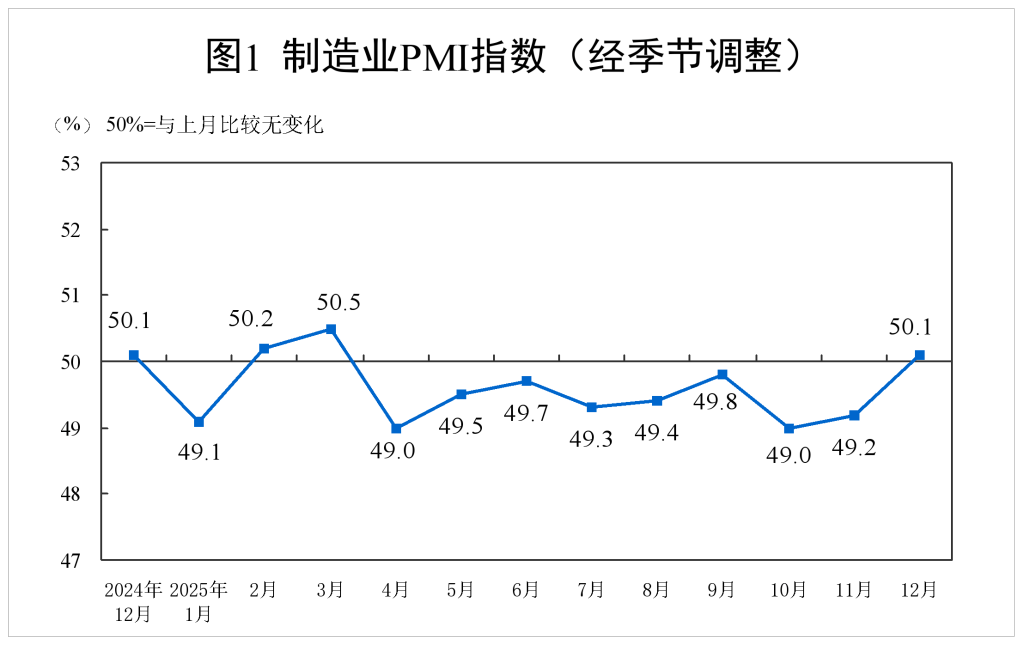
Group 1: PMI Overview - The manufacturing PMI for December increased to 50.1%, up 0.9 percentage points from 49.2% in November, marking a return to the expansion zone after 9 months[1][7] - The non-manufacturing PMI also rose to 50.2%, an increase of 0.7 percentage points from the previous month[1][7] Group 2: Key Support Factors - New momentum and consumer goods sectors contributed to the PMI rebound, with manufacturing PMI supported by a 1.7 percentage point rise in production and a 1.6 percentage point rise in new orders[2][8] - Emerging industries such as electrical machinery and pharmaceuticals saw PMI increases of 1.3 and 0.9 percentage points, respectively, indicating improvement despite traditional sectors declining[2][11] - The construction PMI rose significantly by 3.2 percentage points to 52.8%, reflecting a reduction in the crowding-out effect of debt on investment[3][16] - Export resilience was noted, with the new export orders index improving by 1.4 percentage points to 49%, while domestic orders increased by 1.6 percentage points to 51.1%[4][20] Group 3: Sector Performance - The overall consumer goods PMI increased by 1 percentage point to 50.4%, with notable recovery in textiles and apparel, which rose by 4.5 percentage points[3][14] - The service sector PMI improved slightly to 49.7%, with new orders and employment indices showing marginal increases[5][31] - The construction sector's new orders index rose by 1.3 percentage points to 47.4%, indicating a positive trend in demand[5][36] Group 4: Economic Outlook - The report suggests that economic growth remains resilient, driven by new momentum and supportive fiscal policies, despite traditional sectors facing downward pressure[4][22] - Risks include potential changes in the external environment and the pace of growth policies not meeting expectations[5][38]
分析|产需两端明显回升,12月制造业PMI时隔8个月回升至扩张区间
Sou Hu Cai Jing· 2025-12-31 09:15
Group 1: Manufacturing Sector - In December, the Manufacturing Purchasing Managers' Index (PMI) rose to 50.1%, an increase of 0.9 percentage points from the previous month, marking the first time it has entered the expansion zone since April [8] - The production index reached 51.7%, up 1.7 percentage points, and the new orders index increased to 50.8%, up 1.6 percentage points, indicating significant improvement in manufacturing demand [8] - The new export orders index also improved to 49.0%, up 1.4 percentage points, suggesting a recovery in external demand [8] Group 2: Non-Manufacturing Sector - The Non-Manufacturing Business Activity Index rose to 50.2%, an increase of 0.7 percentage points, returning to the expansion zone [10] - The service sector's business activity index was at 49.7%, indicating it remains in the contraction zone despite a slight increase [11] - The construction sector showed improvement with a business activity index of 52.8%, up 3.2 percentage points, attributed to favorable weather and policy-driven infrastructure investments [12] Group 3: Economic Outlook - The overall economic activity in December showed signs of recovery, with both domestic and external demand improving due to effective growth stabilization policies [13] - The price indices showed mixed results, with the main raw material purchase price index decreasing by 0.5 percentage points to 53.1%, while the factory price index increased by 0.7 percentage points to 48.9%, indicating potential for improved corporate profits [9] - Looking ahead, the manufacturing PMI is expected to remain in the expansion zone into early 2026, supported by ongoing growth policies and a recovering market demand [13][14]
12月中国PMI评论:亮眼数据迎新年
Yin He Qi Huo· 2025-12-31 09:14
Report Summary 1) Report Industry Investment Rating No information provided in the content. 2) Core View of the Report In December 2025, China's manufacturing PMI reached 50.1, up 0.9 from the previous month, significantly higher than the market - expected 49.3, returning above 50 for the first time in 8 months. The non - manufacturing PMI business activity was 50.2, up 0.7 from the previous month, higher than the market - expected 49.5. The manufacturing PMI showed an overall recovery, while the non - manufacturing PMI was in a relatively weak state [4][21]. 3) Summary by Relevant Catalogs First Part: Review of China's Manufacturing and Non - manufacturing PMI Data Tables - The table presents the manufacturing PMI and its sub - items for December and November 2025, including production, new orders, new export orders, etc., along with their changes [2]. Second Part: Full Recovery of Manufacturing PMI in December - In December 2025, the manufacturing PMI reached 50.1, with significant recoveries in production, new orders, new export orders, and production and operation expectations. The main raw material purchase price and employment sub - items declined. It recovered against the seasonal trend, and most sub - items were at the middle level of the historical same period, indicating economic recovery. The finished product inventory was at a relatively high level, and there was a time lag in the economic recovery reaching the price end. Small - sized enterprises' PMI declined, while large and medium - sized enterprises' PMI increased. The economic cycle also showed a repair state [4][5]. Third Part: Mixed Performance and Overall Weakness of Non - manufacturing PMI in December - In December 2025, the non - manufacturing PMI business activity was 50.2. Some sub - items such as new orders, employment, and business activity increased, while sales price, new export orders, input price, and on - hand orders decreased. The decline in input and sales prices reflected the weakness of the non - manufacturing economy. Seasonally, many key indicators were at relatively low levels in the historical same period. The construction industry PMI continued to decline, and the service industry PMI was at a relatively low level [21][22].
PMI大幅反弹,什么信号
HUAXI Securities· 2025-12-31 09:08
Group 1: PMI Overview - Manufacturing PMI rebounded to 50.1% in December, up 0.9 percentage points from 49.2%, marking the first expansion in eight months and exceeding Bloomberg's expectation of 49.2%[1] - Non-manufacturing PMI also increased to 50.2%, up from 49.5%[1] - The composite PMI for December rose by 1 percentage point to 50.7%, the highest in the second half of the year[5] Group 2: Manufacturing Sector Insights - Key drivers for the manufacturing PMI were production and new orders, with production increasing by 1.7 percentage points to 51.7% and new orders rising by 1.6 percentage points to 50.8%[1] - New export orders improved by 1.4 percentage points to 49.0%, nearing the highest level of the year[2] - Manufacturing purchasing volume increased by 1.6 percentage points to 51.1%, while raw material purchase prices decreased by 0.5 percentage points to 53.1%[2] Group 3: Construction and Services Sector - The construction sector saw a significant rebound, with the business activity index rising by 3.2 percentage points to 52.8%, the highest in the second half of the year[3] - Service sector PMI increased slightly by 0.2 percentage points to 49.7%, remaining below the expansion threshold[3] - New orders in the service sector rose by 1.8 percentage points to 47.3%, indicating some improvement despite overall weakness in consumer-related services[3] Group 4: Price Trends and Economic Outlook - Price trends showed divergence, with manufacturing output prices rebounding by 0.7 percentage points to 48.9%, while service and construction prices fell[4] - The overall economic recovery in December is attributed to increased fiscal spending and positive expectations for the upcoming year, particularly with the 2026 Spring Festival being later in February[4] - The necessity for aggressive monetary policy easing appears to be decreasing, with potential delays in interest rate cuts anticipated[6]
12月PMI数据点评:供、需指数共同回暖
Bank of China Securities· 2025-12-31 08:25
Group 1: Manufacturing Sector Insights - December Manufacturing PMI index rose to 50.1%, an increase of 0.9 percentage points from November, indicating a return to expansion territory[2] - New orders index for December was 50.8%, up 1.6 percentage points, with external demand contributing positively[2] - Production index increased to 51.7%, up 1.7 percentage points, reflecting improved manufacturing activity[2] - Supplier delivery time index slightly increased to 50.2%, up 0.1 percentage points, indicating stable supply chain conditions[2] Group 2: Investment and Economic Outlook - Fixed asset investment growth is expected to remain promising at the beginning of 2026, despite some weakness in December[3] - December's main raw material purchase price index was at 53.1%, down 0.5 percentage points, indicating high price levels[9] - The manufacturing profit margin is expanding as factory prices rise while raw material costs slightly decline[9] - Construction sector PMI rose to 52.8%, up 3.2 percentage points, indicating a recovery in construction activity[15] Group 3: Non-Manufacturing Sector Insights - December Non-Manufacturing PMI index rose to 50.2%, an increase of 0.7 percentage points, indicating expansion[11] - New orders index for non-manufacturing was at 47.3%, up 1.6 percentage points, but still below the expansion threshold[11] - Employment index in the non-manufacturing sector was at 46.1%, indicating contraction despite a slight increase of 0.8 percentage points[11]
——12月PMI数据解读:PMI为何重回扩张?
Huafu Securities· 2025-12-31 07:44
Group 1: PMI Performance - The national manufacturing PMI rose to 50.1% in December, marking a 0.9 percentage point increase from the previous month, and entering the expansion zone for the first time since April[3] - The new orders index reached 50.8%, up 1.6 percentage points, while the production index increased to 51.7%, rising by 1.7 percentage points[5] - The supplier delivery time index increased, indicating a rise in supply chain pressures, while the employment index declined[3] Group 2: Demand and Supply Dynamics - New export orders index for December was 49.0%, up 1.4 percentage points, with a cumulative increase of 3.1 percentage points over November and December[5] - The production index's improvement is the most significant in nearly a decade, reflecting synchronized recovery in supply and demand[4] - The raw material inventory index rose to 47.8%, while the finished goods inventory index increased to 48.2%, indicating a buildup of demand-side inventory[5] Group 3: Price Trends and Expectations - The purchasing price index fell to 53.1%, down 0.5 percentage points, while the factory price index rose to 48.9%, up 0.7 percentage points, suggesting improved profit distribution for downstream sectors[5] - The manufacturing business activity expectation index reached a new high for the year, indicating improved business conditions and potential increases in capital expenditure[4] - The non-manufacturing business activity index rose to 50.2%, up 0.7 percentage points, with the construction sector showing significant recovery[6]
12月PMI数据点评:景气重返扩张区间
Mai Gao Zheng Quan· 2025-12-31 07:29
Group 1: Manufacturing Sector - December Manufacturing PMI recorded at 50.1%, up 0.9 percentage points from the previous month, marking the first entry into the expansion zone since April 2025[2] - Production index rose to 51.7%, an increase of 1.7 percentage points, while new orders index reached 50.8%, up 1.6 percentage points, indicating improved production and demand[12] - Large enterprises' PMI increased to 50.8%, up 1.5 percentage points, supporting the manufacturing recovery, while small enterprises' PMI fell to 48.6%, reflecting ongoing challenges[18] Group 2: Non-Manufacturing Sector - December Non-Manufacturing Business Activity Index rose to 50.2%, returning to the expansion zone, showing improvement from November[3] - Construction PMI recorded at 52.8%, up 3.2 percentage points, driven by favorable weather and accelerated project progress[25] - Service sector Business Activity Index increased to 49.7%, still in contraction, with significant variation across industries, indicating a slow recovery[25] Group 3: Economic Outlook - Overall PMI data for December reflects a phase of economic recovery, confirming the effectiveness of growth stabilization policies[5] - Anticipated economic expansion supported by upcoming consumption peaks and infrastructure projects, alongside a special bond issuance plan of 62.5 billion yuan to stimulate consumption[5] - Risks include potential delays in policy implementation, slow global economic recovery, and insufficient domestic demand[6]