
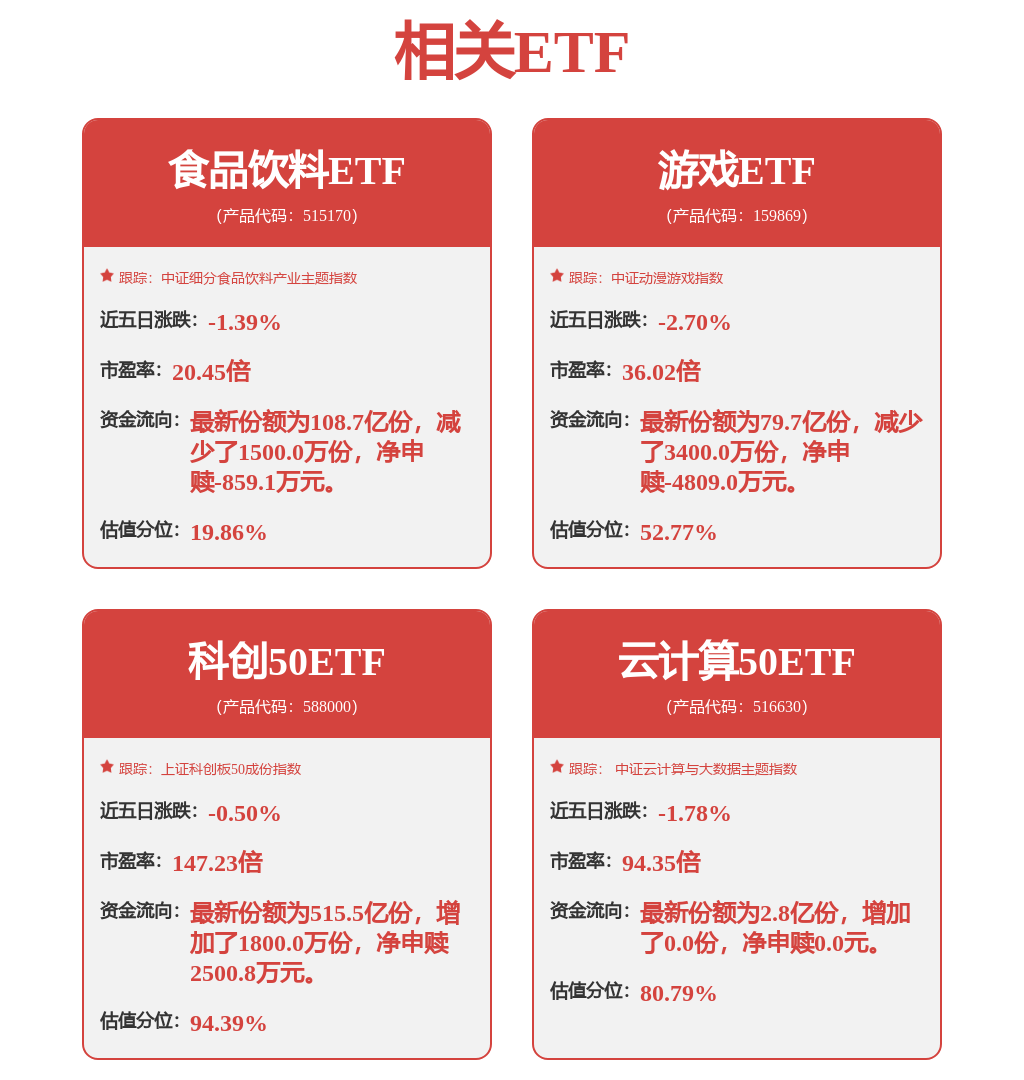
食品饮料等

Search documents
收评:创业板涨1%,半导体等板块拉升,人形机器人概念等活跃
Zheng Quan Shi Bao Wang· 2025-12-04 07:49
Core Viewpoint - The market is experiencing a mixed performance with the Shanghai Composite Index slightly declining while the Shenzhen Component and ChiNext indices show strength, indicating sector-specific movements and underlying market dynamics [1][2]. Market Performance - As of the market close, the Shanghai Composite Index fell by 0.06% to 3875.79 points, while the Shenzhen Component rose by 0.4%, the ChiNext Index increased by 1.01%, and the Sci-Tech 50 Index gained 1.36%. The total trading volume across the Shanghai and Shenzhen markets reached 15,617 billion yuan [2]. Sector Analysis - Various sectors such as tourism, catering, food and beverage, brewing, agriculture, real estate, and retail experienced declines. In contrast, the semiconductor sector saw an increase, along with active movements in humanoid robots, commercial aerospace, and satellite navigation concepts [3]. Market Sentiment and Outlook - According to Kaiyuan Securities, the current market adjustment is primarily influenced by overseas liquidity risks, geopolitical disturbances, and a vacuum in policy expectations. However, liquidity remains loose, and the fundamental economic conditions are gradually improving, maintaining the core logic of a bull market. The upcoming December Political Bureau meeting and Central Economic Work Conference are expected to provide strong market guidance for the economic outlook in 2026. Additionally, with the Spring Festival occurring later, there may be an early onset of spring market activity, suggesting that investors should consider early positioning [3].


主力资金动向 5.90亿元潜入轻工制造业
Zheng Quan Shi Bao Wang· 2025-11-27 09:57
Core Insights - The main point of the article is the analysis of capital flow across various industries, highlighting significant net inflows and outflows of funds in the market today. Industry Summary - The industry with the largest net capital inflow is Light Industry Manufacturing, with a net inflow of 590 million yuan and a price change of 1.09% [1] - The industry with the largest net capital outflow is Computer, with a net outflow of 4.048 billion yuan and a price change of -0.82% [1] - Other industries with notable net inflows include Electronics (499 million yuan), Food and Beverage (333 million yuan), and Basic Chemicals (206 million yuan) [1] - Industries experiencing significant net outflows include Media (-3.730 billion yuan), Pharmaceuticals (-2.781 billion yuan), and Electrical Equipment (-1.547 billion yuan) [2] - Overall, 6 industries saw net inflows while 25 industries experienced net outflows today [1]
2026年A股市场投资展望:变局蕴机遇,聚势盈未来
Yin He Zheng Quan· 2025-11-24 14:15
Group 1: 2025 A-Share Market Review - As of November 14, 2025, the overall A-Share index increased by 26.58%, with the ChiNext index and STAR 50 leading at 45.29% and 37.65% respectively [6] - Among 31 primary industries, 30 saw an increase in closing prices compared to the end of the previous year, with non-ferrous metals, communication, and electric equipment leading with gains exceeding 50% [4][19] - The food and beverage industry experienced a decline of 3.40% [4][19] Group 2: 2026 Investment Environment Analysis - The 2026 investment environment is characterized by a stable macroeconomic policy in China, with expected resilience in economic growth and a potential recovery in inflation from low levels [4][36] - The international landscape remains uncertain, with geopolitical risks and trade order challenges impacting global economic growth [36][40] - The "14th Five-Year Plan" is expected to provide a clear development blueprint, enhancing market confidence in China's long-term economic resilience [4][36] Group 3: Market Trend Predictions for 2026 - The A-Share market is anticipated to benefit from improved liquidity, with the current valuation being relatively reasonable compared to global equity markets [4][36] - Earnings growth is expected to become a key focus, driven by the deepening of China's economic transformation and the continuous development of emerging industries [4][36] - The PPI decline is expected to narrow, potentially leading to an increase in corporate profit margins [4][36] Group 4: Style Judgments for 2026 - Small-cap stocks are expected to perform well, particularly in the context of a favorable environment for risk appetite driven by the Fed's anticipated rate cuts and the upward trend in emerging industries [4][36] - Growth stocks are projected to continue outperforming value stocks in the first three quarters of 2026, supported by favorable policies and market conditions [4][36] - In the fourth quarter, as the U.S. midterm elections approach, market risk appetite may shift, potentially favoring value stocks [4][36] Group 5: Structural Investment Opportunities - The "14th Five-Year Plan" is expected to create significant policy dividends and industry opportunities, focusing on two main lines: new productivity driven by technology and the "anti-involution" policy promoting supply-demand optimization [4][36] - Key sectors to watch include artificial intelligence, new energy, and quantum technology, which are highlighted in the "14th Five-Year Plan" [4][36] - The consumer sector is seen as a potential area for investment, with policies aimed at expanding domestic demand [4][36]
34家企业,公示名单发布!
中国能源报· 2025-11-18 03:36
Core Viewpoint - The Ministry of Industry and Information Technology (MIIT) is promoting electricity demand-side management in the industrial sector by collecting typical case studies nationwide, with 34 companies and 30 products/technologies proposed for inclusion in the "National Typical Cases of Electricity Demand-Side Management in the Industrial Sector (2025)" list [1][4]. Summary by Sections Case Collection and Evaluation - The MIIT has initiated a nationwide collection of typical cases for electricity demand-side management in the industrial sector, involving preliminary reviews by local authorities and expert evaluations by the China Electricity Council [4]. Proposed Companies and Technologies - A total of 34 companies and 30 products/technologies are proposed for inclusion in the 2025 list, showcasing various management and technical measures aimed at improving energy efficiency and reducing electricity consumption [4][5]. Implementation Results - Companies like Hebei Changan Automobile reported direct electricity savings of 13.45 million yuan in 2024 through various energy efficiency measures, including upgrading distribution networks and promoting the use of electric vehicles [6]. - Jilin Linglong Tire achieved a direct electricity savings of 9.31 million kWh in 2024 by improving power factor and utilizing distributed solar power [6]. - Budweiser (Jiamusi) implemented a series of energy optimization measures, resulting in a reduction of 491,900 kWh in electricity consumption in 2024 compared to 2023, alongside a 15% increase in production efficiency [7]. Management and Technical Measures - Companies are establishing dedicated energy management teams and systems to oversee electricity demand-side management, with many implementing advanced technologies such as smart energy management platforms and distributed energy systems [8][9]. - The use of renewable energy sources, such as solar power, is being emphasized, with companies like Jiangdong Hengkang New Materials planning significant solar and energy storage projects to enhance green development [8]. Public Participation and Feedback - The MIIT has opened a public consultation period for stakeholders to provide feedback on the proposed list of companies and technologies, encouraging transparency and community involvement in the electricity demand-side management initiative [4].
中国消费者洞察报告 | 埃森哲
Sou Hu Cai Jing· 2025-11-12 10:46
Core Insights - The report by Accenture titled "New Propositions for a Better Life - Insights into Chinese Consumers" analyzes the structural changes occurring in the Chinese consumer market, highlighting two main themes: "Rational Upgrade" and "Demand Restructuring" [2][10]. Group 1: Rational Consumption and Brand Loyalty - Chinese consumers are becoming increasingly rational, with over 55% frequently comparing multiple brands even if they have a preferred one, indicating a dilution of brand loyalty [3][25]. - Domestic brands are rising across various categories, with consumer preference for domestic products surpassing that for international brands in beauty, 3C electronics, home appliances, and apparel [3][14]. - The preference for domestic brands is driven not only by price but also by cultural recognition and emotional value, with 85% of consumers prioritizing cost-effectiveness and 70% valuing product quality [15][25]. Group 2: New Priorities and Consumer Behavior - Consumers are reordering their life priorities, with a significant increase in focus on health and wealth, while aspirations related to career, love, and personal growth are being suppressed [4][40]. - Nearly 90% of consumers actively focus on physical and mental health, with 70% choosing to save money to enhance financial resilience, and 60% engaging in skill development or side jobs, forming a "safety triangle" of health, wealth, and learning [4][47]. - The shopping experience is evolving, with 85% of consumers preferring online browsing while still valuing in-store experiences, indicating a desire for a blend of efficiency and emotional interaction [4][39]. Group 3: AI Integration in Daily Life - AI is rapidly becoming integrated into daily life, with 77% of consumers frequently using AI tools, viewing them as advisors (65%) or assistants (63%), and even as partners (46%) [5][26]. - AI lowers the barriers to information access, enabling consumers to make more autonomous and efficient decisions in shopping, learning, and other areas [5][39]. Group 4: Brand Response Strategies - In the era of rational consumption, brands must provide "justifiable premiums" through solid product quality and clear value propositions to gain consumer trust [6][11]. - Emotional connections are crucial, with brands needing to engage deeply with consumers in real-life scenarios, such as creating immersive experiences or enhancing consumer confidence through integrated online and offline services [6][11]. - Leveraging AI to understand consumer needs and optimize experiences is becoming a core competitive advantage for brands [6][11].
【盘中播报】沪指涨0.06% 基础化工行业涨幅最大
Zheng Quan Shi Bao Wang· 2025-11-10 03:07
Market Overview - The Shanghai Composite Index increased by 0.06% as of 10:28 AM, with a trading volume of 672.42 million shares and a transaction value of 10,685.29 billion yuan, representing an 11.01% increase compared to the previous trading day [1] Industry Performance - The top-performing sectors included: - Basic Chemicals: +1.84%, transaction value of 908.73 billion yuan, led by Dongyue Silicon Material (+12.13%) [1] - Comprehensive: +1.54%, transaction value of 34.96 billion yuan, led by Yuegui Co. (+10.03%) [1] - Oil and Petrochemicals: +1.36%, transaction value of 80.45 billion yuan, led by Hengyi Petrochemical (+7.23%) [1] - The sectors with the largest declines included: - Communication: -1.67%, transaction value of 474.01 billion yuan, led by Guodun Quantum (-6.66%) [2] - Electronics: -1.29%, transaction value of 1,792.18 billion yuan, led by Tiancheng Technology (-9.79%) [2] - Machinery Equipment: -0.74%, transaction value of 619.94 billion yuan, led by Degute (-19.99%) [2] Notable Stocks - The leading stocks in the rising sectors included: - Dongyue Silicon Material (+12.13%) in Basic Chemicals [1] - Yuegui Co. (+10.03%) in Comprehensive [1] - Hengyi Petrochemical (+7.23%) in Oil and Petrochemicals [1] - The leading stocks in the declining sectors included: - Guodun Quantum (-6.66%) in Communication [2] - Tiancheng Technology (-9.79%) in Electronics [2] - Degute (-19.99%) in Machinery Equipment [2]


策略观点:市场波动延续,保持定力对待-20251109
China Post Securities· 2025-11-09 13:45
Market Performance Review - The A-share market continues to experience volatility, with large-cap indices leading the gains. The Shanghai 50 index rose by 0.89%, and the CSI 300 index increased by 0.82%, while the STAR 50 index showed a slight increase of 0.01% after significant fluctuations throughout the week [3][12] - In terms of style, cyclical stocks maintained strong performance, while stability and financial styles shifted from decline to growth compared to the previous week. Consumer stocks were the only style index to decline this week [3][12] - Large-cap stocks significantly outperformed small-cap stocks, with the core asset indices, such as the Moutai index and the Ningbo combination, both experiencing declines of 0.98% and 1.27%, respectively [3][12] Industry Insights - The third-quarter reports indicate a reversal in the "anti-involution" theme, with industries such as power equipment (up 4.98%), coal (up 4.52%), oil and petrochemicals (up 4.47%), steel (up 4.39%), and basic chemicals (up 3.54%) leading the gains. Conversely, sectors like beauty care (-3.10%), computers (-2.54%), pharmaceuticals (-2.40%), automobiles (-1.24%), and food and beverages (-0.56%) performed poorly [4][13] - The market has recognized a general profit improvement in industries aligned with the "anti-involution" theme following the third-quarter reports, gaining broader market consensus [4][13] Future Outlook and Investment Strategy - The outlook for the market suggests continued volatility, with a dual vacuum period in policy and performance expected from November to December. The lack of significant movement in household deposits indicates a potential weakness in future capital support, limiting upward space for A-shares [5][30] - The investment strategy emphasizes maintaining a growth style, with a focus on sectors that meet the "dilemma reversal + high growth" composite pricing requirements, particularly in photovoltaic equipment. Additionally, sectors that have lagged since September and are positioned favorably in the "14th Five-Year Plan" are also recommended [5][30]
A股福建板块逆势上涨,平潭发展14天11板
Ge Long Hui· 2025-11-05 01:59
Group 1 - The Fujian sector in the A-share market is experiencing a counter-trend rise, with notable increases in several companies [1] - Zhongneng Electric has surged over 10%, while companies such as Xiamen Construction, Snowman Group, Pingtan Development (14 consecutive trading days with gains), Anji Food, and Shida Group have reached the 10% daily limit [1] - Zhangzhou Development has increased by over 7%, and Haixia Environmental Protection, Zhongfutong, and Qingshan Paper have risen by over 5% [1]


10月第4期:分化
Tai Ping Yang Zheng Quan· 2025-11-03 14:47
Group 1 - The market shows differentiation, with cyclical and national indices performing the best, while the Sci-Tech 50, financials, and dividend indices lag behind [12][15] - The overall market valuation has increased, with the market ERP rising and remaining near the negative one standard deviation level since 2021 [4][20] - The performance of various sectors is mixed, with power equipment, non-ferrous metals, and steel leading in gains, while communication, beauty care, and banking sectors underperform [15][38] Group 2 - The relative PE of the ChiNext Index to the CSI 300 has decreased, while the relative PB has increased, indicating a shift in valuation dynamics [19] - The valuation of major indices is at high historical percentiles, with the financial and real estate sectors showing valuations above the 50% historical percentile [28][30] - The valuation of industries is polarized, with food and beverage, agriculture, forestry, animal husbandry, and beauty care sectors being relatively cheap [41][42] Group 3 - The earnings expectations across industries have seen slight changes, with the steel sector experiencing the largest upward adjustment and the social services sector facing the most significant downward revision [53]
A股市场大势研判:沪指收盘站上4000点大关
Dongguan Securities· 2025-10-29 23:35
Market Overview - The Shanghai Composite Index closed above the 4000-point mark, ending at 4016.33, with a gain of 0.70% [2][4] - The Shenzhen Component Index rose by 1.95% to 13691.38, while the ChiNext Index increased by 2.93% to 3324.27, marking a significant upward trend in the market [2][4] Sector Performance - The top-performing sectors included Electric Power Equipment (+4.79%), Non-ferrous Metals (+4.28%), and Non-bank Financials (+2.08%) [3] - Conversely, the sectors that underperformed were Banks (-1.98%), Food & Beverage (-0.56%), and Textiles & Apparel (-0.24%) [3] Future Outlook - The market is expected to continue its upward trend, supported by a favorable macroeconomic environment and ongoing capital inflows, with a trading volume of 2.26 trillion yuan, an increase of 108.2 billion yuan from the previous trading day [6] - Key sectors to focus on include dividends, TMT (Technology, Media, and Telecommunications), New Energy, and Non-ferrous Metals, as the market is likely to maintain a steady upward trajectory [6] Policy Insights - The recent announcement from the Central Committee emphasizes the need to accelerate the construction of a financial powerhouse, which includes enhancing the central bank's system and developing various financial sectors such as technology finance and green finance [5] - The central bank's commitment to preventing systemic financial risks and supporting the capital market's positive momentum is expected to bolster market confidence [5]