
原油

Search documents
能源化工日报-20260121
Wu Kuang Qi Huo· 2026-01-21 00:53
1. Report Industry Investment Rating No relevant content provided. 2. Core Views of the Report - For crude oil, take profit on heavy oil cracks and buy crude oil on dips within the shale oil break - even cost range [1] - For methanol, with low current valuation and an improving outlook next year, it has the feasibility of buying on dips despite short - term negative pressure [2] - For urea, due to the opening of the import window and the expected increase in production at the end of January, take profit on rallies [5] - For rubber, expect it to continue to decline after consolidation, maintain a short - term short - selling mindset if RU2605 breaks below 16000, and partially build positions for the strategy of buying NR main contract and shorting RU2609 [10] - For PVC, in the short term, electricity price expectations and export rush support it, but in the medium term, adopt a strategy of shorting on rallies before substantial production cuts in the industry [13] - For pure benzene and styrene, it is advisable to go long on non - integrated styrene profits before the first quarter [16] - For polyethylene, although the futures price is falling, the overall inventory may decline from a high level, and the price may be supported [19] - For polypropylene, in the short - term, there is no prominent contradiction, and in the long - term, go long on the PP5 - 9 spread on dips [21] - For PX, expect it to maintain a stock - building pattern before the maintenance season, and pay attention to the opportunity of going long on dips following crude oil in the medium term [23] - For PTA, expect it to enter the Spring Festival stock - building stage, and pay attention to the opportunity of going long on dips in the medium term [26] - For ethylene glycol, the supply - demand pattern needs to be improved by increasing production cuts, and in the medium term, expect further valuation compression without further domestic production cuts [30] 3. Summary by Relevant Catalogs Crude Oil - **Market Information**: INE main crude oil futures closed down 5.60 yuan/barrel, or 1.27%, at 437.00 yuan/barrel. Chinese crude oil weekly data showed inventory accumulation. Crude oil arrival inventory increased by 5.70 million barrels to 210.81 million barrels, gasoline commercial inventory increased by 0.90 million barrels to 92.37 million barrels, diesel commercial inventory increased by 2.00 million barrels to 95.56 million barrels, and total refined oil commercial inventory increased by 2.90 million barrels to 187.93 million barrels [1] - **Strategy View**: Take profit on heavy oil cracks and buy crude oil on dips within the shale oil break - even cost range [1] Methanol - **Market Information**: Regional spot prices showed changes, with Jiangsu down 13 yuan/ton, Lunan down 5 yuan/ton, etc. The main contract decreased by 27.00 yuan/ton to 2206 yuan/ton, and MTO profit increased by 64 yuan [1][2] - **Strategy View**: With low current valuation and an improving outlook next year, it has the feasibility of buying on dips despite short - term negative pressure [2] Urea - **Market Information**: Regional spot prices changed, with Shandong down 20 yuan/ton, Henan down 10 yuan/ton, etc. The main contract increased by 3 yuan/ton to 1775 yuan/ton, and the overall basis was reported at - 25 yuan/ton [4] - **Strategy View**: Due to the opening of the import window and the expected increase in production at the end of January, take profit on rallies [5] Rubber - **Market Information**: Rubber prices fluctuated weakly with a technical bearish signal. Bulls and bears had different views. Tire factory operating rates changed, and the total social inventory of natural rubber in China increased. Spot prices of related products also changed [7][8][9] - **Strategy View**: Expect it to continue to decline after consolidation, maintain a short - term short - selling mindset if RU2605 breaks below 16000, and partially build positions for the strategy of buying NR main contract and shorting RU2609 [10] PVC - **Market Information**: The PVC05 contract rose 6 yuan to 4807 yuan, and the basis, 5 - 9 spread, etc. changed. Cost - end prices were stable, and the overall operating rate was 79.6%. Factory and social inventories changed [12] - **Strategy View**: In the short term, electricity price expectations and export rush support it, but in the medium term, adopt a strategy of shorting on rallies before substantial production cuts in the industry [13] Pure Benzene & Styrene - **Market Information**: In terms of fundamentals, pure benzene spot and futures prices were stable, while styrene spot prices rose and futures prices fell. Supply - side operating rates and inventories changed, as did demand - side operating rates [15] - **Strategy View**: It is advisable to go long on non - integrated styrene profits before the first quarter [16] Polyethylene - **Market Information**: The main contract closed at 6640 yuan/ton, down 27 yuan/ton, and the spot price was 6625 yuan/ton, down 125 yuan/ton. The upstream operating rate increased, and inventories decreased. The downstream average operating rate decreased [18] - **Strategy View**: Although the futures price is falling, the overall inventory may decline from a high level, and the price may be supported [19] Polypropylene - **Market Information**: The main contract closed at 6461 yuan/ton, down 21 yuan/ton, and the spot price was 6550 yuan/ton, down 15 yuan/ton. The upstream operating rate decreased slightly, and inventories decreased. The downstream average operating rate decreased slightly [20] - **Strategy View**: In the short - term, there is no prominent contradiction, and in the long - term, go long on the PP5 - 9 spread on dips [21] PX - **Market Information**: The PX03 contract rose 126 yuan to 7232 yuan, and the CFR price rose 9 dollars to 888 dollars. PX and PTA operating rates changed, and import and inventory data were reported [22] - **Strategy View**: Expect it to maintain a stock - building pattern before the maintenance season, and pay attention to the opportunity of going long on dips following crude oil in the medium term [23] PTA - **Market Information**: The PTA05 contract rose 114 yuan to 5144 yuan, and the spot price rose 35 yuan to 5015 yuan. PTA and downstream operating rates changed, and inventory decreased. Processing fees increased [25] - **Strategy View**: Expect it to enter the Spring Festival stock - building stage, and pay attention to the opportunity of going long on dips in the medium term [26] Ethylene Glycol - **Market Information**: The EG05 contract fell 81 yuan to 3661 yuan, and the spot price fell 36 yuan to 3601 yuan. Supply - side operating rates changed, and downstream operating rates decreased. Import and inventory data were reported, and cost - end prices changed [29] - **Strategy View**: The supply - demand pattern needs to be improved by increasing production cuts, and in the medium term, expect further valuation compression without further domestic production cuts [30]
今日期货市场重要快讯汇总|2026年1月21日
Xin Lang Cai Jing· 2026-01-21 00:33
一、贵金属期货 2月黄金期价当天一度突破每盎司4760美元,3月白银期价一度突破每盎司95美元;随后纽约期金持续走 高,先后突破4760美元/盎司(日内涨3.58%)、4770美元/盎司(日内涨3.80%),截至21日07:46,进一 步突破4780美元/盎司,日内涨0.31%。 现货黄金同步上涨,21日先后突破4740美元/盎司(日内涨1.49%)、4750美元/盎司(日内涨1.70%)、 4760美元/盎司(日内涨1.94%),07:44进一步突破4770美元/盎司,日内涨0.16%。 国内市场方面,白银连续主力合约价格呈现波动,20日22:35跌1%至22920.00元,23:25进一步跌2%至 22680.00元。 二、能源与航运期货 国际原油价格20日出现上涨,布伦特原油突破65美元/桶,日内涨1.68%;WTI原油突破60美元/桶,日 内涨1.13%。 三、宏观与市场影响 周二美股三大股指收盘普跌,道指跌1.82%,纳指跌2.42%,标普跌2.07%,特朗普再次重申有关攫取格 陵兰的强硬言论,威胁提高对欧洲八国的关税,市场避险情绪盛行。 盘中标普500指数一度跌2.00%至6800.970点,纳指 ...
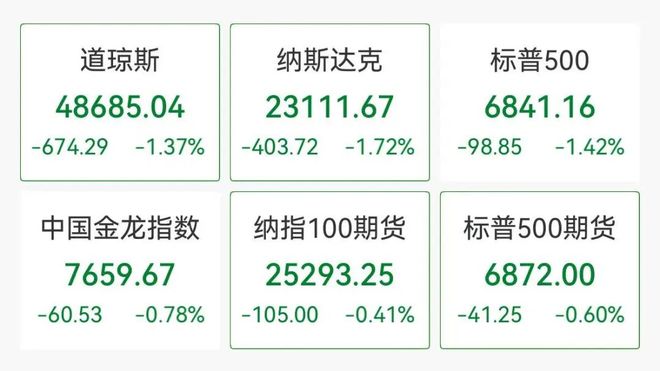
道指跌超670点,英伟达跌超3%,中概股下挫,白银短线跳水
2 1 Shi Ji Jing Ji Bao Dao· 2026-01-20 15:50
Market Overview - The US stock market opened significantly lower, with the Dow Jones down 1.37%, S&P 500 down 1.42%, and Nasdaq down 1.72% [1] - Major European indices also fell, with the Euro Stoxx 50 down 0.92%, FTSE 100 down 1.08%, CAC 40 down 1.15%, DAX 30 down 1.43%, and FTSE MIB down 1.24% [5][6] Technology Sector - Major tech stocks such as Nvidia, Google, Apple, and Tesla experienced declines, with Nvidia dropping over 3% [3] - Intel saw a significant increase of 6% after HSBC raised its target price from $26 to $50 and upgraded its rating from "reduce" to "hold" [3] Semiconductor and Storage Stocks - Micron Technology's stock rose by 5%, reaching a historical high, with at least two brokerages raising its target price [3] - SanDisk's stock surged by 8%, also hitting a historical high, with Citigroup raising its target price from $280 to $490 [3] - Seagate Technology and Western Digital saw stock increases of over 2% and 3%, respectively, both reaching historical highs [3] Gold and Mining Stocks - Gold stocks rose across the board, influenced by new highs in gold prices, with companies like Kinross Gold up 6.8% and Pan American Silver up 4.38% [3] - Analysts predict continued strength in gold prices, with potential for gold to exceed $5,000 per ounce by 2026 [6] Cryptocurrency Market - Major cryptocurrencies experienced declines, with Bitcoin dropping over 2% to below $91,000, and Ethereum down 4.52% [8][9]


美元两连跌 金属涨跌互现 碳酸锂涨停 纽金银沪金续刷新高!
Sou Hu Cai Jing· 2026-01-20 09:48
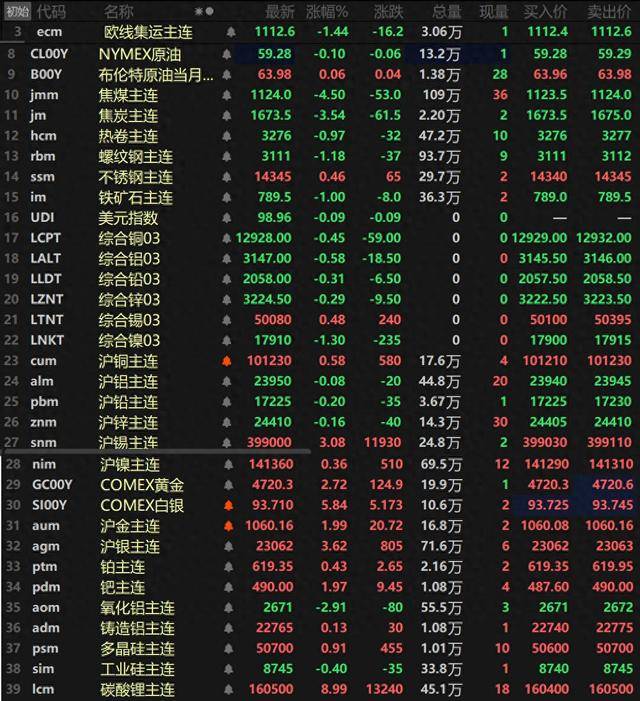
Metal Market - As of the afternoon close, domestic base metals showed mixed performance, with tin leading the gains at 3.08%, followed by copper at 0.58% and nickel at 0.36%. Lead led the declines with a drop of 0.2% [1] - Lithium carbonate futures surged to a limit-up increase of 8.99%, closing at 160,500 yuan/ton. Polysilicon rose by 0.91%, while industrial silicon fell by 0.4% [1] - In the external market, base metals generally declined, with only tin showing a slight increase of 0.48%. Nickel fell by 1.3%, and other metals saw declines within 1% [1] Precious Metals - COMEX gold rose by 2.72%, reaching a new historical high of $4,723.7 per ounce. COMEX silver increased by 5.84%, also hitting a historical high of $94.745 per ounce. Domestic gold rose by 1.99%, reaching a peak of 1,061.16 yuan/gram, marking a new historical high, while silver increased by 3.62% [1][2] Macro Environment - The National Development and Reform Commission emphasized the need to strengthen domestic demand and adapt to the upgrading trend of demand structure. A strategic plan for expanding domestic demand from 2026 to 2030 will be developed [5][6] - The Ministry of Finance announced the expansion of support for equipment renewal loans, including a 1.5% interest subsidy for fixed asset loans related to equipment updates, effective until December 31, 2026 [7] - The central bank conducted a net withdrawal of 346 billion yuan through reverse repos, maintaining the operation rate at 1.40% [8]
综合晨报-20260120
Guo Tou Qi Huo· 2026-01-20 02:42
Group 1: Energy and Metals Crude Oil - In December, domestic industrial crude oil production was 17.8 million tons, a 0.6% year-on-year decline, while processing volume was 62.46 million tons, a 5.0% year-on-year increase. Trump's suspension of military action against Iran led to a partial retreat of geopolitical risk premium. The global crude oil supply-demand structure in Q1 2026 shows significant inventory pressure, and supply surplus remains the main factor suppressing oil prices [1]. Precious Metals - Overnight, precious metals continued to be strong. Fed officials' negative attitude towards short - term interest rate cuts and geopolitical tensions in Iran and the Greenland issue maintain the bullish trend of precious metals [2]. Copper - Overnight, copper prices rebounded. LME US inventory registration and narrowing of the US - London spread affected the market. Domestic copper market is mainly in a "supply exceeds demand" situation, with social inventory reaching 329,400 tons. It is recommended to hold a combination of selling call options with an exercise price of 104,000 and buying put options with an exercise price of 98,000 [3]. Aluminum - Overnight, Shanghai aluminum continued to fluctuate. Social inventories of aluminum ingots and bars increased by 13,000 tons each on Monday, and spot feedback was weak. Shanghai aluminum fluctuates around 24,000 yuan, waiting for a driving factor [4]. Cast Aluminum Alloy - Cast aluminum alloy follows the fluctuation of Shanghai aluminum, with low market activity. Tight scrap aluminum supply and tax adjustments may increase costs in some areas. The seasonal performance of the price difference between cast aluminum alloy and Shanghai aluminum will continue to be weaker than in previous years [5]. Alumina - Domestic alumina operating capacity remains around 95 million tons, with no long - term production cuts. The alumina market is in significant surplus, with the average cash cost in Shanxi and Henan dropping to around 2,600 yuan. Spot prices are under pressure, and it is advisable to participate in short - selling when the basis is low [6]. Zinc - Zinc prices have corrected. Downstream acceptance is limited, and spot trading is weak. The weighted precipitation funds of Shanghai zinc have dropped to 5.1 billion yuan. Considering the import ore TC and downstream pre - holiday stocking demand, the short - term support is seen at 24,000 yuan/ton. The annual high is considered to be 25,600 yuan/ton, and it is advisable to short - sell on rallies [7]. Lead - The import window remains open. Both domestic and foreign markets are in a low - level consolidation due to oversupply. In late January, the resumption of production of domestic primary aluminum smelters is relatively concentrated, increasing supply pressure. The lower support for Shanghai lead is seen at 17,000 yuan/ton [7]. Nickel and Stainless Steel - Shanghai nickel is oscillating at a high level, and the market is active. Stainless steel is in the traditional off - season, with high - level transactions blocked. The negative feedback risk is accumulating. Short - term sentiment is high, and it is advisable to maintain a bullish mindset [8]. Tin - Overnight, domestic and foreign tin prices rebounded. LME tin ingot inventory increased to 6,440 tons, and the spot discount widened to $104. The long - side focuses on factors such as tight ore supply, while the short - side focuses on the reality of restricted demand. It is advisable to hold short - call options at a high level [9]. Lithium Carbonate - Lithium carbonate is weakly oscillating, and the market is active. Downstream acceptance of high prices is weak. The overall inventory reduction speed has slowed down significantly. The futures price is in a high - level oscillation, with high short - term uncertainty [10]. Group 2: Steel and Related Products Rebar and Hot - Rolled Coil - Night - session steel prices mainly oscillated. Rebar apparent demand increased slightly, production decreased slightly, and inventory accumulation slowed down. Hot - rolled coil demand improved, production increased slightly, and inventory continued to decline. Steel prices are expected to oscillate within a range, and it is necessary to pay attention to market trends [11]. Iron Ore - Overnight, the iron ore futures market oscillated, and the basis narrowed recently. Supply is in line with seasonal patterns, with a decline in shipments from Australia and Brazil but an increase in non - mainstream shipments. Domestic arrivals decreased. Demand is affected by potential disruptions to iron - making production. The market is expected to oscillate weakly in the short term [12]. Coke - The daily price mainly oscillated. The first round of coke price increase is expected to be implemented this week. Coke production decreased slightly, and inventory increased slightly. The market is expected to oscillate weakly, affected by factors such as coal inventory and policies [13]. Coking Coal - The daily price mainly oscillated. Mongolian coal customs clearance was 1,465 tons. Coking coal production increased significantly, terminal inventory increased, and total inventory increased slightly. The market is expected to oscillate weakly, affected by inventory and policies [14]. Manganese Silicon - The daily price oscillated downward. There are structural problems in manganese ore port inventory. Iron - making production decreased seasonally, and silicon - manganese production and inventory decreased slightly. It is necessary to pay attention to relevant impacts and cost support [15]. Silicon Iron - The daily price oscillated downward. Affected by policies, the price is relatively strong. There are expectations of a decrease in power and raw material costs. Iron - making production rebounded, and overall demand is still resilient. Supply decreased significantly, and inventory decreased slightly. It is necessary to pay attention to relevant impacts and cost support [16]. Group 3: Shipping and Fuels Container Freight Index (European Line) - The inflection point of spot freight rates has been confirmed, leading the futures market into a weak trend. The near - month contract is affected by the actual "rush - shipping" intensity due to export - tax policy adjustments. The 04 contract may oscillate in the short term, and the far - month contract is suppressed by the resumption - of - shipping expectation. Contract rules will be adjusted [17]. Fuel Oil and Low - Sulfur Fuel Oil - Geopolitical tensions continue to affect the fuel oil market. Geopolitical risks are expected to support the high - sulfur cracking spread, but the supply of high - sulfur heavy - raw materials will tend to be loose in the medium term. The supply of low - sulfur fuel oil is expected to increase, and its weak pattern is expected to continue [18]. Asphalt - Asphalt prices follow crude oil but with limited amplitude. The arrival of Venezuelan crude oil needs to be closely monitored. The market is in an oscillating range [19]. Group 4: Chemicals Urea - Urea production has increased, and downstream demand has also improved. The short - term market may decline slightly, but with the start of agricultural demand, the market is expected to oscillate strongly within a range [20]. Methanol - Methanol prices continued to decline at night. Import arrivals decreased significantly, and port inventory decreased. However, demand from some olefin plants decreased, and the market is expected to oscillate in a stalemate. The expected significant reduction in imports in Q1 provides support [21]. Pure Benzene - Pure benzene prices continued to oscillate strongly at night. Domestic refinery production cuts and reduced imports, along with increased downstream demand, led to a significant reduction in East China port inventory. The short - term market is expected to oscillate strongly [22]. Styrene - Styrene is in a tight - balance state, with limited port arrivals and expected inventory reduction. Domestic production enterprises have good sales, and exports provide some support [23]. Polypropylene, Plastic, and Propylene - The supply of propylene is tight in the short term, but downstream purchasing willingness is limited due to high costs. The demand support for polyethylene is expected to weaken, and the supply - demand fundamentals of polypropylene may lack upward driving force [24]. PVC and Caustic Soda - PVC prices are weakening, with a decline in production capacity utilization. The cost is rising, and it is expected to go through capacity reduction. It is advisable to adopt a low - buying strategy. Caustic soda is operating weakly, with high inventory pressure [25]. PX and PTA - Before and after the Spring Festival, PX has limited upward - driving force, and PTA follows the raw material. In Q2, considering PX maintenance and polyester production increase, there are opportunities for long - term PX processing spreads and positive spreads. PTA processing spreads will moderately recover in the new year [26]. Ethylene Glycol - Domestic new ethylene - glycol plants are put into operation, and overseas plants are shutting down. Supply is expected to increase domestically and decrease overseas. In Q2, there are expectations of concentrated maintenance and demand recovery, but the long - term outlook is under pressure due to capacity growth [27]. Short - Fiber and Bottle Chips - Short - fiber enterprises have high production loads and low inventories. Downstream orders are weak, and prices follow the raw material. Bottle - chip production has decreased, and processing spreads have recovered, but there is long - term capacity pressure [28]. Glass - Glass prices declined due to new ignition plans. The industry is in a state of inventory reduction, but supply may increase slightly. Processing orders are weak, and the market may enter a seasonal inventory - accumulation period. It is advisable to consider long - buying opportunities when the price drops to around 1,000 yuan [29]. 20 - Rubber, Natural Rubber, and Butadiene Rubber - International crude oil prices oscillate, and Thai raw - material prices decline. Natural - rubber supply is decreasing, and demand is gradually recovering. Synthetic - rubber supply is increasing, and inventory trends are different. It is advisable to adopt a wait - and - see strategy [30]. Soda Ash - Soda ash is operating weakly, with high inventory pressure. Production may decline slightly in the short term, but long - term supply pressure is large. It is advisable to short - sell on rallies and wait and see when the price drops to the cost level [31]. Group 5: Agricultural Products Soybeans and Soybean Meal - US soybeans were closed for the Martin Luther King Jr. Day. South American weather has improved, increasing the probability of ENSO neutrality. US soybean exports have strengthened. In China, soybean crushing is expected to increase in January. It is necessary to pay attention to US soybean exports and South American weather [32]. Soybean Oil and Palm Oil - Palm oil export data shows an increase, and production shows a decrease, which is beneficial for inventory reduction. For soybean oil, it is necessary to pay attention to the actual demand for US biodiesel. The overall outlook for soybean and palm oil is an oscillating range [33]. Rapeseed Meal and Rapeseed Oil - China and Canada have reached a preliminary arrangement on trade issues. If the import policy of Canadian rapeseed and rapeseed meal improves as expected before March 1, it is expected to drive purchases. The short - term view on rapeseed products is bearish [34]. Soybean No. 1 - Domestic soybeans are oscillating. Policy - driven auction results have a guiding effect on prices. The supply of grassroots grain sources is tight, and high prices suppress demand. It is necessary to pay attention to policies and the spot market [35]. Corn - Snow in Northeast China boosts the bullish sentiment, and transportation of grassroots grain is difficult. Corn prices in Northeast China and northern ports are strong. However, increased auctions by state and local reserves may form pressure. Dalian corn futures are expected to oscillate weakly in the short term [36]. Live Pigs - On Monday, the sentiment of live - pig futures changed significantly. After a weekend increase in prices, the futures prices dropped in the afternoon. The short - term rebound may be over. The industry capacity is showing signs of contraction, and pig prices are expected to reach a low point in the first half of next year [37]. Eggs - After the New Year's Day, egg spot prices have been strengthening. The futures prices have followed the spot, but on Monday, the futures prices dropped significantly. In the long - term, the inventory of laying hens is expected to decline, and it is advisable to adopt a long - buying strategy on dips [38]. Cotton - Zhengzhou cotton prices continued to correct. After the previous rise, the positive factors have been mostly reflected. Downstream demand is average, and the reduction in Xinjiang's planting area needs further observation. It is advisable to adopt a wait - and - see strategy [39]. Sugar - Overnight, US sugar prices oscillated. India's sugar production is progressing rapidly, while Thailand's is slow. In China, the market focus is on the expected difference in production. Guangxi's production is slow, but there is a strong expectation of an increase in the 2025/26 season, and the rebound of Zhengzhou sugar is expected to be limited [40]. Apples - Futures prices have corrected. Spot market transactions for the Spring Festival are increasing, but the quality of apples is poor, and the high purchase price and strong reluctance to sell may affect inventory reduction. It is necessary to pay attention to future demand [41]. Wood - Futures prices are at a low level. Supply is expected to decrease in the short term, and demand has increased compared to the same period last year. Low inventory provides some support, and it is advisable to adopt a wait - and - see strategy [42]. Pulp - Pulp futures prices were basically flat. The short - term fundamentals are average due to weak downstream demand. Inventory is accumulating, and the price difference between softwood and hardwood pulp is narrowing. Paper mills purchase pulp for immediate needs. It is advisable to adopt a wait - and - see strategy [43]. Group 6: Financial Products Stock Index - Yesterday, China's A - share indices had mixed performance, and futures indices mostly rose. The geopolitical situation has increased the risk - aversion sentiment. The stock - index trend is expected to change from a one - way increase to an oscillatingly strong trend, with a slower upward slope. It is necessary to pay attention to the transition from liquidity - driven to profit - driven and geopolitical impacts [44]. Treasury Bonds - On January 19, 2026, 30 - year treasury - bond futures led the decline. The first structural "interest - rate cut" of the year was implemented. The central bank adjusted the minimum down - payment ratio for commercial - housing loans and carried out reverse - repurchase operations. The money market is gradually becoming loose, but the short - term downward space for interest rates may be limited during the tax - payment period [45].
《能源化工》日报-20260120
Guang Fa Qi Huo· 2026-01-20 02:41
1. Report Industry Investment Ratings - No industry investment ratings are provided in the reports. 2. Core Views of the Reports Polyolefin Industry - Overall, the polyolefin industry is pressured by supply and seasonal demand, but the upside space may be limited due to cost support and profit compression. Attention should be paid to the substantial changes in the demand side. For PE, the HD - LLDPE spread is narrowing, and the marginal supply of the standard product (LLDPE) is expected to increase, while the demand is in the seasonal off - season. For PP, the supply - demand is weak, but the balance has improved significantly, and attention should be paid to the implementation of future maintenance plans [1]. Methanol Industry - Methanol futures are oscillating weakly. The inland supply remains high, and the traditional demand is weak, with short - term pressure. Although the port inventory has decreased slightly, the MTO demand is weak, suppressing the price rebound. The key variables are the reduction rhythm of imported resources and the process of the risk premium fading caused by geopolitical factors [2]. Rubber Industry - Overseas raw material prices for natural rubber continue to decline, weakening the bottom support. The demand has increased slightly in some semi - steel tire foreign trade orders, and the inventory in China continues to accumulate. Considering that Thailand is about to enter the production - reduction period, the decline of raw materials is expected to be limited, and the rubber price is expected to be in the range of 15,500 - 16,500 [3]. Pure Benzene and Styrene Industry - The supply - demand of pure benzene has improved marginally, but the port inventory is still high. Styrene is strong due to export and device accidents, and the spread between styrene and pure benzene has widened. Strategies include looking for short - selling opportunities for BZ03 and narrowing the EB - BZ spread at high levels. Styrene may face inventory accumulation during the Spring Festival, and its upside space is limited [4]. PVC and Caustic Soda Industry - Caustic soda futures are weakly oscillating. The supply has increased slightly, and the demand lacks substantial improvement, so the price is expected to be weak. PVC futures are oscillating downwards. The supply is high, the demand is affected by the festival, and the inventory continues to accumulate, so the price is expected to be weak with limited downside space [5]. Urea Industry - Urea futures have declined, and the supply is at a high level. The demand is weak, and the price is expected to be weakly oscillating in the short term. Attention should be paid to the progress of downstream agricultural demand and the resumption rhythm of devices [6]. Glass and Soda Ash Industry - Soda ash futures are expected to be weakly oscillating in the short term due to high supply and weak demand, and the inventory is at a high level. Glass futures are affected by real - estate data, and the supply - demand is weak in the off - season. The price is expected to follow the decline of the futures price [7]. Crude Oil Industry - Short - term oil prices are still affected by news, and the supply - demand expectation is weak. Brent crude oil is expected to oscillate between 60 - 66 US dollars per barrel. Attention should be paid to the geopolitical conflicts in the Middle East [8]. LPG Industry - LPG futures prices have declined. The inventory has decreased, and the downstream PDH operating rate has decreased. The overall market is affected by supply and demand [11]. Polyester Industry - PX supply is at a high level, and demand is weak. It is expected to be high - level oscillating before the Spring Festival and low - level long - term treated in the medium term. PTA supply - demand is expected to weaken, and it is expected to follow the raw materials. MEG is expected to accumulate a large amount of inventory, and the price is under pressure. Short - fiber is weakly oscillating following the raw materials. Polyester bottle - chip supply is expected to decline, and it follows the cost [13]. 3. Summaries According to Related Catalogs Polyolefin Industry - **Futures Prices**: The closing prices of L2605, L2609, PP2605, and PP2609 have all declined to varying degrees [1]. - **Spreads**: The L59 spread has decreased, the PP59 spread has increased, and the LP05 spread has decreased [1]. - **Spot Prices**: The spot prices of华东PP拉丝,华北LLDPE, and other products have declined [1]. - **Operating Rates**: The PE device operating rate and downstream weighted operating rate have decreased, while the PP device operating rate has increased slightly, and the PP powder operating rate has decreased [1]. - **Inventory**: The PE and PP enterprise and social inventories have decreased [1]. Methanol Industry - **Futures Prices**: The closing prices of MA2605 and MA2609 have declined [2]. - **Spreads**: The MA59 spread has increased significantly [2]. - **Spot Prices**: The spot prices of methanol in various regions have declined [2]. - **Inventory**: The methanol enterprise inventory has increased slightly, while the port and social inventories have decreased [2]. - **Operating Rates**: The upstream domestic and overseas enterprise operating rates have decreased slightly, and the downstream MTO and other operating rates have changed to varying degrees [2]. Rubber Industry - **Spot Prices and Basis**: The spot prices of natural rubber products such as云南国营全乳胶 and泰标混合 rubber have declined, and the basis has changed [3]. - **Monthly Spreads**: The 9 - 1 and 5 - 9 spreads have changed [3]. - **Fundamental Data**: The production in Thailand, Indonesia, etc. has changed, and the operating rates of automobile tires and the production and export of domestic tires have increased [3]. - **Inventory**: The inventory in China has continued to accumulate [3]. Pure Benzene and Styrene Industry - **Upstream Prices and Spreads**: The prices of Brent crude oil and other products have changed, and the spreads between pure benzene and other products have also changed [4]. - **Benzene and Styrene Prices and Spreads**: The prices of benzene and styrene have increased, and the spreads between them have changed [4]. - **Downstream Cash Flows**: The cash flows of downstream products such as phenol and caprolactam have changed [4]. - **Inventory**: The inventories of pure benzene and styrene in Jiangsu ports have decreased [4]. - **Operating Rates**: The operating rates of various industries in the pure benzene and styrene industry chain have changed [4]. PVC and Caustic Soda Industry - **PVC and Caustic Soda Prices**: The prices of PVC and caustic soda products have changed to varying degrees [5]. - **Overseas Quotes and Export Profits**: The overseas quotes and export profits of PVC and caustic soda have changed [5]. - **Supply**: The operating rates of the caustic soda and PVC industries have increased slightly, and the profits have changed [5]. - **Demand**: The operating rates of the downstream industries of caustic soda and PVC have changed [5]. - **Inventory**: The inventories of caustic soda and PVC have changed [5]. Urea Industry - **Futures Prices and Positions**: The futures prices of urea have declined, and the positions of the top 20 long and short have changed [6]. - **Raw Material and Spot Prices**: The prices of upstream raw materials and urea spot have changed [6]. - **Spreads and Basis**: The spreads and basis of urea have changed [6]. - **Downstream Products**: The prices of downstream products such as melamine and compound fertilizer have changed [6]. - **Supply - Demand**: The daily and weekly production, inventory, and operating rate of urea have changed [6]. Glass and Soda Ash Industry - **Prices and Spreads**: The prices of glass and soda ash products and their spreads have changed [7]. - **Supply - Demand**: The operating rates, production, and inventory of glass and soda ash have changed [7]. Crude Oil Industry - **Crude Oil Prices and Spreads**: The prices of Brent, WTI, and SC crude oil and their spreads have changed [8]. - **Refined Oil Prices and Spreads**: The prices and spreads of refined oil products have changed [8]. - **Refined Oil Crack Spreads**: The crack spreads of refined oil products have changed [8]. LPG Industry - **LPG Prices and Spreads**: The prices of LPG futures and spot have declined, and the spreads have changed [11]. - **External Prices**: The external prices of LPG have declined slightly [11]. - **Inventory**: The LPG inventory has decreased [11]. - **Operating Rates**: The upstream and downstream operating rates of LPG have changed [11]. Polyester Industry - **Downstream Polyester Product Prices and Cash Flows**: The prices and cash flows of downstream polyester products have changed [13]. - **PX - Related Prices and Spreads**: The prices and spreads of PX have changed [13]. - **PTA - Related Prices and Spreads**: The prices and spreads of PTA have changed [13]. - **MEG - Related Prices and Spreads**: The prices and spreads of MEG have changed [13]. - **Operating Rates**: The operating rates of various industries in the polyester industry chain have changed [13].
建信期货原油日报-20260120
Jian Xin Qi Huo· 2026-01-20 02:18
Report Information - Report Title: Crude Oil Daily [1] - Date: January 20, 2026 [2] - Research Team: Energy and Chemical Research Team [4] - Researchers: Li Jie (Crude Oil and Asphalt), Ren Junchi (PTA, MEG), Peng Jinglin (Polyolefins), Liu Youran (Pulp), Feng Zeren (Glass and Soda Ash) [4] 1. Report Industry Investment Rating - Not provided in the content 2. Core Viewpoints - The US is accelerating the takeover of Venezuela's oil industry and has started selling the first batch of Venezuelan oil, which is marginally bearish for the supply side. Venezuela is likely to achieve a daily output increase of 100,000 barrels this year. The situation in Iran has cooled down, but the US still retains the option to strike. Geopolitical conflicts that do not substantially affect crude oil production and exports will be good selling points. It is expected that short - term oil prices will follow the Middle East situation, and it is advisable to be cautious about chasing up [6]. 3. Summary by Directory 3.1 Market Review and Operation Suggestions - **Market Review**: WTI's opening price was $59.17, closing at $59.22, with a high of $60.05, a low of $58.81, a daily increase of 0.24%, and a trading volume of 27.18 million hands. Brent's opening price was $63.74, closing at $64.20, with a high of $64.77, a low of $63.44, a daily increase of 0.69%, and a trading volume of 31.52 million hands. SC's opening price was 443.2 yuan/barrel, closing at 437.4 yuan/barrel, with a high of 446.4 yuan/barrel, a low of 436.7 yuan/barrel, a daily decrease of 0.52%, and a trading volume of 7.79 million hands [6]. - **Operation Suggestions**: It is expected that short - term oil prices will follow the Middle East situation, and it is advisable to be cautious about chasing up [6]. 3.2 Industry News - Russia's seaborne oil product exports in December increased by 17% compared to November. Angola's crude oil exports in March are expected to be 1.09 million barrels per day. Iran's Supreme Leader Khamenei stated that Iran will not drag the country into war but will not let criminals at home and abroad go unpunished, and those associated with Israel and the US caused large - scale damage and thousands of deaths in the protests [7]. 3.3 Data Overview - The report provides multiple data charts, including global high - frequency crude oil inventory, EIA crude oil inventory, US crude oil production growth rate, Dtd Brent price, WTI spot price, Oman spot price, US gasoline consumption, and US diesel consumption, with data sources from Bloomberg, EIA, and Wind [9][13][20][22]
光大期货:1月20日能源化工日报
Xin Lang Cai Jing· 2026-01-20 02:11
Oil Market - WTI prices were not available due to the Martin Luther King Jr. Day holiday, while Brent crude for March closed at $63.94 per barrel, down $0.19, a decrease of 0.30% [2][15] - Domestic crude oil production in China for 2025 is projected to be 21,605 million tons, a year-on-year increase of 1.5%, with processing volume at 73,759 million tons, up 4.1% [2][15] - The market is currently experiencing a seasonal decline in diesel and gasoline demand, with oil prices showing no significant driving force, maintaining a volatile trend [2][15] Fuel Oil - The main contract for fuel oil (FU2603) rose by 0.12% to 2,538 yuan per ton, while low-sulfur fuel oil (LU2603) increased by 0.07% to 3,060 yuan per ton [16] - Supply of low-sulfur fuel oil is expected to be sufficient, with Singapore receiving approximately 290-300 million tons in January, up from 260-270 million tons in December [16] - The geopolitical situation in Iran continues to significantly impact oil prices, with fluctuations expected to follow oil price movements [16][4] Asphalt - The main contract for asphalt (BU2602) increased by 0.29% to 3,142 yuan per ton, with concerns over raw material supply easing slightly [17] - The market is currently facing a "weak demand reality" against a backdrop of "strong cost expectations," particularly as winter weather impacts demand [17] Rubber - The main contract for rubber (RU2605) fell by 90 yuan per ton to 15,745 yuan per ton, with NR and BR contracts also experiencing declines [18] - China's rubber tire exports for 2025 are expected to reach 9.65 million tons, a year-on-year increase of 3.6% [18] - Inventory levels for natural rubber in Qingdao increased, indicating a seasonal accumulation trend [18] PX, PTA, and MEG - TA605 closed at 5,030 yuan per ton, up 0.24%, while EG2605 fell by 1.08% to 3,755 yuan per ton [19] - PX futures closed at 7,106 yuan per ton, with a slight increase of 0.28%, and the market is expected to see some support due to supply reductions [19] Methanol - Methanol prices in Taicang were reported at 2,207 yuan per ton, with CFR China prices ranging from $262 to $266 per ton [21] - Domestic supply remains stable, but demand is under pressure due to reduced operating rates in MTO facilities [21] Polyolefins - Polypropylene prices are under pressure, with production margins for various methods showing negative values [22] - Demand is expected to recover slightly in early January, but inventory levels are anticipated to rise as the month progresses [22] PVC - PVC prices have decreased, with the market experiencing a supply-demand imbalance and overall bearish sentiment [23] - The upcoming end of export tax rebates is expected to increase upward pressure on long-term contracts [23] Urea - Urea futures prices are experiencing weak fluctuations, with the main contract closing at 1,772 yuan per ton, down 1.45% [24] - Market sentiment is declining, with production rates and demand showing signs of weakness ahead of the Spring Festival [24] Soda Ash - Soda ash futures prices are fluctuating, with the main contract closing at 1,192 yuan per ton, down 0.33% [25] - The industry is facing pressure from supply and demand dynamics, with cautious sentiment prevailing in the market [25] Glass - Glass futures prices fell significantly, with the main contract closing at 1,070 yuan per ton, down 2.9% [26] - The market is experiencing a supply recovery, but demand remains cautious, leading to a bearish outlook [26]

贵金属早报-20260120
Yong An Qi Huo· 2026-01-20 02:06
Price Performance - London Gold's latest price is 4666.85, with a change of 55.80 [1] - London Silver's latest price is 93.01, with a change of 2.21 [1] - London Platinum's latest price is 2301.00, with a change of -85.00 [1] - London Palladium's latest price is 1755.00, with a change of -51.00 [1] - WTI Crude's latest price is 59.44, with no change [1] - LME Copper's latest price is 12891.50, with a change of 43.00 [1] - The latest value of the US Dollar Index is 99.04, with a change of -0.33 [1] - The latest exchange rate of Euro to US Dollar is 1.16, with no change [1] - The latest exchange rate of British Pound to US Dollar is 1.34, with no change [1] - The latest exchange rate of US Dollar to Japanese Yen is 158.13, with a change of 0.06 [1] - The latest yield of US 10 - year TIPS is 1.91, with no change [1] Trading Data - COMEX Silver inventory is 13348.26, with no change [1][11] - SHFE Silver inventory is 617.76, with a change of -9.08 [1][11] - Gold ETF持仓 is 1085.67, with no change [1][11] - Silver ETF持仓 is 16073.06, with no change [1][11] - SGE Silver inventory is 773.63, with no change [1][11] - SGE Gold deferred fee payment direction is 1 [1] - SGE Silver deferred fee payment direction is 2 [1]
能源化工日报-20260120
Wu Kuang Qi Huo· 2026-01-20 01:11
1. Report's Industry Investment Rating - No information provided regarding the report's industry investment rating 2. Core Views of the Report - The geopolitical situation in Latin America and the Middle East does not strongly support overall oil prices, but the valuation of heavy - oil products will rise significantly. The valuation of heavy - oil products is upgraded to overweight, and the crack spreads of asphalt or fuel oil may have upward momentum [2] - The current methanol valuation is low, and its outlook for the next year will improve marginally, with limited downside space. Despite short - term negative pressure, the recent geopolitical instability in Iran has created certain geopolitical expectations, making it feasible to buy on dips [4] - The current domestic - foreign price difference of urea has opened the import window. Coupled with the expected increase in production at the end of January, negative fundamental expectations for urea are approaching, so it is advisable to take profits on rallies [7] - Rubber is in a seasonally weak period. Currently, a bearish mindset is adopted. If RU2605 falls below 16,000, a short - term bearish strategy will be adopted. It is recommended to partially build a position by buying the main contract of NR and shorting RU2609 [12] - The fundamentals of PVC are poor. Although short - term electricity price expectations and pre - export rush support PVC, in the medium term, the strategy of shorting on rallies is still the main approach until there is a substantial reduction in industry production [14] - The current non - integrated profit of styrene is moderately low, with significant upward valuation repair space. It is advisable to go long on the non - integrated profit of styrene before the first quarter [17] - For polyethylene, the long - term contradiction has shifted from cost - driven downward trends to production - mismatch issues. It is advisable to go long on the LL5 - 9 spread on dips [20] - For polypropylene, in the context of weak supply and demand, the overall inventory pressure is high. The futures price is expected to bottom out when the oversupply situation changes in the first quarter of next year [23] - For PX, it is expected to maintain an inventory - accumulation pattern before the maintenance season, but there are medium - term opportunities to go long following the trend of crude oil on dips [26] - PTA is expected to enter the Spring Festival inventory - accumulation period. There are medium - term opportunities to go long on dips, and the rhythm should be grasped [29] - For ethylene glycol, the supply - demand pattern needs greater production cuts to improve. In the medium term, if there are no further domestic production cuts, the valuation is expected to be compressed [31] 3. Summary by Related Catalogs 3.1 Crude Oil - INE's main crude oil futures closed down 2.30 yuan/barrel, a decline of 0.52%, at 437.40 yuan/barrel. High - sulfur fuel oil in related refined oil products rose 3.00 yuan/ton, a gain of 0.12%, at 2538.00 yuan/ton; low - sulfur fuel oil rose 2.00 yuan/ton, a gain of 0.07%, at 3060.00 yuan/ton [1] - European ARA weekly data showed that gasoline inventory increased by 1.12 million barrels to 11.72 million barrels, a 10.56% increase; diesel inventory increased by 0.16 million barrels to 14.99 million barrels, a 1.06% increase; fuel oil inventory decreased by 0.08 million barrels to 6.74 million barrels, a 1.12% decrease; naphtha inventory increased by 0.95 million barrels to 6.19 million barrels, an 18.21% increase; aviation kerosene inventory decreased by 0.06 million barrels to 7.62 million barrels, a 0.72% decrease; the total refined oil inventory increased by 2.10 million barrels to 47.25 million barrels, a 4.65% increase [1] 3.2 Polyester - Regional spot prices: Jiangsu changed by - 17 yuan/ton, southern Shandong by - 10 yuan/ton, Henan by 0 yuan/ton, Hebei by 0 yuan/ton, and Inner Mongolia by 0 yuan/ton [3] - The main futures contract changed by 36.00 yuan/ton, closing at 2212 yuan/ton, and MTO profit changed by 73 yuan [3] 3.3 Urea - Regional spot prices: Shandong changed by 10 yuan/ton, Henan by 0 yuan/ton, Hebei by 0 yuan/ton, Hubei by 0 yuan/ton, Jiangsu by 0 yuan/ton, Shanxi by 10 yuan/ton, and Northeast China by 0 yuan/ton. The overall basis was reported at - 22 yuan/ton [6] - The main futures contract changed by - 19 yuan/ton, closing at 1772 yuan/ton [6] 3.4 Rubber - Rubber prices fluctuated weakly, with a technical bearish outlook. Bulls cited seasonal expectations and improved demand expectations, while bears pointed to uncertain macro - expectations, increased supply, and seasonal weak demand [9] - As of January 15, 2026, the operating rate of all - steel tires of Shandong tire enterprises was 62.84%, 2.30 percentage points higher than the previous week and 2.78 percentage points higher than the same period last year. The inventory of all - steel tires was under pressure, and it was in the pre - Spring Festival inventory production stage. The operating rate of semi - steel tires of domestic tire enterprises was 74.35%, 6.35 percentage points higher than the previous week and 4.09 percentage points lower than the same period last year [10] - As of January 11, 2026, China's total social inventory of natural rubber was 1.256 million tons, a 1.9% increase from the previous month. Among them, the inventory of dark - colored rubber increased by 2.5% to 835,000 tons, the inventory of light - colored rubber increased by 0.8% to 421,000 tons, and the inventory of natural rubber in Qingdao was 563,900 (+19,600) tons [10] - In the spot market, Thai standard mixed rubber was at 15,000 (- 100) yuan, STR20 was reported at 1880 (- 20) US dollars, STR20 mixed was at 1885 (- 20) US dollars, butadiene in Jiangsu and Zhejiang was at 9500 (- 50) yuan, and cis - polybutadiene in North China was at 11300 (- 200) yuan [11] 3.5 PVC - The PVC05 contract fell 2 yuan, closing at 4801 yuan. The spot price of Changzhou SG - 5 was 4560 (- 20) yuan/ton, the basis was - 241 (- 18) yuan/ton, and the 5 - 9 spread was - 115 (+5) yuan/ton [13] - In terms of cost, the price of calcium carbide in Wuhai was reported at 2500 (+100) yuan/ton, the price of medium - grade semi - coke was 820 (0) yuan/ton, ethylene was 710 (- 20) US dollars/ton, and the spot price of caustic soda was 635 (- 23) yuan/ton [13] - The overall operating rate of PVC was 79.6%, unchanged from the previous period. Among them, the calcium - carbide method was 80%, a 0.3% increase, and the ethylene method was 78.8%, a 0.8% decrease. The overall downstream operating rate was 43.9%, a 0.1% decrease. The in - factory inventory was 311,000 (- 17,000) tons, and the social inventory was 1.144 million (+30,000) tons [13] 3.6 Pure Benzene & Styrene - In terms of fundamentals, the cost of East China pure benzene was 5640 yuan/ton, an increase of 115 yuan/ton; the closing price of the active pure - benzene contract was 5827 yuan/ton, an increase of 115 yuan/ton; the pure - benzene basis was - 187 yuan/ton, a decrease of 56 yuan/ton; the spot price of styrene was 7250 yuan/ton, unchanged; the closing price of the active styrene contract was 7295 yuan/ton, an increase of 117 yuan/ton; the basis was - 45 yuan/ton, a weakening of 117 yuan/ton; the BZN spread was 157.5 yuan/ton, an increase of 12.75 yuan/ton; the profit of non - integrated EB plants was 38.4 yuan/ton, an increase of 0.15 yuan/ton; the EB consecutive 1 - consecutive 2 spread was 69 yuan/ton, a decrease of 19 yuan/ton [16] - On the supply side, the upstream operating rate was 70.86%, a 0.06% decrease; the inventory at Jiangsu ports decreased by 31,700 tons to 100,600 tons [16] - On the demand side, the weighted operating rate of three S products was 41.91%, a 1.02% increase; the PS operating rate was 57.40%, a 1.50% decrease, the EPS operating rate was 54.05%, a 7.34% increase, and the ABS operating rate was 69.80%, unchanged [16] 3.7 Polyethylene - Fundamentals showed that the closing price of the main contract was 6667 yuan/ton, a decrease of 28 yuan/ton, the spot price was 6775 yuan/ton, unchanged, the basis was 108 yuan/ton, a strengthening of 28 yuan/ton [19] - The upstream operating rate was 81.56%, a 1.23% increase. In terms of weekly inventory, the inventory of production enterprises decreased by 45,100 tons to 350,300 tons, and the inventory of traders was 29,200 tons, unchanged. The average downstream operating rate was 41.1%, a 0.11% decrease. The LL5 - 9 spread was - 24 yuan/ton, a 4 - yuan expansion [19] 3.8 Polypropylene - Fundamentals showed that the closing price of the main contract was 6482 yuan/ton, a decrease of 14 yuan/ton, the spot price was 6565 yuan/ton, unchanged, the basis was 83 yuan/ton, a strengthening of 14 yuan/ton [21] - The upstream operating rate was 76.61%, a 0.01% decrease. In terms of weekly inventory, the inventory of production enterprises decreased by 36,700 tons to 431,000 tons, the inventory of traders decreased by 10,800 tons to 193,900 tons, and the port inventory decreased by 500 tons to 70,600 tons [21] - The average downstream operating rate was 52.58%, a 0.02% decrease. The LL - PP spread was 185 yuan/ton, a 14 - yuan narrowing [22] 3.9 PX - The PX03 contract rose 20 yuan, closing at 7106 yuan. The PX CFR remained unchanged at 879 US dollars. The basis was - 9 yuan (- 25) after conversion according to the central parity of the RMB, and the 3 - 5 spread was - 44 yuan (+2) [25] - In terms of PX load, China's load was 89.4%, a 1.5% decrease; Asia's load was 80.6%, a 0.6% decrease. Domestically, Zhejiang Petrochemical reduced its load, while overseas, Thailand's PTTG and Israel's Gadiv plants restarted [25] - The PTA load was 76.9%, a 1.3% decrease. Dushan Energy's plant increased its load, while Yisheng New Materials' plant shut down. In terms of imports, South Korea exported 146,000 tons of PX to China in the first ten days of January, a year - on - year increase of 7000 tons [25] - In terms of inventory, the inventory at the end of November was 4.46 million tons, a 60,000 - ton increase from the previous month. In terms of valuation and cost, PXN was 331 US dollars (+6), South Korea's PX - MX was 142 US dollars (0), and the naphtha crack spread was 78 US dollars (- 10) [25] 3.10 PTA - The PTA05 contract rose 12 yuan, closing at 5030 yuan. The East China spot price rose 10 yuan, closing at 4970 yuan. The basis was - 63 yuan (+4), and the 5 - 9 spread was 42 yuan (- 2) [28] - The PTA load was 76.9%, a 1.3% decrease. Dushan Energy's plant increased its load, while Yisheng New Materials' plant shut down. The downstream load was 88.1%, a 2.7% decrease. Hengyi's 250,000 - ton filament, China Resources' 1.2 - million - ton bottle chip, Shenghong's 250,000 - ton filament, Hanjiang's 300,000 - ton bottle chip, and Quandi's 250,000 - ton filament were under maintenance, Wankai's 200,000 - ton bottle chip reduced its load, and a large factory's 350,000 - ton bottle chip restarted [28] - The terminal texturing load decreased by 2% to 70%, and the weaving load decreased by 1% to 55%. In terms of inventory, the social inventory (excluding credit warehouse receipts) on January 9 was 2.005 million tons, a 25,000 - ton decrease. In terms of valuation and cost, the PTA spot processing fee rose 11 yuan to 314 yuan, and the on - paper processing fee fell 2 yuan to 368 yuan [28] 3.11 Ethylene Glycol - The EG05 contract fell 41 yuan, closing at 3755 yuan. The East China spot price fell 28 yuan, closing at 3637 yuan. The basis was - 121 yuan (+11), and the 5 - 9 spread was - 108 yuan (- 4) [30] - On the supply side, the ethylene glycol load was 74.4%, a 0.3% increase. Among them, the synthetic - gas - to - ethylene - glycol load was 80.2%, a 0.9% increase; the ethylene - to - ethylene - glycol load was 71.2%, a 0.1% decrease. Tianye reduced its load in the synthetic - gas - to - ethylene - glycol segment; Chengdu Petrochemical shut down in the oil - chemical segment; overseas, a Kuwaiti plant shut down, and the US Sasol reduced its load [30] - The downstream load was 88.1%, a 2.7% decrease. Hengyi's 250,000 - ton filament, China Resources' 1.2 - million - ton bottle chip, Shenghong's 250,000 - ton filament, Hanjiang's 300,000 - ton bottle chip, and Quandi's 250,000 - ton filament were under maintenance, Wankai's 200,000 - ton bottle chip reduced its load, and a large factory's 350,000 - ton bottle chip restarted. The terminal texturing load decreased by 2% to 70%, and the weaving load decreased by 1% to 55% [30] - The import arrival forecast was 148,000 tons, and the East China departure volume from January 16 - 18 was 12,600 tons. The port inventory was 795,000 tons, a 7000 - ton decrease. In terms of valuation and cost, the profit of naphtha - to - ethylene - glycol was - 904 yuan, the profit of domestic ethylene - to - ethylene - glycol was - 771 yuan, and the profit of coal - to - ethylene - glycol was - 5 yuan. The cost of ethylene fell to 710 US dollars, and the price of Yulin pit - mouth bituminous coal fines rose to 600 yuan [30]