公共事业

Search documents
红利国企ETF(510720)上一交易日资金净流入1.6亿,市场关注稳定型红利资产防御属性
Sou Hu Cai Jing· 2025-08-01 02:31
Group 1 - The core viewpoint emphasizes the importance of high dividend stocks in a rising uncertainty environment, suggesting a focus on stable dividend assets due to their defensive characteristics and ability to provide stable cash flow returns in a low-growth environment [1] - The Hongli State-owned Enterprise ETF (510720) experienced a net inflow of 160 million, indicating investor interest in dividend-paying stocks [1] - The Hongli State-owned Enterprise ETF tracks the Shangguo Dividend Index (000151), which selects stocks with high dividend characteristics, focusing on stability and sustained profitability across various industries, particularly in traditional sectors like finance and industry [1] Group 2 - The report suggests that stable dividend varieties, such as banks and public utilities, are preferable to cyclical dividend varieties due to the current global demand and domestic "real estate + infrastructure" upturn not yet being realized [1] - Investors without stock accounts are advised to consider the Guotai Shanghai Stock Exchange State-owned Enterprise Dividend ETF Initiation Link A (021701) and Link C (021702) as alternatives [1]
关注军工与银行的配置价值
2025-07-16 06:13
Summary of Conference Call Notes Industry or Company Involved - The discussion primarily revolves around the impact of geopolitical conflicts on the A-share market and sector rotation strategies. Core Points and Arguments 1. **Geopolitical Conflicts and Market Dynamics** The analysis focuses on how geopolitical events, such as the Russia-Ukraine conflict and the India-Pakistan tensions, influence sector performance in the A-share market. The report aims to fill a gap in existing research on this topic [2][5][6]. 2. **Sector Rotation Strategy** The importance of sector rotation is emphasized, suggesting that investors should adapt their strategies based on market conditions and geopolitical events. The report advocates for a shift towards growth-oriented assets during favorable conditions [1][2]. 3. **Historical Data Analysis** The report analyzes 12 significant geopolitical conflicts since the new century, primarily in the Middle East, to identify patterns in excess returns across different sectors before, during, and after these events [3][4][6]. 4. **Impact of Conflicts on A-share Performance** The analysis indicates that prior to conflicts, there is a rise in risk aversion, affecting sectors differently. Defensive sectors like steel and utilities may benefit, while consumer sectors tend to suffer [7][9]. 5. **Market Volatility During Conflicts** The report finds that, except for the 2008 financial crisis, A-share volatility remains relatively stable in the lead-up to geopolitical conflicts, suggesting that markets may not react as dramatically as feared [8][9]. 6. **Sector-Specific Responses to Conflicts** - **Military and Energy Sectors**: These sectors are expected to see increased demand and orders due to heightened geopolitical risks [8][10]. - **Consumer Sectors**: These are likely to be negatively impacted due to increased uncertainty and risk aversion [9][10]. - **Technology and Growth Stocks**: These sectors may experience significant pressure during conflicts but could recover as tensions ease [11][14]. 7. **Post-Conflict Economic Recovery** After conflicts, there is an anticipated shift towards economic recovery, benefiting sectors like banking and consumer goods. The report suggests that banks will see improved lending conditions and asset quality as economic activity resumes [16][17]. 8. **Long-Term Investment Outlook** The report identifies military, technology, and healthcare sectors as long-term growth opportunities, while also highlighting the cyclical nature of energy and consumer sectors [25][26]. Other Important but Possibly Overlooked Content 1. **Behavioral Finance Insights** The report draws parallels with behavioral finance, suggesting that historical patterns can inform future investment strategies during geopolitical tensions [2][3]. 2. **Global Context** The analysis also references historical conflicts, such as World War II and the Cold War, to provide context for current market behaviors and sector performances [19][20][21]. 3. **Future Geopolitical Risks** The report warns that ongoing geopolitical tensions, particularly in regions like India-Pakistan and the Middle East, may continue to influence market dynamics and investment strategies [28]. 4. **Investment Strategy Recommendations** The report concludes with recommendations for investors to consider sector rotation based on the phases of geopolitical conflicts, advocating for a proactive approach to asset allocation [27][28].
投资策略周报:箱体震荡的突破契机,及当下的配置思路-20250621
KAIYUAN SECURITIES· 2025-06-21 13:57
Group 1 - The report highlights that the A-share market has been experiencing narrow fluctuations within the range of 3300-3400 for nearly two months, with low volatility in broad-based indices. The DDM framework indicates that while profits are still bottoming out, valuation support is provided by government measures to maintain wide credit [2][10][11] - The report emphasizes that there has been no overall strong style or rapid rotation in the market this year, with leading sectors being diverse, including consumption, growth, finance, and cyclical industries. This is attributed to three main factors: ongoing profit declines, the presence of both strengths and weaknesses in each style, and persistent uncertainties from overseas [3][20][23] - The current investment strategy suggests a focus on more granular sectors within major categories to avoid over-concentration. Key areas of interest include Delta G consumption, self-controlled technology, stable dividends, and gold as long-term strategic assets [4][26][28] Group 2 - The report outlines specific investment themes, such as Delta G consumption focusing on apparel, automobiles, retail, personal care, food, beverages, and new retail. The emphasis is on the marginal changes in profit growth rather than absolute values [4][26][27] - In technology, the focus is on self-controlled sectors and military applications, including AI, robotics, semiconductors, and military technology. The investment approach requires sensitivity to catalysts and a focus on domestic replacements [4][27] - The report identifies gold as a strategic asset benefiting from global uncertainties and suggests that the beginning of the third quarter will be an optimal time for gold allocation due to several converging factors, including the maturity of US debt and expectations of US interest rate cuts [4][28][29]
沪指突破3400点!中证A500ETF(159338)涨近1%,行业均衡、龙头荟萃,攻守兼备
Mei Ri Jing Ji Xin Wen· 2025-06-11 05:32
Core Viewpoint - The A-shares market experienced a rebound, with the Shanghai Composite Index surpassing 3400 points, and the CSI A500 ETF (159338) rising nearly 1% during active trading [1] Group 1: Index Overview - The CSI A500 Index is constructed using an internationally recognized "industry balanced" approach and is referred to as the "top class" of the A-share market, akin to a domestic "S&P 500" [1] - It selects 500 securities with large market capitalization and good liquidity from various industries, representing the core assets of the A-share market [1] - The index includes nearly all leading companies across three levels of industries, achieving a true "gathering of leaders" [1] Group 2: Composition and Growth Potential - The CSI A500 Index comprises approximately 50% traditional value industries (finance, materials, consumer, energy, public utilities) and about 50% emerging growth industries (industrial, information technology, communication services, healthcare) [1] - Although both the CSI A500 and CSI 300 are value indices, the CSI A500 is more growth-oriented, representing growth within value [1] - During market rebounds, the CSI A500 is expected to capture the upward momentum of value stocks while also benefiting from the rebound elasticity of growth stocks [1] Group 3: Investment Opportunity - Investors interested in this segment may consider the CSI A500 ETF (159338), which ranks first in scale among similar products [1]
【策略】内外因素交织,市场或维持整固状态——策略周专题(2025年6月第1期)(张宇生/王国兴)
光大证券研究· 2025-06-08 13:28
Core Viewpoint - The A-share market has shown signs of recovery due to increased risk appetite, with the ChiNext index leading the gains at 2.3% while the Shanghai 50 index saw the smallest increase of 0.4% [3] Market Performance - The overall A-share market experienced a divergence this week, with major indices generally rising. The valuation of the entire A-share market is currently at a medium level historically since 2010 [3] - The communication, non-ferrous metals, and electronics sectors performed relatively well, with respective increases of 5.3%, 3.7%, and 3.6%. In contrast, the household appliances, food and beverage, and transportation sectors saw declines of 1.8%, 1.1%, and 0.5% [3] Domestic and External Factors - Recent domestic events include the launch of the "Service Consumption Season" by the Ministry of Commerce and the deployment of policies for the 2025 New Energy Vehicles initiative. Externally, significant events include a phone call between Chinese President Xi Jinping and U.S. President Trump, and the SEC tightening regulations on foreign companies listed in the U.S. [4] - The domestic economy remains stable, supported by growth policies, which are expected to provide a cushion for the market. Despite potential market fluctuations, supportive funds are likely to flow into the stock market to stabilize it [4] Market Outlook - The market is expected to maintain a consolidation phase, with external risks potentially limiting further upward movement. The current level of the Shanghai index is near the points seen in early April, making upward breakthroughs challenging [5] - Short-term external risks may have peaked, but vigilance regarding Trump's policy changes is necessary. Domestic policies are expected to continue to be implemented, with consumption remaining a key driver of economic recovery [5] Investment Focus - Attention should be given to three main lines of investment: 1. Domestic consumption, with a focus on home goods, food processing, professional services, and leisure foods, as policies to expand domestic demand are expected to catalyze growth [6] 2. Domestic substitution, focusing on industries with high import ratios from the U.S. and strong domestic supply capabilities, such as publishing and building materials, as well as sectors like aerospace equipment and medical devices that are expected to improve domestic supply [6] Fund Allocation - The "Action Plan for Promoting High-Quality Development of Public Funds" may have a profound impact on fund allocation, with sectors currently underweight by funds, such as banking, non-bank financials, public utilities, and transportation, being worth attention in the medium to long term [7]


超八成组合类保险资管产品近一年实现正收益
Jin Rong Shi Bao· 2025-06-04 07:24
Group 1 - The proportion and influence of insurance funds in the asset management industry are increasing, with total asset management net value in China expected to reach approximately 161.1 trillion yuan by the end of 2024, a year-on-year growth of 11.8%, while insurance funds are projected to be around 33.3 trillion yuan, with a growth rate of 18.1%, significantly higher than the industry average [1] - As of May 31, there are 1,388 combination-type insurance asset management products that disclosed nearly one year of annualized returns, with 1,222 products achieving positive returns, the highest annualized return being 62.9398% and the lowest at -45.833%. Over 75% of fixed income, equity, and mixed products have shown positive returns, indicating the strong asset allocation capabilities and stable operational levels of insurance asset management institutions [1] Group 2 - In the fixed income product category, out of 960 products that disclosed data, 900 achieved positive returns, with an average annualized return of 2.76% and a median of 2.34%. In the equity product category, among 240 disclosed products, 180 achieved positive returns, with an average return of 7.42% and a median of 5.57%. The performance of equity products is closely related to market trends, with the A-share market showing active rotation in technology and consumer sectors this year, providing structural opportunities for insurance fund investments [2] - Mixed products demonstrated a balanced advantage, with 143 out of 188 products achieving positive returns, an average return of 5.21% and a median of 3.38% [2] Group 3 - According to a recent survey by the China Insurance Asset Management Association, 50% of insurance asset management institutions and 53.57% of insurance companies hold an optimistic view of the A-share market for 2025, an increase from the second half of last year. Additionally, 52.78% of institutions and 51.19% of companies believe the A-share market will show a fluctuating upward trend this year [3] - The survey indicates that insurance institutions are optimistic about sectors such as electronics, banking, computers, public utilities, home appliances, food and beverages, communications, and national defense, focusing on new technologies, dividend assets, and high-dividend investments. Ongoing favorable policies to facilitate the entry of insurance funds and other long-term capital into the market have strengthened insurance institutions' interest and confidence in stock allocation [3]
什么是关税不确定性下的最佳决策?
2025-06-04 01:50
Summary of Conference Call Records Industry Overview - The records primarily discuss the tire industry and its relation to the automotive supply chain, particularly focusing on the impact of recent tariff policies in the United States and their effects on both domestic and international markets [1][2][10]. Key Points and Arguments 1. **Tariff Impact on Tire Industry**: - The operating rate of semi-steel tires was initially high in Q1 2025 but dropped to last year's levels after the implementation of equal tariffs in April and further declined with the introduction of tariffs on auto parts in May [1][2]. - This indicates a sustained negative impact from tariffs on the tire industry [2]. 2. **Consumer Behavior and Inventory Management**: - U.S. consumers showed a cautious approach to spending, with durable goods orders spiking in March but declining to the lowest growth rate of the year by April, reflecting increased uncertainty [1][3][4]. - Companies are advised to focus on inventory management and adjust production and sales strategies in response to changing demand [1]. 3. **U.S. Import Trends**: - In Q1 2025, U.S. imports accounted for nearly 13% of consumer spending, with industrial goods imports increasing by 53% year-over-year, while energy imports remained stable [5][6]. - There was a notable decline in imports of automobiles and parts, attributed to domestic price wars in the automotive sector [6]. 4. **Domestic Economic Conditions**: - The domestic economy entered a low season in May, with declines in asphalt and cement mill operating rates, and a drop in rebar demand [8]. - However, the issuance of government bonds and special bonds may support infrastructure development [8]. 5. **Economic Performance in Q2 2025**: - The overall economic performance has shown seasonal weakness, with a decline in operating rates and low PTA prices [9]. - New home sales have rebounded to last year's levels, but the second-hand housing market remains weak [9]. 6. **Manufacturing PMI Data**: - May's manufacturing PMI was reported at 49.5, indicating a slight increase but still below the growth threshold, reflecting the impact of tariffs and other uncertainties [12][18]. - The service sector showed resilience, with a business activity expectation index reaching 56.5, indicating strong performance in productive services [19]. 7. **Future Economic Predictions**: - The upcoming months are expected to be challenging due to seasonal factors and the uncertainty surrounding U.S. tariff policies, which may continue to impact manufacturing negatively [20]. - There is a need for potential policy measures to support domestic demand and stabilize production growth [20]. Other Important Insights - The records highlight the complex interplay between tariff policies, consumer behavior, and inventory management, emphasizing the need for companies to remain agile in their strategies [2][4][10]. - The discussion also touches on the broader economic cycles, indicating that the current tariff uncertainties are beginning to yield to cyclical economic pressures [10][21].
资金积极涌入港股ETF 公募扎堆推出相关产品
Shen Zhen Shang Bao· 2025-06-03 23:27
Group 1 - The Hong Kong stock market has seen strong trading activity this year, with southbound capital actively entering the market despite adjustments, leading to a recovery in the Hang Seng Index, which has risen 17.21% year-to-date as of June 3 [1] - Public funds are launching Hong Kong stock ETFs, with significant inflows into innovative drug ETFs, technology ETFs, and dividend ETFs, indicating a strong interest from investors [2] - Analysts suggest that the current market environment favors a structural "barbell strategy," with technology and dividend sectors expected to contribute to excess returns in a rotating manner [3] Group 2 - The number of shares in various Hong Kong stock ETFs has surged, with the ICBC Innovative Drug ETF increasing from under 1.3 billion shares to nearly 3.7 billion shares, a growth of 192% [2] - The market quality of Hong Kong stocks is expected to improve as high-competitiveness technology giants are listed, and policies encourage quality companies to list in Hong Kong [3] - Analysts recommend focusing on leading stocks in cloud computing, new consumption, and pharmaceuticals, as well as opportunities in newly listed companies, which have shown impressive performance [3]
林园:2025年度策略展望与交流2025下半年投资机会前瞻
2025-05-30 16:09
Summary of Conference Call Notes Industry or Company Involved - Focus on the investment outlook for the A-share market and related sectors in China Core Points and Arguments 1. **Optimistic Investment Outlook for 2025** The company holds an optimistic view on investment opportunities in the second half of 2025, primarily driven by the anticipated Federal Reserve interest rate cuts, which are expected to fall below 1% from the current level above 5% [1][2] 2. **Impact of Federal Reserve Rate Cuts on Capital Flows** The expected rate cuts by the Federal Reserve will alter global capital flow patterns, directing international capital from developed markets to emerging markets, particularly benefiting the A-share market [2][6] 3. **Focus on High Dividend Yield Assets** There is a strategic emphasis on high dividend yield sectors, such as food and beverage and public utilities, which are expected to gain value as interest rates decline [3][6] 4. **Three Main Investment Themes for 2025** The company identifies three key investment themes for the second half of 2025: - High dividend strategies focusing on leading companies related to people's livelihoods - Emerging industries like robotics - Aging population themes, particularly in pharmaceuticals and home care for the elderly [4] 5. **Long-term Holding Strategy** A "buy and hold" strategy is emphasized, focusing on building a resilient asset portfolio to withstand market volatility. The current A-share market is viewed as being at a historical valuation low, with strong policy support and stable earnings from leading companies providing confidence [5][6] 6. **Response to U.S.-China Tariff Policies** The company believes that while U.S. tariffs may cause short-term pain, they will ultimately benefit China's production optimization and industry consolidation. The overall impact on the A-share market is considered neutral, with a recommendation to focus on competitively strong leading companies [3][6] 7. **Cautious Approach to Emerging Industries** Although there is recognition of the potential in emerging industries like robotics, the company prefers to wait for clearer industry dynamics before making investments in these areas [6] 8. **Focus on Aging Population Needs** The company highlights the growing demand related to the aging population, with the number of individuals aged 78 and above expected to increase from 32 million in 2025, indicating a long-term growth opportunity in related sectors [4][6] 9. **Balancing Risk and Return** The strategy to balance risk and return involves a buy-and-hold approach, focusing on constructing a resilient portfolio with an emphasis on essential consumer goods and defensive sectors [6] Other Important but Possibly Overlooked Content - The discussion includes a detailed analysis of the implications of macroeconomic factors, such as interest rates and demographic changes, on investment strategies in the A-share market and related sectors [1][2][4][5][6]
不确定性或贯穿2025年整个行情,关注全市场唯一超200亿元中证A500ETF(159338)
Mei Ri Jing Ji Xin Wen· 2025-05-28 02:09
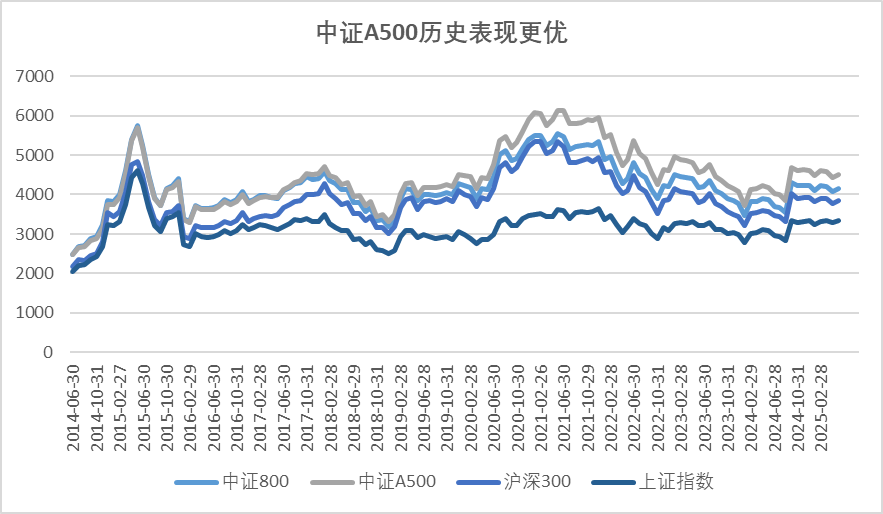
Group 1 - Recent tariff policy easing, interest rate cuts, and technological advancements are expected to lead the A-share market towards an upward trend after previous risk factors have been released [1] - Despite positive factors, uncertainties remain due to fluctuating Trump policies and weak economic recovery, which may affect market performance until 2025 [2] - The main economic characteristics anticipated for the second half of the year include strong production, recovering investment, stable consumption, and resilient exports [2] Group 2 - The CSI A500 index is designed with an "industry balance" approach, representing a selection of 500 large-cap, liquid securities across various sectors, akin to a domestic "S&P 500" [4] - The index includes approximately 50% traditional value sectors and 50% emerging growth sectors, making it more growth-oriented compared to other value indices [4] - Historical performance shows that the CSI A500 index has achieved a return of 359.17% since its inception, outperforming other major indices like the Shanghai Composite and CSI 300 [5]