有色

Search documents
【十大券商一周策略】A股跨年行情已经启动,新的主线浮出水面
券商中国· 2025-12-28 14:59
Group 1 - The article highlights that among 360 industry/theme ETFs, 39 reached new highs in December, with established sectors like telecommunications and non-ferrous metals reflecting North American AI infrastructure and resource logic, while new sectors like commercial aerospace are gaining attention during market fluctuations [2] - The focus is on structural opportunities in a volatile market, with sectors like chemicals, engineering machinery, and new energy being prioritized due to their long-term ROE potential, alongside emerging themes like commercial aerospace [3] - The article emphasizes the importance of the RMB appreciation trend and its implications for investment strategies, particularly in brokerage and insurance sectors [3] Group 2 - The article discusses favorable conditions for the spring market rally, driven by liquidity and investor expectations, with a focus on the A500 ETF and potential market fluctuations at year-end and early next year [4] - It notes that the RMB's recent strength, driven by corporate settlement demand and a favorable external environment, could lead to a capital market rally, benefiting sectors reliant on imported materials and those with significant foreign currency liabilities [6] - The article identifies new investment themes emerging in the commodity market and manufacturing sectors, particularly in AI and global manufacturing recovery, recommending investments in industrial resources and equipment exports [8] Group 3 - The article indicates that the A-share market has entered a cross-year rally phase, supported by optimistic institutional investor sentiment and favorable policy expectations [9] - It suggests that the spring market is likely to exhibit structural characteristics with rapid sector rotation, encouraging investors to adopt a low-buying strategy [13][14] - The article highlights the potential for a continued upward trend in the market leading up to the Spring Festival, with a focus on technology themes and non-bank financial sectors [15]


新年投资展望:经济回暖下的结构性机遇
Shang Hai Zheng Quan Bao· 2025-12-28 13:28
Group 1 - The macroeconomic environment is expected to improve significantly in 2026, driven by stronger policy support and internal growth momentum, leading to a high probability of economic recovery [1] - Export resilience is anticipated, with a continued increase in the proportion of high-end manufacturing and machinery products in the export structure, bolstering the foundation for stable export performance in 2026 [1] - Infrastructure and large projects are expected to be key investment areas in 2026, supported by clear policy guidance and a recovering Consumer Price Index (CPI) [1] Group 2 - Liquidity in the equity market is projected to remain ample in 2026, providing support for market strength [2] - The risk appetite in the market is expected to maintain a neutral to slightly positive stance, with no significant risk points currently observed [2] - Structural opportunities are likely to expand further in 2026, particularly in cyclical industries such as non-ferrous metals and chemicals, which are expected to benefit from economic recovery and "anti-involution" policies [2]
金属周期品高频数据周报(2025.12.22-12.28):热卷库存处于5年同期最高水平-20251228
EBSCN· 2025-12-28 13:09
Investment Rating - The report maintains an "Overweight" rating for the steel and non-ferrous metals sectors [5] Core Insights - The report highlights that hot-rolled inventory is at its highest level for the same period in five years, indicating potential supply chain pressures [41] - The liquidity environment is characterized by a historical high in gold prices, with the London gold spot price reaching $4,533 per ounce [11] - The report notes a decline in construction activity, with national real estate new starts down 20.50% year-on-year for the first 11 months of 2025 [20] Summary by Relevant Sections Liquidity - The BCI small and medium enterprise financing environment index for December 2025 is at 47.15, down 10.19% month-on-month [11] - The M1 and M2 growth rate difference was -3.1 percentage points in November 2025, a decrease of 1.10 percentage points month-on-month [18] - The current London gold price is $4,533 per ounce, reflecting a 4.41% increase from the previous week [11] Infrastructure and Real Estate Chain - Hot-rolled inventory is at the highest level for the same period in five years, with rebar prices down 1.20% this week [41] - The national high furnace capacity utilization rate is at 85%, unchanged from the previous week [10] - The cement price index has decreased by 0.49% this week, with a national cement utilization rate of 30.14%, down 0.9 percentage points [59] Industrial Chain - The national semi-steel tire operating rate is at 72.05%, up 0.66 percentage points week-on-week [2] - The price of tungsten concentrate has reached a new high since 2012, at 460,500 yuan per ton, up 6.35% from last week [2] - The price of electrolytic aluminum is 22,060 yuan per ton, reflecting a 1.01% increase week-on-week [10] Price Relationships - The price difference between hot-rolled and rebar has turned positive, with the current difference at 10 yuan per ton [3] - The price ratio of rebar to iron ore is 4.02 this week [3] - The price of stainless steel hot-rolled and electrolytic nickel has a ratio of 0.10 [3] Export Chain - The new export orders PMI for China in November is 47.60%, an increase of 1.7 percentage points month-on-month [3] - The CCFI composite index for container shipping rates is at 1,146.67 points, up 1.95% week-on-week [3] - The U.S. crude steel capacity utilization rate is at 75.30%, down 1.20 percentage points from the previous week [3] Valuation Metrics - The CSI 300 index increased by 1.95%, with the chemical sector performing best at +4.23% [4] - The PB ratio for the steel sector relative to the CSI 300 is currently at 0.50, with a historical high of 0.82 [4] - The report suggests that the steel sector's supply may be reasonably constrained, leading to potential recovery in profitability to historical average levels [4]
A股分析师前瞻:多头势力聚集,“春季躁动”有望抢跑
Xuan Gu Bao· 2025-12-28 13:08
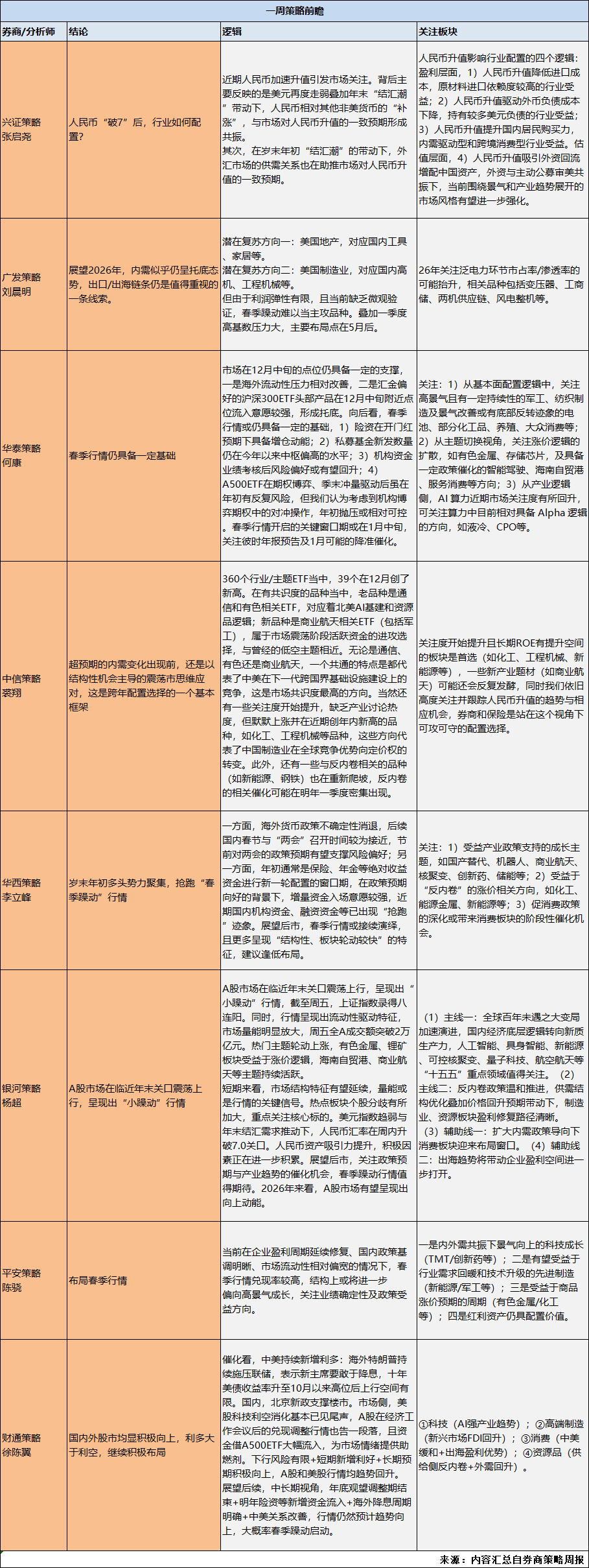
Core Viewpoint - Overall optimism remains among brokerage strategy analysts, with expectations for a "spring rally" as domestic policies and market conditions align favorably [1] Group 1: Market Trends - The A-share market is experiencing a "small rally" as it approaches year-end, with the Shanghai Composite Index recording eight consecutive days of gains [1] - Market liquidity is increasing, with total trading volume in the A-share market exceeding 2 trillion yuan on Friday [1][3] - Analysts suggest that the current market structure may continue, with trading volume being a key indicator of market trends [3] Group 2: Currency Impact - The recent appreciation of the RMB is drawing market attention, with four key implications for industry allocation: 1. Lower import costs benefiting industries reliant on imported raw materials [2] 2. Decreased foreign currency debt costs benefiting industries with significant USD liabilities [2] 3. Enhanced domestic purchasing power benefiting demand-driven and cross-border consumption industries [2] 4. Attraction of foreign capital back to Chinese assets due to RMB appreciation, potentially reinforcing market styles focused on economic trends [2][3] Group 3: Sector Focus - Analysts highlight several sectors for potential investment, including: - High-demand sectors such as military, textiles, and chemicals, which may show signs of recovery [3] - Industries benefiting from policy support, such as domestic substitution, robotics, and commercial aerospace [4] - Growth sectors like advanced manufacturing and technology, which are expected to benefit from economic recovery and policy clarity [5]
A股投资策略周报:近期增量资金变化对A股的影响及涨价品种梳理-20251228
CMS· 2025-12-28 04:08
Core Insights - The report indicates that significant institutional investors are continuously increasing their holdings in A500 ETF and other broad-based products, providing stable incremental capital to the market. This trend is expected to lead to a "cross-year + spring" market rally as the market's profitability improves and financing capital accelerates its net inflow [1][4][22] - The report emphasizes that the main focus of the market is likely to be on blue-chip indices represented by CSI 300 and SSE 50, while cyclical sectors should be prioritized for investment [1][5][22] Group 1: Recent Capital Flow and ETF Trends - Since the beginning of 2025, the capital flow in stock ETFs has shown distinct phase characteristics and structural differentiation, with significant net subscriptions in A500 ETF since December, reflecting institutional investors' entry into the capital market [6][9][12] - The A500 ETF has seen a substantial net subscription of 810 billion yuan in December, indicating a strong interest from institutional investors, particularly in the context of the upcoming launch of A500 ETF options in 2026 [12][13][17] Group 2: Price Trends in Key Commodities - Recent price increases have been concentrated in sectors such as non-ferrous metals, crude oil, chemicals, and the new energy industry chain, with notable price rises in platinum (+32.92%), silver (+14.38%), and nickel (+9.25%) driven by global liquidity easing and geopolitical tensions [23][24] - The report highlights that the holding volumes of various commodities are at historically high levels, indicating potential supply constraints and speculative exposure in metals like aluminum, lead, and tin [26][27] Group 3: Market Sentiment and Economic Indicators - The report notes that the overall A-share market has shown a positive trend, with major indices breaking through key moving averages, supported by a favorable monetary policy environment and improved market liquidity [30][31] - The report also points out that sectors such as non-ferrous metals and defense have performed well due to improved economic expectations and specific market events, while consumer sectors have faced challenges [31][32]
如何深入整治“内卷式”竞争
Xin Lang Cai Jing· 2025-12-28 02:56
深化制度保障,纵深推进全国统一大市场建设。加快推进"五统一、一开放",破除阻碍全国统一大市场 建设的堵点卡点,促进有效市场和有为政府更好结合,为优化资源配置、扩大内需、缓解同质化竞争提 供制度保障。持续深入推进政府职能转变,优化完善政府政绩考核体系,健全政府不当干预市场竞争行 为治理规则,规范地方政府经济促进行为,破除地方保护和市场分割,清理行业壁垒,打通区域"小循 环",畅通释放内需潜力的"大循环",为企业创造更加稳定、透明和可预期的发展环境。 巩固动态平衡,供需两侧协同施策稳根基。将扩大内需战略同深化供给侧结构性改革有机结合起来,推 动供给和需求达到更高水平均衡。在需求侧大力提振居民消费,要进一步优化收入分配格局,加大投资 于人力度,提升公共服务水平,加强社会保障体系建设,切实增强居民实际消费能力和消费意愿;同 时,优化消费环境,加快清理限制性措施。在供给侧持续深化结构性改革,要坚持智能化、绿色化、融 合化方向,发展智能制造、绿色制造、服务型制造,分类开展行业治理,大力推动重点行业产能治理, 以高质量的供给适配不断升级的需求,形成需求牵引供给、供给创造需求的更高水平动态平衡。此外, 要统筹国内国际两个大局 ...
国家统计局公布!高技术制造业利润,两位数增长
Xin Lang Cai Jing· 2025-12-27 11:21
Core Insights - The total profit of industrial enterprises above designated size in China reached 66,268.6 billion yuan from January to November, showing a year-on-year growth of 0.1%, marking four consecutive months of growth [1][7] - The profit growth rate of high-tech manufacturing increased by 10.0% year-on-year, accelerating by 2.0 percentage points compared to the previous month [1][8] High-Tech Manufacturing - High-tech manufacturing profits grew by 10.0% year-on-year, outpacing the overall industrial average by 9.9 percentage points [1][8] - The "Artificial Intelligence +" initiative significantly boosted profits in related sectors, with electronic industrial equipment manufacturing profits rising by 57.4% [2][8] - The semiconductor equipment manufacturing sector saw a remarkable profit increase of 97.2%, while electronic components and electromechanical equipment manufacturing profits grew by 46.0% [2][8] - The aerospace industry also experienced strong growth, with profits in aerospace equipment manufacturing increasing by 192.9% [2][8] Equipment Manufacturing - The equipment manufacturing sector demonstrated a profit growth of 7.7%, contributing 2.8 percentage points to the overall profit growth of industrial enterprises [3][9] - Among the eight major categories in equipment manufacturing, seven reported year-on-year profit growth, with rail, ship, and aerospace industries showing a profit increase of 27.8% [4][10] - The automotive sector also saw a steady profit increase of 7.5%, with an acceleration of 3.1 percentage points compared to the previous month [4][10] Raw Materials Manufacturing - The raw materials manufacturing sector experienced a profit growth of 16.6%, contributing 2.0 percentage points to the overall profit growth of industrial enterprises [5][11] - The steel industry showed significant improvement in profitability, with a notable year-on-year profit increase attributed to rising market demand and revenue growth [5][11] - The A-share steel companies reported a total revenue of 13,291.13 billion yuan, with a net profit of 174.9 billion yuan, reflecting a 351% year-on-year increase [6][11]
前11月中国规上工业企业利润同比增0.1%
Xin Lang Cai Jing· 2025-12-27 05:18
中新社北京12月27日电 (记者 王恩博)中国国家统计局27日公布,1—11月份,全国规模以上工业企业利 润同比增长0.1%,自今年8月份以来累计增速连续四个月保持增长。 国家统计局工业司首席统计师于卫宁表示,1—11月份,规模以上工业企业利润增速有所回落,但仍然 延续8月份以来的增长态势,以装备制造业、高技术制造业为代表的新动能行业保持较快增长,工业经 济转型升级有序推进。 据统计,1—11月份,规模以上装备制造业利润同比增长7.7%,拉动全部规模以上工业企业利润增长2.8 个百分点,是对规模以上工业企业利润增长拉动作用最强的板块。装备制造业的8个大类行业中有7个行 业利润实现同比增长,其中,铁路船舶航空航天、电子行业利润两位数增长,增速分别达27.8%、 15.0%。 1—11月份,规模以上高技术制造业利润同比增长10.0%,较1—10月份加快2.0个百分点,增速高于全部 规模以上工业平均水平9.9个百分点。从行业看,"人工智能+"行动深入实施带动相关设备制造行业利润 向好,电子工业专用设备制造行业利润同比增长57.4%,其中半导体器件专用设备制造、电子元器件与 机电组件设备制造行业利润分别增长97.2% ...
全面复盘:史上5轮PPI回升的股债表现【国盛宏观熊园团队】
Xin Lang Cai Jing· 2025-12-26 14:58
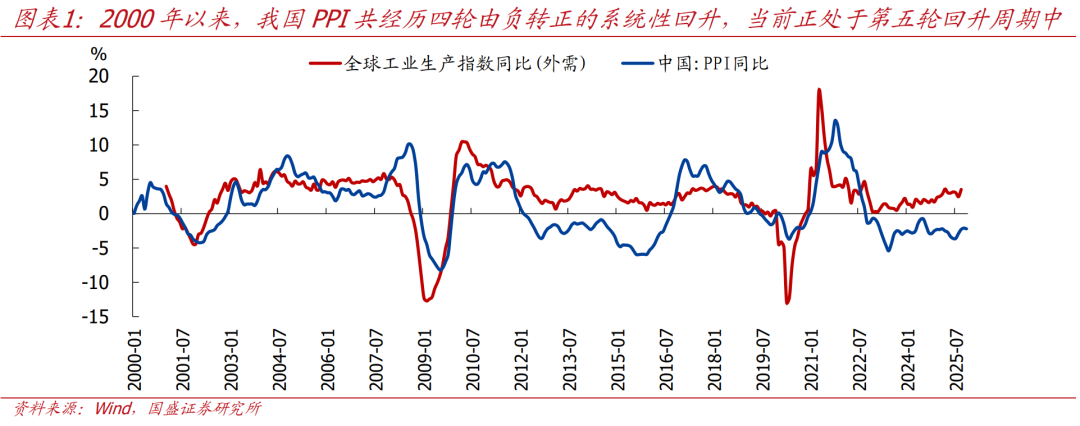
Core Viewpoint - The article discusses the recovery trend of China's Producer Price Index (PPI) since July 2025, predicting a narrowing year-on-year decline in PPI for 2026, with the next six months likely being the fastest recovery period. Historical analysis of past PPI recovery phases is used to identify potential investment opportunities in the stock and bond markets for 2026 [2][3]. Group 1: Historical PPI Recovery Phases - Since 2000, there have been five rounds of PPI recovery in China, with the current phase being the fifth. The PPI has transitioned from negative to positive during these periods, with significant economic events influencing these changes [15][22]. - The first round (2002-2004) saw PPI rise from -4.2% to 8.4%, driven by global economic recovery and domestic urbanization [4][16]. - The second round (2009-2010) experienced a rise from -8.2% to 7.1%, supported by the global financial crisis response and domestic stimulus measures [5][17]. - The third round (2015-2017) saw PPI increase from -5.9% to 7.8%, influenced by supply-side reforms and monetary policies [6][19]. - The fourth round (2020-2021) had PPI rise from -3.7% to 13.5%, primarily due to supply-side factors and global commodity price increases [7][20]. - The current phase (2025-present) has seen PPI recover from -3.6% to -2.2%, with expectations for further recovery in 2026 [8][21]. Group 2: Stock Market Performance During PPI Recovery - Historical analysis indicates that during the first phase of PPI recovery, A-shares typically show an upward trend, with small-cap growth stocks outperforming [3][6]. - In the second phase, as PPI rises from its bottom to positive territory, the stock market experiences a more balanced performance across growth, consumption, and cyclical sectors, with notable performances in electronics, communication, and consumer goods [3][8]. - The third phase, when PPI turns positive, often leads to high-level market fluctuations, with value stocks gaining an advantage over growth stocks [3][7]. Group 3: Bond Market Dynamics - The bond market's response to PPI recovery is influenced by various factors, including growth expectations and liquidity conditions, rather than solely by inflation [10][11]. - Historical data shows that during PPI recovery phases, the 10-year government bond yield may face upward pressure, but this is not always synchronized with PPI movements [10][11]. - A stable liquidity environment and lack of sustained demand improvement can prevent significant upward trends in bond yields, even during periods of PPI recovery [11][12]. Group 4: Outlook for 2026 - The PPI is expected to narrow its year-on-year decline in 2026, with the next six months likely being the fastest recovery period, driven by policies aimed at stabilizing coal and steel prices, as well as rising demand for lithium and copper [12][13]. - The stock market is anticipated to have upward potential, with growth, consumption, and cyclical sectors all presenting investment opportunities, particularly in undervalued sectors such as food and beverage, home appliances, and non-ferrous metals [12][13]. - The bond market is expected to remain in a state of fluctuation, with a continued focus on monetary easing, although significant adjustments in bond yields are not anticipated [13].
跨年布局窗口期,关注成长和周期板块
Sou Hu Cai Jing· 2025-12-26 11:32
Market Review - The Shanghai Composite Index recorded a seven-day winning streak, indicating improved visibility for the year-end market, with a rebalancing of capital allocation [1] - The non-ferrous metals sector continues to show strong performance, driven by the "commercial aerospace" concept, while power equipment stocks are boosted by rising lithium battery material prices [1] - Domestic CSP manufacturers are increasing capital expenditure plans, with reports indicating a leading internet company plans to raise its AI capital expenditure from 150 billion yuan in 2025 to nearly 160 billion yuan in 2026, focusing on AI infrastructure and semiconductor chip procurement [1] - The demand for liquid cooling solutions is rising due to significant power consumption increases from NV chips, providing opportunities for domestic manufacturers amid rapid technological iterations [1] - A lithium battery materials company has announced a price adjustment for lithium carbonate, driven by supply contraction pushing prices back to reasonable levels [1] Overseas Macro - U.S. GDP for Q3 2025 grew at an annualized rate of 4.3%, exceeding market expectations, primarily driven by private consumption and investments in AI-related equipment [2] - Traditional sectors like construction and real estate continue to show weak investment, leading to increased economic internal differentiation [2] - The recent GDP data has somewhat suppressed expectations for interest rate cuts, suggesting the Federal Reserve may maintain current rates in the short term, with potential delays in future rate cuts [2] - Gold prices have surpassed previous highs, supported by the Fed's recent rate cuts and ongoing fiscal deficits, which have raised concerns about debt risks and the independence of the Fed [2] Commodity Market - The recent escalation of U.S. sanctions on Venezuelan oil exports and ongoing geopolitical tensions have increased demand for safe-haven assets like gold [3] - Silver has seen significant price increases due to both its financial and industrial demand, with growth in sectors such as photovoltaics and electric vehicles tightening supply [3] Market Outlook - The year-end market phase is supported by policy backing and industrial catalysts, with expectations for increased fiscal measures during the 2026 Two Sessions [4] - The end of the year is a period when long-term funds, such as insurance capital, tend to increase allocations, potentially bringing new capital into the market [4] - Growth and cyclical sectors are expected to be key areas of focus, with themes likely to exhibit elasticity during this period [4] Investment Directions - Focus on large technology growth sectors and resource/manufacturing sectors benefiting from cyclical reversals and global economic recovery [4] - Specific areas of interest include AI applications, robotics, energy storage, and innovative pharmaceuticals, as well as resources and manufacturing sectors like non-ferrous metals and engineering machinery [4]