
金融业

Search documents
琶洲领跑!二季度广州写字楼租赁活跃,市场租金跌幅收窄
Zhong Guo Chan Ye Jing Ji Xin Xi Wang· 2025-07-05 23:49
Group 1 - The core viewpoint of the report indicates a recovery in the leasing market for Grade A office spaces in Guangzhou during the first half of 2025, with increased inquiry and viewing activity compared to the end of 2024 [1] - The supply of Grade A office spaces in Guangzhou slowed down in Q2 2025, with only one new project delivered, leading to a total stock of 6.937 million square meters [1] - The net absorption in the city recorded 152,000 square meters, a year-on-year decrease of 13.3%, while the vacancy rate increased by 0.9 percentage points to 19.8% [1] Group 2 - In terms of regional performance, Haizhu District's Pazhou became the most active leasing area in Q2, with a vacancy rate decreasing by 1.7 percentage points quarter-on-quarter and 3.6 percentage points year-on-year to 23.2% [1] - The average rent for office spaces in the city decreased by 1.4% to 123.5 yuan per square meter per month, with the decline narrowing by 3.3 percentage points compared to the previous quarter [1] - The TMT sector led the leasing demand with a 30.2% share of the total leased area, followed by the financial sector at 16.8% and trade and retail at 16.3% [2] Group 3 - The report highlights the potential of emerging business districts, particularly Guangzhou International Financial City, where infrastructure improvements are attracting financial institutions to establish headquarters [2] - The establishment of a conducive office environment in new business districts is expected to enhance market attention and resource attraction [2]
【招银研究|海外宏观】乏力的“超预期”——美国非农就业数据点评(2025年6月)
招商银行研究· 2025-07-04 10:53
Core Viewpoint - The U.S. non-farm employment data for June exceeded market expectations, indicating a robust labor market, which may influence the Federal Reserve's future policy decisions [1][4][12]. Group 1: Employment Data - In June, the U.S. added 147,000 non-farm jobs, surpassing the market expectation of 106,000 [1]. - The unemployment rate unexpectedly decreased to 4.1%, against the expected 4.3% [1][4]. - The labor participation rate fell to 62.3%, slightly below the expected 62.4% [1]. - Average hourly earnings increased by 3.7% year-on-year, slightly below the expected 3.8% [1]. Group 2: Labor Market Dynamics - The labor market is showing signs of a mild cooling trend, with private sector job growth slowing significantly to 74,000 in June, down from 134,000 in May [8]. - The government sector saw an unexpected increase of 73,000 jobs, influenced by seasonal factors, particularly in state and local government employment [8][10]. - Wage growth is also slowing, with average hourly earnings growth down to 3.7% year-on-year, indicating a potential softening of persistent inflation [8][12]. Group 3: Federal Reserve Policy Implications - The divergence in views among Federal Reserve officials (doves vs. hawks) may lead to varied interpretations of the employment data, impacting future interest rate decisions [1][12]. - The neutral interest rate is estimated to have reached 3.5%, with the ongoing debate primarily affecting the timing of reaching this neutral rate rather than its overall shape [1][12]. Group 4: Investment Strategy - The recommendation is to buy U.S. Treasuries on dips and short the U.S. dollar on rallies, as the market reacts to the strong employment data [2][13][14]. - The U.S. Treasury yield curve has flattened, with significant increases in yields across various maturities, indicating a shift in market expectations [13]. - The dollar index has shown a slight increase, but the long-term trend remains downward, influenced by various economic factors [14].


美国6月非农与ADP就业为何大幅背离?
GOLDEN SUN SECURITIES· 2025-07-04 03:38
Employment Data Summary - In June, the U.S. added 147,000 non-farm jobs, exceeding the expected 110,000[2] - The unemployment rate fell to 4.1%, lower than the expected 4.3% and previous 4.2%[2] - Labor force participation rate was 62.3%, slightly below the expected and previous 62.4%[2] - Average hourly earnings increased by 0.2% month-on-month, below the expected 0.3% and previous 0.4%[2] Market Reactions - Following the non-farm data release, U.S. stock markets rose, with the S&P 500, Nasdaq, and Dow Jones increasing by 0.8%, 1.0%, and 0.8% respectively[2] - The 10-year U.S. Treasury yield rose by 6.3 basis points to 4.34%[2] - The U.S. dollar index increased by 0.4% to 97.1, while spot gold prices fell by 0.9% to $3326.1 per ounce[2] Fed Rate Expectations - The probability of a rate cut in July dropped from 25% to 0% after the non-farm data release[2] - The probability of a September rate cut decreased from 100% to approximately 73%[2] - The expected number of rate cuts for the year was revised down from 2.6 to 2.1[2] ADP vs Non-Farm Data - The ADP report showed a loss of 33,000 jobs in June, significantly below the expected gain of 95,000[3] - The divergence between ADP and non-farm data is attributed to differences in statistical coverage and the impact of tariffs[3] - Non-farm data is considered more reliable as it covers approximately 80% of employment positions compared to ADP's 17%[3] Economic Outlook - The strong non-farm data suggests resilience in the U.S. economy, supporting previous assessments[4] - The report indicates that if tariffs do not escalate further, a soft landing for the economy remains likely[4] - The Federal Reserve is expected to maintain a cautious stance given manageable economic downturn risks and rising inflation concerns[4]
施罗德投资:2025年经济衰退的风险已有所减低 对股市看法正面
Zhi Tong Cai Jing· 2025-07-03 11:18
施罗德投资表示,虽然有关关税的消息仍然反复不定,但相对于"解放日",目前的贸易发展局势与其基 本预期一致,即对中国征收30%关税、对其他地区征收10%,使实际关税水平维持在约12%。经济不确 定性持续存在,需密切观察企业将如何应对,但部分经济下行风险已较早前受控。因此,施罗德认为 2025年经济衰退的风险已有所减低。对股市维持正面看法,尤其聚焦美国及欧洲的金融业板块。 施罗德投资整体对各地政府债券维持中性立场。虽然收益率已上升且估值有所改善,但由于美国债务水 平上升及持续的通胀风险,中期而言担忧仍然存在。虽然市场预期与其展望更趋一致,但仍预期美联储 的货币政策放宽幅度、将低于目前市场所反映的水平。美国以外地区的通胀压力相对温和,相比美国国 债,继续看好德国国债的表现。 继续看好黄金作为分散投资组合的作用,并对美元持偏淡立场,主要反映于看好欧元及新兴市场本地货 币债券的表现。 由于现届美国政府政策走向难以预测,市场愈趋重视分散资产配置。投资者普遍持有较多美国资产,在 这情况下,预期风险意识将会提升,促使资金被重新分配,并流出美国市场。 而全球原油供应持续增加,将令市场出现供应过剩,并对2025年油价构成压力,因 ...
美股策略下半年资产配置策略:风险事件持续出现
Guosen International· 2025-07-03 07:07
Group 1 - The report indicates that the US stock market has rebounded significantly due to signs of easing in the US-China trade war, with the S&P 500 rising approximately 5% year-to-date and the Nasdaq 100 increasing nearly 7% [12][13] - Despite the rebound, the report highlights that the small-cap Russell 2000 index remains down about 1%, indicating a divergence in market performance [12] - The report notes that the global stock indices, excluding the US, have outperformed the US market, with the world index rising 17% year-to-date, driven by a weaker dollar and capital outflows due to de-dollarization [12][13] Group 2 - The report discusses the ongoing US-China trade negotiations, which have shown signs of temporary easing, but structural differences remain significant, leading to uncertainty in future negotiations [13] - It highlights that the US economy experienced a contraction in the first quarter of 2025, with GDP growth at -0.5%, primarily due to a surge in imports and a slowdown in consumer spending [17][18] - The report emphasizes that retail sales data for May fell short of expectations, with a 0.9% month-over-month decline, indicating a cautious consumer sentiment [22][23] Group 3 - The report outlines that the US job market is showing mixed signals, with job vacancies at 7.769 million but a decline in private sector job creation, reflecting a cautious outlook among employers [32][37] - It notes that the US housing market is under pressure, with new home sales dropping significantly, attributed to high prices and mortgage rates, leading to weakened demand [48][49] - The report also mentions that inflationary pressures are emerging, with core consumer price index data indicating a potential rise in inflation, which could complicate monetary policy decisions [58][59] Group 4 - The report suggests that global capital is shifting away from US dollar assets towards non-dollar markets, benefiting Hong Kong stocks and indicating a trend of de-dollarization [79][84] - It highlights that European and Japanese economies are showing signs of recovery, with improving macroeconomic indicators and investor sentiment, although uncertainties remain due to US trade policies [89][90] - The report recommends investors to consider increasing allocations to Hong Kong, European, and Japanese markets, as valuations are relatively lower compared to the US market [90]
ESG信息披露进入强制时代
Zhong Guo Jing Ying Bao· 2025-07-02 13:51
Group 1 - The global trend towards mandatory ESG (Environmental, Social, and Governance) disclosure is strengthening, with various countries implementing policies to enhance transparency and comparability [1][2] - The European Union has established strict ESG disclosure requirements through the Sustainable Finance Disclosure Regulation (SFDR) and the Corporate Sustainability Reporting Directive (CSRD) [1] - In China, the Shanghai Stock Exchange, Shenzhen Stock Exchange, and Beijing Stock Exchange have released guidelines for sustainable development reporting, effective from May 1, 2024, requiring certain listed companies to disclose sustainability reports by 2026 [1][2] Group 2 - The Ministry of Finance and other regulatory bodies in China are coordinating the development of a sustainable disclosure standards system, aiming for a unified framework by 2030 [2] - The construction industry plays a crucial role in the national economy, maintaining a GDP contribution of over 6.6% since 2020, with a slight increase to 6.67% in 2024 [3] - The number of construction enterprises in China has increased by 5.57% to 168,011, while the average number of employees in the sector has decreased by 12.26%, indicating improved labor productivity [3] Group 3 - The transition to low-carbon practices is essential for construction companies to remain competitive in both domestic and international markets, as the industry has a significant share of global carbon emissions [3] - The introduction of mandatory ESG disclosures provides a new dimension for assessing corporate value and helps construction firms manage ESG risks and seize transformation opportunities [4] - Companies are encouraged to integrate ESG disclosure requirements into their strategic planning and business development to support sustainable economic growth in China [4]
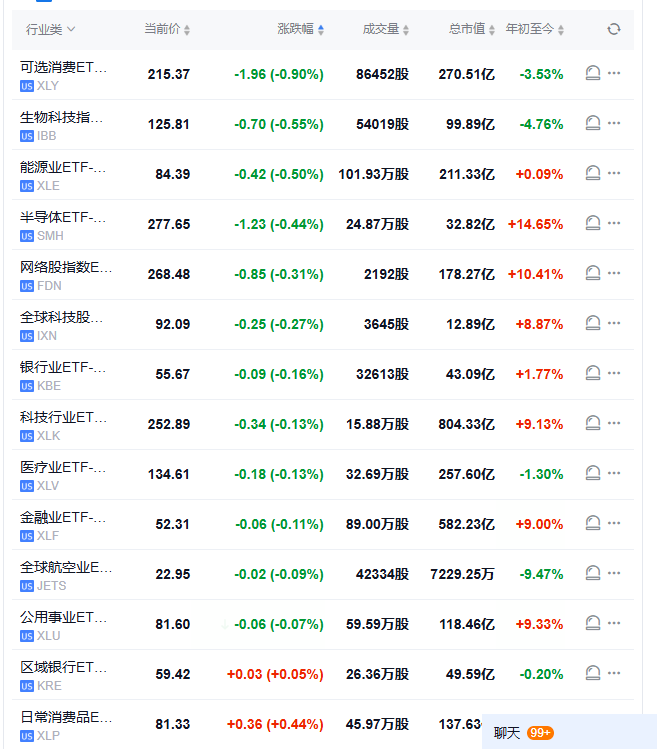
美股盘初:主要行业ETF多数普跌,可选消费ETF跌约1%,生物科技指数ETF跌0.55%,能源业ETF跌0.5%。
news flash· 2025-07-01 13:36
Market Overview - Major industry ETFs mostly declined, with the Consumer Discretionary ETF down approximately 1%, the Biotechnology Index ETF down 0.55%, and the Energy ETF down 0.5% [1] Industry Performance - Consumer Discretionary ETF (US XLY) current price: $215.37, down $1.96 (-0.90%), with a trading volume of 86,452 shares and a total market value of $27.051 billion, down 3.53% year-to-date [2] - Biotechnology Index ETF (US IBB) current price: $125.81, down $0.70 (-0.55%), with a trading volume of 54,019 shares and a total market value of $9.989 billion, down 4.76% year-to-date [2] - Energy ETF (US XLE) current price: $84.39, down $0.42 (-0.50%), with a trading volume of 1.0193 million shares and a total market value of $21.133 billion, up 0.09% year-to-date [2] - Semiconductor ETF (US SMH) current price: $277.65, down $1.23 (-0.44%), with a trading volume of 248,700 shares and a total market value of $3.282 billion, up 14.65% year-to-date [2] - Internet Index ETF (US FDN) current price: $268.48, down $0.85 (-0.31%), with a trading volume of 2,192 shares and a total market value of $17.827 billion, up 10.41% year-to-date [2] - Global Technology ETF (US IXN) current price: $92.09, down $0.25 (-0.27%), with a trading volume of 3,645 shares and a total market value of $1.289 billion, up 8.87% year-to-date [2] - Banking ETF (US KBE) current price: $55.67, down $0.09 (-0.16%), with a trading volume of 32,613 shares and a total market value of $4.309 billion, up 1.77% year-to-date [2] - Technology Sector ETF (US XLK) current price: $252.89, down $0.34 (-0.13%), with a trading volume of 158,800 shares and a total market value of $804.33 billion, up 9.13% year-to-date [2] - Healthcare ETF (US XLV) current price: $134.61, down $0.18 (-0.13%), with a trading volume of 326,900 shares and a total market value of $25.760 billion, down 1.30% year-to-date [2] - Financials ETF (US XLF) current price: $52.31, down $0.06 (-0.11%), with a trading volume of 890,000 shares and a total market value of $58.223 billion, up 9.00% year-to-date [2] - Global Airlines ETF (US JETS) current price: $22.95, down $0.02 (-0.09%), with a trading volume of 42,334 shares and a total market value of $72.293 million, down 9.47% year-to-date [2] - Utilities ETF (US XLU) current price: $81.60, down $0.06 (-0.07%), with a trading volume of 595,900 shares and a total market value of $11.846 billion, up 9.33% year-to-date [2] - Regional Banks ETF (US KRE) current price: $59.42, up $0.03 (+0.05%), with a trading volume of 263,600 shares and a total market value of $4.959 billion, down 0.20% year-to-date [2] - Consumer Staples ETF (US XLP) current price: $81.33, up $0.36 (+0.44%), with a trading volume of 459,700 shares and a total market value of $137.63 million [2]
我国制造业景气水平持续改善 六月新订单指数回升到百分之五十以上
Ren Min Ri Bao· 2025-06-30 21:50
Core Insights - In June, China's manufacturing PMI was 49.7%, indicating a continuous improvement for two months, with the new orders index rising above 50% [1][2] - The non-manufacturing business activity index was 50.5%, showing stable expansion, while the comprehensive PMI output index reached 50.7%, reflecting overall economic expansion [1][2] Manufacturing Sector - The manufacturing PMI increased by 0.2 percentage points from the previous month, with the new orders index rising to 50.2%, indicating a return to expansion after two months below 50% [1][2] - The production index for manufacturing was 51%, up 0.3 percentage points, showing stable expansion in production activities [2] Non-Manufacturing Sector - The non-manufacturing business activity index rose by 0.2 percentage points to 50.5%, remaining above the expansion threshold [2] - The construction industry showed a business activity index of 52.8%, up 1.8 percentage points, indicating robust activity [2] Overall Economic Indicators - The comprehensive PMI output index increased by 0.3 percentage points to 50.7%, reflecting a positive trend in both manufacturing and non-manufacturing sectors [2] - The new export orders index for manufacturing was 47.7%, showing a gradual recovery in exports, with a 0.2 percentage point increase from the previous month [1]
制造业PMI连续两个月回升,新订单指数回到扩张区间
证券时报· 2025-06-30 08:13
Core Viewpoint - The manufacturing and non-manufacturing sectors in China showed signs of recovery in June, with the Manufacturing PMI at 49.7%, Non-Manufacturing Business Activity Index at 50.5%, and Composite PMI Output Index at 50.7%, indicating overall economic expansion [1][3]. Manufacturing Sector - The Manufacturing PMI improved month-on-month from 49.0% in April to 49.7% in June, indicating a gradual recovery despite remaining below the critical 50% threshold [3]. - In June, the Production Index was at 51%, and the New Orders Index rose to 50.2%, marking a return to the expansion zone after two months below 50% [3]. - The easing of external pressures from US-China trade relations contributed to the stabilization of manufacturing activities, with market demand showing signs of recovery [3][4]. Non-Manufacturing Sector - The Non-Manufacturing Business Activity Index increased to 50.5% in June, reflecting continued expansion, although some sectors related to consumer travel saw a decline [10]. - The Business Activity Expectation Index stood at 56.0%, indicating optimism among service sector enterprises regarding future growth [11]. - Financial services showed robust activity, with the Business Activity Index and New Orders Index both exceeding 60%, suggesting increased financial support for the real economy [8]. Construction and Investment - The Construction Business Activity Index rose to 52.8% in June, with investment-related construction activities showing significant improvement [6]. - The ongoing implementation of special bonds for infrastructure projects is expected to stimulate further construction demand [7]. Overall Economic Outlook - The overall economic environment is expected to improve in the second half of the year, driven by policy measures and a gradual recovery in both manufacturing and non-manufacturing sectors [1][13].

6月制造业采购经理指数继续小幅回升,经济景气水平总体保持扩张
Bei Ke Cai Jing· 2025-06-30 03:55
Group 1 - In June, the Manufacturing Purchasing Managers' Index (PMI) in China was 49.7%, an increase of 0.2 percentage points from the previous month, indicating a slight recovery in the manufacturing sector [1][2] - The Non-Manufacturing Business Activity Index rose to 50.5%, also up by 0.2 percentage points, reflecting stable expansion in the non-manufacturing sector [1][2] - The Composite PMI Output Index increased to 50.7%, marking a rise of 0.3 percentage points, suggesting overall economic improvement [1][2] Group 2 - The PMI for large enterprises was 51.2%, up by 0.5 percentage points, while medium-sized enterprises saw a PMI of 48.6%, an increase of 1.1 percentage points; however, small enterprises experienced a decline to 47.3%, down by 2 percentage points [3] - Various sub-indices showed positive changes, with production, new orders, and export orders indices rising between 0.2 to 2.6 percentage points, indicating a general recovery across different industries [4] - The logistics and procurement analyst noted that the slight PMI increase reflects the effectiveness of recent policies aimed at boosting demand, although the overall PMI remains below the growth threshold [4][5] Group 3 - The Non-Manufacturing PMI has consistently remained above 50% this year, with a new orders index of 46.6%, which has increased by 0.5 percentage points, indicating a narrowing decline in demand [6][8] - In the construction sector, the Business Activity Index rose to over 52%, reflecting increased investment-related activities, supported by expanded special bond allocations [7] - The financial services sector also showed growth, with both the Business Activity Index and new orders index exceeding 60%, indicating heightened activity as the quarter ends [7] Group 4 - Overall, the average Non-Manufacturing Business Activity Index for the second quarter was 50.4%, similar to the first quarter, suggesting stable expansion in the non-manufacturing sector [8] - As policy benefits gradually materialize, investment and consumption-related demand are expected to continue to improve, enhancing the internal driving force of economic operations [8]