
集运

Search documents
债市基本面高频数据跟踪:2026年1月第2周:水泥价格再创新低
SINOLINK SECURITIES· 2026-01-14 15:18
Group 1: Economic Growth Production - Power plant daily consumption is higher than the same period last year. On January 13, the average daily consumption of 6 major power generation groups was 826,000 tons, a 2.7% decrease from January 6. On January 6, the daily consumption of power plants in eight southern provinces was 2.278 million tons, a 9.6% increase from December 30 [5][12]. - The blast furnace operating rate has generally recovered moderately. On January 9, the national blast furnace operating rate was 79.3%, a 0.4 - percentage - point increase from January 2; the capacity utilization rate was 86.1%, a 0.8 - percentage - point increase from January 2. However, the blast furnace operating rate of Tangshan steel mills decreased by 3.7 percentage points [5][16]. - The tire operating rate has declined for two consecutive weeks. On January 8, the operating rate of all - steel truck tires was 58.0%, a 0.1 - percentage - point decrease from January 1; the operating rate of semi - steel car tires was 65.9%, a 2.4 - percentage - point decrease from January 1 [5][18]. - The operating rate of looms in the Jiangsu and Zhejiang regions has continued to decline. On January 8, the operating rate of polyester filament in the Jiangsu and Zhejiang regions was 90.5%, a 0.4 - percentage - point increase from January 1, while the operating rate of downstream looms was 57.9%, a 1.7 - percentage - point decrease from January 8 [5][18]. Demand - The sales volume of new homes in 30 cities has weakened month - on - month. From January 1 - 13, the average daily sales area of commercial housing in 30 large and medium - sized cities was 152,000 square meters, a 44.9% decrease from the same period in December, a 41.8% decrease from January of last year, and a 40.8% decrease from January 2024 [5][23]. - The retail growth of the auto market is weak. In January, retail sales decreased by 32% year - on - year, and wholesale sales decreased by 40% year - on - year [5][26]. - Steel prices are oscillating strongly. On January 13, the prices of rebar, wire rod, hot - rolled coil, and cold - rolled coil changed by +0.6%, +1.3%, - 0.3%, and +0.1% respectively compared to January 6 [5][33]. - Cement prices have hit a new low. On January 13, the national cement price index decreased by 1.1% compared to January 6. The cement prices in the East China and Yangtze River regions decreased by 0.5% and 0.6% respectively, performing slightly better than the national average [5][34]. - The rebound strength of glass prices has increased. On January 13, the active futures contract price of glass was 1,119 yuan/ton, an 0.8% increase from January 6 [5][39]. - The container shipping freight rate index has shown a pattern of short - term decline and long - term increase. On January 9, the CCFI index increased by 4.2% compared to December 26, while the SCFI index decreased by 0.5% [5][43]. Group 2: Inflation CPI - The rebound strength of pork prices is weakening. On January 13, the average wholesale price of pork was 18.0 yuan/kg, a 0.3% increase from January 6. Since January, the average wholesale price of pork has increased by 2.0% month - on - month [5][47]. - The agricultural product price index has declined moderately. On January 13, the agricultural product wholesale price index decreased by 0.9% compared to January 6. Since January, the index has increased by 4.0% year - on - year but decreased by 0.6% month - on - month [5][52]. PPI - Oil prices have reached the highest level since October. On January 13, the spot prices of Brent and WTI crude oil were 68.8 and 61.2 dollars/barrel respectively, an 8.4% and 7.0% increase from January 6 [5][55]. - Copper and aluminum prices have continued to rise. On January 13, the prices of LME 3 - month copper and aluminum increased by 0.1% and 2.3% respectively compared to January 6. Since January, the prices of LME 3 - month copper and aluminum have increased by 10.4% and 7.0% month - on - month respectively [5][59]. - The domestic commodity index has changed from a decline to an increase month - on - month. On January 13, the Nanhua Industrial Products Index increased by 1.2% compared to January 6, while the CRB index decreased by 1.5% [5][59].
建信期货集运指数日报-20260114
Jian Xin Qi Huo· 2026-01-14 02:18
Report Information - Report Title: "集运指数日报" [1] - Date: January 14, 2026 [2] - Research Team: Macro Financial Team [4] - Researchers: He Zhuoqiao, Huang Wenxin, Nie Jiayi [3] Industry Investment Rating - Not provided Core Viewpoints - The spot price of shipping increased well in early January, and the SCFIS index rebounded above 1900 points on Monday, rising 8.9% to 1956.39 points. However, shipping companies have recently lowered their quotes for late January, and the inflection point of the spot price peak may appear. The index fluctuated greatly this week, and the 04 contract rebounded significantly. Short - term bullish factors may be difficult to disprove, and sentiment may support the contract to run strongly [8] Summary by Directory 1. Market Review and Operation Suggestions - **Spot Market**: In early January, the price increase was well implemented. On Monday, the SCFIS index returned above 1900 points, rising 8.9% to 1956.39 points. Shipping companies have recently lowered their quotes for late January. After the peak shipping season, they may cut prices to attract customers, and the inflection point of the spot price peak may appear. The index fluctuated greatly this week, affected by factors such as tax - refund rush shipping and the Red Sea situation. The 04 contract rebounded significantly, and short - term sentiment may support the contract [8] 2. Industry News - From January 5th to January 9th, the overall market of China's export container transportation was stable, with different routes showing differentiated trends. In December 2025, China's official comprehensive PMI was 50.7, up 1 percentage point month - on - month. The manufacturing industry's production and demand recovered significantly, and the service industry's prosperity increased slightly. On January 9th, the Shanghai Export Containerized Freight Index was 1647.39 points, down 0.5% from the previous period. In the European route, the eurozone's unemployment rate in November 2025 dropped to 6.3%. The shipping demand was stable, and the spot booking price increased slightly. In the Mediterranean, North American routes, the shipping demand was stable, and the booking prices also rose. On January 12th, the US and the UK launched large - scale military strikes against the Houthi rebels in Yemen. The Houthi rebels warned of a strong response. In December 2025, many shipping companies announced price increases on multiple international routes. The Suez Canal Authority announced that Maersk would resume Red Sea - Suez Canal navigation in early December, but Maersk later denied it [9][10] 3. Data Overview 3.1 Container Shipping Spot Prices - From January 5th to January 12th, the SCFIS European route (basic ports) index rose from 1795.83 to 1956.39, an increase of 8.9%; the SCFIS US - West route (basic ports) index rose from 1250.12 to 1323.98, an increase of 5.9% [12] 3.2 Container Shipping Index (European Line) Futures Market - Provided the trend charts of the main and secondary main contracts of container shipping European line futures [18] 3.3 Shipping - Related Data Trend Charts - Provided trend charts of European container ship capacity, global container ship orders on hand, Shanghai - European basic port freight rates, and Shanghai - Rotterdam spot freight rates [18][21]
建信期货集运指数日报-20260113
Jian Xin Qi Huo· 2026-01-13 02:51
1. Report Information - Report Title: Container Shipping Index Daily Report [1] - Date: January 13, 2026 [2] - Research Team: Macro Financial Team [4] - Researchers: He Zhuoqiao, Huang Wenxin, Nie Jiayi [3] 2. Industry Investment Rating - No relevant information provided. 3. Core Viewpoints - The market strengthened on the day, with the far - month off - season contract EC2604 rising significantly. Besides the tax - refund rush shipping, it may be more driven by the escalation in the Red Sea situation which hit the resumption of shipping. The spot price increase in early January was well - implemented, but shipping companies have recently lowered their quotes for late January. After the shipping peak, they may cut prices to attract cargo, and the inflection point of the spot price high may appear. However, due to the tense situation in the Red Sea over the weekend, the off - season contract EC2604 rebounded sharply, and short - term sentiment may support the contract to run strongly [8]. 4. Summary by Directory 4.1 Market Review and Operation Suggestions - Market Performance: The market strengthened, especially the far - month off - season 04 contract. The SCFIS index rebounded above 1900 points on Monday, rising 8.9% to 1956.39 points [8]. - Spot Market: Shipping companies have lowered their quotes for late January. For example, Maersk lowered its quotes for non - European base ports in the fourth week of January. After the shipping peak, prices may be cut to attract cargo [8]. - Red Sea Situation: The Houthi rebels' tough attitude and the large - scale military strikes by the US and the UK on Yemen over the weekend led to a sharp rebound in the off - season 04 contract, and short - term sentiment may support the contract [8]. 4.2 Industry News - Overall Market: From January 5 to January 9, the China export container shipping market was generally stable, with different routes showing differentiated trends. China's official composite PMI in December 2025 was 50.7, up 1 percentage point month - on - month [9]. - European Route: The eurozone's unemployment rate in November 2025 dropped to 6.3%. The transport demand was stable, and the spot booking price rose slightly. On January 9, the Shanghai Port export freight rate to European base ports was $1719/TEU, up 1.7% [9]. - Mediterranean Route: The market was basically in sync with the European route, and the freight rate continued to rise slightly. On January 9, the Shanghai Port export freight rate to Mediterranean base ports was $3232/TEU, up 2.8% [10]. - North American Route: US private - sector employment increased by 41,000 in December. The transport demand was relatively stable, and the spot booking price continued to rise. On January 9, the Shanghai Port export freight rates to the US West and East base ports were $2218/FEU and $3128/FEU, up 1.4% and 3.1% respectively [10]. - Red Sea Situation: On December 15, 2025, many shipping companies announced freight rate increases. The Suez Canal Authority and Maersk had conflicting statements about the resumption of Red Sea - Suez Canal navigation. On January 12, 2026, the US and the UK launched large - scale military strikes on the Houthi rebels in Yemen [10]. 4.3 Data Overview 4.3.1 Container Shipping Spot Prices - SCFIS European Route (Base Ports): On January 12, 2026, it was 1956.39 points, up 160.56 points (8.9%) from January 5 [12]. - SCFIS US West Route (Base Ports): On January 12, 2026, it was 1323.98 points, up 73.86 points (5.9%) from January 5 [12]. 4.3.2 Container Shipping Index (European Line) Futures Market - The report provides the trading data of multiple contracts such as the opening price, closing price, settlement price, price change, and trading volume of EC2602, EC2604, etc. on January 8, 2026 [6]. - It also includes the trend charts of the main and secondary main contracts of container shipping European line futures [18]. 4.3.3 Shipping - Related Data Trends - The report provides trend charts of European container ship capacity, global container ship orders, Shanghai - European base port freight rates, and Shanghai - Rotterdam spot freight rates [18][21].
中国出口退税政策调整对集运的影响点评
Yin He Qi Huo· 2026-01-12 01:56
Report Industry Investment Rating - Not provided in the content Core Viewpoints - The adjustment of China's export tax - rebate policy will likely lead to a phased rush of container shipments before April 1, 2026, which is favorable for near - month contracts and unfavorable for far - month contracts, and the market may show a positive arbitrage logic [4][20] Summary by Relevant Catalogs Event Background - On January 8, 2026, the Ministry of Finance and the State Taxation Administration announced an adjustment to the export tax - rebate policy for products such as photovoltaics. Starting from April 1, 2026, the VAT export tax - rebate for photovoltaic products will be cancelled; for battery products, the VAT export tax - rebate rate will be reduced from 9% to 6% from April 1, 2026, and cancelled from January 1, 2027 [2] Impact Assessment - **Product Scope**: Affected products include photovoltaic and battery - related products, as well as chemical raw materials and products, plastic PVC and polymers, kitchenware, ceramic products, silicone, cement, glass products, etc [3][9] - **Export Situation**: From January to November, China's photovoltaic module export volume was 227GW, with 81.7GW exported to Europe, accounting for 35.96%. China's battery export volume was 98.7GW, a year - on - year increase of 84.8%, and nearly 90% was exported to non - European and American countries [4][9] - **Shipping Impact**: Most affected products are transported by containers. Routes to Europe, the Middle East, South America, and India - Pakistan may be more affected. Before April 1, a phased rush of container shipments is expected, which is favorable for near - month contracts and unfavorable for far - month contracts [4][20]
集运早报-20260112
Yong An Qi Huo· 2026-01-12 01:38
Group 1: Investment Ratings - No investment ratings provided in the report Group 2: Core Views - The rush shipment may lead to short - term high freight rates. The EC2602 contract is likely to rise and hard to fall. For the EC2604 contract, the actual rush shipment situation needs attention, with short - term upward sentiment being strong but the actual scale of rush shipment may be limited. There may be opportunities to short EC2604 on rallies. The adjustment of export tax rebates is negative for far - month contracts, but due to recent geopolitical tensions, far - month contracts may still fluctuate in the short term, and the overall strategy is to short EC2610 on rallies. [3] Group 3: Market Data Summary Futures Contracts - EC2602: Yesterday's closing price was 1729.8, up 1.40% with a basis of 66.0. The trading volume was 11327 and the open interest was 17703, a decrease of 2305. - EC2604: Yesterday's closing price was 1144.5, down 1.62% with a basis of 651.3. The trading volume was 13495 and the open interest was 29021, an increase of 1247. - EC2606: Yesterday's closing price was 1425.8, up 0.76% with a basis of 370.0. The trading volume was 447 and the open interest was 2505, an increase of 29. - EC2608: Yesterday's closing price was 1525.7, down 0.11% with a basis of 270.1. The trading volume was 75 and the open interest was 1215, an increase of 15. - EC2610: Yesterday's closing price was 1102.2, down 0.27% with a basis of 693.6. The trading volume was 777 and the open interest was 6662, an increase of 43. [2] Month - to - Month Spreads - EC2502 - 2604: The spread was 585.3, with a day - on - day increase of 42.6. - EC2504 - 2606: The spread was - 281.3, with a day - on - day decrease of 29.6. [2] Spot Market - SCEIS (European Line): Updated weekly on Mondays. On January 5, 2026, it was 1795.83 points, up 3.05% from the previous period. - SCFI (European Line): Updated weekly. On January 9, 2026, it was 1719 dollars/TEU, up 1.772% from the previous period. [2] European Line Spot Freight Rates - Week 2: MSK opened at 2500 dollars, Hamburg at 2600 dollars (+100). PA had some price drops, OA had price increases. The central price was 2860 dollars, equivalent to about 2000 points on the futures market. - Week 3: MSK's opening price increased by 100 dollars. Other alliances had small price drops. PA was at 2600 dollars (YML's one route was 2400 dollars), and PA was in the range of 2800 - 2900 dollars. The central price was 2750 dollars, equivalent to about 1930 points on the futures market. - Week 4: MSK's opening price increased by 100 dollars. Most other shipping companies had not adjusted prices for the time being. [4] Group 4: News Summary - On January 11, the Israeli military was reported to plan a new round of strikes on the Gaza Strip in March 2026, aiming to expand control. - On January 11, sources said the Israeli military had no intention to attack Iran currently, but was on defensive alert. - On January 9, the Ministry of Finance adjusted the export tax rebate policy for photovoltaic and other products. From April 1, 2026, to December 31, 2026, the VAT export tax rebate rate for battery products will be lowered from 9% to 6%, and from January 1, 2027, the VAT export tax rebate will be cancelled. [5]
滚动更新丨A股指数多数高开,天普股份一字跌停
Di Yi Cai Jing· 2026-01-12 01:37
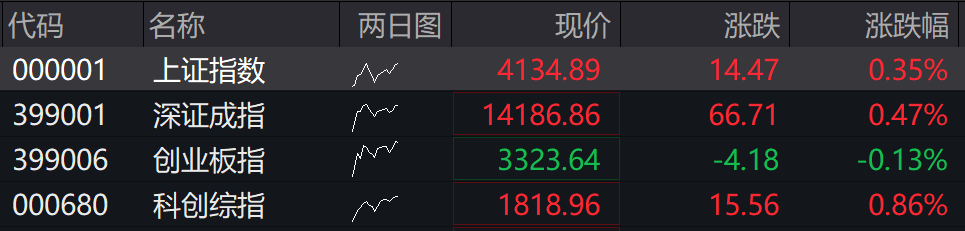
Market Overview - The A-share market opened with the Shanghai Composite Index up by 0.35% and the Shenzhen Component Index up by 0.47%, while the ChiNext Index opened down by 0.13% [1][2] - The Science and Technology Innovation Board Index increased by 0.86%, reaching 1818.96 points [2] Sector Performance - AI application themes are active, with e-commerce and short drama gaming sectors showing significant gains [1][2] - The commercial aerospace index continues to strengthen, with companies like Jili Rigging and Hangxiao Steel Structure achieving three consecutive trading limit increases [1] - Energy metal concept stocks are also gaining traction, while CPO and photovoltaic concept stocks are weakening [2] Individual Stock Movements - Tianpu Co., Guosheng Technology, and Jiamei Packaging are notable stocks, with Tianpu Co. opening at a limit down due to an investigation by the China Securities Regulatory Commission [2] - Guosheng Technology rose nearly 8%, and Jiamei Packaging hit the trading limit [2] - Defu Technology opened down over 11% after terminating the acquisition of 100% equity in a Luxembourg copper foil company [3][4] Hong Kong Market - The Hang Seng Index opened up by 0.55%, with the Hang Seng Tech Index rising by 0.88% [5][6] - Notable gainers include WuXi Biologics, Meituan, Baidu Group, Zijin Mining, and Bilibili, all rising over 2% [5] - Zhipu AI, referred to as the "first global large model stock," surged nearly 15% [5] Economic Indicators - The central bank conducted a 861 billion yuan reverse repurchase operation with an interest rate of 1.4%, while 500 billion yuan of reverse repos matured on the same day [6] - The RMB to USD central parity rate was reported at 7.0108, an increase of 20 basis points from the previous day [6]


日度策略参考-20260109
Guo Mao Qi Huo· 2026-01-09 05:51
Report Industry Investment Rating No relevant content provided. Core View of the Report - The market sentiment cooled slightly yesterday, with the commodity market weakening significantly and the stock index showing a volatile trend. The trading volume also contracted. After a rapid rise, the stock index has entered a stage of shock consolidation. There are no obvious macro-level negatives at present, and the short-term outlook for the stock index remains bullish. The bond futures are favored by the asset shortage and weak economy, but the central bank has recently warned of interest rate risks. Attention should be paid to the Bank of Japan's interest rate decision. [1] - The prices of various commodities are affected by different factors, such as supply and demand, policy changes, and macro sentiment. The report provides trend judgments and trading suggestions for each commodity, including metals, energy, chemicals, and agricultural products. [1] Summary by Related Catalogs Macro Finance - Stock Index: After a rapid rise, the stock index has entered a stage of shock consolidation. There are no obvious macro-level negatives at present, and the short-term outlook for the stock index remains bullish. Attention should be paid to capital flows and market sentiment changes. [1] - Treasury Bonds: The bond futures are favored by the asset shortage and weak economy, but the central bank has recently warned of interest rate risks. Attention should be paid to the Bank of Japan's interest rate decision. [1] Non-Ferrous Metals - Copper: The copper price has fallen from its recent high, but there are still disruptions in the mining end. The downside space for the copper price is expected to be limited. [1] - Aluminum: There has been an accumulation of domestic electrolytic aluminum stocks recently, and the industrial driving force is limited. The macro anti-involution sentiment has ebbed, and the aluminum price has fallen from its high. [1] - Alumina: The supply side of alumina still has a large release space, and the industrial side exerts downward pressure on the price. However, the current price is basically near the cost line, and the price is expected to fluctuate. [1] - Zinc: The fundamentals of zinc have improved, and the cost center has shifted upward. The recent macro sentiment has been good, and the zinc price has risen. However, considering the still existing pressure on the fundamentals, caution is advised regarding the upside space. [1] - Nickel: The market's concerns about nickel supply have significantly cooled, and the LME nickel inventory has increased significantly recently. The nickel price has corrected from its high. Since Indonesia has not disclosed the specific amount and said that it is still in the process of accounting, there is still uncertainty about the implementation of the subsequent policy. The short-term volatility risk of the nickel price has increased. Attention should be paid to the implementation of Indonesia's policy, changes in macro sentiment, and changes in futures positions, and risk control should be done well. [1] Precious Metals and New Energy - Gold and Silver: The annual weight adjustment of the BCOM index has officially started, and the exchange has introduced multiple risk control measures for silver to suppress speculative enthusiasm. The prices of precious metals have fallen across the board, with a significant decline in silver. In the short term, gold and silver are expected to continue to be weak and volatile. In the medium and long term, attention can be paid to the opportunity to buy on dips after this round of risk release. [1] - Platinum and Palladium: Platinum and palladium have followed the weakening of precious metals. In the short term, they are expected to be in a wide-range volatile pattern. In the medium and long term, with the still existing supply-demand gap for platinum and the tendency of palladium to have a loose supply, platinum can still be bought on dips or a [long platinum, short palladium] arbitrage strategy can be adopted. [1] Industrial Products - Industrial Silicon: There is an increase in production in the northwest and a decrease in production in the southwest. The production schedules for polysilicon and organic silicon in December have decreased. [1] - Polysilicon: It is the traditional peak season for new energy vehicles. The demand for energy storage is strong. The supply side has increased production resumption. There is a short-term rapid increase. [1] - Rebar and Hot Rolled Coil: In the short term, sentiment and capital have a greater influence than industrial contradictions. One can try to follow long positions with a stop-loss; for futures-spot trading, participate in positive spread positions. [1] - Iron Ore: There is sector rotation, but the upside pressure on iron ore is obvious. It is not recommended to chase long positions at this level. [1] - Non-Ferrous Metals: There is a combination of weak reality and strong expectations. The current supply and demand situation remains weak, but in terms of expectations, energy consumption double control and anti-involution may have an impact on supply. [1] - Soda Ash: Soda ash follows the trend of glass. In the medium term, the supply and demand situation will be more relaxed, and the price will be under pressure. [1] - Coking Coal and Coke: If the "capacity reduction" expectation continues to ferment and there is pre-holiday restocking of spot goods, coking coal may still have room to rise. However, since the current market's "capacity reduction" expectation mainly comes from online rumors, it is difficult to judge the actual upside space. After a significant increase, the volatility will intensify, and caution should be exercised. The logic for coke is the same as that for coking coal. [1] Agricultural Products - Palm Oil: The MPOB December data is expected to be bearish for palm oil, but palm oil will reverse under the themes of seasonal production reduction, the B50 policy, and US biodiesel in the future. Short-term rebounds due to macro sentiment should be watched out for. [1] - Soybean Oil: The fundamentals of soybean oil are relatively strong. It is recommended to allocate more in the oil sector and consider a long Y, short P spread. Wait for the January USDA report. [1] - Rapeseed Oil: The trade relationship between China and Canada may improve, and Australian rapeseed will be imported smoothly. After the rapeseed trade flow is opened up, the trading logic of rapeseed oil will gradually shift from the domestic tight supply situation to the global rapeseed production increase expectation. There is still room for the price to fall. Short-term rebounds due to macro sentiment should be watched out for. [1] - Cotton: There is a strong expectation of a good harvest for domestic new crops, and the purchase price of seed cotton supports the cost of lint cotton. The downstream operating rate remains low, but the inventory of yarn mills is not high, and there is a rigid demand for restocking. Considering the growth of spinning capacity, the demand for cotton in the new crop market year is relatively resilient. Currently, the cotton market is in a situation of "having support but no driving force." Future attention should be paid to the tone of the No. 1 Central Document in the first quarter of next year regarding the direct subsidy price and cotton planting area, the intention of cotton planting area next year, the weather during the planting period, and the demand during the "Golden Three and Silver Four" peak season. [1] - Sugar: Currently, there is a global surplus of sugar, and the supply of domestic new crops has increased. The short-selling consensus is relatively strong. If the futures price continues to fall, there will be strong cost support below. However, there is a lack of continuous driving force in the short-term fundamentals. Attention should be paid to changes in the capital side. [1] - Corn: The fundamentals of corn have not changed significantly. The spot price remains firm, and the progress of grain sales at the grassroots level is relatively fast. Most traders have not yet strategically built inventories, and feed enterprises maintain a safe inventory. There is a certain restocking demand before the holiday. The short-term outlook for CO3 is expected to be oscillating and slightly bullish. Attention should be paid to the dynamics of policy grain auctions. [1] - Soybean Meal: The domestic market may restart the auction of imported soybeans; the relationship between China and Canada is expected to ease, and China is expected to suspend the tax on Canadian rapeseed meal; the macro sentiment has cooled, and the domestic market has returned to the fundamentals and shown a significant decline. Recently, it has been greatly affected by policy news. The soybean meal futures price is expected to be mainly oscillating in the short term. Attention should be paid to the adjustment of the January USDA supply and demand report and the trend of the Brazilian premium. [1] - Pulp: Pulp has fallen today due to the decline in the commodity macro market. The overall price has not broken through the oscillating range. The short-term commodity sentiment fluctuates greatly, and it is recommended to observe cautiously. [1] - Logs: The spot price of logs has shown a certain sign of bottoming out and rebounding recently. The further downside space for the futures price is expected to be limited. However, the January overseas quotation has still slightly declined, and the log futures and spot markets lack upward driving factors. It is expected to oscillate in the range of 760 - 790 yuan/m³. [1] - Hogs: Recently, the spot price has gradually stabilized. Supported by demand and with the出栏体重 not yet fully cleared, the production capacity still needs to be further released. [1] Energy and Chemicals - Crude Oil: OPEC+ has suspended production increases until the end of 2026. There is uncertainty about the Russia-Ukraine peace agreement. The United States has imposed sanctions on Venezuela's crude oil exports. [1] - Fuel Oil: In the short term, the supply-demand contradiction is not prominent, and it follows the trend of crude oil. The probability of the 14th Five-Year Plan's rush demand being falsified is high, and the supply of Ma Rui crude oil is not short. The profit of asphalt is relatively high. [1] - BR Rubber: The futures position has declined, and the number of new warehouse receipts has increased. The increase in BR has slowed down temporarily. The spot price has led the rise to repair the basis, and BR continues to focus on the upward momentum above the 12,000 yuan line. The listed prices of BD/BR have been continuously raised, and the processing profit of butadiene rubber has narrowed. The overseas cracking device capacity has been cleared, which is beneficial to the long-term export expectation of domestic butadiene. The tax on naphtha also has a positive impact on the butadiene price. Fundamentally, butadiene rubber maintains high production and high inventory operation, and the trading center is generally average. Styrene-butadiene rubber is relatively better than butadiene rubber. [1] - PX and PTA: The PX market has experienced a rapid rise, but this round of rise is not due to a fundamental change. The fundamentals of PX do have support, and the market is expected to continue to tighten in 2026, driven by the new PTA production capacity in India and the organic growth of demand. Domestic PTA maintains high production. The gasoline spread is still at a high level, which supports aromatics. [1] - Ethylene Glycol: There is news that two sets of MEG plants in Taiwan, China, with a total annual capacity of 720,000 tons, plan to stop production next month due to efficiency reasons. Ethylene glycol has rebounded rapidly during the continuous decline, stimulated by supply-side news. The current operating rate of the polyester downstream remains above 90%, and the demand performance is slightly better than expected. [1] - Short Fiber: The PX market has experienced a rapid rise, but this round of rise is not due to a fundamental change. Domestic PTA maintains high production, and the domestic polyester load has declined. The short fiber price continues to closely follow the cost fluctuations. [1] - Styrene: The Asian styrene market is generally stable. Suppliers are reluctant to lower prices due to continuous losses, while buyers insist on pressing prices due to weak downstream polymer demand and compressed profits. Although the downstream demand is weak, the domestic market has a strong bullish sentiment due to export support. The market is in a weak balance state, and the short-term upward momentum needs to be driven by the overseas market. [1] - Urea: The export sentiment has slightly eased, and there is limited upside space due to insufficient domestic demand. There is support from anti-involution and the cost side below. [1] - PF: Geopolitical conflicts have intensified, and there is a risk of an increase in crude oil prices. There are fewer maintenance activities, the operating load is at a high level, and there are overseas arrivals, so the supply has increased. The downstream demand operating rate has weakened. In 2026, there will be more new production capacity, and the supply-demand surplus will further intensify, and the market expectation is weak. [1] - Propylene: There are fewer maintenance activities, the operating load is relatively high, and the supply pressure is relatively large. The improvement in the downstream is less than expected. The propylene monomer price is at a high level, the crude oil price has risen, and the cost support is strong. Geopolitical conflicts have intensified, and there is a risk of an increase in crude oil prices. [1] - PVC: In 2026, there will be less global new production capacity, and the future expectation is relatively optimistic. Currently, there are fewer maintenance activities, new production capacity is being released, and the supply pressure is increasing. The demand has weakened, and the orders are not good. The differential electricity price in the northwest region is expected to be implemented, which will force the clearance of PVC production capacity. [1] - LPG: The January CP has risen more than expected, and the cost support for imported gas is relatively strong. The geopolitical conflicts between the United States, Venezuela, and the Middle East have escalated, and the short-term risk premium has increased. The trend of inventory accumulation in the EIA weekly C3 inventory has slowed down, and it is expected to gradually turn to inventory reduction. The domestic port inventory has also decreased. Domestic PDH maintains high production and deep losses. There is a rigid demand for global civil combustion, and the demand for MTBE from overseas olefin blending for gasoline has declined temporarily. Since January 1, 2026, naphtha has been re-taxed, and the long-term demand expectation for light cracking raw materials such as LPG has increased, and the performance of downstream olefin products is relatively strong. [1] Shipping - Container Shipping - European Line: It is expected to peak in mid-January. Airlines are still relatively cautious in their trial reflights. The pre-holiday restocking demand still exists. [1]
商品日报(1月8日):金属板块普遍回调 多晶硅多数合约封板跌停
Sou Hu Cai Jing· 2026-01-09 00:51
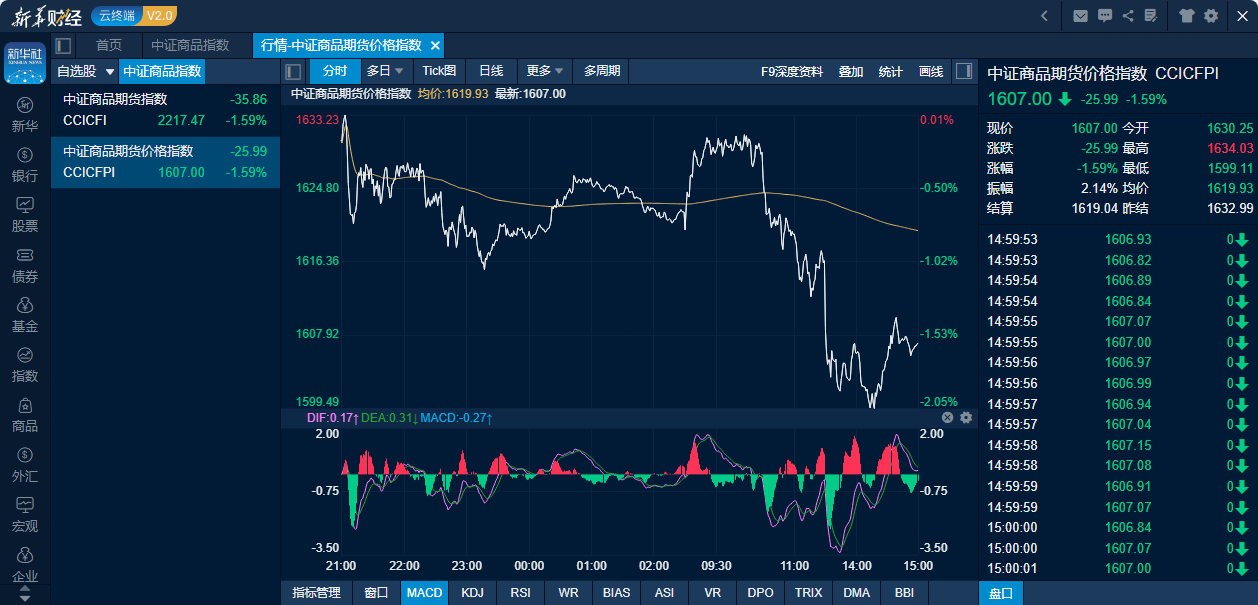
Market Overview - The domestic commodity futures market experienced a high-level correction on January 8, with significant declines in the metal sector. The China Securities Commodity Futures Price Index closed at 1607.00 points, down 25.99 points or 1.59% from the previous trading day [1] - The China Securities Commodity Futures Index also fell to 2217.47 points, a decrease of 35.86 points or 1.59% [1] Metal Sector Performance - The metal sector saw widespread declines, with nearly all contracts for polysilicon hitting the daily limit down, while platinum, nickel, and silver dropped around 6%. Industrial silicon and palladium fell over 4% and 3%, respectively, and copper, aluminum, and lead also decreased by more than 2% [1] - In contrast, the black chain commodities continued to show a rebound, with coking coal rising nearly 5%, leading the market, while coke increased over 2%. Iron ore saw a brief rise of nearly 2% but later fluctuated downwards [1] Coking Coal Insights - Coking coal maintained a strong performance, closing up over 4% despite a noticeable retreat from its night session highs. The supply side remains relatively tight, and the overall valuation of the black series is low, making it susceptible to positive factors [3] - Market sentiment has cooled, and recent data indicates a renewed accumulation of steel inventory, reflecting weak terminal demand. The outlook suggests that while coking coal supply and demand are balanced, market movements will be driven by macro sentiment and funding [3] Glass Market Trends - The main contract for glass continued its strong performance, closing up 2.65%. This was supported by rising coal prices and a slight improvement in the spot market, leading to a 2.37% decrease in national float glass inventory [4] - However, demand remains weak, with processing orders declining. The industry is expected to continue reducing capacity, with daily melting rates anticipated to drop below 150,000 tons [4] Polysilicon Market Dynamics - On January 8, polysilicon contracts faced significant declines, with most contracts hitting the daily limit down, resulting in a 9% drop. This was primarily driven by rumors of regulatory scrutiny regarding monopolistic risks in the polysilicon market [5] - Despite some production cuts in polysilicon supply regions, demand is also weakening, leading to a continued accumulation trend in January. Analysts suggest that the market may return to a marginal cost pricing model, which could stabilize prices once terminal demand improves [5][6] Shipping Market Conditions - The shipping market, particularly the European route, is experiencing heightened pessimism due to price cuts from major shipping companies like Maersk and CMA CGM. This has led to increased selling pressure on the main contracts [6] - Concerns are growing that if shipping volumes do not meet expectations before the Spring Festival peak, it could further negatively impact the shipping market [6]
每日期货全景复盘1.8:多晶硅价格大幅回调,焦煤日内波动加剧!
Xin Lang Cai Jing· 2026-01-08 11:43
Market Overview - The market sentiment is weak, with significant declines in polysilicon prices, which fell by 9% to reach a limit down [2][10] - Coal prices are rising, while shipping rates have dropped by nearly 9% [2][10] Polysilicon Market - The main polysilicon futures contract hit a limit down, closing at 53,610 yuan, marking a nearly one-month low [10][25] - Regulatory changes emphasize a market-driven approach to capacity reduction, shifting expectations from organizational coordination to technological iteration and market competition [4][10] - Weak demand and high inventory levels are limiting high-price transactions, leading to a significant price correction [10][25] Coal Market - The main coking coal futures contract is experiencing increased volatility, closing at 1,190 yuan per ton, still at a one-month high [11][26] - Recent price increases are attributed to market sentiment and funding rather than fundamental changes, with macroeconomic conditions improving [11][26] - Supply-side rumors and reduced coal imports from Mongolia are supporting coal prices, although the market remains cautious about future price increases [12][27] Shipping Market - The main European shipping contract (EC2602) fell by 8.98%, reflecting a lack of pricing power from shipping companies [12][28] - The market is facing pessimistic sentiment due to weak demand and insufficient price increases, with expectations of continued operational control by shipping companies [12][28] - Seasonal pricing strategies may lead to further price reductions as companies seek to maintain vessel utilization rates ahead of the Chinese New Year [12][28]

建信期货集运指数日报-20260108
Jian Xin Qi Huo· 2026-01-08 01:34
Report Information - Report Name: Container Shipping Index Daily Report [1] - Date: January 8, 2026 [2] - Research Team: Macro Financial Research Team [4] - Researchers: He Zhuoqiao, Huang Wenxin, Nie Jiayi [3] Industry Investment Rating - Not mentioned in the report Core Viewpoints - The SCFIS index rebounded 3.1% to 1795.83 points this week. The freight rate in early January was maintained at around $2880, and the cargo collection was in good condition. There is still an upward expectation for the price increase in late January, and there may be some upward space for the February contract. However, the expectation of resuming navigation in the Red Sea after the Spring Festival may heat up, and attention should be paid to the short - selling opportunity of the April contract in the off - season and the positive spread arbitrage opportunity between the 02 and 04 contracts [8] Summary by Directory 1. Market Review and Operation Suggestions - Spot market: The SCFIS index rose 3.1% to 1795.83 points this week. The freight rate in early January was around $2880, and the cargo collection was good. The late - January quotation is in the range of $2700 - 3100, and the Maersk's fourth - week opening price of $2800 is better than expected. There is still an upward expectation for the February contract, but attention should be paid to the short - selling opportunity of the April contract in the off - season and the 02 - 04 positive spread arbitrage opportunity [8] 2. Industry News - From December 22 to 26, 2025, the China Export Container Shipping Market showed a good trend, and the comprehensive index rose. The European economy was weak in 2025, with high geopolitical and energy security risks. The spot market booking price in the European and Mediterranean routes rose during the signing season. The North American employment market showed a slight recovery, and the freight rate also increased. Multiple shipping companies announced price hikes and PSS adjustments. Military operations in the Middle East continued, and there were uncertainties about Maersk's resumption of Red Sea - Suez Canal navigation [9][10] 3. Data Overview - **Container shipping spot prices**: The SCFIS European route index rose 3.1% to 1795.83 points from December 29, 2025, to January 5, 2026, while the US - West route index fell 3.9% to 1250.12 points [12] - **Container shipping index (European line) futures market**: Provided trading data for multiple contracts such as EC2602, EC2604, etc., including opening price, closing price, settlement price, etc. [6] - **Shipping - related data trend charts**: Included data on European container ship capacity, global container ship orders, Shanghai - European basic port freight rates, etc. [18][20]