能源业

Search documents
资讯早班车-2025-12-03-20251203
Bao Cheng Qi Huo· 2025-12-03 01:26
投资咨询业务资格:证监许可【2011】1778 号 期货研究报告 资讯早班车-2025-12-03 一、 宏观数据速览 | 发布日期 | 指标日期 | 指标名称 | 单位 | 当期值 | 上期值 | 去年同期值 | | --- | --- | --- | --- | --- | --- | --- | | 20251020 | 2025/09 | GDP:不变价:当季同比 | % | 4.80 | 5.20 | 4.60 | | 20251130 | 2025/11 | 制造业 PMI | % | 49.20 | 49.00 | 50.30 | | 20251130 | 2025/11 | 非制造业 PMI:商务活 动 | % | 49.50 | 50.10 | 50.00 | | 20251114 | 2025/10 | 社会融资规模增量:当 | 亿元 | 8161.00 | 35299.00 | 14120.00 | | | | 月值 | | | | | | 20251113 | 2025/10 | M0(流通中的现金):同 比 | % | 10.60 | 11.50 | 12.80 | | 202511 ...
港股收评:恒指涨0.67%、科指涨0.82%,有色金融、航运股走高,加密货币及新消费概念股走低
Sou Hu Cai Jing· 2025-12-01 08:49
Market Overview - The Hong Kong stock market showed a slight upward trend, with the Hang Seng Index rising by 0.67% to close at 26,033.26 points, and the Hang Seng Tech Index increasing by 0.82% to 5,644.76 points [1] - Major technology stocks mostly rose, with Alibaba up 2.24%, Tencent up 1.31%, and JD Group up 0.52%. However, Xiaomi fell by 1.76% and Meituan dropped by 2.88% [1] - The metals sector saw significant gains, with China Nonferrous Mining rising over 13% [1] - Cryptocurrency-related stocks generally declined, with New Fire Technology Holdings down over 9% [1] Company News - Meituan reported Q3 revenue of 95.5 billion yuan, a year-on-year increase of 2%, but its core local business operating profit turned negative, resulting in a loss of 14.1 billion yuan [2] - China Gas reported revenue of 34.481 billion HKD and a profit of 1.334 billion HKD for the six months ending September 30, 2025 [3] - Yingtong Holdings reported a revenue of 1.028 billion RMB, a year-on-year decrease of 3.42%, but net profit increased by 15.4% to 133 million RMB [3] - Jihai Resources reported a revenue of 450 million RMB, a year-on-year increase of 23.41%, with a net profit of 88.127 million RMB, up 2.98% [3] - Yuhua Education reported annual revenue of 2.497 billion RMB, a year-on-year increase of 5.4%, and a net profit of 930 million RMB, up 133.2% [3] - Huitai Textile reported mid-term revenue of 2.524 billion HKD, a year-on-year decrease of 6.72%, and a net profit of 79.322 million HKD, down 25.77% [3] - Huaxin Handbag International reported revenue of 432 million HKD, a year-on-year increase of 22.55%, and a profit of 48.262 million HKD, up 78.88% [4] Institutional Insights - GF Securities noted that the foundation for a bull market in Hong Kong stocks remains intact, but the evolution may present a "volatile upward, gradually rising" characteristic rather than a rapid increase [12] - Dongwu Securities indicated that short-term risk factors in Hong Kong stocks are decreasing, but a catalyst is needed for confirmation of a rebound [12] - Everbright Securities suggested that compared to previous bull markets, there is still significant room for index growth, but the duration of the bull market may be more important than the magnitude of the increase [12] - CICC highlighted that dividends have become a preferred choice in the current market environment, with the banking sector rebounding nearly 10% since the end of September [13]
AH股市场周度观察(11月第4周)-20251129
ZHONGTAI SECURITIES· 2025-11-29 11:36
Group 1: A-Share Market - The A-share market experienced an overall increase, with small-cap stocks outperforming large-cap stocks. The CSI 2000 index and the ChiNext index rose by 4.99% and 4.54% respectively, while the SSE 50 index only increased by 0.47% [6] - The market's structural rise was primarily driven by positive developments in the technology sector, particularly a significant partnership between Google and Meta, which is expected to enhance the performance of core hardware suppliers like Zhongji Xuchuang [6][7] - Looking ahead, the technology growth sector is anticipated to remain a market focus due to strong government support for technological self-reliance. However, a decrease in trading volume may indicate reduced investor enthusiasm for high-priced stocks, leading to potential rapid rotations and short-term volatility in specific sectors [7] Group 2: Hong Kong Market - The Hong Kong market also saw gains, with the Hang Seng Technology Index leading the way with a 3.77% increase, while the Hang Seng Index rose by 2.53%. The materials, discretionary consumer, and healthcare sectors performed well, whereas the energy sector declined [8] - The positive performance in the Hong Kong market was largely influenced by sentiment and policy expectations from the mainland, particularly a new implementation plan aimed at enhancing the adaptability of supply and demand for consumer goods [8] - Future trends in the Hong Kong market are expected to closely align with mainland policies and market sentiment. The technology and healthcare sectors are likely to benefit from ongoing policy support, while investors should remain vigilant regarding the Federal Reserve's policy direction and its impact on global liquidity [8]
宝城期货资讯早班车-20251128
Bao Cheng Qi Huo· 2025-11-28 05:14
投资咨询业务资格:证监许可【2011】1778 号 期货研究报告 资讯早班车-2025-11-28 一、 宏观数据速览 | 发布日期 | 指标日期 | 指标名称 | 单位 | 当期值 | 上期值 | 去年同期值 | | --- | --- | --- | --- | --- | --- | --- | | 20251020 | 2025/09 | GDP:不变价:当季同比 | % | 4.80 | 5.20 | 4.60 | | 20251031 | 2025/10 | 制造业 PMI | % | 49.00 | 49.80 | 50.10 | | 20251031 | 2025/10 | 非制造业 PMI:商务活 动 | % | 50.10 | 50.00 | 50.20 | | 20251113 | 2025/10 | 社会融资规模增量:当 | 亿元 | 8161.00 | 35299.00 | 14120.00 | | | | 月值 | | | | | | 20251113 | 2025/10 | M0(流通中的现金):同 比 | % | 10.60 | 11.50 | 12.80 | | 202511 ...

气候转型风险压力测试框架
Shi Jie Yin Hang· 2025-11-27 08:41
Investment Rating - The report does not explicitly provide an investment rating for the banking sector in Albania, but it emphasizes the importance of understanding and managing climate-related financial risks as a foundation for future assessments [12][20]. Core Insights - The report represents the first climate transition risk stress test for the Albanian banking sector, aimed at assessing the impact of transitioning to a low-carbon economy under different climate policy scenarios [12][14]. - It identifies key climate-related risks and transmission mechanisms affecting financial institutions, focusing on how the banking sector can adapt to economic changes brought about by the introduction of carbon taxes [13][20]. - The analysis predicts a moderate negative impact on GDP by 2030 across three climate transition scenarios, with the orderly NDC scenario causing the least disruption [14][16]. Summary by Sections 1. Introduction - Climate financial risks pose significant challenges to the financial sector, including both physical risks from climate-related disasters and transition risks from moving to a low-carbon economy [22]. 2. Methodology - The report employs a four-step framework for climate transition risk stress testing, including scenario development, macroeconomic modeling, credit risk assessment, and a stress testing model [39][70]. 3. Low-Carbon Transition Scenarios - Three low-carbon transition scenarios are evaluated, with the orderly NDC scenario projected to achieve a 21% reduction in emissions by 2030 compared to the business-as-usual (BAU) scenario [75][80]. 4. Macroeconomic and Sectoral Impacts - The orderly NDC scenario is expected to lead to gradual adoption of carbon taxes, incentivizing low-carbon technologies while causing moderate inflation and slight declines in domestic consumption and exports [14][16]. 5. Impact on the Financial Sector - The banking sector's performance remains robust, with limited increases in non-performing loan (NPL) ratios during orderly transitions, but higher credit risks in sectors like industry and construction during disorderly transitions [16][20]. 6. Conclusions and Policy Implications - The findings highlight the need for enhanced regulatory guidance and alignment with international disclosure standards to effectively manage climate-related risks in the Albanian banking sector [20][36].
专访彭博全球首席经济学家:巨变潮涌,美国全球贸易份额正在收缩
2 1 Shi Ji Jing Ji Bao Dao· 2025-11-24 12:24
Group 1: Global Trade and Economic Impact - The escalation of U.S. tariff policies is significantly altering global trade structures and economic growth paths, with average tariffs rising from approximately 2% to about 15% under the Trump administration, leading to a projected 20% decline in exports to the U.S. compared to a no-tariff scenario [2][14] - The World Trade Organization (WTO) warns that Trump's tariffs are causing unprecedented damage to the international trade system, predicting only a 0.5% growth in global goods trade by 2026 [2] - The global economic growth rate is expected to slow to 2.9% in 2026, down from 3.2% in 2025, partly due to the delayed impact of tariffs as companies are currently in a phase of inventory digestion [3][5] Group 2: U.S. Economic Outlook - Despite the absence of stagflation in the U.S. currently, risks remain as tariffs begin to affect consumer prices, and the labor market shows signs of slowing down [3][7] - The potential for stagflation in the U.S. economy cannot be ruled out for 2026, as the transmission of tariffs to consumer prices is just beginning [7] - The U.S. economy's resilience is currently supported by significant capital expenditures in data centers driven by AI, despite tariffs being a drag on growth [7] Group 3: European Economic Dynamics - Europe is facing long-term structural challenges, including an aging population and high debt levels in countries like France and Italy, compounded by geopolitical risks such as the Russia-Ukraine conflict [8][9] - However, there are positive developments, such as the "Draghi Report" proposing systemic reforms for stronger growth and Germany's commitment to significantly increase infrastructure and defense spending [9] Group 4: Currency and Capital Flow - The dominance of the U.S. dollar is being questioned, but there are no ideal alternatives, as options like the euro and gold have their limitations [10] - A decline in the dollar's role could lead to reduced demand for U.S. Treasury bonds, resulting in higher overall interest rates, which could have profound implications for the U.S. economy [11] - If the Federal Reserve's rate cuts outpace those of other central banks, it may lead to capital outflows from the U.S. as investors seek higher returns elsewhere [13][12] Group 5: China's Economic Transition - China is at a critical stage of economic transition, with traditional sectors like real estate declining while high-end manufacturing in AI, electric vehicles, and sustainable energy is on the rise [4][15] - The growth data and price pressures in China will continue to be affected by old industries in the near term, but the emergence of high-end manufacturing is expected to drive growth into the 2030s [15]


日度策略参考-20251124
Guo Mao Qi Huo· 2025-11-24 06:24
Report Industry Investment Ratings No specific industry investment ratings are provided in the report. Core Views - The current macro - level is in a relatively vacuum period, and A - shares lack a clear upward mainline. The market trading volume remains low, and short - term market differences are expected to be gradually digested during the index's shock adjustment. New driving mainlines are awaited for further index upward movement [1]. - Asset shortage and weak economy are beneficial to bond futures, but the central bank has recently warned of interest - rate risks, suppressing the upward space [1]. - There are various trends and influencing factors for different commodities, such as metals, energy, and agricultural products, with most prices expected to maintain a volatile trend, and some having specific supply - demand and macro - factor - related outlooks [1]. Summary by Related Catalogs Stock Index - The current macro - level is in a vacuum, A - shares lack an upward mainline, trading volume is low, and short - term market differences will be digested in index shock adjustment. New driving mainlines are needed for further upward movement [1]. Treasury Bonds - Asset shortage and weak economy are good for bond futures, but short - term central - bank interest - rate risk warnings suppress the upward space [1]. Non - ferrous Metals - **Copper**: The expectation of a December Fed rate cut has cooled, causing copper price to回调. However, the Fed is still in a rate - cut cycle, and there are still disturbances at the mine end, so the callback range is expected to be limited [1]. - **Aluminum**: Recently, industrial - side driving forces are limited, and macro - sentiment is volatile, so the aluminum price is running in a high - level shock [1]. - **Alumina**: With domestic alumina production capacity continuously releasing, production and inventory are both increasing, the fundamental situation is weak, and the price is oscillating around the cost line [1]. - **Zinc**: There are signs of short - term domestic improvement in the fundamentals, but the surplus pattern remains unchanged. With the Fed's internal differences on the December rate cut, the zinc price is expected to maintain a shock trend [1]. - **Nickel**: The Fed has large internal differences on the December rate cut, and the macro - sentiment is volatile. Indonesia has restricted nickel - related smelting project approvals again. Recently, the planned production cut of Indonesian intermediate products may affect about 6000 metal tons in July. If the macro - sentiment improves, the nickel price has a repair expectation. In the long - term, the primary nickel market will continue to be in a surplus pattern [1]. - **Stainless Steel**: The Fed's internal differences on the December rate cut are large, and the macro - sentiment is volatile. The price of raw - material nickel - iron has weakened again, and the social inventory of stainless steel has increased. The November production cut of steel mills is limited. The stainless - steel futures are searching for the bottom in shock [1]. - **Tin**: The Fed's internal differences are increasing, and the macro - sentiment is expected to be volatile. The long - term view on tin is bullish due to the significant decline in Indonesian tin export scale, unrepaired tin - ore supply, and expected terminal - downstream demand [1]. Precious Metals and New Energy - **Precious Metals**: Fed officials have soothed the market, and the probability of a December rate cut has rebounded. Precious - metal prices may fluctuate [1]. - **Industrial Silicon**: There is an expectation of medium - long - term capacity reduction. In the fourth quarter, terminal installation has a marginal increase. Northwest production capacity is continuously resuming, and the southwest's start - up is weaker than in previous years, with the impact of the dry season weakening [1]. - **Polysilicon**: The production schedule in November has decreased [1]. - **Organic Silicon**: There has been a joint production cut [1]. - **Lithium Carbonate**: The traditional peak season for new energy vehicles is approaching, energy - storage demand is strong, and there is supply - side resumption and production increase. But there are concerns about potential weakening of industrial demand in the off - season [1]. Building Materials and Energy - **Rebar**: The industry off - season effect is not obvious, but the industrial structure is still loose. In the short - term macro - vacuum period, the basis is acceptable, and it is advisable to participate in spot - futures positive arbitrage or use option strategies to optimize costs or sales profits [1]. - **Hot - Rolled Coil**: The near - month is restricted by production cuts, but the commodity sentiment is good, and the far - month still has upward opportunities [1]. - **Iron Ore**: The direct demand is okay, and there is cost support, but the supply is high, inventory is accumulating, and the sector is under pressure. The price rebound space is limited [1]. - **Coke and Coking Coal**: From a valuation perspective, this round of decline is close to the end. The coke price at 1630 reflects the expectation of 2 - 3 rounds of price cuts, and coking - coal contracts are also close to key support levels. Further decline requires continuous increase in coking - coal supply. Downstream is expected to start a new round of replenishment around mid - December [1]. - **Glass**: It follows the glass trend, but the supply - demand situation is average, and there is significant upward resistance [1]. - **Soda Ash**: The valuation indicates that this round of decline is close to the end, and the driving force may need more time. Downstream is expected to start replenishment around mid - December [1]. Agricultural Products - **Palm Oil**: High - frequency data shows increased production and reduced exports in the origin, and the near - month pressure is still high. Domestic ship - buying is active, and the basis is expected to be weak. The risk lies in a significant production cut in the origin [1]. - **Soybean and Soybean Oil**: The rumor of "US delaying the implementation of preferential cuts for imported bio - fuel raw materials" has been refuted, which has a positive expected difference for US soybeans and US soybean oil. Under high domestic crushing, the basis may be stable or slightly weak [1]. - **Rapeseed Oil**: The industry is optimistic about the replenishment of Australian rapeseed and imported crude rapeseed oil, and the trend remains unchanged, so it is advisable to wait and see [1]. - **Cotton**: There is a strong expectation of a domestic new - crop harvest, and the purchase price of seed cotton supports the cost of lint cotton. The downstream start - up remains low, but the yarn - mill inventory is not high, with rigid replenishment demand [1]. - **Sugar**: The global sugar supply has shifted from shortage to surplus, and the domestic new - crop supply pressure has increased year - on - year. Zhengzhou sugar futures are expected to be under pressure and follow the raw - sugar price [1]. - **Corn**: Short - term factors such as farmers' reluctance to sell, tight logistics in the Northeast, and low downstream inventory have led to a temporary supply shortage. The selling pressure is postponed, and the market's acceptance of high - price corn is limited before the supply pressure is fully released [1]. - **Soybean Meal**: Short - term attention should be paid to China's purchase of US soybeans. From December to January, the market is expected to gradually shift to trading the pressure of a bumper South American new crop. MO5 is recommended to be shorted on rallies [1]. Pulp and Wood - **Paper Pulp**: The pulp - futures price has risen above the registration - warehouse - receipt cost of most coniferous - pulp delivery products, and the upward space is limited. After new warehouse - receipts are registered, 1 - 3 reverse arbitrage can be considered [1]. - **Log**: The fundamental situation of logs has weakened, but it has been priced in the market. After a sharp decline in the futures price, the profit - loss ratio of short - selling is low, so it is advisable to wait and see [1]. Livestock - **Pig**: Recently, the spot price has gradually stabilized. With demand support and the un - cleared slaughter weight, the production capacity still needs to be further released [1]. Energy and Chemicals - **Crude Oil**: OPEC + plans to continue a small - scale production increase in December, the Russia - Ukraine peace agreement is being promoted, and the US has increased a new round of sanctions against Russia [1]. - **Fuel Oil**: It follows the crude - oil trend in the short - term, the demand for the 14th Five - Year Plan construction rush is likely to be falsified, and the supply of Ma Rui crude oil is sufficient. The asphalt profit is high [1]. - **BR Rubber**: The cost - end support of butadiene is insufficient, the supply of synthetic rubber is loose, and high - start - up and high - inventory have not been the main factors suppressing the price. The short - term price shows signs of stopping the decline [1]. - **PTA**: Gasoline profit and low benzene price support PX. Overseas and some domestic device malfunctions have led to a decline in the load of reforming devices. Domestic large - scale PTA devices are undergoing rotational inspections, and domestic PTA production has decreased [1]. - **Ethylene Glycol**: The crude - oil price decline has led to a fall in the ethylene - glycol price. The increase in coal price has slightly strengthened the cost support of domestic ethylene glycol. The strong expectation of domestic device commissioning suppresses the increase in ethylene - glycol price [1]. - **Short - Fiber**: Gasoline profit and low benzene price support PX. The PTA price has rebounded, and the short - fiber basis has strengthened. The short - fiber price continues to closely follow the cost [1]. - **Styrene**: The Asian benzene price is still weak, and the start - up rates of STDP devices and reforming devices have decreased. The US pure - benzene price has increased by 30 US dollars, and some US devices have reduced their loads [1]. - **Urea**: There is support from anti - involution and the cost end, but the export sentiment has eased, and domestic demand is insufficient [1]. - **PF**: The number of overhauls has decreased, the start - up load is high, the supply pressure is large, and the downstream improvement is limited [1]. - **PP**: The propylene monomer price is high, providing strong cost support. The supply pressure is increasing due to fewer future overhauls and new - capacity release [1]. - **PVC**: The delivery of Guangxi alumina has started, some alumina plants have postponed production, and the delivery rhythm has slowed down. There is a risk of a short squeeze due to low absolute prices and limited near - month warehouse receipts [1]. - **LPG**: The international oil - gas fundamental situation is continuously loose, and the CP/FEI price has weakened. The domestic spot fundamental situation is stable, with price - valuation repair, restarting of combustion demand, and chemical rigid - demand support [1]. Shipping - **Asia - Europe Line**: The macro - positive sentiment has been gradually digested, the peak - season price - increase expectation has been priced in advance, and the shipping - capacity supply in November is relatively loose [1].
研究所晨会观点精萃:美联储官员放鸽,提振全球风险偏好-20251124
Dong Hai Qi Huo· 2025-11-24 02:20
Report Industry Investment Rating No relevant information provided. Core View of the Report The recent market trading logic mainly focuses on domestic incremental stimulus policies, the quality of economic growth, and changes in the Fed's monetary policy expectations. The short - term macro upward drive has weakened, with the stock index oscillating in the short term. Attention should be paid to the domestic economic growth situation and the implementation of domestic incremental policies. Different asset classes have different trends and operational suggestions: the stock index and various commodity sectors are in short - term oscillations, and cautious observation is recommended; the national debt is in short - term oscillations, and cautious long - positions are advised [2][3]. Summary by Directory Macro Finance - **Stock Index**: Affected by sectors such as lithium - battery, semiconductor chips, and artificial intelligence, the domestic stock market fell sharply. The slowdown of China's economic data in October and the Fed's previous hawkish signals and then dovish remarks have affected market sentiment. The short - term macro upward drive has weakened, and the stock index is in short - term oscillations. Short - term cautious observation is recommended [3]. - **Precious Metals**: The precious metals market rose slightly on Friday night. Due to the dovish remarks of Fed official Williams, the market's expectation of a December interest rate cut increased. The short - term precious metals are oscillating, and the medium - to - long - term upward pattern remains unchanged. Short - term cautious observation and medium - to - long - term buying on dips are recommended [3]. Black Metals - **Steel**: The domestic steel spot market rebounded slightly on Friday, while the futures price continued to be weak. The LPR rate remained unchanged, and the real demand improved, with the inventory of five major steel products decreasing. The supply increased after the end of environmental protection restrictions in the north. The price does not have the condition for a deep decline, but the short - term upward space is limited. An interval oscillation approach is recommended [4]. - **Iron Ore**: The iron ore spot price fell slightly on Friday, and the futures trend was relatively strong. The production of five major steel products increased, but the proportion of profitable steel mills decreased. The global iron ore shipment volume increased, and the arrival volume decreased. The port inventory continued to decline. The key factor determining the price is the process of the decline in hot metal production and when it bottoms out. Short - term interval oscillation is expected [5]. - **Silicon Manganese/Silicon Iron**: The spot prices of silicon iron and silicon manganese were flat on Friday, and the futures prices continued to be weak. The demand for ferroalloys was acceptable. The supply of manganese ore was tight, and the prices of raw materials for silicon iron were stable. The operating rates and daily outputs of both decreased. The futures prices are expected to continue to oscillate in the interval [6]. - **Soda Ash**: Due to the decline in cost - end prices, the soda ash futures contract was weak last week. The supply decreased slightly due to some device overhauls, but the overall supply pressure remained. The demand for heavy soda was stable, and the demand for light soda slightly recovered. It is expected to oscillate in the short term and be bearish in the medium - to - long - term [7]. - **Glass**: The glass futures contract was weak last week. The glass production decreased due to some device cold repairs, and there is still a cold - repair expectation at the end of the year. The demand weakened, and the inventory increased. The overall supply - demand situation is weak, and it is expected to run weakly in the short term [7]. Non - ferrous Metals and New Energy - **Copper**: Macroscopically, the Fed has internal differences, and the expectation of a December interest rate cut has significantly declined. The US copper inventory is at a historical high, and the domestic refined copper de - stocking is less than expected. The suspension of Indonesia's second - largest copper mine supports the price to some extent. There is a risk of the copper price breaking down in the short term [8][9]. - **Aluminum**: The price of Shanghai aluminum fluctuated greatly on Friday, affected by the decline in the external market and weak bulk sentiment. Although NVIDIA's performance exceeded expectations, concerns about the AI bubble still exist. The downstream replenished inventory at low prices, but the inventory is still at a high level. The aluminum price may have a large correction [9]. - **Tin**: The supply has recovered from the overhaul, and the production of Myanmar's Wa State is expected to increase. The demand is weak, and the social inventory has increased for three consecutive weeks. The tin price is at a high level, and the downstream purchasing is cautious. In the short - to - medium - term, the tin price has support below but is pressured above, and it is expected to oscillate at a high level [10]. - **Lithium Carbonate**: The production of lithium carbonate has reached a new high, and the ore end is actively raising prices. The current supply and demand are both strong, and the social inventory is continuously decreasing. Due to the increase in trading fees and position limits by the exchange and macro - negative impacts, short - term short - selling is recommended, and long - term long - positions should wait for the market to stabilize [11]. - **Industrial Silicon**: The weekly production has decreased, and the number of open furnaces has decreased. The supply and demand are both weak after the end of the wet season. The cost support has weakened, and the market is expected to continue to oscillate. Interval operation is recommended [11]. - **Polysilicon**: The inventory is at a high level, and the policy expectation supports the spot price, but the terminal demand is weak. It is expected to oscillate in a high - level interval, and interval operation is recommended [12]. Energy and Chemical Industry - **Crude Oil**: Affected by the decrease in the probability of interest rate cuts and the possible restart of Russia - Ukraine peace talks, the oil price has dropped significantly. The strength of refined oil products may support the oil price. The long - term bearish pressure remains, and short - term attention should be paid to the impact of the interest - rate cut path on risk assets [14]. - **Asphalt**: The asphalt futures price followed the decline of the oil price. The social and factory inventories are slightly decreasing, but the demand is in the off - season, and the market transaction is sluggish. The profit has increased slightly, and the over - supply pressure is high. Attention should be paid to the recent fluctuations in the oil price [14]. - **PX**: The overseas refined oil market is strong, and the supply of PX is strongly supported. The PXN spread has slightly rebounded, and PX is still in a tight supply situation. Short - term attention should be paid to the cost of crude oil, overseas oil - blending, and import situations [14]. - **PTA**: The PTA price has slightly rebounded following PX. The raw material price has increased due to possible impacts on imports from Japan. The downstream demand is more resilient than expected, and the inventory accumulation rate has decreased. It may continue to be in a relatively strong oscillation pattern in the short term [15]. - **Ethylene Glycol**: The port inventory has significantly increased, the downstream operation rate has decreased, and the supply pressure is high. The futures price is still testing the bottom support, and short - term low - buying is not recommended [15]. - **Short - fiber**: The short - fiber oscillates following the polyester sector in the short term, but the later pressure is large. The terminal orders are seasonally declining, and the inventory is slightly increasing. Medium - term short - selling following the polyester sector is recommended [15]. - **Methanol**: The demand has slightly increased, and the inventory has slightly decreased, but the overall inventory pressure is still high. The cost pressure has increased, and the price is expected to be weak in the short term [16]. - **PP**: The contradiction in polypropylene lies in the supply side. The production is increasing, and the demand is expected to weaken with the approach of the traditional off - season. The price is expected to continue to decline [16]. - **LLDPE**: The core contradiction in the polyethylene market is the continuous accumulation of supply pressure. The downstream demand support will gradually weaken, and the cost support is insufficient. The price is expected to continue to be under pressure [17]. - **Urea**: The supply of urea remains high, with agricultural demand in the off - season and industrial procurement continuing. The factory inventory is decreasing, and the port inventory is increasing. The cost has strong support. The price is expected to be strong in the long - term but limited in the upward space [17]. Agricultural Products - **US Soybeans**: The US biodiesel policy news has a negative impact on the US soybean price. Although China's procurement provides some support, there are still doubts about the procurement speed. South American soybean planting is delayed due to irregular rainfall, increasing weather risk pricing [18]. - **Soybean and Rapeseed Meal**: The supply and demand of domestic soybean and soybean meal are loose, with high arrivals, high operation rates, and high inventories. The soybean meal may have a phased correction, and the rapeseed meal is affected by the soybean meal [18]. - **Edible Oils**: The phased negative factors for edible oils have increased. The supply of domestic soybean oil is strong and the demand is weak, the supply of rapeseed oil is becoming more relaxed, and the export of palm oil has declined. The prices of various edible oils are under pressure [19]. - **Corn**: Farmers' willingness to sell at low prices is average, and the price is stable. The demand from deep - processing enterprises and feed enterprises is different, and the phased bullish logic remains, but the upward space is limited [19]. - **Pigs**: Although the consumption has increased after the cooling, the supply is still strong and the demand is weak. The price has stabilized recently, but if there is a short - term consumption boost, the selling pressure may increase, and the rebound may not last long [19][20].
资讯早班车-2025-11-20-20251120
Bao Cheng Qi Huo· 2025-11-20 01:12
Report Industry Investment Rating No relevant information provided. Core Viewpoints - The report presents a comprehensive overview of macro - economic data, commodity investment trends, financial news, and stock market conditions, offering a multi - faceted view of the current economic and financial landscape [1][2][14][31]. Summary by Directory Macro Data - In Q3 2025, GDP grew at a 4.8% year - on - year rate, down from 5.2% in the previous quarter but up from 4.6% in the same period last year [1]. - In October 2025, the manufacturing PMI was 49.0%, down from 49.8% in the previous month and 50.1% in the same period last year; the non - manufacturing PMI for business activities was 50.1%, up slightly from 50.0% in the previous month but down from 50.2% last year [1]. - In October 2025, the month - on - month increase in social financing scale was 816.1 billion yuan, a significant drop from 3529.9 billion yuan in the previous month but higher than 1412 billion yuan in the same period last year. New RMB loans from financial institutions were 220 billion yuan, down from 1290 billion yuan in the previous month and 500 billion yuan last year [1]. - CPI in October 2025 increased by 0.2% year - on - year, up from - 0.3% in the previous month but down from 0.3% last year; PPI decreased by 2.1% year - on - year, an improvement from - 2.3% in the previous month and - 2.9% last year [1]. - In October 2025, the cumulative year - on - year growth rate of fixed - asset investment (excluding rural households) was - 1.7%, down from - 0.5% in the previous period and 3.4% last year; the cumulative year - on - year growth rate of total retail sales of consumer goods was 4.28%, down from 4.5% in the previous period but up from 3.5% last year [1]. - In October 2025, exports decreased by 1.1% year - on - year, a significant drop from 8.3% in the previous month and 12.64% last year; imports increased by 1.0% year - on - year, a decline from 7.4% in the previous month but an improvement from - 2.38% last year [1]. Commodity Investment Comprehensive - China has notified Japan of the suspension of Japanese aquatic product imports due to Japan's failure to provide promised technical materials and the Japanese Prime Minister's wrong remarks on the Taiwan issue [2]. - Since 2024, sulfur prices have been rising, reaching a peak in November 2025. On November 14, 2025, the CIF price of 99.5% sulfur in East China was 3860 yuan/ton, up 43% month - on - month and 166% year - on - year [2]. - On November 19, 2025, 42 domestic commodity varieties had positive basis, and 27 had negative basis. Among them, Shanghai nickel, Zhengzhou cotton, and cast aluminum alloy had the largest basis, while butadiene rubber, Shanghai tin, and apples had the smallest [3]. - Russia will launch grain trading on the exchange on December 20, 2025. The Fed's decision - makers were divided on the interest rate cut in October 2025, with some advocating maintaining the rate and others suggesting a cut in December if the economy performs as expected [3]. Metals - In October 2025, the value - added of the non - ferrous metal industry above designated size increased by 4.0% year - on - year. From January to October, it increased by 7.4% year - on - year, 0.4 percentage points lower than the first three quarters but 1.3 percentage points higher than the overall industrial value - added [5]. - On November 18, 2025, copper, zinc, and tin inventories on the London Metal Exchange reached multi - month highs, with significant increases; nickel, aluminum, and lead inventories decreased [6]. - The Chilean Copper Commission raised its copper price expectations for 2025 to $4.45 per pound and for 2026 to $4.55 per pound, the highest in its history [6]. - As of the week ending September 30, 2025, COMEX gold and silver speculators reduced their net long positions [7]. - The platinum market is expected to have a shortage of 22 tons in 2025, with total supply down 2% year - on - year to 222 tons and total demand at 243 tons, a decrease of 13 tons [7]. Coal, Coke, Steel, and Minerals - US President Trump proposed to simplify the approval process for new energy and mining projects [8]. - In October 2025, Germany's crude steel production decreased by 3% year - on - year to 3.126 million metric tons [9]. - In October 2025, Brazil's steel sales decreased by 6.5% year - on - year to 1.814 million tons [9]. Energy and Chemicals - China's first high - pressure natural gas long - distance pipeline residual pressure power generation project in Haimen Station was put into operation [10]. - US energy data shows changes in various oil inventories and demand in the week, including an increase in distillate and gasoline inventories, and changes in import and export volumes [10]. - As of the week ending September 30, 2025, natural gas speculators in four major markets increased their net long positions [11]. - In September 2025, Saudi Arabia's crude oil exports increased by 53,000 barrels per day month - on - month to 6.46 million barrels per day, and its crude oil inventory increased by 6.729 million barrels [11]. - Russia's 2025 oil production forecast remains at 510 million tons, and it will adhere to the OPEC+ agreement [11]. Agricultural Products - China's National Food and Strategic Reserves Administration conducted research on grain purchase, sales, and storage management, emphasizing the importance of ensuring national food security [13]. - In 2025, Ukraine's wheat harvest was 23 million tons, up from 22.6 million tons in 2024 [13]. - Brazil's soybean exports in November 2025 are expected to reach 4.71 million tons, up from the previous forecast of 4.26 million tons [13]. - Chile launched the 2025 - 2026 cherry sea - freight export season, shipping cherries to China [13]. Financial News Open Market - On November 19, 2025, the central bank conducted 310.5 billion yuan of 7 - day reverse repurchase operations, with a net injection of 115 billion yuan [14]. - The Ministry of Finance and the central bank will conduct a total of 200 billion yuan of central treasury cash management commercial bank time deposits on November 24, 2025 [14]. Key News - The market expects the November 2025 LPR to remain unchanged [16]. - The Fed's decision - makers were divided on the interest rate cut in October 2025, and most agreed to stop the QT action [16]. - China has suspended the import of Japanese aquatic products [16]. - The Netherlands suspended the administrative order against Nexperia, but the key issue remains unresolved [17]. - Chinese Vice - Premier Zhang Guoqing emphasized the digital and intelligent transformation of the manufacturing industry [17]. - The second - hand housing market in key cities is expected to see a marginal improvement in November 2025 but still faces pressure compared to last year [17]. - China successfully issued 4 billion euros of sovereign bonds in Luxembourg [18]. - Hong Kong will optimize the "Swap Connect" and explore the south - bound "Swap Connect" [18]. - Hong Kong and Shenzhen jointly released an action plan to build a global fintech center [18]. - The Shanghai Stock Exchange revised the rules for index funds [19]. - Many local governments have issued special bonds to invest in government investment funds this year [19]. - Trump criticized the Fed and Powell [19]. - Japan is experiencing a severe sell - off in government bonds [20]. - South Korea's external financial assets reached a record high in Q3 2025 [20]. - There are major bond - related events such as mergers, debt defaults, and changes in control [21]. - Moody's issued and adjusted credit ratings for some companies [21]. Bond Market - The Chinese bond market weakened, with most interest - rate bond yields rising and treasury bond futures falling. The money market tightened slightly [22]. - In the exchange - traded bond market, most Vanke bonds declined, while some other bonds rose or fell [23]. - The convertible bond index rose, and some convertible bonds had significant gains or losses [23]. - On November 19, 2025, most money market interest rates declined [24]. - The winning bid yields of some financial bonds and treasury bonds were announced [25]. - European and US bond yields mostly rose [25][26]. Foreign Exchange Market - The on - shore RMB against the US dollar rose slightly on November 19, 2025, while the central parity rate was adjusted down [27]. - The US dollar index rose, and most non - US currencies fell [27]. Research Report - CITIC Securities believes that the long - term annualized return of convertible bond - related indices has outperformed the underlying stock indices, and future returns may focus more on the underlying stock performance and the downward - revision clause [28]. - CITIC Securities also believes that the credit market has shown differentiation from the benchmark interest rate since Q3 2025, and there is still room for the credit bond term spread to decline [28]. Stock Market - A - shares fluctuated with reduced trading volume on November 19, 2025. The Shanghai Composite Index rose 0.18%, the Shenzhen Component Index was flat, and the ChiNext Index rose 0.25%. Bank stocks and some sectors such as military and aquatic products rose, while some sectors such as culture and media and real estate declined [31]. - The Hong Kong Hang Seng Index fell 0.38% on November 19, 2025. Some sectors such as non - ferrous metals and military rose, while tech and new - energy vehicle stocks declined. Southbound funds had a net inflow of HK$6.591 billion [31]. - The CSRC optimized the ETF registration and listing review process [31]. - Many foreign institutions are bullish on the long - term investment value of the Chinese stock market, and they have increased their research and investment in A - shares [32]. Today's Reminder - On November 20, 2025, 220 bonds will be listed, 178 bonds will be issued, 130 bonds will be paid for, and 175 bonds will pay principal and interest [30].
中国慈善捐赠十年图鉴:雷军最“慷慨” 教育捐款最受青睐
Sou Hu Cai Jing· 2025-11-19 08:39
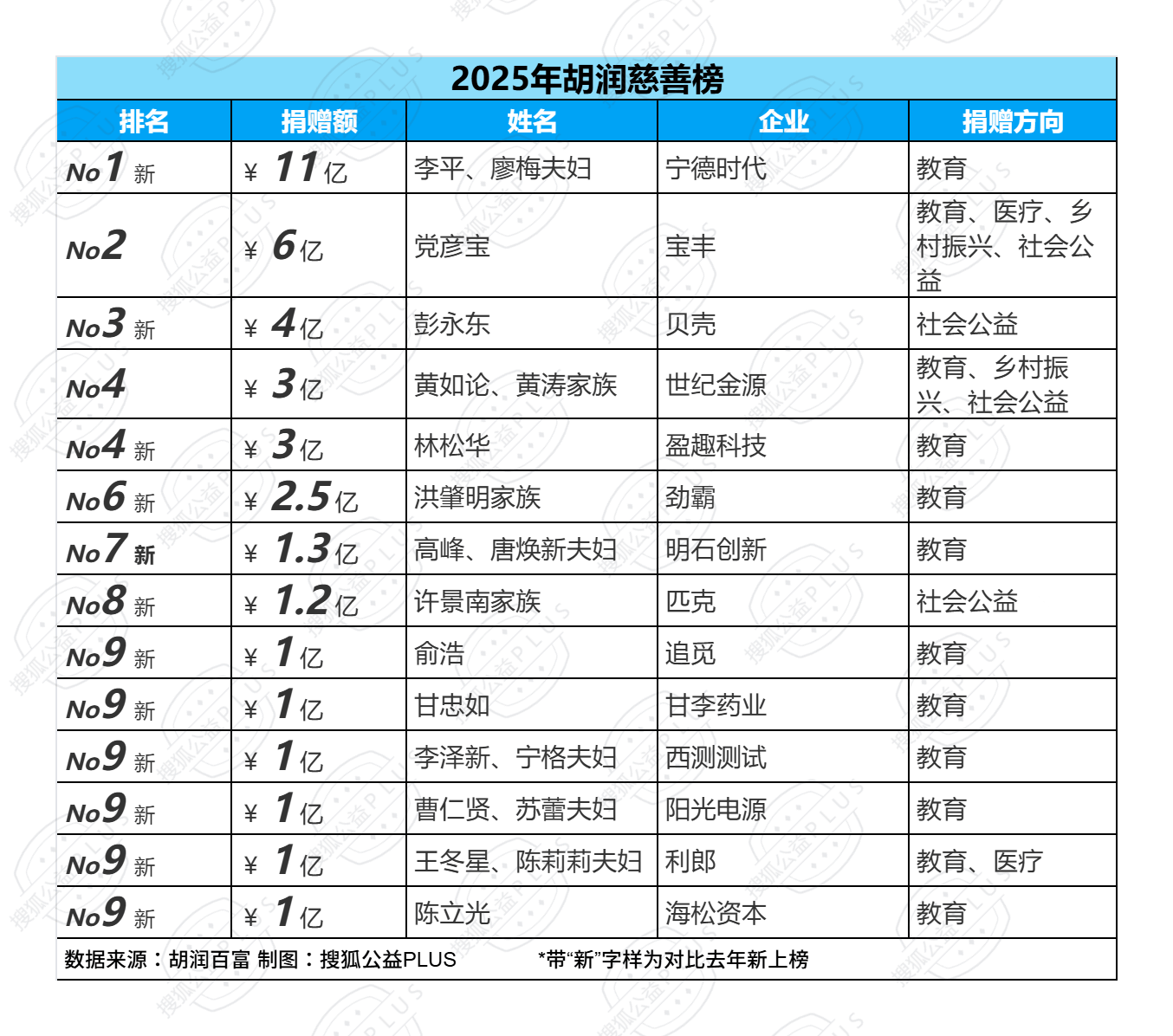
Group 1 - The 2025 Hurun Charity List highlights significant donations, with Li Ping and Liao Mei donating ¥11 billion in stock to Fudan University, making them the top donors [1] - The list shows a strong trend of entrepreneurs donating to education, particularly to their alma maters, with 40% of donations directed towards this sector [12][14] - The total donations from all entrepreneurs on the Hurun Charity List over the past decade amount to ¥239.5 billion, with 35 individuals donating over ¥1 billion each [5] Group 2 - The top five donors include Lei Jun (¥15.9 billion), Ma Huateng (¥15.4 billion), Liu Qiangdong (¥14.9 billion), Wang Xing (¥14.7 billion), and Xu Jiayin (¥12.3 billion), predominantly from the internet and technology sectors [9] - The representation of real estate entrepreneurs on the list has significantly decreased, from 50% in 2020 to 20% in 2023, while the investment and energy sectors have gained prominence [10][11] - The trend of donations towards social welfare has remained stable, with a notable shift towards education and social causes over the years, reflecting broader societal trends [14]